anaheim-gazette 1929-05-09
Scanned page
Searchable text
THE ANAHEIM GAZETTE
ESTABLISHED 1870
HENRY KUCHEL, Editor and Proprietor.
ISSUED EVERY THURSDAY
SUBSCRIPTION PER YEAR.....$1.50
SIX MONTHS.....1.00
Published at the Ampheim, California Postoffice as second-class matter.
THE PRESIDENT IS RIGHT
While giving credit to the originators of the debenture plan of farm relief full credit for good intentions, President Hoover rightfully declares and convincingly shows that the scheme would defeat the very purpose sought.
The debenture plan in itself provides for a bonus or subsidy on grain which, while taking an estimated amount of $200,000,000 a year from the United States Treasury, would give only a portion of that amount to the farmer. Under the plan the exporter would receive script redeemable at par by importers at the customs houses. The exporter would have to sell his certificates at a discount to speculators. Here the door is opened for some financial juggling at the expense of the farmer. It is not clear why the originators of this plan did not propose instead that the bonus be paid direct to the producers or exporters of grain.
The first result of the plan, President Hoover shows, would be to profit immensely existing holders or speculators in grain, without yielding a cent of profit to the farmer. Without insurance of the maintenance of the scheme over a definite period, the uncertainties of the situation would be to increase the profits of speculators and warehousing concerns.
At a time when over-production is the source of depressed grain prices, the proposed plan would stimulate additional production, thus depreciating world prices and the price the American farmer would receive. Export subsidies, the President declares, have always followed the adoption of subsidy plans.
The first result of the plan, President Hoover shows, would be to profit immensely existing holders or speculators in grain without yielding a cent of profit to the farmer. Without insurance of the maintenance of the scheme over a definite period, the uncertainties of the situation would be to increase the profits of speculators and warehousing concerns.
At a time when over-production is the source of depressed grain prices, the proposed plan would stimulate additional production, thus depreciating world prices and the price the American farmer would receive. Export subsidies, the President declares, have always followed the adoption of subsidy plans abroad. Moreover this stimulation would be applied only to a few products, causing a shortage in other crops and an interruption of the program of greater diversification in farming, which must be looked to as a means of farm relief.
Since the subsidy is to be paid not to the farmer, but to the exporters of farm products, it would offer opportunity, the President points out, for manipulation of the export market to the disadvantage of both producer and consumer.
In the case of cotton goods and flour, the President shows, the foreign purchaser of this product would be receiving his raw materials at a lower price to the amount of the subsidy, than the American manufacturer, and this would require a readjustment of tariff rates on the finished materials.
An export bounty, the President declares, if placed by other nations on commodities imported into the United States would be a violation of our laws, and would be unlawful under the laws of some other countries.
Under this plan the foreign producer of cattle and swine would be able to purchase grain at a lower price than that prevailing in our maket, and the scheme would have the same effect on dairy products.
President Hoover cuts the ground completely out from under the debenture plan. He shows that it would be unscientific, costly, oppressive and self-defeating. Moreover, in indicating his position at this time instead of expressing it in a veto when legislation has been enacted, he paves the way for a farm relief measure upon which Congress and the Executive can agree.
THE ROOT AGREEMENT
Elihu Root, former Secretary of State, has returned from Europe, where he had gone unofficially, in an effort to smooth the way for the entry of the United States into the World Court. According to newspaper dispatches from New York, he returned in excellent health and high spirits, despite his eighty-four years, and expressed the opinion in a prepared statement, that the United States demand on the World Court have been met. In the statement handed out to the newspapers, Mr. Root said:
"The committee has framed a brief agreement based upon an acceptance of all the Senate reservations and providing for the application of the reservations to particular cases as they arise. This agreement, in the form of a protocol to be annexed to the statute of the court will in the opinion of the committee., protect the interests of all parties concerned in the practical application of undisputed principles of action. This proposed protocol has been or is about to be communicated to all parties concerned."
"The members of the committee, the statement goes on to explain, were appointed as individual experts and not as governmental representatives. They were assisted by the president and vice-president of the court and by other experts on particular phases of their work. Sixteen sessions were held and resulted in complete agreement."
acceptance of all the Senate reservations and providing for the application of the reservations to particular cases as they arise.
This agreement, in the form of a protocol to be annexed to the statute of the court will, in the opinion of the committee., protect the interests of all parties concerned in the practical application of undisputed principles of action. This proposed protocol has been or is about to be communicated to all parties concerned.
"The members of the committee, the statement goes on to explain, were appointed as individual experts and not as governmental representatives. They were assisted by the president and vice-president of the court and by other experts on particular phases of their work. Sixteen sessions were held and resulted in complete agreement."
It is not expected that any action by the United States Senate on the so-called Root agreement will be taken until the winter term of Congress at least. Action on the agreement, it is assumed, will be taken by the European powers when the league assembly meets at Geneva in September, although there is said to be no assurance that all of the other nations will agree to the modifications made.
Enough opposition has already arisen in the Senate to indicate that the new agreement will be examined very closely by the Senate, especially as to what extent it modifies Reservation Number Five of the World Court resolution passed by the Senate some time ago. It was this reservation which provided that the World Court should not hand down an advisory opinion on any question in which the United States had or claimed an interest without the consent of the United States.
It is the matter of advisory opinions which has caused the most uncertainty and omission on the part of American senators. Many of them claim that its should not be in the province of a court to hand down advisory opinions. Many senators are declaring that if the court were permitted to hand down advisory opinions on matters affecting us without our consent, they might pass upon international phases of our immigration laws, our tariffs, our prohibition laws and the Monroe Doctrine, and that such opinions might prove very embarrassing to us in regulating what we regard as our own affairs, especially as there are so many denatured Americans who always insist on taking the European side of every controversy and making as much noise as possible on every question which arises.
It was for this reason, and to protect our interests in all possible contingencies, that reservations were adopted by the Senate. If it finally develops in the opinion of the Senate that the so-called Root agreement in any way weakens the reservations in our World Court resolution, another battle equally in bitterness the famous League of Nations fight is apt to be staged in our upper legislative body.
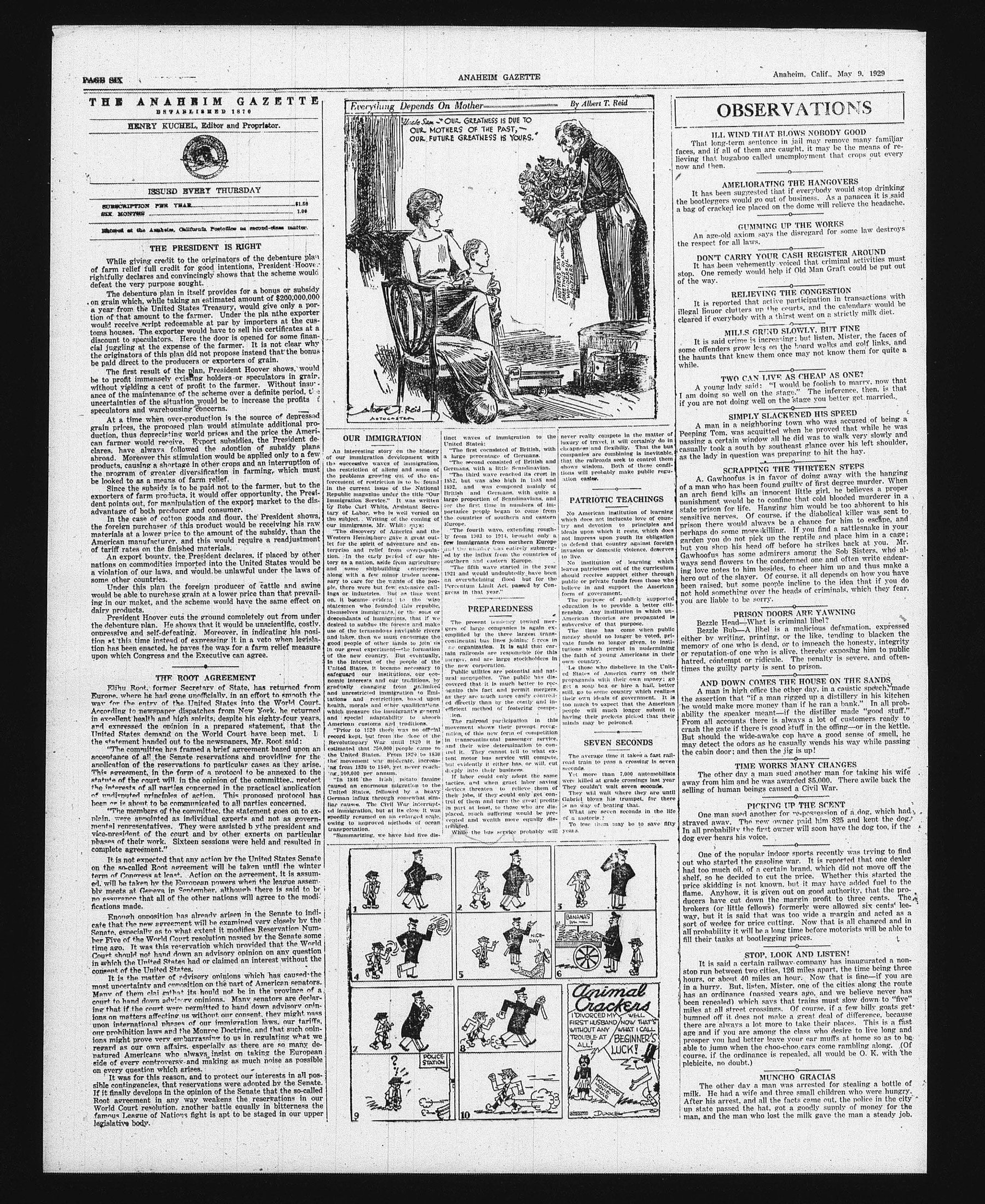
Everything Depends On Mother By Albert T. Reid
Wide Sum - OUR GREATNESS IS DUE TO
OUR MOTHERS OF THE PAST,
OUR FUTURE GREATNESS IS YOURS.
MOTHERS DAY
GREETINGS TO OUR
WONDERFUL
MOTHERS
OUR IMMIGRATION
tinct waves of immigration to the United States;
never really compete in the matter of luxury of travel, it will certainly do in cheapness and flexibility. That the bus
OUR IMMIGRATION
An interesting story on the history of our immigration development with the successive waves of immigration, the restriction of allens and some of the problems growing out of the enforcement of restriction is to be found in the current issue of the National Republic magazine under the title "Our Immigration Service." It was written by Robe Carl White, Assistant Secretary of Labor, who is well versed on the subject. Writing of the coming of our immigrants, Mr. White says:
"The discovery of America and the Western Hemisphere gave a great outlet for the spirit of adventure and enterprise and relief from overpopulation. In the early period of our history as a nation, aside from agriculture and some shipbuilding enterprises, along with a few minor trades necessary to care for the wante of the people, there were but few extensive calls or industries. But as time went on, it became evident to the wise statesmen who founded this republic, themselves immigrants, or the sons or descendants of immigrants, that if we desired to subduse the forests and make use of the termendous navigable rivers and lakes, then we must encourage the good people of other lands to join us in our great experiment—the formation of the new country. But eventually, in the interest of the people of the United States, it became necessary to safeguard our institutions, our economic interests and our traditions, by gradually changing from unlimited and unrestricted immigration to limitations and restrictions, based upon health, morals and other qualifications, which measure the immigrant's general and special adaptability to absorb American customs and traditions.
"Prior to 1820 there was no official record kept, but from the close of the Revolutionary War until 1820 it is estimated that 250,000 people came to the United States. From 1820 to 1830 the movement war moderate, increasing from 1830 to 1840, yet never reaching 100,000 per annum.
In 1846 the Irish potato famine caused an enormous migration to the United States, followed by a heavy German influx through somewhat similar causes. The Civil War interrupted immigration, but at its close it was speedily resumed on an enlarged scale, owing to improved methods of ocean transportation.
"Summarizing, we have had five distinct waves of immigration to the United States:
"The first coexisted of British, with a large percentage of Germans.
"The second consisted of British and Germans, with a little Scandinavian.
"The third wave reached its crest in 1882, but was also high in 1888 and 1892, and was composed mainly of British and Germans, with quite a large proportion of Scandinavians, and for the first time in numbers of importance people began to come from the countries of southern and eastern Europe.
"The fourth wave, extending roughly from 1903 to 1914, brought only a few immigrants from northern Europe and the number was entirely submerged by the influx from the countries of southern and eastern Europe.
"The fifth wave started in the year 1921 and would undoubtedly have been an overwhelming flood but for the Percentum Limit Act, passed by Congress in that year."
PREPAREDNESS
The present tendency toward mergers of large companies is again exemplified by the three largest transcontinental bus lines joining forces in one organization. It is said that certain railroads are responsible for this merger, and are large stockholders in the new corporation.
Public utilities are potential and natural monopolies. The public has discovered that it is much better to recognize this fact and permit mergers as they are much more easily controlled directly than by the costly and inefficient method of fostering competition.
The railroad participation in this movement shows their prompt recognition, of this new form of competition in transcontinental passenger service, and their wise determination to control it. They cannot tell to what extent motor bus service will compete, but evidently it either has, or will, cut deeply into their business.
If labor could only adopt the same tactics, and when graft labor saving devices threaten to relieve them of their jobs, if they could only get control of them and turn the great profits in part at least, to those who are displaced, much suffering would be prevented and wealth more equally distributed.
While the bus service probably will never really compete in the matter of luxury of travel, it will certainly do in cheapness and flexibility. That the bus companies are combining is inevitable; that the railroads seek to control them shows wisdom. Both of these conditions will probably make public regulation easier.
PATRIOTIC TEACHINGS
No American institution of learning which does not include love of country and devotion to principles and ideals upon which it rests, which does not impress upon youth its obligation to defend that country against foreign invasion or domestic violence, deserves to live.
No institution of learning which leaves patriotism out of the curriculum should receive support either through public or private funds from those who believe in and support the American form of government.
The purpose of publicly supported education is to provide a better citizenship. Any institution in which un-American theories are propagated is subversive of that purpose.
The time has come when public money should no longer be voted, private funds no longer given, to institutions which persist in undermining the faith of young Americans in their own country.
Le those who disbelieve in the United States of America carry on their propaganda with their own money: go get a soap box or hire a hail, better still, go to some country which realizes their own ideals of government. It is too much to expect that the American people will much longer submit to having their pockets picked that their minds may be poisoned.
SEVEN SECONDS
The average time it takes a fast railroad train to pass a crossing is seven seconds.
Yet more than 7,000 automobilists were killed at grade crossings last year. They could wait seven seconds. They will wait where they are until Gabriel blows his trumpet, for there is no way of beating that.
What are seven seconds in the life of a motors? To lose them may be to save fifty years.
In 1846 the Irish potato famine caused an enormous migration to the United States, followed by a heavy German influx through somewhat similar causes. The Civil War interrupted immigration, but at its close it was speedily resumed on an enlarged scale, owing to improved methods of ocean transportation.
"Summarizing, we have had five dis-tent motor bus service will compete, but evidently it either has, or will, cut deeply into their business.
If labor could only adopt the same tactics, and when graet labor saving devices threaten to relieve them of their jobs, if they could only get control of them and turn the great profits in part at least, to those who are displaced, much suffering would be prevented and wealth more equally distributed.
While the bus service probably will
The average time it takes a fast railroad train to pass a crossing is seven seconds.
Yet more than 7,000 automobilists were killed at grade crossings last year. They couldn't wait seven seconds.
They will wait where they are until Gabriel blows his trumpet, for there is no way of beating that.
What are seven seconds in the life of a motorist?
To lose them may be to save fifty years.
OBSERVATIONS
ILL WIND THAT BLOWS NOBODY GOOD
That long-term sentence in jail may remove many familiar faces, and if all of them are caught, it may be the means of relieving that bugaboo called unemployment that crops out every now and then.
AMELIORATING THE HANGOVERS
It has been suggested that if everybody would stop drinking the bootleggers would go out of business. As a panacea it is said a bag of cracked ice placed on the dome will relieve the headache.
GUMMING UP THE WORKS
An age-old axiom says the disregard for some law destroys the respect for all laws.
DON'T CARRY YOUR CASH REGISTER AROUND
It has been vehemently voiced that criminal activities must stop. One remedy would help if Old Man Graft could be put out of the way.
RELIEVING THE CONGESTION
It is reported that active participation in transactions with illegal liquor clutters up the courts, and the calendars would be cleared if everybody with a thirst went on a strictly milk diet.
MILLS GRIND SLOWLY, BUT FINE
It is said crime is increasing; but listen, Mister, the faces of some offenders grow less on the board walks and golf links, and the haunts that knew them once may not know them for quite a while.
TWO CAN LIVE AS CHEAP AS ONE?
A young lady said: "I would be foolish to marry, now that I am doing so well on the stage." The inference, then, is that if you are not doing well on the stage you better get married.
SIMPLY SLACKENED HIS SPEED
A man in a neighboring town who was accused of being a Peeping Tom, was acquitted when he proved that while he was passing a certain window all he did was to walk very slowly and usually took a south by southeast glance over his left shoulder.
TWO CAN LIVE AS CHEAP AS ONE?
A young lady said: "I would be foolish to marry, now that I am doing so well on the stage." The inference, then, is that if you are not doing well on the stage you better get married.
SIMPLY SLACKENED HIS SPEED
A man in a neighboring town who was accused of being a Peeping Tom, was acquitted when he proved that while he was passing a certain window all he did was to walk very slowly and casually took a south by southeast glance over his left shoulder, as the lady in question was preparing to hit the hay.
SCRAPPING THE THIRTEEN STEPS
A. Gawhoofus is in favor of doing away with the hanging of a man who has been found guilty of first degree murder. When an arch fiend kills an innocent little girl, he believes a proper punishment would be to confine that cold blooded murderer in a state prison for life. Hanging him would be too abhorent to his sensitive nerves. Of course, if the diabolical killer was sent to prison there would always be a chance for him to escape, and perhaps do some more killing. If you find a rattlesnake in your garden you do not pick up the reptile and place him in a cage; but you shop his head off before he strikes back at you. Mr. Gawhoofus has some admirers among the Sob Sisters, who always send flowers to the condemned one and often write endearing love notes to him besides, to cheer him up and thus make a hero out of the slayer. Of course, it all depends on how you have been raised; but some people incline to the idea that if you do not hold something over the heads of criminals, which they fear, you are liable to be sorry.
PRISON DOORS ARE YAWNING
Bezzle Head—What is criminal libel?
Bezzle Bub—a libel is a malicious defamation, expressed either by writing, printing, or the like, tending to blacken the memory of one who is dead, or to impeach the honesty, integrity or reputation of one who is alive, thereby exposing him to public hatred, contempt or ridicule. The penalty is severe, and oftentimes the guilty party is sent to prison.
AND DOWN COMES THE HOUSE ON THE SANDS
A man in high office the other day, in a caustic speech, made the assertion that "if a man rigged up a distillery in his kitchen he would make more money than if he ran a bank." In all probability the speaker meant—if the distiller made "good stuff." From all accounts there is always a lot of customers ready to crash the gate if there is good stuff in the offing—and in the kettle. But should the wide-awake cop have a good sense of smell, he may detect the odors as he casually wends his way while passing the cabin door; and then the jig is up!
TIME WORKS MANY CHANGES
The other day a man sued another man for taking his wife away from him and he was awarded $5,000. There awile back the selling of human beings caused a Civil War.
PICKING UP THE SCENT
One man sued another for re-possession of a dog, which had straved away. The new owner paid him $25 and kept the dog. In all probability the first owner will soon have the dog too, if the dog ever hears his voice.
TIME WORKS MANY CHANGES
The other day a man sued another man for taking his wife away from him and he was awarded $5,000. There awile back the selling of human beings caused a Civil War.
PICKING UP THE SCENT
One man sued another for re-possession of a dog, which had straved away. The new owner paid him $25 and kept the dog. In all probability the first owner will soon have the dog too, if the dog ever hears his voice.
One of the popular indoor sports recently was trying to find out who started the gasoline war. It is reported that one dealer had too much oil, of a certain brand, which did not move off the shelf, so he decided to cut the price. Whether this started the price skidding is not known, but it may have added fuel to the flame. Anyhow, it is given out on good authority, that the producers have cut down the margin profit to three cents. The brokers (or little fellows) formerly were allowed six cents' leeway, but it is said that was too wide a margin and acted as a sort of wedge for price cutting. Now that is all changed and in all probability it will be a long time before motorists will be able to fill their tanks at bootlegging prices.
STOP, LOOK AND LISTEN!
It is said a certain railway company has inaugurated a non-stop run between two cities, 126 miles apart, the time being three hours, or about 40 miles an hour. Now that is fine—if you are in a hurry. But, listen, Mister, one of the cities along the route has an ordinance (passed years ago, and we believe never has been repealed) which says that trains must slow down to "five" miles at all street crossings. Of course, if a few billy goats get bumped off it does not make a great deal of difference, because there are always a lot more to take their places. This is a fast age and if you are among the class who desire to live long and prosper you had better leave your ear muffs at home so as to be able to jump when the choo-choo cars come rambling along. (Of course, if the ordinance is repealed, all would be O. K. with the plebicite, no doubt.)
MUNCHO GRACIAS
The other day a man was arrested for stealing a bottle of milk. He had a wife and three small children who were hungry. After his arrest, and all the facts came out, the police in the city up state passed the hat, got a goodly supply of money for the man, and the man who lost the milk gave the man a steady job.