anaheim-gazette 1929-01-24
Scanned page
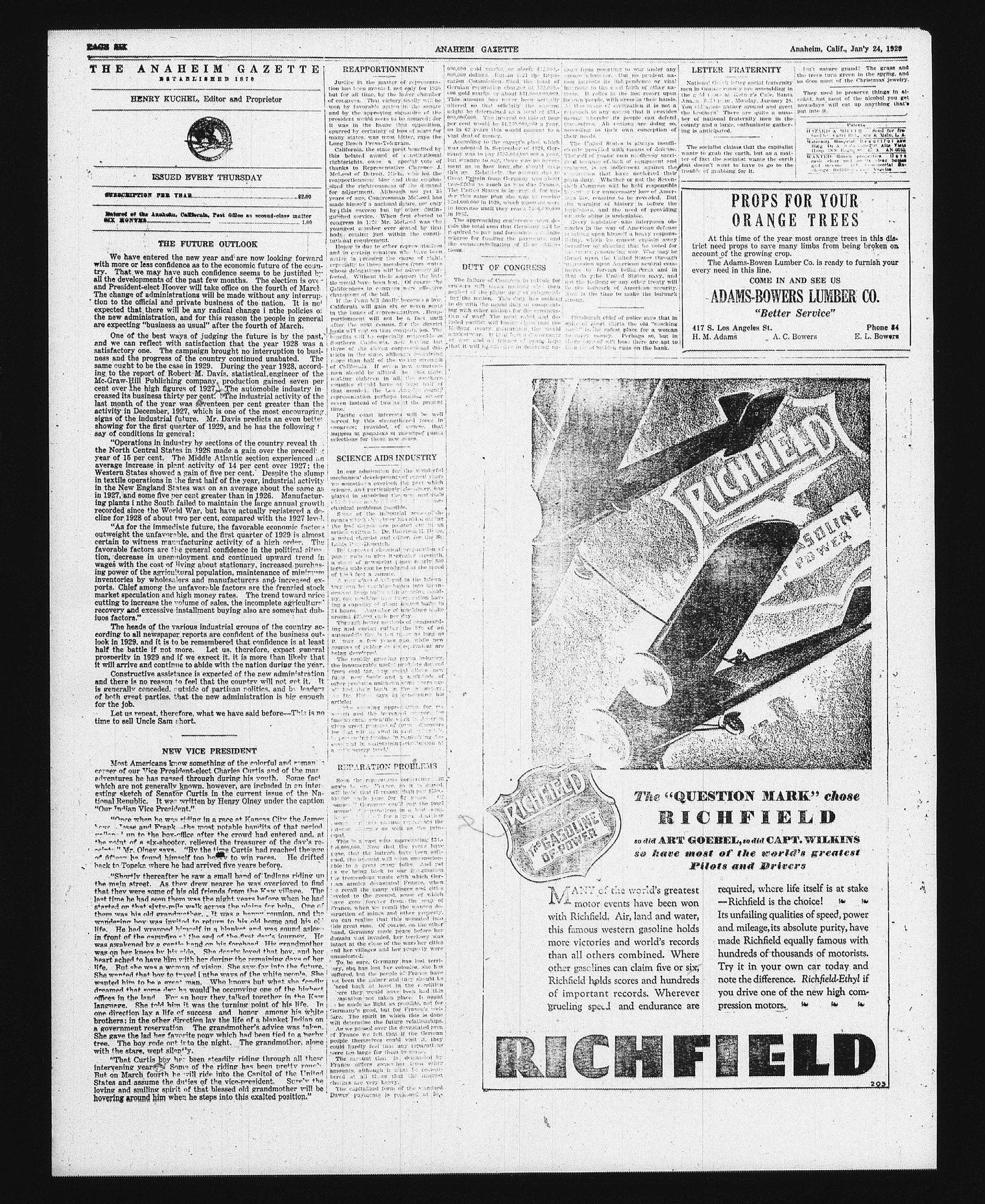
Searchable text
THE ANAHEIM GAZETTE
ESTABLISHED 1876
HENRY KUCHEL, Editor and Proprietor
ISSUED EVERY THURSDAY
SUBSCRIPTION PER YEAR.....$2.00
Entered at the Anaheim, California, Post Office as second-class matter
SIX MONTHS.....1.00
THE FUTURE OUTLOOK
We have entered the new year and are now looking forward with more or less confidence as to the economic future of the country. That we may have such confidence seems to be justified by all the developments of the past few months. The election is over and President-elect Hoover will take office on the fourth of March. The change of administrations will be made without any interruption to the official and private business of the nation. It is not expected that there will be any radical change in the policies of the new administration, and for this reason the people in general are expecting "business as usual" after the fourth of March.
One of the best ways of judging the future is by the past, and we can reflect with satisfaction that the year 1928 was a satisfactory one. The campaign brought no interruption to business and the progress of the country continued unabated. The same ought to be the case in 1929. During the year 1928, according to the report of Robert M. Davis, statistical engineer of the Mc-Graw-Hill Publishing company, production gained seven per cent over the high figures of 1927. The automobile industry increased its business thirty per cent. The industrial activity of the last month of the year was seventeen per cent greater than the activity in December, 1927, which is one of the most encouraging signs of the industrial future. Mr. Davis predicts an even better showing for the first quarter of 1929, and he has the following say of conditions in general:
"Operations in industry by sections of the country reveal tha
the North Central States in 1929 provide a main overseeing body for regulation."
ness and the progress of the country continued unabated. The same ought to be the case in 1929. During the year 1928, according to the report of Robert M. Davis, statistical engineer of the Mc-Graw-Hill Publishing company, production gained seven per cent over the high figures of 1927. The automobile industry increased its business thirty per cent. The industrial activity of the last month of the year was seventeen per cent greater than the activity in December, 1927, which is one of the most encouraging signs of the industrial future. Mr. Davis predicts an even better showing for the first quarter of 1929, and he has the following say of conditions in general:
"Operations in industry by sections of the country reveal that the North Central States in 1928 made a gain over the preceding year of 15 per cent. The Middle Atlantic section experienced an average increase in plant activity of 14 per cent over 1927; the Western States showed a gain of five per cent. Despite the slump in textile operations in the first half of the year, industrial activity in the New England States was on an average about the same as in 1927, and some five per cent greater than in 1926. Manufacturing plants in the South failed to maintain the large annual growth recorded since the World War, but have actually registered a decline for 1928 of about two per cent, compared with the 1927 level.
"As for the immediate future, the favorable economic factors outweight the unfavorable, and the first quarter of 1929 is almost certain to witness manufacturing activity of a high order. The favorable factors are the general confidence in the political situation, decrease in unemployment, and continued upward trend in wages with the cost of living about stationary, increased purchasing power of the agricultural population, maintenance of minimum inventories by wholesalers and manufacturers and increased exports. Chief among the unfavorable factors are the frenzied stock market speculation and high money rates. The trend toward price cutting to increase the volume of sales, the incomplete agriculture' recovery and excessive installment buying also are somewhat dubious factors."
The heads of the various industrial groups of the country according to all newspaper reports are confident of the business outlook in 1929, and it is to be remembered that confidence is at least half the battle if not more. Let us, therefore, expect general prosperity in 1929 and if we expect it, it is more than likely that it will arrive and continue to abide with the nation during the year.
Constructive assistance is expected of the new administration and there is no reason to feel that the country will not get it. It is generally conceded, outside of partisan politics, and by leaders of both great parties, that the new administration is big enough for the job.
Let us repeat, therefore, what we have said before—This is no time to sell Uncle Sam short.
NEW VICE PRESIDENT
Most Americans know something of the colorful and romantic career of our Vice President-elect Charles Curtis and of the man adventures he has passed through his youth. Some fact which are not generally known, however, are included in an interesting sketch of Senator Curtis in the current issue of the National Republic. It was written by Henry Olney under the caption "Our Indian Vice President."
"Once when he was riding in a race at Kansas City the James house, Jesse and Frank—the most notable bandits of that period gallered up to the box-office after the crowd had entered and, at the point of a six-shooter, relieved the treasurer of the day's reckoning." Mr. Curtis says. "By the time Curtis had reached the age
Most Americans know something of the colorful and romantic career of our Vice President-elect Charles Curtis and of the many adventures he has passed through during his youth. Some fact which are not generally known, however, are included in an interesting sketch of Senator Curtis in the current issue of the National Republic. It was written by Henry Olney under the caption "Our Indian Vice President."
"Once when he was riding in a race at Kansas City the James house, Jesse and Frank—the most notable handits of that period—called up to the box-office after the crowd had entered and, at the point of a six-shooter, relieved the treasurer of the day's receipt." Mr. Olney says. "By the time Curtis had reached the age of fifteen he found himself too heavy to win races. He drifted back to Topeka where he had arrived five years before.
"Shortly thereafter he saw a small band of Indians riding up the main street. As they drew nearer he was overjoyed to find that they were some of his old friends from the Kaw village. The last time he had seen them was the night years before when he had started on that sixty-mile walk across the plains for help. One of them was his old grandmother. It was a honour reunion, and the wondering boy was invited to return to his old home and his old life. He had wrapped himself in a blanket and was sound asleep in front of the campfire at the end of the first day's journey. He was awakened by a gentle hand on his forehead. His grandmother was on her knees by his side. She clearly loved that boy, and her heart ached to have him with her during the remaining days of her life. But she was a woman of vision. She saw far into the future. She wanted that boy to travel inthe ways of the white people. She wanted him to be a great man. Who knows but what she fondly dreamed that some day he would be occupying one of the highest offices in the land. For an hour they talked together in the Kaw language. She told him it was the turning point of his life. In one direction lay a life of success and honor among his white brothers; in the other direction lay the life of a blanket Indian on a government reservation. The grandmother's advice was taken. She gave the lad her favorite pony which had been tied to a herbiv tree. The boy rode out into the night. The grandmother, alone with the stars, wept silently.
"That Curtis boy has been steadily riding through all these intervening years. Some of the riding has been pretty rough. But on March fourth he will ride into the Capitol of the United States and assume the duties of the vice-president. Surely the loving and smiling spirit of that blessed old grandmother will be hovering around him when he steps into this exalted position."
REAPPORTIONMENT
Justice in the matter of representation has been granted, not only for 1839 but for all time, by the lower chamber of congress. That victory finally will be won by favorable action in the senate and by the approving signature of the president would seem to be assured; for it was in the house that opposition, spurred by certainty of loss of seats in many states, was most bitter, says the Long Bench Press-Telegram.
California, the state most benefited by this belated award of constitutional rightsrights, owes a special vote of thanks to Representative Clarence J. McLeod of Detroit, Mich., who led the reapportionment bloe and thus emphasized the righteousness of the demand for adjustment. Although not yet 35 years of age, Congressman McLeod has unde himself a national figure, not only by this success but by other distinguished service. When first elected to congress in 1820 Mr. McLeod was the youngest member ever seated by that body coming just within the constitutional requirement.
Honor is due to other representatives and to certain senators who have been active in pressing the cause of right, especially to those members from states whose delegations will be adversely affected. Without their support the battle would have been lost. Of course the Californians in congress were effective champions of the bill.
If the Penn bill finally becomes a law California will gain six or seven seats in the house of representatives. Reapportionment will not be a fact until after the next census, for the district basis will rest on that computation. The benefits will be especially noticeable on Southern California, now having but three of the eleven congressional districts in the state, although containing more than half of the voting strength of California. If seven new congressmen should be allowed to this state making eighteen in all, the southern counties should have at least half of that number; the Los Angeles county representation perhaps touching sixten instead of two must at the present time.
Pacific coast interests will be well served by this strengthened force in congress; provided, of course, that supppu ut posaatax sr manspaf punxs elections for these new seats.
000,000 gold marks, or about $12,000,000,000 dollars. But in 1821 the Reparation Commission fixed the total of German reparation charges at 132,000,000 gold marks, or about $31,000,000,000. This amount has never been actually altered so that officially the amount might be determined as a total of $31,000,000,000. The interest on this at four per cent would be $1,219,000,000 a year, so in 62 years this would amount to a vast deal of money.
According to the expert's plan which was adopted in September of 1924 Germany was to pay $355,000,000 a year, but strange to say there was no agreement as to how long she should keep this up. Relatively the amount due to Great Britain from Germany was about two-fifths as much as was due France. The United States is interested for under this same plan she was to receive $244,000,000 in 1928, which ignores were to increase until they reach $406,000,000 in 1933.
The approaching conference must decide the total sum that Germany will be required to pay and formulae for salute scheme for funding the payments, and the commercialization of these obligations.
DUTY OF CONGRESS
The failure of Congress to private for cruisers will mean nothing less than neglect of the plain duty of safeguarding the nation. This duty has nothing to do with the moral duty of cooperating with other nations for the continuation of war. The most rabid and decided pacifist will burden claim that the Kellogg treaty guarantees the world annihilator war. It is at least a discommerger of war and all releases of peace hope that it will be effective in deterring nations from resorting to war under any excuse whatever. But no prudent nation intrusts its independence or vital interests to the good faith of other nations. It relies in the last resort upon its own people, with arms in their hands. At this stage of civilization it is not a reproach to any nation that it provides means whereby its people can defend themselves. All nations are doing so, according to their own conception of their needs.
The United States is always insufficiently provided with means of defense. The roll of young men needless sacrifice because of lack of equipment and training, is an indictment against the congresses that have neclected their pain duty. Whether or not the Seventh Congress will be hold responsible because for unnecessary loss of American life, remains to be revealed. But the warning of history is before the legislators, and the need of providing suitable ships is undeniable.
Every legislator who interposes objections in the way of American defense banking upon himself a heavy responsibility war. War may be thrust upon the United States through impression upon American neutral commerce by foreign bellings and in that da yle the United States navy, and not the Kellong or any other treaty will be the bulwark of American security. Now is the time to make the bulwark strong.
Pittsburgh chief of police says that in spite of short shirts the old "stocking bank" is the safest place for a woman to carry money. Perhaps so, but in there days of salt hose there are apt to be a lot of sudden runs on the bank.
SCIENCE AIDS INDUSTRY
In our admiration for the wonderful mechanical developments of recent years we sometimes overlook the part which science, and particularly chemistry, has played in supplying the new materials which have made possible mechanical problems possible.
Some of the industrial accomplishments which chemistry has added during the last decade are pointed out in an article written by Dr. Harrison H. Howe, a noted chemist and editor, for the St. Louis Post Dispatch.
By improved chemical preparation of paper pulp to give it greater strength, a short of newsprint paper nearly 300 inches wide can be produced at the speed of 1,000 feet a minute.
A new glass developed in the laboratory can be machine built with existing conditions; one machine now in operation having a capacity of about 400,000 bulbs in 34 hours. A number of machines make around $25,000 each per day.
Through better methods of compounding and curing rubber the life of an automobile this is no longer as long as it was a few years ago, while new sources of rubber or its equivalent are being developed.
The rapidly growing rayon industry, the innumerable useful products derived from coal tar, new metal alloys, new fuels, new foods and a multitude of other products unknown some years ago all had their birth in the laboratory. Dr. Howe says in concluding his article:
The growing appreciation for research and the increased support for functional scientific work in America gives great promise of future discoveries that will be vital in pooling life in presenting future in promoting disease and in maintaining civilization at a higher level.
REPARATION PROBLEMS
Soon the reparations conference will again be on. France, so it is dated, will indicate that Germany shall pay $550,000 each year for 62 years. Of course Germany could pay the total amount of reparations in a built-up sum, but for a great deal less concrete prints annually represents the latter changes as well as the principal.
This is a vast sum, aggregating $34,000,000. Now that the years have
REPARATION PROBLEMS
Soon the reparations conference will again be on France, so it is dated will include that Germany shall pay $500,000 each year for 62 years. Of course if Germany could pay the total amount of reparations in a built-up sum, he would for a great deal less than this amount represents the later charges as well as the principal.
This is a vast sum aggregating $34,000,000,000. Now that the years have gone, that the hatreds have been softened, the amount will soon unconsolable to a great trang folks. And yet we bring back to our imagination the tremendous waste with which German armies devastated France, when we recall the many villages and cities leveled to the ground, some of which have gone forever from the map of France, when we recall the wanton destruction of mines and other property, we can realize that this mounted into this great sum. Of course, on the other hand, Germany made peace before her domain was invaded, her territory was intact at the close of the war; her cities and her villages and her property were unmilested.
To be sure, Germany has lost territory, she has lost her colonies, she has suffered, but the people of France have not been the gainer and they should be faced back at least in the condition where they would have been had thisvasitation not taken place. It ought to be made as light as possible, not for Germany's good, but for France's welfare. The spirit in which this is done will determine the future relationships.
As we passed over the devastated area of France we felt that if the German people themselves could visit it, they could hardly feel that any reparations were too large for them to make.
The amount that is demanded by France differs somewhat from other amounts, although it must be remembered at all times that the interest charges are very heavy.
The capitalized form of the standard Dawson' payments is rechaued at 59-
Anaheim, Calif., Jan'y 24, 1920
LETTER FRATERNITY
National Greek letter social fraternity men in Orange county are assembling in the gold room at Ketter's Cafe, Santa Ana, a full point. Monday, January 28. You old grade gather around and greet the brothers." There are quite a number of national fraternity men in the county and a large, enthusiastic gathering is anticipated.
The socialist claims that the capitalist wants to grab the earth, but as a matter of fact the socialist wants the earth out doesn't want to have to go to the trouble of grabbing for it.
PROPS FOR YOUR ORANGE TREES
At this time of the year most orange trees in this district need props to save many limbs from being broken on account of the growing crop.
The Adams-Bowen Lumber Co. is ready to furnish your every need in this line.
COME IN AND SEE US
ADAMS-BOWERS LUMBER CO.
"Better Service"
417 S. Los Angeles St.
H. M. Adams A. C. Bowers E. L. Bowers
The "QUESTION MARK" chose RICHFIELD
so did ART GOEBEL, so did CAPT. WILKINS
The "QUESTION MARK" chose RICHFIELD
so did ART GOEBEL, so did CAPT. WILKINS
so have most of the world's greatest Pilots and Drivers
the world's greatest
ants have been won
Air, land and water,
tern gasoline holds
and world’s records
combined. Where
an claim five or six,
cores and hundreds
records. Wherever
and endurance are
required, where life itself is at stake
—Richfield is the choice!
Its unfailing qualities of speed, power
and mileage, its absolute purity, have
made Richfield equally famous with
hundreds of thousands of motorists.
Try it in your own car today and
note the difference. Richfield-Ethyl if
you drive one of the new high compression motors.