anaheim-gazette 1928-11-29
Scanned page
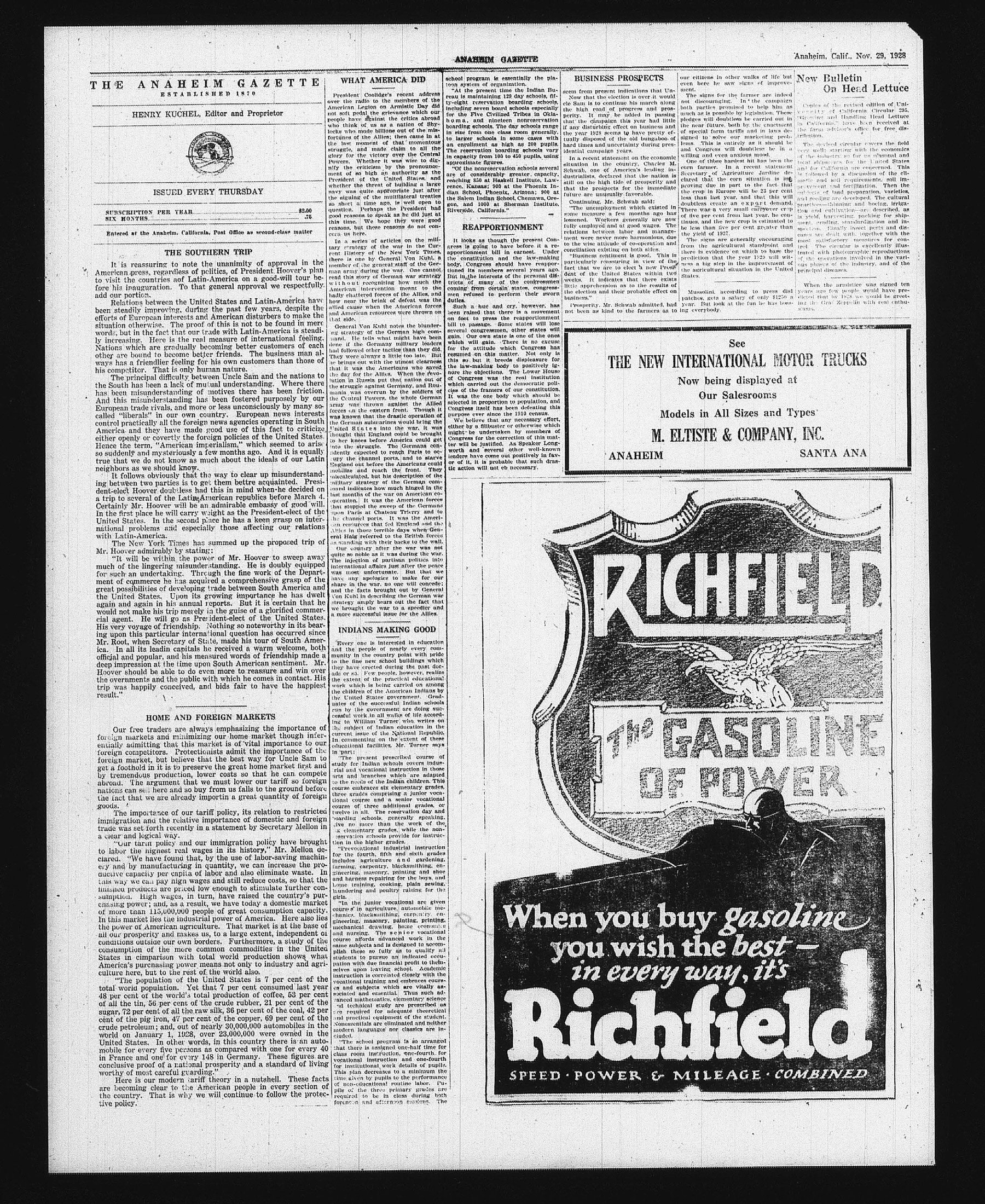
Searchable text
THE ANAHEIM GAZETTE
ESTABLISHED 1870
HENRY KUCHEL, Editor and Proprietor
ISSUED EVERY THURSDAY
SUBSCRIPTION PER YEAR.....$2.00
SIX MONTHS.....75
Entered at the Anaheim, California, Post Office as second-class matter
THE SOUTHERN TRIP
It is reassuring to note the unanimity of approval in the American press, regardless of politics, of President Hoover's plan to visit the countries of Latin-America on a good-will tour before his inauguration. To that general approval we respectfully add our portion.
Relations between the United States and Latin-America have been steadily improving, during the past few years, despite the efforts of European interests and American disturbers to make the situation otherwise. The proof of this is not to be found in mere words, but in the fact that our trade with Latin-America is steadily increasing. Here is the real measure of international feeling. Nations which are gradually becoming better customers of each other are bound to become better friends. The business man always has a friendlier feeling for his own customers than those of his competitor. That is only human nature.
The principal difficulty between Uncle Sam and the nations to the South has been a lack of mutual understanding. Where there has been misunderstanding of motives there has been friction. And this misunderstanding has been fostered purposely by our European trade rivals, and more or less unconsciously by many so-called "liberals" in our own country. European news interests control practically all the foreign news agencies operating in South America and they have made good use of this fact to criticize either openly or covertly the foreign policies of the United States. Hence the term, "American imperialism," which seemed to arise...
The principal difficulty between Uncle Sam and the nations to the South has been a lack of mutual understanding. Where there has been misunderstanding of motives there has been friction. And this misunderstanding has been fostered purposely by our European trade rivals, and more or less unconsciously by many so-called "liberals" in our own country. European news interests control practically all the foreign news agencies operating in South America and they have made good use of this fact to criticize either openly or covertly the foreign policies of the United States. Hence the term, "American imperialism," which seemed to arise so suddenly and mysteriously a few months ago. And it is equally true that we do not know as much about the ideals of our Latin neighbors as we should know.
It follows obviously that the way to clear up misunderstanding between two parties is to get them bettre acquainted. President-elect Hoover doubtless had this in mind when he decided on a trip to several of the Latin American republics before March 4. Certainly Mr. Hoover will be an admirable embassy of good will. In the first place he will carry weight as the President-elect of the United States. In the second place he has a keen grasp on international problems and especially those affecting our relations with Latin-America.
The New York Times has summed up the proposed trip of Mr. Hoover admirably by stating:
"It will be within the power of Mr. Hoover to sweep away much of the lingering misunderstanding. He is doubly equipped for such an undertaking. Through the fine work of the Department of commerce he has acquired a comprehensive grasp of the great possibilities of developing trade between South America and the United States. Upon its growing importance he has dwelt again and again in his annual reports. But it is certain that he would not make his trip merely in the guise of a glorified commercial agent. He will go as President-elect of the United States. His very voyage of friendship. Nothing so noteworthy in its bearing upon this particular international question has occurred since Mr. Root, when Secretary of State, made his tour of South America. In all its leadin capitals he received a warm welcome, both official and popular, and his measured words of friendship made a deep impression at the time upon South American sentiment. Mr. Hoover should be able to do even more to reassure and win over the overnments and the public with which he comes in contact. His trip was happily conceived, and bids fair to have the happiest result."
HOME AND FOREIGN MARKETS
Our free traders are always emphasizing the importance of foreign markets and minimizing our home market though inferentially admitting that this market is of vital importance to our foreign competitors. Protectionists admit the importance of the foreign market, but believe that the best way for Uncle Sam to get a foothold in it is to preserve the great home market first and by tremendous production, lower costs so that he can compete abroad. The argument that we must lower our tariff so foreign nations can sell here and so buy from us falls to the ground before the fact that we are already importin a great quantity of foreign goods.
The importance of our tariff policy, its relation to restricted immigration and the relative importance of domestic and foreign trade was set forth recently in a statement by Secretary Mellon in a clear and logical way.
"Our tariff policy and our immigration policy have brought to labor the biggest real wages in its history." Mr. Mellon de-
The importance of our tariff policy, its relation to restricted immigration and the relative importance of domestic and foreign trade was set forth recently in a statement by Secretary Mellon in a clear and logical way.
"Our tariff policy and our immigration policy have brought to labor the nighest real wages in its history," Mr. Mellon declared. "We have found that, by the use of labor-saving machinery and by manufacturing in quantity, we can increase the productive capacity per capita of labor and also eliminate waste. In this way we can pay nign wages and still reduce costs, so that the finished products are priced low enough to stimulate further consumption. High wages, in turn, have raised the country's purchasing power; and, as a result, we have today a domestic market of more than 115,000,000 people of great consumption capacity. In this market lies the industrial power of America. Here also lies the power of American agriculture. That market is at the base of all our prosperity and makes us, to a large extent, independent of conditions outside our own borders. Furthermore, a study of the consumption of the more common commodities in the United States in comparison with total world production shows what America's purchasing power means not only to industry and agriculture here, but to the rest of the world also.
"The population of the United States is 7 per cent of the total world population. Yet that 7 per cent consumed last year 48 per cent of the world's total production of coffee, 53 per cent of all the tin, 56 per cent of the crude rubber, 21 per cent of the sugar, 72 per cent of all the raw silk, 36 per cent of the coal, 42 per cent of the pig iron, 47 per cent of the copper, 69 per cent of the crude petroleum; and, out of nearly 30,000,000 automobiles in the world on January 1, 1928, over 23,000,000 were owned in the United States. In other words, in this country there is an automobile for every five persons as compared with one for every 40 in France and one for every 148 in Germany. These figures are conclusive proof of a national prosperity and a standard of living worthy of most careful guarding."
Here is our modern tariff theory in a nutshell. These facts are becoming clear to the American people in every section of the country. That is why we will continue to follow the protective policy.
WHAT AMERICA DID
President Coolidge's recent address over the radio to the members of the American Legion on Armistic Day did not soft pedal the grievance which our people have against the critics abroad who think of us as a nation of Shylocks who made billions out of the misfortunes of the Allies; then came in at the last moment of that momentous struggle, and made claim to all the glory for the victory over the Central Powers. Whether it was wise to dignify the criticism by the pronouncement of so high an authority as the President of the United States, and whether the threat of building a large navy was quite appropriate just after the signing of the multilateral treaties so short a time ago, is well open to question. Perhaps the President had good reasons to speak as he did just at this time. We hope they were good reasons, but these reasons do not concern us here.
In a series of articles on the military strategy of the war in the Current History of the New York Times, there is one by General Von Kuhl, a member of the general staff of the German army during the war. One cannot read this story of German war strategy without recognizing how much the American intervention meant to the badly shattered forces of the Allies, and how near the brink of defeat was the allied cause when the American forces and American resources were thrown on that side.
General Von Kuhl notes the blundering strategy of the German high command. He tells what might have been done if the Germany military leaders had followed other tactics than they did. They were always a little too late. But he brings out with the utmost clearness that it was the Americans who saved the day for the Allies. When the revolution in Russia put that nation out of the struggle against Germany, and Roumania was overrun by the soldiers of the Central Powers, the whole German army was thrown against the Allied forces on the eastern front. Though it was known that the drastic operation of the German submarines would bring the United States into the war, it was thought that England could be brought to her knees before America could get into the struggle. The Germans conschool program is essentially the platoon system of organization.
"At the present time the Indian Bureau is maintaining 129 day schools, fifty-eight reservation boarding schools, including seven board schools especially for the Five Civilized Tribes in Oklahoma, and nineteen nonreservation boarding schools. The day schools range in size from one class room generally, to larger schools in some cases with an enrollment as high as 200 pupils. The reservation boarding schools vary in capacity from 100 to 450 pupils, using approximate figures.
"Of the nonreservation schools several are of considerably greater capacity, reaching 850 at Haskell Institute, Lawrence, Kansas; 900 at the Phoenix Indian School, Phoenix, Arizona; 900 at the Salem Indian School, Chemawa, Oregon, and 1000 at Sherman Institute, Riverside, California."
REAPPORTIONMENT
It looks as though the present Congress is going to have before it a reapportionment bill in earnest. Under the constitution and the law-making body, Congress should have reapportioned its members several years ago. But in the interests of the personal districts of many of the congressmen coming from certain states, congressmen refused to perform their sworn duties.
Such a hue and cry, however, has been raised that there is a movement on foot to press the reapportionment bill to passage. Some states will lose several congressmen, other states will gain. Our own state is one of the ones which will gain. There is no excuse for the attitude which Congress has resumed on this matter. Not only is this so but it breeds displeasure for the law-making body to positively ignore the objections. The Lower House of Congress was the real institution which carried out the democratic policies of the framers of our constitution. It was the one body which should be selected in proportion to population, and Congress itself has been defeating this purpose ever since the 1910 census.
We believe that any necessary effort, either by a filibuster or otherwise which might be undertaken by members of Congress for the correction of this matter will be justified. As Speaker Longworth and several other well-known citizens from present indications that Uncle Sam is to continue his march along the high road of progress and prosperity. It may be added in passing that the campaign this year had little if any disturbing effect on business and the year 1928 seems to have pretty effectively disposed of the old bungaboo of hard times and uncertainty during presidential campaign years.
In a recent statement on the economic situation in the country, Charles M. Schwab, one of America's leading industrialists, declared that the nation is still on the high tide of prosperity and that the prospects for the immediate future are unusually favorable.
Continuing, Mr. Schwab said:
"The unemployment which existed in some measure a few months ago has lessened. Workers generally are now fully employed and at good wages. The relations between labor and management were never more harmonious, due to the wise attitude of co-operation and conciliation existing on both sides.
"Business sentiment is good. This is particularly reassuring in view of the fact that we are to elect a new President of the United States within two weeks. It indicates that there exists little apprehension as to the results of the election and their probable effect on business."
Prosperity, Mr. Schwab admitted, had not been as kind to the farmers as to our chief even even more.
The new model has pledged to provide for less debt.
There are five tunes being less than yew.
The from there predicts in an interesting way.
Must patch year-end events every eve...
They were always a little too late. But he brings out with the utmost clearness that it was the Americans who saved the day for the Allies. When the revolution in Russia put that nation out of the struggle against Germany, and Roumania was overrun by the soldiers of the Central Powers, the whole German army was thrown against the Allied forces on the eastern front. Though it was known that the drastic operation of the German submarines would bring the United States into the war, it was thought that England could be brought to her knees before America could get into the struggle. The Germans confidently expected to reach Paris to occupy the channel ports, and to starve England out before the Americans could mobilize and reach the front. They calculated, but his description of the military strategy of the German command indicates how much hinged in the last months of the war on American cooperation. It was the American forces that stopped the sweep of the Germans upon Paris at Chateau Trierry and to the channel ports. It was the American resources that fed England and the Allies in those terrible days when General Haig referred to the British forces as standing with their backs to the wall.
Our country after the war was not quite so noble as it was during the war. The injection of partisan politics into international affairs just after the peace was most unfortunate. But that we have any apologies to make for our share in the war, no one will concede; and the facts brought out by General Von Kuhl in describing the German war strategy amply bears out the fact that we brought the war to a speedier and a more successful issue for the Allies.
INDIANS MAKING GOOD
Every one is interested in education and the people of nearly every community in the country point with pride to the fine new school buildings which they have erected during the past decade or so. Few people, however, realize the extent of the practical educational work which is being carried on among the children of the American Indians by the United States government. Graduates of the successful Indian schools run by the government are doing successful work in all walks of life according to William Turner who writes on the subject of Indian education in the current issue of the National Republic. In commenting on the extent of these educational facilities, Mr. Turner says in part:
"The present prescribed course of study for Indian schools covers industrial and vocational instruction in those arts and branches which are adapted to the needs of the Indian children. This course embraces six elementary grades, three grades comprising a junior vocational course and a senior vocational course of three additional grades, or twelve in all. The reservation day and boarding schools, generally speaking, give no more than the work of the six elementary grades, while the non-reservation schools provide for instruction in the higher grades."
Prevocational industrial instruction resumed on this matter. Not only is this so but it breeds displeasure for the law-making body to positively ignore the objections. The Lower House of Congress was the real institution which carried out the democratic policies of the framers of our constitution. It was the one body which should be selected in proportion to population, and Congress itself has been defeating this purpose ever since the 1910 census.
We believe that any necessary effort, either by a filibuster or otherwise which might be undertaken by members of Congress for the correction of this matter will be justified. As Speaker Longworth and several other well-known leaders have come out positively in favor of it, it is probable that such drastic action will not eb necessary.
"The present prescribed course of study for Indian schools covers industrial and vocational instruction in those arts and branches which are adapted to the needs of the Indian children. This course embraces six elementary grades, three grades comprising a junior vocational course and a senior vocational course of three additional grades, or twelve in all. The reservation day and boarding schools generally speaking give no more than the work of the six elementary grades, while the non-reservation schools provide for instruction in the higher grades.
"Prevocational industrial instruction for the fourth, fifth and sixth grades includes agriculture and gardening, farming, carpentry, blacksmithing, engineering, masonry, painting and shoe and harness repairing for the boys, and home training, cooking, plain sewing, laundering and poultry raising for the girls.
"In the junior vocational are given courses in agriculture, automobile mechanics, blacksmithing, carpentry, engineering, masonry, painting, printing, mechanical drawing, home economics and nursing. The senior vocational course affords advanced work in the same subjects and is designed to accomplish these so fully as to qualify all students to pursue an indicated occupation with due financial profit to themselves upon leaving school. Academic instruction is correlated closely with the vocational training and embraces courses and subjects which are vitally associated and essential. Thus such advanced mathematics, elementary science and technical study are prescribed as are required for adequate theoretical and practical equipment of the student. Nonessentials are eliminated and neither modern languages nor classics are included.
"The school program is so arranged that there is assigned one-half time for class room instruction, one-fourth for vocational instruction and one-fourth for institutional work details of pupils. This plan decreases to a minimum the time given by pupils to the performance of non-educational routine labor. Pupils of the three primary grades are required to be in class during both forenoon and afternoon sessions. The
When you buy
you wish th
in every w
Richf
SPEED • POWER & M
PROSPECTS
Indications that Unrest is over it would cause his march along progress and prose added in passing this year had little effect on business and was to have pretty effusive the old bungaboo of certainty during presidents.
Schwab said: The event which existed in New months ago has generally are now at good wages. The labor and manage more harmonious, due to co-operation and being on both sides. Event is good. This is arising in view of the elect in new President States within two states that there exists as to the results of their probable effect on country, Charles M. America's leading indeed that the nation is made of prosperity and is for the immediate friendly favorable.
New Bulletin On Head Lettuce
Copies of the revised edition of University of California Circular 295, "Growing and Handling Head Lettuce in California" have been received at the farm advisor's office for free distribution.
The devised circular covers the field very well; starting with the economics of the industry so far as seasonal and total shipments for the United States and for California are concerned. This is followed by a discussion of the climate and soil requirements, soil improvement and fertilization. Then the subjects of land preparation, varieties, and seedling are developed. The cultural practices—thinning and hoeing, irrigation and cultivation—are described, as yield, harvesting, packing for shipment, grading, standardization and inspection. Finally insect pests and diseases are dealt with together with the most satisfactory measures for control. The circular is excellently illustrated with photographic reproductions of the operations involved in the various phases of the industry, and of the principal diseases.
Mussolini, according to press disl patches, gets a salary of only $1250 a year. But look at the fun he has bossing everybody.
See THE NEW INTERNATIONAL MOTOR TRUCKS
Now being displayed at Our Salesrooms
Models in All Sizes and Types
M. ELTISTE & COMPANY, INC.
THE NEW INTERNATIONAL MOTOR TRUCKS
Now being displayed at
Our Salesrooms
Models in All Sizes and Types
M. ELTISTE & COMPANY, INC.
NAHEIM SANTA ANA
RICHFIELD
THE GASOLINE
OF POWER
OF POWER
you buy gasoline
wish the best -
every way, it's
chfield
ER & MILEAGE · COMBINED