anaheim-gazette 1928-10-18
Scanned page
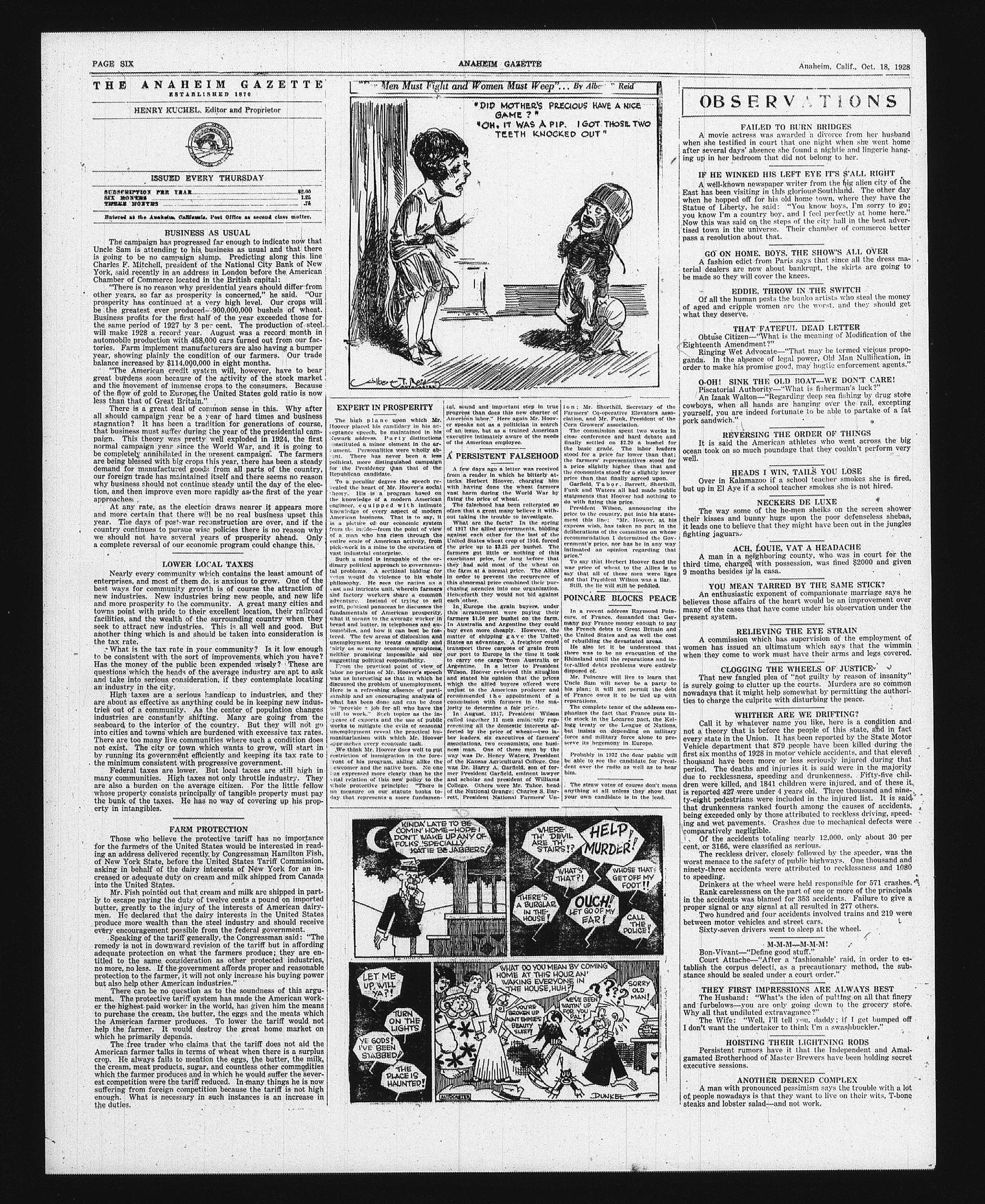
Searchable text
THE ANAHEIM GAZETTE
ESTABLISHED 1870
HENRY KUCHEL, Editor and Proprietor
ISSUED EVERY THURSDAY
SUBSCRIPTION PER YEAR.....$2.00
SIX MONTHS.....1.25
THREE MONTHS.....7.75
Entered at the Anaheim, California, Post Office as second class matter.
BUSINESS AS USUAL
The campaign has progressed far enough to indicate now that Uncle Sam is attending to his business as usual and that there is going to be no campaign slump. Predicting along this line Charles F. Mitchell, president of the National City Bank of New York, said recently in an address in London before the American Chamber of Commerce located in the British capital:
“There is no reason why presidential years should differ from other years, so far as prosperity is concerned,” he said. “Our prosperity has continued at a very high level. Our crops will be the greatest ever produced—900,000,000 bushels of wheat. Business profits for the first half of the year exceeded those for the same period of 1927 by 3 per cent. The production of steel will make 1928 a record year. August was a record month in automobile production with 458,000 cars turned out from our factories. Farm implement manufacturers are also having a bumper year, showing plainly the condition of our farmers. Our trade balance increased by $114,000,000 in eight months.
"The American credit system will, however, have to bear great burdens soon because of the activity of the stock market and the movement of immense crops to the consumers. Because of the flow of gold to Europe, the United States gold ratio is now less than that of Great Britain."
There is a great deal of common sense in this. Why after all should campaign year be a year of hard times and business stagnation? It has been a tradition for generations of course, that business must suffer during the year of the presidential campaign. This theory was pretty well exploded in 1924, the first normal campaign year since the World War, and it is going to
year, showing plainly the condition of our farmers. Our trade balance increased by $114,000,000 in eight months.
"The American credit system will, however, have to bear great burdens soon because of the activity of the stock market and the movement of immense crops to the consumers. Because of the flow of gold to Europe, the United States gold ratio is now less than that of Great Britain."
There is a great deal of common sense in this. Why after all should campaign year be a year of hard times and business stagnation? It has been a tradition for generations of course, that business must suffer during the year of the presidential campaign. This theory was pretty well exploded in 1924, the first normal campaign year since the World War, and it is going to be completely annihilated in the present campaign. The farmers are being blessed with big crops this year, there has been a steady demand for manufactured goods from all parts of the country, our foreign trade has maintained itself and there seems no reason why business should not continue steady until the day of the election, and then improve even more rapidly as the first of the year approaches.
At any rate, as the election draws nearer it appears more and more certain that there will be no real business upset this year. The days of post-war reconstruction are over, and if the country continues to pursue wise policies there is no reason why we should not have several years of prosperity ahead. Only a complete reversal of our economic program could change this.
LOWER LOCAL TAXES
Nearly every community which contains the least amount of enterprises, and most of them do, is anxious to grow. One of the best ways for community growth is of course the attraction of new industries. New industries bring new people, and new life and more prosperity to the community. A great many cities and towns point with pride to their excellent location, their railroad facilities, and the wealth of the surrounding country when they seek to attract new industries. This is all well and good. But another thing which is and should be taken into consideration is the tax rate.
What is the tax rate in your community? Is it low enough to be consistent with the sort of improvements which you have? Has the money of the public been expended wisely? These are questions which the heads of the average industry are apt to ask and take into serious consideration, if they contemplate locating an industry in the city.
High taxes are a serious handicap to industries, and they are about as effective as anything could be in keeping new industries out of a community. As the center of population changes industries are constantly shifting. Many are going from the seaboard to the interior of the country. But they will not go into cities and towns which are burdened with excessive tax rates. There are too many live communities where such a condition does not exist. The city or town which wants to grow, will start in by running its government efficiently and keeping its tax rate to the minimum consistent with progressive government.
Federal taxes are lower. But local taxes are still high in many communities. High taxes not only throttle industry. They are also a burden on the average citizen. For the little fellow whose property consists principally of tangible property must pay the bunk of the taxes. He has no way of covering up his property in intangibles.
FARM PROTECTION
Those who believe the protective tariff has no importance for the farmers of the United States would be interested in read-
FARM PROTECTION
Those who believe the protective tariff has no importance for the farmers of the United States would be interested in reading an address delivered recently by Congressman Hamilton Fish, of New York State, before the United States Tariff Commission, asking in behalf of the dairy interests of New York for an increased or adequate duty on cream and milk shipped from Canada into the United States.
Mr. Fish pointed out that cream and milk are shipped in partly to escape paying the duty of twelve cents a pound on imported butter, greatly to the injury of the interests of American dairy-men. He declared that the dairy interests in the United States produce more wealth than the steel industry and should receive every encouragement possible from the federal government.
Speaking of the tariff generally, the Congressman said: "The remedy is not in downward revision of the tariff but in affording adequate protection on what the farmers produce; they are entitled to the same consideration as other protected industries, no more, no less. If the government affords proper and reasonable protection to the farmer, it will not only increase his buying power but also help other American industries."
There can be no question as to the soundness of this argument. The protective tariff system has made the American worker the highest paid worker in the world, has given him the means to purchase the cream, the butter, the eggs and the meats which the American farmer produces. To lower the tariff would not help the farmer. It would destroy the great home market on which he primarily depends.
The free trader who claims that the tariff does not aid the American farmer talks in terms of wheat when there is a surplus crop. He always fails to mention the eggs, the butter, the milk, the cream, meat products, sugar, and countless other commodities which the farmer produces and in which he would suffer the severest competition were the tariff reduced. In many things he is now suffering from foreign competition because the tariff is not high enough. What is necessary in such instances is an increase in the duties.
"Men Must Fight and Women Must Weep"... By Albert Reid
"DID MOTHER'S PRECIOUS HAVE A NICE GAME?"
"OH, IT WAS A PIP. I GOT THOSE TWO TEETH KNOCKED OUT"
EXPERT IN PROSPERITY
The high plane upon which Mr. Hoover placed his candidacy in his acceptance speech, he maintained in his Newark address. Party distinctions constituted a minor element in the archaic sound and important step in true progress than does this new charter of American labor." Here again Mr. Hoover speaks not as a politician in search of an issue, but as a trained American executive intimately aware of the needs of the American employee.
Mr. Shorthill, Secretary of the Farmers' Co-operative Elevators association, and Mr. Funk, President of the Corn Growers' association.
The commission spent two weeks in close conference and hard debate and finally settled on $2.20 a bushel for the basic grade. The labor leaders
EXPERT IN PROSPERITY
The high plane upon which Mr. Hoover placed his candidacy in his acceptance speech, he maintained in his Newark address. Party distinctions constituted a minor element in the argument. Personalities were wholly absent. There has never been a less political, more distinguished campaign for the Presidency than that of the Republican candidate.
To a peculiar degree the speech revealed the heart of Mr. Hoover's social theory. His is a program based on the knowledge of a modern American engineer, equipped with intimate knowledge of every aspect of modern American business. That is to say, it is a picture of our economic system from the inside—from the point of view of a man who has risen through the entire scale of American activity, from pick-work in a mine to the operation of vast industrial enterprise.
Such a mind is incapable of the ordinary political approach to governmental problems. A sectidal bidding for votes would do violence to his whole philosophy. He sees the nation as a vast and intricate unit, wherein farmers and factory workers share a common adventure. Instead of trying to sell swift, political panaceas he discusses the fundamentals of American prosperity, what it means to the average worker in bread and butter, in telephones and automobiles, and how it can best be fostered. The few areas of dislocation and unemployment he treats candidly and fairly as so many economic symptoms, neither promising impossible aid nor suggesting political responsibility.
From the practical point of view of labor no portion of Mr. Hoover's speech was as interesting as that in which he discussed the problem of unemployment. Here is a refreshing absence of partisanship and an encouraging analysis of what has been done and can be done to "provide a job for all who have the will to work." Such topics as the increase of exports and the use of public works to mitigate the evils of seasonal unemployment reveal the practical humanitarianism with which Mr. Hoover approaches every economic task.
We think Mr. Hoover does well to put restriction of immigration in the forefront of his program, aliding alike the newcomer and the native born. No one has expressed more clearly than he the vital relation of this new policy to the whole protective principle: "There is no measure on our statute books today that represents a more fundamental sound and important step in true progress than does this new charter of American labor." Here again Mr. Hoover speaks not as a politician in search of an issue, but as a trained American executive intimately aware of the needs of the American employee.
A PERSISTENT FALSEHOOD
A few days ago a letter was received from a reader in which he bitterly attacks Herbert Hoover, charging him with having done the wheat farmers vast harm during the World War by fixing the price of wheat.
The falsehood has been reiterated so often that a great many believe it without taking the trouble to investigate.
What are the facts? In the spring of 1917 the allied governments, blinding against each other for the last of the United States wheat crop of 1916, forced the price up to $3.25 per bushel. The farmers got little or nothing of this exorbitant price, for long before that they had sold most of the wheat on the farm at a normal price. The Allies in order to prevent the recurrence of this abnormal price combined their purchasing agencies into one organization. Henceforth they would not bid against each other.
In Europe the grain buyers under this arrangement were paying their farmers $1.50 per bushel on the farm. In Australia and Argentina they could buy even more cheaply. However, the matter of shipping gave the United States an advantage. A freighter could transport three cargoes of grain from our port to Europe in the time it took to carry one cargo from Australia or Argentine. In a letter to President Wilson, Hoover reviewed this situation and stated his opinion that the prices which the allied buyers offered were unjust to the American producer and recommended the appointment of a commission with farmers in the majority to determine a fair price.
In August, 1917, President Wilson called together 11 men eminently representing all the domestic interests affected by the price of wheat—two labor leaders, six executives of farmers' associations, two economists, one business man. One of these men by the way was Dr. Henry Waters, President of the Kansas Agricultural College. One was Dr. Harry A. Garfield, son of former President Garfield, eminent lawyer and scholar and president of Williams College. Others were Mr. Tabor, head of the National Grange; Charles S. Barrett, President National Farmers' Union; Mr. Shorthill, Secretary of the Farmers' Co-operative Elevators association, and Mr. Funk, President of the Corn Growers' association.
The commission spent two weeks in close conference and hard debate and finally settled on $2.20 a bushel for the basic grade. The labor leaders stood for a price far lower than that; the farmers' representatives stood for a price slightly higher than that and the economists stood for a slightly lower price than that finally agreed upon.
Garfield, Tabor, Barrett, Shorthill, Funk and Waters all had made public statements that Hoover had nothing to do with fixing this price.
President Wilson, announcing the price to the country, put into his statement this line: "Mr. Hoover, at his express wish, has taken no part in the deliberations of the committee on whose recommendation I determined the Government's price, nor has he in any way intimated an opinion regarding that price."
To say that Herbert Hoover fixed the war price of wheat to the Allies is to say that all of these men were liars and that President Wilson was a liar.
Still, the lie will still be peddled.
POINCARE BLOCKS PEACE
In a recent address Raymond Poincare, of France, demanded that Germany pay France money enough to pay the French debts to Great Britain and the United States and as well the cost of rebuilding the devastated areas.
He also let it be understood that there was to be no evacuation of the Rhineland until the reparations and inter-allied debts problems were entirely disposed of.
Mr. Poincare will live to learn that Uncle Sam will never be a party to his plan; it will not permit the debt of France owes it to be tied up with reparations.
The complete tenor of the address emphasizes the fact that France puts little stock in the Locarno pact, the Kelogg treaty or the League of Nations, but insists on depending on military force and military force alone to preserve its hegemony in Europe.
Probably in 1932 the dear public will be able to see the candidate for President over the radio as well as to hear him.
The straw votes of course don't mean anything at all unless they show that your own candidate is in the lead.
KINDA' LATE TO BE COMIN' HOME—HOPE! DON'T WAKE UP ANY OF FOLKS 'SPECIALLY KATIE BE JABBERS!
WHERE TH' DEVIL ARE TH' STAIRS!!
WHAT'S THAT?!
WHOSE THAT GET OFF MY FOOT!!
THERE'S A BURGLAR IN THE HOUSE!
OUCH! LET GO OF MY EAR!
CALL THE POLICE!
LET ME UP, WILL YA?!
TURN ON THE LIGHTS
YE GODS! IVE BEEN STABBED!
THE PLACE IS HAUNTED!
WHAT DO YOU MEAN BY COMING HOME AT THIS HOUR AN' WAKING EVERYONE IN THE HOUSE,HUH?
WE'RE BROKEN UP AUNT EMMIE'S BEAUTY SLEEP!
SORRY OLD MAN!
DUNKEL
OBSERVATIONS
FAILED TO BURN BRIDGES
A movie actress was awarded a divorce from her husband when she testified in court that one night when she went home after several days' absence she found a nightie and lingerie hanging up in her bedroom that did not belong to her.
IF HE WINKED HIS LEFT EYE IT'S S'ALL RIGHT
A well-known newspaper writer from the big alien city of the East has been visiting in this glorious Southland. The other day when he hopped off for his old home town, where they have the Statue of Liberty, he said: "You know boys, I'm sorry to go; you know I'm a country boy, and I feel perfectly at home here." Now this was said on the steps of the city hall in the best advertised town in the universe. Their chamber of commerce better pass a resolution about that.
GO ON HOME, BOYS, THE SHOW'S ALL OVER
A fashion edict from Paris says that since all the dress material dealers are now about bankrupt, the skirts are going to be made so they will cover the knees.
EDDIE, THROW IN THE SWITCH
Of all the human pests the bunko artists who steal the money of aged and cripple women are the worst, and they should get what they deserve.
THAT FATEFUL DEAD LETTER
Obtuse Citizen—"What is the meaning of Modification of the Eighteenth Amendment?"
Ringing Wet Advocate—"That may be termed vicious propaganda. In the absence of legal power, Old Man Nullification, in order to make his promise good, may hogtie enforcement agents."
O-OH! SINK THE OLD BOAT—WE DON'T CARE!
Piscatorial Authority—"What is fisherman's luck?"
An Izaak Walton—"Regarding deep sea fishing by drug store cowboys, when all hands are hanging over the rail, excepting yourself, you are indeed fortunate to be able to partake of a fat pork sandwich."
REVERSING THE ORDER OF THINGS
It is said the American athletes who went across the big
O-OH! SINK THE OLD BOAT—WE DON'T CARE!
Piscatorial Authority—"What is fisherman's luck?"
An Izaak Walton—"Regarding deep sea fishing by drug store cowboys, when all hands are hanging over the rail, excepting yourself, you are indeed fortunate to be able to partake of a fat pork sandwich."
REVERSING THE ORDER OF THINGS
It is said the American athletes who went across the big ocean took on so much poundage that they couldn't perform very well.
HEADS I WIN, TAILS YOU LOSE
Over in Kalamazoo if a school teacher smokes she is fired, but up in El Aye if a school teacher smokes she is not hired.
NECKERS DE LUXE
The way some of the he-men sheiks on the screen shower their kisses and bunny hugs upon the poor defenseless shebas, it leads one to believe that they might have been out in the jungles fighting jaguars.
ACH, LOUIE, VAT A HEADACHE
A man in a neighboring county, who was in court for the third time, charged with possession, was fined $2000 and given 9 months besides in la casa.
YOU MEAN TARRED BY THE SAME STICK?
An enthusiastic exponent of companionate marriage says he believes those affairs of the heart would be an improvement over many of the cases that have come under his observation under the present system.
RELIEVING THE EYE STRAIN
A commission which has supervision of the employment of women has issued an ultimatum which says that the wimmin when they come to work must have their arms and legs covered.
CLOGGING THE WHEELS OF JUSTICE
That new fangled plea of "not guilty by reason of insanity" is surely going to clutter up the courts. Murders are so common nowadays that it might help somewhat by permitting the authorities to charge the culprite with disturbing the peace.
WHITHER ARE WE DRIFTING?
Call it by whatever name you like, here is a condition and not a theory that is before the people of this state, and in fact every state in the Union. It has been reported by the State Motor Vehicle department that 879 people have been killed during the first six months of 1928 in motor vehicle accidents, and that eleven thousand have been more or less seriously injured during that period. The deaths and injuries it is said were in the majority due to recklessness, speeding and drunkenness. Fifty-five children were killed, and 1841 children were injured, and of these it is reported 427 were under 4 years old. Three thousand and ninety-eight pedestrians were included in the injured list. It is said that drunkenness ranked fourth among the causes of accidents, being exceeded only by those attributed to reckless driving, speeding and wet pavements. Crashes due to mechanical defects were comparatively negligible.
Of the accidents totaling nearly 12,000, only about 30 per cent, or 3166, were classified as serious.
thousand have been more or less seriously injured during that period. The deaths and injuries it is said were in the majority due to recklessness, speeding and drunkenness. Fifty-five children were killed, and 1841 children were injured, and of these it is reported 427 were under 4 years old. Three thousand and ninety-eight pedestrians were included in the injured list. It is said that drunkenness ranked fourth among the causes of accidents, being exceeded only by those attributed to reckless driving, speeding and wet pavements. Crashes due to mechanical defects were comparatively negligible.
Of the accidents totaling nearly 12,000, only about 30 per cent, or 3166, were classified as serious.
The reckless driver, closely followed by the speeder, was the worst menace to the safety of public highways. One thousand and ninety-three accidents were attributed to recklessness and 1080 to speeding.
Drinkers at the wheel were held responsible for 571 crashes.
Rank carelessness on the part of one or more of the principals in the accidents was blamed for 353 accidents. Failure to give a proper signal or any signal at all resulted in 277 others.
Two hundred and four accidents involved trains and 219 were between motor vehicles and street cars.
Sixty-seven drivers went to sleep at the wheel.
M-M-M—M-M-M!
Bon-Vivant—"Define good stuff."
Court Attache—"After a 'fashionable' raid, in order to establish the corpus delecti, as a precautionary method, the substance should be sealed under a court order."
THEY FIRST IMPRESSIONS ARE ALWAYS BEST
The Husband: "What's the idea of putting on all that finery and furbelows—you are only going down to the grocery store. Why all that undiluted extravagance?"
The Wife: "Well, I'll tell you, daddy; if I get bumped off I don't want the undertaker to think I'm a swashbuckler."
HOISTING THEIR LIGHTNING RODS
Persistent rumors have it that the Independent and Amalgamated Brotherhood of Master Brewers have been holding secret executive sessions.
ANOTHER DERNED COMPLEX
A man with pronounced pessimism says the trouble with a lot of people nowadays is that they want to live on their wits, T-bone steaks and lobster salad—and not work.