anaheim-gazette 1928-08-30
Scanned page
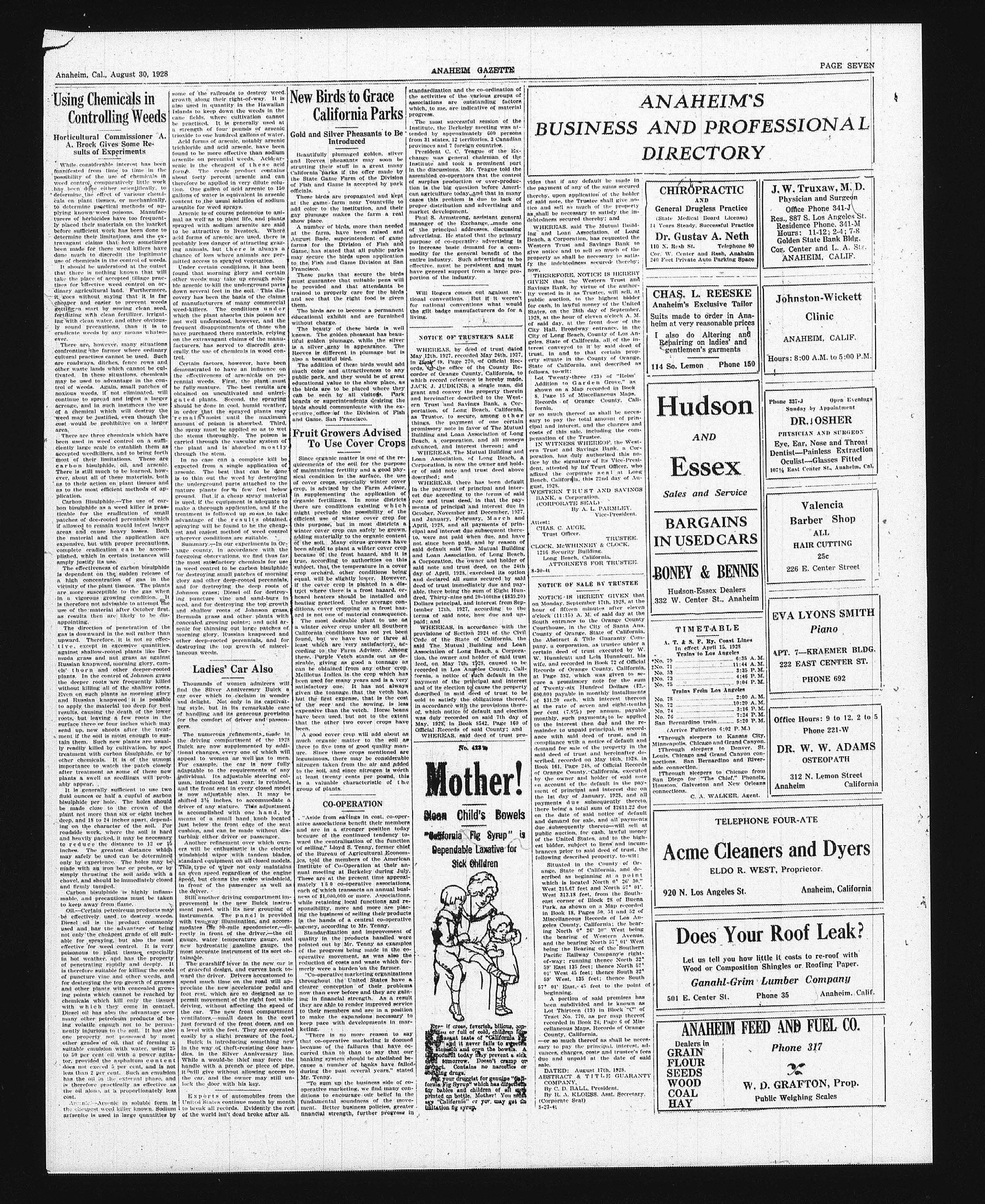
Searchable text
Using Chemicals in Controlling Weeds
Horticultural Commissioner A. A. Brock Gives Some Results of Experiments
While considerable interest has been manifested from time to time in the possibility of the use of chemicals in weed control, comparatively little work has been done either scientifically, to determine the effect of various chemicals on plant tissues, or mechanically, to determine practical methods of applying known weed poisons. Manufacturers of herbicides have too frequently placed their materials on the market before sufficient work has been done to determine their limitations, and the extravagant claims that have sometimes been made for these weed killers have done much to discredit the legitimate use of chemicals in the control of weeds.
It should be understood at the outset that there is nothing known that will take the place of accepted tillage practices for effective weed control on ordinary agricultural land. Furthermore, it goes without saying that it is far cheaper and easier to prevent weeds getting a start by sowing clean seed, fertilizing with clean fertilizer, irrigating with clean water, and other obviously sound precautions, than it is to eradicate weeds by any means whatsoever.
There are, however, many situations confronting the farmer where ordinary cultural practises cannot be used. Such are roadways, ditches, fence rows and other waste lands which cannot be cultivated. In these situations, chemicals may be used to advantage in the control of weeds. Again, small patches of noxious weeds, if not eliminated, will continue to spread and infest a larger acreage, and in such instances the use of a chemical which will destroy the weed may be justified, even though the cost would be prohibitive on a larger area.
There are three chemicals which have been used in weed control on a sufficiently large scale to establish them as some of the railroads to destroy weed growth along their right-of-way. It is also used in quantity in the Hawaiian Islands to keep down the weeds in the cane fields, where cultivation cannot be practised. It is generally used at a strength of four pounds of arsenic trioxide to one hundred gallons of water.
Acid forms of arsenic, notably arsenic trichloride and acid arsenic, have been found to be more effective than sodium arsenite on perennial weeds. Acid arsenic is the cheapest of these acid forms. The crude product contains about forty percent arsenic and can therefore be applied in very dilute solution. One gallon of acid arsenic to 150 gallons of water is equivalent in arsenic content to the usual solution of sodium arsenite for weed sprays.
Arsenic is of course poisonous to animal as well as to plant life, and plants sprayed with sodium arsenite are said to be attractive to livestock. Where acid forms of arsenic are used, there is probably less danger of attracting grazing animals, but there is always a chance of loss where animals are permitted access to sprayed vegetation.
Under certain conditions, it has been found that morning glory and certain other weeds may take up enough soluble arsenic to kill the underground parts down several feet in the soil. This discovery has been the basis of the claims of manufacturers of many commercial weed-killers. The conditions under which the plant absorbs this poison are not well understood, however, and the frequent disappointments of those who have purchased these materials, relying on the extravagant claims of the manufacturers, has served to discredit generally the use of chemicals in wood control.
Certain factors, however, have been demonstrated to have an influence on the effectiveness of arsenicals on perennial weeds. First, the plant must be fully mature. The best results are obtained on uncultivated and unirrigated plants. Second, the spraying should be done in cool, humid weather, in order that the sprayed plants may remain moist until the maximum amount of poison is absorbed. Third, the spray must be applied so as to wet the stems thoroughly. The poison is carried through the vascular system of the plant and is absorbed mostly...
cultural practices cannot be used. Such are roadways, ditches, fence rows and other waste lands which cannot be cultivated. In these situations, chemicals may be used to advantage in the control of weeds. Again, small patches of noxious weeds, if not eliminated, will continue to spread and infest a larger acreage, and in such instances the use of a chemical which will destroy the weed may be justified, even though the cost would be prohibitive on a larger area.
There are three chemicals which have been used in weed control on a sufficiently large scale to establish them as accepted weedkillers, and to bring forth most of their limitations. These are carbon bisulphide, oil, and arsenic. There is still much to be learned, however, about all of these materials, both as to their action on plant tissues and as to the most efficient methods of application.
Carbon Bisulphide—The use of carbon bisulphide as a weed killer is practicable for the eradication of small patches of dee-rooted perennials which if allowed to remain would infest larger areas and cause heavy losses. Both the material and the application are expensive, but with proper precautions, complete eradication can be accomplished, which in certain instances will amply justify its use.
The effectiveness of carbon bisulphide is dependent on the sudden release of a high concentration of gas in the vicinity of the plant tissues. The plants are more susceptible to the gas when in a vigorous growing condition. It is therefore not advisable to attempt the use of the material after October first, as results then are likely to be disappointing.
The direction of penetration of the gas is downward in the soil rather than upward. Therefore, it is not so effective, except in excessive quantities against shallow-rooted plants like Bermuda grass and nut grass as against Russian knapweed, morning glory, camel's horn and other deeper-rooted plants. In the control of Johnson grass the deeper roots are frequently killed without killing all of the shallow roots. Even on such plants as morning glory and Russian knapweed it is possible to apply the material too deep for best results, causing the death of the lower roots, but leaving a few roots in the surface three or four inches which may send up new shoots after the treatment if the soil is moist enough to sustain them. Such new plants are usually readily killed by cultivation, by spot treatment with carbon bisulphide, or by other chemicals. It is of the utmost importance to watch the patch closely after treatment as some of these new plants a swell as seedlings will probably appear.
It is generally sufficient to use two fluid ounces or half a cupful of sarbon bisulphide per hole. The holes should be made close to the crown of the plant not more than six or eight inches deep, and 18 to 24 inches apart, depending on the character of the soil. For roadside work, where the soil is hard and heavily packed, it may be necessary to reduce the distance to 12 or 15 inches. The greatest distance which cultural practices cannot be used. Such are roadways, ditches, fence rows and other waste lands which cannot be cultivated. In these situations, chemicals may be used to advantage in the control of weeds. Again, small patches of noxious weeds, if not eliminated, will continue to spread and infest a larger acreage, and in such instances the use of a chemical which will destroy the weed may be justified, even though the cost would be prohibitive on a larger area.
There are three chemicals which have been used in weed control on a sufficiently large scale to establish them as accepted weedkillers, and to bring forth most of their limitations. These are carbon bisulphide, oil, and arsenic. There is still much to be learned, however, about all of these materials, both as to their action on plant tissues and as to the most efficient methods of application.
Carbon Bisulphide—The use of carbon bisulphide as a weed killer is practicable for the eradication of small patches of dee-rooted perennials which if allowed to remain would infest larger areas and cause heavy losses. Both the material and the application are expensive, but with proper precautions, complete eradication can be accomplished, which in certain instances will amply justify its use.
The effectiveness of carbon bisulphide is dependent on the sudden release of a high concentration of gas in the vicinity of the plant tissues. The plants are more susceptible to the gas when in a vigorous growing condition. It is therefore not advisable to attempt the use of the material after October first, as results then are likely to be disappointing.
The direction of penetration of the gas is downward in the soil rather than upward. Therefore, it is not so effective, except in excessive quantities against shallow-rooted plants like Bermuda grass and nut grass as against Russian knapweed, morning glory, camel's horn and other deeper-rooted plants. In the control of Johnson grass the deeper roots are frequently killed without killing all of the shallow roots. Even on such plants as morning glory and Russian knapweed it is possible to apply the material too deep for best results, causing the death of the lower roots, but leaving a few roots in the surface three or four inches which may send up new shoots after the treatment if the soil is moist enough to sustain them. Such new plants are usually readily killed by cultivation, by spot treatment with carbon bisulphide, or by other chemicals. It is of the utmost importance to watch the patch closely after treatment as some of these new plants a swell as seedlings will probably appear.
It is generally sufficient to use two fluid ounces or half a cupful of sarbon bisulphide per hole. The holes should be made close to the crown of the plant not more than six or eight inches deep, and 18 to 24 inches apart, depending on the character of the soil. For roadside work, where the soil is hard and heavily packed, it may be necessary to reduce the distance to 12 or 15 inches. The greatest distance which cultural practices cannot be used. Such are roadways, ditches, fence rows and other waste lands which cannot be cultivated. In these situations, chemicals may be used to advantage in the control of weeds. Again, small patches of noxious weeds, if not eliminated, will continue to spread and infest a larger acreage, and in such instances the use of a chemical which will destroy the weed may be justified, even though the cost would be prohibitive on a larger area.
There are three chemicals which have been used in weed control on a sufficiently large scale to establish them as accepted weedkillers, and to bring forth most of their limitations. These are carbon bisulphide, oil, and arsenic. There is still much to be learned, however, about all of these materials, both as to their action on plant tissues and as to the most efficient methods of application.
Carbon Bisulphide—The use of carbon bisulphide as a weed killer is practicable for the eradication of small patches of dee-rooted perennials which if allowed to remain would infest larger areas and cause heavy losses. Both the material and the application are expensive, but with proper precautions, complete eradication can be accomplished, which in certain instances will amply justify its use.
The effectiveness of carbon bisulphide is dependent on the sudden release of a high concentration of gas in the vicinity of the plant tissues. The plants are more susceptible to the gas when in a vigorous growing condition. It is therefore not advisable to attempt the use of the material after October first, as results then are likely to be disappointing.
The direction of penetration of the gas is downward in the soil rather than upward. Therefore, it is not so effective, except in excessive quantities against shallow-rooted plants like Bermuda grass and nut grass as against Russian knapweed, morning glory, camel's horn and other deeper-rooted plants. In the control of Johnson grass the deeper roots are frequently killed without killing all of the shallow roots. Even on such plants as morning glory and Russian knapweed it is possible to apply the material too deep for best results, causing the death of the lower roots, but leaving a few roots in the surface three or four inches which may send up new shoots after the treatment if the soil is moist enough to sustain them. Such new plants are usually readily killed by cultivation, by spot treatment with carbon bisulphide, or by other chemicals. It is of the utmost importance to watch the patch closely after treatment as some of these new plants a swell as seedlings will probably appear.
It is generally sufficient to use two fluid ounces or half a cupful of sarbon bisulphide per hole. The holes should be made close to the crown of the plant not more than six or eight inches deep, and 18 to 24 inches apart, depending on the character of the soil. For roadside work, where the soil is hard and heavily packed, it may be necessary to reduce the distance to 12 or 15 inches. The greatest distance which cultural practices cannot be used. Such are roadways, ditches, fence rows and other waste lands which cannot be cultivated. In these situations, chemicals may be used to advantage in the control of weeds. Again, small patches of noxious weeds, if not eliminated, will continue to spread and infest a larger acreage, and in such instances the use of a chemical which will destroy the weed may be likely to be disappointing.
The direction of penetration of the gas is downward in the soil rather than upward. Therefore it is not so effective except in excessive quantities against shallow-rooted plants like Bermuda grass and nut grass as against Russian knapweed, morning glory, camel's horn and other deeper-rooted plants. In the control of Johnson grass the deeper roots are frequently killed without killing all of the shallow roots. Even on such plants as morning glory and Russian knapweed it is possible to apply the material too deep for best results causing the death of the lower roots but leaving a few roots in the surface three or four inches which may send up new shoots after the treatment if the soil is moist enough to sustain them. Such new plants are usually readily killed by cultivation by spot treatment with carbon bisulphide or by other chemicals. It is of utmost importance to watch the patch closely after treatment as some of these new plants a swell as seedlings will probably appear.
It is generally sufficient to use two fluid ounces or half a cupful of sarbon bisulphide per hole. The holes should be made close to the crown of the plant not more than six or eight inches deep, and 18 to 24 inches apart depending on the character of the soil. For roadside work where the soil is hard and heavily packed it may be necessary to reduce the distance to 12 or 15 inches. The greatest distance which cultural practices cannot be used. Such are roadways, ditches, fence rows and other waste lands which cannot be cultivated.
In no case can a complete kill be expected from a single application of arsenic. The best that can be done is to thin out the weed by destroyingthe underground parts attachedtothe mature plants fora few feet below ground. But ifa cheap spray materialis used, ifthe equipmentisadequateto makea thoroughapplication,andIfthetreatmentisfollowedupsoasto takeadvantageoftheresultsobtainedsprayingwillbefoundtobecheapandeasiestmethodofweedcontrolwhereverconditionsaresuitable.
Summary—In our experimentsinOrange countyin accordancewiththeforegoingobservationswefindthusfarmostsatisfactorychemicalsforuseinweedcontroltobecarbonbisulphidforgestroysmallgloryandotherdeep-rootedperennials,andfordestroyingthedeeprootsofJohnsongrass;Dieseloilfordestroyingpuncturevineandsand-bursinseed,andfordestroyingthetopgrowthandshallowrootsofJohnsongrass.Bernudagrassandotherplantswithconcealedgrowingpoints;andacidsensellereasonthinkingoutlargepatchesofmorningglory.Russianknapweedandotherdeep-rootedperennials,andfordestroyingthetopgrowthmiscellaneousweeds.
Ladies' Car Also
Thousandsofwomen admirerswillfindtheSilverAnniversaryBulkacaroverwhichtoexclaimin wonderanddelight.Notonlyinitscaptivatingstylebutinitsremarkablecaseofhandlinganditsgenerousprovisionforthecomfortofdriverandpassengers.
The numerous refinementsmadeinthedrivingcompartmentofthe1928Bulkacaroverwhichtoexclaiminademaintenanceanddifficultyone.Ihagiventhetonnagethattbutthefirstexpense,thefoeflorecardheatersshouldbefoundheatingpracticed.Undertitionscovercroppingandarenotoneofmaterials.ThemostdesirableplayawintercovercpropunderCaliforniaconditionshasfoundbutwehavetwoleastwhichareverysasycordingtotheFarmAdherethesePurpleVetchstandsirable,givingasgoodcanbeobtainfromanMellotusIndicaisthecrimebeenusedformanyyearssatisfactoryone.Ihagiventhetonnagethattbutthefirstexpense,thefoeflorecardheatersshouldbefoundheatingpracticed.Undertitionscovercroppingandarenotoneofmaterials.ThemostdesirableplayawintercovercpropunderCaliforniaconditionshasfoundbutwehavetwoleastwhichareverysasycordingtotheFarmAdherethesePurpleVetchstandsirable,givingasgoodcanbeobtainfromanMellotusIndicaisthecrimebeenusedformanyyearssatisfactoryone.Ihagiventhetonnagethattbutthefirstexpense,thefoeflorecardheatersshouldbefoundheatingpracticed.Undertitionscovercroppingandarenotoneofmaterials.ThemostdesirableplayawintercovercpropunderCaliforniaconditionshasfoundbutwehavetwoleastwhichareverysasycordingtotheFarmAdherethesePurpleVetchstandsirable,givingasgoodcanbeobtainfromanMellotusIndicaisthecrimebeenusedformanyyearssatisfactoryone.Ihagiventhetonnagethattbutthefirstexpense,thefoeflorecardheatersshouldbefoundheatingpracticed.Undertitionscovercroppingandarenotoneofmaterials.ThemostdesirableplayawintercovercpropunderCaliforniaconditionshasfoundbutwehavetwoleastwhichareverysasycordingtotheFarmAdherethesePurpleVetchstandsirable,givingasgoodcanbeobtainfromanMellotusIndicaisthecrimebeenusedformanyyearssatisfactoryone.Ihagiventhetonnagethattbutthefirstexpense,thefoeflorecardheatersshouldbefoundheatingpracticed.Undertitionscovercroppingandarenotoneofmaterials.ThemostdesirableplayawintercovercpropunderCaliforniaconditionshasfoundbutwehavetwoleastwhichareverysasycordingtotheFarmAdherethesePurpleVetchstandsirable,givingasgoodcanbeobtainfromanMellotusIndicaisthecrimebeenusedformanyyearssatisfactoryone.Ihagiventhetonnagethattbutthefirstexpense,thefoeflorecardheatersshouldbefoundheatingpracticed.Undertitionscovercroppingandarenotoneofmaterials.ThemostdesirableplayawintercovercpropunderCaliforniaconditionshasfoundbutwehavetwoleastwhichareverysasycordingtotheFarmAdherethesePurpleVetchstandsirable,givingasgoodcanbeobtainfromanMellotusIndicaisthecrimebeenusedformanyyearssatisfactoryone.Ihagiventhetonnagethattbutthefirstexpense,thefoeflorecardheatersshouldbefoundheatingpracticed.Undertitionscovercroppingandarenotoneofmaterials.ThemostdesirableplayawintercovercpropunderCaliforniaconditionshasfoundbutwehavetwoleastwhichareverysasycordingtotheFarmAdherethesePurpleVetchstandsirable,givingasgoodcanbeobtainfromanMellotusIndicaisthecrimebeenusedformanyyearssatisfactoryone.Ihagiventhetonnagethatt但thefirstexpense,thefoeflorecardheatersshouldbefoundheatingpracticed.Undertitionscovercropping和arenotoneofmaterials.ThemostdesirableplayawintercovercpropunderCalifornia conditions has found but we have two leasts which are very sassy cursive writing that they do not least twenty cents per unit at least twenty cents per unit at least twenty cents per unit at least twenty cents per unit at least twenty cents per unit at least twenty cents per unit at least twenty cents per unit at least twenty cents per unit at least twenty cents per unit at least twenty cents per unit at least twenty cents per unit at least twenty cents per unit at least twenty cents per unit at least twenty cents per unit at least twenty cents per unit at least twenty cents per unit at least twenty cents per unit at least twenty cents per unit at least twenty cents per unit at least twenty cents per unit at least twenty cents per unit at least twenty cents per unit at least twenty cents per unit at least twenty cents per unit at least twenty cents per unit at least twenty cents per unit at least twenty cents per unit at least twenty cents per unit at least twenty cents per unit at least twenty cents per unit at least twenty cents per unit at least twenty cents per unit at least twenty cents per unit at least twenty cents per unit at least twenty cents per unit at least twenty cents per unit at least twenty cents per unit at least二十二年二十二年二十二年二十二年二十二年二十二年二十二年二十二年二十二年二十二年二十二年二十二年二十二年二十二年二十二年二十二年二十二年二十二年二十二年二十二年二十二年二十二年二十二年二十二年二十二年二十二年二十二年二十二年二十二年二十二年二十二年二十二年二十二年二十二年二十二年二十二年二十二年二十二年二十二年二十二年二十二年二十二年二十二年二十二年二十二年二十二年二十二年二十二年二十二年二十年三十三年三十三年三十三年三十三年三十三年三十三年三十三年三十三年三十三年三十三年三十三年三十三年三十三年三十三年三十三年三十三年三十三年三十三年三十三年三十三年三十三年三十三年三十三年三十三年三十三年三十三年三十三年三十三年三十三年三十三年三十三年三十三年三十三年三十三年三十三年三十三年三十三年三十三年三十三年三十三年三十三年三十三年三十三年三十三年三十三年三十三年三十三年三十三年三十年四十二年四十二年四十二年四十二年四十二年四十二年四十二年四十二年四十二年四十二年四十二年四十二年四十二年四十二年四十二年四十二年四十二年四十二年四十二年四十二年四十二年四十二年四十二年四十二年四十二年四十二年四十二年四十二年四十二年四十二年四十二年四十二年四十二年四十一年四十一年四十一年四十一年四十一年四十一年四十一年四十一年四十一年四十一年四十一年四十一年四十一年四十一年四十一年四十一年四十一年四十一年四十一年四十一年四十一年四十一年四十一年四十一年四十一 year 四十一 year 四十一 year 四十一 year 四十一 year 四十一 year 四十一 year 四十一 year 四十一 year 四十一 year 四十一 year 四十一 year 四十一 year 四十一 year 四十一 year 四十一 year 四十一 year 四十一 year 四十一 year 四十一 year 四十一 year 四十一 year 四十一 year 四十一 year 四十一 year 四十一 year 四十一 year 四十一 year 四十一 year 四十一 year 四十一 year 四十一 year 四十一 year 四一十四 年四年四年四年四年四年四年四年四年四年四年四年四年四年四年四年四年四年四年四年四年四年四年四年四年四年四年四年四年四年四年四年四年四年四年四年四年四年四年四年四年四年四年四年五年五年五年五年五年五年五年五年五年五年五年五年五年五年五年五年五年五年五年五年五年五年五年五年五年五年五年五年五年五年五年五年五年五年五年五年五年五年五年五年五年五年五年五年五年五年五年五年五年五年五年五年五年五年五年五年五年五年五年五年五年五年五年五年五年五年五年五年五年五年五年来五年来五年来五年来五年来五年来五年来五年来五年来五年来五年来五年来五年来五年来五年来五年来五年来五年来五年来五年来五年来五年来五年来五年来五年来五年来五年来五年来五年来五年来五年来五年来五年来五年来五年来五年来五年来五年来五年来五年来五年来五年来五年来五年来五年来五年来五年来五年来五年来五十年来五十年来五十年来五十醒来五十醒来五十醒来五十醒来五十醒来五十醒来五十醒来五十醒来五十醒来五十醒来五十醒来五十醒来五十醒来五十醒来五十醒来五十醒来五十醒来五十醒来五十醒来五十醒来五十醒来五十醒来五十醒来五十醒来五十醒来五十醒来五十醒来五十醒来五十醒来五十醒来五十醒来五十醒来五十醒来五十醒来五十醒来五十醒来四十醒来四十醒来四十醒来四十醒来四十醒来四十醒来四十醒来四十醒来四十醒来四十醒来四十醒来四十醒来四十醒来四十醒来四十醒来四十醒来四十醒来四十醒来四十醒来四十醒来四十醒来四十醒来四十醒来四十醒来四十迎来四十迎来四十迎来四十迎来四十迎来四十迎来四十迎来四十迎来四十迎来四十迎来四十迎来四十迎来四十迎来四十迎来四十迎来四十迎来四十迎来四十迎来四十迎来四十迎来四十迎来四十迎来四十迎来四十迎来四十迎来四十迎来四十迎来四十迎来四十迎来四十迎来四十迎来四十迎来四十迎来四十迎来四十迎来四十迎来四十迎来十进来十进来十进来十进来十进来十进来十进来十进来十进来十进来十进来十进来十进来十进来十进来十进来十进来十进来十进来十进来十进来十进来十进来十进来十进来十进来十进来十进来十进来十进来十进来十进来十进来十进来十进来十进来十进来十进来十进来十进来十进来十进来十进来十进来十进来十进来十进来十过来十过来十过来十余来十余来十余来十余来十余来十余来十余来十余来十余来十余来十余来十余来十余来十余来十余来十余来十余来十余来十余来十余来十余来十余来十余来十余来十余来十余来十余来十余来十余来十余来十余来十余来十余来十余来十余来十余来十余来十余来十余来十余来十余来十余来十余来十余来十余来十余来十余来十余来十余来余余来余余来余余来余余来余余来余余来余余来余余来余余来余余来余余来余余来余余来余余来余余来余余来余余来余余来余余来余余来余余来余余来余余来余余来余余来余余来余余来余余来余余来余余来余余来余余来余余来源源源源源源源源源源源源源源源源源源源源源源源源源源源源源源源源源源源源源源源源源源源源源源源源源源源源源源源源源源源源源源源源源源源源源源源源源源源源源源源源源源源源源源源源source source source source source source source source source source source source source source source source source source source source source source source source source source source source source source source source source source source source source source source source source source source source source source source source source source source source source source source source source.source.source.source.source.source.source.source.source.source.source.source.source.source.source.source.source.source.source.source.source.source.source.source.source.source.source.source.source.source.source.source.source.source.source.source.source.source.source.source.source.source.source.source.source.source.source.source.source.source.source.source.source.source.source.source.source.source.source.source.source.source_source_source_source_source_source_source_source_source_source_source_source_source_source_source_source_source_source_source_source_source_source_source_source_source_source_source_source_source_source_source_source_source_source_source_source_source_source_source_source_source_source_source_source_source_source_source_source_source_source_source_source_source_source_source_source_source_source_sourceSource Source Source Source Source Source Source Source Source Source Source Source Source Source Source Source Source Source Source Source Source Source Source Source Source Source Source Source Source Source Source Source Source Source Source Source Source Source Source Source Source Source Source Source Source Source Source Source Source Source Source Source Source Source Source Source Source Source Source Source Source Source Source Source Source Source Source Source Source Source Source Source Source Source Source Source Source Source SourceSourceSourceSourceSourceSourceSourceSourceSourceSourceSourceSourceSourceSourceSourceSourceSourceSourceSourceSourceSourceSourceSourceSourceSourceSourceSourceSourceSourceSourceSourceSourceSourceSourceSourceSourceSourceSourceSourceSourceSourceSourceSourceSourceSourceSourceSourceSourceSourceSourceSourceSourceSourceSourceSourceSourceSourceSourceSourceSourceSourceSourceSourceSourceSourceSourceSourceSourceSourceSourceSourceSourceSourceSourceSourceSourceSourceSource.Source.Source.Source.Source.Source.Source.Source.Source.Source.Source.Source.Source.Source.Source.Source.Source.Source.Source.Source.Source.Source.Source.Source.Source.Source.Source.Source.Source.Source.Source.Source.Source.Source.Source.Source.Source.Source.Source.Source.Source.Source.Source.Source.Source.Source.Source.Source.Source.Source.Source.Source.Source.Source.State.State.State.State.State.State.State.State.State.State.State.State.State.State.State.State.State.State.State.State.State.State.State.State.State.State.State.State.State.State.State.State.State.State.State.State.State.State.State.State.State.State.State.State.State.State.State.State.State.State.State.State.State.State.State.State.State.State.State.StateStateStateStateStateStateStateStateStateStateStateStateStateStateStateStateStateStateStateStateStateStateStateStateStateStateStateStateStateStateStateStateStateStateStateStateStateStateStateStateStateStateStateStateStateStateStateStateStateStateStateStateStateStateStateStateStateStateStateStateStateStateStateStateStateStateStateStateState State State State State State State State State State State State State State State State State State State State State State State State State State State State State State State State State State State State State State State State State State State State State State State State State State State State State State State State State State State State State State State State State State State State State State State State State State State State State State State State State States States States States States States States States States States States States States States States States States States States States States States States States States States States States States States States States States States States States States States States States States States States States States States States States States States States States States StatesStatesStatesStatesStatesStatesStatesStatesStatesStatesStatesStatesStatesStatesStatesStatesStatesStatesStatesStatesStatesStatesStatesStatesStatesStatesStatesStatesStatesStatesStatesStatesStatesStatesStatesStatesStatesStatesStatesStatesStatesStatesStatesStatesStatesStatesStatesStatesStatesStatesStatsStatsStatsStatsStatsStatsStatsStatsStatsStatsStatsStatsStatsStatsStatsStatsStatsStatsStatsStatsStatsStatsStatsStatsStatsStatsStatsStatsStatsStatsStatsStatsStatsStatsStatsStatsStatsStatsStatsStatsStatsStatsStatsStatsStatsStatsStatsStatsStatsStatsStatsStatsStatsStatsStatsStatsStatsStatsStatsStatsStatsStatsStatsStatsStatsStatsStatsStatsStats_stats stats stats stats stats stats stats stats stats stats stats stats stats stats stats stats stats stats stats stats stats stats stats stats stats stats stats stats stats stats stats stats stats stats stats stats stats stats stats stats stats stats stats stats stats stats stats statsstatsstatsstatsstatsstatsstatsstatsstatsstatsstatsstatsstatsstatsstatsstatsstatsstatsstatsstatsstatsstatsstatsstatsstatsstatsstatsstatsstatsstatsstatsstatsstatsstatsstatsstatsstatsstatsstatsstatsstatsstatsstatsstatsstatsstatsstatsstatsstatsstatsstatsstatsstatsstatsstatsstatsstatsstatsstatsstatsstatsstatsstatsstatsstatsstatsstatssatsstatssatsstatssatsstatsssatssatssatssatssatssatss
It is generally sufficient to use two fluid ounces or half a cupful of carbon bisulphide per hole. The holes should be made close to the crown of the plant not more than six or eight inches deep, and 18 to 24 inches apart, depending on the character of the soil. For roadside work, where the soil is hard and heavily packed, it may be necessary to reduce the distance to 12 or 15 inches. The greatest distance which may safely be used can be determined only by experience. The holes may be made with an iron bar or probe, or by simply thrusting the soil aside with a chovel, and should be immediately closed and firmly tamped.
Carbon bisulphide is highly inflammable, and precautions must be taken to keep away from flame.
Oil—Certain petroleum products may be effectively used to destroy weeds. Diesel oil is the product commonly used and has the advantage of being not only the cheapest grade of oil suitable for spraying, but also the most effective for weed control. It is very poisonous to plant tissues especially in hot weather, and has the property of penetrating rapidly and deeply. It is therefore suitable for killing the seeds of puncture vine and other weeds, and for destroying the top growth of grasses and other plants with concealed growing points which cannot be reached by chemicals which kill only the tissues with which they come in contact. Diesel oil has also the advantage over many other petroleum products of being volatile enough not to be permanently injurious to the soil. It has also one property not possessed by most other grades of oil, that of forming a suitable emulsion with water, using 25 to 50 per cent oil with a power agitator, provided the asphaltum content does not exceed 5 per cent, and is not less than 2 per cent. Such an emulsion has the oil in the external phase, and is therefore practically as effective as the oil alone at a proportionately less cost.
Arsenic—Arsenic in soluble form is the cheapest weed killer known. Sodium arsenite is used in large quantities by appeal to women as well as to men. For example, the car is now fully adaptable to the requirements of any individual. Its adjustable steering column, introduced last year, is retained, and the front seat in every closed model is now adjustable also. It may be shifted 3½ inches, to accommodate a driver of any stature. This adjustment is accomplished with one hand, by means of a small hand knob located just below the front edge of the seat cushion, and can be made without disturbing either driver or passenger.
Another refinement over which owners will be enthusiastic is the electric windshield wiper with tandem blades, standard equipment on all closed models. This type of wiper not only maintains an even speed regardless of the engine speed, but cleans the entire windshield, in front of the passenger as well as the driver.
Still another driving compartment improvement is the new Buick instrument panel, with its new grouping of instruments. The panel is provided with two-way illumination, and accommodates the 90-mile speedometer, directly in front of the driver—the oil gauge, water temperature gauge, and new hydrostatic gasoline gauge, the most accurate instrument of its sort obtainable.
The gearshift lever in the new car is of graceful design, and curves back toward the driver. Drivers accustomed to spend much time on the road will appreciate the new accelerator pedal and foot rest, which are so designed as to permit movement of the right foot while driving, without affecting the speed of the car. The new front compartment ventilators—small doors in the cowl just forward of the front doors, and on a level with the feet. They are operated easily by a slight pressure of the foot.
Buick is introducing something new in the way of theft-resisting door handles, in the Silver Anniversary line. While a would-be thief may force the handle with a prench or piece of pipe, it will give without allowing access to the car, and the owner may still unlock the door with his key.
Exports of automobiles from the United States continue month by month to break all records. Evidently the rest of the world isn't dead broke after all.
"Aside from savings in active associations benefits and are in a stronger position at least twenty cents per unit is a valuable character group of plants."
CO-OPERATE
"Aside from savings in active associations benefits and are in a stronger position at least twenty cents per unit is a valuable character group of plants."
New Birds to Grace California Parks
Gold and Silver Pheasants to Be Introduced
Beautifully plumaged golden, silver and Reeves pheasants may soon be strutting their stuff in a great many California parks if the offer made by the State Game Farm of the Division of Fish and Game is accepted by park officials.
These birds are propagated and kept at the game-farm near Yountville to add color to the institution, and their gay plumage makes the farm a real show place.
A number of birds, more than needed at the farm, have been raised and August Bade, superintendent of game farms for the Division of Fish and Game, has stated that all public parks may secure the birds upon application to the Fish and Game Division at San Francisco.
These parks that secure the birds must guarantee that suitable pens will be provided and that attendants be trained to properly care for the birds and see that the right food is given them.
The birds are to become a permanent educational exhibit and are furnished without charge.
The beauty of these birds is well known. The golden pheasant has beautiful golden plumage, while the silver is a silver-gray in appearance. The Reeves is different in plumage but is also a beautiful bird.
The addition of these birds would add much color and attractiveness to any public park, and they would be of great educational value to the show place, as the birds are to be placed where they can be seen by all visitors. Park boards or superintendents desiring the birds should communicate with the executive office of the Division of Fish and Game, San Francisco.
Fruit Growers Advised To Use Cover Crops
standardization and the co-ordination of the activities of the various groups of associations are outstanding factors which, to me, are indicative of material progress.
The most successful session of the Institute, the Berkeley meeting was attended by approximately 600 persons from 31 states, 12 territories, 3 Canadian provinces and 7 foreign countries.
President C. C. Teague of the Exchange was general chairman of the Institute and took a prominent part in the discussions. Mr. Teague told the assembled co-operators that the control of surplus production or over-production is the big question before American agriculture today, and that in many cases this problem is due to lack of proper distribution and advertising and market development.
Paul S. Armstrong, assistant general manager of the Exchange, made one of the principal addresses, discussing advertising. He stated that the primary purpose of co-operative advertising is to increase basic demand for a commodity for the general benefit of the entire industry. Such advertising to be effective, must be persistent and must have general support from a large proportion of the industry.
Will Rogers comes out against national conventions. But if it weren't for national conventions what would the gilt badge manufacturers do for a living.
NOTICE OF TRUSTEE'S SALE
WHEREAS, by deed of trust dated May 12th, 1927, recorded May 26th, 1927, in Book 49, Page 270, of Official Records, in the office of the County Recorder of Orange County, California, to which record reference is hereby made, JACK J. JUDKINS, a single man, did grant and convey the property therein and hereinafter described to the Western Trust and Savings Bank, a Corporation, of Long Beach, California, as Trustee, to secure, among other things, the payment of one certain promissory note in favor of The Mutual Building and Loan Association of Long Beach, a corporation, and all moneys advanced, and interest thereon; and provides that if any default be made in the payment of any of the sums secured thereby, upon application of the holder of said note, the Trustee shall give notice and sell so much of the property as shall be necessary to satisfy the indebtedness secured thereby; and
WHEREAS, said The Mutual Building and Loan Association, of Long Beach, a Corporation, has requested the Western Trust and Savings Bank to give notice and to sell so much of the property as shall be necessary to satisfy the indebtedness secured thereby; now,
THEREFORE, NOTICE IS HEREBY GIVEN that the Western Trust and Savings Bank, by virtue of the authority vested in it as Trustee, will sell at public auction, to the highest bidder for cash, in lawful money of the United States, on the 28th day of September, 1928, at the hour of eleven o'clock A.M. of said day, at the front door of City Hall. Broadway entrance, in the City of Long Beach, County of Los Angeles, State of California, all of the interest conveyed to it by said deed of trust, in and to that certain property situate in the County of Orange. State of California, and described as follows, to-wit:
Lot Twenty-three (23) of "Reiss" Addition to Garden Grove," as shown on a Map recorded in Book 8. Page 15 of Miscellaneous Maps. Records of Orange County, California.
or so much thereof as shall be necessary to pay the total amount of principal and interest, and the charges and costs of this sale, including the compensation of the Trustee.
IN WITNESS WHEREOF, the West-Trust and Savings Bank, a CorCHIRO
General DruDr. Gust
110 N. Resh St.
Cor. W. Center
240 Feet Private
Fruit Growers Advised To Use Cover Crops
Since organic matter is one of the requirements of the soil for the purpose of maintaining fertility and a good physical condition in the surface, the use of cover crops, especially winter cover crop, is advised by the Farm Advisor, in supplementing the application of organic fertilizers. In some districts there are conditions existing which might preclude the possibility of the efficient use of winter cover crop for this purpose, but in most districts a winter cover crop can safely be grown, adding materially to the organic content of the soil. Many citrus growers have been afraid to plant a winter cover crop because of the frost hazard, and it is true, according to authorities on this subject, that the temperature in a cover orchard, other conditions being equal, will be slightly lower. However, if the cover crop is planted in a district where there is a frost hazard, or heard heaters should be installed and heating practiced. Under average conditions, cover cropping as a frost hazard is not one of material consequence.
The most desirable plant to use as a winter cover crop under all Southern California conditions has not yet been found, but we have two or three at least which are very satisfactory, according to the Farm Advisor. Among these, Purple Vetch stands out as desirable, giving as good a tonnage as can be obtained from any other crop. Mellotus Indica is the crop which has been used for many years and is a very satisfactory one. It has not always given the tonnage that the vetch has, but the first expense, that is the cost of the seer and the sowing, is less expensive than the vetch. Horse beans have been used, but not to the extent that the other two cover crops have been.
A good cover crop will add about as much organic matter to the soil as three to five tons of good quality manure. Since these crops mentioned are leguminous, there may be considerable nitrogen taken from the air and added to the soil, and since nitrogen is worth at least twenty cents per pound, this is a valuable characteristic of the group of plants.
CO-OPERATION
"Aside from savings in cost, co-operative associations benefit their members and are in a stronger position today because of the continued tendency toward the centralization of the function of selling," Lloyd S. Tenny, former chief
NOTICE OF SALE BY TRUSTEE
NOTICE IS HEREBY GIVEN that on Monday, September 17th, 1928, at the hour of fifteen minutes after eleven o'clock (11:15) A.M. of said day at the South entrance to the Orange County Courthouse, in the City of Santa Ana, County of Orange, State of California, the Abstract & Title Guaranty Company, a corporation, as trustee under a certain deed of trust executed by W. W. Hunniecutt and Lola Hunniecutt, his wife, and recorded in Book 72 of Official Records of Orange County, California, at Page 352, which was given to secure a promissory note for the sum of Twenty-six Hundred Dollars ($260.00) payable in monthly installments of $31.20 each with interest thereon at the rate of seven and eight-tenths per cent (7.8%) per annum; payable monthly, such payments to be applied to the interest then due and the remainder to unpaid principal, in accordance with said deed of trust, and in compliance with a notice of default and demand for sale of the property in the said deed of trust and hereinafter described, recorded on May 16th, 1928, in Book 161, Page 248 of Official Records of Orange County., California, executed by the owner and holder of said note on account of the default in the payment of principal and interest due on the 1st day of January, 1928, and all payments due subsequently thereto; there being a total sum of $2611.22 due on the date of said notice of default and demand for sale, and all payments due subsequently thereto—will sell at public auction, for cash, lawful money of the United States, and to the highest bidder, subject to liens and incumbers prior to said deed of trust,
No. 423
Mother!
Clean Child's Bowels
California Fig Syrup" is Dependable Laxative for
CO-OPERATION
"Aside from savings in cost, co-operative associations benefit their members and are in a stronger position today because of the continued tendency toward the centralization of the function of selling," Lloyd S. Tenny, former chief of the Bureau of Agricultural Economics, told the members of the American Institute of Co-Operation at their annual meeting at Berkeley during July. There are at the present time approximately 150 co-operative associations, each of which transacts an annual business of $1,000,000 or more. Associations, while retaining local functions and responsibility, more and more are placing the business of selling their products in the hands of a central co-operative agency, according to Mr. Tenny.
Standardization and improvement of quality in the products handled were pointed out by Mr. Tenny as examples of the progress being made in the co-operative movement, as was also the reduction of costs and waste which formerly were a burden on the farmer.
"Co-operative marketing organizations throughout the United States have a clearer conception of their problems now than ever before and they are gaining in financial strength. As a result they are able to render improved service to their members and are in a position to make the expansions necessary to keep pace with developments in marketing.
"There is no more reason to say that co-operative marketing is doomed because of the failures that have occurred than to than to say that our banking system should be abolished because a number of banks have failed during the past several years," stated Mr. Tenny.
"To sum up the business side of co-operative marketing, we find many conditions to encourage our belief in the fundamental soundness of the movement. Better business policies, greater financial strength, further progress in..."
ANAHEIM'S
SS AND PROFESSIONAL
DIRECTORY
CHIROPRACTIC
AND
General Drugless Practice
(State Medical Board License)
14 Years Steady. Successful Practice
Dr. Gustav A. Neth
110 N. Resh St. Telephone 80
Cor. W. Center and Resh, Anaheim
240 Feet Private Auto Parking Space
J. W. Truxaw, M.D.
Physician and Surgeon
Office Phone 341-J
Res., 887 S. Los Angeles St.
Residence Phone, 341-M
Hours: 11-12; 2-4; 7-8
Golden State Bank Bldg.
Cor. Center and L. A. Sts.
ANAHEIM, CALIF.
CHAS. L. REESKE
Anaheim's Exclusive Tailor
Suits made to order in Anaheim at very reasonable prices
I also do Altering and Repairing on ladies' and gentlemen's garments
114 So. Lemon Phone 150
Johnston-Wickett
Clinic
ANAHEIM, CALIF.
Hours: 8:00 A.M. to 5:00 P.M.
Hudson
AND
Phone 337-J Open Evenings
Sunday by Appointment
DR. OSHER
PHYSICIAN AND SURGEON
Eye, Ear, Nose and Throat
Hudson AND Essex
Sales and Service
BARGAINS IN USEDCARS
BONEY & BENNIS
Hudson-Essex Dealers
332 W. Center St., Anaheim
TIMETABLE
A. T. & S. F. Ry. Coast Lines
In effect April 15, 1928
Trains to Los Angeles
*No. 79 ..... 6:35 A.M.
$No. 71 ..... 11:44 A.M.
No. 53 ..... 3:35 P.M.
$No. 73 ..... 4:46 P.M.
No. 75 ..... 9:04 P.M.
Trains From Los Angeles
No. 78 ..... 2:00 A.M.
No. 72 ..... 10:20 A.M.
No. 74 ..... 3:16 P.M.
No. 76 ..... 7:24 P.M.
San Bernardino train ..... 5:20 P.M.
(Arrive Fullerton 6:02 P.M.)
*Through sleepers to Kansas City,
Minneapolis, Chicago and Grand Canyon.
*Through sleepers to Denver, St.
Louis, Chicago and Grand Canyon connections. San Bernardino and Riverside connection.
*Through sleepers to Chicago from
San Diego for "The Chief," Phoneix,
Houston, Galveston and New Orleans
connections.
C. A. WALKER, Agent.
TELEPHONE FOUR-ATE
OSTEOPATH
312 N. Lemon Street
Anaheim California
TELEPHONE FOUR-ATE
Acme Cleaners and Dyers
ELDO R. WEST, Proprietor.
920 N. Los Angeles St. Anaheim, California
Does Your Roof Leak?
Let us tell you how little it costs to re-roof with
Wood or Composition Shingles or Roofing Paper.
Ganahl-Grim Lumber Company
501 E. Center St. Phone 35 Anaheim, Calif.
ANAHEIM FEED AND FUEL CO.
Dealers in
GRAIN
FLOUR
SEEDS
WOOD
COAL
HAY
Phone 317
W. D. GRAFTON, Prop.
Public Weighing Scales