anaheim-gazette 1928-08-30
Scanned page
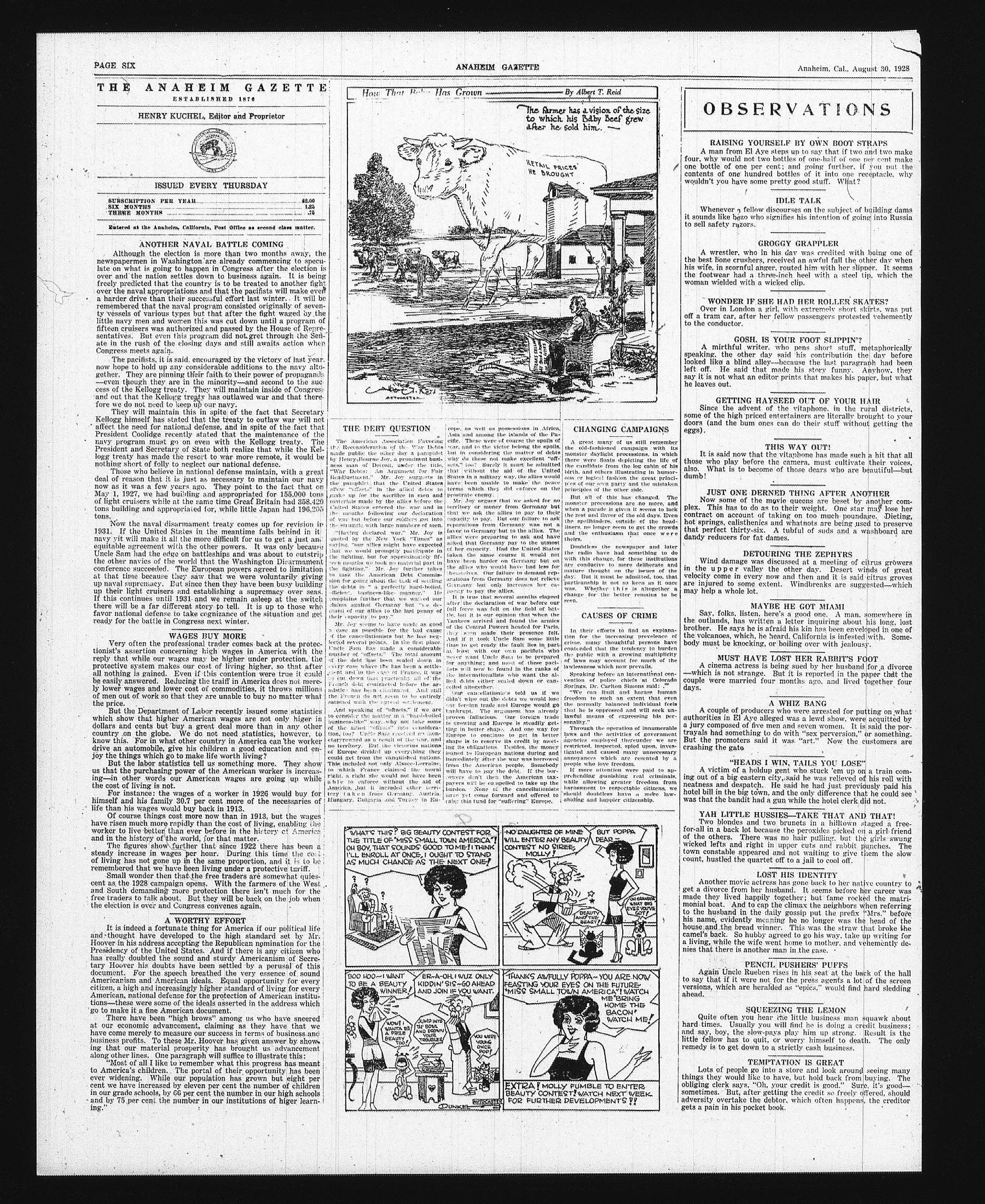
Searchable text
THE ANAHEIM GAZETTE
ESTABLISHED 1876
HENRY KUCHEL, Editor and Proprietor
ISSUED EVERY THURSDAY
SUBSCRIPTION PER YEAR $2.00
SIX MONTHS 1.25
THREE MONTHS .75
Entered at the Anaheim, California, Post Office as second class matter.
ANOTHER NAVAL BATTLE COMING
Although the election is more than two months away, the newspapermen in Washington are already commencing to speculate on what is going to happen in Congress after the election is over and the nation settles down to business again. It is being freely predicted that the country is to be treated to another fight over the naval appropriations and that the pacifists will make even a harder drive than their successful effort last winter. It will be remembered that the naval program consisted originally of seventy vessels of various types but that after the fight waged by the little navy men and women this was cut down until a program of fifteen cruisers was authorized and passed by the House of Representatives. But even this program did not gret through the Senate in the rush of the closing days and still awaits action when Congress meets again.
The pacifists, it is said, encouraged by the victory of last year, now hope to hold up any considerable additions to the navy altogether. They are pinning their faith to their power of propaganda—even though they are in the minority—and second to the success of the Kellogg treaty. They will maintain inside of Congress and out that the Kellogg treaty has outlawed war and that therefore we do not need to keep up our navy.
They will maintain this in spite of the fact that Secretary Kellogg himself has stated that the treaty to outlaw war will not affect the need for national defense, and in spite of the fact that President Coolidge recently stated that the maintenance of the navy program must go on even with the Kellogg treaty. The President and Secretary of State both realize that while the Kel
The pacifists, it is said, encouraged by the victory of last year, now hope to hold up any considerable additions to the navy altogether. They are pinning their faith to their power of propaganda—even though they are in the minority—and second to the success of the Kellogg treaty. They will maintain inside of Congress and out that the Kellogg treaty has outlawed war and that therefore we do not need to keep up our navy.
They will maintain this in spite of the fact that Secretary Kellogg himself has stated that the treaty to outlaw war will not affect the need for national defense, and in spite of the fact that President Coolidge recently stated that the maintenance of the navy program must go on even with the Kellogg treaty. The President and Secretary of State both realize that while the Kellogg treaty has made the resort to war more remote, it would be nothing short of folly to neglect our national defense.
Those who believe in national defense maintain, with a great deal of reason that it is just as necessary to maintain our navy now as it was a few years ago. They point to the fact that on May 1, 1927, we had building and appropriated for 155,000 tons of light cruisers while at the same time Great Britain had 358,420 tons building and appropriated for, while little Japan had 196,205 tons.
Now the naval disarmament treaty comes up for revision in 1931. If the United States in the meantime falls behind in its navy yet will make it all the more difficult for us to get a just and equitable agreement with the other powers. It was only because Uncle Sam had the edge on battleships and was about to outstrip the other navies of the world that the Washington Disarmament conference succeeded. The European powers agreed to limitation at that time because they saw that we were voluntarily giving up naval supremacy. But since then they have been busy building up their light cruisers and establishing a supremacy over seas. If this continues until 1931 and we remain asleep at the switch there will be a far different story to tell. It is up to those who favor national defense to take cognizance of the situation and get ready for the battle in Congress next winter.
WAGES BUY MORE
Very often the professional trader comes back at the protectionist's assertion concerning high wages in America with the reply that while our wages may be higher under protection, the protective system makes our cost of living higher, so that after all nothing is gained. Even if this contention were true it could be easily answered. Reducing the traffit in America does not merely lower wages and lower cost of commodities, it throws millions of men out of work so that they are unable to buy no matter what the price.
But the Department of Labor recently issued some statistics which show that higher American wages are not only higher in dollars and cents but buy a great deal more than in any other country on the globe. We do not need statistics, however, to know this. For in what other country in America can the worker drive an automobile, give his children a good education and enjoy the things which go to make life worth living?
But the labor statistics tell us something more. They show us that the purchasing power of the American worker is increasing—in other words our American wages are going up while the cost of living is not.
For instance: the wages of a worker in 1926 would buy for himself and his family 30.7 per cent more of the necessaries of life than his wages would buy back in 1913.
Of course things cost more now than in 1913, but the wages have risen much more rapidly than the cost of living, enabling the worker to live better than ever before in the history of America and in the history of the world, for that matter.
The figures show further that since 1922 there has been a
But the labor statistics tell us something more. They show us that the purchasing power of the American worker is increasing—in other words our American wages are going up while the cost of living is not.
For instance: the wages of a worker in 1926 would buy for himself and his family 30.7 per cent more of the necessaries of life than his wages would buy back in 1913.
Of course things cost more now than in 1913, but the wages have risen much more rapidly than the cost of living, enabling the worker to live better than ever before in the history of America and in the history of the world, for that matter.
The figures show further that since 1922 there has been a steady increase in wages per hour. During this time the cost of living has not gone up in the same proportion, and it is to be remembered that we have been living under a protective tariff.
Small wonder then that the free traders are somewhat quiescent as the 1928 campaign opens. With the farmers of the West and South demanding more protection there isn't much for the free traders to talk about. But they will be back on the job when the election is over and Congress convenes again.
A WORTHY EFFORT
It is indeed a fortunate thing for America if our political life and thought have developed to the high standard set by Mr. Hoover in his address accepting the Republican nomination for the Presidency of the United States. And if there is any citizen who has really doubted the sound and sturdy Americanism of Secretary Hoover his doubts have been settled by a perusal of this document. For the speech breathed the very essence of sound Americanism and American ideals. Equal opportunity for every citizen, a high and increasingly higher standard of living for every American, national defense for the protection of American institutions—these were some of the ideals asserted in the address which go to make it a fine American document.
There have been "high brows" among us who have sneered at our economic advancement, claiming as they have that we have come merely to measure our success in terms of business and business profits. To these Mr. Hoover has given answer by showing that our material prosperity has brought us advancement along other lines. One paragraph will suffice to illustrate this:
"Most of all I like to remember what this progress has meant to America's children. The portal of their opportunity has been ever widening. While our population has grown but eight per cent we have increased by eleven per cent the number of children in our grade schools, by 66 per cent the number in our high schools and by 75 per cent the number in our institutions of higher learning."
How That Baby Has Grown By Albert T. Reid
The farmer has a vision of the size to which his Baby Beef grew after he sold him.
RETAIL PRICES HE BROUGHT
THE DEBT QUESTION
The American Association Favoring the Reconsideration of the War Debts
CHANGING CAMPAIGNS
A great many of us still remember the old-fashioned campaign with its
THE DEBT QUESTION
The American Association Favoring the Reconsideration of the War Debts made public the other day a pamphlet by Henry Bourne Joy, a prominent business man of Detroit, under the title, "War Debts: An Argument for Fair Readjustment." Mr. Joy suggests in the pamphlet that the United States allow "offsets" in the allied debts to make up for the sacrifice in men and materials made by the allies before the United States entered the war and in the months following our declaration of war but before our soldiers got into the struggle with large numbers of men.
"Having declared war," Mr. Joy is quoted by the New York "Times" as saying, "our allies might have expected that we would promptly participate in the fighting, but for approximately fifteen months we took no material part in the fighting." Mr. Joy further takes to task the American Debt Commission for going about the task of settling the debts in "a perfectly hard-bolled, efficient, business-like manner." He complains further that we waved our claims against Germany but "we demand of our allies to the last penny of their capacity to pay."
Mr. Joy seems to have made as good a case as possible for the bad cause of the cancellationists but he has neglected several points. In the first place, Uncle Sam has made a considerable number of "offsets." The total amount of the debt has been sealed down in every case where the has been a settlement and in the case of France, it was so cut down that practically all of the French debt contracted before the armistice has been eliminated. And still the French do not seem to be entirely satisfied with the agreed settlement.
And speaking of "offsets," if we are to consider the matter in a "hard-bolled business-like" way, why not take some of the called "offsets" into consideration, too? Uncle Sam received no monetary reward as a result of the war, and no territory. But the victorius nations of Europe divided up everything they could get from the vanquished nations. This included not only Alsace-Lorraine, to which France claimed the moral right, a right she would not have been able to enforce without the aid of America, but it included other territories taken from Germany, Austria, Hungary, Bulgaria and Turkey in Europe, as well as possessions in Africa, Asia and among the islands of the Pacific.
These were of course the spoils of war, and to the victor belong the spoils, but in considering the matter of debts why do these not make excellent "offsets," too? Surely it must be admitted that without the aid of the United States in a military way, the allies would have been unable to make the peace terms which they did enforce on the prostrate enemy.
Mr. Joy argues that we asked for no territory or money from Germany but that we ask the allies to pay to their capacity to pay. But our failure to ask reparations from Germany was not a favor to Germany but to the allies. The allies were preparing to ask and have asked that Germany pay to the utmost of her capacity. Had the United States taken the same course it would not have been harder on Germany but on the allies who would have had less for themselves. Our failure to demand reparations from Germany does not relieve Germany but only increases her capacity to pay the allies.
It is true that several months elapsed after the declaration of war before our full force was felt on the field of battle, but it is our opinion that when the Yankees arrived and found the armies of the Central Powers headed for Paris, they soon made their presence felt. And if it took Uncle Sam some little time to get ready the fault lies in part at least with our own pacifists who never want Uncle Sata to be prepared for anything; and most of these pacifists will now be found in the ranks of the internationalists who want the allied debts either scaled down or canceled altogether.
Our cancellationists told us if we didn't wipe out the debts we would lose our foreign trade and Europe would go bankrupt. The argument has already proven fallacious. Our foreign trade is growing and Europe is steadily getting in better shape. And one way for Europe to continue to get in better shape is to reserve its credit by meeting its obligations. Besides, the money loaned to European nations during and immediately after the war was borrowed from the American people. Somebody will have to pay the debt. If the borrowers don't then the American taxpayers will be compelled to take up the burden. None of the cancellationists have yet come forward and offered to raise this fund for "suffering" Europe.
CHANGING CAMPAIGNS
A great many of us still remember the old-fashioned campaign with its monster daylight processions, in which there were floats depicting the life of the candidate from the log cabin of his birth, and others illustrating in humorous or logical fashion the great principles of our own party and the mistaken principles of the other side.
But all of this has changed. The monster processions are no more, and when a parade is given it seems to lack the zest and flavor of the old days. Even the spellbinders, outside of the headliners, no longer seem to get the crowds and the enthusiasm that once were theirs.
Doubtless newspaper and later radio have had something to do with this change, for these institutions are conducive to more deliberate and mature thought on the issues of the day. But it must be admitted, too, that partisanship is not so keen as it once was. Whether this is altogether a change for the better remains to be seen.
CAUSES OF CRIME
In their efforts to find an explanation for the increasing prevalence of crime, many thoughtful persons have contended that the tendency to burden the public with a growing multiplicity of laws may account for much of the lawlessness which now prevails.
Speaking before an international convention of police chiefs at Colorado Springs, Dr. Carlton Simons said:
"We can limit and harass human freedom to such an extent that even normally balanced individual feels that he is oppressed and will seek unlawful means of expressing his personality."
Through the operation of innumerable laws and the activities of government agencies employed thereunder we are restricted, inspected, spied upon, investigated and caused many unnecessary annoyances which are resented by a people who love freedom.
If more attention were paid to prehending punishing real criminals, while allowing greater freedom from harassment to respectable citizens, we should doubtless have a more law-abiding and happier citizenship.
WHAT'S THIS? BIG BEAUTY CONTEST FOR THE TITLE OF "MISS SMALL TOWN AMERICA" OH BOY, THAT SOUNDS GOOD TO ME! I THINK I'LL ENROLL AT ONCE, I OUGHT TO STAND AS MUCH CHANCE AS THE NEXT ONE!
NO DAUGHTER OF MINE WILL ENTER ANY BEAUTY CONTEST NO SIREE, MOLLY!
OH GRANDPA WHAT BIG EYES YOU VOICE GOT!
BEAUTY AND THE BEAST!
BOO HOO~I WANT TO BE A BEAUTY WINNER!
ER-A-OH, I WUZ ONLY KIDDIN' SIS~GO AHEAD AND JOIN IF YOU WANT.
WOW! I WAITA BE A PRIZE BEAUTY TOO!
JUMP INTO THE BOW AND DROWN YOUR TROUBLES!
YOU WERE YOUNG ONCE POP!
THANKS AVFULLY POPPA--YOU ARE NOW FEASTING YOUR EYES ON THE FUTURE "MISS SMALL TOWN AMERICA!" WATCH ME'BIRNG HOME THE BACON' WATCH ME!
EXTRA! MOLLY FUMBLE TO ENTER BEAUTY CONTEST! WATCH NEXT WEEK FOR FURTHER DEVELOPMENT'S!!
OBSERVATIONS
RAISING YOURSELF BY OWN BOOT STRAPS
A man from El Aye steps up to say that if two and two make four, why would not two bottles of one-half of one per cent make one bottle of one per cent; and going further, if you put the contents of one hundred bottles of it into one receptacle, why wouldn't you have some pretty good stuff. What?
IDLE TALK
Whenever a fellow discourses on the subject of building dams it sounds like bozo who signifies his intention of going into Russia to sell safety razors.
GROGGY GRAPPLER
A wrestler, who in his day was credited with being one of the best bone crushers, received an awful fall the other day when his wife, in scornful anger, routed him with her slipper. It seems the footwear had a three-inch heel with a steel tip, which the woman wielded with a wicked clip.
WONDER IF SHE HAD HER ROLLER SKATES?
Over in London a girl, with extremely short skirts, was put off a tram car, after her fellow passengers protested vehemently to the conductor.
GOSH. IS YOUR FOOT SLIPPIN'?
A mirthful writer, who pens short stuff, metaphorically speaking, the other day said his contribution the day before looked like a blind alley—because the last paragraph had been left off. He said that made his story funny. Anyhow, they say it is not what an editor prints that makes his paper, but what he leaves out.
GETTING HAYSEED OUT OF YOUR HAIR
Since the advent of the vitaphone, in the rural districts, some of the high-priced entertainers are literally brought to your doors (and the hum ones can do their stuff without getting the eggs).
GETTING HAYSEED OUT OF YOUR HAIR
Since the advent of the vitaphone, in the rural districts, some of the high-priced entertainers are literally brought to your doors (and the bum ones can do their stuff without getting the eggs).
THIS WAY OUT!
It is said now that the vitaphone has made such a hit that all those who play before the camera, must cultivate their voices, also. What is to become of those dears who are beautiful—but dumb!
JUST ONE DERNED THING AFTER ANOTHER
Now some of the movie queens are beset by another complex. This has to do as to their weight. One star may lose her contract on account of taking on too much poundage. Dieting, hot springs, calisthenics and whatnots are being used to preserve that perfect thirty-six. A tubful of suds and a washboard are dandy reducers for fat dames.
DETOURING THE ZEPHYRS
Wind damage was discussed at a meeting of citrus growers in the upper valley the other day. Desert winds of great velocity come in every now and then and it is said citrus groves are injured to some extent. Windbreaks are suggested—which may help a whole lot.
MAYBE HE GOT MIAMI
Say, folks, listen, here's a good one. A man, somewhere in the outlands, has written a letter inquiring about his long, lost brother. He says he is afraid his kin has been enveloped in one of the volcanoes, which he heard. California is infested with. Somebody must be knocking, or boiling over with jealousy.
MUST HAVE LOST HER RABBIT'S FOOT
A cinema actress is being sued by her husband for a divorce—which is not strange. But it is reported in the paper that the couple were married four months ago, and lived together four days.
A WHIZ BANG
A couple of producers who were arrested for putting on what authorities in El Aye alleged was a lewd show, were acquitted by a jury composed of five men and seven women. It is said the portrayals had something to do with "sex perversion," or something. But the promoters said it was "art." Now the customers are crashing the gate.
“HEADS I WIN, TAILS YOU LOSE”
A victim of a holdup gent who stuck 'em up on a train coming out of a big eastern city, said he was relieved of his roll with neatness and despatch. He said he had just previously paid his hotel bill in the big town, and the only difference that he could see was that the bandit had a gun while the hotel clerk did not.
YAH LITTLE HUSSIES—TAKE THAT AND THAT!
Two blondes and two brunets in a hilltown staged a free-for-all in a back lot because the peroxides picked on a girl friend of the others. There was no hair pulling, but the girls swung wicked lefts and right in upper cuts and rabbit punches. The
"HEADS I WIN, TAILS YOU LOSE"
A victim of a holdup gent who stuck 'em up on a train coming out of a big eastern city, said he was relieved of his roll with neatness and despatch. He said he had just previously paid his hotel bill in the big town, and the only difference that he could see was that the bandit had a gun while the hotel clerk did not.
YAH LITTLE HUSSIES—TAKE THAT AND THAT!
Two blondes and two brunets in a hilltown staged a free-for-all in a back lot because the peroxides picked on a girl friend of the others. There was no hair pulling, but the girls swung wicked lefts and right in upper cuts and rabbit punches. The town constable appeared and not waiting to give them the slow count, hustled the quartet off to a jail to cool off.
LOST HIS IDENTITY
Another movie actress has gone back to her native country to get a divorce from her husband. It seems before her career was made they lived happily together; but fame rocked the matrimonial boat. And to cap the climax the neighbors when referring to the husband in the daily gossip put the prefix "Mrs." before his name, evidently meaning he no longer was the head of the house and the bread winner. This was the straw that broke the camel's back. So hubby agreed to go his way, take up writing for a living, while the wife went home to mother, and vehemently denies that there is another man in the case.
PENCIL PUSHERS' PUFFS
Again Uncle Rueben rises in his seat at the back of the hall to say that if it were not for the press agents a lot of the screen versions, which are heralded as "epics," would find hard sledding ahead.
SQUEEZING THE LEMON
Quite often you hear the little business man squawk about hard times. Usually you will find he is doing a credit business; and say, boy, the slow-pays play him up strong. Result is the little fellow has to quit, or worry himself to death. The only remedy is to get down to a strictly cash business.
TEMPTATION IS GREAT
Lots of people go into a store and look around seeing many things they would like to have, but hold back from buying. The obliging clerk says, "Oh, your credit is good." Sure, it's good—sometimes. But, after getting the credit so freely offered, should adversity overtake the debtor, which often happens, the creditor gets a pain in his pocket book.