anaheim-gazette 1928-07-12
Scanned page
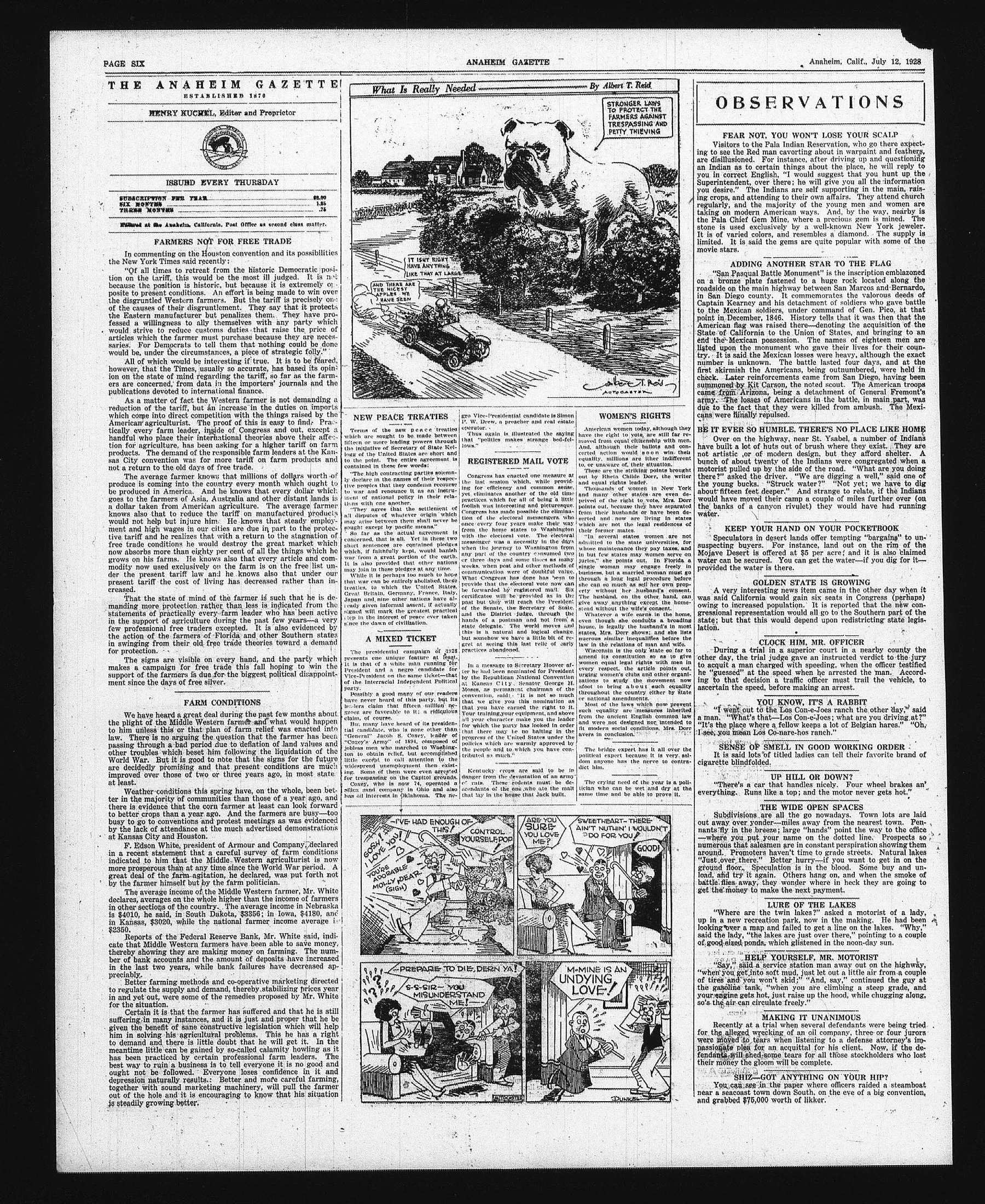
Searchable text
THE ANAHEIM GAZETTE
ESTABLISHED 1870
HENRY HUCHEL, Editor and Proprietor
ISSUED EVERY THURSDAY
SUBSCRIPTION FOR YEAR $2.00
SIX MONTHS 1.95
THREE MONTHS .75
Farmers Not For Free Trade
In commenting on the Houston convention and its possibilities the New York Times said recently:
"Of all times to retreat from the historic Democratic position on the tariff, this would be the most ill judged. It is not because the position is historic, but because it is extremely opposite to present conditions. An effort is being made to win over the disgruntled Western farmers. But the tariff is precisely one of the causes of their disgruntlement. They say that it protects the Eastern manufacturer but penalizes them. They have professed a willingness to ally themselves with any party which would strive to reduce customs duties that raise the price of articles which the farmer must purchase because they are necessaries. For Democrats to tell them that nothing could be done would be, under the circumstances, a piece of strategic folly."
All of which would be interesting if true. It is to be feared, however, that the Times, usually so accurate, has based its opinion on the state of mind regarding the tariff, so far as the farmers are concerned; from data in the importers' journals and the publications devoted to international finance.
As a matter of fact the Western farmer is not demanding a reduction of the tariff, but an increase in the duties on imports which come into direct competition with the things raised by the American agriculturist. The proof of this is easy to find: Practically every farm leader, inside of Congress and out, except a handful who place their international theories above their affection for agriculture, has been asking for a higher tariff on farm
All of which would be interesting if true. It is to be feared, however, that the Times, usually so accurate, has based its opinion on the state of mind regarding the tariff, so far as the farmers are concerned; from data in the importers' journals and the publications devoted to international finance.
As a matter of fact the Western farmer is not demanding a reduction of the tariff, but an increase in the duties on imports which come into direct competition with the things raised by the American agriculturist. The proof of this is easy to find. Practically every farm leader, inside of Congress and out, except a handful who place their international theories above their affection for agriculture, has been asking for a higher tariff on farm products. The demand of the responsible farm leaders at the Kansas City convention was for more tariff on farm products and not a return to the old days of free trade.
The average farmer knows that millions of dollars worth of produce is coming into the country every month which ought to be produced in America. And he knows that every dollar which goes to the farmers of Asia, Australia and other distant lands is a dollar taken from American agriculture. The average farmer knows also that to reduce the tariff on manufactured products would not help but injure him. He knows that steady employment and high wages in our cities are due in part to the protective tariff and he realizes that with a return to the stagnation of free trade conditions he would destroy the great market which now absorbs more than eighty per cent of all the things which he grows on his farms. He knows also that every article and commodity now used exclusively on the farm is on the free list under the present tariff law and he knows also that under our present tariff the cost of living has decreased rather than increased.
That the state of mind of the farmer is such that he is demanding more protection rather than less is indicated from the statements of practically every farm leader who has been active in the support of agriculture during the past few years—a very few professional free traders excepted. It is also evidenced by the action of the farmers of Florida and other Southern states in swinging from their old free trade theories toward a demand for protection.
The signs are visible on every hand, and the party which makes a campaign for free trade this fall hoping to win the support of the farmers is due for the biggest political disappointment since the days of free silver.
FARM CONDITIONS
We have heard a great deal during the past few months about the plight of the Middle Western farmer and what would happen to him unless this or that plan of farm relief was enacted into law. There is no arguing the question that the farmer has been passing through a bad period due to deflation of land values and other troubles which beset him following the liquidation of the World War. But it is good to note that the signs for the future are decidedly promising and that present conditions are much improved over those of two or three years ago, in most state-at least.
Weather conditions this spring have, on the whole, been better in the majority of communities than those of a year ago, and there is evidence that the corn farmer at least can look forward to better crops than a year ago. And the farmers are busy—too busy to go to conventions and protest meetings as was evidenced by the lack of attendance at the much advertised demonstrations at Kansas City and Houston.
F. Edson White, president of Armour and Company, declared
World War. But it is good to note that the signs for the future are decidedly promising and that present conditions are much improved over those of two or three years ago, in most states at least.
Weather conditions this spring have, on the whole, been better in the majority of communities than those of a year ago, and there is evidence that the corn farmer at least can look forward to better crops than a year ago. And the farmers are busy—too busy to go to conventions and protest meetings as was evidenced by the lack of attendance at the much advertised demonstrations at Kansas City and Houston.
F. Edson White, president of Armour and Company, declared in a recent statement that a careful survey of farm conditions indicated to him that the Middle Western agriculturist is now more prosperous than at any time since the World War period. A great deal of the farm agitation, he declared, was put forth not by the farmer himself but by the farm politician.
The average income of the Middle Western farmer, Mr. White declares, averages on the whole higher than the income of farmers in other sections of the country. The average income in Nebraska is $4010, he said, in South Dakota, $3356; in Iowa, $4180, and in Kansas, $3020, while the national farmer income average is $2350.
Reports of the Federal Reserve Bank, Mr. White said, indicate that Middle Western farmers have been able to save money, thereby showing they are making money on farming. The number of bank accounts and the amount of deposits have increased in the last two years, while bank failures have decreased appreciably.
Better farming methods and co-operative marketing directed to regulate the supply and demand, thereby stabilizing prices year in and yet out, were some of the remedies proposed by Mr. White for the situation.
Certain it is that the farmer has suffered and that he is still suffering in many instances, and it is just and proper that he be given the benefit of sane constructive legislation which will help him in solving his agricultural problems. This he has a right to demand and there is little doubt that he will get it. In the meantime little can be gained by so-called calamity howling as it has been practiced by certain professional farm leaders. The best way to ruin a business is to tell everyone it is no good and ought not be followed. Everyone loses confidence in it and depression naturally results.: Better and more careful farming, together with sound marketing machinery, will pull the farmer out of the hole and it is encouraging to know that his situation is steadily growing better.
What Is Really Needed — By Albert T. Reid
STRONGER LAWS TO PROTECT THE FARMERS AGAINST TRESPASSING AND PETTY THIEVING
IT IS NOT RIGHT TO HAVE ANYTHING LIKE THAT AT LARGE
AND THERE ARE THE NICEST APPLES WE HAVE SEEN
NEW PEACE TREATIES
Terms of the new peace treaties which are sought to be made between fifteen or more leading powers through the initiative of Secretary of State Kelso.
gro Vice-Presidential candidate is Simon P. W. Drew, a preacher and real estate operator.
Thus again is illustrated the saying that "politics makes strange bed-fellows."
WOMEN'S RIGHTS
American women today, although they have the right to vote, are still far removed from equal citizenship with men. And, although their ballots and con-
NEW PEACE TREATIES
Terms of the new peace treaties which are sought to be made between fifteen or more leading powers through the initiative of Secretary of State Kellogg of the United States are short and to the point. The entire agreement is contained in these few words:
"The high contracting parties solemnly declare in the names of their respective peoples that they condemn recourse to war and renounce it as an instrument of national policy in their relations with one another.
They agree that the settlement of all disputes of whatever origin which may arise between them shall never be sought except by pacific means."
So far as the actual agreement is concerned, that is all. Yet in these two short sentences are contained pledges which, if faithfully kept, would banish war from a great portion of the earth. It is also provided that other nations may join in these pledges at any time.
While it is perhaps too much to hope that war can be entirely abolished, these treaties, to which the United States, Great Britain, Germany, France, Italy, Japan and nine other nations have already given informal assent, if actually signed will mark the greatest practical step in the interest of peace ever taken since the dawn of civilization.
A MIXED TICKET
The presidential campaign of 1928 presents one unique feature at least: it is that of a white man running for President and a negro candidate for Vice-President on the same ticket—that of the Interracial Independent Political party.
Possibly a good many of our readers have never heard of this party, but its leaders claim that fifteen million Negroes are favorable to it; a ridiculous claim, of course.
But many have heard of its presidential candidate, who is none other than "General" Jacob S. Coxey, leader of "Coxey's Army" of 1894, composed of jobless men who marched to Washington to obtain relief, but accomplished little except to call attention to the widespread unemployment then existing. Some of them were even arrested for trespassing on the Capitol grounds.
Coxey, who is now 74, operated a silica sand company in Ohio and also has all interests in Oklahoma. The necropsy Vice-Presidential candidate is Simon P. W. Drew, a preacher and real estate operator.
Thus again is illustrated the saying that "politics makes strange bed-felows."
REGISTERED MAIL VOTE
Congress has enacted one measure at the last session which, while providing for efficiency and common sense, yet eliminates another of the old time practices which for all of being a little foolish was interesting and picturesque. Congress has made possible the elimination of the electoral messengers, who once every four years make their way from the home states to Washington with the electoral vote. The electoral messenger was a necessity in the days when the journey to Washington from any part of the country consumed two or three days and some times as many weeks, when post and other methods of communication were of doubtful value. What Congress has done has been provided that the electoral vote now can be forwarded by registered mail. Six certificates will be provided as in the past but they will reach the President of the Senate, the Secretary of State, and the District judge, through the hands of a postman and not from a state delegate. The world moves and this is a natural and logical change, but somehow we have a little bit of regret at seeing this last relic of early practices abandoned.
In a message to Secretary Hoover after he had been nominated for President by the Republican National Convention at Kansas City, Senator George H. Moses, as permanent chairman of the convention, said: "It is not so much that we give you this nomination as that you have earned the right to it. Your training, your equipment, and above all your character make you the leader for which the party has looked in order that there may be no halting in the progress of the United States under the policies which are warmly approved by the people and to which you have contributed so much."
Kentucky crops are said to be in danger from the devastation of an army of rats. These rodents must be descendants of the one who ate the malt that lay in the house that Jack built.
WOMEN'S RIGHTS
American women today, although they have the right to vote, are still far removed from equal citizenship with men. And, although their ballots and concerted action would soon win their equality, millions are either indifferent to, or unaware of, their situation.
These are the striking points brought out by Rhea Childe Dorr, the writer and equal rights leader.
Thousands of women in New York and many other states are even deprived of the right to vote. Mrs. Dorr points out, because they have separated from their husbands or have been deserted and now are living in states which are not the legal residences of their former mates.
"In several states women are not admitted to the state universities, for whose maintenance they pay taxes, and in but few states may women serve on juries," she points out. In Florida a single woman may engage freely in business, but a married woman must go through a long legal procedure before she can so much as sell her own property without her husband's consent. The husband, on the other hand, can give away anything except the home-stead without the wife's consent.
Whatever a wife earns in the home, even though she conducts a broading house, is legally the husband's in most states, Mrs. Dorr shows; and she lists numerous similar inequalities before the law in the relations of man and wife.
Wisconsin is the only state so far to amend its constitution so as to give women equal legal rights with men in every respect, the article points out, urging women's clubs and other organizations to study the movement now afloat to bring about such equality throughout the country either by state or national amendments.
Most of the laws which now prevent such equality are measures inherited from the ancient English common law and were not designed nor intended to fit modern social conditions. Mrs. Dorr avers in conclusion.
The bridge expert has it all over the political expert because it is very seldom anyone has the nerve to contradict him.
The crying need of the year is a politician who can be wet and dry at the same time and be able to prove it.
for the future
ions are much
n most state
hole, been betyear ago, and
look forward
are busy—too
was evidenced
demonstrations
company, declared
rm conditions
turist is now
War period. A
put forth not
ner, Mr. White
me of farmers
in Nebraska
va, $4180, and
one average i
white said, indino save money,
g. The numave increased
decreased ap-
eting directed
ng prices year
by Mr. White
that he is still
per that he be
which will help
he has a right
get it. In the
howling as it
leaders. The
is no good and
pace in it and
fearful farming,
full the farmer
his situation
Kentucky crops are said to be in danger from the devastation of an army of rats. These rodents must be descendants of the one who ate the malt that lay in the house that Jack built.
I'VE HAD ENOUGH OF THIS!
CONTROL YOURSELF,POP!
GOSH! I LOVE YOU!
YOU'RE ADDRABLE MOLLY DEAR (SIGH)
ARE YOU SURE YOU LOVE ME?
SWEETHEART--THERE AIN'T NUTMIN' I WOULDN'T DO FOR YOU!
GOOD!
PREPARE TO DIE, DERN YA!
S-S-GIR-- YOU MISUNDERSTAND ME!
M-MINE IS AN UNDYING LOVE!
OBSERVATIONS
FEAR NOT, YOU WON'T LOSE YOUR SCALP
Visitors to the Pala Indian Reservation, who go there expecting to see the Red man cavorting about in warpaint and feathers, are disillusioned. For instance, after driving up and questioning an Indian as to certain things about the place, he will reply to you in correct English, "I would suggest that you hunt up the Superintendent, over there; he will give you all the information you desire." The Indians are self supporting in the main, raising crops, and attending to their own affairs. They attend church regularly, and the majority of the young men and women are taking on modern American ways. And, by the way, nearby is the Pala Chief Gem Mine, where a precious gem is mined. The stone is used exclusively by a well-known New York jeweler. It is of varied colors, and resembles a diamond. The supply is limited. It is said the gems are quite popular with some of the movie stars.
ADDING ANOTHER STAR TO THE FLAG
"San Pasqual Battle Monument" is the inscription emblazoned on a bronze plate fastened to a huge rock located along the roadside on the main highway between San Marcos and Bernardo, in San Diego county. It commemorates the valorous deeds of Captain Kearney and his detachment of soldiers who gave battle to the Mexican soldiers, under command of Gen. Pico, at that point in December, 1846. History tells that it was then that the American flag was raised there—denoting the acquisition of the State of California to the Union of States, and bringing to an end the Mexican possession. The names of eighteen men are listed upon the monument who gave their lives for their country. It is said the Mexican losses were heavy, although the exact number is unknown. The battle lasted four days, and at the first skirmish the Americans, being outnumbered, were held in check. Later reinforcements came from San Diego, having been summoned by Kit Carson, the noted scout. The American troops came from Arizona, being a detachment of General Fremont's army. The losses of Americans in the battle, in main part, was due to the fact that they were killed from ambush. The Mexicans were finally repulsed.
BE IT EVER SO HUMBLE, THERE'S NO PLACE LIKE HOME
Over on the highway, near St. Ysabel, a number of Indians have built a lot of huts out of brush where they exist. They are
BE IT EVER SO HUMBLE, THERE'S NO PLACE LIKE HOME
Over on the highway, near St. Ysabel, a number of Indians have built a lot of huts out of brush where they exist. They are not artistic or of modern design, but they afford shelter. A bunch of about twenty of the Indians were congregated when a motorist pulled up by the side of the road. "What are you doing there?" asked the driver. "We are digging a well," said one of the young bucks. "Struck water?" "Not yet; we have to dig about fifteen feet deeper." And strange to relate, if the Indians would have moved their camp a couple of miles further over (on the banks of a canyon rivulet) they would have had running water.
KEEP YOUR HAND ON YOUR POCKETBOOK
Speculators in desert lands offer tempting "bargains" to unsuspecting buyers. For instance, land out on the rim of the Mojave Desert is offered at $5 per acre; and it is also claimed water can be secured. You can get the water—if you dig for it—provided the water is there.
GOLDEN STATE IS GROWING
A very interesting news item came in the other day when it was said California would gain six seats in Congress (perhaps owing to increased population). It is reported that the new congressional representation would all go to the Southern part of the state; but that this would depend upon redistricting state legislation.
CLOCK HIM, MR. OFFICER
During a trial in a superior court in a nearby county the other day, the trial judge gave an instructed verdict to the jury to acquit a man charged with speeding, when the officer testified he "guessed" at the speed when he arrested the man. According to that decision a traffic officer must trail the vehicle, to ascertain the speed, before making an arrest.
YOU KNOW, IT'S A RABBIT
"I went out to the Los Con-e-Joes ranch the other day," said a man. "What's that—Los Con-e-Joes; what are you driving at?" "It's the place where a fellow keeps a lot of Belgian hares." "Oh, I see, you mean Los Co-nare-hos ranch."
SENSE OF SMELL IN GOOD WORKING ORDER
It is said lots of titled ladies can tell their favorite brand of cigarette blindfolded.
UP HILL OR DOWN?
"There's a car that handles nicely. Four wheel brakes an' everything. Runs like a top; and the motor never gets hot."
THE WIDE OPEN SPACES
Subdivisions are all the go nowadays. Town lots are laid out away over yonder—miles away from the nearest town. Pennants fly in the breeze; large "hands" point the way to the office—where you put your name on the dotted line. Prospects so numerous that salesmen are in constant perspiration showing them
UP HILL OR DOWN?
"There's a car that handles nicely. Four wheel brakes an' everything. Runs like a top; and the motor never gets hot."
THE WIDE OPEN SPACES
Subdivisions are all the go nowadays. Town lots are laid out away over yonder—miles away from the nearest town. Pennants fly in the breeze; large "hands" point the way to the office—where you put your name on the dotted line. Prospects so numerous that salesmen are in constant perspiration showing them around. Promoters haven't time to grade streets. Natural lakes "Just over there." Better hurry—if you want to get in on the ground floor. Speculation is in the blood. Some buy and unload, and try it again. Others hang on, and when the smoke of battle flies away, they wonder where in heck they are going to get the money to make the next payment.
LURE OF THE LAKES
"Where are the twin lakes?" asked a motorist of a lady, up in a new recreation park, now in the making. He had been looking over a map and failed to get a line on the lakes. "Why," said the lady, "the lakes are just over there," pointing to a couple of good sized ponds, which glistened in the noon-day sun.
HELP YOURSELF, MR. MOTORIST
"Say," said a service station man away out on the highway, "when you get into soft mud, just let out a little air from a couple of tires and you won't skid;" "And, say," continued the guy at the gasoline tank, "when you are climbing a steep grade, and your engine gets hot, just raise up the hood, while chugging along, so's the air can circulate freely."
MAKING IT UNANIMOUS
Recently at a trial when several defendants were being tried for the alleged wrecking of an oil company, three or four jurors were moved to tears when listening to a defense attorney's impassionate plea for an acquittal for his client. Now, if the defendants will shed some tears for all those stockholders who lost their money the gloom will be complete.
SHIZ—GOT ANYTHING ON YOUR HIP?
You can see in the paper where officers raided a steamboat near a seacoast town down South, on the eve of a big convention, and grabbed $75,000 worth of likker.