anaheim-gazette 1928-06-28
Scanned page
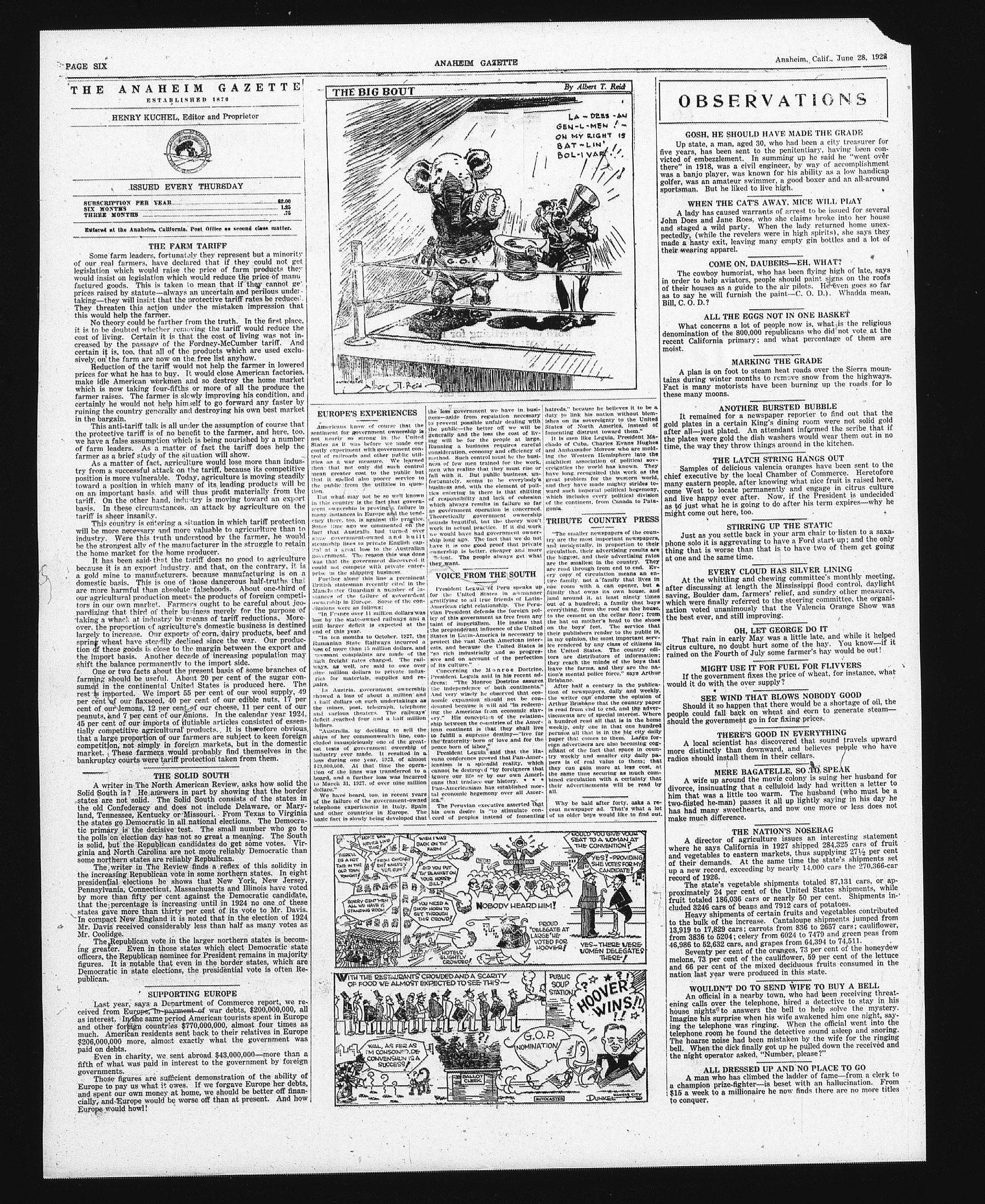
Searchable text
THE ANAHEIM GAZETTE
ESTABLISHED 1870
HENRY KUCHEL, Editor and Proprietor
ISSUED EVERY THURSDAY
SUBSCRIPT PER YEAR.....$2.00
SIX MONTHS.....1.25
THREE MONTHS......75
Entered at the Anaheim, California. Post Office as second class matter.
THE FARM TARIFF
Some farm leaders, fortunately they represent but a minority of our real farmers, have declared that if they could not get legislation which would raise the price of farm products they would insist on legislation which would reduce the price of manu factured goods. This is taken to mean that if they cannot get prices raised by statute—always an uncertain and perilous undertaking—they will insist that the protective tariff rates be reduced. They threaten this action under the mistaken impression that this would help the farmer.
No theory could be farther from the truth. In the first place, it is to be doubted whether removing the tariff would reduce the cost of living. Certain it is that the cost of living was not increased by the passage of the Fordney-McCumber tariff. And certain it is, too, that all of the products which are used exclusively on the farm are now on the free list anyhow.
Reduction of the tariff would not help the farmer in lowered prices for what he has to buy. It would close American factories, make idle American workmen and so destroy the home market which is now taking four-fifths or more of all the produce the farmer raises. The farmer is slowly improving his condition, and certainly he would not help himself to go forward any faster by ruining the country generally and destroying his own best market in the bargain.
This anti-tariff talk is all under the assumption of course that the protective tariff is of no benefit to the farmer, and here, too, we have a false assumption which is being nourished by a number of farm leaders. As a matter of fact the tariff does help the
Reduction of the tariff would not help the farmer in lowered prices for what he has to buy. It would close American factories, make idle American workmen and so destroy the home market which is now taking four-fifths or more of all the produce the farmer raises. The farmer is slowly improving his condition, and certainly he would not help himself to go forward any faster by ruining the country generally and destroying his own best market in the bargain.
This anti-tariff talk is all under the assumption of course that the protective tariff is of no benefit to the farmer, and here, too, we have a false assumption which is being nourished by a number of farm leaders. As a matter of fact the tariff does help the farmer as a brief study of the situation will show.
As a matter of fact, agriculture would lose more than industry from a successful attack on the tariff, because its competitive position is more vulnerable. Today, agriculture is moving steadily toward a position in which many of its leading products will be on an important basis, and will thus profit materially from the tariff. On the other hand, industry is moving toward an export basis. In these circumstances, an attack by agriculture on the tariff is sheer insanity.
This country is entering a situation in which tariff protection will be more necessary and more valuable to agriculturism than to industry. Were this truth understood by the farmer, he would be the strongest ally of the manufacturer in the struggle to retain the home market for the home producer.
It has been said that the tariff does no good to agriculture because it is an export industry, and that, on the contrary, it is a gold mine to manufacturers, because manufacturing is on a domestic basis. This is one of those dangerous half-truths that are more harmful than absolute falsehoods. About one-third of our agricultural production meets the products of foreign competitors in our own market. Farmers ought to be careful about jeopardizing that third of their business merely for the purpose of taking a whack at industry by means of tariff reductions. Moreover, the proportion of agriculture's domestic business is destined largely to increase. Our exports of corn, dairy products, beef and spring wheat have steadily declined since the war. Our production of these goods is close to the margin between the export and the import basis. Another decade of increasing population may shift the balance permanently to the import side.
One or two facts about the present basis of some branches of farming should be useful. About 20 per cent of the sugar consumed in the continental United States is produced here. The rest is imported. We import 55 per cent of our wool supply, 49 per cent of our flaxseed, 40 per cent of our edible nuts, 17 per cent of our lemons, 12 per cent of our cheese, 11 per cent of our peanuts, and 7 per cent of our onions. In the calendar year 1924, 45 per cent of our imports of dutiable articles consisted of essentially competitive agricultural products. It is therefore obvious that a large proportion of our farmers are subject to keen foreign competition, not simply in foreign markets, but in the domestic market. These farmers would probably find themselves in the bankruptcy courts were tariff protection taken from them.
THE SOLID SOUTH
A writer in The North American Review, asks how solid the Solid South is? He answers in part by showing that the border states are not solid. The Solid South consists of the states in the old Confederacy and does not include Delaware, or Maryland, Tennessee, Kentucky or Missouri. From Texas to Virginia the states go Democratic in all national elections. The Democratic primary is the decisive test. The small number who go to the polls on election day has not so great a meaning. The South is solid, but the Republican candidates do get some votes. Virginia knows not nearly so strong States as it was b costly experiment w trol of railroads and ites as a war mea then that not only mean greater cost that it spelled also the public from thie tion.
But what may not in this country is thentent ownership is m many instances in E ney there, too, is Some time ago we fact that Australia some government-o steamship lines to p lital at a great loss government. The re was that the gover r could not compete prise in the shipping Further along th e British statesman r Manchester Guardi stances of the fail ownership in Europe clusions were as follo "In France over I lost by the state-over still larger deficits end of this year." "In ten months th Rumanian State F loss of more than i necessant complaining high freight rates ways, as well, are nine million dollars for materials pairs.
In Austria, gov hows a loss of n half dollars on s the mines, post, post and various theatre deficit reached four dollars.
"Australia, by o ships of her comm eluded inapplicpious est tests of govern industry ever mad loss during one yr $49,000,000. At th e tion of the lines w board, and a further to March 31, 1927., dollars."
We have heard, of the failure of th e telephone experime n and other countrie basic fact is slowly
THE SOLID SOUTH
A writer in The North American Review, asks how solid the Solid South is? He answers in part by showing that the border states are not solid. The Solid South consists of the states in the old Confederacy and does not include Delaware, or Maryland, Tennessee, Kentucky or Missouri. From Texas to Virginia the states go Democratic in all national elections. The Democratic primary is the decisive test. The small number who go to the polls on election day has not so great a meaning. The South is solid, but the Republican candidates do get some votes. Virginia and North Carolina are not more reliably Democratic than some northern states are reliably Republican.
The writer in The Review finds a reflex of this solidity in the increasing Republican vote in some northern states. In eight presidential elections he shows that New York, New Jersey, Pennsylvania, Connecticut, Massachusetts and Illinois have voted by more than fifty per cent against the Democratic candidate, that the percentage is increasing until in 1924 no one of these states gave more than thirty per cent of its vote to Mr. Davis. In compact New England it is noted that in the election of 1924 Mr. Davis received considerably less than half as many votes as Mr. Coolidge.
The Republican vote in the larger northern states is becoming greater. Even in those states which elect Democratic state officers, the Republican nominee for President remains in majority figures. It is notable that even in the border states, which are Democratic in state elections, the presidential vote is often Republican.
SUPPORTING EUROPE
Last year, says a Department of Commerce report, we received from Europe, in payment of war debts, $200,000,000, all as interest. In the same period American tourists spent in Europe and other foreign countries $770,000,000, almost four times as much. American residents sent back to their relatives in Europe $206,000,000 more, almost exactly what the government was paid on debts.
Even in charity, we sent abroad $43,000,000—more than a fifth of what was paid in interest to the government by foreign governments.
Those figures are sufficient demonstration of the ability of Europe to pay us what it owes. If we forgave Europe her debts, and spent our own money at home, we should be better off financially, and Europe would be worse off than at present. And how Europe would howl!
THE BIG BOUT
By Albert T. Reid
LA - DEBS - AN
GEN-L-MEN!
ON MY RIGHT IS
BAT-LIN'
BOL-I-VAR!
EUROPE'S EXPERIENCES
Americans know of course that the sentiment for government ownership is not nearly so strong in the United States as it was before we made our government with government control.
the less government we have in business—aside from regulation necessary to prevent possible unfair dealing with the public—the better off we will be generally and the less the cost of living will be for the people at large. Running a business requires careful hatreds," because he believes it to be a duty to link his nation without blemishes on its sovereignty to the United States of North America, instead of fomenting distrust toward them."
It is men like Leguia, President Machado of Cuba, Charles Evans Hughes and Andrew Morrow who are mold-
EUROPE'S EXPERIENCES
Americans know of course that the sentiment for government ownership is not nearly so strong in the United States as it was before we made our costly experiment with government control of railroads and other public utilities as a war measure. We learned then that not only did such control mean greater cost to the public but that it spelled also poorer service to the public from the utilities in question.
But what may not be so well known in this country is the fact that government ownership is proving a failure in many instances in Europe and the tendency there, too, is against the practice. Some time ago we commented on the fact that Australia had turned over some government-owned and built steamship lines to private English capital at a great loss to the Australian government. The reason this was done was that the government discovered it could not compete with private enterprise in the shipping business.
Further along this line a prominent British statesman recently cited in the Manchester Guardian a number of instances of the failure of government ownership in Europe. Some of the conclusions were as follows:
"In France over 11 million dollars was lost by the state-owned railways and a still larger deficit is expected at the end of this year."
"In ten months to October, 1927, the Romanian State Railways incurred a loss of more than 15 million dollars, and necessary complaints are made of the high freight rates charged. The railways, as well, are said to owe nine million dollars to private industries for materials, supplies and repairs.
In Austria, government ownership showed a loss of about a million and a half dollars on such undertakings as the mines, post, telegraph, telephone and various theaters. The railways' deficit reached four and a half million dollars.
"Australia, by deciding to sell the ships of her commonwealth line, concluded inauspiciously one of the greatest tests of government ownership of industry ever made. It resulted in a loss during one year, 1923, of almost $40,000,000. At that time the operation of the lines was transferred to a board, and a further loss was incurred to March 31, 1927, of over nine million dollars."
We have heard, too, in recent years of the failure of the government-owned telephone experiments in Italy, Spain and other countries in Europe. The basic fact is slowly being developed that the less government we have in business—aside from regulation necessary to prevent possible unfair dealing with the public—the better off we will be generally and the less the cost of living will be for the people at large. Running a business requires careful consideration, economy and efficiency of method. Such control must be the business of few men trained for the work, men who realize that they must rise or fall with it. But public business, unfortunately, seems to be everybody's business and, with the element of politics entering in there is that shifting of responsibility and lack of cohesion which always results in failure so far as government operation is concerned.
Theoretically government ownership sounds beautiful, but the theory won't work in actual practice. If it did work we would have had government ownership long ago. The fact that we do not have it is one good proof that private ownership is better, cheaper and more efficient. The people always get what they want.
VOICE FROM THE SOUTH
President Leguia of Peru speaks up for the United States in a manner gratifying to all true friends of Latin American right relationship. The Peruvian President defends the foreign policy of this government as free from any taint of imperialism. He insists that the preponderant influence of the United States in Latin America is necessary to protect the vast North American interests, and because the United States is "so rich industrially and so progressive and on account of the perfection of its culture."
Concerning the Monroe Doctrine, President Leguia said in his recent address: "The Monroe Doctrine assures the independence of both continents." And very wisely he observed that economic expansion should not be condemned because it will aid "in redeeming the Americas from economic slavery." His conception of the relationship between the countries of the American continent is that they shall live to fulfill a supreme destiny—"live for the fraternity born of love and for the peace born of labor."
President Leguia said that the Havana conference proved that Pan-Americanism is a splendid reality, which cannot be destroyed by foreigners that ignore our life or by our own Americans that traduce our history.
Pan-Americanism has established mortal economic hegemony over all America."
The Peruvian executive asserted that his own desire is "to stimulate concord of peoples instead of fomenting hatreds," because he believes it to be a duty to link his nation without blemishes on its sovereignty to the United States of North America, instead of fostering distrust toward them.
It is men like Leguia, President Machado of Cuba, Charles Evans Hughes and Ambassador Morrow who are molding the Western Hemisphere into the mightiest association of political sovereignies the world has known. They have long recognized this work as the great problem for the western world, and they have made mighty strides toward such imperial political hegemony, which includes every political division of the continent, from Canada to Patagonia.
TRIBUTE COUNTRY PRESS
"The smaller newspapers of the country are the most important newspapers, and incidentally, in proportion to their circulation, their advertising results are the biggest, and their advertising rates are the smallest in the country. They are read through from end to end. Every copy of circulation means an entire family, not a family that lives in one room with a can opener, but a family that owns its own house, and land around it, at least ninety times out of a hundred; a family that buys everything, from the roof on the house, to the cement on the cellar floor; from the hat on mother's head to the shoes on the boys' feet. The service that their publishers render to the public is in my opinion, the most important service rendered by any class of citizens in the United States. The country editors are distributors of information; they reach the minds of the boys that leave the farms, and they are the nation's mental police force," says Arthur Brisbane.
After half a century in the publication of newspapers, daily and weekly, the writer can endorse the opinion of Arthur Brisbane that the country paper is read from end to end, and the advertisements are of special interest. Where a hundred read all that is in the home weekly, only one in that one hundred peruses all that is in the big city daily paper that comes to them. Large foreign advertisers are also becoming cognizant of the fact that space in country weekly and smaller city daily papers is of real value to them; that they can gain more at less cost, at the same time securing as much combined circulation with a certainty that their advertisements will be read by all.
Why be bald after forty, asks a recent newspaper ad. That's what a lot of us older boys would like to find out.
We have heard, too, in recent years of the failure of the government-owned telephone experiments in Italy, Spain and other countries in Europe. The basic fact is slowly being developed that vana conference proved that Pan-Americanism is a splendid reality, which cannot be destroyed "by foreigners that ignore our life or by our own Americans that traduce our history." Pan-Americanism has established mortal economic hegemony over all America."
The Peruvian executive asserted that his own desire is "to stimulate concord of peoples instead of fomenting
WISH I WAS BACK ON TH' FARM!
THERELL BE A HOT TIME IN THE OLD TOWN TOONIGHT!
FROM CHICAGO EN? WHERE'S VER GUN?
SORRY GENTLEMEN ALL WE HAVE IS STANDING ROOM!
YOU NEED A SHOP HORN TO GET THROUGH THIS CROWD!
HOTELS SLIGHTLY CROWDED!
PROUD "DELEGATE AT LARGE" HE VOTED FOR HOOVER!
YES--THERE WERE WOMEN DELEGATES THERE!
WITH THE RESTAURANTS CROWDED AND A SCARITY OF FOOD WE ALMOST EXPECTED TO SEE THIS~
PUBLIC SOUP STATION!
HOOVER WINS!!
WAL, AS FER AS I'M CONSOLED, DE CONVENSIUN IS A SUCCESS!
DALLOT CLURK
AUTOCASTER
DUNKEE MANHATTAN CITY
GOSH, HE SHOULD HAVE MADE THE GRADE
Up state, a man, aged 30, who had been a city treasurer for five years, has been sent to the penitentiary, having been convicted of embezzlement. In summing up he said he "went over there" in 1918, was a civil engineer, by way of accomplishment was a banjo player, was known for his ability as a low handicap golfer, was an amateur swimmer, a good boxer and an all-around sportsman. But he liked to live high.
WHEN THE CAT'S AWAY, MICE WILL PLAY
A lady has caused warrants of arrest to be issued for several John Does and Jane Roes, who she claims broke into her house and staged a wild party. When the lady returned home unexpectedly, (while the revelers were in high spirits), she says they made a hasty exit, leaving many empty gin bottles and a lot of their wearing apparel.
COME ON, DAUBERS—EH, WHAT?
The cowboy humorist, who has been flying high of late, says in order to help aviators, people should paint signs on the roofs of their houses as a guide to the air pilots. He even goes so far as to say he will furnish the paint—C. O. D.). Whadda mean, Bill, C. O. D.?
ALL THE EGGS NOT IN ONE BASKET
What concerns a lot of people now is, what is the religious denomination of the 800,000 republicans who did not vote at the recent California primary; and what percentage of them are moist.
MARKING THE GRADE
A plan is on foot to steam heat roads over the Sierra mountains during winter months to remove snow from the highways. Fact is many motorists have been burning up the roads for lo these many moons.
ANOTHER BURSTED BUBBLE
It remained for a newspaper reporter to find out that the gold plates in a certain King's dining room were not solid gold after all—just plated. An attendant informed the scribe that if the plates were gold the dish washers would wear them out in no time, the way they throw things around in the kitchen.
MARKING THE GRADE
A plan is on foot to steam heat roads over the Sierra mountains during winter months to remove snow from the highways. Fact is many motorists have been burning up the roads for lo these many moons.
ANOTHER BURSTED BUBBLE
It remained for a newspaper reporter to find out that the gold plates in a certain King's dining room were not solid gold after all—just plated. An attendant informed the scribe that if the plates were gold the dish washers would wear them out in no time, the way they throw things around in the kitchen.
THE LATCH STRING HANGS OUT
Samples of delicious valencia oranges have been sent to the chief executive by the local Chamber of Commerce. Heretofore many eastern people, after knowing what nice fruit is raised here, come West to locate permanently and engage in citrus culture and live happy ever after. Now, if the President is undecided as to just what he is going to do after his term expires—why he might come out here, too.
STIRRING UP THE STATIC
Just as you settle back in your arm chair to listen to a saxaphone solo it is aggrevating to have a Ford start-up; and the only thing that is worse than that is to have two of them get going at one and the same time.
EVERY CLOUD HAS SILVER LINING
At the whittling and chewing committee's monthly meeting, after discussing at length the Mississippi flood control, daylight saving, Boulder dam, farmers' relief, and sundry other measures, which were finally referred to the steering committee, the organization voted unanimously that the Valencia Orange Show was the best ever, and still improving.
OH, LET GEORGE DO IT
That rain in early May was a little late, and while it helped citrus culture, no doubt hurt some of the hay. You know—if it rained on the Fourth of July some farmer's hay would be out!
MIGHT USE IT FOR FUEL FOR FLIVVERS
If the government fixes the price of wheat, for instance, what would it do with the over supply?
SEE WIND THAT BLOWS NOBODY GOOD
Should it so happen that there would be a shortage of oil, the people could fall back on wheat and corn to generate steam—should the government go in for fixing prices.
THERE'S GOOD IN EVERYTHING
A local scientist has discovered that sound travels upward more distinctly than downward, and believes people who have radios should install them in their cellars.
MERE BAGATELLE, SO TO SPEAK
A wife up around the movie colony is suing her husband for divorce, insinuating that a celluloid lady had written a letter to him that was a little too warm. The husband (who must be a two-fisted he-man) passes it all up lightly saying in his day he has had many sweethearts, and now one more or less does not make much difference.
THE NATION'S NOSEBAG
A director of agriculture issues an interesting statement where he says California in 1927 shipped 284,325 cars of fruit
MERE BAGATELLE, SO TO SPEAK
A wife up around the movie colony is suing her husband for divorce, insinuating that a celluloid lady had written a letter to him that was a little too warm. The husband (who must be a two-fisted he-man) passes it all up lightly saying in his day he has had many sweethearts, and now one more or less does not make much difference.
THE NATION'S NOSEBAG
A director of agriculture issues an interesting statement where he says California in 1927 shipped 284,325 cars of fruit and vegetables to eastern markets, thus supplying 27½ per cent of their demands. At the same time the state's shipments set up a new record, exceeding by nearly 14,000 cars the 270,366-car record of 1926.
The state's vegetable shipments totaled 87,131 cars, or approximately 24 per cent of the United States shipments, while fruit totaled 186,036 cars or nearly 50 per cent. Shipments included 3246 cars of beans and 7912 cars of potatoes.
Heavy shipments of certain fruits and vegetables contributed to the bulk of the increase. Cantaloupe shipments jumped from 13,919 to 17,829 cars; carrots from 836 to 2657 cars; cauliflower, from 3836 to 5204; celery from 6024 to 7479 and green peas from 46,986 to 52,632 cars, and grapes from 64,394 to 74,511.
Seventy per cent of the oranges, 73 per cent of the honeydew melons, 73 per cent of the cauliflower, 59 per cent of the lettuce and 66 per cent of the mixed deciduous fruits consumed in the nation last year were produced in this state.
WOULDN'T DO TO SEND WIFE TO BUY A BELL
An official in a nearby town, who had been receiving threatening calls over the telephone, hired a detective to stay in his house nights to answers the bell to help solve the mystery. Imagine his surprise when his wife awakened him one night, saying the telephone was ringing. When the official went into the telephone room he found the detective sound asleep and snoring. The hoarse noise had been mistaken by the wife for the ringing bell. When the dick finally got up he pulled down the received and the night operator asked, "Number, please?"
ALL DRESSED UP AND NO PLACE TO GO
A man who has climbed the ladder of fame—from a clerk to a champion prize-fighter—is beset with an hallucination. From $15 a week to a millionaire he now finds there are no more titles to conquer.