anaheim-gazette 1928-06-14
Scanned page
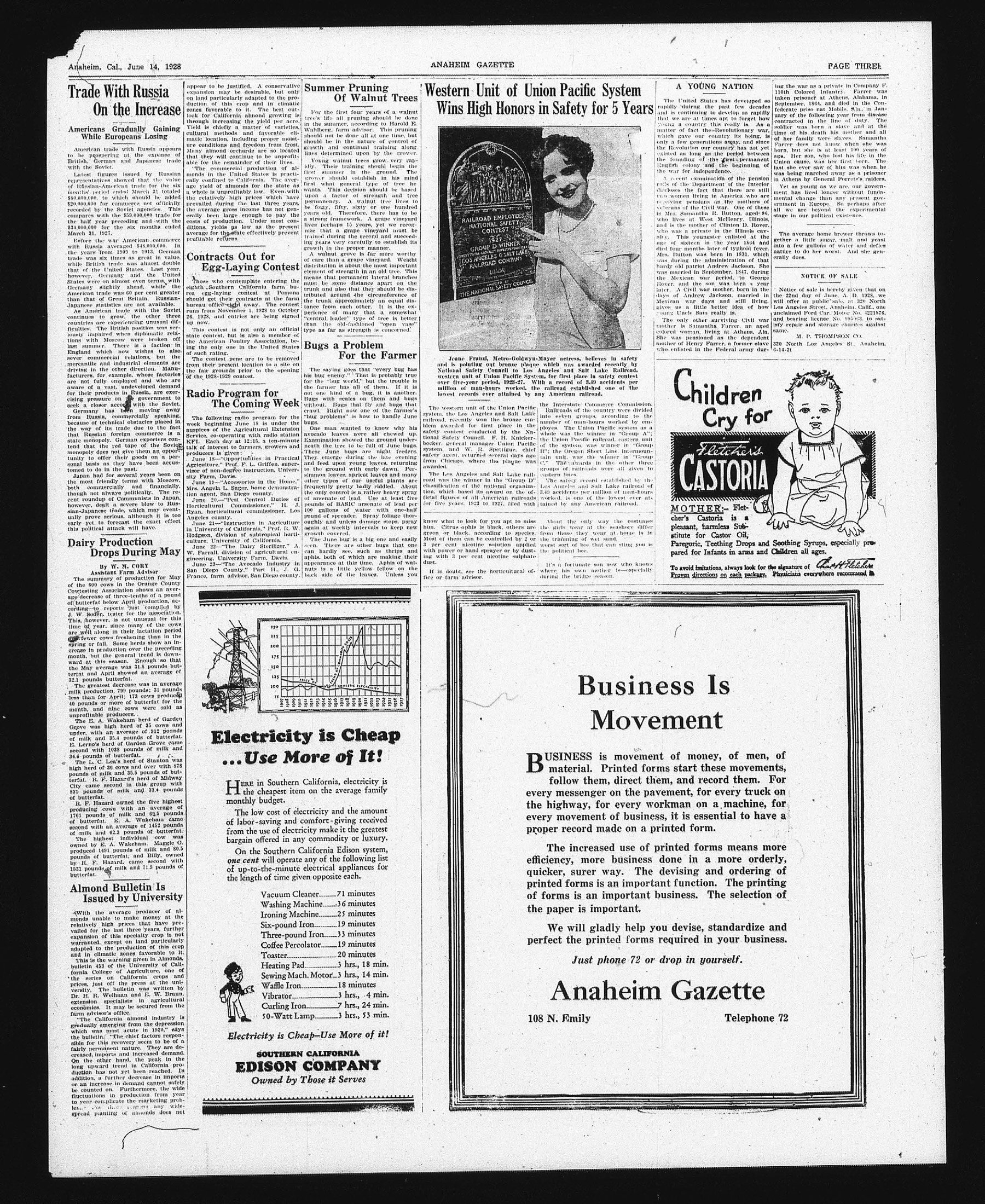
Searchable text
Trade With Russia On the Increase
Americans Gradually Gaining While Europeans Losing
American trade with Russia appears to be prospering at the expense of British, German and Japanese trade with the Soviet.
Latest figures issued by Russian representatives showed that the value of Russian-American trade for the six months' period ended March 31 totaled $80,000,000, to which should be added $20,000,000 for commerce not officially recorded by the Soviet agencies. This compares with the $59,000,000 trade for the half year preceding and with the $34,000,000 for the six months ended March 31, 1927.
Before the war American commerce with Russia averaged $48,000,000. In the years from 1909 to 1913, German trade was six times as great in value while British trade was almost double that of the United States. Last year, however, Germany and the United States were on almost even terms, with Germany slightly ahead, while the American trade was 60 per cent greater than that of Great Britain. Russian-Japanese statistics are not available.
As American trade with the Soviet continues to grow, the other three countries are experiencing unusual difficulties. The British position was seriously impaired when diplomatic relations with Moscow were broken off last summer. There is a faction in England which now wishes to also sever commercial relations, but the mercantile and industrial elements are driving in the other direction. Manufacturers, for example, whose factories are not fully employed and who are aware of a vast, undeveloped demand for their products in Russia, are exercising pressure on the government to seek a closer accord with the Soviet.
Germany has been moving away from Russia, commercially speaking, because of technical obstacles placed in the way of its trade due to the fact that Russian foreign commerce is a state monopoly. German exporters contend that the red tape of the Soviet appear to be justified. A conservative expansion may be desirable, but only on land particularly adapted to the production of this crop and in climatic zones favorable to it. The best outlook for California almond growing is through increasing the yield per acre. Yield is chiefly a matter of varieties, cultural methods and favorable climatic location, including proper moisture conditions and freedom from frost. Many almond orchards are so located that they will continue to be unprofitable for the remainder of their lives.
"The commercial production of almonds in the United States is practically confined to California. The average yield of almonds for the state as a whole is unprofitably low. Even with the relatively high prices which have prevailed during the last three years, the average gross income has not generally been large enough to pay the costs of production. Under most conditions, yields as low as the present average for the state effectively prevent profitable returns.
Contracts Out for Egg-Laying Contest
Those who contemplate entering the eighth Southern California farm burea egg-laying contest at Pomona should get their contracts at the farm bureau office right away. The contest runs from November 1, 1928 to October 26, 1928, and entries are being signed up now.
This contest is not only an official state contest, but is also a member of the American Poultry Association, being the only one in the United States of such rating.
The contest pens are to be removed from their present location to a site on the fair grounds prior to the opening of the 1928-1929 contest.
Radio Program for The Coming Week
The following radio program for the week beginning June 18 is under the auspices of the Agricultural Extension Service, co-operating with radio station KFI. Each day at 12:15, a ten-minute talk of interest to farmers, growers and Summer Pruner Of War
For the first four years tree's life all pruning in the summer, according Wahlberg, farm advice should not be done all growth and continual lines determined upon Young walnut trees nicely. Their training first summer in the grower should establish first what general wants. This decision upon a factor of six permanence. A walnut be forty, fifty, sixty years old. Therefore, a strong framework lives perhaps 15 years size that a grape vined during the seeding years very careful growth in the proper way.
A walnut grove is of care than a grape vine distribution is about the element of strength in means that permanent must be some distance trunk and also that the trunk approximate tance from each other perience of many th "central leader" type than the old-fashion type as far as strength.
Bugs a Problem For The
The saying goes that his bug enemy." That for the "bug world," he the farmer has all one not one kind of a bug Bugs with scales on without. Bugs that frawl. Right now one "bug problems" is how bugs.
One man wanted to avocado leaves were Examination showed that neat the tree to be f
sever commercial relations, but the mercantile and industrial elements are driving in the other direction. Manufacturers, for example, whose factories are not fully employed and who are aware of a vast, undeveloped demand for their products in Russia, are exercising pressure on the government to seek a closer accord with the Soviet.
Germany has been moving away from Russia, commercially speaking, because of technical obstacles placed in the way of its trade due to the fact that Russian foreign commerce is a state monopoly. German exporters contend that the red tape of the Soviet monopoly does not give them an opportunity to offer their goods on a personal basis as they have been accustomed to do in the past.
Japan had for several years been on the most friendly terms with Moscow, both commercially and financially, though not always politically. The recent roundup of Communists in Japan, however, dealt a severe blow to Russian-Japanese trade, which may eventually prove serious, although it is too early yet to forecast the exact effect this political attack will have.
Dairy Production Drops During May
By W. M. CORY
Assistant Farm Advisor
The summary of production for May of the 600 cows in the Orange County Cowtesting Association shows an average decrease of three-tenths of a pound of butterfat below April production, according to reports just compiled by J. W. Soden, tester for the association. This, however, is not unusual for this time of year, since many of the cows are well along in their lactation period with fewer cows freshening than in the spring or fall. Some herds show an increase in production over the preceding month, but the general trend is downward at this season. Enough so that the May average was 31.8 pounds butterfat and April showed an average of 32.1 pounds butterfat.
The greatest decrease was in average milk production, 799 pounds; 31 pounds less than for April; 173 cows produced 40 pounds or more of butterfat for the month, and nine cows were sold as unprofitable producers.
The E. A. Wakeham herd of Garden Grove was high herd of 35 cows and upder, with an average of 912 pounds of milk and 35.4 pounds of butterfat. E. Lerno's herd of Garden Grove came second with 1038 pounds of milk and 34.6 pounds of butterfat.
The L. C. Lea's herd of Stanton was high herd of 36 cows and over with 878 pounds of milk and 35.5 pounds of butterfat. R. F. Hazard's herd of Midway City came second in this group with 831 pounds of milk and 33.4 pounds of butterfat.
R. F. Hazard owned the five highest producing cows with an average of 1761 pounds of milk and 69.5 pounds of butterfat. E. A. Wakeham came second with an average of 1452 pounds of milk and 62.3 pounds of butterfat.
The highest individual cow was owned by E. A. Wakeham. Maggie G. produced 1491 pounds of milk and 80.5 pounds commercial relations, but the mercantile and industrial elements are driving in the other direction. Manufacturers, for example, whose factories are not fully employed and who are aware of a vast, undeveloped demand for their products in Russia, are exercising pressure on the government to seek a closer accord with the Soviet.
Germany has been moving away from Russia, commercially speaking, because of technical obstacles placed in the way of its trade due to the fact that Russian foreign commerce is a state monopoly. German exporters contend that the red tape of the Soviet monopoly does not give them an opportunity to offer their goods on a personal basis as they have been accustomed to do in the past.
Japan had for several years been on the most friendly terms with Moscow, both commercially and financially, though not always politically. The recent roundup of Communists in Japan, however, dealt a severe blow to Russian-Japanese trade, which may eventually prove serious, although it is too early yet to forecast the exact effect this political attack will have.
Radio Program for The Coming Week
The following radio program for the week beginning June 18 is under the auspices of the Agricultural Extension Service, co-operating with radio station KFI. Each day at 12:15, a ten-minute talk of interest to farmers, growers and producers is given:
June 18—"Opportunities in Practical Agriculture," Prof. F. L. Griffen, supervisor of non-degree instruction, University Farm, Davis.
June 19—"Accessories in the Home," Mrs. Angela L. Sager, home demonstration agent, San Diego county.
June 20—"Pest Control Duties of Horticultural Commissioner," H. J. Ryan, horticultural commissioner, Los Angeles county.
June 21—"Instruction in Agriculture in University of California," Prof. R. W. Hodgson, division of subtropical horticulture, University of California.
June 22—"The Dairy Sterilizer," A. W. Farrall, division of agricultural engineering, University Farm, Davis.
June 23—"The Avocado Industry in San Diego County," Part II., J. G. France, farm advisor, San Diego county.
Electricity is Chargeable...Use More Of It
Here in Southern California, electricity is cheapest item on the average monthly budget.
The low cost of electricity and the amount of labor-saving and comfort-giving recourse from the use of electricity make it the great bargain offered in any commodity or luxury product offered in any commodity or luxury product offered in any commodity or luxury product offered in any commodity or luxury product offered in any commodity or luxury product offered in any commodity or luxury product offered in any commodity or luxury product offered in any commodity or luxury product offered in any commodity or luxury product offered in any commodity or luxury product offered in any commodity or luxury product offered in any commodity or luxury product offered in any commodity or luxury product offered in any commodity or luxury product offered in any commodity or luxury product offered in any commodity or luxury product offered in any commodity or luxury product offered in any commodity or luxury product offered in any commodity or luxury product offered in any commodity or luxury product offered in any commodity or luxury product offered in any commodity or luxury product offered in any commodity or luxury product offered in any commodity or luxury product offered in any commodity or luxury product offered in any commodity or luxury product offered in any commodity or luxury product offered in any commodity or luxury product offered in any commodity or luxury product offered in any commodity or luxury product offered in any commodity or luxury product offered in any commodity or luxury product offered in any commodity or luxury product offered in any commodity or luxury product offered in any commodity or luxury product offered in any commodity or luxury product offered in any commodity or luxury product offered in any commodity or luxury product offered in any commodity or luxury product offered in any commodity or Luxury is Chargeable...Use More Of It
For th
The L. C. Lea's herd of Stanton was high herd of 36 cows and over with 878 pounds of milk and 35.5 pounds of butterfat. R. F. Hazard's herd of Midway City came second in this group with 831 pounds of milk and 33.4 pounds of butterfat.
R. F. Hazard owned the five highest producing cows with an average of 1761 pounds of milk and 69.5 pounds of butterfat. E. A. Wakeham came second with an average of 1452 pounds of milk and 62.3 pounds of butterfat.
The highest individual cow was owned by E. A. Wakeham. Maggie G. produced 1491 pounds of milk and 80.5 pounds of butterfat; and Billy, owned by R. F. Hazard, came second with 1531 pounds of milk and 71.9 pounds of butterfat.
Almond Bulletin Is Issued by University
With the average producer of almonds unable to make money at the relatively high prices that have prevailed for the last three years, further expansion of this specialty crop is not warranted, except on land particularly adapted to the production of this crop and in climatic zones favorable to it.
This is the warning given in Almonds, bulletin 453 of the University of California College of Agriculture, one of the series on California crops and prices, just off the press at the university. The bulletin was written by Dr. H. R. Wellman and E. W. Braun, extension specialists in agricultural economics. It may be secured from the farm advisor's office.
"The California almond industry is gradually emerging from the depression which was most acute in 1920," says the bulletin. "The chief factors responsible for this recovery seem to be of a fairly permanent nature. They are decreased imports and increased demand. On the other hand, the peak in the long upward trend in California production has not yet been reached. In addition, a further decrease in imports or an increase in demand cannot safely be counted on. Furthermore, the wide fluctuations in production from year to year complicate the marketing problem."
Electricity is Cheap—Use More
SOUTHERN CALIFORNIA
EDISON COMPANY
Owned by Those it Serves
Summer Pruning Of Walnut Trees
For the first four years of a walnut tree's life all pruning should be done in the summer, according to Harold E. Wahlberg, farm advisor. This pruning should not be done all at one time, but should be in the nature of control of growth and continual training along lines determined upon by the grower.
Young walnut trees grow very rapidly. Their training should begin the first summer in the ground. The grower should establish in his mind first what general type of tree he wants. This decision should be based upon a factor of strength and tree permanency. A walnut tree lives to be foggy, fifty, sixty or one hundred years old. Therefore, there has to be a strong framework. A grape vineyard lives perhaps 15 years, yet we recognize that a grape vineyard must be trained during the second and succeeding years very carefully to establish its growth in the proper manner.
A walnut grove is far more worthy of care than a grape vineyard. Weight distribution is about the most important element of strength in an old tree. This means that permanent lateral branches must be some distance apart on the trunk and also that they should be distributed around the circumference of the trunk approximately an equal distance from each other. It is the experience of many that a somewhat "central leader" type of tree is better than the old-fashioned "open vase" type as far as strength is concerned.
Bugs a Problem For the Farmer
The saying goes that "every bug has his bug enemy." That is probably true for the "bug world," but the trouble is the farmer has all of them. If it is not one kind of a bug, it is another. Bugs with scales on them and bugs without. Bugs that fly and bugs that crawl. Right now one of the farmer's "bug problems" is how to handle June bugs.
One man wanted to know why his avocado leaves were all chewed up. Examination showed the ground underneath the tree to be full of June bugs.
Western Unit of Union Pacific System Wins High Honors in Safety for 5 Years
RAILROAD EMPLOYEES NATIONAL SAFETY CONTEST
1927
GROUP D WINNER
LOS ANGELES & SALT LAKE RAILROAD COMPANY
THE NATIONAL SAFETY COUNCIL
Jeane Franzl, Metro-Goldwyn-Mayer actress, believes in safety and is pointing out bronze plaque which was awarded recently by National Safety Council to Los Angeles and Salt Lake Railroad, western unit of Union Pacific System, for first place in safety contest over five-year period, 1927-27. With a record of 3,49 accidents per million of man-hours worked, the railroad established one of the lowest records ever attained by any American railroad.
The western unit of the Union Pacific system, the Los Angeles and Salt Lake railroad, recently won the bronze emblem awarded for first place in the safety contest conducted by the National Safety Council. F. H. Knickerbocker, general manager Union Pacific system and W. B. Spittock chief of the Interstate Commerce Commission.
Railroads of the country were divided into seven groups, according to the number of man-hours worked by employees. The Union Pacific system as a whole was the winner in "Group A"; the Union Pacific railroad, eastern unit of the system, was winner in "Group
The saying goes that "every bug has his bug enemy." That is probably true for the "bug world," but the trouble is the farmer has all of them. If it is not one kind of a bug, it is another. Bugs with scales on them and bugs without. Bugs that fly and bugs that crawl. Right now one of the farmer's "bug problems" is how to handle June bugs.
One man wanted to know why his avocado leaves were all chewed up. Examination showed the ground underneath the tree to be full of June bugs. These June bugs are night feeders. They emerge during the late evening and feed upon young leaves, returning to the ground with early dawn. Persimmon leaves, apricot leaves and many other types of our useful plants are frequently pretty badly riddled. About the only control is a rather heavy spray of arsenate of lead. Use at least five pounds of BASIC arsenate of lead per 100 gallons of water with one-half pound of spreader. Spray foliage thoroughly and unless damage stops, spray again at weekly intervals to keep new growth covered.
The June bug is a big one and easily seen. There are other bugs that one can hardly see, such as thrips and aphis, both of which are making their appearance at this time. Aphis of walnuts is a little yellow fellow on the back side of the leaves. Unless you know what to look for you apt to miss him. Citrus siphis is black, others are green or black, according to species. Most of them can be controlled by 2 or 3 per cent nicotine solution applied with power or hand sprayer or by dusting with 3 per cent nicotine sulphate dust.
If in doubt, see the horticultural office or farm advisor.
Business Movement
BUSINESS is movement of material. Printed forms start follow them, direct them, and every messenger on the pavement, the highway, for every workman every movement of business, it is proper record made on a printed fo...
More of It:
Northern California, electricity is
item on the average family
of electricity and the amount
and comfort-giving received
electricity make it the greatest
any commodity or luxury.
Northern California Edison system,
rate any of the following list
ute electrical appliances for
given opposite each.
Cleaner...71 minutes
G Machine...36 minutes
M Machine...25 minutes
And Iron...19 minutes
Round Iron...33 minutes
Percolator...19 minutes
20 minutes
Pad...3 hrs., 18 min.
Mach. Motor...3 hrs., 14 min.
Iron...18 minutes
R...3 hrs., 4 min.
Iron...7 hrs., 24 min.
Lamp...3 hrs., 53 min.
Cheap—Use More of it!
NORTHERN CALIFORNIA
COMPANY
by Those it Serves
BUSINESS is movement of material. Printed forms start
follow them, direct them, and
every messenger on the pavement,
the highway, for every workman
every movement of business, it is eproper record made on a printed fo
The increased use of printed f
efficiency, more business done in
quicker, surer way. The devising
printed forms is an important funcof forms is an important business.
the paper is important.
We will gladly help you devise
perfect the printed forms required
Just phone 72 or drop in
Anaheim Ga
108 N. Emily
A YOUNG NATION
The United States has developed so rapidly during the past few decades and is continuing to develop so rapidly that we are at times apt to forget how young a country this really is. As a matter of fact the Revolutionary war, which gave our country its being, is only a few generations away, and since the Revolution our country has not yet existed as long as the period between the founding of the first permanent English colony and the beginning of the war for independence.
A recent examination of the pension rolls of the Department of the Interior discloses the fact that there are still two women living in America who are receiving pensions as the mothers of veterans of the Civil war. One of these is Mrs. Samantha R. Button, aged 96, who lives at West McHenry, Illinois, and is the mother of Clinton D. Rover, who was a private in the Illinois cavalry. This youngster enlisted at the age of sixteen in the year 1864 and died four months later of typhoid fever. Mrs. Button was born in 1831, which was during the administration of that hardy old patriot Andrew Jackson. She was married in September, 1847, during the Mexican war period, to George Rover, and the son was born a year later. A Civil war mother, born in the days of Andrew Jackson, married in Mexican war days and still living, gives us a little better idea of how young Uncle Sam really is.
The only other surviving Civil war mother is Samantha Farrer, an aged colored woman living at Athens, Ala. She was pensioned as the dependent mother of Henry Farrer, a former slave who enlisted in the Federal army during the war as a private in Company F. 110th Colored Infantry. Farrer was taken prisoner at Athens, Alabama, in September, 1864, and died in the Confederate priso nat Mobile, Ala., in January of the following year from disease contracted in the line of duty. The soldier was born a slave and at the time of his death his mother and all of her family were slaves. Samantha Farrer does not know when she was born, but she is at least 100 years of age. Her son, who lost his life in the Union cause, was her firstborn. The last she ever saw of him was when he was being marched away as a prisoner in Athens by General Forrets's raiders.
Yet as young as we are, our government has lived longer without fundamental change than any present government in Europe. So perhaps after all we are beyond the experimental stage in our political existence.
The average home brewer throws together a little sugar, malt and yeast into a few gallons of water and deflux nature to do her worst. And she generally does.
NOTICE OF SALE
Notice of sale is hereby given that on the 22nd day of June, A.D. 1928, we will offer at public sale, at 320 North Los Angeles Street, Anaheim, Calif., one unclaimed Ford Car, Motor No. 4221876, and bearing license No. 805063, to satisfy repair and storage charges against same.
M. P. THOMPSON CO.
320 North Los Angeles St., Anaheim,
6-14-2t
Children Cry for
Fletcher's
CASTORIA
MOTHER: Fletcher's Castoria is a pleasant, harmless Substitute for Castor Oil,
Paregoric, Teething Drops and Soothing Syrups, especially prepared for Infants in arms and Children all ages.
To avoid limitations, always look for the signature of Charles Fletcher.
Proven directions on each package. Physicians everywhere recommend
movement of money, or men, of
printed forms start these movements,
direct them, and record them. For
on the pavement, for every truck on
every workman on a machine, for
business, it is essential to have a
e on a printed form.
use of printed forms means more
business done in a more orderly,
by. The devising and ordering of
an important function. The printing
important business. The selection of
tant.
help you devise, standardize and
forms required in your business.
ne 72 or drop in yourself.
eim Gazette
Telephone 72