anaheim-gazette 1928-06-07
Scanned page
Searchable text
THE ANAHEIM GAZETTE
ESTABLISHED 1870
HENRY KUCHEL, Editor and Proprietor
ISSUED EVERY THURSDAY
SUBSCRIPTION PER YEAR..... $2.00
SIX MONTHS ..... 1.25
THREE MONTHS ..... .75
Entered at the Anaheim, California. Post Office as second class matter.
OUR FOREIGN LOANS
AN INTERESTING angle to the much debated question as to the much debated question as to the advisability of continuing the practice of making great private loans to Europe is furnished in a statement made recently by Matthew Woll, vice-president of the American Federation of Labor, who declares that American labor views these loans with concern, for the reason that the transfer of American money to foreign lands where the labor market is cheap and plentiful threatens to tear down the defense which our immigration laws and protective tariff have set up against the goods and the products manufactured by cheap labor. He declares that American labor must adhere to the policy of opposing the use of American money to set up competition by cheap labor abroad. In his article Mr. Woll says in part:
"It is reasonable to believe that within a few years we will find the international bankers massed solidly back of free traders. Already we are noticing large purchases abroad. Then, too, economists here and there and everywhere are being subsidized to expound the alleged virtues and advantages of free trade.
"American labor needs not only to insist upon continued and further exclusion of foreign labor; it must not only demand the unimpaired retention of the present tariff protection; indeed, it must insist on a further upward revision in a number of instances, and reclassification in other instances if the tariff is to serve adequately so a protection to American standards of life and
TORCHLIGHT PARADE AGAIN
MEMORIES of earlier political campaigns will be revived at Kansas City if a plan now under consideration is carried into effect. It is proposed to organize a parade on the eve of the Republican national convention, June 11 next; a flambeau parade, consisting of marching clubs bearing torches and garbed in picturesque costumes will make its way through the business streets to a city park, where a great pyrotechnic display will be held. Floats will feature the demonstration, representing great Republicans, including the party's presidents.
For a good many years the spectacular features of campaigning have been discarded. In the times gone by the marching clubs were prominent in every contest. Fifty years and more ago they furnished colorful atmosphere to the struggle for votes. They vied for conspicuous attire. They carried kerosene torches at night, the blazing of which in the comparatively dim streets of that time made a striking picture.
Before the Civil war there was the keenest rivalry between the marching organizations, and many clashes occurred in the streets of the larger cities as they paraded. Not much care was exercised to prevent the coincidence of dates, and sometimes the battle for ballots took on a sanguinary aspect as the paraders labor. He declares that American labor must adhere to the policy of opposing the use of American money to set up competition by cheap labor abroad. In his article Mr. Woll says in part:
"It is reasonable to believe that within a few years we will find the international bankers massed solidly back of free traders. Already we are noticing large purchases abroad. Then, too, economists here and there and everywhere are being subsidized to expound the alleged virtues and advantages of free trade.
"American labor needs not only to insist upon continued and further exclusion of foreign labor; it must not only demand the unimpaired retention of the present tariff protection; indeed, it must insist on a further upward revision in a number of instances, and reclassification in other instances if the tariff is to serve adequately as a protection to American standards of life and work. Even with these ends realized, American labor will not have complete protection against the competition of pauperized labor until some method is found for preventing national exportation of national savings to competitive countries and foreign competitive enterprises. The principle of opposition to the use of American savings by competing industrial countries and industries is as vital to a fundamental American labor policy as is the principle of support of the immigration laws and the tariff."
There is food for considerable thought in the above statement which sets out three important principles of American economic procedure to be supported by the laboring men of the country. That so well known a labor leader as Mr. Woll puts the foreign loan question in the same category with the tariff and the immigration policies is of more than passing significance.
In his statement also, Mr. Woll shows beyond doubt that the American worker is alive to the benefits which the American protective tariff bring him and that he is concerned with the building up of competitive industries in the cheap labor countries of Europe and the Orient. The employers of labor have the same sort of concern and here is another indication that both the employers and employees in America now realize that their interests lie in the same direction. For prosperity we must have the home market for the home producer, because steady production means a prosperous worker who can purchase what the home market has to offer. The more he can purchase the better the market, and the better the market the greater the demand and the steadier the employment. This is a combination hard to beat, and the producers in America are coming to realize this fact.
While the Secretary five minutes later and a half flood Coolidge, it is recklessly seconds in while the stop signington of his fast congressional course discussion oo little bit over Coolidge character its veracity. On set day, as it committemenen, President would reached him again at his hopes of tempering some concessions allow them to stay off "pork" with hardened means. In advance, it make a grand upon him, with him that they was all wrong termination they were usher were anxious to avoid facts first of them Good-gates, then an inquiry for a story goes thus ducing it, but, over a copy, and were trying start of protest President reaches drew out the incubus with which his most effectthe bill on his d through the juction measure. To the bill we "therefores." Standing up, re-made copy to mittee and advise if the bill were would sign it. floods of unde mitteteenen sole afternoon the President Coolidge
For a good many years the spectacular features of campaigning have been discarded. In the times gone by the marching clubs were prominent in every contest. Fifty years and more ago they furnished colorful atmosphere to the struggle for votes. They vied for conspicuous attire. They carried kerosene torches at night, the blazing of which in the comparatively dim streets of that time made a striking picture.
Before the Civil war there was the keenest rivalry between the marching organizations, and many clashes occurred in the streets of the larger cities as they paraded. Not much care was exercised to prevent the coincidence of dates, and sometimes the battle for ballots took on a sanguinary aspect as the paraders collided. Then the torch staffs became weapons, and many were the wounds inflicted.
If the Kansas City parade sets the fashion anew for marching partisans, this coming campaign may be livelier than even present expectations promise. But these are motor days, and pedestrianism is not much in favor. Will the new mode of demonstration adopt the modern vehicle of transport? Will there be illuminated runabouts and sedans and coupes "all dolled up" with draperies and pictures and perhaps with electric lights?
It would be well, perhaps, thus to revive the old custom of public demonstration of party affiliation. Campaigning by letter, by speech, by radio and by print is rather dull work. A good, old-fashioned rally, with marchers and bands and floats and torches, with speeches delivered to thousands attracted by the show and keyed up to enthusiasm by the spectacle, is likely to be more effective than the stay-at-home method of reasoning. It may thus be possible to bring out the voters to the point at which more than a minority of the people will declare preferences.
OUR BEST CUSTOMER
The growing commercial importance of Canada to the United States has once again been demonstrated by the March figures given out by the Department of Commerce. For two successive months the value of American exports to the Dominion has exceeded that of American goods sent to Great Britain, traditionally our best customer. The United States has, of course, long been the best customer of Canada. The near future will in all likelihood see Canada firmly established as the country which takes the largest proportion of American products. In spite of tariffs and in spite of the ties that bind Canadians to the mother country, they are becoming more and more oriented toward the United States, both commercially and financially. This is a natural development. It not only enhances the importance of Canada within the British empire, but makes all the more certain that the political relations of the United States with that empire will increasingly come o be based upon common interests rather than antagonism.
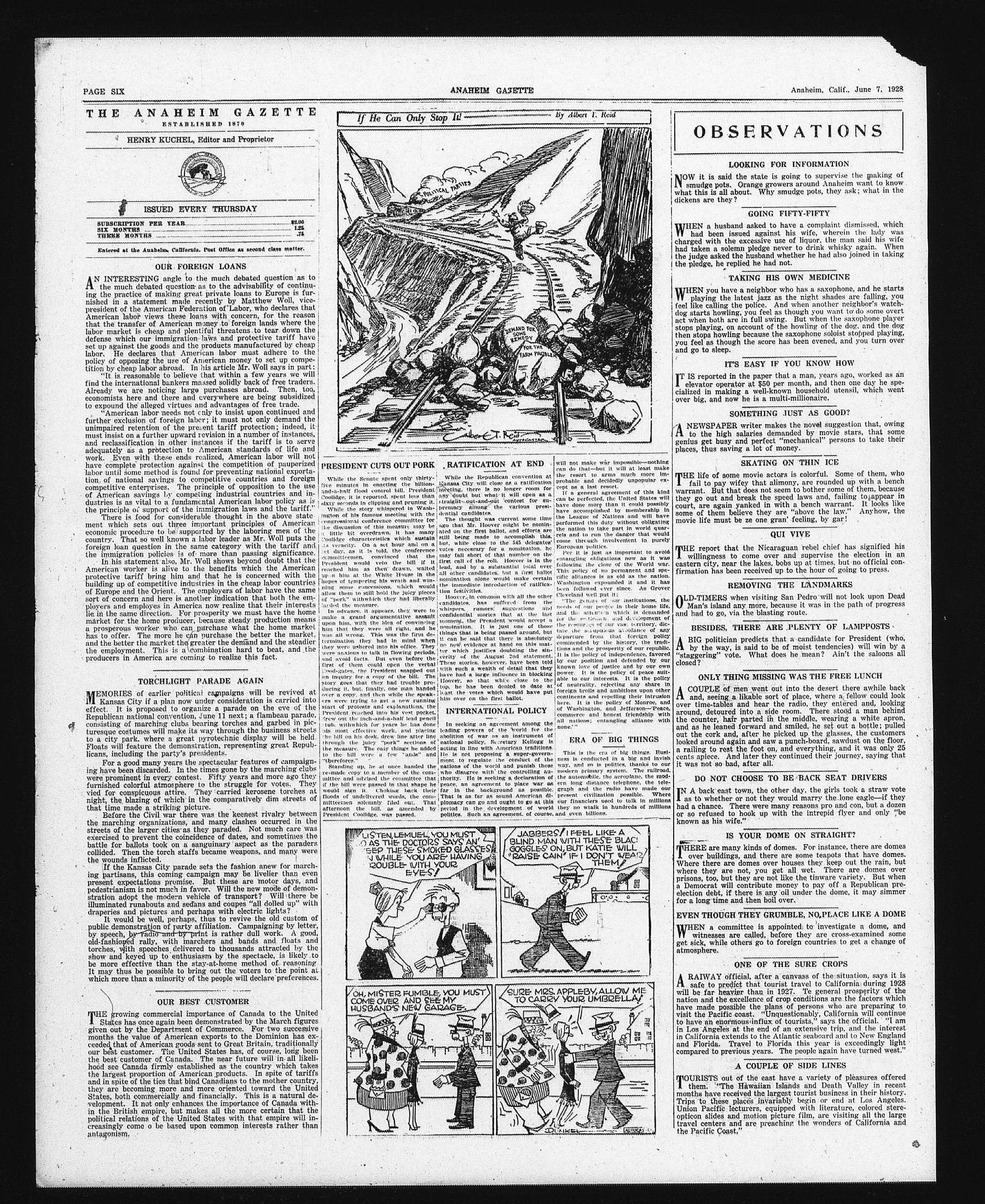
ANAHEIM GAZETTE
If He Can Only Stop It! By Albert T. Reid
DEMAND FOR SOME REMEDY FOR THE FARM PROBLEM
Albert E. T. Reid
PRESIDENT CUTS OUT PORK
While the Senate spent only thirty-five minutes in enacting the billion-and-a-half flood control bill, President Coolidge, it is reported, spent less than sixty seconds in clipping and pruning it.
While the story whispered in Washington of his famous meeting with the congressional conference committee for the discussion of this measure may be a little bit overdrawn. It has many Coolidge characteristics which sustain its veracity. On a set hour and on a set day, as it is told, the conference committee convinced that the President would veto the bill if it reached him as then drawn, waited upon him at the White House in the hopes of tempering his wrath and winning some concessions, which would allow them to still hold the juicy pieces of "pork" withwhich they had liberally larded the measure.
In advance, it appears, they were to make a grand argumentative assault upon him, with the idea of convincing him that they were all right, and he was all wrong. This was the firm determination they had in mind when they were ushered into his office. They were anxious to talk in flowing periods, and avoid facts. But even before the first of them could open the verbal Good-gates, the President snapped out an inquiry for a copy of the bill. The story goes that they had trouble producing it, but, finally, one man handed over a copy, and then while the speakers were trying to get a new running start of protests and explanations, the President reached into his vest pocket, drew out the inch-and-a-half lead penil club, withwhich for years he has done his most effective work, and placing the bill on his desk, drew line after line through the juicy "pork" sections of the measure. The only things he added to the bill were a few "ande" and "therefores."
Standing up, he at once handed the re-made copy to a member of the committee and advised the committee that if the bill were passed in that shape he would sign it. Choking back their floods of undelivered words, the committee solemnly filed out. That afternoon the bill, as amended by President Coolidge, was passed.
RATIFICATION AT END
While the Republican convention at Kansas City will close as a ratification meeting, there is no longer room for any doubt but what it will open as a straight-out-and-out contest for supremacy among the various presidential candidates.
The thought was current some time ago that Mr. Hoover might be nominated on the first ballot, and efforts are still being made to accomplish this, but, while close to the 545 delegates' votes necessary for a nomination, he may fall short of that number on the first call of the roll. Hoover is in lead, and by a substantial total over all other candidates, but a first ballot nomination alone would make certain the immediate introduction of ratification festivities.
Hoover, in common with all the other candidates, has suffered from the whispers, rumors, suggestions and confidential stories that at last moment, the President would accept a nomination. It is just one of those things that is being passed around, but it can be said that there is absolutely no new evidence at hand on this matter which justifies doubting the sincerity of the August 2nd statement. These stories, however, have been told with such a wealth of detail that they have had a large influence in blocking Hoover, so that while close to the top, he has been denied to date at least the votes which would have put him over on the first ballot.
INTERNATIONAL POLICY
In seeking an agreement among the leading powers of the world for the abolition of war as an instrument of national policy, Secretary Kellogg is acting in line with American traditions. He is not proposing a super-government to regulate the conduct of the nations of the world and punish those who disagree with the controlling authority. He is seeking a declaration of peace, an agreement to place war as far in the background as possible. That is as far as sound American diplomacy can go and ought to go at this period in the development of world politics. Such an agreement, of course, will not make war impossible—nothing can do that—but it will at least make the resort to arms much more improbable and decidedly unpopular except as a last resort.
If a general agreement of this kind can be perfected, the United States will have done more than it could possibly have accomplished by membership in the League of Nations and will have performed this duty without obligating the nation to take part in world quarrels and to run the danger that would come through involvement in purely European politics.
For it is just as important to avoid entangling obligations now as it was following the close of the World War. This policy of no permanent and specific alliances is as old as the nation. Washington expounded it and it has been followed ever since. As Grover Cleveland well put it:
"The genius of our institutions, the needs of our people in their home life, and the attention which is demanded for the settlement and development of the resources of our vast territory, dictate the suspicious avoidance of any departure from that foreign policy commended by the history, the traditions and the prosperity of our republic. It is the policy of independence, favored by our position and defended by our known love of justice and by our own power. It is the policy of peace suitable to our interests. It is the policy of neutrality, rejecting any share in foreign broils and ambitions upon other continents and repelling their intrusion here. It is the policy of Monroe, and Washington, and Jefferson—Peace, commerce and honest friendship with all nations; entangling alliance with none."
ERA OF BIG THINGS
This is the era of big things. Business is conducted in a big and lavish way, and so is politics, thanks to our modern primary system. The railroad, the automobile, the aeroplane, the modern long distance telephone, the telegraph and the radio have made our present civilization possible. Where our financiers used to talk in millions they no walk in hundreds of millions they no walk in hundreds of millions
Standing up, he at once handed the re-made copy to a member of the committee and advised the committee that if the bill were passed in that shape he would sign it. Choking back their floods of undelivered words, the committee solemnly filed out. That afternoon the bill, as amended by President Coolidge, was passed.
LISTEN, LEMUEL, YOU MUST AS THE DOCTORS SAYS AN' KEEP THESE SMOKED GLASSES IN WHILE YOU ARE HAVING ROUBLE WITH YOUR EYES!
JABBERS! I FEEL LIKE A BLIND MAN WITH THESE BLACK GOGGLES ON, BUT KATIE WILL 'RAISE CAIN' IF I DON'T WEAR THEM!
OH, MISTER FUMBLE, YOU MUST COME OVER AND SEE MY HUSBAND'S NEW GARAGE!
SURE MRS. APPLEBY, ALLOW ME TO CARRY YOUR UMBRELLA!
OBSERVATIONS
LOOKING FOR INFORMATION
Now it is said the state is going to supervise the making of smudge pots. Orange growers around Anaheim want to know what this is all about. Why smudge pots, they ask; what in the dickens are they?
GOING FIFTY-FIFTY
When a husband asked to have a complaint dismissed, which had been issued against his wife, wherein the lady was charged with the excessive use of liquor, the man said his wife had taken a solemn pledge never to drink whisky again. When the judge asked the husband whether he had also joined in taking the pledge, he replied he had not.
TAKING HIS OWN MEDICINE
When you have a neighbor who has a saxophone, and he starts playing the latest jazz as the night shades are falling, you feel like calling the police. And when another neighbor's watchdog starts howling, you feel as though you want to do some overt act when both are in full swing. But when the saxophone player stops playing, on account of the howling of the dog, and the dog then stops howling because the saxophone soloist stopped playing, you feel as though the score has been evened, and you turn over and go to sleep.
IT'S EASY IF YOU KNOW HOW
It is reported in the paper that a man, years ago, worked as an elevator operator at $50 per month, and then one day he specialized in making a well-known household utensil, which went over big, and now he is a multi-millionaire.
SOMETHING JUST AS GOOD?
A NEWSPAPER writer makes the novel suggestion that, owing to the high salaries demanded by movie stars, that some genius get busy and perfect "mechanical" persons to take their places, thus saving a lot of money.
IT'S EASY IF YOU KNOW HOW
IT IS reported in the paper that a man, years ago, worked as an elevator operator at $50 per month, and then one day he specialized in making a well-known household utensil, which went over big, and now he is a multi-millionaire.
SOMETHING JUST AS GOOD?
A NEWSPAPER writer makes the novel suggestion that, owing to the high salaries demanded by movie stars, that some genius get busy and perfect "mechanical" persons to take their places, thus saving a lot of money.
SKATING ON THIN ICE
THE life of some movie actors is colorful. Some of them, who fail to pay wifey that alimony, are rounded up with a bench warrant. But that does not seem to bother some of them, because they go out and break the speed laws and, failing to appear in court, are again yanked in with a bench warrant. It looks like some of them believe they are "above the law." Anyhow, the movie life must be ze one gran' feeling, by gar!
QUI VIVE
THE report that the Nicaraguan rebel chief has signified his willingness to come over and supervise the election in an eastern city, near the lakes, bobs up at times, but no official confirmation has been received up to the hour of going to press.
REMOVING THE LANDMARKS
OLD-TIMERS when visiting San Pedro will not look upon Dead Man's island any more, because it was in the path of progress and had to go, via the blasting route.
BESIDES, THERE ARE PLENTY OF LAMPPOSTS
A BIG politician predicts that a candidate for President (who, by the way, is said to be of moist tendencies) will win by a "staggering" vote. What does he mean? Ain't the saloons all closed?
ONLY THING MISSING WAS THE FREE LUNCH
A COUPLE of men went out into the desert there awhile back and, seeing a likable sort of place, where a fellow could look over time-tables and hear the radio, they entered and, looking around, detoured into a side room. There stood a man behind the counter, hair parted in the middle, wearing a white apron, and as he leaned forward and smiled, he set out a bottle; pulled out the cork and, after he picked up the glasses, the customers looked around again and saw a punch-board, sawdust on the floor, a railing to rest the foot on, and everything, and it was only 25 cents apiece. And later they continued their journey, saying that it was not so bad, after all.
DO NOT CHOOSE TO BE BACK SEAT DRIVERS
In a back east town, the other day, the girls took a straw vote as to whether or not they would marry the lone eagle—if they had a chance. There were many reasons pro and con, but a dozen or so refused to hook up with the intrepid flyer and only "be known as his wife."
IS YOUR DOME ON STRAIGHT?
There are many kinds of domes. For instance, there are domes
DO NOT CHOOSE TO BE BACK SEAT DRIVERS
IN A back east town, the other day, the girls took a straw vote as to whether or not they would marry the lone eagle—if they had a chance. There were many reasons pro and con, but a dozen or so refused to hook up with the intrepid flyer and only "be known as his wife."
IS YOUR DOME ON STRAIGHT?
THERE are many kinds of domes. For instance, there are domes over buildings, and there are some teapots that have domes. Where there are domes over houses they keep out the rain, but where they are not, you get all wet. There are domes over prisons, too, but they are not like the tinware variety. But when a Democrat will contribute money to pay off a Republican pre-election debt, if there is any oil under the dome, it may simmer for a long time and then boil over.
EVEN THOUGH THEY GRUMBLE, NO PLACE LIKE A DOME
WHEN a committee is appointed to investigate a dome, and witnesses are called, before they are cross-examined some get sick, while others go to foreign countries to get a change of atmosphere.
ONE OF THE SURE CROPS
ARAIWAY official, after a canvass of the situation, says it is safe to predict that tourist travel to California during 1928 will be far heavier than in 1927. Te general prosperity of the nation and the excellence of crop conditions are the factors which have made possible the plans of persons who are preparing to visit the Pacific coast. "Unquestionably, California will continue to have an enormous influx of tourists," says the official. "I am in Los Angeles at the end of an extensive trip, and the interest in California extends to the Atlantic seaboard and to New England and Florida. Travel to Florida this year is exceedingly light compared to previous years. The people again have turned west."
A COUPLE OF SIDE LINES
TOURISTS out of the east have a variety of pleasures offered them. "The Hawaiian Islands and Death Valley in recent months have received the largest tourist business in their history. Trips to these places invariably begin or end at Los Angeles. Union Pacific lecturers, equipped with literature, colored stereo-opticon slides and motion picture film, are visiting all the large travel centers and are preaching the wonders of California and the Pacific Coast."