anaheim-gazette 1928-05-10
Scanned page
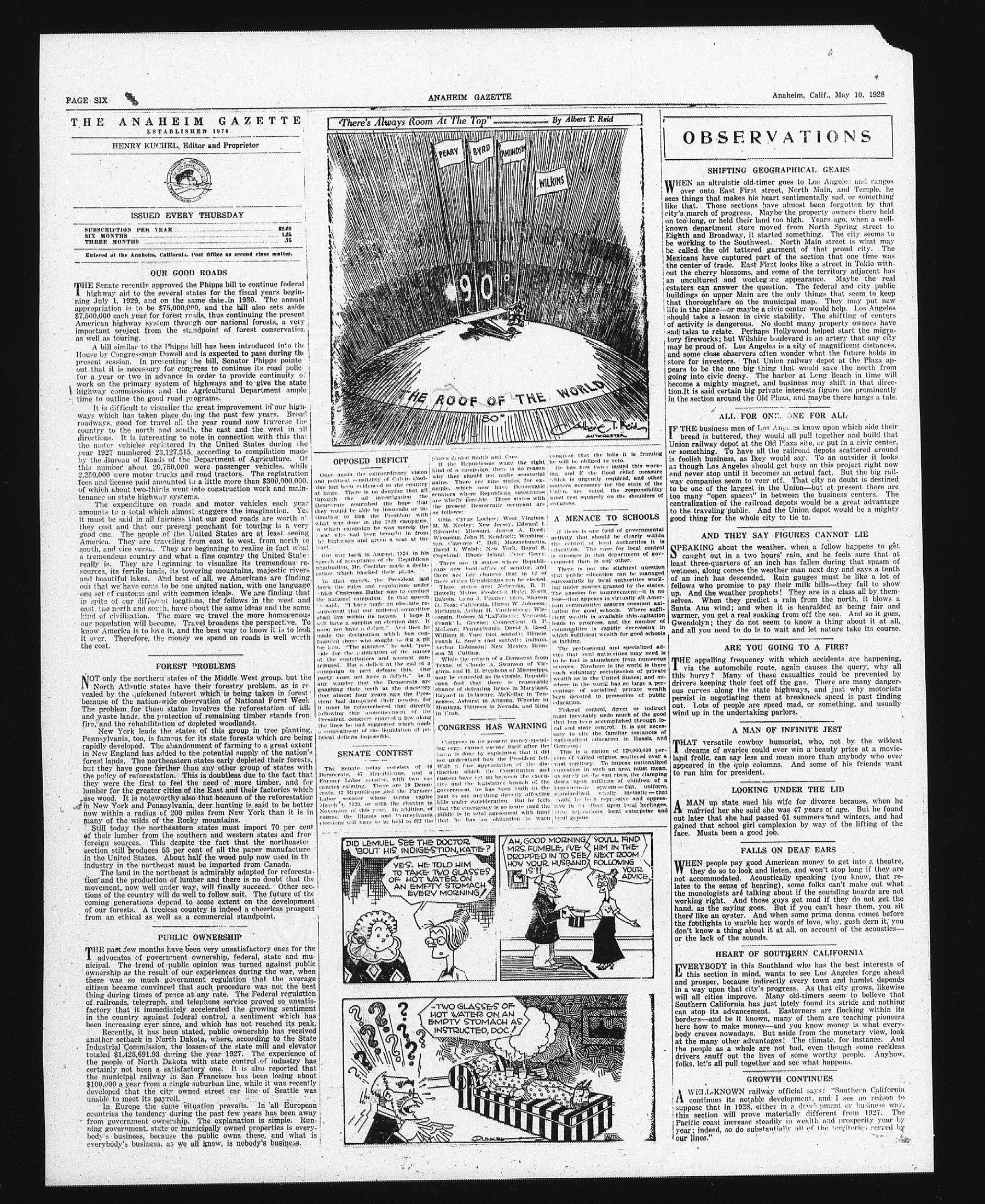
Searchable text
THE ANAHEIM GAZETTE
ESTABLISHED 1870
HENRY KUCHEL, Editor and Proprietor
ISSUED EVERY THURSDAY
SUBSCRIPTION PER YEAR $2.00
SIX MONTHS 1.25
THREE MONTHS .75
Entered at the Annabell, California, Post Office as second class matter.
OUR GOOD ROADS
The Senate recently approved the Phipps bill to continue federal highway aid to the several states for the fiscal years beginning July 1, 1929, and on the same date in 1930. The annual appropriation is to be $75,000,000, and the bill also sets aside $7,500,000 each year for forest roads, thus continuing the present American highway system through our national forests, a very important project from the standpoint of forest conservation as well as touring.
A bill similar to the Phipps bill has been introduced into the House by Congressman Dowell and is expected to pass during the present session. In presenting the bill, Senator Phipps pointed out that it is necessary for congress to continue its road policy for a year or two in advance in order to provide continuity of work on the primary system of highways and to give the state highway commissions and the Agricultural Department ample time to outline the good road programs.
It is difficult to visualize the great improvement in our highways which has taken place during the past few years. Broad roadways, good for travel all the year round now traverse the country to the north and south, the east and the west in all directions. It is interesting to note in connection with this that motor vehicles registered in the United States during
House by Congressman Dowen and is expected to pass during the present session. In presenting the bill, Senator Phipps pointed out that it is necessary for congress to continue its road policy for a year or two in advance in order to provide continuity of work on the primary system of highways and to give the state highway commissions and the Agricultural Department ample time to outline the good road programs.
It is difficult to visualize the great improvement in our highways which has taken place during the past few years. Broad roadways, good for travel all the year round now traverse the country to the north and south, the east and the west in all directions. It is interesting to note in connection with this that the motor vehicles registered in the United States during the year 1927 numbered 23,127,315, according to compilation made by the Bureau of Roads of the Department of Agriculture. Of this number about 20,750,000 were passenger vehicles, while 2,250,000 were motor trucks and road tractors. The registration fees and license paid amounted to a little more than $300,000,000, of which about two-thirds went into construction work and maintenance on state highway systems.
The expenditure on roads and motor vehicles each year amounts to a total which almost staggers the imagination. Yet it must be said in all fairness that our good roads are worth a they cost and that our present penchant for touring is a very good one. The people of the United States are at least seeing America. They are traveling from east to west, from north to south, and vice versa. They are beginning to realize in fact what a tremendous country and what a fine country the United States really is. They are beginning to visualize its tremendous resources, its fertile lands, its towering mountains, majestic rivers and beautiful lakes. And best of all, we Americans are finding out that we have come to be one united nation, with one language one set of customs and with common ideals. We are finding that in spite of our different locations, the fellows in the west and east the north and south, have about the same ideas and the same kind of civilization. The more we travel the more homogenous our population will become. Travel broadens the perspective. To know America is to love it, and the best way to know it is to look it over. Therefore, the money we spend on roads is well worth the cost.
FOREST PROBLEMS
Not only the northern states of the Middle West group, but the North Atlantic states have their forestry problem, as is revealed by the quickened interest which is being taken in forest because of the nation-wide observation of National Forst Week. The problem for these states involves the reforestation of idle and waste lands, the protection of remaining timber stands from fire, and the rehabilitation of depleted woodlands.
New York leads the states of this group in tree planting, Pennsylvania, too, is famous for its state forests which are being rapidly developed. The abandonment of farming to a great extent in New England has added to the potential supply of the nation's forest lands. The northeastern states early depleted their forests, but they have gone farther than any other group of states with the policy of reforestation. This is doubtless due to the fact that they were the first to feel the need of more timber, and for lumber for the greater cities of the East and their factories which use wood. It is noteworthy also that because of the reforestation in New York and Pennsylvania, deer hunting is said to be better now within a radius of 200 miles from New York than it is in many of the wilds of the Rocky mountains.
Still today the northeastern states must import 70 per cent of their lumber from the southern and western states and from foreign sources. This despite the fact that the northeastern section still produces 53 per cent of all the paper manufacture...
forest lands. The northeastern states early depleted their forests,
but they have gone farther than any other group of states with
the policy of reforestation. This is doubtless due to the fact that
they were the first to feel the need of more timber, and for
lumber for the greater cities of the East and their factories which
use wood. It is noteworthy also that because of the reforestation
in New York and Pennsylvania, deer hunting is said to be better
now within a radius of 200 miles from New York than it is in
many of the wilds of the Rocky mountains.
Still today the northeastern states must import 70 per cent
of their lumber from the southern and western states and from
foreign sources. This despite the fact that the northeaster
section still produces 53 per cent of all the paper manufacture
in the United States. About half the wood pulp now used in the
industry in the northeast must be imported from Canada.
The land in the northeast is admirably adapted for reforestation and the production of lumber and there is no doubt that the movement, now well under way, will finally succeed. Other sections of the country will do well to follow suit. The future of the coming generations depend to some extent on the development of our forests. A treeless country is indeed a cheerless prospect from an ethical as well as a commercial standpoint.
PUBLIC OWNERSHIP
THE past few months have been very unsatisfactory ones for the advocates of government ownership, federal, state and municipal. The trend of public opinion was turned against public ownership as the result of our experiences during the war, when there was so much government regulation that the average citizen became convinced that such procedure was not the best thing during times of peace at any rate. The Federal regulation of railroads, telegraph, and telephone service proved so unsatisfactory that it immediately accelerated the growing sentiment in the country against federal control, a sentiment which has been increasing ever since, and which has not reached its peak.
Recently, it has been stated, public ownership has received another setback in North Dakota, where, according to the State Industrial Commission, the losses-of the state mill and elevator totaled $1,425,691.93 during the year 1927. The experience of the people of North Dakota with state control of industry has certainly not been a satisfactory one. It is also reported that the municipal railway in San Francisco has been losing about $100,000 a year from a single suburban line, while it was recently developed that the city owned street car line of Seattle was unable to meet its payroll.
In Europe the same situation prevails. In all European countries the tendency during the past few years has been away from government ownership. The explanation is simple. Running government, state or municipally owned properties is everybody's business, because the public owns these, and what is everybody's business, as we all know, is nobody's business.
ANAHEIM GAZETTE
"There's Always Room At The Top" By Albert T. Reid
PEARY BYRD AMUNDSEW WILKINS
90°
THE ROOF OF THE WORLD
80°
Albert T. Reid
AUTOGRAPH
OPPOSED DEFICIT
Once again the extraordinary vision and political sensibility of Calvin Coolidge has been evidenced to the country at large. There is no denying that all through the oil investigation the Democrat nourished the hope that they would be able by innuendo or intimation to link the President with what was done in the 1920 campaign in which campaign he was merely the most who had been brought in from his highways and given a seat at the least.
But way back in August, 1924, in his speech of acceptance of the Republican nomination, Mr. Coolidge made a declaration which blocked their plans.
In that speech, the President laid down the rules and regulations under which Chairman Butler was to conduct the national campaign. In that speech he said: "I have made an absolute requirement that our national committee shall live within its means. I hope it will have a surplus on election day. It must not have a deficit." And then he made the declaration which has confounded those who sought to dig a pit for him. "The statutes," he said, "provide for the publication of the names of the contributors and amount contributed. But a deficit at the end of a campaign in part defeats this. Our party must not have a deficit." Is it any wonder that the Democrats are grasshishing their teeth at the discovery that almost four years ago the President had dampened their powder, for it must be renewed that directly following this announcement of the President, congress enacted a law along the lines he had suggested which made a concealment of the liquidation of political deficits impossible.
SENATE CONTEST
The Senate today consists of 46 Democrats, 47 Republicans, and a Farmer Labor senator, with two vacancies existing. There are 20 Democrats, 12 Republicans, and the Farmer-Labor senator whose terms expire March 4, 1929, or with the election in November of this year. In addition, of course, the Illinois and Pennsylvania elections will have to be held to fill the places denied Smith and Vare.
If the Republicans waged the right kind of a campaign, there is no reason why they should not make senatorial gains. There are nine states, for example, which now have Democratic senators where Republican substitutes are wholly possible. Those states with the present Democratic occupant are as follows:
Ohio, Cyrus Locher; West Virginia, M. M. Neely; New Jersey, Edward L. Edwards; Missouri, James A. Reed; Wyoming, John B. Kendrick; Washington, Clarence C. Dill; Massachusetts, David L. Walsh; New York, Royal S. Copeland; Rhode Island, Peter Gerry.
There are 13 states where Republicans now hold office of senator, and there are fair chances that in 12 of these states Republicans can be elected.
Those states are: Nebraska, R. B. Howell; Maine, Frederick Hale; North Dakota, Lynn J. Frazier; Ohio, Siueon D. Fess; California, Irwin W. Johnson; Michigan, Arthur H. Vandenberg; Wisconsin, Robert M. LaFollette; Vermont, Frank L. Greene; Connecticut, G. P. McLean; Pennsylvania, David A. Reed; William S. Vare (not seated); Illinois, Frank L. Smith (not seated); Indiana, Arthur Robinson; New Mexico, Bronson M. Cutting.
While the return of a Democrat from Texas, of Claude A. Swanson of Virginia, and H. D. Stephens of Mississippi may be conceded as inevitable, Republicans feel that there is reasonable chance of defeating Bruce In Maryland, Bayard in Delaware, McKellar in Tennessee, Ashurst in Arizona, Wheeler in Montana, Pittman in Nevada, and King in Utah.
CONGRESS HAS WARNING
Congress in its present money-spending orgy cannot excuse itself after the barra is done by explaining that it did not understand how the President felt.
With a fine appreciation of the distinction which the Constitution and custom have set up between the executive and the legislative branch of the government, he has been leath in the past to say anything directly affecting bills under consideration. But he feels that the emergency is so acute (and the public is in total agreement with him) that he has an obligation to warn congress that the bills it is framing he will be obliged to veto.
He has now twice issued this warning, and if it the flood relief measure which is urgently required, and other matters necessary for the state of the Union, are voted, the responsibility must rest squarely on the shoulders of congress.
A MENACE TO SCHOOLS
If there is one field of governmental activity that should be clearly within the control of local authorities it is education. The case for local control is stronger in that department of government than in any other.
There is not the slightest question that public education can be managed successfully by local authorities working under powers granted by the states. The passion for improvement—it is no less—that appears in virtually all American communities assures constant agitation for good schools. Where sufficient wealth is available this agitation leads to progress, and the number of communities is rapidly decreasing in which sufficient wealth for good schools is lacking.
The professional and specialized advice that local authorities may need is to be had in abundance from numerous sources. Nowhere in the world is there such voluntary socialization of private wealth as in the United States; and nowhere in the world has so large a percentage of socialized private wealth been devoted to promotion of public education.
Federal control, direct or indirect must inevitably undo much of the good that has been accomplished through local and state control. It is not necessary to cite the familiar instances of nationalized education in Russia and Germany.
This is a nation of 120,000,000 persons of varied origins, scattered over a vast territory. To impose nationalized education in such an area must mean as surely as the sun rises, the clamping down upon millions of children of a bureaucratic system—flat, uniform, standardized, wholly ineelastic—that could be both repressive and oppressive in its effect upon local heritages, local aspirations, local enterprise and local geopius.
The Senate today consists of 46 Democrats, 47 Republicans, and a Farmer Labor senator, with two vacancies existing. There are 20 Democrats, 12 Republicans, and the Farmer-Labor senator whose terms expire March 4, 1929, or with the election in November of this year. In addition, of course, the Illinois and Pennsylvania elections will have to be held to fill the not understand how the President felt.
With a fine appreciation of the dis-tinction which the Constitution and custom have set up between the executive and the legislative branch of the government, he has been loath in the past to say anything directly affecting bills under consideration. But he feels that the emergency is so acute (and the public is in total agreement with him) that he has an obligation to warn sons of varied origins, scattered over a vast territory. To impose nationalized education in such an area must mean, as surely as the sun rises, the clamping down upon millions of children of a bureaucratic system—flat, uniform, standardized, wholly inelastic—that could be both repressive and oppressive in its effect upon local heritage.
DID LEMUEL SEE THE DOCTOR 'BOUT HIS INDIGESTION, KATIE?
YES. HE TOLD HIM TO TAKE TWO GLASSES OF HOT WATER ON AN EMPTY STOMACH EVERY MORNING!
AH, GOOD MORNING MRS. FUMBLE, I'VE DROPPED IN TO SEE HOW YOUR HUSBAND IS!!
YOU'LL FIND HIM IN THE NEXT ROOM FOLLOWING YOUR ADVICE.
-TWO GLASSES OF HOT WATER ON AN BMPTY STOMACH AS INSTRUCTED, DOC!
OBSERVATIONS
SHIFTING GEOGRAPHICAL GEARS
WHEN an altruistic old-timer goes to Los Angeles and ranges over onto East First street, North Main, and Temple, he sees things that makes his heart sentimentally sad, or something like that. Those sections have almost been forgotten by that city's march of progress. Maybe the property owners there held on too long, or held their land too high. Years ago, when a well-known department store moved from North Spring street to Eighth and Broadway, it started something. The city seems to be working to the Southwest. North Main street is what may be called the old tattered garment of that proud city. The Mexicans have captured part of the section that one time was the center of trade. East First looks like a street in Tokio without the cherry blossoms, and some of the territory adjacent has an uncultured and woebegone appearance. Maybe the real estaters can answer the question. The federal and city public buildings on upper Main are the only things that seem to keep that thoroughfare on the municipal map. They may put new life in the place—or maybe a civic center would help. Los Angeles should take a lesson in civic stability. The shifting of centers of activity is dangerous. No doubt many property owners have sad tales to relate. Perhaps Hollywood helped start the migratory fireworks; but Wilshire boulevard is an artery that any city may be proud of. Los Angeles is a city of magnificent distances, and some close observers often wonder what the future holds in store for investors. That Union railway depot at the Plaza appears to be the one big thing that would save the north from going into civic decay. The harbor at Long Beach in time will become a mighty magnet, and business may shift in that direction. It is said certain big private interests figure too prominently in the section around the Old Plaza, and maybe there hangs a tale.
ALL FOR ONE. ONE FOR ALL
IF THE business men of Los Angeles know upon which side their bread is buttered, they would all pull together and build that Union railway depot at the Old Plaza site, or put in a civic center,
ALL FOR ONE ONE FOR ALL
IF THE business men of Los Angeles know upon which side their bread is buttered, they would all pull together and build that Union railway depot at the Old Plaza site, or put in a civic center, or something. To have all the railroad depots scattered around is foolish business, as Ikey would say. To an outsider it looks as though Los Angeles should get busy on this project right now and never stop until it becomes an actual fact. But the big railway companies seem to veer off. That city no doubt is destined to be one of the largest in the Union—but at present there are too many "open spaces" in between the business centers. The centralization of the railroad depots would be a great advantage to the traveling public. And the Union depot would be a mighty good thing for the whole city to tie to.
AND THEY SAY FIGURES CANNOT LIE
SPEAKING about the weather, when a fellow happens to get caught out in a two hours' rain, and he feels sure that at least three-quarters of an inch has fallen during that spasm of wetness, along comes the weather man next day and says a tenth of an inch has descended. Rain gauges must be like a lot of fellows who promise to pay their milk bills—they fail to show up. And the weather prophets! They are in a class all by themselves. When they predict a rain from the north, it blows a Santa Ana wind; and when it is hearalded as being fair and warmer, you get a real soaking from off the sea. And so it goes, Gwendolyn; they do not seem to know a thing about it at all, and all you need to do is to wait and let nature take its course.
ARE YOU GOING TO A FIRE?
THE appalling frequency with which accidents are happening, via the automobile route, again causes the query, why all this hurry? Many of these casualties could be prevented by drivers keeping their feet off the gas. There are many dangerous curves along the state highways, and just why motorists persist in negotiating them at breakneck speed is past finding out. Lots of people are speed mad, or something, and usually wind up in the undertaking parlors.
A MAN OF INFINITE JEST
THAT versatile cowboy humorist, who, not by the wildest dreams of avarice could ever win a beauty prize at a movie-land frolic, can say less and mean more than anybody who ever appeared in the quip columns. And some of his friends want to run him for president.
LOOKING UNDER THE LID
MAN up state sued his wife for divorce because, when he married her she said she was 47 years of age. But he found out later that she had passed 61 summers and winters, and had gained that school girl complexion by way of the lifting of the face. Musta been a good job.
LOOKING UNDER THE LID
A MAN up state sued his wife for divorce because, when he married her she said she was 47 years of age. But he found out later that she had passed 61 summers and winters, and had gained that school girl complexion by way of the lifting of the face. Musta been a good job.
FALLS ON DEAF EARS
WHEN people pay good American money to get into a theatre, they do so to look and listen, and won't stop long if they are not accommodated. Acoustically speaking (you know, that relates to the sense of hearing), some folks can't make out what the monologists are talking about if the sounding boards are not working right. And those guys get mad if they do not get the hand, as the saying goes. But if you can't hear them, you sit there like an oyster. And when some prima donna comes before the footlights to warble her words of love, why, gosh darn it, you don't know a thing about it at all, on account of the acoustics—or the lack of the sounds.
HEART OF SOUTHERN CALIFORNIA
EVERYBODY in this Southland who has the best interests of this section in mind, wants to see Los Angeles forge ahead and prosper, because indirectly every town and hamlet depends in a way upon that city's progress. As that city grows, likewise will all cities improve. Many old-timers seem to believe that Southern California has just lately found its stride and nothing can stop its advancement. Easterners are flocking within its borders—and be it known, many of them are teaching pioneers here how to make money—and you know money is what everybody craves nowadays. But aside from the monetary view, look at the many other advantages! The climate, for instance. And the people as a whole are not bad, even though some reckless drivers snuff out the lives of some worthy people. Anyhow, folks, let's all pull together and see what happens.
GROWTH CONTINUES
A WELL-KNOWN railway official says: "Southern California continues its notable development, and I see no reason to suppose that in 1928, either in a development or business way, this section will prove materially different from 1927. The Pacific coast increase steadily in wealth and prosperity year by year; indeed, so do substantially all of the territories served by our lines."