anaheim-gazette 1928-03-29
Scanned page
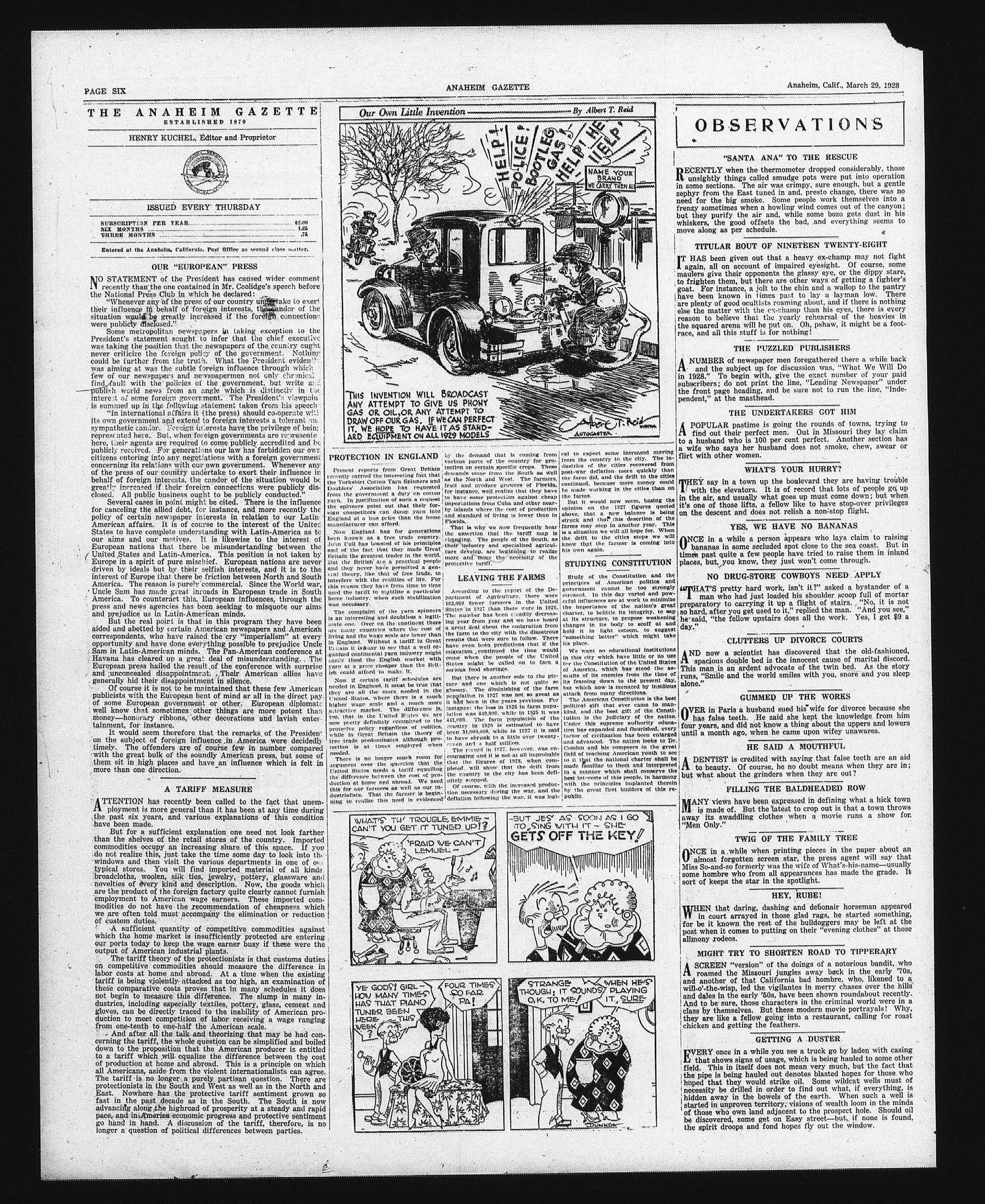
Searchable text
THE ANAHEIM GAZETTE
ESTABLISHED 1870
HENRY KUCHEL, Editor and Proprietor
ISSUED EVERY THURSDAY
SUBSCRIPTION PER YEAR.....$2.00
SIX MONTHS.....1.25
THREE MONTHS......75
Entered at the Anaheim, California, Post Office as second class matter.
OUR "EUROPEAN" PRESS
NO STATEMENT of the President has caused wider comment recently than the one contained in Mr. Coolidge's speech before the National Press Club in which he declared:
"Whenever any of the press of our country undertake to exert their influence in behalf of foreign interests, the candor of the situation would be greatly increased if the foreign connections were publicly disclosed."
Some metropolitan newspapers in taking exception to the President's statement sought to infer that the chief executive was taking the position that the newspapers of the country ought never criticize the foreign policy of the government. Nothing could be further from the truth. What the President evidently was aiming at was the subtle foreign influence through which few of our newspapers and newspapermen not only chronically find fault with the policies of the government, but write and publish world news from an angle which is distinctly in the interest of some foreign government. The President's viewpoint is summed up in the following statement taken from his speech:
"In international affairs it (the press) should co-operate with its own government and extend to foreign interests a tolerant and sympathetic candor. Foreign interests have the privilege of being represented here. But, when foreign governments are represented here, their agents are required to come publicly accredited and be publically received."
never criticize the foreign policy of the government. Not only could be further from the truth. What the President evidently was aiming at was the subtle foreign influence through which few of our newspapers and newspapermen not only chronically find fault with the policies of the government, but write and publish world news from an angle which is distinctly in the interest of some foreign government. The President's viewpoint is summed up in the following statement taken from his speech:
"In international affairs it (the press) should co-operate with its own government and extend to foreign interests a tolerant and sympathetic candor. Foreign interests have the privilege of being represented here. But, when foreign governments are represented here, their agents are required to come publicly accredited and be publicly received. For generations our law has forbidden our own citizens entering into any negotiations with a foreign government concerning its relations with our own government. Whenever any of the press of our country undertake to exert their influence in behalf of foreign interests, the candor of the situation would be greatly increased if their foreign connections were publicly disclosed. All public business ought to be publicly conducted."
Several cases in point might be cited. There is the influence for canceling the allied debt, for instance, and more recently the policy of certain newspaper interests in relation to our Latin American affairs. It is of course to the interest of the United States to have complete understanding with Latin-America as to our aims and our motives. It is likewise to the interest of European nations that there be misunderstanding between the United States and Latin-America. This position is not taken by Europe in a spirit of pure mischief. European nations are never driven by ideals but by their selfish interests, and it is to the interest of Europe that there be friction between North and South America. The reason is purely commercial. Since the World war, Uncle Sam has made great inroads in European trade in South America. To counteract this, European influences, through the press and news agencies has been seeking to misquote our aims and prejudice us in Latin-American minds.
But the real point is that in this program they have been aided and abetted by certain American newspapers and American correspondents, who have raised the cry "imperialism" at every opportunity and have done everything possible to prejudice Uncle Sam in Latin-American minds. The Pan-American conference at Havana has cleared up a great deal of misunderstanding. The European press hailed the result of the conference with surprise and unconcealed disappointment. Their American allies have generally hid their disappointment in silence.
Of course it is not to be maintained that these few American publicists with the European bent of mind ar all in the direct pay of some European government or other. European diplomats well know that sometimes other things are more potent than money—honorary ribbons, other decorations and lavish entertainment, for instance.
It would seem therefore that the remarks of the President on the subject of foreign influence in America were decidedly timely. The offenders are of course few in number compared with the great bulk of the soundly American press, but some of them sit in high places and have an influence which is felt in more than one direction.
A TARIFF MEASURE
ATTENTION has recently been called to the fact that unemployment is more general than it has been at any time during the past six years, and various explanations of this condition have been made.
But for a sufficient explanation one need not look farther than the shelves of the retail stores of the country. Imported commodities occupy an increasing share of this space. If you
A TARIFF MEASURE
ATTENTION has recently been called to the fact that unemployment is more general than it has been at any time during the past six years, and various explanations of this condition have been made.
But for a sufficient explanation one need not look farther than the shelves of the retail stores of the country. Imported commodities occupy an increasing share of this space. If you do not realize this, just take the time some day to look into the windows and then visit the various departments in one of our typical stores. You will find imported material of all kinds: broadcloths, woolen, silk ties, jewelry, pottery, glassware and novelties of every kind and description. Now, the goods which are the product of the foreign factory quite clearly cannot furnish employment to American wage earners. These imported commodities do not have the recommendation of cheapness which we are often told must accompany the elimination or reduction of custom duties.
A sufficient quantity of competitive commodities against which the home market is insufficiently protected are entering our ports today to keep the wage earner busy if these were the output of American industrial plants.
The tariff theory of the protectionists is that customs duties on competitive commodities should measure the difference in labor costs at home and abroad. At a time when the existing tariff is being violently attacked as too high, an examination of these comparative costs proves that in many schedules it does not begin to measure this difference. The slump in many industries, including especially textiles, pottery, glass, cement and gloves, can be directly traced to the inability of American production to meet competition of labor receiving a wage ranging from one-tenth to one-half the American scale.
And after all the talk and theorizing that may be had concerning the tariff, the whole question can be simplified and boiled down to the proposition that the American producer is entitled to a tariff which will equalize the difference between the cost of production at home and abroad. This is a principle on which all Americans, aside from the violent internationalists can agree. The tariff is no longer a purely partisan question. There are protectionists in the South and West as well as in the North and East. Nowhere has the protective tariff sentiment grown so fast in the past decade as in the South. The South is now advancing along the highroad of prosperity at a steady and rapid pace, and in America economic progress and protective sentiment go hand in hand. A discussion of the tariff, therefore, is no longer a question of political differences between parties.
Our Own Little Invention By Albert T. Reid
HELP!
POLICE!
BOOTLEG!
GAS!
HELP! HE
HELP!
NAME YOUR BRAND
WE CARRY THEM ALL
THIS INVENTION WILL BROADCAST ANY ATTEMPT TO GIVE US PHONY GAS OR OIL, OR ANY ATTEMPT TO DRAW OFF OUR GAS. IF WE CAN PERFECT IT, WE HOPE TO HAVE IT AS STANDARD EQUIPMENT ON ALL 1929 MODELS
Albert T. Reid
AUTOCASTER
PROTECTION IN ENGLAND
Present reports from Great Britain recently carried the interesting fact that the Yorkshire Cotton Yarn Spinners and Doublers' Association has requested from the government a duty on cotton yarn. In justification of such a request the spinners point out that their foreign competitors can dump yarn into England at a less price than the home manufacturer can afford.
Now England has for generations been known as a free trade country. John Full has boasted of his principles and of the fact that they made Great Britain the greatest trader in the world. But the British are a practical people and they never have permitted a general theory, like that of free trade, to interfere with the realities of life. For this reason they have from time to time used the tariff to stabilize a particular home industry, when such stabilization was necessary.
The complaint of the yarn spinners is an interesting and doubtless a legitimate one. Over on the continent there are many countries where the cost of living and the wage scale are lower than in England. Without a tariff in Great Britain it is easy to see that a well organized continental yarn industry might easily flood the English market with yarn at a price cheaper than the British could afford to make it.
Now if certain tariff schedules are needed in England, it must be true that they are all the more needed in the United States, where there is a much higher wage scale and a much more attractive market. The difference is, too, that in the United States we are now pretty definitely committed to the protective policy regardless of politics, while in Great Britain the theory of free trade predominates, although protection is at times employed when needed.
There is no longer much room for argument over the question that the United States needs a tariff equalling the difference between the cost of production at home and abroad. We need this for our farmers as well as our industrialists. That the farmer is beginning to realize this need is evidenced by the demand that is coming from various parts of the country for protection on certain specific crops. These demands come from the South as well as the North and West. The farmers, fruit and produce growers of Florida, for instance, well realize that they have to have some protection against cheap importations from Cuba and other nearby islands where the cost of production and standard of living is lower than in Florida.
That is why we now frequently hear the assertion that the tariff map is changing. The people of the South, as their industry and specialized agriculture develop, are beginning to realize more and more the necessity of the protective tariff.
LEAVING THE FARMS
According to the report of the Department of Agriculture, there were 193,000 fewer farmers in the United States in 1927 than there were in 1926. The number has been steadily decreasing year from year and we have heard a great deal about the emigration from the farm to the city with the disastrous results that were sure to follow. There have even been predictions that if migration continued the time would come when the people of the United States might be called on to face a serious food shortage.
But there is another side to the picture and one which is not quite so gloomy. The diminishing of the farm population in 1927 was not so great as it had been in the years previous. For instance: the loss in 1926 in farm population was 649,000, while in 1925 it was 441,000. The farm population of the country in 1920 is estimated to have been 31,000,000, while in 1927 it is said to have shrunk to a little over twenty-even and a half million.
The record in 1927, however, was encouraging and it is not at all improbable that the figures of 1928, when completed, will show that the drift from the country to the city has been definitely stopped.
Of course, with the increased production necessary during the war, it was logical to expect some increased moving from the country to the city. The industries of the cities recovered from post-war deflation more quickly than the farm did, and the drift to the cities continued, because more money could be made working in the cities than on the farms.
But it would now seem, basing the opinion on the 1927 figures quoted above, that a new balance is being struck and that this desertion of the farms may stop in another year. This is a situation we will all hope for. When the drift to the cities stops we will know that the farmer is coming into his own again.
STUDYING CONSTITUTION
Study of the Constitution and the principles of American politics and government cannot be too strongly stressed. In this day varied and powerful influences are at work to minimize the importance of the nation's great charter, to bellittle its integrity, to sap at its structure, to propose weakening changes in its body to scoff at and hold it in light esteem, to suggest "something better" which might take its place.
We want no educational institutions in this city which have little or no use for the Constitution of the United States of America, which has stood the assaults of its enemies from the time of its framing down to the present day, but which now is menaced by insidious attack from many directions.
The American Constitution is the best political gift that ever came to mankind, and the best gift of the Constitution is the judiciary of the nation. Under this supreme authority education has expanded and flourished, every factor of civilization has been enlarged and advanced. The nation looks to Dr. Condon and his compeers in the great field of teaching American youth to see it that the national charter shall be made familiar to them and interpreted in a manner which shall conserve the best interests of these people, in harmony with the principles implanted therein by the great first builders of this republic.
There is no longer much room for argument over the question that the United States needs a tariff equalling the difference between the cost of production at home and abroad. We need this for our farmers as well as our industrialists. That the farmer is beginning to realize this need is evidenced by courage and it is not at an impasse that the figures of 1928, when completed, will show that the drift from the country to the city has been definitely stopped.
Of course, with the increased production necessary during the war, and the deflation following the war, it was logi-
WHAT'S TH' TROUBLE, EMMIE ~ CAN'T YOU GET IT TUNED UP!?
FRAID WE CAN'T LEMUEL ~
BUT JES' AS SOON AS I GO TO SING WITH IT ~ SHE GETS OFF THE KEY!
YE GODS! GIRL ~ HOW MANY TIMES HAS THAT PIANO TUNER BEEN HERE THIS WEEK?
FOUR TIMES SO FAR PA!
STRANGE THOUGH; IT SOUNDS PLAYING IT, SURE-
DUNKEN
OBSERVATIONS
"SANTA ANA" TO THE RESCUE
RECENTLY when the thermometer dropped considerably, those unsightly things called smudge pots were put into operation in some sections. The air was crimpy, sure enough, but a gentle zephyr from the East tuned in and, presto change, there was no need for the big smoke. Some people work themselves into a frenzy sometimes when a howling wind comes out of the canyon; but they purify the air and, while some bozo gets dust in his whiskers, the good offsets the bad, and everything seems to move along as per schedule.
TITULAR BOUT OF NINETEEN TWENTY-EIGHT
IT HAS been given out that a heavy ex-champ may not fight again, all on account of impaired eyesight. Of course, some maulers give their opponents the glassy eye, or the dippy stare, to frighten them, but there are other ways of getting a fighter's goat. For instance, a jolt to the chin and a wallop to the pantry have been known in times past to lay a layman low. There are plenty of good oculists roaming about, and if there is nothing else the matter with the ex-champ than his eyes, there is every reason to believe that the yearly rehearsal of the heavies in the squared arena will be put on. Oh, pshaw, it might be a footrace, and all this stuff is for nothing!
THE PUZZLED PUBLISHERS
A NUMBER of newspaper men foregathered there a while back and the subject up for discussion was, "What We Will Do in 1928." To begin with, give the exact number of your paid subscribers; do not print the line, "Leading Newspaper" under the front page heading, and be sure not to run the line, "Independent," at the masthead.
THE UNDERTAKERS GOT HIM
A POPULAR pastime is going the rounds of towns, trying to find out their perfect men. Out in Missouri they lay claim to a husband who is 100 per cent perfect. Another section has a wife who says her husband does not smoke, chew, swear or
NUMBER of newspaper men foregathered there a while back and the subject up for discussion was, "What We Will Do in 1928." To begin with, give the exact number of your paid subscribers; do not print the line, "Leading Newspaper" under the front page heading, and be sure not to run the line, "Independent," at the masthead.
THE UNDERTAKERS GOT HIM
POPULAR pastime is going the rounds of towns, trying to find out their perfect men. Out in Missouri they lay claim to a husband who is 100 per cent perfect. Another section has a wife who says her husband does not smoke, chew, swear or flirt with other women.
WHAT'S YOUR HURRY?
THEY say in a town up the boulevard they are having trouble with the elevators. It is of record that lots of people go up in the air, and usually what goes up must come down; but when it's one of those lifts, a fellow like to have stop-over privileges on the descent and does not relish a non-stop flight.
YES, WE HAVE NO BANANAS
ONCE in a while a person appears who lays claim to raising bananas in some secluded spot close to the sea coast. But in times past quite a few people have tried to raise them in inland places, but, you know, they just won't come through.
NO DRUG-STORE COWBOYS NEED APPLY
"THAT'S pretty hard work, isn't it?" asked a bystander of a man who had just loaded his shoulder scoop full of mortar preparatory to carrying it up a flight of stairs. "No, it is not so hard, after you get used to it," replied the man. "And you see," he said, "the fellow upstairs does all the work. Yes, I get $9 a day."
CLUTTERS UP DIVORCE COURTS
AND now a scientist has discovered that the old-fashioned, spacious double bed is the innocent cause of marital discord. This man is an ardent advocate of the twin bed. As the story runs, "Smile and the world smiles with you, snore and you sleep alone."
GUMMED UP THE WORKS
OVER in Paris a husband sued his wife for divorce because she has false teeth. He said she kept the knowledge from him four years, and did not know a thing about the uppers and lowers until a month ago, when he came upon wifey unawares.
HE SAID A MOUTHFUL
ADENTIST is credited with saying that false teeth are an aid to beauty. Of course, he no doubt means when they are in; but what about the grinders when they are out?
FILLING THE BALDHEADED ROW
MANY views have been expressed in defining what a hick town is made of. But the latest to crop out is that a town throws away its swaddling clothes when a movie runs a show for "Men Only."
TWIG OF THE FAMILY TREE
DENTIST is credited with saying that false teeth are an aid to beauty. Of course, he no doubt means when they are in; but what about the grinders when they are out?
FILLING THE BALDHEADED ROW
MANY views have been expressed in defining what a hick town is made of. But the latest to crop out is that a town throws away its swaddling clothes when a movie runs a show for "Men Only."
TWIG OF THE FAMILY TREE
ONCE in a while when printing pieces in the paper about an almost forgotten screen star, the press agent will say that Miss So-and-so formerly was the wife of What's-his-name—usually some hombre who from all appearances has made the grade. It sort of keeps the star in the spotlight.
HEY, RUBE!
WHEN that daring, dashing and debonair horseman appeared in court arrayed in those glad rags, he started something, for be it known the rest of the bulldoggers may be left at the post when it comes to putting on their "evening clothes" at those allmony rodeos.
MIGHT TRY TO SHORTEN ROAD TO TIPPERARY
ASCREEN "version" of the doings of a notorious bandit, who roamed the Missouri jungles away back in the early '70s, and another of that California bad hombre, who, likened to a will-o'-the-wisp, led the vigilantes in merry chases over the hills and dales in the early '50s, have been shown roundabout recently. And to be sure, those characters in the criminal world were in a class by themselves. But these modern movie portrayals! Why, they are like a fellow going into a restaurant, calling for roast chicken and getting the feathers.
GETTING A DUSTER
EVERY once in a while you see a truck go by laden with casing that shows signs of usage, which is being hauled to some other field. This in itself does not mean very much, but the fact that the pipe is being hauled out denotes blasted hopes for those who hoped that they would strike oil. Some wildcat wells must of necessity be drilled in order to find out what, if everything, is hidden away in the bowels of the earth. When such a well is started in unproven territory, visions of wealth loom in the minds of those who own land adjacent to the prospect hole. Should oil be discovered, some get on Easy street—but, if none is found, the spirit droops and fond hopes fly out the window.