anaheim-gazette 1927-12-01
Scanned page
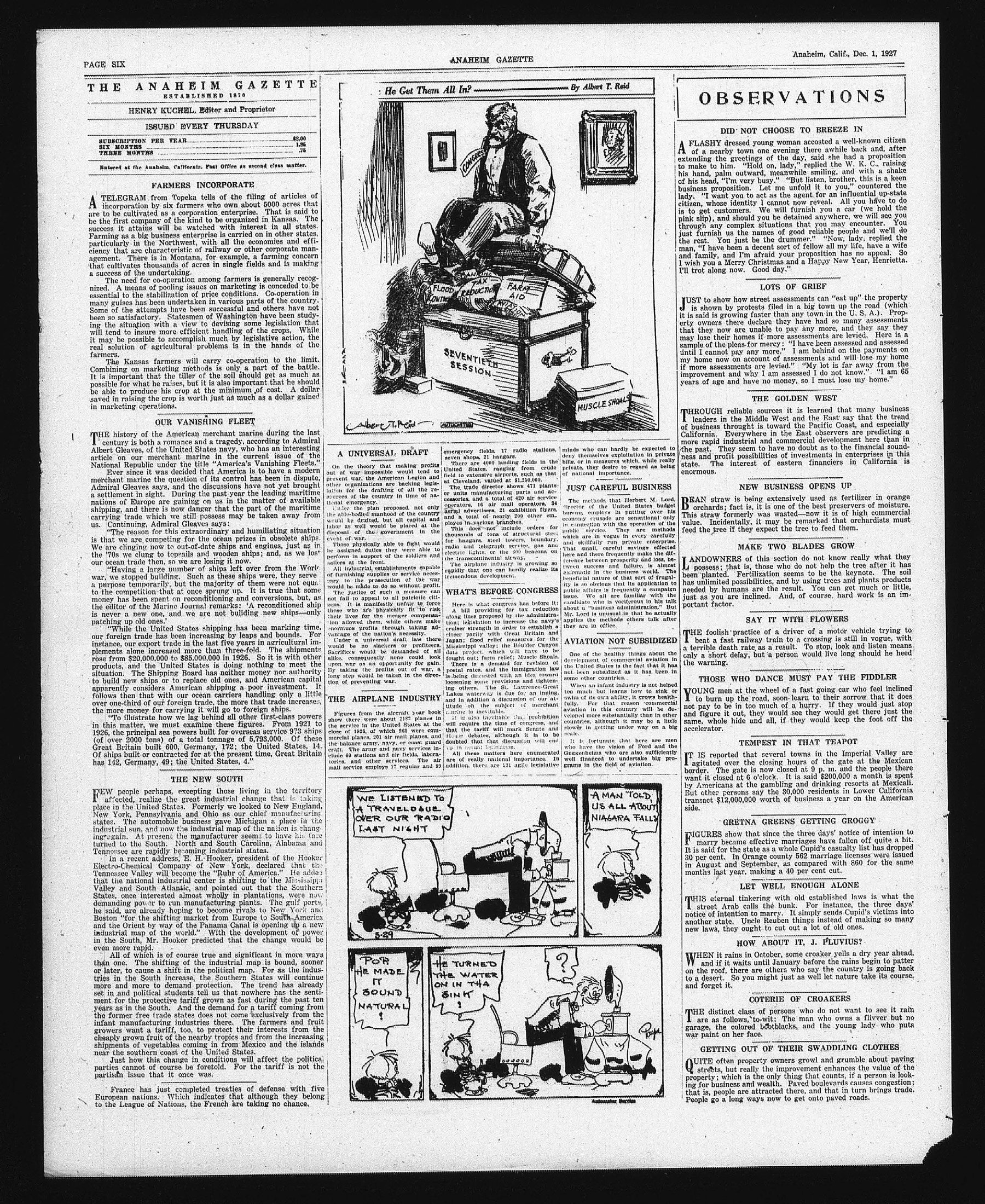
Searchable text
THE ANAHEIM GAZETTE
ESTABLISHED 1870
HENRY KUCHEL, Editor and Proprietor
ISSUED EVERY THURSDAY
SUBSCRIPTION PER YEAR.....$2.00
SIX MONTHS.....1.50
THREE MONTHS.....7.50
Entered at the Anaheim, California, Post Office as second class matter.
FARMERS INCORPORATE
A TELEGRAM from Topeka tells of the filing of articles of incorporation by six farmers who own about 5000 acres that are to be cultivated as a corporation enterprise. That is said to be the first company of the kind to be organized in Kansas. The success it attains will be watched with interest in all states. Farming as a big business enterprise is carried on in other states, particularly in the Northwest, with all the economies and efficiency that are characteristic of railway or other corporate management. There is in Montana, for example, a farming concern that cultivates thousands of acres in single fields and is making a success of the undertaking.
The need for co-operation among farmers is generally recognized. A means of pooling issues on marketing is conceded to be essential to the stabilization of price conditions. Co-operation in many guises has been undertaken in various parts of the country. Some of the attempts have been successful and others have not been so satisfactory. Statesmen of Washington have been studying the situation with a view to devising some legislation that will tend to insure more efficient handling of the crops. While it may be possible to accomplish much by legislative action, the real solution of agricultural problems is in the hands of the farmers.
The Kansas farmers will carry co-operation to the limit. Combining on marketing methods is only a part of the battle. It is important that the tiller of the soil should get as much as possible for what he raises, but it is also important that he should be able to produce his crop at the minimum of cost. A dollar saved in raising the crop is worth just as much as a dollar gained in marketing operations.
OUR VANISHING FLEET
The history of the American merchant marine during the last century is both a romance and a tragedy, according to Admiral Albert Cleaves, of the United States navy, who has an interesting
The Kansas farmers will carry co-operation to the limit. Combining on marketing methods is only a part of the battle. It is important that the tiller of the soil should get as much as possible for what he raises, but it is also important that he should be able to produce his crop at the minimum of cost. A dollar saved in raising the crop is worth just as much as a dollar gained in marketing operations.
OUR VANISHING FLEET
THE history of the American merchant marine during the last century is both a romance and a tragedy, according to Admiral Albert Gleaves, of the United States navy, who has an interesting article on our merchant marine in the current issue of the National Republic under the title "America's Vanishing Fleets."
Ever since it was decided that America is to have a modern merchant marine the question of its control has been in dispute, Admiral Gleaves says, and the discussions have not yet brought a settlement in sight. During the past year the leading maritime nations of Europe are gaining on us in the matter of available shipping, and there is now danger that the part of the maritime carrying trade which we still possess may be taken away from us. Continuing, Admiral Gleaves says:
"The reason for this extraordinary and humiliating situation is that we are competing for the ocean prizes in obsolete ships. We are clinging now to out-of-date ships and engines, just as in the '70s we clung to topsails and wooden ships; and, as we lost our ocean trade then, so we are losing it now.
"Having a large number of ships left over from the World war, we stopped building. Such as these ships were, they serve a purpose temporarily, but the majority of them were not equal to the competition that at once sprung up. It is true that some money has been spent on reconditioning and conversions, but, as the editor of the Marine Journal remarks: 'A reconditioned ship is never a new one, and we are not building new ships—only patching up old ones.'
"While the United States shipping has been marking time, our foreign trade has been increasing by leaps and bounds. For instance, our export trade in the last five years in agricultural implements alone increased more than three-fold. The shipments rose from $20,000,000 to $85,000,000 in 1926. So it is with other products, and the United States is doing nothing to meet the situation. The Shipping Board has neither money nor authority to build new ships or to replace old ones, and American capital apparently considers American shipping a poor investment. It follows then that with our ocean carriers handling only a little over one-third of our foreign trade, the more that trade increases, the more money for carrying it will go to foreign ships.
"To illustrate how we lag behind all other first-class powers in this matter, we must examine these figures. From 1921 to 1926, the principal sea powers built for overseas service 973 ships (of over 2000 tons) of a total tonnage of 5,793,000. Of these Great Britain built 600, Germany, 172; the United States, 14. Of ships built or contracted for at the present time, Great Britain has 142, Germany, 49; the United States, 4."
THE NEW SOUTH
New people perhaps, excepting those living in the territory affected, realize the great industrial change that is taking place in the United States. Formerly we looked to New England, New York, Pennsylvania and Ohio as our chief manufacturing states. The automobile business gave Michigan a place in the industrial sun, and now the industrial map of the nation is changing again. At present the manufacturer seems to have his face turned to the South. North and South Carolina, Alabama and Tennessee are rapidly becoming industrial states.
THE NEW SOUTH
FEW people perhaps, excepting those living in the territory affected, realize the great industrial change that is taking place in the United States. Formerly we looked to New England, New York, Pennsylvania and Ohio as our chief manufacturing states. The automobile business gave Michigan a place in the industrial sun, and now the industrial map of the nation is changing again. At present the manufacturer seems to have his face turned to the South. North and South Carolina, Alabama and Tennessee are rapidly becoming industrial states.
In a recent address, E. H. Hooker, president of the Hooker Electro-Chemical Company of New York, declared that the Tennessee Valley will become the "Ruhr of America." He added that the national industrial center is shifting to the Mississippi Valley and South Atlantic, and pointed out that the Southern States, once interested almost wholly in plantations, were now demanding power to run manufacturing plants. The gulf ports, he said, are already hoping to become rivals to New York and Boston "for the shifting market from Europe to South America and the Orient by way of the Panama Canal is opening up a new industrial map of the world." With the development of power in the South, Mr. Hooker predicted that the change would be even more rapid.
All of which is of course true and significant in more ways than one. The shifting of the industrial map is bound, sooner or later, to cause a shift in the political map. For as the industries in the South increase, the Southern States will continue more and more to demand protection. The trend has already set in and political students tell us that nowhere has the sentiment for the protective tariff grown as fast during the past ten years as in the South. And the demand for a tariff coming from the former free trade states does not come exclusively from the infant manufacturing industries there. The farmers and fruit growers want a tariff, too, to protect their interests from the cheaply grown fruit of the nearby tropics and from the increasing shipments of vegetables coming in from Mexico and the islands near the southern coast of the United States.
Just how this change will affect the political parties cannot of course be foretold. For the tariff is not the partisan issue that it once was.
France has just completed treaties of defense with five European nations. Which indicates that although they belong to the League of Nations, the French are taking no chance.
ANAHEIM GAZETTE
He Get Them All In? By Albert T. Reid
CONGRESS
FLOOD CONTROL
TAX REDUCTION
FARM AID
SEVENTIETH SESSION
MUSCLE SHOALS
Albert T. Reid
A UNIVERSAL DRAFT
On the theory that making profits out of war impossible would tend to prevent war, the American Legion and other organizations are backing legislation for the drafting of all the resources of the country in time of national emergency.
Under the plan proposed, not only the able-bodied manhood of the country would be drafted, but all capital and labor as well would be placed at the disposal of the government in the event of war.
Those physically able to fight would be assigned duties they were able to perform in support of the soldiers and sailors at the front.
All industrial establishments capable of furnishing supplies or service necessary to the prosecution of the war would be made to do without profit.
The justice of such a measure can not fail to appeal to all patriotic citizens. It is manifestly unfair to force those who are physically fit to risk their lives for the meager compensation allowed them, while others make enormous profits through taking advantage of the nation's necessity.
Under a universal draft law there would be no slackers or profiteers. Sacrifices would be demanded of all alike, consequently none could look upon war as an opportunity for gain. By taking the profits out of war, a long step would be taken in the direction of preventing war.
THE AIRPLANE INDUSTRY
Figures from the aircraft year book show there were about 2152 planes in the service in the United States at the close of 1926, of which 969 were commercial planes, 201 air mail planes, and the balance army, navy, or coast guard craft. The army and navy services include 60 stations and air fields, laboratories, and other services. The air mail service employs 17 regular and 89 emergency fields, 17 radio stations, seven shops, 21 hangars.
There are 4000 landing fields in the United States, ranging from crude field to extensive airports, such as that at Cleveland, valued at $1,250,000.
The trade director shows 471 plants or units manufacturing parts and accessories, and a total of 420 air service operators, 16 air mail operators, 34 aerial advertisers, 21 exhibition flyers, and a total of nearly 200 other employees in various branches.
This does not include orders for thousands of tons of structural steel for hangars, steel towers, boundary radio and telegraph service, gas and electric lights, or the 600 beacons on the transcontinental airway.
The airplane industry is growing so rapidly that one can hardly realize its tremendous development.
WHAT'S BEFORE CONGRESS
Here is what congress has before it:
A bill providing for tax reduction along lines proposed by the administration; legislation to increase the navy's cruiser strength in order to establish a closer parity with Great Britain and Japan; flood relief measures for the Mississippi valley; the Boulder Canyon data project, which will have to be fought out; farm relief; Muscle Shoals.
There is a demand for revision of postal rates, and the immigration law is being discussed with an idea toward loosening some provisions and tightening others. The St. Lawrence-Great Lakes waterway is due for an inning, and in addition a discussion of our attitude on the subject of merchant marine is inevitable.
It is also inevitable that prohibition will require the time of congress, and that the tariff will mark Senate and House debates, although it is to be doubted that that discussion will end up in actual legislation.
All these matters here enumerated are of really national importance. In addition, there are 831 agile legislative minds who can hardly be expected to deny themselves exploitation in private bills, or in measures which, while really private, they desire to regard as being of national importance.
JUST CAREFUL BUSINESS
The methods that Herbert M. Lord, director of the United States budget bureau, employs in putting over his economy crusade are sensational only in connection with the operation of the public service. They are methods which are in vogue in every carefully and skillfully run private enterprise. That small, careful savings effected here and there frequently make the difference between prosperity and loss, between success and failure, is almost axiomatic in the business world. The beneficial nature of that sort of frugality is so obvious that its application to public affairs is frequently a campaign issue. We all are familiar with the candidate who is vociferous in his talk about a "business administration." But Mr. Lord is unusual in that he actually applies the methods others talk after they are in office.
AVIATION NOT SUBSIDIZED
One of the healthy things about the development of commercial aviation in the United States is the fact that it has not been subsidized as it has been in some other countries.
When an infant industry is not helped too much but learns how to sink or swim of its own ability, it grows healthfully. For that reason commercial aviation in this country will be developed more substantially than in other countries, although it may be a little slower in getting under way on a big scale.
It is fortunate that here are men who have the vision of Ford and the Guggenheim who are also sufficiently well financed to undertake big programs in the field of aviation.
WE LISTENED TO A TRAVELOGUE OVER OUR RADIO LAST NIGHT
A MAN TOLD US ALL ABOUT NIAGARA FALLS
POR HE MADE IT SOUND NATURAL!
HE TURNED THE WATER ON IN THA SINK!
OBSERVATIONS
DID NOT CHOOSE TO BREEZE IN
A FLASHY dressed young woman accosted a well-known citizen of a nearby town one evening there awhile back and, after extending the greetings of the day, said she had a proposition to make to him. "Hold on, lady," replied the W. K. C., raising his hand, palm outward, meanwhile smiling, and with a shake of his head, "I'm very busy." "But listen, brother, this is a keen business proposition. Let me unfold it to you," countered the lady. "I want you to act as the agent for an influential up-state citizen, whose identity I cannot now reveal. All you have to do is to get customers. We will furnish you a car (we hold the pink slip), and should you be detained anywhere, we will see you through any complex situations that you may encounter. You just furnish us the names of good reliable people and we'll do the rest. You just be the drummer." "Now, lady, replied the man, "I have been a decent sort of fellow all my life, have a wife and family, and I'm afraid your proposition has no appeal. So I wish you a Merry Christmas and a Happy New Year, Henrietta. I'll trot along now. Good day."
LOTS OF GRIEF
JUST to show how street assessments can "eat up" the property is shown by protests filed in a big town up the road (which it is said is growing faster than any town in the U. S. A.). Property owners there declare they have had so many assessments that they now are unable to pay any more, and they say they may lose their homes if more assessments are levied. Here is a sample of the pleas-for mercy: "I have been assessed and assessed until I cannot pay any more." I am behind on the payments on my home now on account of assessments and will lose my home if more assessments are levied." "My lot is far away from the improvement and why I am assessed I do not know." "I am 65 years of age and have no money, so I must lose my home."
THE GOLDEN WEST
THROUGH reliable sources it is learned that many business leaders in the Middle West and the East say that the trend of business thought is toward the Pacific Coast, and especially California. Everywhere in the East observers are predicting a more rapid industrial and commercial development here than in the past. They seem to have no doubt as to the financial sound-
THE GOLDEN WEST
THROUGH reliable sources it is learned that many business leaders in the Middle West and the East say that the trend of business thought is toward the Pacific Coast, and especially California. Everywhere in the East observers are predicting a more rapid industrial and commercial development here than in the past. They seem to have no doubt as to the financial soundness and profit possibilities of investments in enterprises in this state. The interest of eastern financiers in California is enormous.
NEW BUSINESS OPENS UP
BEAN straw is being extensively used as fertilizer in orange orchards; fact is, it is one of the best preservers of moisture. This straw formerly was wasted—now it is of high commercial value. Incidentally, it may be remarked that orchardists must feed the tree if they expect the tree to feed them.
MAKE TWO BLADES GROW
LANDOWNERS of this section do not know really what they possess; that is, those who do not help the tree after it has been planted. Fertilization seems to be the keynote. The soil has unlimited possibilities, and by using trees and plants products needed by humans are the result. You can get much or little, just as you are inclined. And, of course, hard work is an important factor.
SAY IT WITH FLOWERS
THE foolish practice of a driver of a motor vehicle trying to beat a fast railway train to a crossing is still in vogue, with a terrible death rate as a result. To stop, look and listen means only a short delay, but a person would live long should he heed the warning.
THOSE WHO DANCE MUST PAY THE FIDDLER
YOUNG men at the wheel of a fast going car who feel inclined to burn up the road, soon learn to their sorrow that it does not pay to be in too much of a hurry. If they would just stop and figure it out, they would see they would get there just the same, whole hide and all, if they would keep the foot off the accelerator.
TEMPEST IN THAT TEAPOT
IT IS reported that several towns in the Imperial Valley are agitated over the closing hours of the gate at the Mexican border. The gate is now closed at 9 p.m. and the people there want it closed at 6 o'clock. It is said $200,000 a month is spent by Americans at the gambling and drinking resorts at Mexicali. But other persons say the 30,000 residents in Lower California transact $12,000,000 worth of business a year on the American side.
GRETNA GREENS GETTING GROGGY
FIGURES show that since the three days' notice of intention to marry became effective marriages have fallen off quite a bit. It is said for the state as a whole Cupid's casualty list has dropped
GRETNA GREENS GETTING GROGGY
FIGURES show that since the three days' notice of intention to marry became effective marriages have fallen off quite a bit. It is said for the state as a whole Cupid's casualty list has dropped 30 per cent. In Orange county 562 marriage licenses were issued in August and September, as compared with 860 for the same months last year, making a 40 per cent cut.
LET WELL ENOUGH ALONE
THIS eternal tinkering with old established laws is what the street Arab calls the bunk. For instance, the three days' notice of intention to marry. It simply sends Cupid's victims into another state. Uncle Reuben things instead of making so many new laws, they ought to cut out a lot of old ones.
HOW ABOUT IT, J. PLUVIUS?
WHEN it rains in October, some croaker yells a dry year ahead, and if it waits until January before the rains begin to patter on the roof, there are others who say the country is going back to a desert. So you might just as well let nature take its course, and forget it.
COTERIE OF CROAKERS
THE distinct class of persons who do not want to see it rain are as follows, to-wit: The man who owns a flivver but no garage, the colored bootblacks, and the young lady who puts war paint on her face.
GETTING OUT OF THEIR SWADDLING CLOTHES
QUITE often property owners growl and grumble about paving streets, but really the improvement enhances the value of the property; which is the only thing that counts, if a person is looking for business and wealth. Paved boulevards causes congestion; that is, people are attracted there, and that in turn brings trade. People go a long ways now to get onto paved roads.