anaheim-gazette 1927-09-22
Scanned page
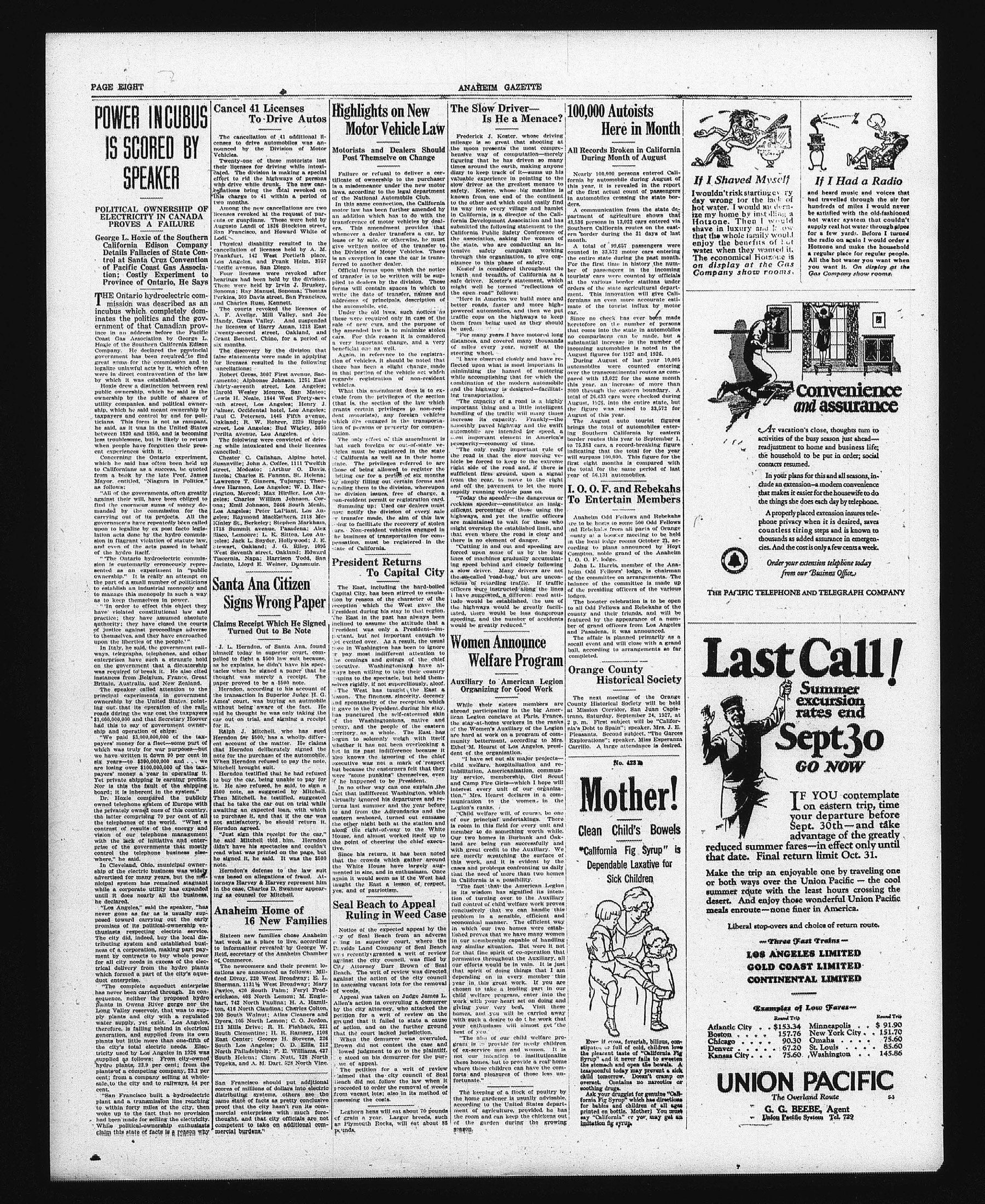
Searchable text
POWER INCUBUS IS SCORED BY SPEAKER
POLITICAL OWNERSHIP OF ELECTRICITY IN CANADA PROVES A FAILURE
George L. Hoxie of the Southern California Edison Company Details Fallacies of State Control at Santa Cruz Convention of Pacific Coast Gas Association; Costly Experiment to Province of Ontario, He Says
THE Ontario hydroelectric commission was described as an incubus which completely dominates the politics and the government of that Canadian province in an address before the Pacific Coast Gas Association by George L. Hoxie of the Southern California Edison Company. He declared the provincial government has been required to find great sums for the commission and to legalize unlawful acts by it, which often were in direct contravention of the law by which it was established.
Hoxie drew a distinction between real public ownership, which he said is the ownership by the public of shares of utility companies, and political ownership, which he said meant ownership by taxpayers and control by and for politicians. This form is not as rampant, he said, as it was in the United States between 1830 and 1850, and is becoming less troublesome, but is likely to return when people have forgotten their prescriptions.
Cancel 41 Licenses To Drive Autos
The cancellation of 41 additional licenses to drive automobiles was announced by the Division of Motor Vehicles.
Twenty-one of these motorists lost their licenses for driving while intoxicated. The division is making a special effort to rid the highways of persons who drive while drunk. The new cancellations bring the total revoked on this charge to 41 within a period of two months.
Among the new cancellations are two licenses revoked at the request of parents or guardians. These were held by Augusto Landi of 1826 Stockton street, San Francisco, and Howard White of Lodf.
Physical disability resulted in the cancellation of licenses held by A. M. Frankfurt, 142 West Fortieth place, Los Angeles, and Frank Helm, 3757 Pacific avenue, San Diego.
Four licenses were revoked after hearings had been held by the division. These were held by Irvin J. Bruskey, Sonoma; Ray Manuel, Sonoma; Thomas Perkins, 309 Davis street, San Francisco, and Charles Russ, Kennett.
The courts revoked the licenses of A. F. Avellar, Mill Valley, and Joe Handy, Grass Valley. And suspended the licenses of Harry Aman, 1218 East twenty-second street, Oakland, and Grant Bennett, Chino, for a period of six months.
The discovery by the division that false statements were made in applying for licenses resulted in the following cancellations:
Robert Gross, 3007 First avenue, Sacramento; Alphonse Johnson, 1251 East thirty-seventh street, Los Angeles; Harold Wesley Monroe, San Mateo; Lewis H. Neale, 1844 West Forty-seventh street, Los Angeles; Henry J. Palmer, Occidental hotel, Los Angeles; Paul C. Petersen, 1445 Fifth avenue, Oakland; R. W. Rohrer, 2229 Ripple street, Los Angeles; Bud Wigley, 3050 Perlita avenue, Los Angeles.
The foliolwing were convicted of driving while intoxicated and their licenses.
government has been required to find great sums for the commission and to legalize unlawful acts by it, which often were in direct contravention of the law by which it was established.
Hoxie drew a distinction between real public ownership, which he said is the ownership by the public of shares of utility companies, and political ownership, which he said meant ownership by taxpayers and control by and for politicians. This form is not as rampant, he said, as it was in the United States between 1830 and 1850, and is becoming less troublesome, but is likely to return when people have forgotten their present experiences with it.
Concerning the Ontario experiment, which he said has often been held up to Californians as a success, he quoted from a book by the late Prof. James Mayor, entitled, "Niagara in Politics," as follows:
"All of the governments, often greatly against their will, have been obliged to find the enormous sums of money demanded by the commission for the carrying out of its projects. All the governments have repeatedly been called upon to legalize by ex post facto legislation acts done by the hydro commission in flagrant violation of statute law, and even of the acts passed in behalf of the hydro itself."
"The Ontario hydroelectric commission is customarily erroneously represented as an experiment in "public ownership." It is really an attempt on the part of a small number of politicians to establish an industrial monopoly and to manage this monopoly in such a way as to keep themselves in power.
"In order to effect this object they have violated constitutional law and practice; they have assumed absolute authority; they have closed the courts of justice against proceedings adverse to themselves, and they have encroached upon the liberties of the people."
In Italy, he said, the government railways, telegraphs, telephones, and other enterprises have such a strangle hold on the government that a dictatorship was required to break it. He also cited instances from Belgium, France, Great Britain, Australia, and New Zealand.
The speaker called attention to the principal experiments in government ownership by the United States, pointing out that its operation of the railroads during the war cost the taxpayers $1,600,000,000 and that Secretary Hoover had this to say of government ownership and operation of ships:
"We paid $3,000,000,000 of the taxpayers' money for a fleet—some part of which was truly for war purposes—but we have written it down 90 per cent in six years—to $300,000,000 and . . . we are losing over $100,000,000 of the taxpayers' money a year in operating it. Yet private shipping is earning profits. Nor is this the fault of the shipping board; it is inherent in the system."
Dr. Hoxie compared the publicly owned telephone system of Europe with the privately owned ones of this country, the latter comprising 70 per cent of all the telephones of the world. "What a contrast of results of the energy and vision of our telephone management with the lack of initiative and enterprise of the governments that mostly
Santa Ana Citizen Signs Wrong Paper
Claims Receipt Which He Signed Turned Out to Be Note
J. L. Herndon, of Santa Ana, found himself today in superior court, compelled to fight a $500 law suit because, as he explains, he didn't have his spectacles when he signed a paper that he thought was merely a receipt. The paper proved to be a $500 note.
Herndon, according to his account of the transaction in Superior Judge H. G. Ames' court, was buying an automobile without being aware of the fact. He said he thought he was only taking the car out on trial, and signing a receipt for it.
Ralph J. Mitchell, who has sued Herndon for $500, has a wholly different account of the matter. He claims that Herndon deliberately signed the note for the purchase of the automobile. When Herndon refused to pay the note, Mitchell brought suit.
Herndon testified that he had refused to buy the car, being unable to pay for it. He also refused, he said, to sign a $500 note, as suggested by Mitchell. Then Mitchell, he testified, suggested that he take the car out on trial while awaiting an expected loan, with which to purchase it, and that if the car was not satisfactory, he should return it. Herndon agreed.
"Just sign this receipt for the car," he said Mitchell told him. Herndon didn't have his spectacles and couldn't (else statements were made in applying for licenses resulted in the following cancellations):
Robert Gross, 3007 First avenue, Sacramento; Alphonse Johnson, 1251 East thirty-seventh street, Los Angeles; Harold Wesley Monroe, San Mateo; Lewis H. Neale, 1844 West Forty-seventh street, Los Angeles; Henry J. Palmer, Occidental hotel, Los Angeles; Paul C. Petersen, 1445 Fifth avenue; Oakland; R. W. Rohrer, 2229 Ripple street, Los Angeles; Bud Wigley, 3050 Perlita avenue, Los Angeles.
The foliolwing were convicted of driving while intoxicated and their licenses cancelled:
Chester C. Callahan, Alpine hotel; Susanville; John A. Coffee, 1111 Twelfth street; Modesto; Arthur O. Davis; Imola; Charles E. Fannon, St. Helena; Lawrence T. Gianera, Tujenga; Theodore Harmon, Los Angeles; W. D. Harrington, Merced; Max Hirdler, Los Angeles; Charles William Johnson, Corona; Emil Johnson, 2666 South Menlo, Los Angeles; Peter LaPlant, Los Angeles; Raymond MacEsthern, 2118 McKinley St.; Berkeley; Stephen Markham, 1718 Summit avenue; Pasadena; Alexisco Lemoore; L. K. Sitton, Los Angeles; Jack L. Snyder, Hollywood; J. E. Stewart, Oakland; J. G. Riley, 1095 West Seventh street, Oakland; Edward Tiscernia, Napa; Harrison Todd, San Jacinto, Lloyd E. Weiner, Dunsmuir.
Santa Ana Citizen Signs Wrong Paper
Claims Receipt Which He Signed Turned Out to Be Note
J. L. Herndon, of Santa Ana, found himself today in superior court, compelled to fight a $500 law suit because, as he explains, he didn't have his spectacles when he signed a paper that he thought was merely a receipt. The paper proved to be a $500 note.
Herndon, according to his account of the transaction in Superior Judge H. G. Ames' court, was buying an automobile without being aware of the fact. He said he thought he was only taking the car out on trial, and signing a receipt for it.
Ralph J. Mitchell, who has sued Herndon for $500, has a wholly different account of the matter. He claims that Herndon deliberately signed the note for the purchase of the automobile. When Herndon refused to pay the note, Mitchell brought suit.
Herndon testified that he had refused to buy the car being unable to pay for it. He also refused, he said, to sign a $500 note as suggested by Mitchell. Then Mitchell, he testified suggested that he take the car out on trial while awaiting an expected loan with which to purchase it, and that if the car was not satisfactory he should return it. Herndon agreed.
"Just sign this receipt for the car," he said Mitchell told him. Herndon didn't have his spectacles and couldn't (else statements were made in applying for licenses resulted in the following cancellations):
Robert C. Callahan, Alpine hotel; Susanville; John A. Coffee, 1111 Twelfth street; Modesto; Arthur O. Davis; Imola; Charles E. Fannon, St. Helena; Lawrence T. Gianera, Tujenga; Theodore Harmon, Los Angeles; W. D. Harrington,Merced;Max Hirdler,Los Angeles;Charles William Johnson,Corona;Emil Johnson,2666 South Menlo,Los Angeles;Peter LaPlant,Los Angeles;Raymond MacEsthern,2118 McKinley St.; Berkeley;Stephen Markham,1718 Summit avenue;Pasadena;Alexisco Lemoore;L. K. Sitton,Los Angeles;Jack L. Snyder,Hollywood;J. E. Stewart,Oakland;J. G. Riley,1095 West Seventh street,Oakland;Edward Tiscernia,Napa;Harrison Todd,San Jacinto,Lloyd E. Weiner,Dunsmuir.
The East,Capital City,by reason why President due The East In inclined to a President wont get excited o pose in Waslah or pay most comings executive ways been w housins to tha selves rigidly The West Less lesson The end spontane it gave to tha has puncture of The War proxy,and territory as begun to so whether it h but in its p also knows executive w but because were "some if he happened In no other fact that indica virtually ign turns last s t o and from eastern seaboard other nik along r House,and at point of five
Dr. Hoxle compared the publicly owned telephone system of Europe with the privately owned ones of this country, the latter comprising 70 per cent of all the telephones of the world. "What a contrast of results of the energy and vision of our telephone management with the lack of initiative and enterprise of the governments that mostly control the telephone business elsewhere," he said.
In Cleveland, Ohio, municipal ownership of the electric business was widely advertised for many years, but the municipal system has remained stagnant while a corporate utility has expanded until it does nearly all the business, he declared.
"Los Angeles," said the speaker, "has never gone as far as is usually supposed toward carrying out the early promises of its political-ownership enthusiasts respecting electric service. The city did, indeed, buy the local distributing system and established business of a corporation, making part payment by contracts to buy whole power for all city needs in excess of the electrical delivery from the hydro plants which formed a part of the city's aqueduct enterprise.
"The complete aqueduct enterprise has never been carried through. In consequence, neither the proposed hydro plants in Owens River gorge nor the Long Valley reservoir, that was to supply plants and city with a regulated water supply, yet exist. Los Angeles, therefore, is falling behind in electrical generation, and supplied from its own plants but little more than one-fifth of the city's total electric needs. Electricity used by Los Angeles in 1926 was supplied as follows: From city-owned hydro plants, 22.9 per cent; from the plants of a competing company, 23.1 per cent; from a company selling at wholesale to the city and to railways, 54 per cent.
"San Francisco built a hydroelectric plant and a transmission line reaching to within forty miles of the city, then woke up to the fact that no provision had been made for selling the electricity. While political-ownership enthusiasts claim this state of facts is a reason why
San Francisco should put additional scores of millions of dollars into electric distributing systems, others see the same state of facts as pretty conclusive proof that the city hasn't run its commercial enterprises with much forethought, and that city officials are not competent to take on additional commercial burdens."
Highlights on New Motor Vehicle Law
Motorists and Dealers Should Post Themselve on Change
Failure or refusal to deliver a certificate of ownership to the purchaser is a misdemeanor under the new motor laws, according to the legal department of the National Automobile Club.
In this same connection, the California motor law has been further amended by an addition which has to do with the transference of motor vehicles by dealers. This amendment provides that whenever a dealer transfers a car, by lease or by sale, or otherwise, he must give written notice of the transfer to the Division of Motqr Vehicles. There is an exception in case the car is transferred to another dealer.
Official forms upon which the notice of transfer is to be written will be supplied to dealers by the division. These forms will contain spaces in which to write the date of transfer, names and addresses of principals, description of the automobile, etc.
Under the old laws, such notices as these were required only in case of the sale of new cars, and the purpose of the amended law is to minimize stolen cars. For this reason it is considered a very important change, and a very beneficial one as well.
Again, in reference to the registration of vehicles, it should be noted that there has been a slight change made in that portion of the vehicle act which regards registration of non-resident vehicles.
What this amendment does is to exclude from the privileges of the section (that is, the section of the law which grants certain privileges to non-resident motorists), any foreign vehicles which are engaged in the transportation of persons or property for compensation.
The only effect of this amendment is that such foreign or out-of-state vehicles bring the total of automobiles entering Southern California by eastern border routes this year to September 1, to 75,383 cars, a record-breaking figure.
Again, in reference to the registration of vehicles, it should be noted that there has been a slight change made in that portion of the vehicle not which regards registration of non-resident vehicles.
What this amendment does is to exclude from the privileges of the section (that is, the section of the law which grants certain privileges to non-resident motorists), any foreign vehicles which are engaged in the transportation of persons or property for compensation.
The only effect of this amendment is that such foreign or out-of-state vehicles must be registered in the state of California as well as in their home state. The privileges referred to are those of being allowed to register the existing car for a period of six months by simply filling out certain forms and sending them to the division, whereupon he division issues, free of charge, a non-resident permit or registration card.
Summing up: Used car dealers must now notify the division of every sale or transfer made, the aim of this law is to facilitate the recovery of stolen cars. Non-resident vehicles engaged in the business of transportation for compensation, must be registered in the state of California.
President Returns To Capital City
The East, including the hard-bolled Capital City, has been stirred to emulation by reason of the character of the reception which the West gave the President during his stay in that region. The East in the past has always been inclined to assume the attitude that a President was only a President—important, but not important enough to get excited over. As a result, the usual pose in Washington has been to ignore or pay most indifferent attention to the comings and goings of the chief executive. Washingtonian have always been willing to take their country musics rigidly, if not superciliously, aloof.
The West has taught the East a lesson. The fineness, sincerity, decency and spontaneity of the reception which it gave to the President during his stay has punctured the self-esteemed skin of the Washingtonians, native and proxy, and the people of the eastern territory as a whole. The East has begun to solemnly weigh with itself whether it has not been overlooking a bit in its past indifference because it also knows the ignoring of the chief executive was not a mark of respect but because the easterners felt that they were "some punkins" themselves, even if he happened to be President.
In no other way can one explain the fact that indifferent Washington, which certainly ignored his departures and returns last summer and the year before to and from the Adirondacks and the eastern seaboard, turned out enmasse the other night both at the station and along the right-of-way to the White House, and almost worked itself up to the point of cheering the chief executive.
I have observed closely and have reflected upon what is most important in minimizing the hazard of motoring while accomplishing that for which the combination of the modern automobile and the highway is designed—facilitating transportation.
"The capacity of a road is a highly important thing and a little intelligent handling of the traffic will many times increase its capacity. Frankly—the smoothly paved highway and the swift automobile are intended for speed, a most important element in America's prosperity—economy of time."
"The only really important rule of the road is that the slow moving vehicle be forced to keep to the extreme right side of the road, if there is sufficient firm ground, upon a signal from the rear, to move to the right and off the pavement to let the more rapidly running vehicle pass on.
"Today the speeder—the dangerous or ceekless speeder—constitutes an insignificant percentage of those using the highways, and yet the traffic officers are maintained to wait for those who might overstep the established limit, and that even where the road is clear and there is no element of danger.
"Cutting in and out and speeding are forced upon some of us by the long lines of machines gradually accumulating speed behind and closely following a slow driver. Many drivers are not so-called 'road-hog,' but are unconscious of retarding traffic. If traffic officers were instructed along the lines I have suggested, a different road attitude would be established, the use of the highways would be greatly facilitated, there would be less dangerous speeding, and the number of accidents would be greatly reduced."
Women Announce Welfare Program
Auxiliary to American Legion Organizing for Good Work
While their sisters members are abroad participating in the big American Legion conclave at Paris, France, the stay-at-home workers in the ranks of the Women's Auxiliary of the Legion are hard at work on a program of community betterment, according to Mrs. Ethel M. Hearst of Los Angeles, president of the organization.
"I have set out six major projects—child welfare, hospitalization and rehabilitation, Americanization, community service, membership, Girl Scout and Camp Fire Girls—which I hope will interest every unit of our organization." Mrs. Hearst declares in a communication to the women in the Legion's ranks.
"Child welfare will, of course, be one of our principal undertakings. There is room in this field for every unit and member to do something worth while. Our two homes in Burbank and Oakland are being run successfully and with great credit to the Auxiliary. We
During August of last year 10,005 automobiles were counted entering over the transcontinental routes as compared with 13,022 for the same month this year, an increase of more than 3000 through the eastern boundary. A total of 26,433 cars were checked during August, 1925, into the entire state, but the figure was raised to 33,572 for August of this year.
The August auto tourist figures brings to total of automobiles entering Southern California by eastern border routes this year to September 1, to 75,383 cars, a record-breaking figure indicating that the total for the year will surpass 100,000. This figure for the first eight months is compared with the total for the same period of last year of 56,131 automobiles.
I. O. O. F. and Rebekahs To Entertain Members
Anaheim Odd Fellows and Rebekahs are to be hosts to some 500 Odd Fellows and Rebekahs from all parts of Orange county at a booster meeting to be held in local lodge rooms October 21, according to plans announced by Hoyt Compton, noble grand of the Anaheim I. O. O. F. lodge.
John L. Harris, member of the Anaheim Odd Fellows' lodge, is chairman of the committee on arrangements. The balance of the committee is made up of the presiding officers of the various lodges.
The booster celebration is to be open to all Odd Fellows and Rebekahs of the county and their friends, and will be featured by the appearance of a number of grand officers from Los Angeles and Pasadena, it was announced.
The affair is planned primarily as a social event and will close with a grand ball, according to arrangements so far completed.
Orange County Historical Society
The next meeting of the Orange County Historical Society will be held at Mission Corridor, San Juan Capistrano, Saturday, September 24, 1927, at 2 p.m. First subject will be "California's Debt to Spain"; speaker, Mrs. J. E. Pleasants. Second subject. "The Garces Explorations"; speaker, Miss Esperanza Carrillo. A large attendance is desired.
No. 423
Mother!
Clean Child's Bowels
California Fig Syrup" is
also knows the ignoring of the chief executive was not a mark of respect but because the easterners felt that they were "some punkins" themselves, even if he happened to be President.
In no other way can one explain the fact that indifferent Washington, which virtually ignored his departures and returns last summer and the year before to and from the Adirondacks and the eastern seaboard, turned out enmase the other night both at the station and along the right-of-way to the White House, and almost worked itself up to the point of cheering the chief executive.
Since his return, it has been noted that the crowds which gather around the White House have largely augmented in size, and in enthusiasm. Once again it would seem as if the West had taught the East a lesson of respect, yes, and of patriotism.
Seal Beach to Appeal Ruling in Weed Case
Notice of the expected appeal by the city of Seal Beach from an adverse ruling in superior court, where the Bayside Land Company of Seal Beach was recently granted a writ of review against the city council, was filed by City Attorney Burr Brown of Seal Beach. The writ of review was directed against the action of the city council in assessing vacant lots for the removal of weeds.
Appeal was taken on Judge James L. Allen's action in overruling a demurrier by the city attorney, who attacked the petition for a writ of review on the ground that it failed to state a cause of action, and on the further ground that the court lacked jurisdiction.
When the demurrier was overruled, Brown did not contest the case and allowed judgment to go to the plaintiff. He stood on his demurrier for the purpose of appeal.
The petition for a writ of review claimed that the city council of Seal Beach did not follow the law when it proceeded to remove weeds from vacant lots; also in its method of assessing costs.
Leghorn hens will eat about 70 pounds of grain a year. Larger breeds, such as Plymouth Rocks, will eat about 85 pounds.
"I have set out six major projects—child welfare, hospitalization and rehabilitation, Americanization, community service, membership, Girl Scout and Camp Fire Girls—which I hope will interest every unit of our organization." Mrs. Hearst declares in a communication to the women in the Legion's ranks.
"Child welfare will, of course, be one of our principal undertakings. There is room in this field for every unit and member to do something worth while. Our two homes in Burbank and Oakland are being run successfully and with great credit to the Auxiliary. We are merely scratching the surface of this work, and it is evident by the causes and problems confronting us daily that the need of more than two homes in California is a possibility.
"The fact that the American Legion in its wisdom has signified its intention of turning over to the Auxiliary full control of child welfare work proves conclusively that we can handle this problem in a sensible, efficient and economical manner. The efficient way in which our two homes were established proves that we have many women in our membership capable of handling any similar situation. But were it not for that fine spirit of co-operation that permeates throughout the Auxiliary, all our efforts would be in vain. It is just that spirit of doing things that I am depending on in every member this year in this great work. If you are chosen to take a leading part in our child welfare program, enter into the work with your heart set on doing and giving your very best. Visit these homes, and you will be carried away with such a desire to do the work that your enthusiasm will almost get the best of you."
"The aim of our child welfare program is to provide for needy children of ex-service men and women. It is not our intention to institutionalize these homes, but to provide a real home where these children can have the comforts and pleasures of those less fortunate."
The keeping of a flock of poultry by the home gardener is usually advisable, according to the United States department of agriculture, provided he has the room and can keep the chickens out of the garden during the growing season.
Even if cross, feverish, billious, constipation or full of cold, children love the pleasant taste of "California Fig Syrup" and it never fails to sweeten the stomach and open the bowels. A teaspoonful today may prevent a sick child tomorrow. Doesn't cramp or overact. Contains no narcotics or soothing drugs.
Ak your druggist for genuine "California Fig Syrup" which has directions for babies and children of all ages printed on bottle. Mother! You must say "California" or you may get an limitation fig syrup.
autoists
are in Month
broken in California
month of August
persons entered Callmobile during August of
revealed in the report
count of passengers
crossing the state boron from the state deculture shows that
13,022 cars entered via
routes on the eastthe 31 days of last
657 passengers were
motor cars entering
hurrying the past month.
in history the numers in the incoming
counted by officials
border stations under
agricultural departation will give Callmore accurate estirist influx by motor
has ever been made
number of persons
state in automobiles
can be made, but a
case in the number of
billies is noted in the
year 1927 and 1926.
of last year 10,005
counted entering
instrumental routes as comfor the same month
increase of more than
eastern boundary.
A were checked during
the entire state, but
raised to 33,572 for
year.
auto tourist figures
of automobiles entercalifornia by eastern
year to September 1,
record-breaking figure
If I Shaved Myself
I wouldn't risk starting every day wrong for the lack of hot water. I would modernize my home by installing a Hotzone. Then I would shave in luxury and know that the whole family would enjoy the benefits of hot water when they wanted it.
The economical Hotzone is on display at the Gas Company show rooms.
If I Had a Radio
and heard music and voices that bad travelled through the air for hundreds of miles I would never be satisfied with the old-fashioned hot water system that couldn't supply real hot water through alpes for a few yards. Before I turned the radio on again I would order a Hotzone and make the household a regular place for regular people.
All the hot water you want when you want it. On display at the Gas Company show rooms.
Convenience and assurance
At vacation's close, thoughts turn to activities of the busy season just ahead—readjustment to home and business life;
Convenience and assurance
At vacation's close, thoughts turn to activities of the busy season just ahead—readjustment to home and business life; the household to be put in order; social contacts resumed.
In your plans for this and all seasons, include an extension—a modern convenience that makes it easier for the housewife to do the things she does each day by telephone.
A properly placed extension insures telephone privacy when it is desired, saves countless tiring steps and is known to thousands as added assurance in emergencies. And the cost is only a few cents a week.
Order your extension telephone today from our Business Office
THE PACIFIC TELEPHONE AND TELEGRAPH COMPANY
Last Call!
Summer excursion rates end
Sept.30
GO NOW
If YOU contemplate on eastern trip, time your departure before Sept. 30th—and take advantage of the greatly reduced summer fares—in effect only until
GO NOW
IF YOU contemplate
on eastern trip, time your departure before Sept. 30th—and take advantage of the greatly reduced summer fares—in effect only until that date. Final return limit Oct. 31.
Make the trip an enjoyable one by traveling one or both ways over the Union Pacific—the cool summer route with the least hours crossing the desert. And enjoy those wonderful Union Pacific meals enroute—none finer in America.
Liberal stop-overs and choice of return route.
Three Fast Trains—
LOS ANGELES LIMITED
GOLD COAST LIMITED
CONTINENTAL LIMITED
Examples of Low Fares—
Round Trip Round Trip
Atlantic City $153.34 Minneapolis $91.90
Boston 157.76 New York City 151.70
Chicago 90.30 Omaha 75.60
Denver 67.20 St. Louis 85.60
Kansas City 75.60 Washington 145.86
UNION PACIFIC
The Overland Route
G. G. BEEBE, Agent
Union Pacific System Tel. 722