anaheim-gazette 1927-09-22
Scanned page
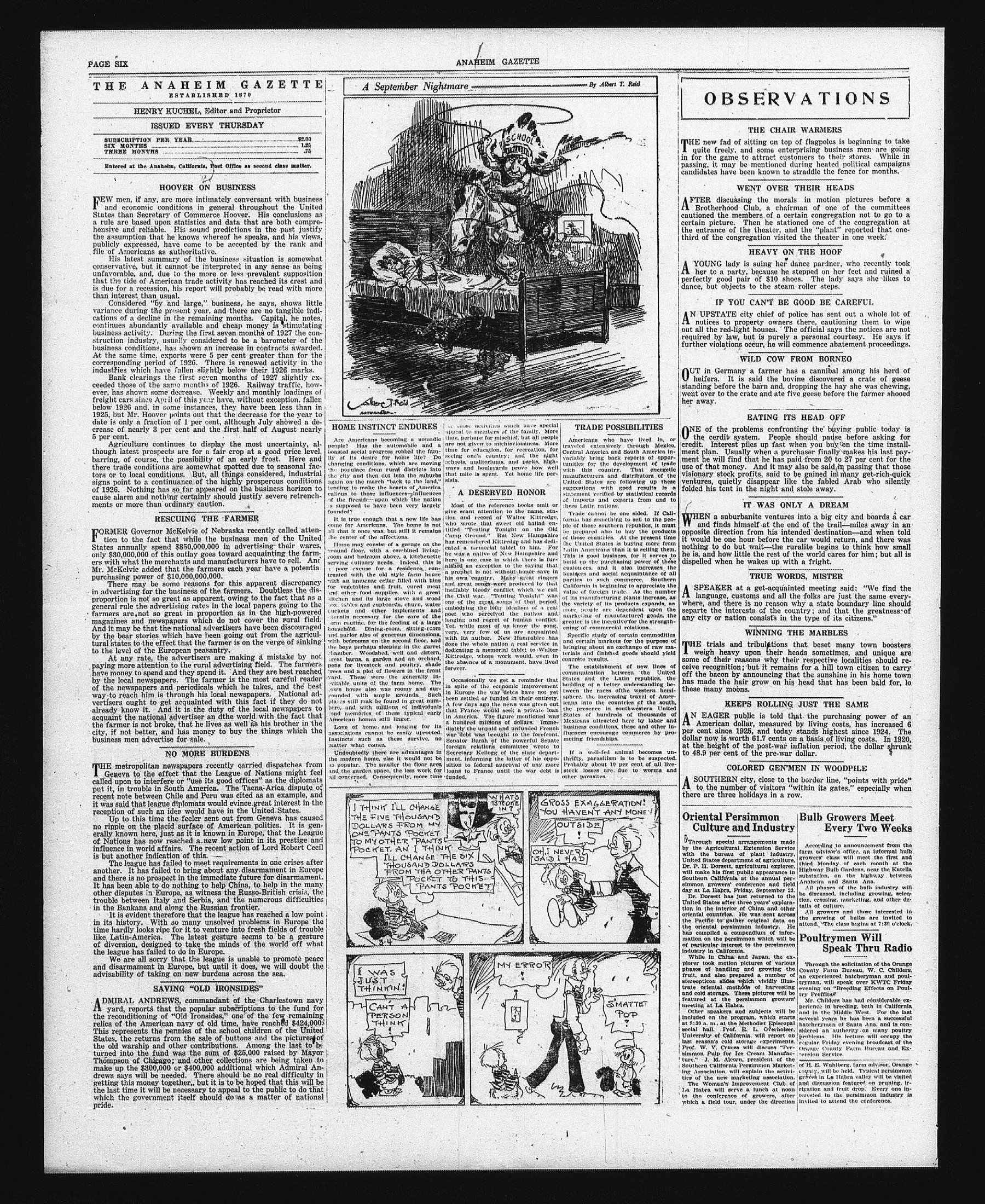
Searchable text
THE ANAHEIM GAZETTE
ESTABLISHED 1870
HENRY KUCHEL, Editor and Proprietor
ISSUED EVERY THURSDAY
SUBSCRIPTION PER YEAR.....$2.00
SIX MONTHS.....1.25
THREE MONTHS......75
Entered at the Anaheim, California, Post Office as second class matter.
HOOVER ON BUSINESS
FEW men, if any, are more intimately conversant with business and economic conditions in general throughout the United States than Secretary of Commerce Hoover. His conclusions as a rule are based upon statistics and data that are both comprehensive and reliable. His sound predictions in the past justify the assumption that he knows whereof he speaks, and his views publicly expressed, have come to be accepted by the rank and file of Americans as authoritative.
His latest summary of the business situation is somewhat conservative, but it cannot be interpreted in any sense as being unfavorable, and, due to the more or less prevalent supposition that the tide of American trade activity has reached its crest and is due for a recession, his report will probably be read with more than interest than usual.
Considered "by and large," business, he says, shows little variance during the present year, and there are no tangible indications of a decline in the remaining months. Capital, he notes, continues abundantly available and cheap money is stimulating business activity. During the first seven months of 1927 the construction industry, usually considered to be a barometer of the business conditions, has shown an increase in contracts awarded. At the same time, exports were 5 per cent greater than for the corresponding period of 1926. There is renewed activity in the industries which have fallen slightly below their 1926 marks.
Bank clearings the first seven months of 1927 slightly exceeded those of the same months of 1926. Railway traffic, however, has shown some decrease. Weekly and monthly loadings of freight cars since April of this year have, without exception, fallen below 1926 and, in some instances, they have been less than in 1925, but Mr. Hoover points out that the decrease for the year to date is only a fraction of 1 per cent, although July showed a decrease of nearly 3 per cent and the first half of August nearly 5 per cent.
Agriculture continues to display the most uncertainty, al-
At the same time, exports were 5 per cent greater than for the corresponding period of 1926. There is renewed activity in the industries which have fallen slightly below their 1926 marks.
Bank clearings the first seven months of 1927 slightly exceeded those of the same months of 1926. Railway traffic, however, has shown some decrease. Weekly and monthly loadings of freight cars since April of this year have, without exception, fallen below 1926 and, in some instances, they have been less than in 1925, but Mr. Hoover points out that the decrease for the year to date is only a fraction of 1 per cent, although July showed a decrease of nearly 3 per cent and the first half of August nearly 5 per cent.
Agriculture continues to display the most uncertainty, although latest prospects are for a fair crop at a good price level, barring, of course, the possibility of an early frost. Here and there trade conditions are somewhat spotted due to seasonal factors or to local conditions. But, all things considered, industrial signs point to a continuance of the highly prosperous conditions of 1926. Nothing has so far appeared on the business horizon to cause alarm and nothing certainly should justify severe retrenchments or more than ordinary caution.
RESCUING THE FARMER
FORMER Governor McKelvie of Nebraska recently called attention to the fact that while the business men of the United States annually spend $850,000,000 in advertising their wares, only $30,000,000 of this outlay goes toward acquainting the farmers with what the merchants and manufacturers have to sell. And Mr. McKelvie added that the farmers each year have a potential purchasing power of $10,000,000,000.
There may be some reasons for this apparent discrepancy in advertising for the business of the farmers. Doubtless the proportion is not so great as apparent, owing to the fact that as a general rule the advertising rates in the local papers going to the farmers are not so great in proportion as in the high-powered magazines and newspapers which do not cover the rural field. And it may be that the national advertisers have been discouraged by the bear stories which have been going out from the agricultural states to the effect that the farmer is on the verge of sinking to the level of the European peasantry.
At any rate, the advertisers are making a mistake by not paying more attention to the rural advertising field. The farmers have money to spend and they spend it. And they are best reached by the local newspapers. The farmer is the most careful reader of the newspapers and periodicals which he takes, and the best way to reach him is through his local newspapers. National advertisers ought to get acquainted with this fact if they do not already know it. And it is the duty of the local newspapers to acquaint the national advertiser an dthe world with the fact that the farmer is not broke, that he lives as well as his brother in the city, if not better, and has money to buy the things which the business men advertise for sale.
NO MORE BURDENS
THE metropolitan newspapers recently carried dispatches from Geneva to the effect that the League of Nations might feel called upon to interfere or "use its good offices" as the diplomats put it, in trouble in South America. The Tacna-Arica dispute of recent note between Chile and Peru was cited as an example, and it was said that league diplomats would evince great interest in the reception of such an idea would have in the United States.
Up to this time the feeler sent out from Geneva has caused no ripple on the placid surface of American politics. It is generally known here, just as it is known in Europe, that the League of Nations has now reached a new low point in its prestige and influence in world affairs. The recent action of Lord Robert Cecil...
THE metropolitan newspapers recently carried dispatches from Geneva to the effect that the League of Nations might feel called upon to interfere or "use its good offices" as the diplomats put it, in trouble in South America. The Tacna-Arica dispute of recent note between Chile and Peru was cited as an example, and it was said that league diplomats would evince great interest in the reception of such an idea would have in the United States.
Up to this time the feeler sent out from Geneva has caused no ripple on the placid surface of American politics. It is generally known here, just as it is known in Europe, that the League of Nations has now reached a new low point in its prestige and influence in world affairs. The recent action of Lord Robert Cecil is but another indication of this.
The league has failed to meet requirements in one crises after another. It has failed to bring about any disarmament in Europe and there is no prospect in the immediate future for disarmament. It has been able to do nothing to help China, to help in the many other disputes in Europe, as witness the Russo-British crisis, the trouble between Italy and Serbia, and the numerous difficulties in the Bankans and along the Russian frontier.
It is evident therefore that the league has reached a low point in its history. With so many unsolved problems in Europe the time hardly looks ripe for it to venture into fresh fields of trouble like Latin-America. The latest gesture seems to be a gesture of diversion, designed to take the minds of the world off what the league has failed to do in Europe.
We are all sorry that the league is unable to promote peace and disarmament in Europe, but until it does, we will doubt the advisability of taking on new burdens across the sea.
SAVING "OLD IRONSIDES"
ADMIRAL ANDREWS, commandant of the Charlestown navy yard, reports that the popular subscriptions to the fund for the reconditioning of "Old Ironsides," one of the few remaining relics of the American navy of old time, have reached $424,000. This represents the pennies of the school children of the United States, the returns from the sale of buttons and the pictures of the old warship and other contributions. Among the last to be turned into the fund was the sum of $25,000 raised by Mayor Thompson of Chicago; and other collections are being taken to make up the $300,000 or $400,000 additional which Admiral Andrews says will be needed. There should be no real difficulty in getting this money together,, but it is to be hoped that this will be the last time it will be necessary to appeal to the public to do that which the government itself should do as a matter of national pride.
ANAHEIM GAZETTE
A September Nightmare — By Albert T. Reid
HOME INSTINCT ENDURES
Are Americans becoming a nomadic people? Has the automobile and a
TRADE POSSIBILITIES
Americans who have lived in, or traveled extensively through Mexico,
HOME INSTINCT ENDURES
Are Americans becoming a nomadic people? Has the automobile and a boasted social progress robbed the family of its desire for home life? Do changing conditions, which are moving the populace from rural districts into the city and then out into the suburbs again on the march "back to the land," tending to make the hearts of America calious to those influences influences of the fireside—upon which the nation is supposed to have been very largely founded?
It is true enough that a new life has come for Americans. The home is not all that it once was, but still it remains the center of the affections.
Home may consist of a garage on the ground floor, with a combined living-room and bedroom above, a kitchenette serving culinary needs. Indeed, this is a poor excuse for a residence, contrasted with the old style farm house with an immense cellar filled with bins for vegetables and fruit, cured meat and other food supplies, with a great kitchen and its large stove and wood tables and cupboards, churn, water buckets and other implements and tensils necessary for the care of the farm routine, for the feeding of a large household. Dining-room, sitting-room and parlor also of generous dimensions, with bedrooms on the second floor, and the boys perhaps sleeping in the garret chamber. Woodshed, well and cistern, great barns, a garden and an orchard, pens for livestock and poultry, shade trees and a plot of flowers in the front yard. These were the generally inevitable units of the farm home. The town house also was roofty and surrounded with ample grounds. Such places still mak be found in great numbers, and with millions of individuals and memories of these typical early American homes still linger.
Love of home, and longing for its associations cannot be easily uprooted. Instincts such as these survive, no matter what comes.
Undoubtedly there are advantages in the modern home, else it would not be so popular. The smaller the floor area and the garden space, the less work for all concerned. Consequently, more time most activities which have special appeal to members of the family. More time, perhaps for mischief, but all people are not given to milleviciousness. More time for education, for recreation, for seeing one's country; and the night schools, auditoriums, and parks, highways and boulevards prove how well that mite is spent. Yet home life persists.
A DESERVED HONOR
Most of the reference books omit or give scant attention to the name, station and record of Walter Kittredge who wrote that sweet old ballad entitled "Tenting Tonight on the Old Camp Ground." But New Hampshire has remembered Kittredge and has dedicated a memorial tablet to him. For he was a native of New Hampshire and here is one case in which there is furnished an exception to the saying that a prophet is not without honor save in his own country. Many great singers and great songs are produced by that ineffably bloody conflict which we call the Civil war. "Tenting Tonight" was one of the great songs of that period; embodying the lofty idealism of a real poet who perceived the pathos and longing and regret of human conflict. Yet, while most of us know the song, very, very few of us are acquainted with its author. New Hampshire has done the whole nation a real service in dedicating a memorial tablet to Walter Kittredge, whose work would, even in the absence of a monument, have lived forever.
Occasionally we get a reminder that in spite of the economic improvement in Europe the war debts have not yet been settled or funded in their entirety. A few days ago the news was given out that France would seek a private loan in America. The figure mentioned was a hundred millions of dollars. Immediately the unpaid and unfunded French war debt was brought to the forefront. Senator Borah of the powerful Senate foreign relations committee wrote to Secretary Kellogg of the state department, informing the latter of his opposition to federal approval of any more loans to France until the war debt is funded.
TRADE POSSIBILITIES
Americans who have lived in, or traveled extensively through Mexico, Central America and South America invariably bring back reports of opportunities for the development of trade with this country. That energetic manufacturers and distributors of the United States are following up these suggestions with good results is a statement verified by statistical records of imports and exports from and to these Latin nations.
Trade cannot be one sided. If California has something to sell to the people of those southern republics, it must be prepared also to buy the products of those countries. At the present time the United States is buying more from Latin Americans than it is selling them. This is good business, for it serves to build up the purchasing power of these customers, and it also increases the business and social acquaintance of all parties to such commerce. Southern California is beginning to appreciate the value of foreign trade. As the number of its manufacturing plants increase, as the variety of its products expands, as more people are dependent upon the marketing of manufactured goods, greater is the incentive for the strengthening of commercial relations.
Specific study of certain commodities and certain markets for the purpose of bringing about an exchange of raw materials and finished goods should yield concrete results.
The establishment of new lines of communication between the United States and the Latin republics, the building of a better understanding between the races ofthe western hemisphere, the increasing travel of Americans into the countries of the south, the presence in southwestern United States of hundreds of thousands of Mexicans attracted here by labor and business conditions, these and other influences encourage commerce by promoting friendships.
If a well-fed animal becomes unthrify, parasitism is to be suspected. Probably about 10 per cent of all livestock losses are due to worms and other parasites.
the modern home, else it would not be popular. The smaller the floor area and the garden space, the less work for all concerned. Consequently, more time funded.
I THINK ILL CHANGE THE FIVE THOUSAND DOLLARS FROM MY ONE PANTS POCKET TO MY OTHER PANTS POCKET. AN I THINK ILL CHANGE THE SIX THOUSAND DOLLARS FROM THA OTHER PANTS POCKET TO THIS PANTS POCKET
WHAT'S STROKE IN?
GROSS EXAGGERATION! YOU HAVEN'T ANY MONEY OUTSIDE!
OH I NEVER SAID I HAD
I WAS JUST THINKING!
CAN'T A PERSON THINK!
MY ERROR!
SMATTET POP?
OBSERVATIONS
THE CHAIR WARMERS
The new fad of sitting on top of flagpoles is beginning to take quite freely, and some enterprising business men are going in for the game to attract customers to their stores. While in passing, it may be mentioned during heated political campaigns candidates have been known to straddle the fence for months.
WENT OVER THEIR HEADS
After discussing the morals in motion pictures before a Brotherhood Club, a chairman of one of the committees cautioned the members of a certain congregation not to go to a certain picture. Then he stationed one of the congregation at the entrance of the theater, and the "plant" reported that one-third of the congregation visited the theater in one week.
HEAVY ON THE HOOF
A young lady is suing her dance partner, who recently took her to a party, because he stepped on her feet and ruined a perfectly good pair of $10 shoes. The lady says she likes to dance, but objects to the steam roller steps.
IF YOU CAN'T BE GOOD BE CAREFUL
An upstate city chief of police has sent out a whole lot of notices to property owners there, cautioning them to wipe out all the red-light houses. The official says the notices are not required by law, but is purely a personal courtesy. He says if further violations occur, he will commence abatement proceedings.
WILD COW FROM BORNEO
Out in Germany a farmer has a cannibal among his herd of heifers. It is said the bovine discovered a crate of geese standing before the barn and, dropping the hay she was chewing, went over to the crate and ate five geese before the farmer shooed her away.
EATING ITS HEAD OFF
One of the problems confronting the buying public today is the credit system. People should pause before asking for credit. Interest piles up fast when you buy on the time install-
WILD COW FROM BORNEO
OUT in Germany a farmer has a cannibal among his herd of heifers. It is said the bovine discovered a crate of geese standing before the barn and, dropping the hay she was chewing, went over to the crate and ate five geese before the farmer shooed her away.
EATING ITS HEAD OFF
ONE of the problems confronting the buying public today is the credit system. People should pause before asking for credit. Interest piles up fast when you buy on the time installment plan. Usually when a purchaser finally makes his last payment he will find that he has paid from 20 to 27 per cent for the use of that money. And it may also be said in passing that those visionary stock profits, said to be gained in many get-rich-quick ventures, quietly disappear like the fabled Arab who silently folded his tent in the night and stole away.
IT WAS ONLY A DREAM
WHEN a suburbanite ventures into a big city and boards a car and finds himself at the end of the trail—miles away in an opposite direction from his intended destination—and when told it would be one hour before the car would return, and there was nothing to do but wait—the ruralite begins to think how small he is, and how little the rest of the world cares for him; but all is dispelled when he wakes up with a fright.
TRUE WORDS, MISTER
A SPEAKER at a get-acquainted meeting said: "We find the language, customs and all the folks are just the same everywhere, and there is no reason why a state boundary line should separate the interests of the country; and that the greatness of any city or nation consists in the type of its citizens."
WINNING THE MARBLES
THE trials and tribulations that beset many town boosters weigh heavy upon their heads sometimes, and unique are some of their reasons why their respective localities should receive recognition; but it remains for a hill town citizen to carry off the bacon by announcing that the sunshine in his home town has made the hair grow on his head that has been bald for, lo these many moons.
KEEPS ROLLING JUST THE SAME
AN EAGER public is told that the purchasing power of an American dollar, measured by living costs, has increased 6 per cent since 1925, and today stands highest since 1924. The dollar now is worth 61.7 cents on a basis of living costs. In 1920, at the height of the post-war inflation period; the dollar shrunk to 48.9 per cent of the pre-war dollar.
COLORED GEN'MEN IN WOODPILE
SOUTHERN city, close to the border line, "points with pride" to the number of visitors "within its gates," especially when there are three holidays in a row.
Oriental Persimmon Culture and Industry
Through special arrangements made by the Agricultural Extension Service
Bulb Growers Meet Every Two Weeks
According to announcement from the
COLORED GEN'MEN IN WOODPILE
A SOUTHERN city, close to the border line, "points with pride" to the number of visitors "within its gates," especially when there are three holidays in a row.
Oriental Persimmon Culture and Industry
Through special arrangements made by the Agricultural Extension Service with the bureau of plant industry, United States department of agriculture, Dr. P. H. Dorsett, agricultural explorer, will make his first public appearance in Southern California at the annual persimmon growers' conference and field day at La Habra, Friday, September 23.
Dr. Dorsett has just returned to the United States after three years' exploration in the interior of China and other oriental countries. He was sent across the Pacific to gather original data on the oriental persimmon industry. He has compiled a compendium of information on the persimmon which will be of particular interest to the persimmon industry in California.
While in China and Japan, the explorer took motion pictures of various phases of handling and growing the fruit, and also prepared a number of stereopticon slides which vividly illustrate oriental methods of harvesting and cold storage. These pictures will be featured at the persimmon growers' meeting at La Habra.
Other speakers and subjects will be included on the program, which starts at 9:30 a.m., at the Methodist Episcopal social hall. Prof. E. L. Overholser, University of California, will report on last season's cold storage experiments. Prof. W. V. Cruess will discuss "Persimmon Pulp for Ice Cream Manufacture." J. M. Alcorn, president of the Southern California Persimmon Marketing Association, will explain the activities of the new marketing association.
The Woman's Improvement Club of La Habra will serve a lunch at noon to the conference of growers, after which a field tour, under the direction Bulb Growers Meet Every Two Weeks
According to announcement from the farm advisor's office, an informal bulb growers' class will meet the first and third Monday of each month at the Highway Bulb Gardens, near the Katella substation, on the highway between Anaheim and Santa Ana.
All phases of the bulb industry will be discussed, including growing, selection, crossing, marketing, and other details of culture.
All growers and those interested in the growing of bulbs are invited to attend. The class begins at 7:30 o'clock.
Poultrymen Will Speak Thru Radio
Through the solicitation of the Orange County Farm Bureau, W. C. Childers, an experienced hatcheryman and poultryman, will speak over KWTC Friday evening on "Breeding Effects on Poultry Proffits."
Mr. Childers has had considerable experience in breeding, both in California and in the Middle West. For the last several years he has been a successful hatcheryman of Santa Ana, and is considered an authority on many poultry problems. His lecture will occupy the regular Friday evening broadcast of the Orange County Farm Bureau and Extension Service.
of H. E. Wahlberg, farm advisor, Orange county, will be held. Typical persimmon graves in La Habra valley will be visited and discussion featured on pruning, irrigation and fruit drop. Every one interested in the persimmon industry is invited to attend the conference.