anaheim-gazette 1927-03-03
Scanned page
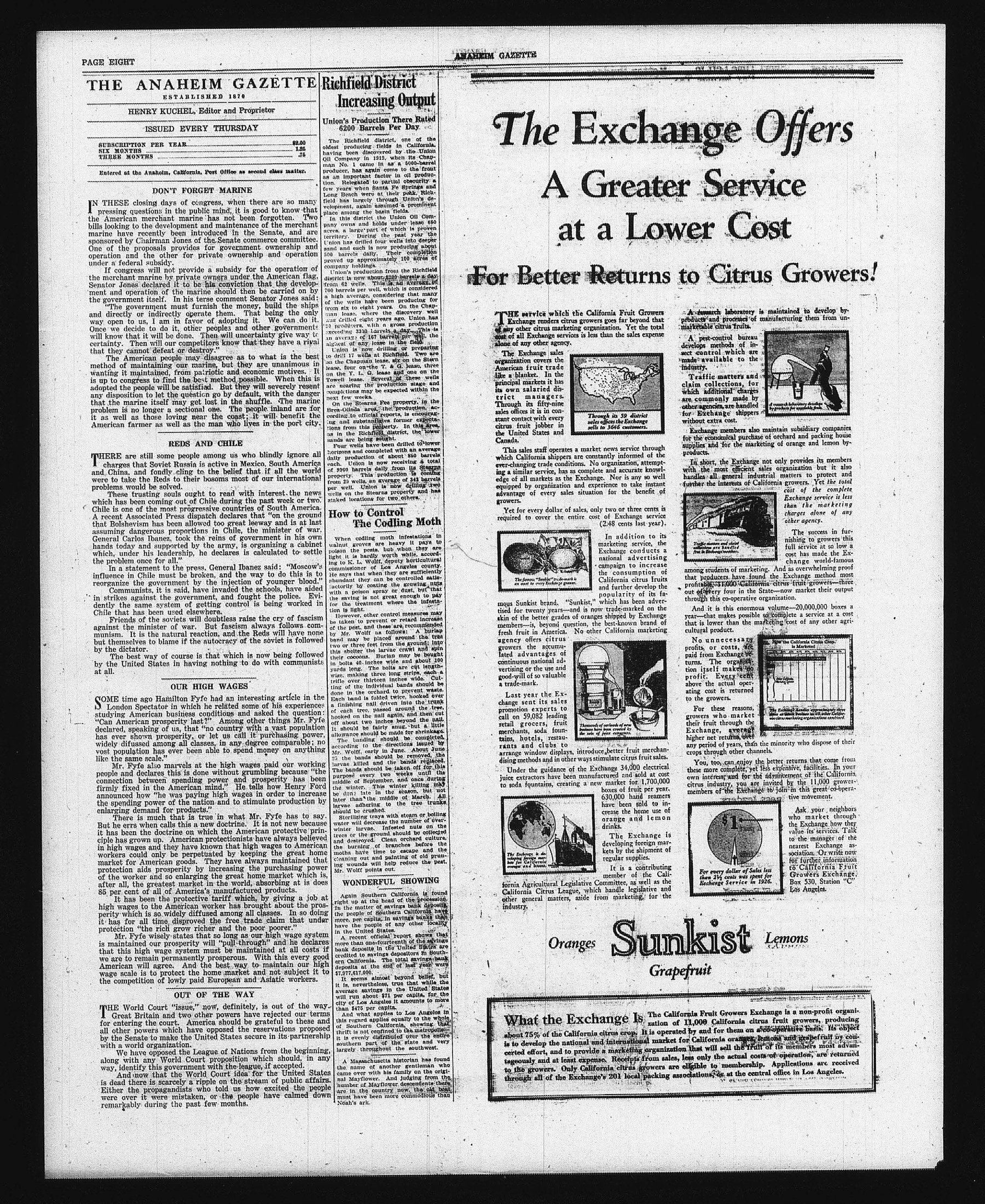
Searchable text
THE ANAHEIM GAZETTE
ESTABLISHED 1870
HENRY KUCHEL, Editor and Proprietor
ISSUED EVERY THURSDAY
SUBSCRIPTION PER YEAR.....$2.00
SIX MONTHS.....1.25
THREE MONTHS......75
Entered at the Anaheim, California, Post Office as second class matter.
DON'T FORGET MARINE
IN THESE closing days of congress, when there are so many pressing questions in the public mind, it is good to know that the American merchant marine has not been forgotten. Two bills looking to the development and maintenance of the merchant marine have recently been introduced in the Senate, and are sponsored by Chairman Jones of the Senate commerce committee. One of the proposals provides for government ownership and operation and the other for private ownership and operation under a federal subsidy.
If congress will not provide a subsidy for the operation of the merchant marine by private owners under the American flag, Senator Jones declared it to be his conviction that the development and operation of the marine should then be carried on by the government itself. In his terse comment Senator Jones said:
"The government must furnish the money, build the ships and directly or indirectly operate them. That being the only way open to us, I am in favor of adopting it. We can do it. Once we decide to do it, other peoples and other governments will know that it will be done. Then will uncertainty give way to certainty. Then will our competitors know that they have a rival that they cannot defeat or destroy."
The American people may disagree as to what is the best method of maintaining our marine, but they are unanimous in wanting it maintained, from patriotic and economic motives. It is up to congress to find the best method possible. When this is adopted the people will be satisfied. But they will severely resent any disposition to let the question go by default, with the danger that the marine itself may get lost in the shuffle. The marine problem is no longer a sectional one. The people inland are for it as well as those loving near the coast; it will benefit the American farmer as well as the man who lives in the port city.
REDS AND CHILE
The American people may disagree as to what is the best method of maintaining our marine, but they are unanimous in wanting it maintained, from patriotic and economic motives. It is up to congress to find the best method possible. When this is adopted the people will be satisfied. But they will severely resent any disposition to let the question go by default, with the danger that the marine itself may get lost in the shuffle. The marine problem is no longer a sectional one. The people inland are for it as well as those loving near the coast; it will benefit the American farmer as well as the man who lives in the port city.
REDS AND CHILE
THERE are still some people among us who blindly ignore all charges that Soviet Russia is active in Mexico, South America and China, and fondly cling to the belief that if all the world were to take the Reds to their bosoms most of our international problems would be solved.
These trusting souls ought to read with interest the news which has been coming out of Chile during the past week or two. Chile is one of the most progressive countries of South America. A recent Associated Press dispatch declares that "on the ground that Bolshevism has been allowed too great leeway and is at last assuming dangerous proportions in Chile, the minister of war, General Carlos Ibanez, took the reins of government in his own hands today and supported by the army, is organizing a cabinet which, under his leadership, he declares is calculated to settle the problem once for all."
In a statement to the press, General Ibanez said: "Moscow's influence in Chile must be broken, and the way to do this is to reorganize the government by the injection of younger blood."
Communists, it is said, have invaded the schools, have aided in strikes against the government, and fought the police. Evidently the same system of getting control is being worked in Chile that has been used elsewhere.
Friends of the soviets will doubtless raise the cry of fascism against the minister of war. But fascism always follows communism. It is the natural reaction, and the Reds will have none but themselves to blame if the autocracy of the soviet is followed by the dictator.
The best way of course is that which is now being followed by the United States in having nothing to do with communists at all.
OUR HIGH WAGES
SOME time ago Hamilton Fyfe had an interesting article in the London Spectator in which he related some of his experiences studying American business conditions and asked the question: "Can American prosperity last?" Among other things Mr. Fyfe declared, speaking of us, that "no country with a vast population has ever shown prosperity, or let us call it purchasing power, widely diffused among all classes, in any degree comparable; no vost population has ever been able to spend money on anything like the same scale."
Mr. Fyfe also marvels at the high wages paid our working people and declares this is done without grumbling because "the connection between spending power and prosperity has been firmly fixed in the American mind." He tells how Henry Ford announced how "he was paying high wages in order to increase the spending power of the nation and to stimulate production by enlarging demand for products."
There is much that is true in what Mr. Fyfe has to say. But he errs when calls this a new doctrine. It is not new because it has been the doctrine on which the American protective principle has grown up. American protectionists have always believed in high wages and they have known that high wages to American
Mr. Fyfe also marvels at the high wages paid our working people and declares this is done without grumbling because "the connection between spending power and prosperity has been firmly fixed in the American mind." He tells how Henry Ford announced how "he was paying high wages in order to increase the spending power of the nation and to stimulate production by enlarging demand for products."
There is much that is true in what Mr. Fyfe has to say. But he errs when calls this a new doctrine. It is not new because it has been the doctrine on which the American protective principle has grown up. American protectionists have always believed in high wages and they have known that high wages to American workers could only be perpetuated by keeping the great home market for American goods. They have always maintained that protection aids prosperity by increasing the purchasing power of the worker and so enlarging the great home market which is, after all, the greatest market in the world, absorbing at is does 85 per cent of all of America's manufactured products.
It has been the protective tariff which, by giving a job at high wages to the American worker has brought about the prosperity which is so widely diffused among all classes. In so doing it has for all time disproved the free trade claim that under protection "the rich grow richer and the poor poorer."
Mr. Fyfe wisely states that so long as our high wage system is maintained our prosperity will "pull through" and he declares that this high wage system must be maintained at all costs if we are to remain permanently prosperous. With this every good American will agree. And the best way to maintain our high wage scale is to protect the home market and not subject it to the competition of lowly paid European and Asiatic workers.
OUT OF THE WAY
The World Court "issue," now, definitely, is out of the way. Great Britain and two other powers have rejected our terms for entering the court. America should be grateful to these and all other powers which have opposed the reservations proposed by the Senate to make the United States secure in its partnership with a world organization.
We have opposed the League of Nations from the beginning, along with any World Court proposition which should, in any way, identify this government with the league, if accepted.
And now that the World Court idea for the United States is dead there is scarcely a ripple on the stream of public affairs. Either the propagandists who told us how excited the people were over it were mistaken, or the people have calmed down remarkably during the past few months.
Richfield District Increasing Output
Union's Production There Rated 6200 Barrels Per Day
The Richfield district, one of the oldest producing fields in California, having been discovered by the Union Oil Company in 1919, when its Chapman No. 1 came in as a 5000-barrel producer, has again come to the front as an important factor in oil production. Relegated to partial obscurity a few years when Santa Fe Springs and Long Beach were at their peak, Richfield has largely through Union's development, again assumed a prominent place among the basin fields.
In this district the Union Oil Company owns and holds under lease 650 acres, a large part of which is proven territory. During the past year the Union has drilled four wells into deeper sand and each is now producing about 500 barrels daily. Their completion proved up approximately 100 acres of company holdings.
Union's production from the Richfield district is now about 4200 barrels a day from 62 wells. This is an average of 700 barrels per well, which is considered a high average, considering that many of the wells have been producing for six to eight years. On the Chapman lease, where the discovery well was grilled eight years ago, Union has 29 producers, with a gross production exceeding 3300 barrels a day. This is an average of 167 barrels per well, the highest of any lease in the field.
Union is now drilling or preparing to drill 17 wells at Richfield. Two are on the Chapman lease, six on the Stern lease, four on-the T. & G. lease, three on the Y. L. G. lease and one on the Towell lease. Several of these wells are nearing the production stage and complications may be expected within the next few weeks.
On the Stearna Fee property, in the Brea-Olinda area, the production, according to official reports, is encouraging and substantial former expectations from this property. In this area, as in the Richfield district, the lower sands are being sought.
Four wells have been drilled to tower through its 59 district sales offices the Exchange sells to 3646 customers.
The Exchange
A Greater
at a Lower
For Better Returns to
THE service which the California Fruit Growers Exchange renders citrus growers goes far beyond that of any other citrus marketing organization. Yet the total cost of all Exchange services is less than the sales expense alone of any other agency.
The Exchange sales organization covers the American fruit trade like a blanket. In the principal markets it has its own salaried district managers. Through its fifty-nine sales offices it is in constant contact with every citrus fruit jobber in the United States and Canada.
Through its 59 district sales offices the Exchange sells to 3646 customers.
How to Control The Codling Moth
When codling moth infestations in walnut groves are heavy it pays to poison the peats, but when they are light it is hardly worth while, according to K. L. Wolff, deputy horticultural commissioner of Los Angeles county. He says that when they are sufficiently abundant they can be controlled satisfactorily by coating the growing nuts with a poison spray or dust, but that the saving is not great enough to pay for the treatment where the infestation is light.
However, other control measures may be taken to prevent or retard increase of the pest, and these are recommended by Mr. Wolff as follows: A burlap band may be placed around the tree two or three feet from the ground; into this shelter the larvae crawl and spin their cocoons. Burlap may be bought in bolts 40 inches wide and about 100 yards long. The bolts are cut lengthwise, making three long strips, each a trifle over thirteen inches wide. Cutting of the individual bands should be done in the orchard to prevent waste. Each band is folded twice, hooked over a finishing nail driven into the trunk of each tree, passed around the tree, hooked on the nail again, and then cut off about two inches beyond the nail. It should be fairly snug, but a little allowance should be made for shrinkage.
The banding should be completed, according to the directions issued by Mr. Wolff, early in June. About June 25 the bands should be removed, the larvae killed and the bands replaced. The bands should be taken off for this purpose every two weeks until the middle of September, and once during the winter. This winter killing may be done late in the season, but not later than the middle of March. All larvae adhering to the tree trunks should be crushed.
Sterilizing trays with steam or boiling water will decrease the number of overwinter larvae. Infested nuts on the trees or the ground should be collected and destroyed. Clean orchard culture, the burning of branches before the frost, and the
WONDERFUL SHOWING
Again Southern California is found right up at the head of the procession. In the matter of savings bank deposits, the people of Southern California have more, per capita, in savings banks than have the people of any other locality in the United States.
A recent official report shows that more than one-fourteenth of the savings bank deposits in the United States are credited to savings depositors in Southern California. The total savings bank deposits at the end of last year were $7,977,617,000.
It seems almost beyond belief, but it is, nevertheless, true that while the average savings in the United States will run about $71 per capita, for the city of Los Angeles it amounts to more than $475 per capita.
And what applies to Los Angeles in this regard applies equally to the whole of Southern California, showing that thrift is not confined to the metropolis—it is evenly distributed over the entire southern part of the state and very largely throughout the southwest.
A Massachusetts historian has found the name of another gentleman who came over with his family on the original Mayflower. And judging from the number of Mayflower descendants there are in the country now, the old boat must have been more commodious than Noah's ark.
Exchange Offers
Greater Service
Lower Cost
returns to Citrus Growers!
A research laboratory is maintained to develop by-products and processes of manufacturing them from unmarketable citrus fruits.
A pest-control bureau develops methods of insect control which are made available to the industry.
Traffic matters and claim collections, for which additional charges are commonly made by other agencies, are handled for Exchange shippers without extra cost.
Exchange members also maintain subsidiary companies for the economical purchase of orchard and packing house supplies and for the marketing of orange and lemon by-
Traffic matters and claim collections, for which additional charges are commonly made by other agencies, are handled for Exchange shippers without extra cost.
Exchange members also maintain subsidiary companies for the economical purchase of orchard and packing house supplies and for the marketing of orange and lemon by-products.
In short, the Exchange not only provides its members with the most efficient sales organization but it also handles all general industrial matters to protect and further the interests of California growers. Yet the total cost of the complete Exchange service is less than the marketing charges alone of any other agency.
The success in furnishing to growers this full service at so low a cost has made the Exchange world-famous among students of marketing. And as overwhelming proof that producers have found the Exchange method most profitable, California citrus fruit growers—three out of every four in the State—now market their output through this co-operative organization.
And it is this enormous volume—20,000,000 boxes a year—that makes possible so complete a service at a cost that is lower than the marketing cost of any other agricultural product.
No unnecessary profits, or costs, are paid from Exchange returns. The organization itself makes no profit. Every cent above the actual operating cost is returned to the growers.
For these reasons, growers who market their fruit through the Exchange, average higher net returns over any period of years, than the minority who dispose of their crops through other channels.
You, too, can enjoy the better returns that come from these more complete, yet less expensive, facilities. In your own interest and for the advancement of the California citrus industry, you are invited by the 11,000 grower-members of the Exchange to join in this great co-operative movement.
Ask your neighbors who market through the Exchange how they value its services. Talk to the manager of the nearest Exchange as-
You, too, can enjoy the better returns that come from these more complete, yet less expensive, facilities. In your own interest and for the advancement of the California citrus industry, you are invited by the 11,000 grower members of the Exchange to join in this great co-operative movement.
Ask your neighbors who market through the Exchange how they value its services. Talk to the manager of the nearest Exchange association. Or write now for further information to California Fruit Growers Exchange, Box 530, Station "C" Los Angeles.
Sunkist Lemons Grapefruit
The California Fruit Growers Exchange is a non-profit organization of 11,000 California citrus fruit growers, producing crop. It is operated by and for them on a co-operative basis. Its object international market for California oranges, lemons and grapefruit by marketing organization that will sell the fruit of its members most advanced receipts from sales, less only the actual costs of operation, are returned citrus growers are eligible to membership. Applications are received at local packing associations, or at the central office in Los Angeles.