anaheim-gazette 1927-02-10
Scanned page
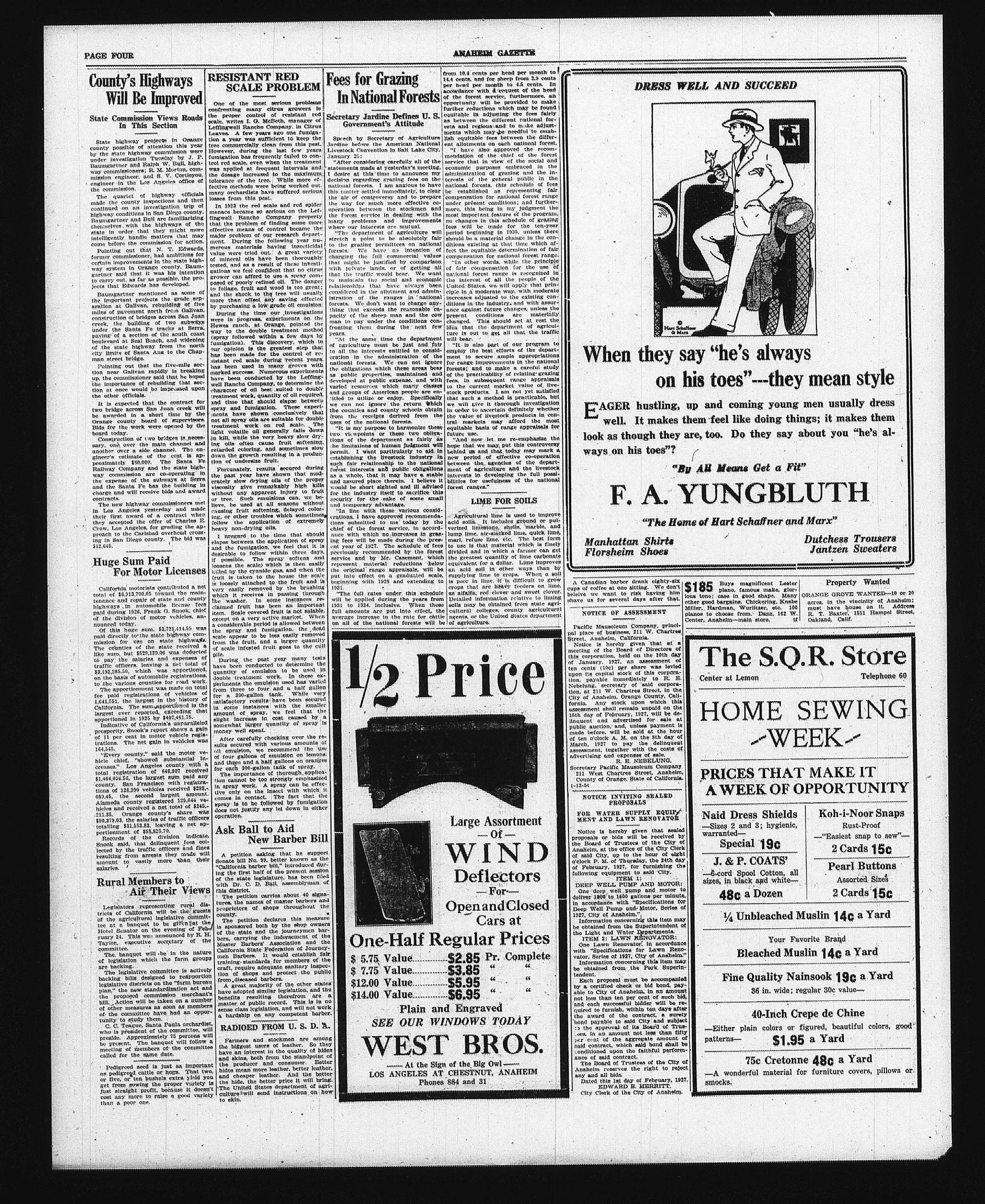
Searchable text
County's Highways Will Be Improved
State Commission Views Roads In This Section
State highway projects in Orange county possible of attention this year by the state highway commission were under investigation Tuesday by J. P. Baumgartner and Ralph W. Bull, highway commissioners; R. M. Morton, commission engineer, and S. V. Cortleyou, engineer in the Los Angeles office of the commission.
The quartet of highway officials made the county inspections and then continued on an investigation trip of highway conditions in San Diego county. Baumgartner and Bull are familiarizing themselves with the highways of the state in order that they might more intelligently handle matters that may come before the commission for action.
Pointing out that N. T. Edwards, former commissioner, had ambitions for certain improvements in the state highway system in Orange county. Baumgartner said that it was his intention to carry out, as far as possible, the projects that Edwards has developed.
Baumgartner mentioned as some of the important projects the grade separation at Galivan, rebuilding of five miles of pavement north from Galivan, construction of bridges across San Juan creek, the building of two subways under the Santa Fe tracks at Serra, paving of a section of the south coast boulevard at Seal Beach, and widening of the state highway from the north city limits of Santa Ana to the Chapman street bridge.
Pointing out that the five-mile section near Galivan rapidly is breaking up, the commissioner said that he hoped the importance of rebuilding that section at once would be impressed upon the other officials.
It is expected that the contract for two bridge across San Juan creek will be awarded in a short time by the Orange county board of supervisors. Bids for the work were opened by the board today.
Construction of two bridges is necessary, one over the main channel and another over the side channel. The end of each bridge generally falls down in kill, while the very heavy slow drying oils often cause fruit softening, retarded coloring, and sometimes slows down.
RESISTANT RED SCALE PROBLEM
One of the most serious problems confronting many citrus growers is the proper control of resistant red scale, writes I. G. McBeth, manager of Lefflingwell Rancho Company, in Citrus Leaves. A few years ago one fumigation a year was sufficient to keep the tree commercially clean from this pest. However, during the last few years fumigation has frequently failed to control red scale, even when the treatment was applied at frequent intervals and the dosage increased to the maximum tolerance of the tree. While more effective methods were being worked out, many orchardists have suffered serious losses from this pest.
In 1923 the red scale and red spider menace became so serious on the Lefflingwell Rancho Company property that the problem of finding some more effective means of control became the major problem of our research department. During the following year numerous materials having insecticidal value were tried out. A great variety of mineral oils have been thoroughly tested, and as a result of these investigations we feel confident that no citrus grower can afford to use a spray composed of poorly refined oil. The danger to foliage, fruit and wood is too great; and the shock to the tree will usually more than offset any saving effected by purchasing a low grade oil emulsion.
During the time our investigations were in progress, experiments on the Hewes ranch, at Orange, pointed the way to the double treatment method (spray followed within a few days by fumigation). This discovery, which in our opinion is the greatest step that has been made for the control of resistant red scale during recent years, has been used in many groves with marked success. Numerous experiments have been conducted by the Lefflingwell Rancho Company, to determine the character of oil best suited to double treatment work, quantity of oil required, and time that should elapse between spray and fumigation. These experiments have shown conclusively that not all spray oils are suitable for double treatment work on red scale. The light volatile oil generally falls down in kill, while the very heavy slow drying oils often cause fruit softening, retarded coloring, and sometimes slows down.
Fees for In Nature
Secretary Jo Governa
Speech by Jardine before Livestock Control January 25:
"After const statements made I desire at the decision regarding national forest this matter see the air for co operation bettween the forest secreth many problems where our intuition "The depart stretch a point to the grazing forests. We charging them that might be with private with private that the traffic to maintain relationships considered in instruction of forests. We thing that capacity of the man to pay for fronting their years.
"At the same of agriculture to all the introduction in national forestthe obligation as public pr developed at varied resourc and groups o titled to utilise we cannot not be counties from the reuses of the r it is my part two viewpoints of the limitation."
Pointing out that the five-mile section near Galivan rapidly is breaking up, the commissioner said that he hoped the importance of rebuilding that section at once would be impressed upon the other officials.
It is expected that the contract for two bridge across San Juan creek will be awarded in a short time by the Orange county board of supervisors. Bids for the work were opened by the board today.
Construction of two bridges is necessary, one over the main channel and another over a side channel. The engineer’s estimate of the cost is approximately $50,000. The Santa Fe Railway Company and the state highway commission are co-operating in the expense of the subways at Serra and the Santa Fe has the building in charge and will receive bids and award contracts.
The new highway commissioners met in Los Angeles yesterday and made their first award of a contract when they accepted the offer of Charles E. Crow, Los Angeles, for grading the approach to the Carlsbad overhead crossing in San Diego county. The bid was $12,645.
Huge Sum Paid For Motor Licenses
California motorists contributed a net total of $6,913,700.05 toward the maintenance and repair of state and county highways in automobile license fees paid during 1926. Frank G. Snook, chief of the division of motor vehicles, announced today.
Of this huge sum, $3,721,414.55 was paid directly to the state highway commission for use on state highways. The counties of the state received a like sum, but $529,129.06 was deducted to pay the salaries and expenses of traffic officers, leaving a net total of $3,192,285.50, which was apportioned, on the basis of automobile registrations, to the various counties for road work.
The apportionment was made on total fee paid registrations of vehicles of 1,641,551, the largest in the history of California. The sum apportioned is the largest ever reported, exceeding that apportioned in 1925 by $407,481.75.
Indicative of California’s unparalleled prosperity, Snook’s report shows a gain of 11 per cent in motor vehicle registrations. The net gain in vehicles was 164,545.
“Every county,” said the motor vehicle chief, “showed substantial increases.” Los Angeles county with a total registration of 646,907 received $1,464,096.56, the largest sum paid any county. San Francisco with registrations of 128,290 vehicles received $292,089.45, the second largest amount. Alameda county registered 129,644 vehicles and received a net total of $245,211.35. Orange county’s share was $90,379.03, the salaries of traffic officers totalling $31,553.83, leaving a net apportionment of $58,825.70.
Records of the division indicate, Snook said, that delinquent fees collected by the traffic officers and fines has been made for the control of resistant red scale during recent years, has been used in many groves with marked success. Numerous experiments have been conducted by the Leffing-well Rancho Company, to determine the character of oil best suited to double treatment work, quantity of oil required, and time that should elapse between spray and fumigation. These experiments have shown conclusively that not all spray oils are suitable for double treatment work on red scale. The light volatile oil generally falls down in kill, while the very heavy slow drying oils often cause fruit softening, retarded coloring, and sometimes slow down the growth resulting in a production of undersize fruit.
Fortunately, results secured during the past year have shown that moderately slow drying oils of the proper viscosity give remarkably high kills without any apparent injury to fruit or tree. Such emulsions can, we believe, be used at all seasons without causing fruit softening, delayed coloring, or other troubles which sometimes follow the application of extremely heavy non-drying oils.
I nregard to the time that should elapse between the application of spray and the fumigation, we feel that it is desirable to follow within three days if possible. The spray softens and loosens the scales which is then easily killed by the cyanide gas, and when the fruit is taken to the house the scale is loosely attached to the fruit and is very easily removed by the brushing which it receives in passing through the washer. In some instances claimed fruit has been an important item. Scale covered fruit is not salable except on a very active market. When a considerable period is allowed between the spray and fumigation, the dead scale appear to be less easily removed from the fruit, and a larger quantity of scale infested fruit goes to the culpile.
During the past year many tests have been conducted to determine the quantity of emulsion to be used in double treatment work. In these experiments the emulsion used has varied from three to four and a half gallon for a 300-gallon tank. While very satisfactory results have been secured in some instances with the smaller amount of spray, we feel that the slight increase in cost caused by a somewhat larger quantity of spray is money well spent.
After carefully checking over the results secured with various amounts of oil emulsion, we recommend the use of four gallons of emulsion on lemons and threes and a half gallons on oranges for each 300-gallon tank of spray.
The importance of thorough application cannot be too strongly emphasized in spray work. A spray can be effective only on the insect with which it comes in contact. The fact that the spray is to be followed by fumigation does not justify any let down in either operation.
Ask Ball to Aid New Barber Bill
Rural Members to Air Their Views
Legislators representing rural districts of California will be the guests of the agricultural legislative committee at a banquet to be given at the Hotel Senator on the evening of February 24. This was announced by R. H. Taylor, executive secretary of the committee.
The banquet will be in the nature of legislation which the farm groups are backing.
The legislative committee is actively backing bills designed to reposition legislative districts on the "farm bureau plan," the new standardization act and the proposed commission merchant's bill. Action will be taken on a number of other measures as soon as members of the committee have had an opportunity to study them.
C. C. Teague, Santa Paula orchardist, who is president of the committee, will preside. Approximately 75 persons will be present. The banquet will follow a meeting of members of the committee called for the same date.
Pedigreed seed is just as important as pedigree cattle or hogs. That two, or five, or ten bushels extra yield you get from sowing the proper variety is just straight profit, because it doesn't cost any more to raise a good variety than a poor one.
Ask Ball to Aid New Barber Bill
A petition asking that he support Senate bill No. 99, better known as the "California barber bill," introduced during the first half of the present session of the state legislature, has been filed with Dr. C. D. Ball, assemblyman of this district.
The petition carries about 40 signatures, the names of master barbers and proprietors of shops throughout the county.
The petition declares this measure is sponsored both by the shop owners of the state and the journeymen barbers, carrying the indorsement of the Master Barbers' Association and the California State Federation of Journeymen Barbers. It would establish fair training standards for members of the craft, require adequate sanitary inspection of shops and protect the public from diseased barbers.
A great majority of the other states have adopted similar legislation, and the benefits resulting therefrom are a matter of public record. This is in no sense class legislation, and will not work a hardship on any competent barber.
RADIOED FROM U. S. D. A.
Farmers and stockmen are among the biggest users of leather. So they have an interest in the quality of hides and skins, both from the standpoint of the producer and consumer. Better hides mean more leather, better leather, and cheaper leather. And the better hide, the better price it will bring. The United States department of agriculture will send instructions on how to skin.
Fees for Grazing In National Forests
Secretary Jardine Defines U. S. Government's Attitude
Speech by Secretary of Agriculture Jardine before the American National Livestock Convention in Salt Lake City, January 25:
"After considering carefully all of the statements made at yesterday's meeting, I desire at this time to announce my decision regarding grazing fees on the national forests. I am anxious to have this matter settled immediately, to clear the air of controversy and to prepare the way for much more effective cooperation between the stockmen and the forest service in dealing with the many problems and improvements where our interests are mutual.
The department of agriculture will stretch a point to be absolutely fair to the grazing permittees on national forests. We have no intention of charging the full commercial values that might be justified by comparison with private lands, or of getting all that the traffic would bear. We want to maintain the social and economic relationships that have always been considered in the allotment and administration of the ranges in national forests. We don't want to charge anything that exceeds the reasonable capacity of the sheep man and the cow man to pay under the conditions confronting them during the next few years.
At the same time the department of agriculture must be just and fair to all the interests entitled to consideration in the administration of the national forests. We can not ignore the obligations which these areas bear as public properties, maintained and developed at public expense, and varied resources which many classes and groups of American people are entitled to utilize or enjoy. Specifically we cannot ignore the return which the counties and county schools obtain from the receipts derived from the uses of the national forests.
It is my purpose to harmonize these two viewpoints or these two obligations of the department as fairly as the limitations of human judgment will from 10.4 cents per head per month to 14.4 cents, and for sheep from 2.3 cents per head per month to 4.5 cents. In accordance with A request of the head of the forest service, furthermore, an opportunity will be provided to make further reductions which may be found equitable in adjusting the fees fairly as between the different national forests and regions; and to make adjustments which may be needful to establish equitable fees between the different allotments on each national forest.
"I have also approved the recommendation of the chief of the forest service that in view of the social and economic purposes embraced in the administration of grazing and the interests of the general public in the national forests, this schedule of fees be established as representing fair compensation for national forest range under present conditions; and furthermore, this being in my judgment the most important feature of the program, no changes in this schedule of grazing fees will be made for the ten-year period beginning in 1935, unless there should be a material change in the conditions existing at that time which affect the equitable determination of fair compensation for national forest range.
In other words, while the principle of fair compensation for the use of national forest range is recognized in the interest of all the people of the United States, we will apply that principle in a moderate way, with moderate increases adjusted to the existing conditions in the industry, and with assurance against future changes, unless the present conditions are materially changed. This should set at rest the idea that the department of agriculture is out to get all that the traffic will bear.
"It is also part of our program to employ the best efforts of the department to secure ample appropriations for range improvements in the national forests; and to make a careful study of the practicability of relating grazing fees, in subsequent range appraisals to the current market value of livestock products. I am not yet satisfied that such a method is practicable, but we will give it thorough investigation in order to ascertain definitely whether the value of livestock products in central markets may afford the most equitable basis of range appraisals for future use."
And now let me re-emphasize the hope that we may put this controversy
Large Assortment of Wind
When they sailed on his well. It makes the look as though they are ways on his toes?
F. A. Y.
The Home Manhattan Shirts Florsheim Shoes
A Canadian barber drank eighty-six cups of coffee at one sitting. We don't believe we want to risk having him shave us for several days after that.
NOTICE OF ASSESSMENT
Pacific Mauoleum Company, principal place of business, 211 W. Chartres Street, Anaheim, California.
Notice is hereby given that at a meeting of the Board of Directors of this corporation, held on the 10th day of January, 1927, an assessment of ten cents (10c) per share was levied upon its capital stock of this corporation, payable immediately to R. E. Nebelung, secretary of said corporation, at 211 W. Chartres Street, in the City of Anaheim, Orange County, California.
Any stock upon which this assessment shall remain unpaid on the 15th day of February, 1927, will be delinquent and advertised for sale at public auction, and, unless payment is made before, will be sold at the hour of ten o'clock A.M. on the 8th day of March, 1927 to pay the delinquent assessment, together with the costs of advertising and expenses of sale.
R. E. NEBELUNG,
Secretary Pacific Mauoleum Company
211 West Chartres Street, Anaheim,
County of Orange; State of California.
1-13-6t
NOTICE INVITING SEALED PROPOSALS
FOR WATER SUPPLY EQUIPMENT AND LAWN RENOVATOR
Notice is hereby given that sealed proposals or bids will be received by the Board of Trustees of the City of Anaheim, at the office of the City Clerk
Large Assortment
Of
WIND
Deflectors
For
Open and Closed
Cars at
One-Half Regular Prices
$ 5.75 Value.....$2.85 Pr. Complete
$ 7.75 Value.....$3.85 “ “
$12.00 Value.....$5.95 “ “
$14.00 Value.....$6.95 “ “
Plain and Engraved
SEE OUR WINDOWS TODAY
WEST BROS.
At the Sign of the Big Owl—
LOS ANGELES AT CHESTNUT, ANAHEIM
Phones 884 and 31
DRESS WELL AND SUCCEED
en they say "he's always on his toes"---they mean style
ER hustling, up and coming young men usually dress well. It makes them feel like doing things; it makes them though they are, too. Do they say about you "he's al-
on his toes”---they mean style
ER hustling, up and coming young men usually dress
all. It makes them feel like doing things; it makes them
though they are, too. Do they say about you “he's aln his toes”?
“By All Means Get a Fit”
F. A. YUNGBLUTH
“The Home of Hart Schaffner and Marx”
Dutchess Trousers
Jantzen Sweaters
ASSESSMENT
um Company, princiness. 211 W. Chartres
California.
by given that at a
Board of Directors of
held on the 10th day
7. an assessment of
per share was levied
stock of this corporamediately to R. E.
ary of said corporaChartres Street, in the
Orange County, Callock upon which this
remain unpaid on the
January, 1927, will be devertised for sale at
and unless payment is
be sold at the hour
M. on the 8th day of
pay the delinquent
other with the costs of
expenses of sale.
R. E. NEBELUNG,
Mausoleum Company
Chartres Street, Anaheim,
State of California.
VITING SEALED
OPOSALS
SUPPLY EQUIP/
LAWN RENOVATOR
by given that sealed
ids will be received by
trustees of the City of
office of the City Clerk
$185 Buys magnificent Lester
piano, famous make, glorious tone; case in good shape. Many
other good bargains. Chickering, Knabe
Miller, Hardman, Wurillzer, etc. 100
planos to choose from. Danz, 162 W.
Center, Anaheim—main store.
Property Wanted
ORANGE GROVE WANTED—10 or 20
acres. in the vincinity of Anaheim;
must have house on it. Address
R. T. Baxter, 1551 Hampel Street,
Oakland, Calif.
The S.Q.R. Store
Center at Lemon Telephone 60
HOME SEWING
-WEEK-
PRICES THAT MAKE IT
A WEEK OF OPPORTUNITY
Naid Dress Shields
—Sizes 2 and 3; hygienic,
warranted—
Special 19c
Koh-i-Noor Snaps
Rust-Proof
—“Easiest snap to sew”—
2 Cards 15c
PRICES THAT MAKE IT
A WEEK OF OPPORTUNITY
Naid Dress Shields
—Sizes 2 and 3; hygienic,
warranted—
Special 19c
Koh-i-Noor Snaps
Rust-Proof
—"Easiest snap to sew"—
2 Cards 15c
J. & P. COATS'
—6-cord Spool Cotton, all
sizes, in black and white—
48c a Dozen
Pearl Buttons
Assorted Sizes
2 Cards 15c
¼ Unbleached Muslin 14c a Yard
Your Favorite Brand
Bleached Muslin 14c a Yard
Fine Quality Nainsook 19c a Yard
36 in. wide; regular 30c value—
40-Inch Crepe de Chine
—Either plain colors or figured, beautiful colors, good
patterns—
$1.95 a Yard
75c Cretonne 48c a Yard
—a wonderful material for furniture covers, pillows or
smocks.