anaheim-gazette 1926-11-11
Scanned page
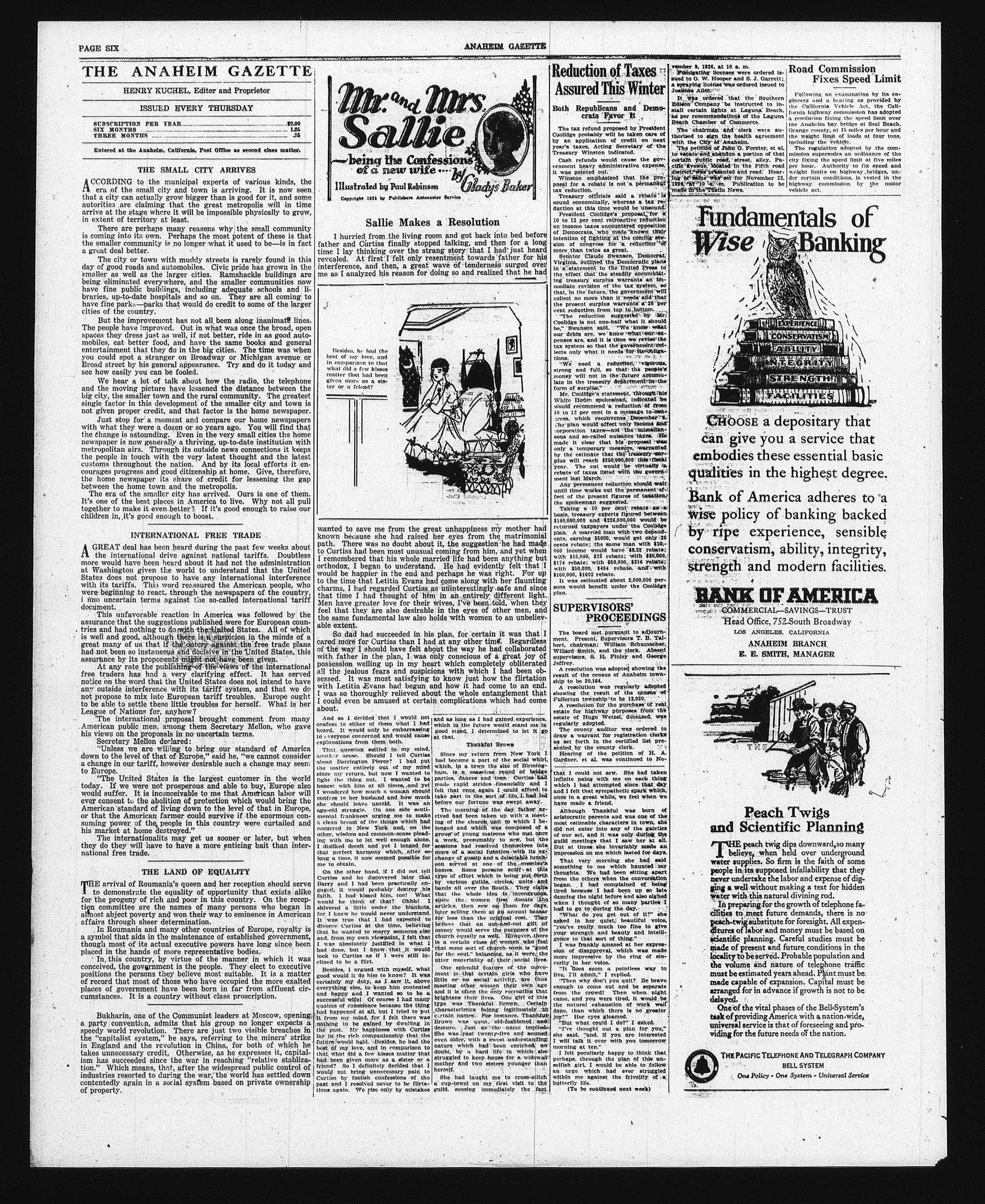
Searchable text
THE ANAHEIM GAZETTE
HENRY KUCHEL, Editor and Proprietor
ISSUED EVERY THURSDAY
SUBSCRIPTION PER YEAR $2.00
SIX MONTHS 1.25
THREE MONTHS .75
Entered at the Anaheim, California, Post Office as second class matter.
THE SMALL CITY ARRIVES
ACCORDING to the municipal experts of various kinds, the era of the small city and town is arriving. It is now seen that a city can actually grow bigger than is good for it, and some autorities are claiming that the great metropolis will in time arrive at the stage where it will be impossible physically to grow, in extent of territory at least.
There are perhaps many reasons why the small community is coming into its own. Perhaps the most potent of these is that the smaller community is no longer what it used to be—is in fact a great deal better.
The city or town with muddy streets is rarely found in this day of good roads and automobiles. Civic pride has grown in the smaller as well as the larger cities. Ramshackle buildings are being eliminated everywhere, and the smaller communities now have fine public buildings, including adequate schools and libraries, up-to-date hospitals and so on. They are all coming to have fine parks—parks that would do credit to some of the larger cities of the country.
But the improvement has not all been along inanimate lines. The people have improved. Out in what was once the broad, open spaces they dress just as well, if not better, ride in as good automobiles, eat better food, and have the same books and general entertainment that they do in the big cities. The time was when you could spot a stranger on Broadway or Michigan avenue or Broad street by his general appearance. Try and do it today and see how easily you can be fooled.
We hear a lot of talk about how the radio, the telephone and the moving picture have lessened the distance between the big city, the smaller town and the rural community. The greatest single factor in this development of the smaller city and town is not given proper credit, and that factor is the home newspaper.
Just stop for a moment and compare our home newspapers with what they were a dozen or so years ago. You will find that the change is astounding. Even in the very small cities the home newspaper is now generally a thriving, up-to-date institution with metropolitan airs. Through its outside news connections it keeps
you could spot a stranger on Broadway or Michigan avenue or Broad street by his general appearance. Try and do it today and see how easily you can be fooled.
We hear a lot of talk about how the radio, the telephone and the moving picture have lessened the distance between the big city, the smaller town and the rural community. The greatest single factor in this development of the smaller city and town is not given proper credit, and that factor is the home newspaper.
Just stop for a moment and compare our home newspapers with what they were a dozen or so years ago. You will find that the change is astounding. Even in the very small cities the home newspaper is now generally a thriving, up-to-date institution with metropolitan airs. Through its outside news connections it keeps the people in touch with the very latest thought and the latest customs throughout the nation. And by its local efforts it encourages progress and good citizenship at home. Give, therefore, the home newspaper its share of credit for lessening the gap between the home town and the metropolis.
The era of the smaller city has arrived. Ours is one of them. It's one of the best places in America to live. Why not all pull together to make it even better? If it's good enough to raise our children in, it's good enough to boost.
INTERNATIONAL FREE TRADE
A GREAT deal has been heard during the past few weeks about the international drive against national tariffs. Doubtless more would have been heard about it had not the administration at Washington given the world to understand that the United States does not propose to have any international interference with its tariffs. This word reassured the American people, who were beginning to react, through the newspapers of the country, into uncertain terms against the so-called international tariff document.
This unfavorable reaction in America was followed by the assurance that the suggestions published were for European countries and had nothing to do with the United States. All of which is well and good, although there is a suspicion in the minds of a great many of us that if the outcry against the free trade plans had not been so instaneous and decisive in the United States, this assurance by its proponents might not have been given.
At any rate the publishing of the views of the international free traders has had a very clarifying effect. It has served notice on the word that the United States does not intend to have any outside interference with its tariff system, and that we do not propose to mix into European tariff troubles. Europe ought to be able to settle these little troubles for herself. What is her League of Nations for, anyhow?
The international proposal brought comment from many American public men, among them Secretary Mellon, who gave his views on the proposals in no uncertain terms.
Secretary Mellon declared:
"Unless we are willing to bring our standard of America down to the level of that of Europe," said he, "we cannot consider a change in our tariff, however desirable such a change may seem to Europe.
"The United States is the largest customer in the world today. If we were not prosperous and able to buy, Europe also would suffer. It is inconceivable to me that American labor will ever consent to the abolition of protection which would bring the American standard of living down to the level of that in Europe, or that the American farmer could survive if the enormous consuming power of the people in this country were curtailed and his market at home destroyed."
The internationalists may get us sooner or later, but when they do they will have to have a more enticing bait than inter-
down to the level or that of Europe," said he, "we cannot consider a change in our tariff, however desirable such a change may seem to Europe.
"The United States is the largest customer in the world today. If we were not prosperous and able to buy, Europe also would suffer. It is inconceivable to me that American labor will ever consent to the abolition of protection which would bring the American standard of living down to the level of that in Europe, or that the American farmer could survive if the enormous consuming power of the people in this country were curtailed and his market at home destroyed."
The internationalists may get us sooner or later, but when they do they will have to have a more enticing bait than international free trade.
THE LAND OF EQUALITY
The arrival of Roumania's queen and her reception should serve to demonstrate the equality of opportunity that exists alike for the progeny of rich and poor in this country. On the reception committee are the names of many persons who began in almost abject poverty and won their way to eminence in American affairs through sheer determination.
In Roumania and many other countries of Europe, royalty is a symbol that aids in the maintenance of established government, though most of its actual executive powers have long since been placed in the hands of more representative bodies.
In this country, by virtue of the manner in which it was conceived, the government is the people. They elect to executive positions the persons they believe most suitable. It is a matter of record that most of those who have occupied the more exalted places of government have been born in far from affluent circumstances. It is a country without class proscription.
Bukharin, one of the Communist leaders at Moscow, opening a party convention, admits that his group no longer expects a speedy world revolution. There are just two visible breaches in the "capitalist system," he says, referring to the miners' strike in England and the revolution in China, for both of which he takes unnecessary credit. Otherwise, as he expresses it, capitalism has succeeded since the war in reaching "relative stabilization." Which means, that, after the widespread public control of industries resorted to during the war, the world has settled down contentedly again in a social system based on private ownership of property.
Mr. and Mrs. Sallie
being the Confessions of a new wife... by Gladys Baker
Illustrated by Paul Robinson
Copyright 1926 by Publishers Autocaster Service
Sallie Makes a Resolution
I hurried from the living room and got back into bed before father and Curtiss finally stopped talking, and then for a long time I lay thinking over the strang story that I had just heard revealed. At first I felt only resentment towards father for his interference, and then, a great wave of tenderness surged over me as I analyzed his reason for doing so and realized that he had
Besides, he had the best of my love, and in comparison to that what did a few kisses matter that had been given more as a sister or a friend?
Reduction of Taxes Assured This Winter
Both Republicans and Democrats Favor R
The tax refund proposed by President Coolidge probably will be taken care of by an application of credit on next year's taxes, Acting Secretary of the Treasury Winston indicated.
Cash refunds would cause the government heavy administrative expense, it was pointed out.
Winston emphasized that the proposal for a rebate is not a permanent tax reduction.
Treasury officials said a rebate is sound economically, whereas a tax reduction at this time would be unsound.
President Coolidge's proposal for a 10 to 12 per cent retroactive reduction on income taxes encountered opposition of Democrats, who made known their intention of fighting at the coming session of congress for a reduction of more than twice as great.
Senator Claude Swanson, Democrat, Virginia, outlined the Democratic plans in a statement to the United Press to the effect that the steadily accumulating treasury surplus warrants an immediate revision of the tax system, so that, in the future, the government will collect no more than it needs and that the present surplus warrants a 25 per cent reduction from top to bottom.
"The reduction suggested by Mr. Coolidge is not one-half what it should be," Swanson said. "We know what our debts are, we know what our expenses are, and it is time we review the tax system so that the government collects only what it needs for its obligations."
"We need a reduction, vigorous, strong and full, so that the people's money will not in the future accumulate in the treasury department in the form of surplus."
Mr. Coolidge's statement, through his White House spokesman, indicated he would recommend a reduction of from 10 to 12 per cent in a message to Congress, which reconvenes December 8. The plan would affect only income and corporation taxes—not the miscellaneous and so-called nuisance taxes. He made it clear that his proposal was only a temporary measure warranted
wanted to save me from the great unhappiness my mother had known because she had raised her eyes from the matrimonial path. There was no doubt about it, the suggestion he had made to Curtiss had been most unusual coming from him, and yet when I remembered that his whole married life had been anything but orthodox, I began to understand. He had evidently felt that I would be happier in the end and perhaps he was right. For up to the time that Letitia Evans had come along with her flaunting charms, I had regarded Curtiss as uninterestingly safe and since that time I had thought of him in an entirely different light. Men have greater love for their wives, I've been told, when they feel that they are also desirable in the eyes of other men, and the same fundamental law also holds with women to an unbelievable extent.
So dad had succeeded in his plan, for certain it was that I cared more for Curtiss than I had at any other time. Regardless of the way I should have felt about the way he had collaborated with father in the plan, I was only conscious of a great joy of possession welling up in my heart which completely obliterated all the jealous fears and suspicions with which I had been obsessed. It was most satisfying to know just how the flirtation with Letitia Evans had begun and how it had come to an end. I was so thoroughly relieved about the whole entanglement that I could even be amused at certain complications which had come about.
And so I decided that I would not confess to either of them what I had heard. It would only be embarrassing to everyone concerned and would cause explanations from them both.
That question settled in my mind, another arose. Should I tell Curtiss about Barrington Pierce? I had put the matter entirely out of my mind since my return, but now I wanted to fight the thing out. I wanted to be honest with him at all times, and yet I wondered how much a woman should confess to her husband and how much she should leave untold. It was an age-old struggle. On one side sentimental frankness urging me to make a clean breast of the things which had occurred in New York and, on the other, wisdom and common-sense pleading with me to let well enough alone. I disliked deceit and yet I longed for
and as long as I had gained experience, which in the future would stand me in good stead, I determined to let it go at that.
Thankful Brown
Since my return from New York I had become a part of the social whirl, which, in a town the size of Birmingham, is a cohesive round of bridge parties, dances and teas. Curtiss had made rapid strides financially and I felt that once again I could afford to take part in the sort of life I had led before our fortune was swept away.
The morning of the day father arrived had been taken up with a meeting of the church unit to which I belonged and which was composed of a group of young matrons who met once a week, presumably to sew, but the sessions had resolved themselves into tensions.
"We need a reduction, vigorous, strong and full, so that the people's money will not in the future accumulate in the treasury department in the form of surplus."
Mr. Coolidge's statement through his White House spokesman indicated he would recommend a reduction of from 10 to 12 per cent in a message to address which reconvenes December 8. The plan would affect only income and corporation taxes—not the miscellaneous and so-called nuisance taxes. He made it clear that his proposal was only a temporary measure, warranted by the estimate that the treasury surplus will reach $250,000,000 this fiscal year. The cut would be virtually a rebate of taxes listed with the government last March.
Any permanent reduction should wait until time works out the permanent effect of the present figures of taxation/the spokesman suggested.
Taking a 10 per cent rebate as basis, treasury experts figured between $180,000,000 and $226,000,000 would be returned taxpayers under the Coolidge plan. A married man with two dependents, earning $6000, would get only 25 cents rebate; the same man with $10,000 income would have $8.32 rebate; with $15,000, $28 rebate; with $10,000, $174 rebate; with $50,000, $316 rebate; with $50,000, $484 rebate; and with $100,000, $1602 rebate.
It was estimated about 2,500,000 persons would benefit under the Coolidge plan.
SUPERVISORS' PROCEEDINGS
The board met pursuant to adjournment. Present: Supervisors T. B. Talbert, chairman; William Schumacher, Willard Smith, and the clerk. Absent supervisors, S. H. Finley and George Jeffrey.
A resolution was adopted showing the result of the census of Anaheim township to be 20,164.
A resolution was regularly adopted showing the result of the census of Fullerton township to be 13,020.
A resolution for the purchase of real estate for highway purposes from the estate of Hugo Wetzel, deceased, was regularly adopted.
The county auditor was ordered to draw a warrant for registration clerks as set forth in the certified list presented by the county clerk.
Hearing of the petition of H. A. Gardner, et al., was continued to No-that I could not sew. She had taken infinite palms with me on each thing which I had attempted since that day and I felt that sympathetic spark which once in a great while, we feel when we have made a friend.
Although Thankful was born of aristocratic parents and was one of the most estimable characters in town, she did not enter into any of the gaieties of our set, and it was only during the guild meetings that I saw her at all. But at times she invariably made an
consider another arose. Should I tell Curtiss about Barrington Pierce? I had put the matter entirely out of my mind since my return, but now I wanted to fight the thing out. I wanted to be honest with him at all times, and yet I wondered how much a woman should confess to her husband and how much she should leave untold. It was an age-old struggle. On one side sentimental frankness urging me to make a clean breast of the things which had occurred in New York and, on the other, wisdom and common-sense pleading with me to let well enough alone. I disliked deceit and yet I longed for that perfect harmony which, after so long a time, it now seemed possible for me to obtain.
On the other hand, if I did not tell Curtiss and he discovered later that Barry and I had been practically engaged. It would probably destroy his faith. I had kissed him, too! What would he think of that? Ohhh! I shivered a little under the blankets, for I knew he would never understand. It was true that I had expected to divorce Curtiss at the time, believing that he wanted to marry someone else and, from my own viewpoint, I felt that I was absolutely justified in what I had done, but I knew that it would look to Curtiss as if I were still inclined to be a flirt.
Besides, I argued with myself, what good would it do him to know? It was certainly my duty, as I saw it, above everything else, to keep him contented and happy and I wanted so to be a successful wife! Of course I had many qualms of conscience because the thing had happened at all, but I tried to put it from my mind, for I felt there was nothing to be gained by dwelling in the past. My happiness with Curtiss lay in the rich companionship that the future would hold. Besides, he had the best of my love, and in comparison to that what did a few kisses matter that he been given more as a sister or a friend? So I definitely decided that I would not bring unnecessary pain to Curtiss by foolish confessions of the past and I resolved never to be flirtatious again. We rise only by mistakes once my return became part of the social whirl, which, in a town size of Birmingham, is a coseless round of bridge parties, dances and teas. Curtiss had made rapid strides financially and I felt that once again I could afford to take part in the sort of life I had led before our fortune was swept away.
The morning of the day father arrived had been taken up with a meeting of the church unit to which I belonged and which was composed of a group of young matrons who met once a week, presumably to sew, but the sessions had resolved themselves into more of a social function with its exchange of gossip and a delicate lunch served at one of the member's homes. Some persons scoff at this type of effort which is being put forth by various guilds, circles, units and bands all over the South. They claim that the whole idea is incongruous since the women first donate the articles, then sew on them for days, later selling them at an annual bazaar for less than the original cost. They believe that an out-and-out gift of money would serve the purposes of the church equally as well. However, there is a certain class of women who feel that some sort of church work is "good for the soul," balancing as it were, the utter materiality of their social lives.
One splendid feature of the movement is that certain girls who have little or no social activity, are thus meeting other women their own age and it is often the only recreation that brightens their lives. One girl of this type was Thankful Brown. Certain characteristics belong legitimately to certain names. For instance, Thankful Brown was quiet, old-fashioned and demure. Just as the name implied She was past twenty-five and seemed even older, with a sweet understanding nature which had been enriched no doubt, by a hard life in which she struggled to keep house for a widowed mother and two sisters younger than herself.
She had taught me to cross-stitch a cup-towel on my first visit to the guild, sonning immediately the fact that I could not sew. She had taken infinite palms with me on each thing which I had attempted since that day and I felt that sympathetic spark which once in a great while, we feel when we have made a friend.
Although Thankful was born of aristocratic parents and was one of the most estimable characters in town, she did not enter into any of the galleties of our set, and it was only during the guild meetings that I saw her at all. But at times she invariably made an impression on me which lasted for days.
That very morning she had said something to me which haunted my thoughts. We had been sitting apart from the others when the conversation began. I had complained of being tired because I had been up so late dancing the night before and also aligned when I thought of so many parties I had to go to during the day.
"What do you get out of it?" she asked in her quiet, beautiful voice, "you're really much too fine to give your strength and beauty and intelligence to that sort of thing."
I was frankly amazed at her expression of disapproval, which was made more impressive by the ring of sincerity in her voice.
"It does seem a pointless way to live, I'll admit," I replied.
"Then why don't you quit? Be brave enough to come out and be separate from the crowd! Then when night came, and you were tired, it would be the natural exhaustion of work well done, than which there is no greater joy!" Her eyes gleamed.
"But what could I do?" I asked.
"I've thought out a plan for you," she said, "and, if you are interested I will talk it over with you tomorrow morning at ten."
I felt peculiarly happy to think that perhaps, through the plan of this unselfish girl, I would be able to follow an urge which had ever struggled within me against the frivolity of a butterfly life.
(To be continued next week)
November 9, 1926, at 10 a.m.
Fungiating licenses were ordered issued to O. W. Hooper and S. J. Garrett; a spraying license was ordered issued to Joanne Allen.
It was ordered that the Southern Edison Company be instructed to install certain lights at Laguna Beach, as per recommendations of the Laguna Beach Chamber of Commerce.
The chairman and clerk were authorised to sign the health agreement with the City of Anaheim.
The petition of John O. Forster, et al., to vacate and abandon a portion of that certain public road, street, alley, Pacific Avenue, located in the Fifth road district, was presented and read. Hearing being held was set for November 23, 1926, at 10 a.m. Publication to be made in the Tustin News.
Road Commission Fixes Speed Limit
Following an examination by its engineers and a hearing as provided by the California Vehicle Act, the California highway commission has adopted a resolution fixing the speed limit over the Anaheim bay bridge at Seal Beach, Orange county, at 15 miles per hour and the weight limit of loads at four tons, including the vehicle.
The regulation adopted by the commission supersedes an ordinance of the city fixing the speed limit at five miles per hour. Authority to fix speed and weight limits on highway bridges, under certain conditions, is vested in the highway commission by the motor vehicle act.
Fundamentals of Wise Banking
EXPERIENCE
CONSERVATISM
ABILITY
INTEGRITY
STRENGTH
FACILITIES
CHOOSE a depositary that can give you a service that
INTEGRITY
STRENGTH
FACILITIES
Choose a depositary that can give you a service that embodies these essential basic qualities in the highest degree.
Bank of America adheres to a wise policy of banking backed by ripe experience, sensible conservatism, ability, integrity, strength and modern facilities.
BANK OF AMERICA
COMMERCIAL—SAVINGS—TRUST
Head Office, 752 South Broadway
LOS ANGELES, CALIFORNIA
ANAHEIM BRANCH
E. E. SMITH, MANAGER
Peach Twigs
and Scientific Planning
The peach twig dips downward, so many
Peach Twigs and Scientific Planning
THE peach twig dips downward, so many believe, when held over underground water supplies. So firm is the faith of some people in its supposed infallibility that they never undertake the labor and expense of digging a well without making a test for hidden water with this natural divining rod.
In preparing for the growth of telephone facilities to meet future demands, there is no peach-twig substitute for foresight. All expenditures of labor and money must be based on scientific planning. Careful studies must be made of present and future conditions in the locality to be served. Probable population and the volume and nature of telephone traffic must be estimated years ahead. Plant must be made capable of expansion. Capital must be arranged for in advance if growth is not to be delayed.
One of the vital phases of the Bell-System's task of providing America with a nation-wide, universal service is that of foreseeing and providing for the future needs of the nation.
THE PACIFIC TELEPHONE AND TELEGRAPH COMPANY
BELL SYSTEM
One Policy - One System - Universal Service