anaheim-gazette 1926-11-04
Scanned page
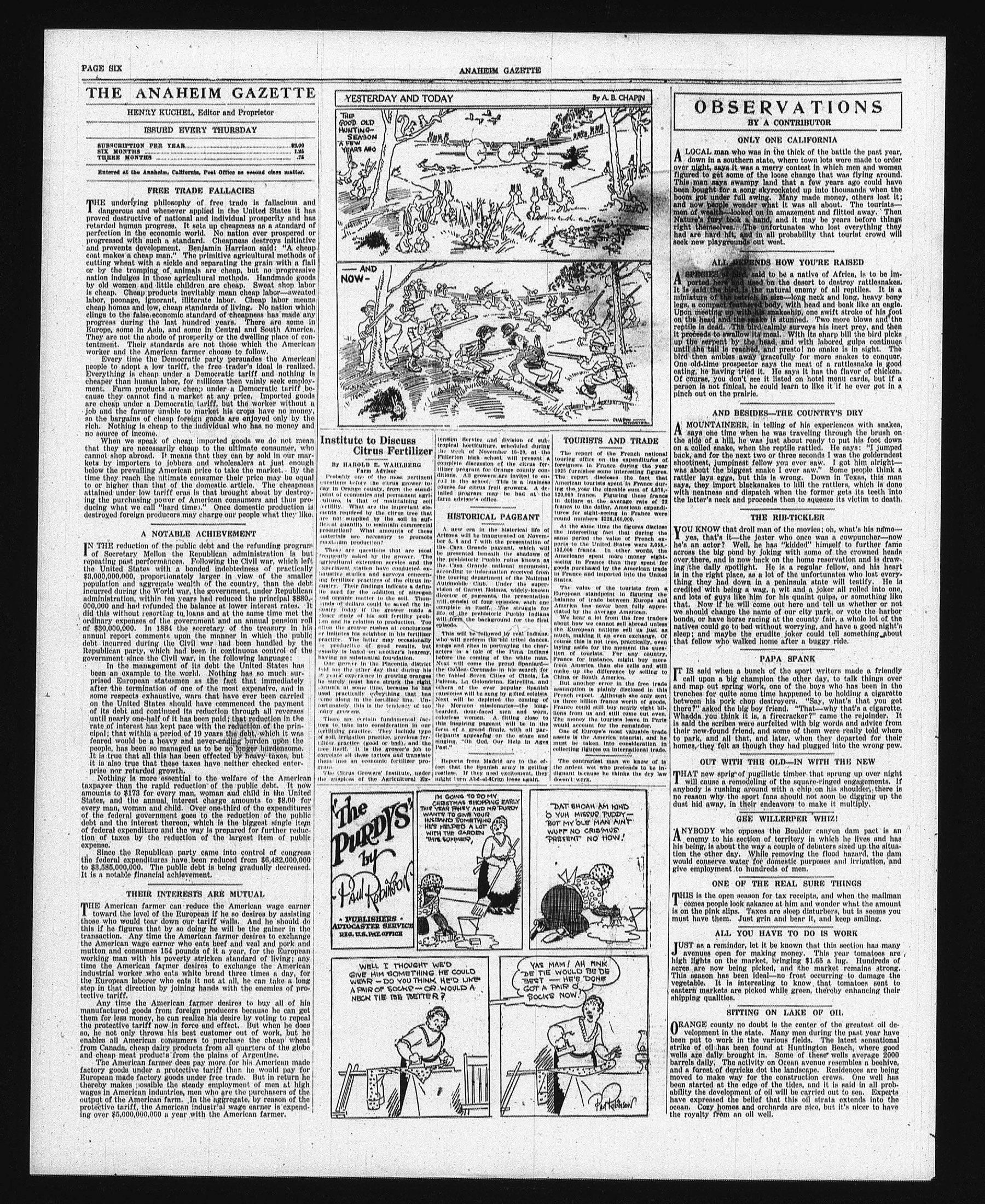
Searchable text
THE ANAHEIM GAZETTE
HENRY KUCHEL, Editor and Proprietor
ISSUED EVERY THURSDAY
SUBSCRIPTION PER YEAR ..... $2.00
SIX MONTHS ..... 1.85
THREE MONTHS ..... 1.75
Entered at the Anaheim, California, Post Office as second class matter.
FREE TRADE FALLACIES
The underlying philosophy of free trade is fallacious and dangerous and whenever applied in the United States it has proved destructive of national and individual prosperity and has retarded human progress. It sets up cheapness as a standard of perfection in the economic world. No nation ever prospered or progressed with such a standard. Cheapness destroys initiative and prevents development. Benjamin Harrison said: "A cheap coat makes a cheap man." The primitive agricultural methods of cutting wheat with a sickle and separating the grain with a flail or by the tromping of animals are cheap, but no progressive nation indulges in those agricultural methods. Handmade goods by old women and little children are cheap. Sweat shop labor is cheap. Cheap products inevitably mean cheap labor—sweated labor, peonage, ignorant, illiterate labor. Cheap labor means cheap homes and low, cheap standards of living. No nation which clings to the false economic standard of cheapness has made any progress during the last hundred years. There are some in Europe, some in Asia, and some in Central and South America. They are not the abode of prosperity or the dwelling place of contentment. Their standards are not those which the American worker and the American farmer choose to follow.
Every time the Democratic party persuades the American people to adopt a low tariff, the free trader's ideal is realized. Everything is cheap under a Democratic tariff and nothing is cheaper than human labor, for millions then vainly seek employment. Farm products are cheap under a Democratic tariff because they cannot find a market at any price. Imported goods are cheap under a Democratic tariff, but the worker without a job and the farmer unable to market his crops have no money, so the bargains of cheap foreign goods are enjoyed only by the rich. Nothing is cheap to the individual who has no money and no source of income.
When we speak of cheap imported goods we do not mean that they are necessarily cheap to the ultimate consumer, who
Every time the Democratic party persuades the American people to adopt a low tariff, the free trader's ideal is realized. Everything is cheap under a Democratic tariff and nothing is cheaper than human labor, for millions then vainly seek employment. Farm products are cheap under a Democratic tariff because they cannot find a market at any price. Imported goods are cheap under a Democratic tariff, but the worker without a job and the farmer unable to market his crops have no money, so the bargains of cheap foreign goods are enjoyed only by the rich. Nothing is cheap to the individual who has no money and no source of income.
When we speak of cheap imported goods we do not mean that they are necessarily cheap to the ultimate consumer, who cannot shop abroad. It means that they can be sold in our markets by importers to jobbers and wholesalers at just enough below the prevailing American price to take the market. By the time they reach the ultimate consumer their price may be equal to or higher than that of the domestic article. The cheapness attained under low tariff eras is that brought about by destroying the purchasing power of American consumers and thus producing what we call "hard times." Once domestic production is destroyed foreign producers may charge our people what they like.
A NOTABLE ACHIEVEMENT
IN THE reduction of the public debt and the refunding program of Secretary Mellon the Republican administration is but repeating past performances. Following the Civil war, which left the United States with a bonded indebtedness of practically $3,000,000,000, proportionately larger in view of the smaller population and aggregate wealth of the country, than the debt incurred during the World war, the government, under Republican administration, within ten years had reduced the principal $880,-000,000 and had refunded the balance at lower interest rates. It did this without resorting to loans and at the same time met the ordinary expenses of the government and an annual pension roll of $80,000,000. In 1884 the secretary of the treasury in his annual report comments upon the manner in which the public debt incurred during the Civil war had been handled by the Republican party, which had been in continuous control of the government since the Civil war, in the following language:
In the management of its debt the United States has been an example to the world. Nothing has so much surprised European statesmen as the fact that immediately after the termination of one of the most expensive, and in some respects exhaustive, wars that have ever been carried on the United States should have commenced the payment of its debt and continued its reduction through all reverses until nearly one-half of it has been paid; that reduction in the rate of interest has kept pace with the reduction of the principal; that within a period of 19 years the debt, which it was feared would be a heavy and never-ending burden upon the people, has been so managed as to be no longer burdensome. It is true that all this has been effected by heavy taxes, but it is also true that these taxes have neither checked enterprise nor retarded growth.
Nothing is more essential to the welfare of the American taxpayer than the rapid reduction of the public debt. It now amounts to $173 for every man, woman and child in the United States, and the annual interest charge amounts to $8.00 for every man, woman and child. Over one-third of the expenditures of the federal government goes to the reduction of the public debt and the interest thereon, which is the biggest single item of federal expenditure and the way is prepared for further reduction of taxes by the reduction of the largest item of public expense.
It is true that all this has been effected by heavy taxes, but it is also true that these taxes have neither checked enterprise nor retarded growth.
Nothing is more essential to the welfare of the American taxpayer than the rapid reduction of the public debt. It now amounts to $173 for every man, woman and child in the United States, and the annual interest charge amounts to $8.00 for every man, woman and child. Over one-third of the expenditures of the federal government goes to the reduction of the public debt and the interest thereon, which is the biggest single item of federal expenditure and the way is prepared for further reduction of taxes by the reduction of the largest item of public expense.
Since the Republican party came into control of congress the federal expenditures have been reduced from $6,482,000,000 to $3,585,000,000. The public debt is being gradually decreased. It is a notable financial achievement.
THEIR INTERESTS ARE MUTUAL
The American farmer can reduce the American wage earner toward the level of the European if he so desires by assisting those who would tear down our tariff walls. And he should do this if he figures that by so doing he will be the gainer in the transaction. Any time the American farmer desires to exchange the American wage earner who eats beef and veal and pork and mutton and consumes 154 pounds of it a year, for the European working man with his poverty stricken standard of living; any time the American farmer desires to exchange the American industrial worker who eats white bread three times a day, for the European laborer who eats it not at all, he can take a long step in that direction by joining hands with the enemies of protective tariff.
Any time the American farmer desires to buy all of his manufactured goods from foreign producers because he can get them for less money, he can realize his desire by voting to repeal the protective tariff now in force and effect. But when he does so, he not only throws his best customer out of work, but he enables all American consumers to purchase the cheap wheat from Canada, cheap dairy products from all quarters of the globe and cheap meat products from the plains of Argentine.
The American farmer does pay more for his American made factory goods under a protective tariff than he would pay for European made factory goods under free trade. But in return he thereby makes possible the steady employment of men at high wages in American industries, men who are the purchasers of the output of the American farm. In the aggregate, by reason of the protective tariff, the American industrial wage earner is expending over $5,000,000,000 a year with the American farmer.
YESTERDAY AND TODAY
By A. B. CHAPIN
THE GOOD OLD HUNTING SEASON
A Few Years Ago
AND NOW-
Institute to Discuss
Citrus Farming
TOURISTS AND TRADE
Institute to Discuss Citrus Fertilizer
By HAROLD E. WAHLBERG
Farm Advisor
Probably one of the most pertinent questions before the citrus grower today in Orange county, from the standpoint of economics and permanent agriculture, is that of maintaining soil fertility. What are the important elements required by the citrus tree that are not supplied by the soil in sufficient quantity to maintain commercial production? What amounts of these materials are necessary to promote maximum production?
These are questions that are most frequently asked by the grower. The agricultural extension service and the experiment station have conducted extensive studies and surveys concerning fertilizer practices of the citrus industry. Their findings indicate a definite need for the addition of nitrogen and organic matter to the soil. Thousands of dollars could be saved in the industry today if the grower made a closer study of his soil fertility problem and its relation to production. Too often the grower rushes at conclusions or initiates his neighbor in his fertilizer practice. The latter may occasionally be productive of good results, but usually is based on another’s hearty, having no substantial foundation.
One grower in the Placenta district told me the other day that during his 10 years’ experience in growing oranges he surely must have struck the right formula at some time, because he has used practically everything that has come along in the fertilizer line. Unfortunately, this is the tendency of too many growers.
There are certain fundamental factors to take into consideration in our fertilizing practice. They include type of soil, irrigation practice, previous fertilizer practice (good or bad), and the tree itself. It is the grower’s job to correlate all these factors and translate them into an economic fertilizer program.
The Citrus Growers’ Institute, under the auspices of the Agricultural Examination Service and division of subtropical horticulture, scheduled during the week of November 15-20, at the Fullerton high school, will present a complete discussion of the citrus fertilizer program for Orange county conditions. All growers are invited to enroll in the school. This is a business course for citrus fruit growers. A detailed program may be had at the farm advisor’s office.
HISTORICAL PAGEANT
A new era in the historical life of Arizona will be inaugurated on November 5, 4 and 7 with the presentation of the Casa Grande pageant, which will be presented beneath the shadows of the prehistoric Pueblo ruins known as the Casa Grande national monument, according to information received from the touring department of the National Automobile Club. Under the supervision of Garnet Holmes, widely-known director of pageants, the presentation will consist of four episodes, each one complete in itself. The struggle for life of the prehistoric Pueblo Indians will form the background for the first episode.
This will be followed by real Indians, who will perform the old tribal dances, songs and rites in portraying the characters in a tale of the Pima Indians before the coming of the white man. Next will come the proud Spaniard—the Golden Coronado—in his search for the fabled Seven Cities of Cibola, La Paloma, La Golondrina, Estrellita, and others of the ever popular Spanish canciones will be sung by gifted soloists. Next will be depicted the coming of the Mormon missionaries—the long-bearded, dour-faced men and worn colorless women. A fitting close to this inspiring pageant will be in the form of a grand finale, with all participants appearing on the stage and singing, “Oh God, Our Help in Ages Past.”
Reports from Madrid are to the effect that the Spanish army is getting rotters. If they need excitement, they might turn Abd-al-Krim loose again.
TOURISTS AND TRADE
The report of the French national touring office on the expenditures of foreigners in France during the year 1925 furnishes some interesting figures. The report discloses the fact that American tourists spent in France during the year the sizeable sum of 4,976,-520,000 francs. Figuring these francs in dollars at the average rate of 22 francs to the dollar, American expenditures for sight-seeing in France were round numbers $228,160,000.
At the same time the figures disclose the interesting fact that during the same period the value of French exports to the United States were 3,088,-122,000 francs. In other words, the Americans spent more money sightseeing in France than they spent for goods purchased by the American trade in France and imported into the United States.
The value of the tourists from a European standpoint in figuring the balance of trade between Europe and America has never been fully appreciated by the average American.
We hear a lot from the free traders about how we cannot sell abroad unless the European nations sell us just as much, making it an even exchange. Of course this is not true, practically, oven laying aside for the moment the question of tourists. For any country, France for instance, might buy more from America than she sells and still make up the difference by selling to China or South America.
But another error in the free trade assumption is plainly disclosed in this French report. Although she only sent us three billion francs worth of goods, France could still buy nearly eight billions from us and still come out even. The money the tourists leave in Paris would account for the remainder.
One of Europe’s most valuable trade assets is the America tourist, and he must be taken into consideration in collecting figures on international trade.
The contrariest man we know of is the ardent wet who pretends to be indignant because he thinks the dry law doesn’t work.
The Purdys' by Paul Robinson
PUBLISHERS ADTOCASTER SERVICE REG. U.S. PAT. OFFICE
I'm going to do my Christmas shopping early this year and Mr. Purdy wants to give your husband something he helped a lot with the garden this summer.
DAT SHOAH AM KIND
O YUH MISSUD PUDDY—
BUT MY OLE MAN AINT WUFF NO CRISMUS
PRESENT NO HOW!
WELL I THOUGHT WE'D GIVE HIM SOMETHING HE COULD WEAR — DO YOU THINK HE'D LIKE A PAIR OF SOCKS? OR WOULD A NECK TIE BE BETTER?
YAS MAM! AH MINK DE TIE WOULD BE DE BEST — HE'S DONE GOT A PAIR OF SOCKS NOW.
OBSERVATIONS
BY A CONTRIBUTOR
ONLY ONE CALIFORNIA
A LOCAL man who was in the thick of the battle the past year,
down in a southern state, where town lots were made to order
over night, says it was a merry contest in which men and women
figured to get some of the loose change that was flying around.
This man says swampy land that a few years ago could have
been bought for a song skyrocketed up into thousands when the
boom got under full swing. Many made money, others lost it;
and now people wonder what it was all about. The tourists—
men of wealth—looked on in amazement and flitted away. Then
Nature's fury took a hand, and it may be years before things
right themselves. The unfortunates who lost everything they
had are hard hit, and in all probability that tourlst crowd will
seek new playgrounds out west.
ALL DEPENDS HOW YOU'RE RAISED
A SPECIES of bird, said to be a native of Africa, is to be imported here and used on the desert to destroy rattlesnakes.
It is said the bird is the natural enemy of all reptiles. It is a
miniature of the ostrich in size—long neck and long, heavy bony
legs, a compact feathered body, with head and beak like an eagle.
Upon meeting up with his snakeship, one swift stroke of his foot
on the head and the snake is stunned. Two more blows and the
reptile is dead. The bird calmly surveys his inert prey, and then
it proceeds to swallow its meal. With its sharp bill the bird pleks
up the serpent by the head, and with labored gulps continues
until the tail is reached, and prestol no snake is in sight. The
bird then ambles away gracefully for more snakes to conquer.
One old-time prospector says the meat of a rattlesnake is good
eating, he having tried it. He says it has the flavor of chicken.
Of course, you don't see it listed on hotel menu cards, but if a
person is not clinical, he could learn to like it if he ever got in a pinch out on the prairie.
AND BESIDES—THE COUNTRY'S DRY
A MOUNTAINEER, in telling of his experiences with snakes,
says one time when he was traveling through the brush on
the side of a hill, he was just about ready to put his foot down
on a colled snake, when the reptile rattled. He says: "I jumped
AND BESIDES—THE COUNTRY'S DRY
MOUNTAINEER, in telling of his experiences with snakes, says one time when he was traveling through the brush on the side of a hill, he was just about ready to put his foot down on a colled snake, when the reptile rattled. He says: "I jumped back, and for the next two or three seconds I was the golderndest shootinest, jumpinest fellow you ever saw. I got him alright—was about the biggest snake I ever saw." Some people think a rattler lays eggs, but this is wrong. Down in Texas, this man says, they import blacksnakes to kill the rattlers, which is done with neatness and dispatch when the former gets its teeth into the latter's neck and proceeds then to squeeze its victim to death.
THE RIB-TICKLER
YOU KNOW that droll man of the movies; oh, what's his name—yes, that's it—the jester who once was a cowpuncher—now he's an actor? Well, he has "kidded" himself to further fame across the big pond by joking with some of the crowned heads over there, and is now back on the home reservation and is drawing/the daily spotlight. He is a regular fellow, and his heart is in the right place, as a lot of the unfortunates who lost everything they had down in a peninsula state will testify. He is credited with being a wag, a wit and a joker all rolled into one, and lots of guys like him for his quaint quips, or something like that. Now if he will come out here and tell us whether or not we should change the name of our city park, or vote the harbor bonds, or have horse racing at the county fair, a whole lot of the natives could go to bed without worrying, and have a good night's sleep; and maybe the erudite joker could tell something about that fellow who walked home after a buggy ride.
PAPA SPANK
IT IS said when a bunch of the sport writers made a friendly call upon a big champion the other day, to talk things over and map out spring work, one of the boys who has been in the trenches for quite some time happened to be holding a cigarette between his pork chop destroyers. "Say, what’s that you got there?" asked the big boy friend. "That—why that’s a cigarette. Whadda you think it is, a firecracker?" came the rejoinder. It is said the scribes were surfeited with big words and advice from their new-found friend, and some of them were really told where to park, and all that, and later, when they departed for their homes, they felt as though they had plugged into the wrong pew.
OUT WITH THE OLD—IN WITH THE NEW
THAT new sprig of pugillistic timber that sprung up over night will cause a remodeling of the square-ringed engagements. If anybody is rushing around with a chip on his shoulder, there is no reason why the sport fans should not soon be digging up the dust hid away, in their endeavors to make it multiply.
GEE WILLERPER WHIZ!
ANYBODY who opposes the Boulder canyon dam pact is an enemy to his section of territory in which he lives and has his being, is about the way a couple of debaters sized up the situa-
OUT WITH THE OLD—IN WITH THE NEW
THAT new sprig of pugilistic timber that sprung up over night will cause a remodeling of the square-ringed engagements. If anybody is rushing around with a chip on his shoulder, there is no reason why the sport fans should not soon be digging up the dust hid away, in their endeavors to make it multiply.
GEE WILLERPER WHIZ!
ANYBODY who opposes the Boulder canyon dam pact is an enemy to his section of territory in which he lives and has his being, is about the way a couple of debaters sized up the situation the other day. While removing the flood hazard, the dam would conserve water for domestic purposes and irrigation, and give employment to hundreds of men.
ONE OF THE REAL SURE THINGS
THIS is the open season for tax receipts, and when the mailman comes people look askance at him and wonder what the amount is on the pink slips. Taxes are sleep disturbers, but is seems you must have them. Just grin and bear it, and keep smiling.
ALL YOU HAVE TO DO IS WORK
JUST as a reminder, let it be known that this section has many avenues open for making money. This year tomatoes are high lights on the market, bringing $1.65 a lug. Hundreds of acres are now being picked, and the market remains strong. This season has been ideal—no frost occurring to damage the vegetable. It is interesting to know that tomatoes sent to eastern markets are picked while green, thereby enhancing their shipping qualities.
SITTING ON LAKE OF OIL
ORANGE county no doubt is the center of the greatest oil development in the state. Many men during the past year have been put to work in the various fields. The latest sensational strike of oil has been found at Huntington Beach, where good wells are daily brought in. Some of these wells average 2000 barrels daily. The activity on Ocean avenue resembles a beehive, and a forest of derricks dot the landscape. Residences are being moved to make way for the construction crews. One well has been started at the edge of the tides, and it is said in all probability the development of oil will be carried out to sea. Experts have expressed the belief that this oil strata extends into the ocean. Cozy homes and orchards are nice, but it's nicer to have the royalty from an oil well.