anaheim-gazette 1926-07-29
Scanned page
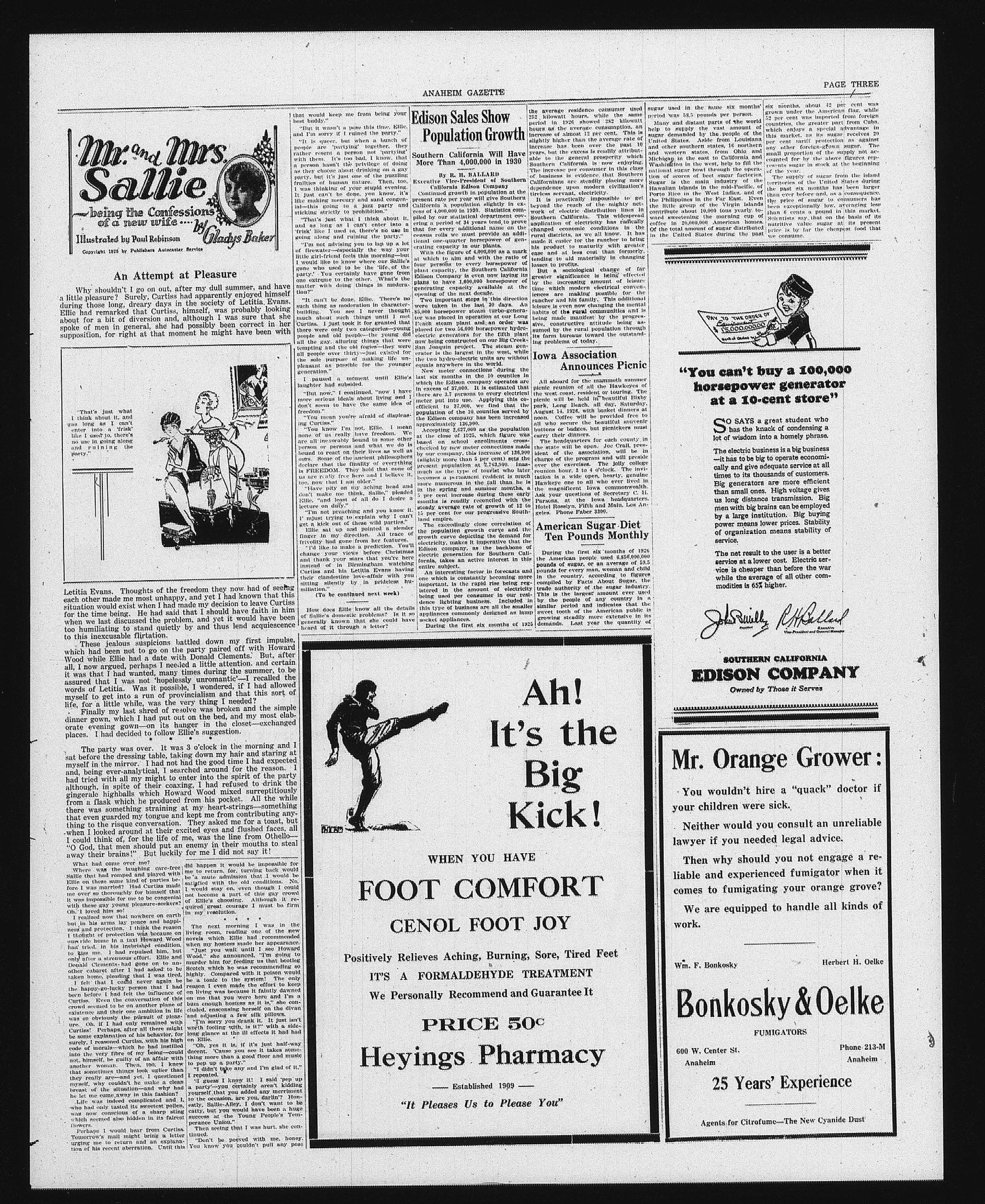
Searchable text
Mr. and Mrs. Sallie
being the Confessions of a new wife ... by Gladys Baker
Illustrated by Paul Robinson
Copyright 1925 by Publishers Autocaster Service
An Attempt at Pleasure
Why shouldn't I go on out, after my dull summer, and have a little pleasure? Surely, Curtiss had apparently enjoyed himself during those long, dreary days in the society of Letitia Evans. Ellie had remarked that Curtiss, himself, was probably looking about for a bit of diversion and, although I was sure that she spoke of men in general, she had possibly been correct in her supposition, for right at that moment he might have been with
"That's just what I think about it, and as long as I can't enter into a 'frisk' like I used to, there's no use in going along and ruining the
But it wasn't a pose tha and I'm sorry if I ruined it.
"It is queer, but when people are 'partying' to rather resent a person with them. It's too bad, a person hasn't the privilege as they choose about drinking party, but it's just one of frailties of human nature. I was thinking of your sire. It just can't be done, you like making mercury and alcohol—this going to a jar sticking strictly to prohibition."
"That's just what I think and as long as I can't frisk' like I used to, the going along and ruining.
"I'm not advising you of firewater—especially little girl-friend feels this. I would like to know who gone who used to be the party." You certainly had one extreme to the other matter with doing thing tion?
"It can't be done. Elli such thing as moderation building. You see I much about such things. Curtiss. I just took it for there were only two cat people and old people—all the gay, alluring the tempting and the old fog all people over thirty—just the sole purpose of my pleasant as possible for generation."
I paused a moment laughter had subsided.
"But now," I continue more serious ideals about don't seem to have the freedom."
"You mean you're affraying Curtiss."
"You know I'm not, none of us really have are all inexorably bound person or persons and..."
"That's just what I think about it, and was long as I can't enter into a 'frisk' like I used to, there's no use in going along and ruining the party."
Letitia Evans. Thoughts of the freedom they now had of seeing each other made me most unhappy, and yet I had known that this situation would exist when I had made my decision to leave Curtiss for the time being. He had said that I should have faith in him when we last discussed the problem, and yet it would have been too humiliating to stand quietly by and thus lend acquiescence to this inexcusable flirtation.
These jealous suspicions battled down my first impulse, which had been not to go on the party paired off with Howard Wood while Ellie had a date with Donald Clements. But, after all, I now argued, perhaps I needed a little attention. and certain it was that I had wanted, many times during the summer, to be assured that I was not 'hopelessly unromantic'—I recalled the words of Letitia. Was it possible, I wondered, if I had allowed myself to get into a run of provincialism and that this sort of life, for a little while, was the very thing I needed?
Finally my last shred of resolve was broken and the simple dinner gown, which I had put out on the bed, and my most elaborate evening gown—on its hanger in the closet—exchanged places. I had decided to follow Ellie's suggestion.
The party was over. It was 3 o'clock in the morning and I sat before the dressing table, taking down my hair and staring at myself in the mirror. I had not had the good time I had expected and, being ever-analytical, I searched around for the reason. I had tried with all my might to enter into the spirit of the party although, in spite of their coaxing, I had refused to drink the gingerale highballs which Howard Wood mixed surreptitiously from a flask which he produced from his pocket. All the while there was something straining at my heart-strings—something that even guarded my tongue and kept me from contributing anything to the risque conversation. They asked me for a toast, but when I looked around at their excited eyes and flushed faces, all I could think of, for the life of me, was the line from Othello—"O God, that men should put an enemy in their mouths to steal
I paused a moment laughter had subsided.
"But now," I continue more serious ideals about don't seem to have the freedom."
"You mean you're afraid Curtiss."
"You know I'm not, none of us really have are all inexorably bound person or persons and bound to react on their ours. Some of the anecdote declare that the finality is FREEDOM. They hold us are really free here too, now that I am older."
"Have pity on my ad don't make me think, Ellie, "and least of all lecture on duty."
"I'm not preaching and I'm just trying to explain get a kick out of these."
Ellie sat up and poised finger in my direction frivolity had gone from.
"I'd like to make a change your views be and thank your stars instead of in Birmingham Curtiss and his Letitia their clandestine love-sitting silently by in miliation."
(To be continued)
sat before the dressing table, taking down my hair and staring myself in the mirror. I had not had the good time I had expected and, being ever-analytical, I searched around for the reason. I had tried with all my might to enter into the spirit of the party although, in spite of their coaxing, I had refused to drink the gingerale highballs which Howard Wood mixed surreptitiously from a flask which he produced from his pocket. All the while there was something straining at my heart-strings—something that even guarded my tongue and kept me from contributing anything to the risque conversation. They asked me for a toast, but when I looked around at their excited eyes and flushed faces, all I could think of, for the life of me, was the line from Othello—"O God, that men should put an enemy in their mouths to steal away their brains!" But luckily for me I did not say it!
What had come over me?
Where was the laughing care-free Sallie that had romped and played with Ellie on these same kind of parties before I was married? Had Curtiss made me over so thoroughly for himself that it was impossible for me to be congenial with these gay young pleasure-seekers? Oh, I loved him so!
I realized now that nowhere on earth but in his arms lay peace and happiness and protection. I think the reason I thought of protection was because on our ride home in a taxi Howard Wood had tried, in his inebriated condition, to kiss me. I had repulsed him, but only after a strenuous effort. Ellie and Donald Clements had gone on to another cabaret after I had asked to be taken home, pleading that I was tired.
I felt that I could never again be the happy-go-lucky person that I had been before I had felt the influence of Curtiss. Even the conversation of this crowd seemed to be on another plane of existence and their one ambition in life was so obviously the pursuit of pleasure. Oh, if I had only remained with Curtiss! Perhaps, after all there might be some explanation of his behavior, for surely, I reasoned Curtiss, with his high code of morals—which he had instilled into the very fibre of my being—could not, himself, be guilty of an affair with another woman. Then, too, I knew that sometimes things look uglier than they really are—and yet, I questioned myself, why couldn't he make a clean breast of the situation—and why had he let me come away in this fashion?
Life was indeed complicated and I who had only tasted its sweetest pollen, was now conscious of a sharp sting which seemed also hidden in its fairest flowers.
Perhaps I would hear from Curtiss. Tomorrow's mail might bring a letter urging me to return and an explanation of his recent aberration. Until this did happen it would be impossible for me to return, for turning back would be a mute admission that I would be satisfied with the old conditions. No, I would stay on, even though I could not become a part of this gay crowd of Ellie's choosing. Although it required great courage I must be firm in my resolution.
The next morning I was in the living room, reading one of the new novels which Ellie had recommended when my hostess made her appearance. "Just you wait until I see Howard Wood," she announced, "I'm going to murder him for feeding us that bootleg Scotch which he was recommending so highly. Compared with it poison would be a tonic to the system! The only reason I even made the effort to keep on living was because it faintly dawned on me that you were here and I'm a bum enough hostess as it is," she concluded, enconsoling herself on the divan and adjusting a few silk pillows.
"I'm sorry you drank it. It just isn't worth fooling with, is it?" with a side-long glance at the ill effects it had had on Ellie.
"Oh, yes it is, if it's just half-way decent." Cause you see it takes something more than a good floor and music to pep up a party."
"I didn't take any and I'm glad of it," I repeated.
"I guess I know it! I said 'pep up a party'—you certainly aren't kidding yourself that you added any merriment to the occasion, are you, darlin'? Honestly, Sallie-Alley, I don't want to be catty, but you would have been a huge success at the Young People's Temperance Union."
Then seeing that I was hurt, she continued.
"Don't be peeved with me, honey. You know you couldn't pull any pose
that would keep me from being your best buddy."
"But it wasn't a pose this time. Ellie, and I'm sorry if I ruined the party."
"It is queer, but when a bunch of people are 'partying' together, they rather resent a person not 'partying' with them. It's too bad, I know, that a person hasn't the privilege of doing as they choose about drinking on a gay party, but it's just one of the puzzling frailties of human nature. Then, too, I was thinking of your stupid evening. It just can't be done, you know, it's like making mercury and sand congenial—this going to a jazz party and sticking strictly to prohibition."
"That's just what I think about it, and as long as I can enter into a 'frisk' like I used to, there's no use in going along and ruining the party."
"I'm not advising you to tap up a lot of firewater—especially the way your little girl-friend feels this morning—but I would like to know where our Sallie's gone who used to be the 'life' of the party.' You certainly have gone from one extreme to the other. What's the matter with doing things in moderation?
"It can't be done. Ellie. There's no such thing as moderation in character-building. You see I never thought much about such things until I met Curtiss. I just took it for granted that there were only two categories—young people and old people—the young did all the gay, alluring things that were tempting and the old fogies—they were all people over thirty—just existed for the sole purpose of making life unpleasant as possible for the younger generation."
I paused a moment until Ellie's laughter had subsided.
"But now," I continued, "now I have more serious ideals about living and I don't seem to have the same idea of freedom."
"You mean you're afraid of displeasing Curtiss."
"You know I'm not, Ellie. I mean none of us really have freedom. We are all inexorably bound to some other person or persons and what we do is"
Accepting 2,627,000 as the population at the close of 1925, which figure was based on school enrollments cross-checked by new meter connections made
the average residence consumer used 252 kilowatt hours, while the same period in 1926 showed 282 kilowatt hours as the average consumption, an increase of almost 12 per cent. This is slightly higher than the average rate of increase has been over the past 10 years, but the excess is readily attributable to the general prosperity which Southern California is now enjoying. The increase per consumer in this class of business is evidence that Southern Californians are steadily placing more dependence upon modern civilization's tireless servant, electricity.
It is practically impossible to get beyond the reach of the mighty network of electric distribution lines in Southern California. This widespread application of electricity has radically changed economic conditions in the rural districts, as we all know. It has made it easier for the rancher to bring his product to maturity with greater ease and at less cost than formerly, tending to aid materially in changing losses to profits.
But a sociological change of far greater significance is being effected by the increasing amount of leisure time which modern electrical conveniences are making possible for the rancher and his family. This additional leisure is even now changing the mental habits of the rural communities and is being made manifest by the progressive, constructive attitude being assumed by the rural population through its farm bureau toward the outstanding problems of today.
Iowa Association Announces Picnic
All aboard for the mammoth summer picnic reunion of all the Hawkeyes of the west coast, resident or touring. The picnic will be held in beautiful Bixby Park, Long Beach, all day, Saturday, August 14, 1926, with basket dinners at noon. Coffee will be provided free to all who secure the beautiful souvenir buttons or badges, but picnickers must carry their dinners.
The headquarters for each county in the state will be open. Joe Crail presides.
I paused a moment until Ellie's laughter had subsided.
"But now," I continued, "now I have more serious ideals about living and I don't seem to have the same idea of freedom."
"You mean you're afraid of displeasing Curtiss."
"You know I'm not, Ellie. I mean none of us really have freedom. We are all inexorably bound to some other person or persons and what we do is bound to react on their lives as well as ours. Some of the ancient philosophers declare that the finality of everything is FREEDOM. They hold that none of us are really free here and I believe it, too, now that I am older."
"Have pity on my aching head and don't make me think, Sallie," pleaded Ellie, "and least of all do I desire a lecture on duty."
"I'm not preaching and you know it. I mjust trying to explain why I can't get a kick out of these wild parties."
Ellie sat up and pointed a slender finger in my direction. All trace of frivolity had gone from her features.
"I'll like to make a prediction. You'll change your views before Christmas and thank your stars that you're here instead of in Birmingham watching Curtiss and his Letitia Evans having their clandestine love-affair with you sitting silently by in prideless humiliation."
(To be continued next week)
How does Ellie know all the details of Sallie's domestic problems? Is it so generally known that she could have heard of it through a letter?
New meter connections during the last six months in the 10 counties in which the Edison company operates are in excess of 37,000. It is estimated that there are 3.7 persons to every electrical meter put into use. Applying this coefficient to 37,000, we find that the population of the 10 counties served by the Edison company has been increased approximately 136,900.
Accepting 2,627,000 as the population at the close of 1925, which figure was based on school enrollments crosschecked by new meter connections made by our company, this increase of 136,900 (slightly more than 5 per cent) sets the present population at 2,763,900. Inasmuch as the type of tourist who later becomes a permanent resident is much more numerous in the fall than he is in the spring and summer months, a 5 per cent increase during these early months is readily reconciled with the steady average rate of growth of 12 to 15 per cent for our progressive Southland empire.
The exceedingly close correlation of the population growth curve and the growth curve depicting the demand for electricity, makes it imperative that the Edison company, as the backbone of electric generation for Southern California, takes an active interest in this entire subject.
An interesting factor in forecasts and one which is constantly becoming more important, is the rapid rise being registered in the amount of electricity being used per consumer in our residence lighting business. Included in this type of business are all the smaller appliances commonly designed as lamp socket appliances.
During the first six months of 1925
Iowa Association Announces Picnic
All aboard for the mammoth summer picnic reunion of all the Hawkeyes of the west coast, resident or touring. The picnic will be held in beautiful Bixby park, Long Beach, all day, Saturday, August 14, 1926, with basket dinners at noon. Coffee will be provided free to all who secure the beautiful souvenir buttons or badges, but picnickers must carry their dinners.
The headquarters for each county in the state will be open. Joe Crail, president of the association, will be in charge of the program and will preside over the exercises. The jolly college reunion hour, 3 to 4 o'clock. The invitation is a wide open, hearty, genuine Hawkeye one to all who ever lived in the magnificent Iowa commonwealth. Ask your questions of Secretary C. H. Parsons, at the Iowa headquarters. Hotel Rosslyn, Fifth and Main, Los Angeles. Phone Faber 3300.
American Sugar Diet Ten Pounds Monthly
During the first six months of 1926 the American people used 6,850,000,000 pounds of sugar, or an average of 59.5 pounds for every man, woman and child in the country, according to figures compiled by Facts About Sugar, the trade authority of the sugar industry. This is the largest amount ever used by the people of any country in a similar period and indicates that the sweet tooth of the American public is growing steadily more extensive in its demands. Last year the quantity of
Big Kick!
WHEN YOU HAVE
FOOT COMFORT
CENOL FOOT JOY
Positively Relieves Aching, Burning, Sore, Tired Feet
IT'S A FORMALDEHYDE TREATMENT
We Personally Recommend and Guarantee It
PRICE 50¢
Heyings Pharmacy
— Established 1909 —
"It Pleases Us to Please You"
sugar used in the same six months' period was 58.5 pounds per person.
Many and distant parts of the world help to supply the vast amount of sugar demanded by the people of the United States. Aside from Louisiana and other southern states, 16 northern and western states, from Ohio and Michigan in the east to California and Washington in the west, help to fill the national sugar bowl through the operation of scores of beet sugar factories. Sugar is the main industry of the Hawaiian islands in the mid-Pacific, of Porto Rico in the West Indies, and of the Philippines in the Far East. Even the little group of the Virgin islands contribute about 10,000 tons yearly toward sweetening the morning cup of coffee in 20,000,000 American homes. Of the total amount of sugar distributed in the United States during the past six months, about 42 per cent was grown under the American flag, while 52 per cent was imported from foreign countries, the greater part from Cuba, which enjoys a special advantage in this market, as its sugar receives 20 per cent tariff protection as against any other foreign-gfown sugar. The small proportion of the supply not accounted for by the above figures represents sugar in stock at the beginning of the year.
The supply of sugar from the island territories of the United States during the past six months has been larger than ever before and, as a consequence, the price of sugar to consumers has been exceptionally low, averaging less than 6 cents a pound in this market. Scientists say that on the basis of its nutritive value sugar at its present price is by far the cheapest food that we consume.
"You can't buy a 100,000 horsepower generator at a 10-cent store"
So says a great student who has the knack of condensing a lot of wisdom into a homely phrase.
"You can't buy a 100,000 horsepower generator at a 10-cent store"
So says a great student who has the knack of condensing a lot of wisdom into a homely phrase.
The electric business is a big business—it has to be big to operate economically and give adequate service at all times to its thousands of customers. Big generators are more efficient than small ones. High voltage gives us long distance transmission. Big men with big brains can be employed by a large institution. Big buying power means lower prices. Stability of organization means stability of service.
The net result to the user is a better service at a lower cost. Electric service is cheaper than before the war while the average of all other commodities is 65% higher.
SOUTHERN CALIFORNIA
EDISON COMPANY
Owned by Those it Serves
Mr. Orange Grower:
You wouldn't hire a "quack" doctor if your children were sick.
Neither would you consult an unreliable lawyer if you needed legal advice.
Mr. Orange Grower:
You wouldn't hire a "quack" doctor if your children were sick.
Neither would you consult an unreliable lawyer if you needed legal advice.
Then why should you not engage a reliable and experienced fumigator when it comes to fumigating your orange grove?
We are equipped to handle all kinds of work.
Wm. F. Bonkosky Herbert H. Oelke
Bonkosky & Oelke
FUMIGATORS
600 W. Center St.
Anaheim
Phone: 213-M
Anaheim
25 Years' Experience
Agents for Citrofume—The New Cyanide Dust