anaheim-gazette 1926-05-27
Scanned page
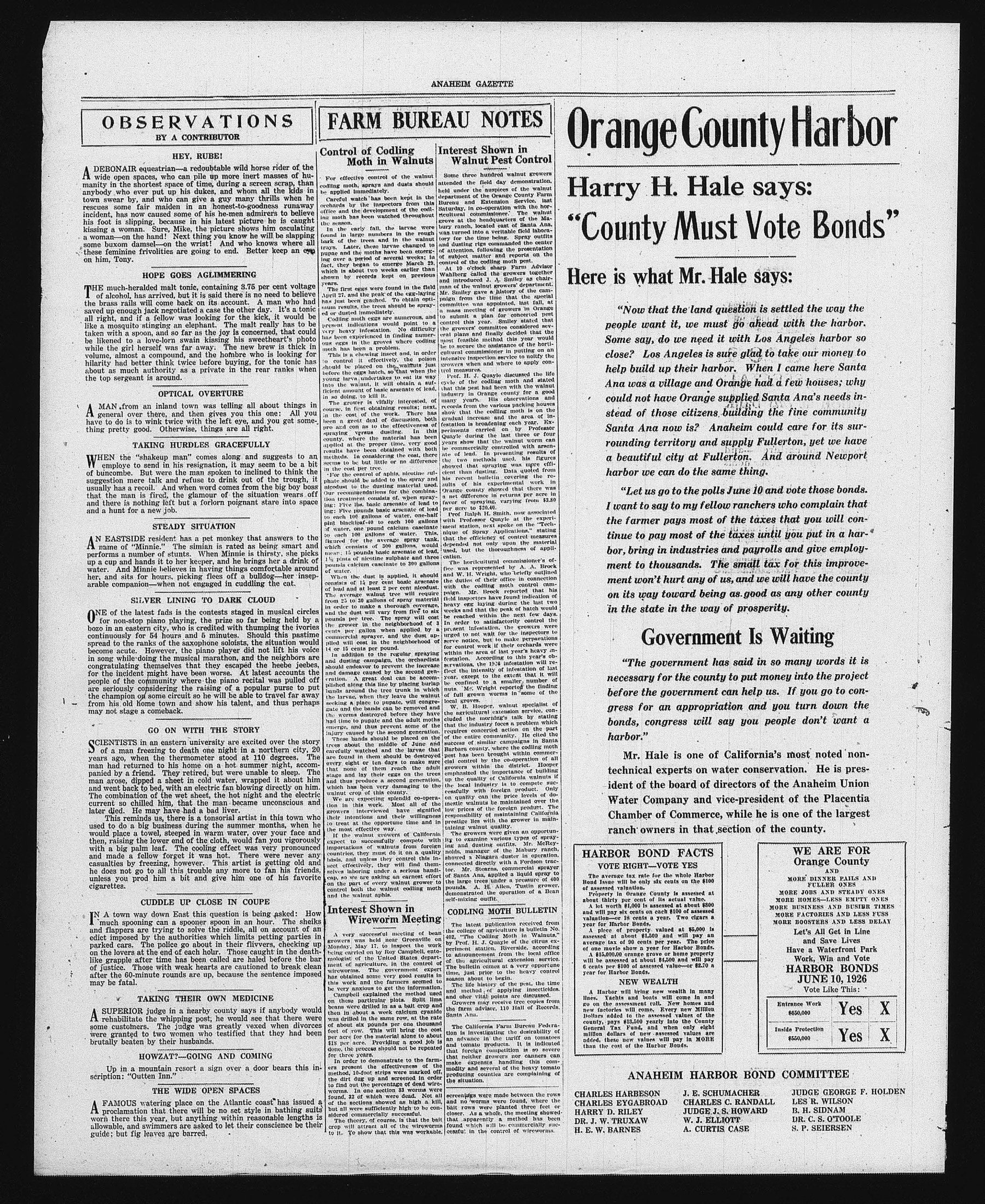
Searchable text
OBSERVATIONS
BY A CONTRIBUTOR
HEY, RUBE!
A DEBONAIR equestrian—a redoubtable wild horse rider of the wide open spaces, who can pile up more inert masses of humanity in the shortest space of time, during a screen scrap, than anybody who ever put up his dukes, and whom all the kids in town swear by, and who can give a guy many thrills when he rescues some fair maiden in an honest-to-goodness runaway incident, has now caused some of his he-men admirers to believe his foot is slipping, because in his latest picture he is caught kissing a woman. Sure, Mike, the picture shows him osculating a woman—on the hand! Next thing you know he will be slapping some buxom damsel—on the wrist! And who knows where all these feminine frivolities are going to end. Better keep an eye on him, Tony.
HOPE GOES AGLIMMERING
The much-heralded malt tonic, containing 3.75 per cent voltage of alcohol, has arrived, but it is said there is no need to believe the brass rails will come back on its account. A man who had saved up enough jack negotiated a case the other day. It's a tonic all right, and if a fellow was looking for the kick, it would be like a mosquito stinging an elephant. The malt really has to be taken with a spoon, and so far as the joy is concerned, that could be likened to a love-lorn swain kissing his sweetheart's photo while the girl herself was far away: The new brew is thick in volume, almost a compound, and the hombre who is looking for hilarity had better think twice before buying, for the tonic has about as much authority as a private in the rear ranks when the top sergeant is around.
OPTICAL OVERTURE
Man from an inland town was telling all about things in general over there, and then gives you this one: All you have to do is to wink twice with the left eye, and you get something pretty good. Otherwise, things are all right.
TAKING HURDLES GRACEFULLY
OPTICAL OVERTURE
MAN from an inland town was telling all about things in general over there, and then gives you this one: All you have to do is to wink twice with the left eye, and you get something pretty good. Otherwise, things are all right.
TAKING HURDLES GRACEFULLY
WHEN the "shakeup man" comes along and suggests to an employee to send in his resignation, it may seem to be a bit of buncombe. But were the man spoken to inclined to think the suggestion mere talk and refuse to drink out of the trough, it usually has a recoil. And when word comes from the big boy boss that the man is fired, the glamour of the situation wears off and there is nothing left but a forlorn poignant stare into space and a hunt for a new job.
STEADY SITUATION
AN EASTSIDE resident has a pet monkey that answers to the name of "Minnie." The simian is rated as being smart and performs a number of stunts. When Minnie is thirsty, she picks up a cup and hands it to her keeper, and he brings her a drink of water. And Minnie believes in having things comfortable around her, and sits for hours, picking flees off a bulldog—her inseparable companion—when not engaged in cuddling the cat.
SILVER LINING TO DARK CLOUD
ONE of the latest fads is the contests staged in musical circles for non-stop piano playing, the prize so far being held by a bozo in an eastern city, who is credited with thumping the ivories continuously for 54 hours and 5 minutes. Should this pastime spread to the ranks of the saxophone soloists, the situation would become acute. However, the piano player did not lift his voice in song while doing the musical marathon, and the neighbors are congratulating themselves that they escaped the heebe jeebes, for the incident might have been worse. At latest accounts the people of the community where the piano recital was pulled off are seriously considering the raising of a popular purse to put the champion on some circuit so he will be able to travel far away from his old home town and show his talent, and thus perhaps may not stage a comeback.
GO ON WITH THE STORY
SCIENTISTS in an eastern university are excited over the story of a man freezing to death one night in a northern city, 20 years ago, when the thermometer stood at 110 degrees. The man had returned to his home on a hot summer night, accompanied by a friend. They retired, but were unable to sleep. The man arose, dipped a sheet in cold water, wrapped it about him and went back to bed, with an electric fan blowing directly on him. The combination of the wet sheet, the hot night and the electric current so chilled him, that the man became unconscious and later died. He may have had a bad liver.
This reminds us, there is a tonsorial artist in this town who used to do a big business during the summer months, when he would place a towel, steeped in warm water, over your face and then, raising the lower end of the cloth, would fan you vigorously with a big palm leaf. The cooling effect was very pronounced...
years ago, when the thermometer stood at 110 degrees. The man had returned to his home on a hot summer night, accompanied by a friend. They retired, but were unable to sleep. The man arose, dipped a sheet in cold water, wrapped it about him and went back to bed, with an electric fan blowing directly on him. The combination of the wet sheet, the hot night and the electric current so chilled him, that the man became unconscious and later died. He may have had a bad liver.
This reminds us, there is a tonsorial artist in this town who used to do a big business during the summer months, when he would place a towel, steeped in warm water, over your face and then, raising the lower end of the cloth, would fan you vigorously with a big palm leaf. The cooling effect was very pronounced and made a fellow forget it was hot. There were never any casualties by freezing, however. This artist is getting old and he does not go to all this trouble any more to fan his friends, unless you prod him a bit and give him one of his favorite cigarettes.
CUDDLE UP CLOSE IN COUPE
In a town way down East this question is being asked: How much spooning can a spooner spoon in an hour. The sheiks and flappers are trying to solve the riddle, all on account of an edict imposed by the authorities which limits petting parties in parked cars. The police go about in their flivvers, checking up on the lovers at the end of each hour. Those caught in the deathlike grapple after time has been called are haled before the bar of justice. Those with weak hearts are cautioned to break clean after the 60-minute rounds are up, because the sentence imposed may be fatal.
TAKING THEIR OWN MEDICINE
A SUPERIOR judge in a nearby county says if anybody would rehabilitate the whipping post, he would see that there were some customers. The judge was greatly vexed when divorces were granted to two women who testified that they had been brutally beaten by their husbands.
HOWZAT?—GOING AND COMING
Up in a mountain resort a sign over a door bears this inscription: "Outten Inn."
THE WIDE OPEN SPACES
A FAMOUS watering place on the Atlantic coast has issued a proclamation that there will be no set style in bathing suits worn there this year, but anything within reasonable lengths is allowable, and swimmers are asked to let their conscience be their guide; but fig leaves are barred.
FARM BUREAU NOTES
Control of Codling Moth in Walnuts
For effective control of the walnut codling moth, sprays and dusts should be applied immediately.
Careful watch has been kept in the orchards by the inspectors from this office and the development of the codling moth has been watched throughout the season.
In the early fall, the larvae were found in large numbers in the rough bark of the trees and in the walnut trays. Later, these larvae changed to pupae and the moths have been emerging over a period of several weeks; in fact, they began to emerge March 29, which is about two weeks earlier than shown by records kept on previous years.
The first eggs were found in the field April 27, and the peak of the egg-laying has just been reached. To obtain optimum results, the trees should be sprayed or dusted immediately.
Codling moth eggs are numerous, and present indications would point to a very heavy infestation. No difficulty has been experienced in finding numerous eggs in the groves where codling moth has been a problem.
This is a chewing insect and, in order to control it effectively, the poison should be placed on the walnut just before the eggs hatch, so that when the young larva undertakes to eat its way into the walnut, it will obtain a sufficient amount of basic arsenate of lead, in so doing, to kill it.
The grower is vitally interested, of course, in first obtaining results; next, in the cost of the work. There has been a great deal of discussion, both pro and con as to the effectiveness of spraying vgrus dusing. In this county, where the material has been applied at the proper time, very good observations have been obtained with both some-
Interest Shown in Walnut Pest Control
Some three hundred walnut growers attended the field day demonstration, held under the auspices of the walnut department of the Orange County Farm Bureau and Extension Service, last Saturday, in co-operation with the horizcultural commissioner. The walnut grove at the headquarters of the Maury ranch, located east of Santa Ana, was turned into a veritable field laboratory for the time being. Spray outfits and dusting rigs commanded the center of attention, following the presentation of subject matter and reports on the control of the codling moth pest.
At 10 o'clock sharp Farm Advisor Wahlberg called the growers together and introduced J. A. Smiley as chairman of the walnut growers' department. Mr. Smiley gave a history of the campaign from the time that the special committee was appointed, last fall, at a mass meeting of growers in Orange to submit a plan for concerted pest control this year. Smiley stated that the growers' committee considered several plans and finally decided that the most feasible method this year would be to secure the assistance of the horizcultural commissioner in putting on an intensive inspection service to notify the growers when and where to apply control measures.
Prof. H. J. Quayle discussed the life cycle of the codling moth and stated that this pest had been with the walnut industry in Orange county for a good many years. His observations and records from the various packing houses show that the codling moth is on the gradual increase and the area of infestation is broadening each year. Experiments carried on by Professor Quayle during the last three or four years show that the walnut worm can be commercially controlled with arsenic.
This is a chewing insect and, in order to control it effectively, the poison should be placed on the walnut just before the eggs hatch, so that when the young larva undertakes to eat its way into the walnut, it will obtain a sufficient amount of basic arsenate of lead, in so doing, to kill it.
The grower is vitally interested, of course, in first obtaining results; next, in the cost of the work. There has been a great deal of discussion, both pro and con as to the effectiveness of spraying vgrus dusting. In this county, where the material has been applied at the proper time, very good results have been obtained with both methods. In considering the cost, there seems to be but little or no difference in the cost per tree.
For the control of aphis, nicotine sulphate should be added to the spray and nicodust to the dusting material used. Our recommendations for the combination treatment consists of, when spraying: Five lbs. basic arsenate of lead to; Five pounds basic arsenate of lead to each 100 gallons of water, one-half pint blackleaf-40 to each 100 gallons of water, one pound calcium caselinate to each 100 gallons of water. This, figured for the average spray tank, which consists of 300 gallons, would mean: 15 pounds basic arsenate of lead, 12 pints of nicotine sulphate and three pounds calcium caselinate to 300 gallons of water.
When the dust is applied, it should consist of 15 per cent basic arsenate of lead and at least 2 per cent nicodust. The average walnut tree will require from 25 to 30 gallons of spray material in order to make a thorough coverage, and the dust will vary from five to six pounds per tree. The spray will cost the grower in the neighborhood of 3 cents per gallon when applied by a commercial sprayer, and the dust applied will cost in the neighborhood of 14 or 15 cents per pound.
In addition to the regular spraying and dusting campaign, the orchardists should endeavor to prevent the increase and damage caused by the second generation. A great deal can be accomplished along this line by placing burlap bands around the tree trunk in which the larvae, when they leave the walnut seeking a place to pupate, will congregate and the bands can be removed and the worms destroyed before they have had time to pupate and the adult moths emerge, and thus prevent some of the injury caused by the second generation.
These bands should be placed on the trees about the middle of June and carefully watched and the larvae that are found in them should be destroyed every eight or ten days to make sure that none of them reach the adult stage and lay their eggs on the trees and thus produce a second generation, which has been very damaging to the walnut crop of this county.
We are expecting splendid co-operation in this work. Most all of the growers interviewed have signified their intentions and their willingness to treat at the opportune time and in the most effective way.
If the walnut growers of California expect to successfully compete with importations of walnuts from foreign intensive inspection service to notify the growers when and where to apply control measures.
Prof. H. J. Quayle discussed the life cycle of the codling moth and stated that this pest had been with the walnut industry in Orange county for a good many years. His observations and records from the various packing houses show that the codling moth is on the gradual increase and the area of infestation is broadening each year. Experiments carried on by Professor Quayle during the last three or four years show that the walnut worm can be commercially controlled with arsenate of lead. In presenting results of the two methods used, his figures showed that spraying was more efficient than dusting. Data quoted from his recent bulletin covering the results of his experimental work in Orange county showed that there was a net difference in returns per acre in favor of spraying, varying from $3.80 per acre to $20.40.
Prof Ralph H. Smith, now associated with Professor Quayle at the experiment station, next spoke on the "Technique of Spray Applications," stating that the efficiency of control measures depended not only upon the material used, but the thoroughness of application.
The horticultural commissioner's office was represented by A. A. Brock and W. H. Wright, who briefly outlined the duties of their office in connection with the codling moth control campaign. Mr. Brock reported that his field inspectors have found indication of heavy egg laying during the last two weeks and that the peak of hatch would be reached within the next few days. In order to satisfactorily control the present infestation, the growers were urged not wait for the inspectors to serve notice, but to make preparations for control work if their orchards were within the area of last year's heavy infestation. According to this year's observations, the 1926 infestation will reflect the intensity of infestation of last year, except to the extent that it will be confined to a smaller number of nuts. Mr. Wright reported the finding of full grown worms in some of the local groves.
W. B. Hooper, walnut specialist of the agricultural extension service, concluded the morning's talk by stating that the industry faces a problem which requires concerted action on part of the entire community. He cited the success of similar campaigns in Santa Barbara county, where the codling moth pest has been brought within commercial control by the co-operation of all growers within the district. Hooper emphasized the importance of building up the quality of California walnuts if the local industry is to compete successfully with foreign product. Only on quality can the price levels of domestic walnuts be maintained over the low prices of the foreign product. The responsibility of maintaining California prestige lies with the grower in maintaining walnut quality.
The growers were given an opportunity to examine various types of spraying and dusting outfits. Mr. McReynolds, manager of the Mabury ranch,
close? Los Angeles help build up their farm Ana was a village could not have Orlando stead of those cities Santa Ana now is rounding territory a beautiful city at harbor we can do tha
"Let us go to tha I want to say to my farmer pays me tinue to pay most o bor, bring in indus ment won't hurt an on its way toward n in the state in tha
Government necessary for tha c before tha governr gress for an appl bonds, congress u harbor."
Mr. Hale is on technical experts o ident of tha board Water Company a Chamber of Comm ranch owners in tha
Interest Shown in Wireworm Meeting
A very successful meeting of bean growers was held near Greenville on Monday, May 17, to inspect the work being carried on by Roy Campbell, entomologist of the United States department of agriculture, in the control of wireworms. The government expert has obtained some very good results in this work and the farmers seemed to be very anxious to get the information.
Campbell explained the method used on these particular plots. Split lima beans were drilled in as a bait crop and then in about a week calcium cyanide was drilled in the same row, at the rate of about six pounds per one thousand feet of row. This will bring the cost per acre for the material alone to about $18 per acre. Providing a good job is done, the process should not be repeated for three years.
In order to demonstrate to the farmers present the effectiveness of the method, 10-foot strips were marked off, the dirt dug up and screened in order to find out the percentage of dead wireworms. In one section 33 worms were found, 32 of which were dead. Not all of the sections showed as high a kill, but all were sufficiently high to be considered commercially successful.
The theory, of course, is that the bait crop will attract all of the wireworms to it. To show that this was workable,
screenings were made between the rows and no worms were found, where the bait rows were planted three feet or closer. As a whole, the meeting showed that apparently a method has been found which will be commercially successful in the control of wireworms.
HARBOR BOND FACE
VOTE RIGHT—VOTE YES
The average tax rate for the whole Bond Issue will be only six cents on the of assessed valuation.
Property in Orange County is assessed about thirty per cent of its actual value.
A lot worth $1,000 is assessed at about and will pay six cents on each $100 of assessed valuation—or 18 cents a year. Two clergy year for Harbor Bonds.
A piece of property valued at $5,500 is assessed at about $1,500 and will pay average tax of 90 cents per year. The one of one movie show a year for Harbor Bonds.
A $15,000.00 orange grove or home price will be assessed at about $4,500 and will 6 cents per $100 of assessed value—or 6 years for Harbor Bonds.
NEW WEALTH
A Harbor will bring new wealth in lines. Yachts and boats will come go on the assessment roll. New home new factories will come. Every new Dollars added to the assessed values county, pays $13,500 yearly into the General Tax Fund, and when only million dollars of new assessed values added, these new values will pay in less than the cost of the Harbor Bonds.
ANAHEIM H
CHARLES HARBESON J.E.
CHARLES EYGABROAD CH
HARRY D.RILEY JULI
DR.J.W.TRUXAW W.
H.E.W.BARNES A.C.
Orange County Harbor
Gerry H. Hale says:
County Must Vote Bonds"
Is what Mr. Hale says:
"Now that the land question is settled the way the people want it, we must go ahead with the harbor. I say, do we need it with Los Angeles harbor so close? Los Angeles is sure glad to take our money to help build up their harbor. When I came here Santa Ana was a village and Orange had a few houses; why would not have Orange supplied Santa Ana's needs instead of those citizens building the fine community Santa Ana now is? Anaheim could care for its surrounding territory and supply Fullerton, yet we have
Los Angeles is sure glad to take our money to help build up their harbor. When I came here Santa Ana was a village and Orange had a few houses; why should not have Orange supplied Santa Ana's needs instead of those citizens building the fine community Santa Ana now is? Anaheim could care for its surrounding territory and supply Fullerton, yet we have a beautiful city at Fullerton. And around Newport Harbor we can do the same thing.
"Let us go to the polls June 10 and vote those bonds. We want to say to my fellow ranchers who complain that the farmer pays most of the taxes that you will continue to pay most of the taxes until you put in a harbor, bring in industries and payrolls and give employment to thousands. The small tax for this improvement won't hurt any of us, and we will have the county on its way toward being as good as any other county in the state in the way of prosperity.
Government Is Waiting
"The government has said in so many words it is necessary for the county to put money into the project before the government can help us. If you go to congress for an appropriation and you turn down the bonds, congress will say you people don't want a harbor."
Mr. Hale is one of California's most noted non-technical experts on water conservation. He is present of the board of directors of the Anaheim Union Water Company and vice-president of the Placentia Chamber of Commerce, while he is one of the largestench owners in that section of the county.
MR. HALE is one of California's most noted technical experts on water conservation. He is president of the board of directors of the Anaheim Union Water Company and vice-president of the Placentia Chamber of Commerce, while he is one of the largest branch owners in that section of the county.
HARBOR BOND FACTS
WE RIGHT—VOTE YES
The tax rate for the whole Harbor will be only six cents on the $100 evaluation.
In Orange County is assessed at per cent of its actual value.
With $1,000 is assessed at about $300
six cents on each $100 of assessed or 18 cents a year. Two cigars a harbor bonds.
Of property valued at $5,000 is about $1,500 and will pay an amount of 90 cents per year. The price to show a year for Harbor Bonds.
$100 orange grove or home property assessed at about $4,500 and will pay $100 of assessed value—or $2.70 a harbor bonds.
NEW WEALTH
We will bring new wealth in many boats and boats will come in and assessment roll. New homes and homes will come. Every new Million added to the assessed values of the boats $18,500 yearly into the County Fund, and when only eight cars of new assessed values are the new values will pay in MORE rest of the Harbor Bonds.
WE ARE FOR Orange County
AND
MORE DINNER PAILS AND FULLER ONES
MORE JOBS AND STEADY ONES
MORE HOMES—LESS EMPTY ONES
MORE BUSINESS AND BUSIBR TIMES
MORE FACTORIES AND LESS FUSS
MORE BOOSTERS AND LESS DELAY
Let's All Get in Line
and Save Lives
Have a Waterfront Park
Work, Win and Vote
HARBOR BONDS
JUNE 10, 1926
Vote Like This:
Entrance Work
$650,000
Inside Protection
$550,000
ANAHEIM HARBOR BOND COMMITTEE
CHARBESON
J. E. SCHUMACHER
JUDGE GEORGE F. HOLDEN
EYGABROAD
CHARLES C. RANDALL
LES R. WILSON
RILEY
JUDGE J. S. HOWARD
B. H. SIDNAM
RUXAW
W. J. ELLIOTT
DR. C. S. O'TOOLE
ARNES
A. CURTIS CASE
S. P. SEIERSEN