anaheim-gazette 1926-01-07
Scanned page
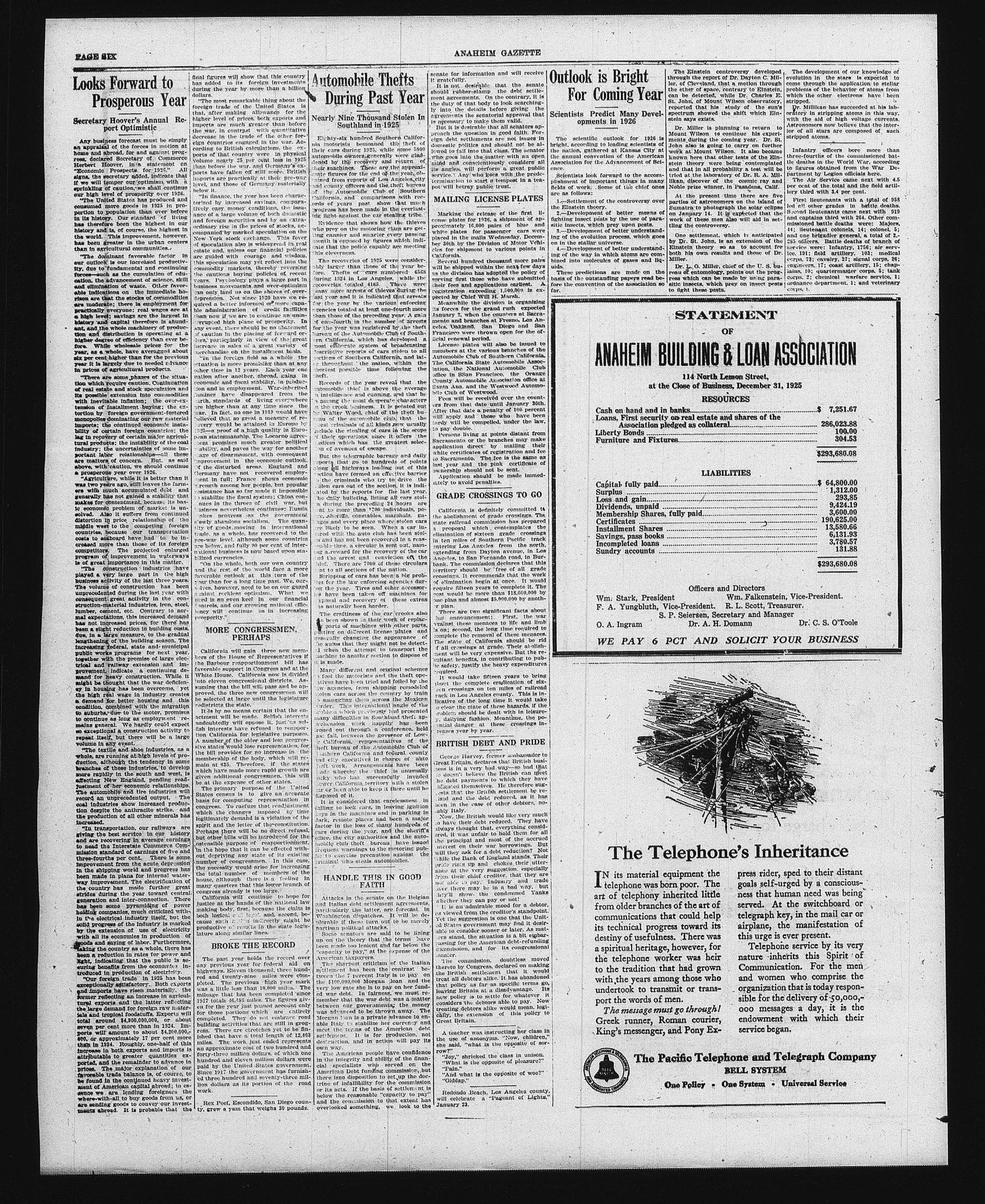
Searchable text
Looks Forward to Prosperous Year
Secretary Hoover's Annual Report Optimistic
Any business forecast must be simply an appraisal of the forces in motion at home and abroad, for and against progress, declared Secretary of Commerce Herbert Hoover, in a statement on "Economic Prospects for 1925." All signals, the secretary added, indicate that if we will temper our optimism with a sprinkling of caution, we shall continue our high level of prosperity over 1926.
"The United States has produced and consumed more goods in 1925 in proportion to population than ever before in its history. Our standard of living has therefore been the highest in our history and is, of course, the highest in the world. This improvement, however, has been greater in the urban centers than in agricultural communities."
The dominant favorable factor in our outlook is our increased productivity, due to fundamental and continuing forces—such as the cumulation of education, the advancement of science, skill and elimination of waste. Other favorable indications on the immediate horizon are that the stocks of commodities are moderate; there is employment for practically everyone; real wages are at a high level; savings are the largest in history and capital therefore is abundant, and the whole machinery of production and distribution is operating at a higher degree of efficiency than ever before. While wholesale prices for the year, as a whole, have averagged about six per cent higher than for the previous year it is largely due to needed advance in prices of agricultural products.
There are some phases of the situation which require caution. Continuation of real estate and stock speculation and its possible extension into commodities with inevitable inflation; the over-extension of installment buying; the extortion by foreign government-fostered monopolies dominating our raw material imports; the continued economic instability of certain foreign countries; the lag in recovery of certain major agricultural products; the instability of the coal industry; the uncertainties of some im-
final figures will show that this country has added to its foreign investments during the year by more than a billion dollars.
"The most remarkable thing about the foreign trade of the United States is that, after making allowance for the higher level of prices, both exports and imports are much greater than before the war, in contrast with quantitative decrease in the trade of the other foreign countries engaged in the war. According to British calculations, the exports of that country were in physical volume nearly 25 per cent less in 1925 than before the war, and Germany's exports have fallen off still more. British imports are practically at their pre-war level, and those of Germany materially below it.
"In finance, the year has been characterized by increased savings, comparatively easy money conditions, the issuance of a large volume of both domestic and foreign securities and by an extraordinary rise in the prices of stocks, accompanied by marked speculation on the New York stock exchange. This fever of speculation also is widespread in real estate and, unless our financial policies are guided with courage and wisdom, this speculation may yet reflect into the commodity markets, thereby reversing the cautious buying policies of recent years. Psychology plays a large part in business movements and over-optimism can only land us on the shores of depression. Not since 1920 have we required a better informed or more capable administration of credit facilities than now if we are to continue an uninterrupted high plane of prosperity. In any event, there should be no abatement of caution in the placing of forward orders, particularly in view of the great increase in sales of a great variety of merchandise on the installment basis.
"In the foreign field as a whole the situation is more promising than at any other time in 12 years. Each year one nation after another, abroad, gains in economic and fiscal stability. In production and in employment. War-inherited famines have disappeared from the earth, standards of living everywhere are higher than at any time since the war. In fact, no one in 1919 would have believed that so great a measure of recovery would be attained in Europe by 1925—a proof of a high quality in European statesmanship. The Locarno agreement promises much greater political stability and pays the way for another..."
There are some phases of the situation which require caution. Continuation of real estate and stock speculation and its possible extension into commodities with inevitable inflation; the over-extension of installment buying; the extortion by foreign government-fostered monopolies dominating our raw material imports; the continued economic instability of certain foreign countries; the lag in recovery of certain major agricultural products; the instability of the coal industry; the uncertainties of some important labor relationships—all these are matters of concern. But, as said above, with caution, we should continue a prosperous year over 1926.
"Agriculture, while it is better than it was two years ago, still leaves the farmers with much accumulated debt and generally has not gained a stability that makes for contentment, because its basic economic problem of market is unsolved. Also it suffers from continued distortion in price relationship of the middle west to the competing foreign countries, because our transportation costs to seaboard have had to be increased more than those of its foreign competitors. The projected enlarged program of improvement in waterways is of great importance in this matter.
"The construction industries have played a very large part in the high business activity of the last three years. The volume of construction has been unprecedented during the last year with consequent great activity in the construction-material industries, iron, steel, lumber, cement, etc. Contrary to normal expectations, this increased demand has not increased prices, for there has been a slight reduction in building costs, due, in a large measure, to the gradual lengthening of the building season. The increasing federal, state and municipal public works programs for next year, together with the promise of large electrical and railway extension and improvement, indicate a continuing demand for heavy construction. While it might be thought that the war defleney in housing has been overcome, yet the high real wage in industry creates a demand for better housing and this condition combined with the migration to suburbs, due to the motor, promises to continue as long as employment remains general. We hardly could expect so exceptional a construction activity to repeat itself, but there will be a large volume in any event.
"The textile and shoe industries, as a whole, are running at high levels of production, although the tendency in some branches of these industries, to develop more rapidly in the south and west, is affecting New England, pending readjustment of her economic relationships. The automobile and tire industries will record an unprecedented output. The coal industries show increased production despite the anthracite strike, and the production of all other minerals has increased.
"In transportation, our railways are giving the best service in our history and are recovering in average earnings to need the Interstate Commerce Com-
whole, are running at high levels of production, although the tendency in some branches of these industries, to develop more rapidly in the south and west, is affecting New England, pending readjustment of her economic relationships. The automobile and tire industries will record an unprecedented output. The coal industries show increased production despite the anthracite strike, and the production of all other minerals has increased.
"In transportation, our railways are giving the best service in our history and are recovering in average earnings to need the Interstate Commerce Commission standard of earnings of five and three-fourths per cent. There is some improvement from the acute depression in the shipping world and progress has been made in plans for internal waterway improvement. The electrification of the country has made further great strides during the year toward central generation and inter-connection. There has been some pyramiding of power holding companies, much criticized within the electrical industry itself, but the solid progress of the industry is marked by the extension of use of electricity with all its economies in production of goods and saying of labor. Furthermore, taking the country as a whole, there has been a reduction in rates for power and light, indicating that the public is seuring benefits from the economies introduced in production of electricity.
Our foreign trade in 1925 has been exceptionally satisfactory. Both exports and imports have risen materially, the former reflecting an increase in agricultural exports and the latter reflecting the large demand for foreign raw materials and tropical foodstuffs. Exports will total around $4,900,000,000, or about seven per cent more than in 1924. Imports will amount to about $4,200,000,000, or approximately 17 per cent more than in 1924. Roughly one-half of this increase in both exports and imports is attributable to greater quantities exported, and the remainder to advance prices. The major explanation of our favorable trade balance is, of course, to be found in the continued heavy investment of American capital abroad; in essence we are lending foreigners the where-with-all to buy goods from us, or are sending goods to convey our investments abroad. It is probable that the membership of the body which will remain at 435. Therefore, if the states which have made more rapid growth are given additional congressmen, this will be at the expense of other states.
The primary purpose of the United States census is to give an accurate basis for computing representation in congress. To raefuse that readjustment which the changes imposed by time legitimately demand is a violation of the spirit and the letter of the constitution. Perhaps there will be no direct refusal, but other bills will be introduced for the ostensible purpose of reapportionment. In the hope that it can be effected without depriving any state of its existing number of congressmen. In this case, the necessity would arise for increasing the total number of members of the house, although there is a feeling in many quarters that this lower branch of congress already is too large.
California will continue to hope for justice at the hands of the national law making body, first because the claim is both logical and legal, and second, because such a law indirectly might be productive of results in the state legislature along similar lines.
BROKE THE RECORD
The past year holds the record over any previous year for federal aid on highways. Eleven thousand, three hundred and twenty-nine miles were completed. The previous high year mark was a little less than 10,000 miles. The mileage that has been completed since 1917 totals 46,480 miles. The figures given for the year just passed account only for those portions which are entirely completed. They do not embrace road building activities that are still in progress. There are stretches yet to be finished that have a total length of 12,463 miles. The work just ended represents an approximate cost of two hundred and forty-three million dollars, of which one hundred and eleven million dollars were paid by the United States government. Since 1917 the government has furnished three hundred and seventy-three million dollars as its portion of the road work.
Rex Peet, Escondido, San Diego county, grew a yam that weighs 30 pounds.
Attacks in the state and Italian debt particularly the la Washington dispute plausible if these parties political Some senators up on the theory they been made too lenient "capacity to pay." American taxpayer.
The sharpest settlement has borne the 7 percent the $100,000,000 M very low rate she ed war debt. In member that the w between our gow was advanced to Morgan loan is a p able Italy to stable meet the terms o settlement. It is destruction, and its own way.
The American p in the integrity ar e elal specialists American Debt fur there isno disposition trine of infallibility or its acts. If tha below the reasona and the commission overlooked something
Automobile Thefts During Past Year
Nearly Nine Thousand Stolen In Southland in 1925
Eighty-six hundred Southern California motorists bemoaned the theft of their cars during 1925, while some 5800 automobile owners generally were gladdened by the recovery and return of their machines. These are the approximate figures for the end of the year obtained from reports of Los Angeles city and county officers and the theft bureau of the Automobile Club of Southern California, and comparisons with records of years past show that much progress has been made in the everlasting fight against the car stealing tribe.
Evidence that shows how the thieves who prey on the motoring class are getting cannier and smarter every passing month is opposed by figures which indicate that the police capably are meeting this cleverness.
The recoveries of 1925 were considerably larger than those of the year before. The thefts of cars numbered 6568 during 1924 in Los Angeles, while the recoveries totaled 4165. There were many more arrests of thieves during the last year and it is indicated that arrests for the year by the various enforcing agencies totaled at least one-fourth more than those of the preceding year. A gain of one-fourth in the number of arrests for the year was registered by the theft bureau of the Automobile Club of Southern California, which has developed a most elaborate system of broadcasting descriptive reports of cars stolen to all sections of Southern California, and later throughout the nation, within the shortest possible time following the theft.
Records of the year reveal that the automobile theft is above the average in intelligence and cunning, and that he is among the most desperate characters in the crook business. It is pointed out by Walter Wood, chief of the theft bureau of the automobile club, that most criminals of all kinds now usually include the stealing of cars in the scope of their operations, since it offers the medium which has the greatest selection of avenues of escape.
Senate for information and will receive it gratefully.
It is not desirable that the senate should rubber-stamp the debt settlement agreements. On the contrary, it is the duty of that body to look searchingly into the details before giving the agreements the senatorial approval that is necessary to make them valid.
But it is desirable that all senators approach the question in good faith. Foreign debt settlements are not issues in domestic politics and should not be allowed to fall into that class. The senator who goes into the matter with an open mind and conscientiously considers all its angles, will perform a great public service. Any who goes with the predetermination to start a tempest in a teapot will betray public trust.
MAILING LICENSE PLATES
Marking the release of the first license plates for 1926, a shipment of approximately 10,000 pairs of blue and white plates for passenger cars were placed in the mails Wednesday. December 30th by the Division of Motor Vehicles for shipment to various points in California.
Several hundred thousand more pairs will be shipped within the next few days as the division has adopted the policy of serving first those who have submitted their fees and applications earliest. A registration exceeding 1,500,000 is expected by Chief Will H. Marsh.
Meanwhile the division is organizing its forces for the grand rush expected January 2, when the counters at Sacramento and branches at Fresno, Los Angeles, Oakland, San Diego and San Francisco were thrown open for the official renewal period.
License plates will also be issued to members at the various branches of the Automobile Club of Southern California. The California State Automobile Association, the National Automobile Club office in SSan Francisco, the Orange County Automobile Association office at Santa Ana, and the Westwood Automobile Club of Westwood.
Fees will be received over the counters from that date until January 30th. After that date a penalty of 100 percent will apply and those who have been hardy will be compelled, under the law, to pay double.
Persons living at points distant from Sacramento or the branches may make application direct by mailing their
Outlook is Bright For Coming Year
Scientists Predict Many Developments in 1926
The scientific outlook for 1926 is bright, according to leading scientists of the nation, gathered at Kansas City at the annual convention of the American Association for the Advancement of Science.
Scientists look forward to the accomplishment of important things in many fields of work. Some of the chief ones are as follows:
1. Settlement of the controversy over the Einstein theory.
2. Development of better means of fighting insect pests by the use of parasitic insects, which prey upon pests.
3. Development of better understanding of the evolution process, which goes on in the stallar universe.
4. Development of better understanding of the way in which atoms are combined into molecules of gases and liquids.
These predictions are made on basis of the outstanding papers read before the convention of the association so far.
Records of the year reveal that the automobile thief is above the average in intelligence and cunning, and that he is among the most desperate characters in the crook business. It is pointed out by Walter Wood, chief of the theft bureau of the automobile club, that most criminals of all kinds now usually include the stealing of cars in the scope of their operations, since it offers the medium which has the greatest selection of avenues of escape.
But the telegraphic barrage and daily reports that go to hundreds of points along all highways leading out of this section have formed an effective barrier to the criminals who try to drive the stolen cars out of the section. It is indicated by the reports for the last year, the daily bulleting, listing all cars stolen during the preceding 24 hours are sent to more than 1700 individuals, police, sheriffs, constables, marshals, guards and every place where stolen cars are likely to be seen. When a car is injured with the auto club has been stolen and has not been recovered in a reasonable time, a circular is sent out, naming a reward for the recovery of the car and the arrest and conviction of the thief. There are 7000 of these circulations sent to all sections of the nation.
Stripping of cars has been a big problem for the law enforcing agencies during the year. Tires and other accessories have been taken off machines for disposal and recovery of these extras naturally been harder.
The craftiness of the car crooks also has been shown in their work of replacements of machines with other parts, putting on different license plates and generally changing the appearance of the autos that they might not be detected when the attempt to transport the machine to another section to dispose of it is made.
Many different and original schemes to fool the motorists and the theft operatives have been tried and folled by the law agencies, from shipping remodeled stolen cars across the country by train to smuggling them across the Mexican border. This international angle of the problem which previously had presented many difficulties in Southland theft apprehension work happily has been ridden out through a conference, held last fall, between the governor of Lowry California, representatives of the theft bureau of the Automobile Club of Southern California and federal county and city executives in charge of auto theft work. Arrangements have been made whereby the thief is unusually lucky who has successfully invaded Lower California territory with a stolen car or been able to keep it there until he disposed of it.
It is considered that carelessness in falling to look cars, in leaving ignition keys in the machines and in parking in dark, remote places had been a major factor in the loss of many hundreds of cars during the year, and the sheriff's office, the city authorities and the automobile club theft bureau have issued frequent warnings to the motoring public.
Records of the year reveal that the automobile thief is above the average in intelligence and cunning, and that he is among the most desperate characters in the crook business. It is pointed out by Walter Wood, chief of the theft bureau of the automobile club, that most criminals of all kinds now usually include the stealing of cars in the scope of their operations, since it offers the medium which has the greatest selection of avenues of escape.
But the telegraphic barrage and daily reports that go to hundreds of points along all highways leading out of this section have formed an effective barrier to the criminals who try to drive the stolen cars out of the section. It is indicated by the reports for the last year, the daily bulleting, listing all cars stolen during the preceding 24 hours are sent to more than 1700 individuals, police, sheriffs, constables, marshals, guards and every place where stolen cars are likely to be seen. When a car is injured with the auto club has been stolen and has not been recovered in a reasonable time, a circular is sent out, naming a reward for the recovery of the car and the arrest and conviction of the thief. There are 7000 of these circulations sent to all sections of the nation.
Stripping of cars has been a big problem for the law enforcing agencies during the year. Tires and other accessories have been taken off machines for disposal and recovery of these extras naturally been harder.
The craftiness of the car crooks also has been shown in their work of replacements of machines with other parts, putting on different license plates and generally changing the appearance of the autos that they might not be detected when the attempt to transport the machine to another section to dispose of it is made.
Many different and original schemes to fool the motorists and the theft operatives have been tried and folled by the law agencies, from shipping remodeled stolen cars across the country by train to smuggling them across the Mexican border. This international angle of the problem which previously had presented many difficulties in Southland theft apprehension work happily has been ridden out through a conference, held last fall, between the governor of Lowry California, representatives of the theft bureau of the Automobile Club of Southern California and federal county and city executives in charge of auto theft work. Arrangements have been made whereby the thief is unusually lucky who has successfully invaded Lower California territory with a stolen car or been able to keep it there until he disposed of it.
It is considered that carelessness in falling to look cars, in leaving ignition keys in the machines and in parking in dark, remote places had been a major factor in the loss of many hundreds of cars during the year, and the sheriff's office, the city authorities and the automobile club theft bureau have issued frequent warnings to the motoring public.
Records of the year reveal that the automobile thief is above the average in intelligence and cunning, and that he is among the most desperate characters in the crook business. It is pointed out by Walter Wood, chief of the theft bureau of the automobile club, that most criminals of all kinds now usually include the stealing of cars in the scope of their operations, since it offers the medium which has the greatest selection of escape.
But the telegraphic barrage and daily reports that go to hundreds of points along all highways leading out of this section have formed an effective barrier to the criminals who try to drive the stolen cars out of the section. It is indicated by the reports for the last year, the daily bulleting, listing all cars stollen during the preceding 24 hours are sent to more than 1700 individuals, police, sheriffs, constables, marshals, guards and every place where stolen cars are likely to be seen. When a car is injured with the auto club has been stolen and has not been recovered in a reasonable time, a circular is sent out, naming a reward for the recovery of the car and the arrest and conviction of the thief. There are 7000 of these circulations sent to all sections of the nation.
Stripping of cars has been a big problem for the law enforcing agencies during the year. Tires and other accessories have been taken off machines for disposal and recovery of these extras naturally been harder.
The craftiness of the car crooks also has been shown in their work of replacements of machines with other parts, putting on different license plates and generally changing the appearance of the autos that they might not be detected when the attempt to transport the machine to another section to dispose of it is made.
Many different and original schemes to fool the motorists and the theft operatives have been tried and folled by law agencies, from shipping remodeled stolen cars across the country by train to smuggling them across the Mexican border. This international angle of the problem which previously had presented many difficulties in Southland theft apprehension work happily has been ridden out through a conference, held last fall, between the governor of Lowry California, representatives ofthe theft bureau ofthe Automobile Clubof SouthernCaliforniaandfederalcountyandcityexecutivesinchargeoftheauto theftwork.ArrangementshavebeenmadewherebythethiefisunusuallyluckywhohassuccessfullyinvadedLowerCaliforniaterritorywitha stolencarorbeenabletokeepitthereuntilhedisposedofit.
It is considered that carelessness in falling to look cars, in leaving ignition keys in the machines and in parking in dark, remote places had been a major factor in the loss of many hundreds of cars during the year, and the sheriff's office,thecityauthoritiesandtheautomobileclubthebureauhaveissuedfrequentwarningstothemotoringpublisher.
Records oftheyearrevealthattheautomobileshifleisabovetheintelligenceandcunning,andthatheisamongthemostdesperatecharactersinthecrookbusiness.itispointedoutthehundredsfointsalongallhighwaysleadingoutofthissectionfromthemotoristswhotrytodrivethestolencarsoutofthesection.itisindicatedbythereportsforthelastyear.thedailybulletling.listingallcarsstollenduringthepreceding24hoursaresenttomorethan1700individuals,poles,sheriffs.constables,marshals,guardsandeveryplacewherestolencarsarelikelytobeseen.WetheatgivingoverthecountersfromthatdateuntilJanuary30th.Afterthatdatea penaltyof100percentwillapplyandthosewhohavebeendurdywillbecompelledunderthelaw,topaydouble.PersonslivingatpointsdistantfromSacramentoorthebranchesmaymakeapplicationdirectbymailingthewhitecertificatesregistrationandfeetoSacramento.Thefeeisaslastyearandthepinkcertificateownershipshouldnotbesent.Applicationshould beimadeimmediatelytoavoidpenalties.
GRADE CROSSINGS TO GO
Californiaisdefinitelycommittedtotheabolishmentofgradecrossings.Thestaterailroadcommissionhas preparedaproposalwhichcontemplatestheeliminationofsixteengradecrossingsintenmilesofSouthernPacifictrackenteringLosAnglesfromthenorthextendingfromDaytonavenue.InLosAngeles,theSanFernandoroad.inBurbank.The commissiondeclaresthatthisterritoryshouldbefreeofallgradecrossings.Ittreatsamoreofallgradecrossingsitrecommendsthattheworkofeliminationbeginatonce.Ittwouldrequirefifteenyearstocompleteit.Thecostwouldbemorethan$18,000,000byoneplanandalmost$5,000,000byanotherplan.
Therearetwosignificantfactssaboutannouncement:First,thewaragainstthemenacestolifeandlimbsison;second,thelongtimerequiredtocompletetheremovalofthemenaces.ThestateofCaliforniashouldbidifailcrossingsatgrade.Theirabolishmentwillbeveryexpensive.Buttheresultbenefits,intributingtopublicsafety.justifytheheavyexpendituresrequired.
ItwouldtakefifteenyearstobringaboutthecompleteeradicationofsixteencrossingsontenmilesofrailroadrackinLosAnglescountyThisisincilitativeofthelongtimeitwould takeoclearthestateofthese hazards iftheproblemshouldbedealtwithinleisurely,dailyingfashion.Meantime,thepotential dangeratthesecrossingsincreasesyearbyyear.
BRITISH DEBT AND PRIDE
GeorgeHarvey,forgemambassadortoGreatBritain declares that Britishbusinessisinaverybadway—sobadthatdoestnotbelievetheBritishcanmeethedebtpaymentstowhichtheyhave obligatedthemselvesHethereforesuggeststhattheBritishsettlementberesistedandthe debtreduced.asithasbeeninthecaseofotherdebtors,nocablyItaly.
Now,theBritishwouldlikeverymuchtohave theirdebtreduced.Thewavealwaysthoughtthat,everythingconsidered.itwas unfairtoholdthemforalltheprincipalandmostoftheaccruedinterestontheirwarborrowings.Notably,thecreditreduction?Not
HANDLE THIS IN GOOD FAITH
Attacks in the senate on the Belgian and Italian debt settlement agreements, particularly the latter, are forecast in Washington dispatches. It will be deplorable if these turn out to be merely partisan political attacks.
Some senators are said to be lining up on the theory that the terms have been made too lenient and far below the "capacity to pay," at the expense of the American taxpayers.
The sharpest criticism of the Italian settlement has been the contrast between the 7 percent Italy is to pay on the $100,000,000 Morgan loan and the very low rate she is to pay on her funded war debt. In fairness, we must remember that the war debt was a matter between our governments; the money was advanced to be thrown away. The Morgan loan is a private advance to enable Italy to stabilize her currency and meet the terms of the American debt settlement. It is for production, not destruction, and in action will pay its own way.
The American people have confidence in the integrity and ability of the financial specialists who served on the American Debt funding commission, but there is no disposition to set up the doctrine of infallibility for the commission or its acts. If the basis of settlement is below the reasonable "capacity to pay" and the commission to that extent has overlooked something, we look to the George Harvey, former ambassador to Great Britain, declares that British business is in a very bad way—so bad that he doesn't believe the British can meet his debt payments to which they have obligated themselves. He therefore suggests that the British settlement be relied upon and the debt reduced, as it has been in the case of other debtors, notably Italy.
Now, the British would like very much to have their debt reduced. They have always thought that everything considered, it was unfair to hold them for all the principal and most of the accrued interest on their war borrowings. But will they ask for a debt reduction? Not while the Bank of England stands. Their pride rises up and chokes their utterance at the very suggestion, especially from their chief creditor, that they are not able to pay. Industry and trade over there may be in a bad way, but they'll show the condemned Yanks whether they can pay or not!
It is an admirable mood for a debtor, as viewed from the creditor's standpoint. Yet the suggestion is one that the United States government may find it desirable to consider sooner or later. As matters stand, the situation is a bit eupharmasizing for the American debt-refunding commission, and for its congressional counter.
The commission, doubtless moved thereto by Congress, declared on making the British settlement that it would treat all debtors alike. It has abandoned that policy as far as specific terms go, leaving Britain at a disadvantage. Its new policy is to settle for whatever it considers the debtors able to pay. Now treating debtors alike would mean, logically, the extension of this policy to Great Britain.
A teacher was instructing her class in the use of antonyms. "Now, children," she said, "what is the opposite of sorrow?"
"Joy," shrieked the class in unison.
"What is the opposite of pleasure?"
"Pain."
"And what is the opposite of woe?"
"Giddap."
Redondo Beach, Los Angeles county, will celebrate a "Pageant of Lights," January 23.
The Einstein controversy developed through the report of Dr. Dayton C. Miller, of Cleveland, that a motion through the ether of space, contrary to Einstein, can be detected, while Dr. Charles E. St. John, of Mount Wilson observatory, reported that his study of the sun's spectrum showed the shift which Einstein says exists.
Dr. Miller is planning to return to Mount Wilson to continue his experiments during the coming year. Dr. St. John also is going to carry on further work at Mount Wilson. It also became known here that other tests of the Einstein theory were being contemplated and that in all probability a test will be tried at the laboratory of Dr. R. A. Millikan, discover of the cosmic ray and Noble prize winner, in Pasadena, Calif.
At the present time there are five parties of astronomers on the island of Sumatra to photograph the solar eclipse on January 14. It is expected that the work of these men also will aid in settling the controversy.
One settlement, which is anticipated by Dr. St. John, is an extension of the Einstein theory so as to account for both his own results and those of Dr. Miller.
Dr. L. O. Miller, chief of the U.S. bureau of entomology, points out the progress which can be made by using parasitic insects, which prey on insect pests to fight these pests.
The development of our knowledge of evolution in the stars is expected to come through the application to stellar problems of the behavior of atoms from which the other electrons have been stripped.
Dr. Millikan has succeeded at his laboratory in stripping atoms in this way, with the aid of high voltage currents. Astronomers now believe that the interior of all stars are composed of such stripped atoms.
Infantry officers bore more than three-fourths of the commissioned battle deaths in the World War, according to figures obtained from the War Department by Legion officials here.
The Air Service came next with 4.5 per cent of the total and the field artillery third with 3.4 per cent.
First lieutenants with a total of 958 led all other grades in battle deaths. Second lieutenants came next with 919 and captains third with 264. Other commissioned battle deaths were: Majors, 44; lieutenant colonels, 14; colonel, 5; and one brigadier general, a total of 2,285 officers. Battle deaths of branch of service were: Infantry, 1756; air service, 191; field artillery, 103; medical corps, 73; cavalry, 27; signal corps, 26; engineers, 17; coast artillery, 15; chaplains, 10; quartermaster corps, 5; tank corps, 2; chemical warfare service, 1; ordnance department, 1; and veterinary corps, 1.
STATEMENT OF SHEIM BUILDING & LOAN ASSOCIATION
114 North Lemon Street,
at the Close of Business, December 31, 1925
RESOURCES
On hand and in banks... $ 7,251.67
First security on real estate and shares of the Association pledged as collateral... 286,023.88
Bury Bonds... 100.00
Furniture and Fixtures... 304.53
114 North Lemon Street,
at the Close of Business, December 31, 1925
RESOURCES
Lemon hand and in banks..... $ 7,251.67
First security on real estate and shares of the Association pledged as collateral..... 286,023.88
Bonds..... 100.00
Fixtures and Fixtures..... 304.53
$293,680.08
LIABILITIES
Total fully paid..... $ 64,800.00
Loans..... 1,312.00
Gain..... 293.85
Bonds, unpaid..... 9,424.19
Ownership Shares, fully paid..... 3,600.00
Deposits..... 190,625.00
Payment Shares..... 13,580.66
Pass books..... 6,131.93
Completed loans..... 3,780.57
Pay accounts..... 131.88
$293,680.08
Officers and Directors
Stark, President Wm. Falkenstein, Vice-President.
Yungbluth, Vice-President R. L. Scott, Treasurer.
S. P. Seiersen, Secretary and Manager
Ingram Dr. A. H. Domann Dr. C. S. O'Toole
PAY 6 PCT AND SOLICIT YOUR BUSINESS
The Telephone's Inheritance
its material equipment the telephone was born poor. The telephony inherited little older branches of the art of communications that could help technical progress toward its day of usefulness. There was virtual heritage, however, for telephone worker was heir tradition that had grown the years among those who took to transmit or transcribe the words of men.
The message must go through a runner, Roman courier, messenger, and Pony Ex-
press rider, sped to their distant goals self-urged by a consciousness that human need was being served. At the switchboard or telegraph key, in the mail car or airplane, the manifestation of this urge is ever present.
Telephone service by its very nature inherits this Spirit of Communication. For the men and women who comprise the organization that is today responsible for the delivery of 50,000,000 messages a day, it is the endowment with which their service began.
The Pacific Telephone and Telegraph Company
BELL SYSTEM
One Policy • One System • Universal Service