anaheim-gazette 1925-12-03
Scanned page
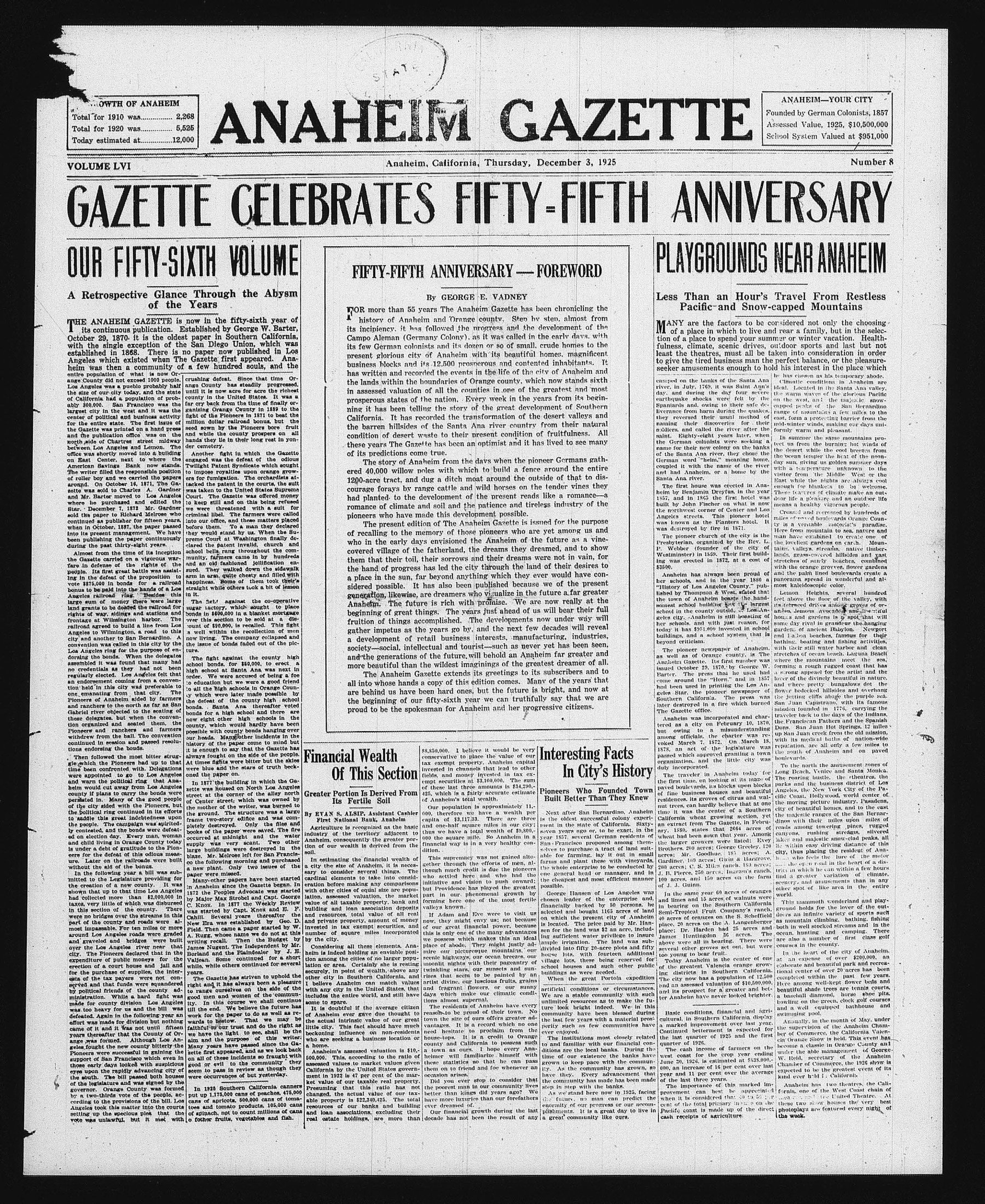
Searchable text
GROWTH OF ANAHEIM
Total for 1910 was... 2,268
Total for 1920 was... 5,525
Today estimated at...12,000
VOLUME LVI
GAZETTE CELEBRATE
OUR FIFTY-SIXTH VOLUME
A Retrospective Glance Through the Abysm of the Years
THE ANAHEIM GAZETTE is now in the fifty-sixth year of its continuous publication. Established by George W. Barter, October 29, 1870, it is the oldest paper in Southern California, with the single exception of the San Diego Union, which was established in 1868. There is no paper now published in Los Angeles which existed when The Gazette first appeared. Anaheim was then a community of a few hundred souls, and the entire population of what is now Orange County did not exceed 1000 people. Los Angeles was a pueblo probably half the size of our city today, and the state of California had a population of probably 300,000. San Francisco was the largest city in the west and it was the center of political and business activity for the entire state. The first issue of the Gazette was printed on a hand press and the publication office was on the north side of Chartres street midway between Los Angeles and Lemon. The crushing defeat. Since that time Orange County has steadily progressed, until it is now acre for acre the richest county in the United States. It was a far cry back from the time of finally organizing Orange County in 1889 to the fight of the Pioneers in 1871 to beat the million dollar railroad bonus, but the seed sown by the Pioneers bore fruit and while the county prospers on all hands they lie in their long rest in yonder cemetery.
Angles which existed when The Gazette first appeared. Anaheim was then a community of a few hundred souls, and the entire population of what is now Orange County did not exceed 1000 people. Los Angeles was a pueblo probably half the size of our city today, and the state of California had a population probably 300,000. San Francisco was the largest city in the west and it was the center of political and business activity for the entire state. The first issue of the Gazette was printed on a hand press and the publication office was on the north side of Chartres street midway between Los Angeles and Lemon. The office was shortly moved into a building on East Center, next to where the American Savings Bank now stands. The writer filled the responsible position of roller boy and we carried the papers around. On October 16, 1871, The Gazette was sold to Charles A. Gardner and Mr. Barton moved to Los Angeles where he purchased and edited the Star. December 7, 1872 Mr. Gardner sold the paper to Richard Melrose who continued as publisher for fifteen years, when in October, 1887, the paper passed into its present management. We have been publishing the paper continuously during the past thirty-eight years.
Almost from the time of its inception the Gazette carried on a vigorous warfare in defense of the rights of the people. Its first great battle was assisting in the defeat of the proposition to vote $875,000 in bonds for a railroad bonus to be paid into the hands of a Los Angeles railroad ring. Besides this large sum of money there were large land grants to be deeded the railroad for rights of way, sidings and stations and frontage at Wilmington harbor. The railroad agreed to build a line from Los Angeles to Wilmington, a road to this city and another to San Bernardino. A convention was called in this city by the Los Angeles ring for the purpose of endorsing the bonds. When the delegates assembled it was found that many had no credentials as they had not been regularly elected. Los Angeles felt that an endorsement coming from a convention held in this city was preferable to one emanating from that city. The Pioneers of Anaheim sided by farmers and ranchers to the north as far as San Gabriel river objected to the seating of these delegates, but when the convention organized and seated them, the Pioneers and ranchers and farmers withdrew from the hall. The convention continued in session and passed resolutions endorsing the bonds.
Then followed the most bitter struggle which the Pioneers had up to that time been confronted with. Delegations were appointed to go to Los Angeles and warn the political ring that Anaheim would cut away from Los Angeles county if plans to carry the bonds were persisted in. Many of the good people of the city sided with the Pioneers, but the political ring continued in its efforts to saddle this great indebtedness upon the people. The campaign was spiritlessly contested, and the bonds were defeated on election day. Every man, woman and child living in Orange County today is under a debt of gratitude to the Pion-
crushing defeat. Since that time Orange County has steadily progressed, until it is now acre for acre the richest county in the United States. It was a far cry back from the time of finally organizing Orange County in 1889 to the fight of the Pioneers in 1871 to beat the million dollar railroad bonus, but the seed sown by the Pioneers bore fruit and while the county prospers on all hands they lie in their long rest in yonder cemetery.
Another fight in which the Gazette engaged was the defeat of the odious Twilight Patent Syndicate which sought to impose royalties upon orange growers for fumigation. The orchardists attacked the patent in the courts, the suit was taken to the United States Supreme Court. The Gazette was offered money to keep still and on this being refused we were threatened with a suit for criminal libel. The farmers were called into our office, and these matters placed before them. To a man they declared they would stand by us. When The Supreme Court at Washington finally declared the patent invalid, church and school bells rang throughout the community, farmers came in by hundreds and an old fashioned jollification ensued. They walked down the sidewalk arm in arm, quite cheaty and filled with happiness. Home of them took their straight while others took a bit of lemon in it.
The fight against the co-operative sugar factory, which sought to place bonds in $600,000 in a blanket mortgage over this section to be sold at a discount of $90,000, is recalled. This fight well within the recollection of men now living. The company collapsed and the issue of bonds faded out of the picture.
The fight against the county high school bonds, for $50,000, to erect a high school at Santa Ana was next in order. We were accused of being a foo to education but we were a good friend to all the high schools in Orange County which were later made possible by the defeat of the county high school bonds. Santa Ana thereafter voted bonds for a high school and there are now eight other high schools in the county, which would hardly have been possible with county bonds hanging over our heads. Many other incidents in the history of the paper come to mind but it is enough to say that the Gazette has always fought on the side of the people. At times fights were bitter but the skies were blue and the stars of truth beckoned the paper on.
In 1877' building in which the Gazette was housed on North Los Angeles street at the corner of the alley north of Center street; which was owned by the mother of the writer, was burned to the ground. The structure was a large frame two-story edifice and was completely destroyed. Only the files and books of the paper were saved. The fire occurred at midnight and the water supply was very scant. Two other large buildings were destroyed in
Then followed the most bitter struggle which the Pioneers had up to that time been confronted with. Delegations were appointed to go to Los Angeles and warn the political ring that Anaheim would cut away from Los Angeles county if plans to carry the bonds were persisted in. Many of the good people of the city sided with the Pioneers, but the political ring continued in its efforts to saddle this great indebtedness upon the people. The campaign was spiritually contested, and the bonds were defeated on election day. Every man, woman and child living in Orange County today is under a debt of gratitude to the Pioneers for the defeat of this odious measure. Later on the railroads were built without the aid of the bonus.
In the following year a bill was submitted to the Legislature providing for the creation of a new county. It was shown that up to that time Los Angeles had collected more than $2,000,000 in taxes, very little of which was disbursed in this section of the county. There were no bridges over the streams in this part of the county and roads were almost impassable. For ten miles or more around Los Angeles roads were graded and gravelled and bridges were built over the Los Angeles river near that city. The Pioneers declared that in the expenditure of public moneys for the erection of a court house and jail and for the purchase of supplies, the interests of the tax payers were not conserved and that funds were squandered by political friends of the county administration. While a hard fight was made for county division Los Angeles was too heavy for us and the bill was defeated. Again in the following year an effort was made for division but nothing came of it and it was not until fifteen years thereafter that the County of Orange was formed. Although Los Angeles fought the new county bitterly the Pioneers were successful in gaining the support of San Francisco which even in those early days looked with suspicious eyes upon the rapidly advancing city of the south. The bill passed both houses of the legislature and was signed by the governor. Orange County was formed by a two-thirds vote of the people, according to the provisions of the bill. Los Angeles took this matter into the courts setting up the specious plea that the vote was unlawful, but it met with always fought on the side of the people.
At times fights were bitter but the skies were blue and the stars of truth beckoned the paper on.
In 1877 the building in which the Gazette was housed on North Los Angeles street at the corner of the alley north of Center street, which was owned by the mother of the writer, was burned to the ground. The structure was a large frame two-story edifice and was completely destroyed. Only the files and books of the paper were saved. The fire occurred at midnight and the water supply was very scant. Two other large buildings were destroyed in the blaze. Mr. Melrose left for San Francisco following morning and purchased a new plant. Only two issues of the paper were missed.
Many other papers have been started in Anaheim since the Gazette began. In 1872 the Pooples Advocate was started by Major Max Strobel and Capt. George C. Knox. In 1877 the Weekly Review was started by Capt. Knox and E. F. Cahill. Several years thereafter the New Era was established by Geo. D. Field. Then came a paper started by W. A. Rugg, whose name we do not at this writing recall. Then the Budget by James Nugent. The Independent by Mr. Borland and the Plaindealer by J. E. Valjean. Some continued for a short while, while others continued for several years.
The Gazette has striven to uphold the right and it has always been a pleasure to range ourselves on the side of the good men and women of the community. In this course we shall continue till the end. We believe the future has work for the paper to do as well as rewards to bestow. That we may be faithful to our trust and do the right as we have the light to see, shall be the aim and the purpose of this writer. Many years have passed since the Gazette first appeared, and as we look back on all of these incidents so fraught with good or evil to the community they seem to pass in review as though they were occurrences of but yesterday.
In 1928 Southern California canners put up 1,175,000 cans of peaches, 475,000 cans of apricots, 500,000 cans of tomatoes and tomato products, 105,000 cans of spinach, not to count millions of cans o father fruits, vegetables and fish.
By EVAN S. ALSIP,
First National Bank
Agriculture is recognized industry of the territory Anaheim, consequently it owes its wealth to soil.
In estimating the size of Anaheim to consider several cardinal elements to orientation before making with other cities of equal value of all taxable property building and loan assets and resources, total and private property invested in tax exemption number of square mile by the city.
Considering all these helm is indeed holding among the cities of lation or area. Certain securely, in point of view other city in Southern I believe Anaheim owns any city in the U.S., includes the entire world some to spare.
It is doubtful if thereof Anaheim ever gave little city. This accurate assessed values to many California by the Uniform in 1922 is 47 per kettle value of our taxes Presuming that this changed, the actual property is $22,236 resources of our bank and loan associations real estate holdings...
AHEIM GAZETTE
Anaheim, California, Thursday, December 3, 1925
CEBRATES FIFTY = FIFTH A
FIFTY-FIFTH ANNIVERSARY — FOREWORD
By GEORGE E. VADNEY
FOR more than 55 years The Anaheim Gazette has been chronicling the history of Anaheim and Orange county. Step by step, almost from its incipiency, it has followed the progress and the development of the Campo Aleman (Germany Colony), as it was called in the early days, with its few German colonists and its dozen or so of small, crude homes to the present glorious city of Anaheim with its beautiful homes, magnificent business blocks and its 12,500 prosperous and contented inhabitants. It has written and recorded the events in the life of the city of Anaheim and the lands within the boundaries of Orange county, which now stands sixth in assessed valuation of all the counties in one of the greatest and most prosperous states of the nation. Every week in the years from its beginning it has been telling the story of the great development of Southern California. It has recorded the transformation of the desert valleys and the barren hillsides of the Santa Ana river country from their natural condition of desert waste to their present condition of fruitfulness. All these years The Gazette has been an optimist and it has lived to see many
present glorious city of Anaheim with its beautiful homes, magnificent business blocks and its 12,500 prosperous and contented inhabitants. It has written and recorded the events in the life of the city of Anaheim and the lands within the boundaries of Orange county, which now stands sixth in assessed valuation of all the counties in one of the greatest and most prosperous states of the nation. Every week in the years from its beginning it has been telling the story of the great development of Southern California. It has recorded the transformation of the desert valleys and the barren hillsides of the Santa Ana river country from their natural condition of desert waste to their present condition of fruitfulness. All these years The Gazette has been an optimist and it has lived to see many of its predictions come true.
The story of Anaheim from the days when the pioneer Germans gathered 40,000 willow poles with which to build a fence around the entire 1200-acre tract, and dug a ditch moat around the outside of that to discourage forays by range cattle and wild horses on the tender vines they had planted to the development of the present reads like a romance—a romance of climate and soil and the patience and tireless industry of the pioneers who have made this development possible.
The present edition of The Anaheim Gazette is issued for the purpose of recalling to the memory of those pioneers who are yet among us and who in the early days envisioned the Anaheim of the future as a vine-covered village of the fatherland, the dreams they dreamed, and to show them that their toil, their sorrows and their dreams were not in vain, for the hand of progress has led the city through the land of their desires to a place in the sun, far beyond anything which they ever would have considered possible. It has also been published because we of the present generation, likewise, are dreamers who visualize in the future a far greater Anaheim. The future is rich with promise. We are now really at the beginning of great things. The years just ahead of us will bear their full fruition of things accomplished. The developments now under way will gather impetus as the years go by, and the next few decades will reveal a development of retail business interests, manufacturing, industries, society—social, intellectual and tourist—such as never yet has been seen, and the generations of the future will behold an Anaheim far greater and more beautiful than the wildest imaginings of the greatest dreamer of all.
The Anaheim Gazette extends its greetings to its subscribers and to all into whose hands a copy of this edition comes. Many of the years that are behind us have been hard ones, but the future is bright, and now at the beginning of our fifty-sixth year we can truthfully say that we are proud to be the spokesman for Anaheim and her progressive citizens.
Financial Wealth Of This Section
Greater Portion Is Derived From Its Fertile Soil
By EVAN S. ALSIF, Assistant Cashier First National Bank, Anaheim
Agriculture is recognized as the basic industry of the territory adjacent to Anaheim, consequently the greater portion of our wealth is derived from the population is approximately 11,000, therefore we have a wealth per capita of $3,117.33. There are three and one-half square miles in our city; thus we have a total wealth of $9,800,000 the square mile. So Anaheim in a very healthy condition.
Interesting Facts In City’s History
Pioneers Who Founded Town Built Better Than They Knew
Next after San Bernardino, Anaheim is the oldest successful colony experiment in the state of California. Sixty-seven years ago or, to be exact, in the year 1857, several German residents of San Francisco proposed among themselves to purchase a tract of land suit-tune it was California who an extract from arary, 1880, stout wheat had been the larger grape brothers.
Financial Wealth Of This Section
Greater Portion Is Derived From Its Fertile Soil
By EVAN S. ALSIP, Assistant Cashier First National Bank, Anaheim
Agriculture is recognized as the basic industry of the territory adjacent to Anaheim, consequently the greater portion of our wealth is derived from the soil.
In estimating the financial wealth of a city the size of Anaheim, it is necessary to consider several things. The cardinal elements to take into consideration before making any comparisons with other cities of equal size are population, assessed valuation, the market value of all taxable property, bank and building and loan association deposits and resources, total value of all real and private property, amount of money invested in tax exempt securities, and number of square miles incorporated by the city.
Considering all these elements, Anaheim is indeed holding an enviable position among the cities of no larger population or area. Certainly she is resting securely, in point of wealth, above any other city in Southern California, and I believe Anaheim can match values with any city in the United States, that includes the entire world, and still have some to spare.
It is doubtful if the average citizen of Anaheim ever gave due thought to the actual intrinsic value of our great little city. This fact should have much beckoning influence on non-residents who are seeking a business location or a home.
Anaheim's assessed valuation is $10,500,000. This, according to the ratio of assessed values to market values given California by the United States government in 1922 is 47 per cent of the market value of our taxable real property. Presuming that this ratio has not changed, the actual value of our taxable property is $22,340,425. The total resources of our banks and building and loan associations, excluding their real estate holdings, are more than conservative to place the value of our tax exempt property. Anaheim capital invested in channels that lead to other fields, and money invested in tax exempt securities at $3,100,000. The sum of these last three amounts is $34,290,-425, which is a fairly accurate estimate of Anaheim's total wealth.
Our population is approximately 11,000, therefore we have a wealth per capita of $3,117.33. There are three and one-half square miles in our city; thus we have a total wealth of $9,800,-000 the square mile. So Anaheim in a financial way is in a very healthy condition.
This supremacy was not gained altogether through the efforts of men, although much credit is due to the pioneers who settled here and who had the initiative and vision to push onward; but Providence has played the greatest part in our phenomenal growth by forming here one of the most fertile valleys known.
If Adam and Eve were to visit us now, they might envy us; not because of our great financial power, because this is only one of the many advantages we possess which makes this an ideal place of abode. They might justly admire our picturesque mountains, our scenic highways, our ocean breezes, our moonlit nights with their pageantry of twinkling stars, our sunsets and sunrises that seem to be painted by an artist divine, our luscious fruits, grains and fragrant flowers, or our sunny days which make our climatic conditions almost supernal.
The residents of Anaheim have every reason to be proud of their town. No town the size of ours offers greater advantages. It is a record which no one need hesitate to proclaim from the house-tops. It is a credit to Orange county and California to possess such a town as ours. I hope every Anahelmer will familiarize himself with these statistics so that he can pass them on to friend and foe whenever an occasion arises.
Did you ever stop to consider that the poorest man in our community lives better than kings did years ago? We have more luxuries than our forefathers ever dreamed of.
Our financial growth during the last decade has not been the result of any
Next after San Bernardino, Anaheim is the oldest successful colony experiment in the state of California. Sixty-seven years ago or, to be exact, in the year 1857, several German residents of San-Franisco proposed among themselves to purchase a tract of land suitable for farming, lay it out in small farms and plant these with vineyards, the whole enterprise to be conducted by one general head or manager, and in the cheapest and most efficient manner possible.
George Hansen of Los Angeles was chosen leader of the enterprise and, financially backed by 50 persons, he selected and bought 1165 acres of land on which the present city of Anaheim is located. The price paid by Mr. Hansen for the land was $2 an acre, including sufficient water privilege to insure ample irrigation. The land was subdivided into fifty 20-acre plots and fifty house lots, with fourteen additional village lots, these being reserved for school houses and such other public buildings as were needed.
When the great Portola expedition artificial conditions or circumstances. We are a stable community with such unlimited resources as to make the future look bright indeed. We in this community have been blessed during the last few years with a material prosperity such as few communities have ever enjoyed.
The institutions most closely related to and familiar with our financial conditions are the local banks. During the time of our existence the banks have grown to keep pace with the community. As the community has grown, so have they. Every advancement that the community has made has been made step in step with the banks.
As we stand here now in 1925, facing the future, no man can predict the enormity of our progress or our accomplishments. It is a great day to live in a great community like ours.
Basic conditional cultural. In a marked imprecision continued before the last quarter of 1925.
The cash west coast June 20, 1926, 000 an increase year and 11th of the last th.
The import movement when it is cent of the Pacific coast cash receipts.
ETTE
ANAHEIM—YOUR CITY
Founded by German Colonists, 1857
Assessed Value, 1925, $10,500,000
School System Valued at $951,000
Number 8
TH ANNIVERSARY
PLAYGROUNDS NEAR ANAHEIM
Less Than an Hour's Travel From Restless Pacific and Snow-capped Mountains
Many are the factors to be considered not only the choosing of a place in which to live and rear a family, but in the selection of a place to spend your summer or winter vacation. Healthfulness, climate, scenic drives, outdoor sports and last but not least the theatres, must all be taken into consideration in order to give the tired business man the perfect balance, or the pleasure-seeker amusements enough to hold his interest in the place which camped on the banks of the Santa Ana river, in July, 1769. It was Saint Ann's day, and during the day four severe earthquake shocks were felt by the Spaniards and, owing to their safe deliverance from harm during the quakes, they reversed their usual method of naming their discoveries for their soldiers, and called the river after the saint. Eighty-eight years later, when the German colonists were seeking a name for their new colony on the banks he has chosen as his temporary abode.
Climatic conditions in Anaheim are ideal. Located in the Santa Ana valley, the warm waves of the glorious Pacific on the west, and the majestic snow-capped peaks of the San Bernardino range of mountains a few miles to the east, form a protecting barrier from the mid-winter winds, making our days uniformly warm and pleasant.
In summer the same mountains protect us from the burning hot winds of
camped on the banks of the Santa Ana river, in July, 1769. It was Saint Ann's day, and during the day four severe earthquake shocks were felt by the Spaniards and, owing to their safe delivery from harm during the quakes, they reversed their usual method of naming their discoveries for their soldiers, and called the river after the saint. Eighty-eight years later, when the German colonists were seeking a name for their new colony on the banks of the Santa Ana river, they chose the German word "helm," meaning home, coupled it with the name of the river and had Anaheim, or a home by the Santa Ana river.
The first house was erected in Anaheim by Benjamin Dreyfus, in the year 1857, and in 1865 the first hotel was built by John Fischer on what is now the northwest corner of Center and Los Angeles streets. This pioneer hotel was known as the Planters hotel. It was destroyed by fire in 1871.
The pioneer church of the city is the Presbyterian, organized by the Rev. L. P. Webber (founder of the city of Westminster) in 1869. Their first building was erected in 1872, at a cost of $3500.
Anaheim has always been proud of her schools, and in the year 1880 a "History of Los Angeles County," published by Thompson & West, stated that the town of Anaheim boasts the handiest school building in the county outside Los Angeles city. Anaheim is still boasting of her schools, and with just reason, for today it has $951,000 invested in school buildings, and a school system that is beyond criticism.
The pioneer newspaper of Anaheim, as well as of Orange county, is The Anaheim Gazette. Its first number was issued October 29, 1870; by George W. Barter. The press that he used had come around the "Horn," and in 1857 had been used in printing the Los Angeles Star, the pioneer newspaper of Southern California. The press was later destroyed in a fire which burned The Gazette office.
Anaheim was incorporated and chartered as a city on February 10, 1870, but owing to a misunderstanding among officials, the charter was revoked March 7, 1872. On March 18, 1878, an act of the legislature was passed which approved granting a town organization, and the little city was duly incorporated.
The traveler in Anaheim today for the first time, on looking at its maze of paved boulevards, its blocks upon blocks of fine business houses and beautiful residences. Its groves of citrus and walnut trees can hardly believe that at one time it was the center of a Southern California wheat growing section, yet an extract from The Gazette, in February, 1880, states that 2664 acres of wheat had been sown that year. Among the larger growers were listed: Evey Brothers, 260 acres; George Greeley, 120 acres.
He has chosen as his temporary abode.
Climate conditions in Anaheim are ideal. Located in the Santa Ana valley, the warm waves of the glorious Pacific on the west, and the majestic snow-capped peaks of the San Bernardino range of mountains a few miles to the east, form a protecting barrier from the mid-winter winds, making our days uniformly warm and pleasant.
In summer the same mountains protect us from the burning hot winds of the desert while the cool breezes from the ocean temper the heat of the noon-day sun, giving us golden summer days with a temperature unknown to the visitor from 'Middle West' or the East while the nights are always cool enough for blankets to be welcome. These features of climate make an outdoor life a pleasure and an outdoor life means a healthy vigorous people.
Crossed and recessed by hundreds of miles of newly boulevards Orange County is a versatile motorist's paradise. Here from mountain to sea, nature and man have combined to create one of the loveliest gardens on earth. Mountains, valleys, streams, native timberlands, grass-covered hillsides and vast stretches of sandy beaches, combined with the orange groves, flower gardens and the palm lined boulevards create a panorama spread in wonderful and almost kalefdoscope color.
Lemon Heights, several hundred feet above the floor of the valley, with its terraced drives among groves of oranges, lemons avocado and sweet homes and gardens is a spot that will some day rival in grandeur the hanging gardens of ancient Babylon. Newport and La Jolla beaches, famous for their bathing, boating and fishing activities, with their still water harbor and clean stretches of ocean beach. Laguna Beach where the mountains meet the sea, forming a rough rugged coast that has a strong appeal for the artist and the lover of the divinely beautiful in nature, and where pretty bungalows dot the flower bedded hillsides and overhang the jettling cliffs above the purple sea. San Juan Capistrano, with its famous mission founded in 1776, carrying the traveler back to the days of the Indians, the Franciscan Fathers and the Spanish Dons. San Juan Hot Springs, 12 miles up San Juan creek from the old mission, with its medical baths of nation-wide reputation, are all only a few miles to the south of Anaheim and on paved boulevards.
To the north the amusement zones of Long Beach, Venice and Santa Monica. The roaring bustle, the theatrees, the parks and the business district of Los Angeles, the New York City of the Pacific Coast, Hollywood world center of the moving picture industry. Pasadena, city of beautiful homes, and to the east the majestic ranges of the San Bernardinos with their miles upon miles of roads among towering pines, rugged canyons, rushing streams, silvered lakes and majestic snow-clad peaks, all within easy driving distance of this city pleasing to the resident of Anaheim.
The traveler in Anaheim today for the first time, on looking at its maze of paved boulevards, its blocks upon blocks of fine business houses and beautiful residences. Its groves of citrus and walnut trees, can hardly believe that at one time it was the center of a Southern California wheat growing section, yet an extract from The Gazette, in February, 1880, states that 2664 acres of wheat had been sown that year. Among the larger growers were listed: Evey Brothers, 200 acres; George Greeley, 120 acres; Mr. Goodhue, 185 acres; A. Gardiner, 100 acres; Gwin & Hargrove, 200 acres; C. S. Miles ranch, 180 acres; J. B. Pierce, 250 acres; Ingram's ranch, 100 acres, and 150 acres on the farm of J. J. Guinn.
In the same year 60 acres of oranges and limes and 15 acres of walnuts were in bearing on the Southern California Semi-Tropical Fruit Company's ranch, 40 acres of oranges on the S. Scheffield place, 20 acres on the A. Langenberger place; Dr. Harden had 25 acres and James Huntingdon 36 acres. The above were all in bearing. There were several other groves set out, but were too young to bear fruit.
Today Anaheim is the center of one of the greatest Valencia orange growing districts in Southern California. The city now has a population of 12,500 and an assessed valuation of $10,500,000, and its prospect for a greater and better Anaheim have never looked brighter.
Basic conditions, financial and agricultural, in Southern California display a marked improvement over last year. Continued betterment is expected for the last quarter of 1925 and the first quarter of 1926.
The cash income of farmers on the west coast for the crop year ending June 20, 1926, is estimated at $338,000, an increase of 16 per cent over last year and 11 per cent over the average of the last three years.
The importance of this marked improvement can best be appreciated when it is considered that 40 to 50 percent of the total primary income on the Pacific coast is made up of the direct cash receipts of agriculture.
To the north the amusement zones of Long Beach, Venice and Santa Monica. The roaring bustle, the theatres, the parks and the business district of Los Angeles, the New York City of the Pacific Coast, Hollywood, world center of the moving picture industry. Pasadena, city of beautiful homes, and to the cast the majestic ranges of the San Bernardinos with their miles upon miles of roads among towering pines, rugged canyons, rushing streams, silvered lakes and majestic snow-clad peaks, all lie within easy driving distance of this city, thus placing the resident of Anaheim who feels the lure of the motor open road in the heart of a district in which he can within a few hours find a greater variation of climate, scenery, and amusements than in any other spot of like area in the entire world.
This manumoth wonderland and playground holds for the lover of the outdoors an infinite variety of sports such as mountain climbing, bathing, fishing both in well stocked streams and in the ocean, hunting and camping. There are also a number of first class golf courses in the county.
In the heart of the city of Anaheim, at an expense of over $200,000, an elaborate and beautiful park and recreational center of over 20 acres has been completed within the past few years. Here among well-kept flower beds and beautiful shade trees are tennis courts, a baseball diamond, horse shoe pits, bowling on the green, clock golf courses and a well equipped bathouse and swimming pool.
Anaheim has two theatres, the California Chamber of Commerce, the California Valencia Orange Show is held. This event has become a classic in Orange County and under the able management of George W. Reid, secretary of the Anaheim Chamber of Commerce, the 1926 show is expected to be the greatest event of its kind ever held in California.
Anaheim has two theatres, the California Chamber of Commerce, the California Valencia Orange Show is held. This event has become a classic in Orange County and under the able management of George W. Reid, secretary of the Anaheim Chamber of Commerce, the 1926 show is expected to be the greatest event of its kind ever held in California.