anaheim-gazette 1925-04-09
Scanned page
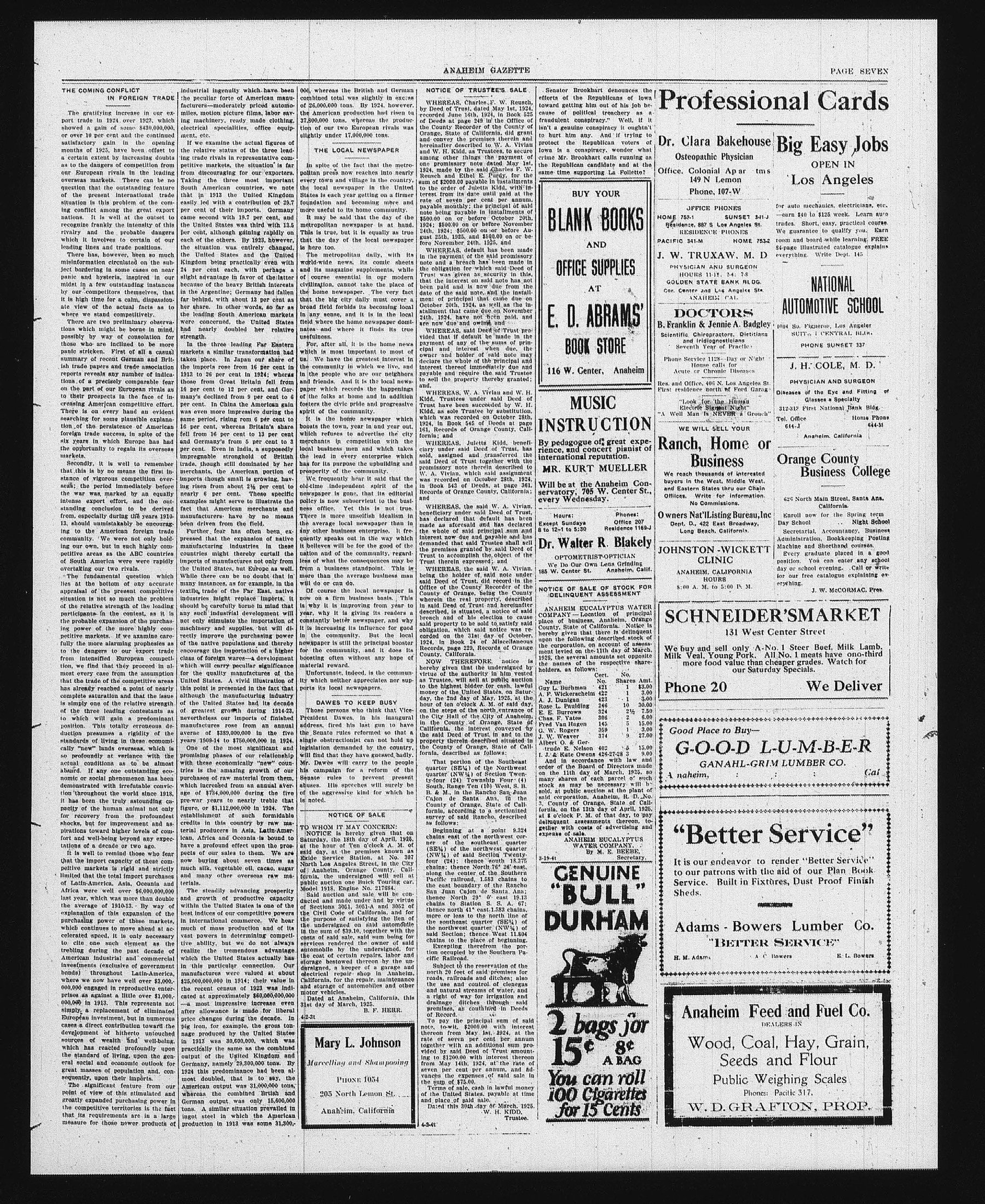
Searchable text
THE COMING CONFLICT
IN FOREIGN TRADE
The gratifying increase in our export trade in 1924 over 1923, which showed a gain of some $430,000,000, or over 10 per cent and the continued satisfactory gain in the opening months of 1925, have been offset to a certain extent by increasing doubts as to the dangers of competition from our European rivals in the leading overseas markets. There can be no question that the outstanding feature of the present international trade situation is this problem of the coming conflict among the great export nations. It is well at the outset to recognize frankly the intensity of this rivalry and the probable dangers which it involves to certain of our leading lines and trade positions.
There has, however, been so much misinformation circulated on the subject bordering in some cases on near panic and hysteria, inspired in our midst in a few outstanding instances by our competitors themselves, that it is high time for a calm, dispassionate view of the actual facts as to where we stand competitively.
There are two preliminary observations which might be borne in mind, possibly by way of consolation for those who are inclined to be more panic stricken. First of all a casual summary of recent German and British trade papers and trade association reports reveals any number of indications of a precisely comparable fear on the part of our European rivals as to their prospects in the face of increasing American competitive effort. There is on every hand an evident searching for some plausible explanation of the persistence of American foreign trade success, in spite of the six years in which Europe has had the opportunity to regain its overseas industrial ingenuity which have been the peculiar forte of American manufacturers—moderately priced automobiles, motion picture films, labor saving machinery, ready made clothing, electrical specialities, office equipment, etc.
If we examine the actual figures of the relative status of the three leading trade rivals in representative competitive markets, the situation is far from discouraging for our exporters. Taking the three most important South American countries, we note that in 1913 the United Kingdom easily led with a contribution of 29.7 per cent of their imports. Germany came second with 19.7 per cent, and the United States was third with 13.5 per cent, although gaining rapidly on each of the others. By 1923, however, the situation was entirely changed, the United States and the United Kingdom being practically even with 24 per cent each, with perhaps a slight advantage in favor of the latter because of the heavy British interests in the Argentine; Germany had fallen far behind, with about 13 per cent as her share. In other words, so far as the leading South American markets were concerned, the United States had nearly doubled her relative strength.
In the three leading Far Eastern markets a similar transformation had taken place. In Japan our share of the imports rose from 16 per cent in 1913 to 26 per cent in 1924; whereas those from Great Britain fell from 16 per cent to 12 per cent, and Germany's declined from 9 per cent to 6 per cent. In China the American gain was even more impressive during the same period, rising from 6 per cent to 16 per cent, whereas Britain's share fell from 16 per cent to 13 per cent and Germany's from 5 per cent to 3 per cent. Even in India a supposed 000, whereas the British combined total was slightly under 17,000,000.
In spite of the fact that politan press now reaches every town and village, the local newspaper States is each year getting foundation and becoming more useful to its home.
It may be said that metropolitan newspapers This is true, but it is that the day of the last here too.
The metropolitan city world-wide news, its and its magazine supply of course essential to civilization, cannot take the home newspaper, that the big city daily broad field forbids its in any sense, and it is field where the home newspaper and where it usefulness.
For, after all, it is which is most important us. We have the greatest community in which in the people who are and friends. And it is paper which records of the folks at home fosters the civic pride spirit of the community.
It is the home new boosts the town, year lwhich refuses to advert merchants in competitor local business men and
summary of recent German and British trade papers and trade association reports reveals any number of indications of a precisely comparable fear on the part of our European rivals as to their prospects in the face of increasing American competitive effort. There is on every hand an evident searching for some plausible explanation of the persistence of American foreign trade success, in spite of the six years in which Europe has had the opportunity to regain its overseas markets.
Secondly, it is well to remember that this is by no means the first instance of vigorous competition overseas; the period immediately before the war was marked by an equally intense export effort, and the outstanding conclusion to be derived from, especially during the years 1910-13, should unmistakably be encouraging to the American foreign trade community. We were not only holding our own, but in such highly competitive areas as the ABC countries of South America were rapidly overtaking our two rivals.
The fundamental question which lies at the bottom of any accurate appraisal of the present competitive situation is not so much the problem of the relative strength of the leading participants in the contest, as it is the probable expansion of the purchasing power of the more highly competitive markets. If we examine carefully the more alarming prophesies as to the dangers to our export trade from intensified European competition, we find that they proceed in almost every case from the assumption that the trade of the competitive areas has already reached a point of nearly complete saturation and that the issue is simply one of the relative strength of the three leading contestants as to which will gain a predominant position. This totally erroneous deduction presumes a rigidity of the standards of living in these economically "new" lands overseas, which is so profoundly at variance with the actual conditions as to be almost absurd. If any one outstanding economic or social phenomenon has been demonstrated with irrefutable conviction throughout the world since 1918, it has been the truly astounding capacity of the human animal not only for recovery from the profoundest shocks, but for improvement and aspirations toward higher levels of comfort and well-being beyond any expectations of a decade or two ago.
In Japan our share of the imports rose from 16 per cent in 1913 to 26 per cent in 1924; whereas those from Great Britain fell from 16 per cent to 12 per cent, and Germany's declined from 9 per cent to 6 per cent. In China the American gain was even more impressive during the same period, rising from 6 per cent to 16 per cent, whereas Britain's share fell from 16 per cent to 13 per cent and Germany's from 5 per cent to 3 per cent. Even in India, a supposedly impregnable stronghold of British trade, though still dominated by her merchants, the American portion of imports though small is growing, having risen from about 2½ per cent to nearly 6 per cent. These specific examples might serve to illustrate the fact that American merchants and manufacturers have by no means been driven from the field.
Further fear has often been expressed that the expansion of native manufacturing industries in these countries might thereby curtail the imports of manufactures not only from the United States, but Europe as well. While there can be no doubt that in many instances, as for example, in the textile trade of the Far East, native industries might replace imports, it should be carefully borne in mind that any such industrial development will not only stimulate the importation of machinery and supplies, but will directly improve the purchasing power of the native populations and thereby encourage the importation of a higher class of foreign wares—a development which will carry peculiar significance for the quality manufactures of the United States. A vivid illustration of this point is presented in the fact that although the manufacturing industry of the United States had its decade of greatest growth during 1914-23, nevertheless our imports of finished manufactures rose from an annual average of $389,000,000 in five years 1909-14 to $750,000,000 in 1924.
One of the most significant and promising phases of our relationship with these economically "new" countries is the amazing growth of our purchases of raw material from them, which increased from an annual average of $734,000,000 during the five pre-war years to nearly treble that figure, or $1,112,000,000 in 1924. The establishment of such formidable credits in this country by raw material producers in Asia, Latin-American, Africa and Oceania is bound to have a profound effect upon the pros-taken place. In Japan our share of the imports rose from 16 per cent in 1913 to 26 per cent in 1924; whereas those from Great Britain fell from 16 per cent to 12 per cent, and Germany's declined from 9 per cent to 6 per cent. In China the American gain was even more impressive during the same period, rising from 6 per cent to 16 per cent, whereas Britain's share fell from 16 per cent to 13 per cent and Germany's from 5 per cent to 3 per cent. Even in India, a supposedly impregnable stronghold of British trade, though still dominated by her merchants, the American portion of imports though small is growing, having risen from about 2½ per cent to nearly 6 per cent. These specific examples might serve to illustrate the fact that American merchants and manufacturers have by no means been driven from the field.
Further fear has often been expressed that the expansion of native manufacturing industries in these countries might thereby curtail the imports of manufactures not only from the United States, but Europe as well. While there can be no doubt that in many instances, as for example, in the textile trade of the Far East, native industries might replace imports, it should be carefully borne in mind that any such industrial development will not only stimulate the importation of machinery and supplies, but will directly improve the purchasing power of the native populations and thereby encourage the importation of a higher class of foreign wares—a development which will carry peculiar significance for the quality manufactures of the United States. A vivid illustration of this point is presented in the fact that although the manufacturing industry of the United States had its decade of greatest growth during 1914-23, nevertheless our imports of finished manufactures rose from an annual average of $389,000,000 in five years 1909-14 to $750,000,000 in 1924.
One of the most significant and promising phases of our relationship with these economically "new" countries is the amazing growth of our purchases of raw material from them, which increased from an annual average of $734,000,000 during the five pre-war years to nearly treble that figure, or $1,112,000,000 in 1924. The establishment of such formidable credits in this country by raw material producers in Asia, Latin-American, Africa and Oceania is bound to have a profound effect upon the pros-taken place. In Japan our share of the imports rose from 16 per cent in 1913 to 26 percent in 1924; whereas those from Great Britain fell from 16 per cent to 12 per cent, and Germany's declined from 9 per cent to 6 per cent. In China the American gain was even more impressive during the same period, rising from 6 per cent to 16 per cent, whereas Britain's share fell from 16 per cent to 13 per cent and Germany's from 5 per cent to 3 per cent. Even in India, a supposedly impregnable stronghold of British trade, though still dominated by her merchants, the American portion of imports though small is growing, having risen from about 2½ per cent to nearly 6 per cent. These specific examples might serve to illustrate the fact that American merchants and manufacturers have by no means been driven from the field.
Further fear has often been expressed that the expansion of native manufacturing industries in these countries might thereby curtail the imports of manufactures not only from the United States, but Europe as well. While there can be no doubt that in many instances, as for example, in the textile trade of the Far East, native industries might replace imports, it should be carefully borne in mind that any such industrial development will not only stimulate the importation of machinery and supplies, but will directly improve the purchasing power of the native populations and thereby encourage the importation of a higher class of foreign wares—a development which will carry peculiar significance for the quality manufactures of the United States. A vivid illustration of this point is presented in the fact that although the manufacturing industry of the United States had its decade of greatest growth during 1914-23, nevertheless our imports of finished manufactures rose from an annual average of $389,000,000 in five years 1909-14 to $750,000,000 in 1924.
One of the most significant and promising phases of our relationship with these economically "new" countries is the amazing growth of our purchases of raw material from them, which increased from an annual average of $734,000,000 during the five pre-war years to nearly treble that figure, or $1,112,000,000 in 1924. The establishment of such formidable credits in this country by raw material producers in Asia, Latin-American, Africa and Oceania is bound to have a profound effect upon the pros-taken place. In Japan our share of the imports rose from 16 per cent in 1913 to 26 percent in 1924; whereas those from Great Britain fell from 16 per cent to 12 per cent, and Germany's declined from 9 per cent to 6 per cent. In China the American gain was even more impressive during the same period, rising from 6 per cent to 16 per cent, whereas Britain's share fell from 16 per cent to 13 per cent and Germany's from 5 per cent to 3 per century. Even in India, a supposedly impregnable stronghold of British trade, though still dominated by her merchants, the American portion of imports though small is growing, having risen from about 2½ per cent to nearly 6 per cent. These specific examples might serve to illustrate the fact that American merchants and manufacturers have by no means been driven from the field.
Further fear has often been expressed that the expansion of native manufacturing industries in these countries might thereby curtail the imports of manufactures not only from the United States, but Europe as well. While there can be no doubt that in many instances, as for example, in the textile trade of the Far East, native industries might replace imports, it should be carefully borne in mind that any such industrial development will not only stimulate the importation of machinery and supplies, but will directly improve the purchasing power of the native populations and thereby encourage the importation of a higher class of foreign wares—a development which will carry peculiar significance for the quality manufactures of the United States. A vivid illustration of this point is presented in the fact that although the manufacturing industry of the United States had its decade of greatest growth during 1914-23, nevertheless our imports of finished manufactures rose from an annual average of $389,000,000 in five years 1909-14 to $750,000,000 in 1924.
One of the most significant and promising phases of our relationship with these economically "new" countries is the amazing growth of our purchases of raw material from them, which increased from an annual average of $734,000,000 during the five pre-war years to nearly treble that figure, or $1,112,000,000 in 1924. The establishment of such formidable credits in this country by raw material producers in Asia, Latin-American,Africa and Oceania is bound to have a profound effect uponthe pros-taken place. In Japan our share ofthe imports rosefrom16percentin1913to26percentin1924;whereasthosefromGreatBritainfellfrom16percentto12percentandGermany'sdeclinedfrom9percentto6percent.InChinatheAmericangainwasevenmoreimpressiveduringthesameperiod,risingfrom6percentto16percent,andwhereasBritain'ssharefellfrom16percentto13percentandGermany'sdeclinedfrom9percentto6percent.Inthecommunityinwhicharepresentedbythemerchantsincompetitorsincompetitionsinlocalbusinessmenandleadersineveryenvironmentofthecommunity.Itshemorewillbeforitspurposethepros-periodofthecommunity.Itshemorewillbeforitspurposethepros-periodofthecommunity.Itshemorewillbeforitspurposethepros-periodofthecommunity.Itshemorewillbeforitspurposethepros-periodofthecommunity.Itshemorewillbeforitspurposethepros-periodofthecommunity.Itshemorewillbeforitspurposethepros-periodofthecommunity.Itshemorewillbeforitspurposethepros-periodofthecommunity.Itshemorewillbeforitspurposethepros-periodofthecommunity.Itshemorewillbeforitspurposethepros-periodofthecommunity.Itshemorewillbeforitspurposethepros-periodofthecommunity.Itshemorewillbeforitspurposethepros-periodofthecommunity.Itshemorewillbeforitspurposethepros-periodofthecommunity.Itshemorewillbeforitspurposethepros-periodofthecommunity.Itshemorewillbeforitspurposethepros-periodofthecommunity.Itshemorewillbeforitspurposethepros-periodofthecommunity.Itshemorewillbeforitspurposethepros-periodofthecommunity.Itshemorewillbeforitspurposethepros-periodofthecommunity.Itshemorewillbeforitspurposethepros-periodofthecommunity.Itshemorewillbeforitspurposethepros-periodofthecommunity.Itshemorewillbeforitspurposethepros-periodofthecommunity.Itshemorewillbeforitspurposethepros-periodofthecommunity.Itshemorewillbeforitspurposethepros-periodofthecommunity.Itshemorewillbeforitspurposethepros-periodofthecommunity.Itshemorewillbeforitspurposethepros-periodofthecommunity.Itshemorewillbeforitspurposethepros-period ofthedomainofthecommunity.Itshemorewillbeforitspurposethepros-period ofthedomainofthecommunity.Itshemorewillbeforitspurposethepros-period ofthedomainofthecommunity.Itshemorewillbeforitspurposethepros-period ofthedomainofthecommunity.Itshemorewillbeforitspurposethepros-period ofthedomainofthecommunity.Itshemorewillbeforitspurposethepros-period ofthedomainofthecommunity.Itshemorewillbeforitspurposethepros-period ofthedomainofthecommunity.Itshemorewillbeforitspurposethepros-period ofthedomainofthecommunity.Itsshemorewillbeforitspurposethepros-period ofthedomainofthecommunity.Itsshemorewillbeforitspurposethepros-period ofthedomainofthecommunity.Itsshemorewillbeforitspurposethepros-period ofthedomainofthecommunity.Itsshemorewillbeforitispurposethepros-period ofthedomainofthecommunity.Itsshemorewillbeforitispurposethepros-period ofthedomainofthecommunity.Itsshemorewillbeforitispurposethepros-period ofthedomainofthecommunity.Itsshemorewillbeforitispurposethepros-period ofthedomainofthecommunity.Itsshemorewillbeforitispurposethepros-period ofthedomainofthecommunity.Itsshemorewillbeforitispurposethepros-period ofthedomainofthecommunity.Itsshemorewillbeforitispurposethepros-period ofthedomainofthecommunity.ItsshemorewillbeforitispurposeThepros-period ofthedomainofthecommunity.ItsshemorewillbeforitispurposeThepros-period ofthedomainofthe Community.ItsshemorewillbeforitispurposeThepros-period ofthedomainofTheCommunity.ItsshemorewillbeforitispurposeThepros-period ofthedomainOfTheCommunity.ItsshemorewillbeforitispurposeThepros-period ofthedomainOfTheCommunity.ItsshemorewillbeforitispurposeThepros-period ofthedomainOfTheCommunity.ItsshemorewillbeforitispurposeThepros-period ofthedomainOfTheCommunity.ItsshemorewillbeforitispurposeThepros-period ofthedomainOfTheCommunity.ItsshemoreWillBeForItIsNewYearInTheCommunity.AmongstTheOpportunitiesForA BusinesspersonToAdvanceInTheCommunity.AmongstTheOpportunitiesForA BusinesspersonToAdvanceInTheCommunity.AmongstTheOpportunitiesForA BusinesspersonToAdvanceInTheCommunity.AmongstTheOpportunitiesForA BusinesspersonToAdvanceInTheCommunity.AmongstTheOpportunitiesForA BusinesspersonToAdvanceInTheCommunity.AmongstTheOpportunitiesForA BusinesspersonToAdvanceInTheCommunity.AmongstTheOpportunitiesForA BusinesspersonToAdvanceInTheCommunity.AmongstTheOpportunitiesForA BusinesspersonToAdvanceInTheCommunity.AmongstTheOpportunitiesForA BusinesspersonToAdvanceInTheCommunity.AmongstTheOpportunitiesForA BusinesspersonToAdvanceInTheCommunity.AmongstTheOpportunitiesForA BusinesspersonToAdvanceInTheCommunity.AmongstTheOpportunitiesForA BusinesspersonToAdvanceInTheCommunity.AmongstTheOpportunitiesForA BusinesspersonToAdvanceInTheCommunity.AmongstTheOpportunitiesForA BusinesspersonToAdvanceInTheCommunity.AmongstTheOpportunitiesForA BusinesspersonToAdvanceInTheCommunity.AmongstTheOpportunitiesForA BusinesspersonToAdvanceInTheCommunity.AmongstTheOpportunitiesForA BusinesspersonToAdvanceInTheCommunity.AmongstTheOpportunitiesForA BusinesspersonToAdvanceInTheCommunity.AmongstTheOpportunitiesForA BusinesspersonToAdvanceInTheCommunity.AmongstTheOpportunitiesForA BusinesspersonToAdvanceInTheCommunity.AmongstTheOpportunitiesForA BusinesspersonToAdvanceInTheCommunity.AmongstTheOpportunitiesForA BusinesspersonToAdvanceInTheCommunity.AmongstTheOpportunitiesForA BusinesspersonToAdvanceInTheCommunity.AmongstTheOpportunitiesForA BusinesspersonToAdvanceInTheCommunity.AmongstTheOpportunitiesForA BusinesspersonToAdvanceInTheCommunity.AmongstTheOpportunitiesForA BusinesspersonToAdvanceInTheCommunity.AmongstTheOpportunitiesForA BusinesspersonToAdvanceInTheCommunity.AmongstTheOpportunitiesForA BusinesspersonToAdvanceInTheCommunity.AmongstTheOpportunitiesForA BusinesspersonToAdvanceInTheCommunity.AmongstTheOpportunitiesForA BusinesspersonToAdvanceInTheCommunity.AmongstTheOpportunitiesForA BusinesspersonToAdvanceInTheCommunity.AmongstTheOpportunitiesForA BusinesspersonToAdvanceInTheCommunity.AmongstTheOpportunitiesForA BusinesspersonToAdvanceInTheCommunity.AmongstTheOpportunitiesForA BusinesspersonToAdvanceInTheCommunity.AmongstTheOpportunitiesForA BusinesspersonToAdvanceInTheCommunity.AmongstTheOpportunitiesForA BusinesspersonToAdvanceInTheCommunity.AmongstTHEOPPORTIONSFORANEWYERINTHECOMMUNITY.AMONGSTTHEOPPORTIONSFORANEWYERINTHECOMMUNITY.AMONGSTTHEOPPORTIONSFORANEWYERINTHECOMMUNITY.AMONGSTTHEOPPORTIONSFORANEWYERINTHECOMMUNITY.AMONGSTTHEOPPORTIONSFORANEWYERINTHECOMMUNITY.AMONGSTTHEOPPORTIONSFORANEWYERINTHECOMMUNITY.AMONGSTTHEOPPORTIONSFORANEWYERINTHECOMMUNITY.AMONGSTTHEOPPORTIONSFORANEWYERINTHECOMMUNITY.AMONGSTTHEOPPORTIONSFORANEWYERINTHECOMMUNITY.AMONGSTTHEOPPORTIONSFORANEWYERINTHECOMMUNITY.AMONGSTTHEOPPORTIONSFORANEWYERINTHECOMMUNITY.AMONGSTTHEOPPORTIONSFORANEWYERINTHECOMMUNITY.AMONGSTTHEOPPORTIONSFORANEWYERINTHECOMMUNITY.AMONGSTTHEOPPORTIONSFORANEWYERINTHECOMMUNITY.AMONGSTTHEOPPORTIONSFORANEWYERINTHECOMMUNITY.AMONGSTTHEOPPORTIONSFORANEWYERINTHECOMMUNITY.AMONGSTTHEOPPORTIONSFORANEWYERIN THECOMMUNITY.AMONGSTTHEOPPORTIONSFORANEWYERIN THECOMMUNITY.AMONGSTTHEOPPORTIONSFORANEWYERIN THECOMMUNITY.АМОНГИТЕРЫНАЯ ОПРОТЫ НА ПАКЕЛЬНОЙ АМОНИЦИИ.АМОНГИТЕРЫНАЯ ОПРОТЫ НА ПАКЕЛЬНОЙ АМОНИЦИИ.АМОНГИТЕРЫНАЯ ОПРОТЫ НА ПАКЕЛЬНОЙ АМОНИЦИИ.Амонгийтеры на пакельно́й амоницыи.Амонгийтеры на пакельно́й амоницыи.Амонгийтеры на пакельно́й амоницыи.Амонгийтеры на пакельно́й амоницыи.Амонгийтеры на пакельно́й амоницыи.Амонгийтеры на пакельно́й амоницыи.Амонгийтеры на пакельно́й амоницыи.Амонгийтеры на пакельно́й амоницыи.Амонгийтеры на пакельно́й амоницыи.Амонгийтеры на пакельно́й амоницыи.Амонгийтеры на пакельно́й амоницыи.Амонгийтеры на пакельно́й амоницыи.Амонгийтеры на пакельно́й амоницыи.Амонгийтеры на пакельно́й амоницыи.Амонгийтеры на пакельно́й амоницыи.Амонгийтеры на пакельно́й амоницыи.Амонгийтеры на пакельно́й а маницыи.Амонгийтеры на пакельно́й а маницыи.Амонгийтеры на пакельно́й а маницыи.Амонгийтеры на пакельно́й а маницыи.Амонгийтеры на пакельно́й а маницыи.Амонгийтерый на пакельно́й а маницыи.Амонгийтерый на пакельно́й а маницыи.Амонгийтерый на пакельно́й а маницыи.Амонгийтерый на пакельно́й а маницыи.Амонгийтерый на пاكельно́й а маницыи.Амонгийтерый на пاكельно́й а маницыи.Амонгийтерый на пاكельно́й а маницыи.Амонгийтерый на пاكельно́й а маницыи.Амонгийтерый на пاكельно́й а маницыи.Амонгийтерый на пاكельно́й а маницыи.Амонгийтерый на пاكельно́й а маницыи.Амонгийтерый на пاكельно́й а маницыи.Амонгийтерый на пاكельно́й а маницыи.Амонгийтерый на пاكельно́й а маницыи.Амонгийтерый на рикейлко́я АМОНИЦИИ.АМОНГИТЕРЫНАЯ ОПРОТЫ НА ПАКЕЛЬНОЙ АМОНИЦИИ.АМОНГИТЕРЫНАЯ ОПРОТЫ НА ПАКЕЛЬНОЙ АМОНИЦИИ.АМОНГИТЕРЫНАЯ ОПРОТЫ НА ПАКЕЛЬНОЙ АМОНИЦИИ.АМОНГИТЕРЫНАЯ ОПРОТЫ НА ПАКЕЛЬНОЙ АМОНИЦИИ.АМОНГИТЕРЫНАЯ ОПРОТЫ НА Рикейлко́я АМОНИЦИИ.АМОНГИТЕРЫНАЯ ОПРОТЫ НА Рикейлко́я АМОНИЦИИ.АМОНГИТЕРЫНАЯ ОПРОТЫ НА Рикейлко́я АМОНИЦИИ.АМОНГИТЕРЫНАЯ ОПРОТЫ НА Рикейлко́я АМОНИЦИИ.АМОНГИТЕРЫНАЯ ОПРОТЫ НА Рикейлко́я АМОНИЦИИ.АМОНГИТЕРЫНАЯ ОПРОТЫ НА Рикейлко́я АМОНИЦИИ.АМОНГИТЕРЫНАЯ ОПРОТЫ НА Рикейлко́я АМОНИЦИИ.АМОНГИТЕРЫНАЯ ОПРОТЫ НА Рикейлко́я АМОНИЦИИ.АМОНГИТЕРЫНАЯ ОПРОТЫ НА Рикейлко́я АМАОНИЦИИ.АМОНГИТЕРЫНАЯ ОПРОТЫ НА РIKейлко́я АМАОНИЦИИ.Alмационерные отношения с другими организациями и other organizations involved with international business men and women are increasingly important for achieving sustainable economic growth through international cooperation. It is also important for promoting international cooperation among different organizations involved with international business
so profoundly at variance with the actual conditions as to be almost absurd. If any one outstanding economic or social phenomenon has been demonstrated with irrefutable conviction throughout the world since 1918, it has been the truly astounding capacity of the human animal not only for recovery from the profoundest shocks, but for improvement and aspirations toward higher levels of comfort and well-being beyond any expectations of a decade or two ago.
It is well to remind those who fear that the import capacity of these competitive markets is rigid and strictly limited that the total import purchases of Latin-America, Asia, Oceania and Africa were well over $6,000,000,000 last year, which was more than double the average of 1910-13. By way of explanation of this expansion of the purchasing power of these markets, which continues to move ahead at accelerated speed, it is only necessary to cite one such element as the trebling during the past decade of American industrial and commercial investments (exclusive of government bonds) throughout Latin-America, where we now have well over $3,000,000,000 engaged in reproductive enterprises as against a little over $1,000,000,000 in 1913. This represents not simply a replacement of eliminated European investment, but in numerous cases a direct contribution toward the development of hitherto untouched sources of wealth and well-being, which has reacted profoundly upon the standard of living, upon the general social and economic outlook for great masses of population and, consequently, upon their imports.
The significant feature from our point of view of this stimulated and greatly expanded purchasing power in the competitive territories is the fact that its requirements are in a large measure for those newer products of promising phases of our relationship with these economically "new" countries is the amazing growth of our purchases of raw material from them, which increased from an annual average of $734,000,000 during the five pre-war years to nearly treble that figure, or $1,112,000,000 in 1924. The establishment of such formidable credits in this country by raw material producers in Asia, Latin-American, Africa and Oceania is bound to have a profound effect upon the prospects of our sales to them. We are now buying about seven times as much silk, vegetable oil, cacao, sugar and many other overseas raw materials.
The steadily advancing prosperity and growth of productive capacity within the United States is one of the best indices of our competitive powers in international commerce. We hear much of mass production and of its vast powers in determining competitive ability, but we do not always realize the tremendous advantage which the United States actually has in this particular connection. Our manufactures were valued at about $25,000,000,000 in 1914; their value in the recent census of 1923 was indicated at approximately $60,000,000,000—a most impressive increase even after allowance is made for liberal price changes during the decade. In pig iron, for example, the gross tonnage produced by the United States in 1913 was 30,600,000, which was practically the same as the combined output of the United Kingdom and Germany, namely 29,300,000 tons. By 1924 this predominance had been almost doubled, that is to say, the American output was 31,000,000 tons; whereas the combined British and German output was only 15,600,000 tons. A similar situation prevailed in ingot steel in which the American production in 1913 was some 31,300,-
ANAHEIM GAZETTE
000, whereas the British and German combined total was slightly in excess of 26,000,000 tons. By 1924, however, the American production had risen to 37,500,000 tons, whereas the production of our two European rivals was slightly under 17,000,000 tons.
THE LOGICAL NEWSPAPER
In spite of the fact that the metropolitan press now reaches into nearly every town and village in the country, the local newspaper in the United States is each year getting on a firmer foundation and becoming more and more useful to its home community.
It may be said that the day of the metropolitan newspaper is at hand. This is true, but it is equally as true that the day of the local newspaper is here too.
The metropolitan daily, with its world-wide news, its comic sheets and its magazine supplements, while of course essential in our modern civilization, cannot take the place of the home newspaper. The very fact that the big city daily must cover a broad field forbids its becoming local in any sense, and it is in the local field where the home newspaper dominates and where it finds its true usefulness.
For, after all, it is the home news which is most important to most of us. We have the greatest interest in the community in which we live, and in the people who are our neighbors and friends. And it is the local newspaper which records the happenings of the folks at home and in addition fosters the civic pride and progressive spirit of the community.
It is the home newspaper which boosts the town, year in and year out, which refuses to advertise the city merchants in competition with the local business men and which takes
NOTICE OF TRUSTEE'S SALE
WHEREAS, Charles F. W. Reusch, by Deed of Trust, dated May 1st, 1924, recorded June 16th, 1924, in Book 525 of Deeds at page 249 in the Office of the County Recorder of the County of Orange, State of California, did grant and convey the premises therein and hereinafter described to W. A. Vivian and W. H. Kidd, as Trustees, to secure among other things the payment of one promissory note dated May 1st, 1924, made by the said Charles F. W. Reusch and Ethel E. Lurdy, for the sum of $2000.00 payable in installments to the order of Julietta Kidd, with interest from its date until paid at the rate of seven per cent per annum, payable monthly; the principal of said note being payable in installments of $500.00 on or before October 20th, 1924; $500.00 on or before November 24th, 1924; $500.00 on or before August 25th, 1925, and $500.00 on or before November 24th, 1925, and
WHEREAS, default has been made in the payment of the said promissory note and a breach has been made in the obligation for which said Deed of Trust was given as security in this that the interest on said note has not been paid and is now due from the date of the said note, and the installation of principal that came due on October 20th, 1924, as well as the installment that came due on November 24th, 1924, have not been paid, and are now due and owed,
WHEREAS, said Deed of Trust provided that if default be made in the payment of any of the sums of principal and interest when due, the owner and holder of said note may declare the whole of the principal and interest thereof immediately due and payable and require the said Trustee to sell the property thereby granted; and,
WHEREAS, W. A. Vivian and W. H. Kidd, Trustees under said Deed of Trust have been succeeded by W. H. Kidd, as sole Trustee by substitution, which was recorded on October 28th, 1924, in Book 545 of Deeds at page 161, Records of Orange County, California; and
WHEREAS, Julietta Kidd, beneficiary under said Deed of Trust, has
We have the greatest interest in the community in which we live, and in the people who are our neighbors and friends. And it is the local newspaper which records the happenings of the folks at home and in addition fosters the civic pride and progressive spirit of the community.
It is the home newspaper which boosts the town, year in and year out, which refuses to advertise the city merchants in competition with the local business men and which takes the lead in every enterprise which has for its purpose the upbuilding and prosperity of the community.
We frequently hear it said that the old-time independent spirit of the newspaper is gone, that its editorial policy is now subservient to the business office. Yet this is not true. There is more unselfish idealism in the average local newspaper than in any other business enterprise. It frequently speaks out in the way which it believes will be for the good of the nation and of the community, regardless of what the consequences may be from a business standpoint. This is more than the average business man will do or can do.
Of course the local newspaper is now on a firm business basis. This is why it is improving from year to year, why it is giving its readers a constantly better newspaper, and why it is increasing its influence for good in the community. But the local newspaper is still the principal booster for the community, and it does its boosting often without any hope of material reward.
Unfortunate indeed, is the community which neither appreciates nor supports its local newspapers.
DAWES TO KEEP BUSY
Those persons who think that Vice-President Dawes, in his inaugural address, fired his last gun to have the Senate rules reformed so that a single obstructionist can not hold up legislation demanded by the country, will find that they have guessed badly. Mr. Dawes will carry to the people his campaign for a reform of the Senate rules to prevent abuses. His speeches will surely be of the aggressive kind for which he is noted.
NOTICE OF SALE
TO WHOM IT MAY CONCERN:
NOTICE is hereby given that on Saturday, the 18th day of April, 1925, at the hour of Ten o'clock A.M. of delivery at the newspaper's location as follows:
That portion of the Southeast quarter (SEI%) of the Northwest quarter (NWI%) of Section Twenty-four (24) Township Four (4) South, Range Ten (10) West, S.B. B. & M., in the Rancho San Juan Cajon de Santa Ana, in the County of Orange, State of California, according to a sectionized survey of said Rancho, described as follows:
Beginning at a point 9.324 chains east of the northwest corner of the southeast quarter (SEI%) of the northwest quarter
MUSIC INSTRUCTION
By pedagogue of great experience, and concert pianist of international reputation.
MR. KURT MUELLER
Will be at the Anaheim Conservatory, 705 W. Center St., every Wednesday.
Hours: Phones:
Except Sundays Office 207
8 to 12-1 to 5:30 Residence 1169-J
Dr. Walter R. Blakely
OPTOMETRIST OPTICIAN
We Do Our Own Lens Grinding
185 W. Center St. Anaheim, Calif.
NOTICE OF SALE OF STOCK FOR DELINQUENT ASSESSMENT
ANAHEIM EUCALYPTUS WATER COMPANY — Location of principal place of business, Anaheim, Orange County, State of California. Notice is hereby given that there is delinquent upon the following described stock of the corporation, on account of assessment levied on the 11th day of March, 1925, the several amounts set opposite the names of the respective shareholders, as follows:
Cert. No.
Name No. Shares Amt.
Guy L. Burhman 421 1 $3.00
A. F. Wickerscheim 422 1 3.00
A. J. Dunigan 423 1 3.00
Rose L. Paulding 246 10 30.00
E. E. Burrows 324 2½ 7.50
Chas. F. Yates 306 2 6.00
Fred Van Hagen 145 5 15.00
G. W. Rogers 359 1 3.00
J. W. Weaver 374 9 27.00
Albert O. & Gertrude E. Nelson 402 5 15.00
I. J. & Kate Owens 426-27-28 3 9.00
And in accordance with law and order of the Board of Directors made on the 11th day of March, 1925, so many shares of each parcel of such stock as may be necessary will be sold, at public auction at the plant of said corporation, Anaheim, R.D.No.3, County of Orange, State of California, on the 13th day of April, 1925, at 8 o'clock P.M. of that day, to pay delinquent assessments thereon, together with costs of advertising and expense of sale.
ANAHEIM EUCALYPTUS WATER COMPANY,
ANAHEIM, CA
NOTICE OF SALE
TO WHOM IT MAY CONCERN:
NOTICE is hereby given that on Saturday, the 18th day of April, 1925, at the hour of Ten o'clock A.M. of said day, at the premises known as Exide Service Station, at No. 307 North Los Angeles Street, in the City of Anaheim, Orange County, California, the undersigned will sell at public auction one Buick Touring car, Model 1918, Engine No. 217684.
Said auction and sale will be conducted and made under and by virtue of Sections 3051, 3051-A and 3052 of the Civil Code of California, and for the purpose of satisfying the lien of the undersigned on said automobile in the sum of $39.10, together with the costs of said sale, said sum being for services rendered the owner of said automobile by the undersigned, for the cost of certain repairs, labor and storage bestowed thereon by the undersigned, a keeper of a garage and electrical repair shop in Anaheim, California, for the repair, maintenance and storage of automobiles and other motor vehicles.
Dated at Anaheim, California, this 31st day of March, 1925.
B. F. HERR.
Mary L. Johnson
Marcelling and Shampooing
PHONE 1054
205 North Lemon St.
Anaheim, California
That portion of the Southeast quarter (SE¼) of the Northwest quarter (NW¼) of Section Twenty-four (24) Township Four (4) South Range Ten (10) West, S. B. B. & M., in the Rancho San Juan Cajon de Santa Ana, in the County of Orange, State of California, according to a sectionized survey of said Rancho, described as follows:
Beginning at a point 9.324 chains east of the northwest corner of the southeast quarter (SE¼) of the northwest quarter (NW¼) of said Section Twenty-four (24); thence south 18.375 chains; thence North 76° 28' east, along the center of the Southern Pacific railroad, 1.583 chains to the east boundary of the Rancho San Juan Cajon de Santa Ana; thence North 29° 0' east 19.13 chains to Station S. S. A. 67; thence north 41° east 1.583 chains, more or less to the north line of the southeast quarter (SE¼) of the northwest quarter (NW¼) of said Section; thence West 11.804 chains to the place of beginning.
Excepting therefrom the portion occupied by the Southern Pacific Railroad.
Subject to the reservation of the north 20 feet of said premises for roads, railroads and ditches; also the use and control of clenegas and natural streams of water, and a right of way for irrigation and drainage ditches through said premises, as contained in Deeds of Record.
To pay the principal sum of said note, to-wit, $2000.00 with interest thereon from May 1st, 1924, at the rate of seven per cent per annum together with an additional sum provided by said Deed of Trust amounting to $1200.00 with interest thereon from May 14th, 1924, at the rate of seven per cent per annum, and advances the expenses of said sale.
Dated this 30th day of March, 1925.
W. H. KIDD,
Truatee.
ANAHEIM EUCALYPTUS
WATER COMPANY.
By M. E. BEEBE.
Secretary.
GENUINE "BULL" DURHAM
2 bags for
15¢
8¢
A BAG
You can roll
100 Cigarettes
for 15 Cents
Professional Cards
Dr. Clara Bakehouse
Osteopathic Physician
Office, Colonial Apartments
149 N Lemon
Phone, 107-W
OFFICE PHONES
HOME 753-1 SUNSET 341-J
Residence, 887 S Los Angeles St.
RESIDENCE PHONES
PACIFIC 341-M HOME 753-2
J. W. TRUXAW, M. D
PHYSICIAN AND SURGEON
HOURS 11:12, 2:4; 7:8
GOLDEN STATE BANK BLDG.
Cor. Center and Los Angeles Sta.
ANAHEIM, CA.
DOCTORS
B. Franklin & Jennie A. Badgley
Scientific Chiropractors, Dietitians
and Iridiagnosticians
Seventh Year of Practice
Phone Service 1128—Day or Night
House calls for Acute or Chronic Diseases
Res. and Office, 406 N. Los Angeles St.
First residence north of Ford Garage
"Look for the Human Electric Signal Night"
"A Well Man Is NEVER a Grouch"
WE WILL SELL YOUR Ranch, Home or Big Easy Jobs OPEN IN Los Angeles
for auto mechanics, electricians, etc.
earn $40 to $125 week. Learn auto trades. Short, easy, practical course.
We guarantee to qualify you. Earn room and board while learning. FREE 84-page illustrated catalogue explains everything. Write Dept. 145
NATIONAL AUTOMOTIVE SCHOOL
1004 So. Figneron, Los Angeles SUITE I CENTRAL BLDG.
PHONE SUNSET 337
J. H. COLE, M. D.
PHYSICIAN AND SURGEON
Diseases of the Eye and Fitting of Glasses a Specialty
312-313 First National Bank Bld.
Tel. Office Home Phone
644-J 644-M Anaheim, California
Phone Service 1128—Day or Night House calls for Acute or Chronic Diseases
Res. and Office, 406 N. Los Angeles St. First residence north of Ford Garage
"Look for the Human Electric Signat Night"
"A Well Man Is NEVER a Grouch"
WE WILL SELL YOUR
Ranch, Home or Business
We reach thousands of interested buyers in the West, Middle West, and Eastern States thru our Chain Offices. Write for information. No Commissions.
Owners Nat'l Listing Bureau, Inc
Dept. D., 422 East Broadway, Long Beach, California.
JOHNSTON-WICKETT CLINIC
ANAHEIM, CALIFORNIA HOURS
8:00 A.M. to 5:00 P.M.
J. H. COLE, M. D.
PHYSICIAN AND SURGEON
Diseases of the Eye and Fitting of Glasses a Specialty
312-313 First National Bank Bldg.
Tel. Office Home Phone
644-J 644-M
Anaheim, California
Orange County Business College
626 North Main Street, Santa Ana, California.
Enroll now for the Spring term Day School Night School
Secretarial, Accountancy, Business Administration, Bookkeeping Posting Machine and Shorthand courses.
Every graduate placed in a good position. You can enter any school day or school evening. Call or write for our free catalogue explaining everything.
J. W. McCORMAC, Pres.
SCHNEIDER'SMARKET
131 West Center Street
We buy and sell only A-No. 1 Steer Beef, Milk Lamb, Milk Veal, Young Pork. All No. 1 meats have ono-third more food value than cheaper grades. Watch for our Saturday Specials.
Phone 20 We Deliver
Good Place to Buy—
G-O-O-D L-U-M-B-E-R
GANAHL-GRIM LUMBER CO.
A naheim,
"Better Service"
GANAHL-GRIM LUMBER CO.
A naheim, Cal.
"Better Service"
It is our endeavor to render "Better Service" to our patrons with the aid of our Plan Book Service. Built in Fixtures, Dust Proof Finish Sheds.
Adams - Bowers Lumber Co.
"BETTER SERVICE"
H. M. Adams A. C. Bowers E. L. Bowers
Anaheim Feed and Fuel Co.
DEALERS IN
Wood, Coal, Hay, Grain,
Seeds and Flour
Public Weighing Scales
Phones: Pacific 317,
W. D. GRAFTON, PROP.