anaheim-gazette 1925-04-09
Scanned page
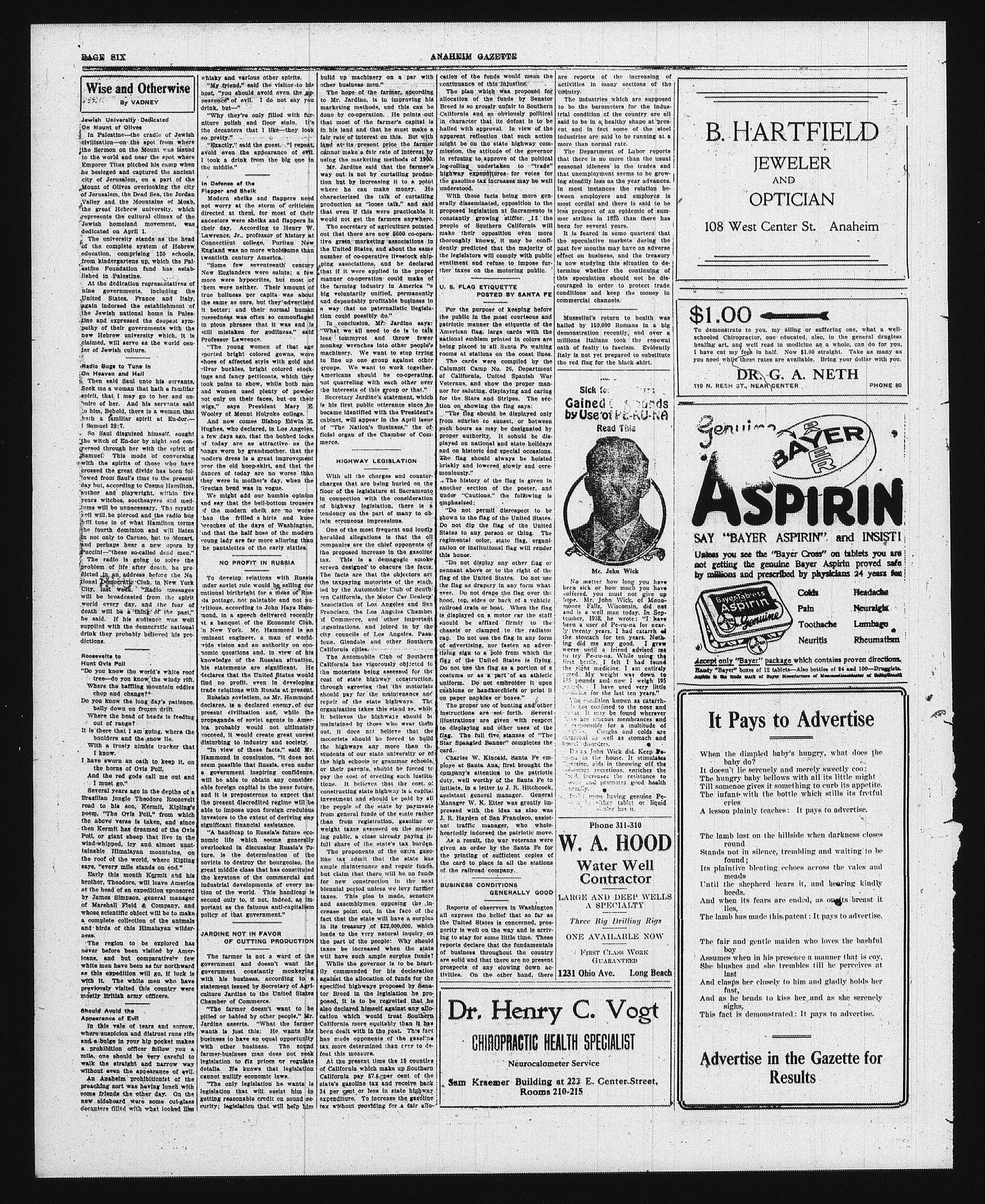
Searchable text
Wise and Otherwise
By VADNEY
Jewish University Dedicated
On Mount of Olives
In Palestine—the cradle of Jewish civilization—on the spot from where the Sermon on the Mount was issued to the world and near the spot where Emporer Titus pitched his camp when he besieged and captured the ancient city of Jerusalem, on a part of the Mount of Olives overlooking the city of Jerusalem, the Dead Sea, the Jordan Valley and the Mountains of Moab, the great Hebrew university, which represents the cultural climax of the Jewish homeland movement, was dedicated on April 1.
The university stands as the head of the complete system of Hebrew education, comprising 120 schools, from kindergartens up, which the Palestine Foundation fund has established in Palestine.
At the dedication representatives of nine governments, including the United States, France and Italy, again indorsed the establishment of the Jewish national home in Palestine and expressed the deepest sympathy of their governments with the new Hebrew university which, it is claimed, will serve as the world center of Jewish culture.
Radio Bugs to Tune In
On Heaven and Hell
Then said Saul unto his servants, Seek me a woman that hath a familiar spirit, that I may go to her and enquire of her. And his servants said to him, Behold, there is a woman that hath a familiar spirit at En-dor.—I Samuel 28:7.
So Saul disguised himself, sought the witch of En-dor by night and conversed through her with the spirit of whisky and various other spirits.
"My friend," said the visitor-to-his host, "you should avoid even the appearance of evil. I do not say you drink, but—"
"Why they're only filled with furniture polish and floor stain. It's the decanters that I like—they look so pretty."
"Exactly," said the guest. "I repeat, avoid even the appearance of evil. I took a drink from the big one in the middle."
In Defense of the Flapper and Sheik
Modern sheiks and flappers need not worry at the storm of criticism directed at them, for most of their ancestors were sheiks and flappers in their day. According to Henry W. Lawrence, Jr., professor of history at Connecticut college, Puritan New England was no more wholesome than twentieth century America.
"Some few seventeenth century New Englanders were saints; a few more were hypocrites, but most of them were neither. Their amount of true holiness per capita was about the same as ours, but they advertised it better; and their normal human cussness was often so camouflaged in pious phrases that it was and is still mistaken for godliness," said Professor Lawrence.
"The young women of that age sported bright colored gowns, wore shoes of affected style with gold and silver buckles, bright colored stockings and fancy petticoats, which they took pains to show, while both men and women used plenty of powder not only on their faces, but on their wigs," says President Mary E. Wooley of Mount Holyoke college.
And now comes Bishop Edwin E. Hughes, who declared, in Los Angeles, a few days ago, that the bobbed locks of today are as attractive as the build up machinery other businessmen.
The hope of Mr. Jardine, marketing method done by co-operators that most of them in his land and fair rate of interest land at its present cannot make a firing using the market.
Mr. Jardine's way out is not intention but by incarnation where he can characterize this production as "that even if this would not get to it."
The secretary out that there are live grain markets in the United States number of co-op associations that if it were a manner co-operate with farming in big voluntarily and dependably a way that no intention could possibly be found.
In conclusion, "What we all need less tommyrot monkay wrench machinery. We to line up one group. We want Americans shoot not quarreling with the interests of Secretary Jardine is his first public became identified cabinet, will apply to "The National financial organ of mercer."
Radio Bugs to Tune In
On Heaven and Hell
Then said Saul unto his servants,
Seek me a woman that hath a familiar spirit,
that I may go to her and enquire of her.
And his servants said to him, Behold, there is a woman that hath a familiar spirit at Endor—I Samuel 28:7.
So Saul disguised himself, sought the witch of Endor by night and conversed through her with the spirit of Samuel. This mode of conversing with the spirits of those who have crossed the great divide has been followed from Saul's time to the present day but, according to Cosmo Hamilton, author and playwright, within five years witches, soothsayers and mediums will be unnecessary. The mystic will be pierced and the radio bug will tune in of what Hamilton terms the fourth dominion and will listen in not only to Caruso, but to Mozart, and perhaps hear a new opera by Puccini—"these so-called dead mon."
The radio is going to solve the problem of life after death, he predicted in an address before the National Democratic Club, in New York City, last week. "Radio messages will be broadcasted from the spirit world every day, and the fear of death will be a thing of the past," he said. If his audience was well supplied with the democratic national drink they probably believed his predictions.
Roosevelt to Hunt Ovis Poll
"Do you know the world's white rooftree—do you know the windy rift.
Where the baffling mountain eddies chop and change?"
Do you know the long day's patience, belly down on frozen drift.
Where the head of heads is feeding out of range?
It is there that I am going, where the boulders and the snow lie.
With a trusty nimble tracker that I know.
I have sworn an oath to keep it, on the horns of Ovis Poll.
And the red gods call me out and I must go."
Several years ago in the depths of a Brazilian jungle Theodore Roosevelt read to his son, Kermit, Kipling's poem, "The Ovis Poll," from which the above verse is taken, and since then Kermit has dreamed of the Ovis Poll, or giant sheep that live in the wind-whipped, icey and almost unnatural landscape.
To develop relations with Russia under Soviet rule would be selling our national birthright for a mess of Russia potage, not palatable and not nutritious, according to John Hays Hammond, in a speech delivered recently at a banquet of the Economic Club, in New York. Mr. Hammond is an eminent engineer, a man of worldwide vision and an authority on economic questions and, in view of his knowledge of the Russian situation, his statements are significant. He declares that the United States would find no profit, even in developing trade relations with Russia at present.
Russian sovietism, as Mr. Hammond declares, is a declared enemy of our present civilization and, while the propaganda of soviet agents in America probably would not ultimately succeed, it would create great unrest disturbing to industry and society.
In view of these facts," said Mr. Hammond in conclusion, "it does not seem possible that Russia, even under a government inspiring confidence, will be able to obtain any considerable foreign capital in the near future, and it is preposterous to expect that the present discredited regime will be able to impose upon foreign credulous investors to the extent of deriving any significant financial assistance.
"A handicap to Russia's future economic life which seems generally overlooked in discussing Russia's future reported bright colored gowns, wore shoes of affected style with gold and silver buckles, bright colored stockings and fancy petticoats, which they took paints to show, while both men and women used plenty of powder not only on their faces, but on their wigs," says President Mary E. Wooley of Mount Holyoke college.
And now comes Bishop Edwin E. Hughes, who declared, in Los Angeles, a few days ago, that theobbed locks of today are as attractive as the hangs worn by grandmother, that the modern dress is a great improvement over the old hoop-skirt, and that the dances of today are no worse than they were in mother's day, when the Grecian bend was in vogue.
We might add our humble opinion and say that the bell-bottom trousers of the modern sheik are no worse than the frilled s hirts and knee breeches of the days of Washington, and that the half hose of the modern young lady are far more alluring than the pantalettes of the early sixties.
NO PROFIT IN RUSSIA
To develop relations with Russia under Soviet rule would be selling our national birthright for a mess of Russia potage, not palatable and not nutritious, according to John Hays Hammond, in a speech delivered recently at a banquet of the Economic Club, in New York. Mr. Hammond is an eminent engineer, a man of worldwide vision and an authority on economic questions and, in view of his knowledge of the Russian situation, his statements are significant. He declares that the United States would find no profit, even in developing trade relations with Russia at present.
Russian sovietism, as Mr. Hammond declares, is a declared enemy of our present civilization and, while the propaganda of soviet agents in America probably would not ultimately succeed, it would create great unrest disturbing to industry and society.
In view of these facts," said Mr. Hammond in conclusion, "it does not seem possible that Russia, even under a government inspiring confidence, will be able to obtain any considerable foreign capital in the near future, and it is preposterous to expect that the present discredited regime will be able to impose upon foreign credulous investors to the extent of deriving any significant financial assistance.
"A handicap to Russia's future economic life which seems generally overlooked in discussing Russia's futur
I have sworn an oath to keep it, on the horns of Ovis Poll,
And the red gods call me out and I must go."
Several years ago in the depths of a Brazilian jungle Theodore Roosevelt read to his son, Kermit, Kipling's poem, "The Ovis Poll," from which the above verse is taken, and since then Kermit has dreamed of the Ovis Poll, or giant sheep that live in the wind-whipped, icy and almost unattainable Himalayan mountains, on the roof of the world, where Kipling says, "every mile stands on end."
Early this month Kermit and his brother, Theodore, will leave America at the head of an expedition sponsored by James Simpson, general manager of Marshall Field & Company, and whose scientific object will be to make a complete collection of the animals and birds of this Himalayan wilderness.
The region to be explored has never before been visited by Americans, and but comparatively few white men have been as far northward as this expedition will go, if luck is with it. The white men who have previously visited this country were mostly British army officers.
Should Avoid the Appearance of Evil
In this vale of tears and sorrow, where suspicion and distrust runs rife and a bulge in your hip pocket makes a prohibition officer follow you a mile, one should be very careful to walk the straight and narrow way without even the appearance of evil.
An Anaheim prohibitionist of the preaching sort was having lunch with some friends the other day. On the new sideboard were some cut-glass decanters filled with what looked like Hammond in conclusion, "It does not seem possible that Russia, even under a government inspiring confidence, will be able to obtain any considerable foreign capital in the near future, and it is preposterous to expect that the present discredited regime will be able to impose upon foreign credulous investors to the extent of deriving any significant financial assistance.
"A handicap to Russia's future economic life which seems generally overlooked in discussing Russia's future, is the determination of the soviets to destroy the bourgeoisie, the great middle class that has constituted the keystone of the commercial and industrial developments of every nation of the world. This handicap is second only to, if not indeed, as important as the fatuous anti-capitalism policy of that government."
JARDINE NOT IN FAVOR OF CUTTING PRODUCTION
The farmer is not a ward of the government and doesn't want the government constantly monkeying with his business, according to a statement issued by Secretary of Agriculture Jardine to the United States Chamber of Commerce.
"The farmer doesn't want to be pitted or babied by other people," Mr. Jardine asserts. "What the farmer wants is just this: He wants his business to have an equal opportunity with other business. The sound farmer-business man does not seek legislation to fix prices or regulate details. He knows that legislation cannot nullify economic laws.
"The only legislation he wants is legislation that will assist him in getting reasonable credit on sound security; legislation that will help him..."
build up machinery on a par with other business men."
The hope of the farmer, according to Mr. Jardine, is in improving his marketing methods, and this can be done by co-operation. He points out that most of the farmer's capital is in his land and that he must make a fair rate of interest on this. But with land at its present price the farmer cannot make a fair rate of interest by using the marketing methods of 1900.
Mr. Jardine said that the farmer's way out is not by curtailing production but by increasing it to a point where he can make money. He characterized the talk of curtailing production as "loose talk," and said that even if this were practicable it would not get the farmers anywhere.
The secretary of agriculture pointed out that there are now 5000 co-operative grain marketing associations in the United States, and about the same number of co-operative livestock shipping associations, and he declared that if it were applied in the proper manner co-operation could make of the farming industry in America "a big voluntarily unified, permanently and dependably profitable business in a way that no paternalistic legislation could possibly do."
In conclusion, Mr. Jardine says: "What we all need to do is to talk less tommyrot and throw fewer monkey wrenches into other people's machinery. We want to stop trying to line up one group against other groups. We want to work together. Americans should be co-operating, not quarreling with each other over the interests of this group or that."
Secretary Jardine's statement, which is his first public utterance since he became identified with the President's cabinet, will appear in the April issue of "The Nation's Business," the official organ of the Chamber of Commerce.
The plan which was proposed for allocation of the funds by Senator Breed is so grossly unfair to Southern California and so obviously political in character that its defeat is to be hailed with approval. In view of the apparent reflection that such action might be on the state highway commission, the attitude of the governor in refusing to approve of the political log-rolling undertaken to "trade" highway expenditures for votes for the gasoline tax increases may be well understood.
With these facts being more generally disseminated, opposition to the proposed legislation at Sacramento is constantly growing stiffer. If the people of Southern California will make their opposition even more thoroughly known, it may be confidently predicted that the majority of the legislators will comply with public sentiment and refuse to impose further taxes on the motoring public.
U.S. FLAG ETIQUETTE
POSTED BY SANTA FE
For the purpose of keeping before the public in the most courteous and patriotic manner the etiquette of the American flag, large cards with the national emblem printed in colors are being placed in all Santa Fe waiting rooms at stations on the coast lines.
The cards were compiled by the Calumpit Camp No. 26, Department of California, United Spanish War Veterans, and show the proper manner for saluting, displaying and caring for the Stars and stripes. The section on showing the flag says:
"The flag should be displayed only from sunrise to sunset, or between such hours as may be designated by proper authority. It should be displayed on national and state holidays are reports of the increasing of activities in many sections of the country.
The industries which are supposed to be the barometers for the industrial condition of the country are all said to be in a healthy shape at present and in fact some of the steel industries are said to be running at a more than normal rate.
The Department of Labor reports that there is no more than the usual seasonal idleness in the trades and that unemployment seems to be growing steadily less as the year advances. In most instances the relation between employers and employees is most cordial and there is said to be less prospect of an epidemic of summer strikes in 1925 than there has been for several years.
It is feared in some quarters that the speculative markets during the past few months may have an adverse effect on business, and the treasury is now studying this situation to determine whether the continuing of this speculation should not be discouraged in order to protect trade conditions and keep the money in commercial channels.
Mussolini's return to health was hailed by 150,000 Romans in a big demonstration recently, and over a millions Italians took the renewal oath of fealty to fascism. Evidently Italy is not yet prepared to substitute the red flag for the black shirt."
HIGHWAY LEGISLATION
With all the charges and countercharges that are being hurled on the floor of the legislature at Sacramento, in connection with the consideration of highway legislation, there is a tendency on the part of many to obtain erroneous impressions.
One of the most frequent and loudly heralded allegations is that the oil companies are the chief opponents of the proposed increase in the gasoline tax. This is a demagogic smoke screen designed to obscure the facts. The facts are that the objectors are the taxpaying motorists of the state, led by the Automobile Club of Southern California, the Motor Car Dealers Association of Los Angeles and San Francisco, the Los Angeles Chamber of Commerce, and other important organizations, and joined in by the city councils of Los Angeles, Pasadena, Glendale and other Southern California cities.
The Automobile Club of Southern California has vigorously objected to the motorists being assessed for the cost of state highway construction, through agreeing that the motorists should pay for the maintenance and repair of the state highways. The organization takes this stand as, while it believes the highways should be maintained by those who wear them out, it does not believe that the motorists should be forced to build the highways any more than the students of our state university or of the high schools or grammar schools, or their parents, should be forced to pay the cost of erecting such institutions. It believes that the cost of constructing state highway is a capital investment and should be paid by all the people of the state by payments from general funds of the state rather than from registration, gasoline or weight taxes assessed on the motorizing public, a class already paying full share of the state's tax burden.
Secretary Jardine's statement, which is his first public utterance since he became identified with the President's cabinet, will appear in the April issue of "The Nation's Business," the official organ of the Chamber of Commerce.
HIGHWAY LEGISLATION
The cards were compiled by the Calumpit Camp No. 26, Department of California, United Spanish War Veterans, and show the proper manner for saluting, displaying and caring for the Stars and Stripes. The section on showing the flag says:
"The flag should be displayed only from sunrise to sunset, or between such hours as may be designated by proper authority. It should be displayed on national and state holidays and on historic and special occasions. The flag should always be hoisted briskly and lowered slowly and ceremoniously."
The history of the flag is given in another section of the poster, and under "Cautions," the following is emphasized:
"Do not permit disrespect to be shown to the flag of the United States. Do not dip the flag of the United States to any person or thing. The regimental color, state flag, organization or institutional flag will render this honor.
"Do not display any other flag or pennant above or to the right of the flag of the United States. Do not use the flag as drapery in any form whatever. Do not drape the flag over the hood, top, sides or back of a vehicle railroad train or boat. When the flag is displayed on a motor car the staff should be affixed firmly to the chassis or clamped to the radiator cap. Do not use the flag in any form of advertising, nor fasten an advertisement sign to a pole from which the flag of the United States is flying. Do not use the flag as a portion of a costume or as a part of an athletic uniform. Do not embroider it upon cushions or handkerchiefs or print it on paper napkins or boxes."
The proper use of bunting and other instructions are set forth. Several illustrations are given with respect to displaying and other uses of the flag. The full five stanzas of "The Star Spangled Banner" completes the card.
Charles W. Kincaid, Santa Fe employee at Santa Ana, first brought the company's attention to the patriotic duty, well worthy of the Santa Fe to initiate, in a letter to J. R. Hitchcock, assistant general manager. General Manager W. K. Etter was greatly impressed with the idea as also was J. R. Hayden of San Francisco, assistant traffic manager, who wholeheartedly indented the patriotic move.
As a result, the war veterans were given an order by the Santa Fe for Italy is not yet prepared to substitute the red flag for the black shirt.
Mr. John Wick
No matter how long you have been sick or how much you have suffered, you must not give up hope. Mr. John Wick, of Monomoe Falls, Wisconsin, did not and is a well man today. In September, 1918, he wrote: "I have been a user of Pe-ru-na for nearly twenty years. I had catarrh at the stomach for ten years. Nothing did me any good. I grew worse until a friend advised me to try Pe-ru-na. While using the first bottle, I felt I had found the right medicine. I am entirely tired. My weight was down to 155 pounds and now I weigh 195 pounds. I have used very little medicine for the last ten years."
The condition known as catarrh has not confined to the nose and throat. It may be found wherever bile are mucous membranes and responsible for a multitude of coughs and colds are material as well as stomach and bowel disorders.
Do as John Wick did. Keep Pe-ru-na in the house. It stimulates infection, aids in throwing off the colonic secretions, enriches the blood increases resistance to fever and promotes good health overall.
In addition having genuine Pe-ru-na either tablet or liquid container has it.
Phone 311-310
W. A. HOOD
Audacity of our state is particularly the high schools or grammar schools, or their parents, should be forced to pay the cost of erecting such institutions. It believes that the cost of constructing state highway is a capital investment and should be paid by all the people of the state by payments from general funds of the state rather than from registration, gasoline or weight taxes assessed on the motor-ing public, a class already paying its full share of the state's tax burden.
The proponents of the extra gasoline tax admit that the state has ample maintenance and repair funds, but claim that there will be no funds for new construction in the next biennial period unless we levy further taxes. This plea is made, senators and assemblymen opposing the increase point out, in the face of the fact that the state will have a surplus in its treasury of $22,000,000, which leads to the very natural inquiry on the part of the people: Why should taxes be increased when the state will have such ample surplus funds?
While the governor is to be heartily commended for his declaration against the allocation of funds for the specified highways proposed by Senator Breed in the legislation he proposed, it is to be regretted that he also declared himself against any allocation which would treat Southern California more equitably than it has been dealt with in the past. This fact has made opponents of the gasoline tax more determined than ever to defeat this measure.
At the present time the 18 counties of California which make up Southern California pay 57.5 per cent of the state's gasoline tax and receive back 34 per cent or less in state highway expenditure. To increase the gasoline tax without providing for a fair allowance at Santa Ana, first brought the company's attention to the patriotic duty, well worthy of the Santa Fe to initiate, in a letter to J. R. Hitchcock, assistant general manager. General Manager W. K. Etter was greatly impressed with the idea as also was J. R. Hayden of San Francisco, assistant traffic manager, who whole-heartedly indorsed the patriotic move.
As a result, the war veterans were given an order by the Santa Fe for the printing of sufficient copies of the card to place in all the stations of the railroad company.
BUSINESS CONDITIONS
GENERALLY GOOD
Reports of observers in Washington all express the belief that so far as the United States is concerned, prosperity is well on the way and is arriving to stay for some little time. These reports declare that the fundamentals of business throughout the country are solid and that there are no present prospects of any slowing down activities. On the other hand, there
Dr. Henry C. Vogt
CHIROPRACTIC HEALTH SPECIALIST
Neurocalometer Service
Sam Kraemer Building at 222 E. Center Street,
Rooms 210-215
B. HARTFIELD
JEWELER
AND
OPTICIAN
108 West Center St. Anaheim
$1.00
To demonstrate to you, my ailing or suffering one, what a well-schooled Chiropractor, one educated, also, in the general drugless healing art, and well read in medicine as a whole, can do for you,
I have cut my flesh in half. Now $1.00 straight. Take as many as you need while these rates are available. Bring your dollar with you.
DR. G. A. NETH
110 N. RESH ST., NEAR CENTER
PHONE 80
Genuine BAYER ASPIRIN
SAY "BAYER ASPIRIN" and INSIST!
Unless you see the "Bayer Cross" on tablets you are not getting the genuine Bayer Aspirin proved safe by millions and prescribed by physicians 24 years ago.
Colds Headache
Pain Neuralgia
Toothache Lumbago
Neuritis Rheumatism
Accept only "Bayer" package which contains proven directions.
Handy "Bayer" boxes of 12 tablets—Also bottles of 24 and 100—Druggists.
It Pays to Advertise
When the dimpled baby's hungry, what does the baby do?
It doesn't lie serenely and merely sweetly coo;
The hungry baby bellows with all its little might
Till somenoe gives it something to curb its appetite.
The infant with the bottle which stills its fretful cries
A lesson plainly teaches: It pays to advertise.
The lamb lost on the hillside when darkness closes round
It doesn't lie serenely and merely sweetly coo;
The hungry baby bellows with all its little might
Till somenee gives it something to curb its appetite.
The infant with the bottle which stills its fretful cries
A lesson plainly teaches: It pays to advertise.
The lamb lost on the hillside when darkness closes round
Stands not in silence, trembling and waiting to be found;
Its plaintive bleating echoes across the vales and meads
Until the shepherd hears it, and hearing kindly heeds.
And when its fears are ended, as on its breast it lies,
The lamb has made this patent: It pays to advertise.
The fair and gentle maiden who loves the bashful boy
Assumes when in his presence a manner that is coy,
She blushes and she trembles till he perceives at last
And clasps her closely to him and gladly holds her fast,
And as he bends to kiss her and as she serenely sighs,
This fact is demonstrated: It pays to advertise.
Advertise in the Gazette for Results