anaheim-gazette 1925-02-26
Scanned page
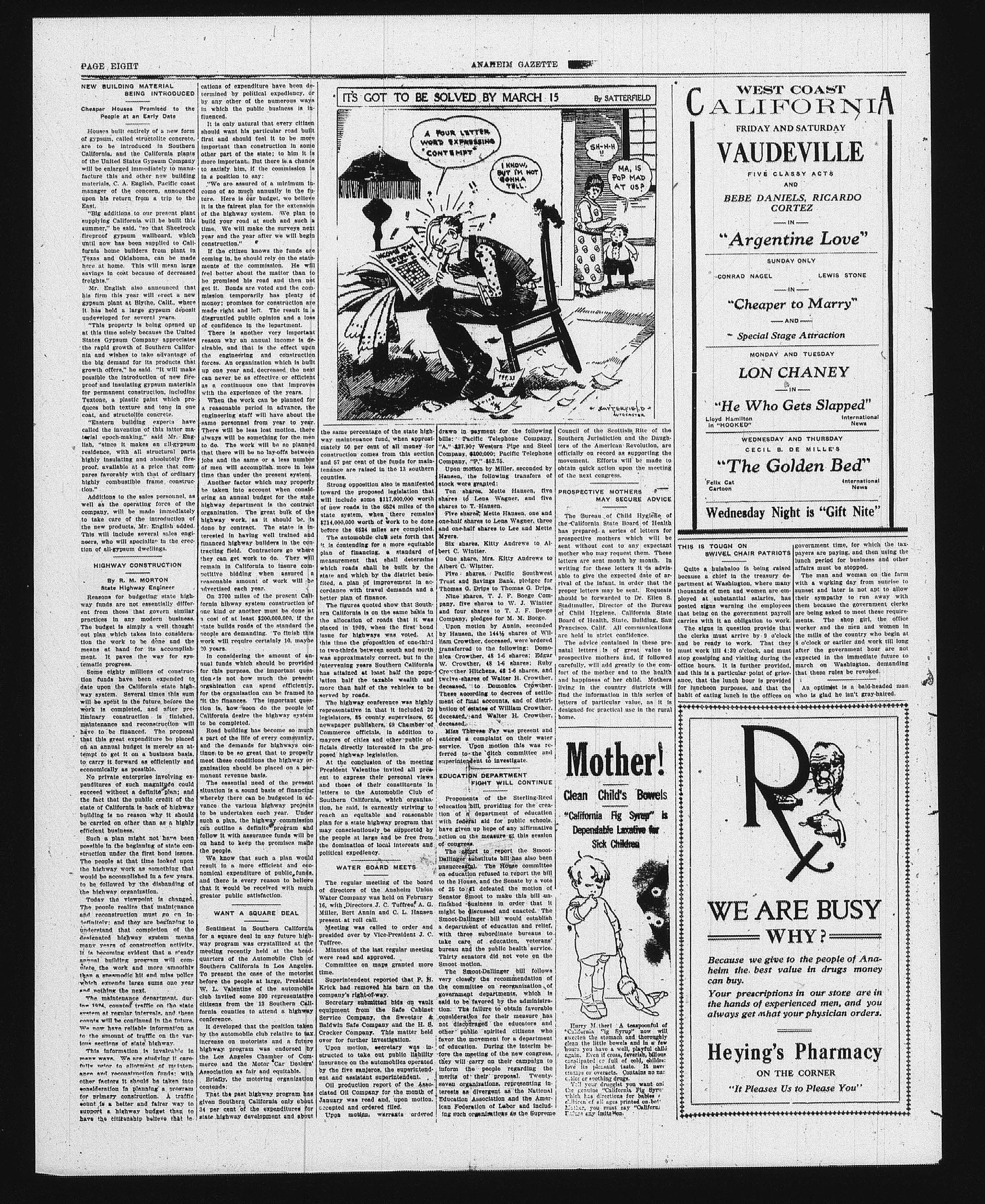
Searchable text
NEW BUILDING MATERIAL BEING INTRODUCED
Cheaper Houses Promised to the People at an Early Date
Houses built entirely of a new form of gypsum, called structolite concrete, are to be introduced in Southern California, and the California plants of the United States Gypsum Company will be enlarged immediately to manufacture this and other new building materials, C. A. English, Pacific coast manager of the concern, announced upon his return from a trip to the East.
"Big additions to our present plant supplying California will be built this summer," he said, "so that Sheetrock fireproof gypsum wallboard, which until now has been supplied to California home builders from plant in Texas and Oklahoma, can be made here at home. This will mean large savings in cost because of decreased freights."
Mr. English also announced that his firm this year will erect a new gypsum plant at Blythe, Calif., where it has held a large gypsum deposit undeveloped for several years.
"This property is being opened up at this time solely because the United States Gypsum Company appreciates the rapid growth of Southern California and wishes to take advantage of the big demand for its products that growth offers," he said. "It will make possible the introduction of new fireproof and insulating gypsum materials for permanent construction, including Textone, a plastic paint which produces both texture and tone in one coat, and structolite concrete.
"Eastern building experts have called the invention of this latter material epoch-making," said Mr. English, "since it makes an all-gypsum cations of expenditure have been determined by political expediency, or by any other of the numerous ways in which the public business is influenced.
It is only natural that every citizen should want his particular road built first and should feel it to be more important than construction in some other part of the state; to him it is more important. But there is a chance to satisfy him, if the commission is in a position to say:
"We are assured of a minimum income of so much annually in the future. Here is our budget, we believe it is the fairest plan for the extension of the highway system. We plan to build your road at such and such a time. We will make the surveys next year and the year after we will begin construction."
If the citizen knows the funds are coming in, he should rely on the statements of the commission. He will feel better about the matter than to be promised his road and then not get it. Bonds are voted and the commission temporarily has plenty of money; promises for construction are made right and left. The result in a disgruntled public opinion and a loss of confidence in the department.
There is another very important reason why an annual income is desirable, and that is the effect upon the engineering and construction forces. An organization which is built up one year and decreased the next can never be as effective or efficient as a continuous one that improves with the experience of the years.
When the work can be planned for a reasonable period in advance, the engineering staff will have about the same personnel from year to year. There will be less lost motion, there always will be something for the men to do. The work will be so planned
HIGHWAY CONSTRUCTION
By R. M. MORTON
State Highway Engineer
Reasons for budgeting state highway funds are not essentially different from those that govern similar practices in any modern business. The budget is simply a well thought out plan which takes into consideration the work to be done and the means at hand for its accomplishment. It paves the way for systematic progress.
Some eighty millions of construction funds have been expended to date upon the California state highway system. Several times this sum will be spent in the future before the work is completed, and after preliminary construction is finished, maintenance and reconstruction will have to be financed. The proposal that this great expenditure be placed on an annual budget is merely an attempt to get it on a business basis, to carry it forward as efficiently and economically as possible.
No private enterprise involving expenditures of such magnitude could succeed without a definite plan; and the fact that the public credit of the state of California is back of highway building is no reason why it should be carried on other than as a highly efficient business.
Such a plan might not have been possible in the beginning of state conlusion and wishes to take advantage of the big demand for its products that growth offers," he said. "It will make possible the introduction of new fire-proof and insulating gypsum materials for permanent construction, including Textone, a plastic paint which produces both texture and tone in one coat, and structolite concrete.
"Eastern building experts have called the invention of this latter material epoch-making," said Mr. English, "since it makes an all-gypsum residence, with all structural parts highly insulating and absolutely fire-proof, available at a price that compares favorably with that of ordinary highly combustible frame construction."
Additions to the sales personnel, as well as the operating force of the company, will be made immediately to take care of the introduction of the new products, Mr. English added. This will include several sales engineers, who will specialize in the erection of all-gypsum dwellings.
Another factor which may properly be taken into account when considering an annual budget for the state highway department is the contract organization. The great bulk of the highway work, as it should be, is done by contract. The state is interested in having well trained and financed highway builders in the contracting field. Contractors go where they can get work to do. They will remain in California to insure competitive bidding when assured a reasonable amount of work will be advertised each year.
On 3700 miles of the present California highway system construction of one kind or another must be done at a cost of at least $200,000,000, if the state builds roads of the standard the people are demanding. To finish this work will require certainly 10, maybe 20 years.
In considering the amount of annual funds which should be provided for this purpose, the important question is not how much the present organization can spend efficiently, for the organization can be framed to fit the finances. The important question is, how soon do the people of California desire the highway system to be completed.
Road building has become so much a part of the life of every community, and the demands for highways continue to be so great that to properly meet these conditions the highway organisation should be placed on a permanent revenue basis.
The essential need of the present situation is a sound basis of financing whereby there can be budgeted in advance the various highway projects to be undertaken each year. Under such a plan, the highway commission can outline a definite program and follow it with assurance funds will be on hand to keep the promises made by the same percentage way maintenance mately 50 per cent construction cost and 57 per cent tenance are raised counties.
Strong opposition toward the proposed new roads in state system, $214,000,000 worth before the 65244.
The automobile it is contending plan of finance measurement to which roads share state and which fitted, a plan of cordance with the better plan of fixtures.
The figures quern California is the allocation placed in 1909, issue for higher this time the price to two-thirds below was approximate intervening year has attained atation half the more than half served by roads.
The highway representative in legislators, 85 c newspaper public Commerce office mayors of cities ficials directly posed highway l.
At the conclusion President Valentien ent to express and those of letters to the Southern California he said, is reach an equiv plan for a state may conscientiousize the people at la domination
No private enterprise involving expenditures of such magnitude could succeed without a definite plan; and the fact that the public credit of the state of California is back of highway building is no reason why it should be carried on other than as a highly efficient business.
Such a plan might not have been possible in the beginning of state construction under the first bond issues. The people at that time looked upon the highway work as something that would be accomplished in a few years, to be followed by the disbanding of the highway organization.
Today the viewpoint is changed. The people realize that maintenance and reconstruction must go on indefinitely; and they are beginning to understand that completion of the designated highway system means many years of construction activity. It is becoming evident that a steady annual building program will complete the work and more smoothly than a snazodic hit and miss policy which extends large sums one year and nothing the next.
The maintenance department, during 1944, counted traffic on the state system at regular intervals, and these counts will be continued in the future. We now have reliable information as to the amount of traffic on the various sections of state highway.
This information is invaluable in many ways. We are studying it carefully prior to allotment of maintenance and reconstruction funds; with other factors it should be taken into consideration in planning a program for primary construction. A traffic count is a better and fairer way to support a highway budget than to have the citizenship believe that le-
The essential need of the present situation is a sound basis of financing whereby there can be budgeted in advance the various highway projects to be undertaken each year. Under such a plan, the highway commission can outline a definite program and follow it with assurance funds will be on hand to keep the promises made the people.
We know that such a plan would result in a more efficient and economical expenditure of public funds, and there is every reason to believe that it would be received with much greater public satisfaction.
WANT A SQUARE DEAL
Sentiment in Southern California for a square deal in any future highway program was crystallized at the meeting recently held at the headquarters of the Automobile Club of Southern California in Los Angeles. To present the case of the motorist before the people at large, President W. L. Valentine of the automobile club invited some 300 representative citizens from the 13 Southern California counties to attend a highway conference.
It developed that the position taken by the automobile club relative to tax increase on motorists and a future highway program was endorsed by the Los Angeles Chamber of Commerce and the Motor Car Dealers' Association as fair and equitable.
Briefly, the motoring organization contends:
That the past highway program has given Southern California only about 34 per cent of the expenditures for state highway development and about
IT'S GOT TO BE SOLVED BY MARCH 15 By SATTERFIELD
A FOUR LETTER WORD EXPRESSING CONTEMPT
I KNOW, BUT I'M NOT GOING TELL.
SH-H-H!!
MA, IS POP MAD AT USP?
SATTERFIELD AUTOSTER
the same percentage of the state highway maintenance fund, when approximately 50 per cent of all money for drawn in payment for the following bills: Pacific Telephone Company, "A." $27.90; Western Pipe and Steel Council of the Scottish Rite of the Southern Jurisdiction and the Daughters of the American Revolution, are
the same percentage of the state highway maintenance fund, when approximately 50 per cent of all money for construction comes from this section and 57 per cent of the funds for maintenance are raised in the 13 southern counties.
Strong opposition also is manifested toward the proposed legislation that will include some $117,000,000 worth of new roads in the 6524 miles of the state system, when there remains $214,000,000 worth of work to be done before the 6524 miles are completed.
The automobile club sets forth that it is contending for a more equitable plan of financing, a standard of measurement that shall determine which roads shall be built by the state and which by the district benefited, a plan of improvement in accordance with travel demands and a better plan of finance.
The figures quoted show that Southern California is on the same basis in the allocation of roads that it was placed in 1909, when the first bond issue for highways was voted. At this time the proposition of one-third to two-thirds between south and north was approximately correct, but in the intervening years Southern California has attained at least half the population half the taxable wealth and more than half of the vehicles to be served by roads.
The highway conference was highly representative in that it included 20 legislators, 85 county supervisors, 65 newspaper publishers, 69 Chamber of Commerce officials, in addition to mayors of cities and other public officials directly interested in the proposed highway legislation.
At the conclusion of the meeting President Valentine invited all present to express their personal views and those of their constituents in letters to the Automobile Club of Southern California, which organization, he said, is earnestly striving to reach an equitable and reasonable plan for a state highway program that may conscientiously be supported by the people at large and be free from the domination of local interests and drawn in payment for the following bills: Pacific Telephone Company, "A," $27.90; Western Pipe and Steel Company, $100,000; Pacific Telephone Company, "P," $52.75.
Upon motion by Miller, seconded by Hansen, the following transfers of stock were granted:
Ten shares, Mette Hansen, five shares to Lena Wagner, and five shares to T. Hansen.
Five shares, Mette Hansen, one and one-half shares to Lena Wagner, three and one-half shares to Lee and Mette Myers.
Six shares, Kitty Andrews to Albert C. Wintter.
One share, Mrs. Kitty Andrews to Albert C. Wintter.
Five shares, Pacific Southwest Trust and Savings Bank, pledged for Thomas G. Drips to Thomas G. Drips.
Nine shares, T. J. F. Boege Company, five shares to W. J. Wintter and four shares to T. J. F. Boege Company, pledged for M. M. Boege.
Upon motion by Aminn, seconded by Hansen, the 144½ shares of William Crowther, deceased, were ordered transferred to the following: Domonica Crowther, 48 1-6 shares; Edgar W. Crowther, 48 1-6 shares; Ruby Crowther Hitchens, 48 1-6 shares, and twelve-shares of Walter H. Crowther, deceased, to Domonica Crowther.
These according to decrees of settlement of final accounts, and of distribution of estates of William Crowther, deceased, and Walter H. Crowther, deceased.
Miss Theresa Pay was present and entered a complaint on their water service. Upon motion this was referred to the ditch committee and superintendent to investigate.
EDUCATION DEPARTMENT
FIGHT WILL CONTINUE
Proponents of the Sterling-Reed education bill, providing for the creation of a department of education with federal aid for public schools, have given up hope of any affirmative action on the measure at this session of congress.
Council of the Scottish Rite of the Southern Jurisdiction and the Daughters of the American Revolution, are officially on record as supporting the movement. Efforts will be made to obtain quick action upon the meeting of the next congress.
PROSPECTIVE MOTHERS
MAY SECURE ADVICE
The Bureau of Child Hygiene of the California State Board of Health has prepared a series of letters for prospective mothers which will be sent without cost to any expectant mother who may request them. These letters are sent month by month. In writing for these letters it is advisable to give the expected date of arrival of the infant, in order that the proper letters may be sent. Requests should be forwarded to Dr. Ellen S. Stadtmuller, Director of the Bureau of Child Hygiene, California State Board of Health, State Building, San Francisco, Calif. All communications are held in strict confidence.
The advice contained in these prenatal letters is of great value to prospective mothers and if followed carefully, will add greatly to the comfort of the mother and to the health and happiness of her child. Mothers living in the country districts will find the information in this series of letters of particular value, as it is designed for practical use in the rural home.
Mother!
Clean Child's Bowels
"California Fig Syrup" is Dependable Laxative for Sick Children
At the conclusion of the meeting President Valentine invited all present to express their personal views and those of their constituents in letters to the Automobile Club of Southern California, which organization, he said, is earnestly striving to reach an equitable and reasonable plan for a state highway program that may conscientiously be supported by the people at large and be free from the domination of local interests and political expediency.
WATER BOARD MEETS
The regular meeting of the board of directors of the Anaheim Union Water Company was held on February 16, with Directors J. C. Tuffree, A. G. Miller, Bert Annin and C. L. Hansen present at roll call.
Meeting was called to order and presided over by Vice-President J. C. Tuffree.
Minutes of the last regular meeting were read and approved.
Committee on maps granted more time.
Superintendent reported that P. H. Krick had removed his barn on the company's right-of-way.
Secretary submitted bids on vault equipment from the Safe Cabinet Service Company, the Sweetser & Baldwin Safe Company and the H. S. Crocker Company. This matter held over for further investigation.
Upon motion, secretary was instructed to take out public liability insurance on the automobiles operated by the five sanjeros, the superintendent and assistant superintendent.
Oil production report of the Associated Oil Company for the month of January was read and, upon motion, accepted and ordered filed.
Upon motion, warrants ordered
EDUCATION DEPARTMENT FIGHT WILL CONTINUE
Proponents of the Sterling-Reed education bill, providing for the creation of a department of education with federal aid for public schools, have given up hope of any affirmative action on the measure at this session of congress.
The effort to report the Smoot-Dallinger substitute bill has also been unsuccessful. The House committee on education refused to report the bill to the House, and the Senate by a vote of 25 to 41 defeated the motion of Senator Smoot to make this bill unfinished business in order that it might be discussed and enacted. The Smoot-Dallinger bill would establish a department of education and relief, with three subordinate bureaus to take care of education, veterans' bureau and the public health service. Thirty senators did not vote on the Smoot motion.
The Smoot-Dallinger bill follows very closely the recommendation of the committee on reorganization of government departments, which is said to be favored by the administration. The failure to obtain favorable consideration for their measure has not discouraged the educators and other public spirited citizens who favor the movement for a department of education. During the interim before the meeting of the new congress, they will carry on their campaign to inform the people regarding the merits of their proposal. Twenty-seven organizations, representing interests as divergent as the National Education Association and the American Federation of Labor and including such organizations as the Supreme
WEST COAST
CALIFORNIA
FRIDAY AND SATURDAY
VAUDEVILLE
FIVE CLASSY ACTS
AND
BEBE DANIELS, RICARDO
CORTEZ
IN
"Argentine Love"
SUNDAY ONLY
CONRAD NAGEL LEWIS STONE
IN
"Cheaper to Marry"
AND
Special Stage Attraction
MONDAY AND TUESDAY
LON CHANEY
IN
"He Who Gets Slapped"
Lloyd Hamilton International News
In "HOOKED"
WEDNESDAY AND THURSDAY
MONDAY AND TUESDAY
LON CHANEY
IN
"He Who Gets Slapped"
Lloyd Hamilton
in "HOOKED"
International News
WEDNESDAY AND THURSDAY
CECIL B. DE MILLE'S
"The Golden Bed"
Fellx Cat
Cartoon
International News
Wednesday Night is "Gift Nite"
THIS IS TOUGH ON
SWIVEL CHAIR PATRIOTS
Quite a hulabaloo is being raised because a chief in the treasury department at Washington, where many thousands of men and women are employed at substantial salaries, has posted signs warning the employees that being on the government payroll carries with it an obligation to work.
The signs in question provide that the clerks must arrive by 9 o'clock and be ready to work. That they must work till 4:30 o'clock, and must stop gossiping and visiting during the office hours. It is further provided, and this is a particular point of grievance, that the lunch hour is provided for luncheon purposes, and that the habit of eating lunch in the offices on government time, for which the taxpayers are paying, and then using the lunch period for business and other affairs must be stopped.
The man and woman on the farm with a working day from sunrise to sunset and later is not apt to allow their sympathy to run away with them because the government clerks are being asked to meet these requirements. The shop girl, the office worker and the men and women in the mills of the country who begin at 8 o'clock or earlier and work till long after the government hour are not expected in the immediate future to march on Washington, demanding that these rules be revoked.
An optimist is a bald-headed man who is glad he isn't gray-haired.
WE ARE BUSY
WHY?
Because we give to the people of Anaheim the best value in drugs money can buy.
Your prescriptions in our store are in the hands of experienced men, and you always get what your physician orders.
Heying's Pharmacy
ON THE CORNER
"It Pleases Us to Please You"