anaheim-gazette 1925-01-08
Scanned page
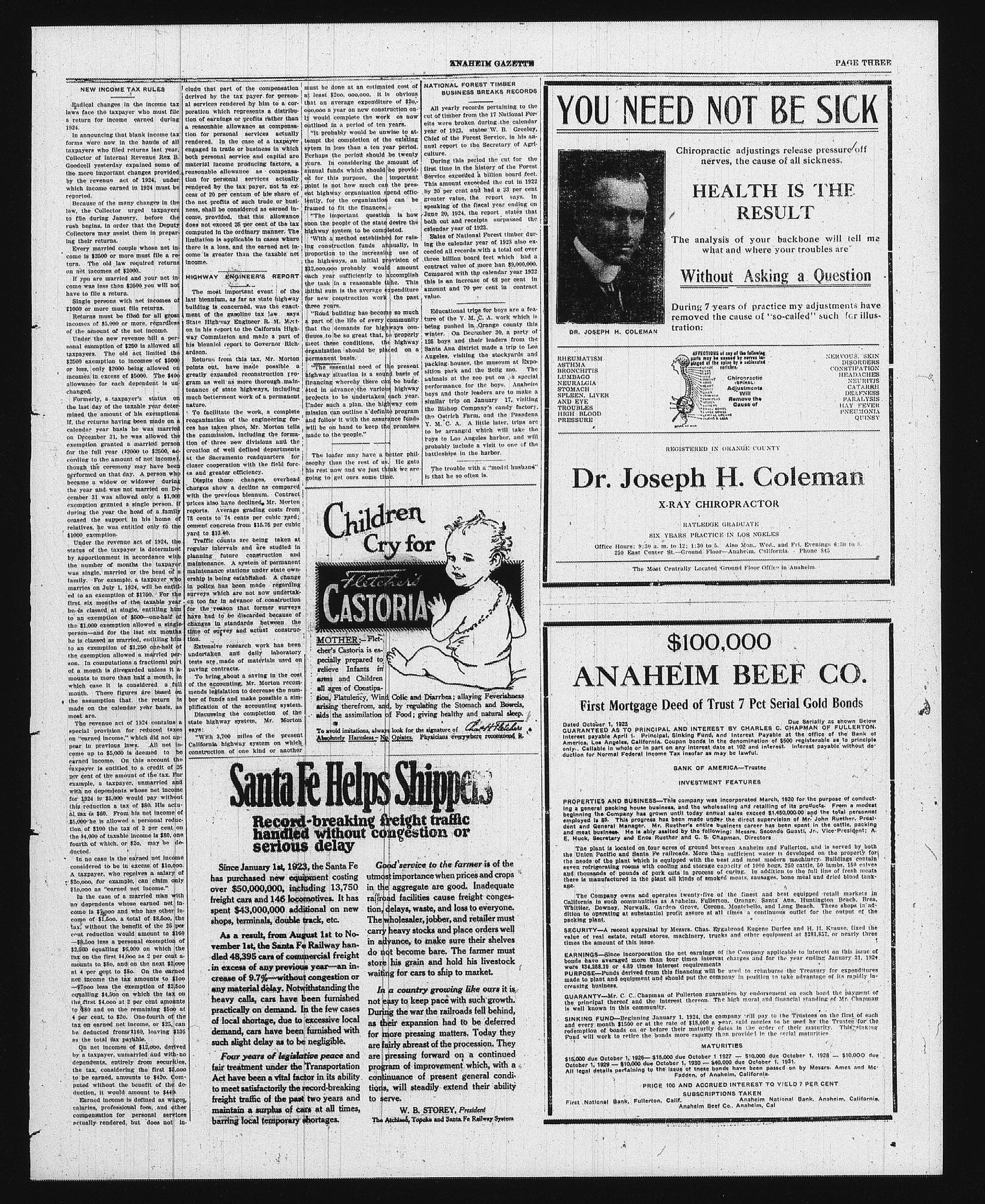
Searchable text
NEW INCOME TAX RULES
Radical changes in the income tax laws face the taxpayer who must file a return for income earned during 1924.
In announcing that blank income tax forms were now in the hands of all taxpayers who filed returns last year, Collector of Internal Revenue Rex B. Goodcell yesterday explained some of the more important changes provided by the revenue act of 1924, under which income earned in 1924 must be reported.
Because of the many changes in the law, the Collector urged taxpayers to file during January, before the rush begins, in order that the Deputy Collectors may assist them in preparing their returns.
Every married couple whose net income is $2500 or more must file a return. The old law required returns on net incomes of $2000.
If you are married and your net income was less than $2500 you will not have to file a return.
Single persons with net incomes of $1000 or more must file returns.
Returns must be filed for all gross incomes of $5,000 or more, regardless of the amount of the net income.
Under the new revenue bill a personal exemption of $250 is allowed all taxpayers. The old act limited the $2500 exemption to incomes of $5000 or less, only $2000 being allowed on incomes in excess of $5000. The $400 allowance for each dependent is unchanged.
Formerly, a taxpayer's status on the last day of the taxable year determined the amount of his exemptions. If, the returns having been made on a calendar year basis he was married on December 31, he was allowed the exemption granted a married person include that part of the compensation derived by the tax payer for personal services rendered by him to a corporation which represents a distribution of earnings or profits rather than a reasonable allowance as compensation for personal services actually rendered. In the case of a taxpayer engaged in trade or business in which both personal service and capital are material income producing factors, a reasonable allowance as compensation for personal services actually rendered by the tax payer, not in excess of 20 per centum of his share of the net profits of such trade or business, shall be considered as earned income, provided, that this allowance does not exceed 25 per cent of the tax computed in the ordinary manner. The limitation is applicable in cases where there is a loss, and the earned net income is greater than the taxable net income.
HIGHWAY ENGINEER'S REPORT
The most important event of the last biennium, as far as state highway building is concerned, was the enactment of the gasoline tax law says State Highway Engineer R. M. Morton in his report to the California Highway Commission and made a part of his blenniel report to Governor Richardson.
Returns from this tax, Mr. Morton points out, have made possible a greatly expanded reconstruction program as well as more thorough maintenance of state highways, including much betterment work of a permanent nature.
To facilitate the work, a complete reorganization of the engineering forces has taken place, Mr. Morton tells the commission, including the formation of three new divisions and the creation of well defined departments must be done at an altitude at least $200, 000,000 that an average expence 000,000 a year on newly would complete the outlined in a period "It probably would tempt the completion system in less than a Perhaps the period six years. In considering annual funds which are ed for this purpose, point is not how much highway organiz mentally, for the organ framed to fit the fin "The important o soon the people of the highway system to be With a method est ing construction fund proportion to the inthe highways, an init $12,000,000 probably each year sufficient the task in a reason initial sum is the ave for new construction three years.
"Road building has a part of the life of that the demands for flumes to be so great meet these condition organization should permanent basis."
"The essential need highway situation is financing whereby th eted in advance th e projects to be under Under such a plan, t mission can outline ad and follow it with th e will be on hand to k made to the people."
Formerly, a taxpayer's status on the last day of the taxable year determined the amount of his exemptions. If the returns having been made on a calendar year basis he was married on December 31, he was allowed the exemption granted a married person for the full year ($2000 to $2500, according to the amount of net income), though the ceremony may have been performed on that day. A person who became a widow or widower during the year and was not married on December 31 was allowed only a $1,000 exemption granted a single person. If during the year the head of a family ceased the support in his home of relatives, he was entitled only to the $1000 exemption.
Under the revenue act of 1924, the status of the taxpayer is determined by apportionment in accordance with the number of months the taxpayer was single, married or the head of a family. For example, a taxpayer who marries on July 1, 1924, will be entitled to an exemption of $1750. For the first six months of the taxable year he is classed at single, entitling him to an exemption of $500—one-half of the $1,000 exemption allowed a single person—and for the last six months he is classed as married, entitling him to an exemption of $1,250 one-half of the exemption allowed a married person. In computations a fractional part of a month is disregarded unless it amounts to more than half a month, in which case it is considered a full month. These figures are based on the assumption that the return is made on the calendar year basis, as most are.
The revenue act of 1924 contains a special provision for reduced taxes on "earned income," which did not appear in previous laws. All net income up to $5,000 is deemed to be earned income. On this account the taxpayer is entitled to a credit of 25 per cent of the amount of the tax. For example, a taxpayer, unmarried and with no dependents whose net income for 1924 is $5,000 would pay without this reduction a tax of $80. His actual tax is $60. From his net income of $5,000 he is allowed a personal reduction of $100 the tax of 2 per cent on the $4,000 of taxable income is $80, one fourth of which, or $20, may be de-
Returns from this tax, Mr. Morton points out, have made possible a greatly expanded reconstruction program as well as more thorough maintenance of state highways, including much betterment work of a permanent nature.
To facilitate the work, a complete reorganization of the engineering forces has taken place, Mr. Morton tells the commission, including the formation of three new divisions and the creation of well defined departments at the Sacramento headquarters for closer cooperation with the field forces and greater efficiency.
Dispite those changes, overhead charges show a decline as compared with the previous biennum. Contract prices also have declined, Mr. Morton reports. Average grading costs from 78 cents to 74 cents per cubic yard; cement concrete from $15.75 per cubic yard to $13.40.
Traffic counts are being taken at regular intervals and are studied in planning future construction and maintenance. A system of permanent maintenance stations under state ownership is being established. A change in policy has been made regarding surveys which are not now undertaken too far in advance of construction for the reason that former surveys have had to be discarded because of changes in standards between the time of survey and actual construction.
Extensive research work has been undertaken and daily laboratory tests are made of materials used on paving contracts.
To bring about a saving in the cost of the accounting, Mr. Morton recommends legislation to decrease the number of funds and make possible a simplification of the accounting system.
Discussing the completion of the state highway system, Mr. Morton says:
"With 3,700 miles of the present California highway system on which construction of one kind or another
earned income. On this account the taxpayer is entitled to a credit of 25 per cent of the amount of the tax. For example, a taxpayer, unmarried and with no dependents whose net income for 1924 is $5,000 would pay without this reduction a tax of $80. His actual tax is $80. From his net income of $5,000 he is allowed a personal reduction of $100 the tax of 2 per cent on the $4,000 of taxable income is $80, one fourth of which, or $20, may be deducted.
In no case is the earned net income considered to be in excess of $10,000. A taxpayer, who receives a salary of $20,000, for example, can claim only $10,000 as "earned net income."
In the case of a married man with no dependents whose earned net income is $2,000 and who has other income of $1,500, a total of $8,500, the tax without the benefit of the 25 per cent reduction would amount to $160—$8,500 less a personal exemption of $2,500 equalling $6,000 on which the tax on the first $4,000 as 2 per cent amounts to $80, and on the next $2,000 at 4 per cent to $80. On the earned net income the tax amounts to $100—$7,000 less the exemption of $2,500 equalling $4,500 on which the tax on the first $4,000 at 2 per cent amounts to $80 and on the remaining $500 at 4 per cent, to $2o. One-fourth of the tax on earned net income, or $25, can be deducted from $160, leaving $135 as the total tax payable.
On net incomes of $12,000, derived by a taxpayer, unmarried and with no dependents, entirely from securities, the tax considering the first $5,000 to be earned, amounts to $42o. Computed without the benefit of the deduction, it would amount to $44o.
Earned income is defined as wages, salaries, professional fees, and other compensation for personal services actually rendered, but does not include income.
Since January 1st, 1923, the Santa Fe has purchased new equipment costing over $50,000,000, including 13,750 freight cars and 146 locomotives. It has spent $43,000,000 additional on new shops, terminals, double track, etc.
As a result, from August 1st to November 1st, the Santa Fe Railway handled 48,395 cars of commercial freight in excess of any previous year—an increase of 9.7%—without congestion or any material delay. Notwithstanding the heavy calls, cars have been furnished practically on demand. In the few cases of local shortage, due to excessive local demand, cars have been furnished with such slight delay as to be negligible.
Four years of legislative peace and fair treatment under the Transportation Act have been a vital factor in its ability to meet satisfactorily the record-breaking freight traffic of the past two years and maintain a surplus of cars at all times, barring local temporary shortages.
NATIONAL FOREST TIMBER
BUSINESS BREAKS RECORDS
All yearly records pertaining to the cut of timber from the 17 National Forests were broken during the calendar year of 1923, states W. B. Greeley, Chief of the Forest Service, in his annual report to the Secretary of Agriculture.
During this period the cut for the first time in the history of the Forest Service exceeded a billion board feet. This amount exceeded the cut in 1922 by 20 per cent and had a 23 per cent greater value, the report says. In speaking of the fiscal year ending on June 20, 1924, the report states that both out and receipts surpassed the calendar year of 1923.
Sales of National Forest timber during the calendar year of 1923 also exceeded all records with a total oof over three billion board feet which had a contract value of more than $9,000,000. Compared with the calendar year 1922 this is an increase of 68 per cent in amount and 70 per cent in contract value.
Educational trips for boys are a feature of the Y. M. C. A. work which is being pushed in Orange county this winter. On December 30, a party of 125 boys and their leaders from the Santa Ana district made a trip to Los Angeles, visiting the stockyards and packing houses, the museum at Exposition park and the Sellg zoo. The animals at the zoo put on a special performance for the boys. Anaheim boys and their leaders are to make a similar trip on January 17, visiting the Bishop Company's candy factory, the Ostrich Farm, and the Pasadena Y. M. C. A. A little later, trips are to be arranged which will take the boys to Los Angeles harbor, and will probably include a visit to one of the
Must be done at an estimated cost of at least $200,000,000. It is obvious that an average expenditure of $20,000,000 a year on new construction only would complete the work os now outlined in a period of ten years.
"It probably would be unwise to attempt the completion of the existing system in less than a ten year period. Perhaps the period should be twenty years. In considering the amount of annual funds which should be provided for this purpose, the important point is not how much can the present highway organization spend efficiently, for the organization can be framed to fit the finances."
"The important question is how soon the people of the state desire the highway system to be completed.
With a method established for raising construction funds annually, in proportion to the increasing use of the highways, an initial provision of $12,000,000 probably would amount each year sufficiently to accomplish the task in a reasonable time. This initial sum is the average expenditure for new construction work the past three years.
"Road building has become so much a part of the life of every community that the demands for highways continue to be so great that, to properly meet these conditions, the highway organization should be placed on a permanent basis."
"The essential need of the present highway situation is a sound basis of financing whereby there can be budgeted in advance the various highway projects to be undertaken each year. Under such a plan, the highway commission can outline a definite program and follow it with the assurance funds will be on hand to keep the promises made to the people."
The essential need of the present highway situation is a sound basis of financing whereby there can be budgeted in advance the various highway projects to be undertaken each year. Under such a plan, the highway commission can outline a definite program and follow it with the assurance funds will be on hand to keep the promises made to the people."
The loafer may have a better philosophy than the rest of us. He gets his rest now and we just think we are going to get ours some time.
Angeles, visiting the stockyards and packing houses, the museum at Exposition park and the Sellig zoo. The animals at the zoo put on a special performance for the boys. Anaheim boys and their leaders are to make a similar trip on January 17, visiting the Bishop Company's candy factory, the Ostrich Farm, and the Pasadena Y. M. C. A. A little later, trips are to be arranged which will take the boys to Los Angeles harbor, and will probably include a visit to one of the battleships in the harbor.
The trouble with a "model husband" is that he so often is.
Children Cry for Fletcher's Castoria
MOTHER:—Fletcher's Castoria is especially prepared to relieve Infants in arms and Children all ages of Constipation, Flatulency, Wind Colic and Diarrhea; allaying Feverishness arising therefrom, and, by regulating the Stomach and Bowels, aids the assimilation of Food; giving healthy and natural sleep.
To avoid imitations, always look for the signature of Absolutely Harmless - No Opiates. Physicians everywhere recommend it.
Fe Helps Shippers
Hard-breaking freight traffic led without congestion or delay
1923, the Santa Fe equipment costing including 13,750 locomotives. It has additional on new cable track, etc.
August 1st to No. 1 Fe Railway hand-commercial freight previous year—an in-out congestion or notwithstanding the have been furnished. In the few cases to excessive local been furnished with to be negligible.
Relative peace and the Transportation factor in its ability the record-breaking past two years and of cars at all times,ary shortages.
Good service to the farmer is of the utmost importance when prices and crops in the aggregate are good. Inadequate railroad facilities cause freight congestion, delays, waste, and loss to everyone. The wholesaler, jobber, and retailer must carry heavy stocks and place orders well in advance, to make sure their shelves do not become bare. The farmer must store his grain and hold his livestock waiting for cars to ship to market.
In a country growing like ours it is not easy to keep pace with such growth. During the war the railroads fell behind, as their expansion had to be deferred for more pressing matters. Today they are fairly abreast of the procession. They are pressing forward on a continued program of improvement which, with a continuance of present general conditions, will steadily extend their ability to serve.
W. B. STOREY, President
The Atchison, Topeka and Santa Fe Railway System
NEED NOT BE SICK
Chiropractic adjustments release pressure off nerves, the cause of all sickness.
HEALTH IS THE RESULT
The analysis of your backbone will tell me what and where your troubles are
Without Asking a Question
During 7 years of practice my adjustments have removed the cause of "so-called" such illustration:
NERVOUS, SKIN
DISORDERS
CONSTIPATION
HEADACHES
NEURITIS
CATARRH
DEAFNESS
PARALYSIS
HAY FEVER
PNEUMONIA
QUINSY
REGISTERED IN ORANGE COUNTY
Joseph H. Coleman
X-RAY CHIROPRACTOR
RATLEDGE GRADUATE
SIX YEARS PRACTICE IN LOS ANGELES
Hours: 9:30 a.m. to 12; 1:30 to 5. Also Mon., Wed., and Fri. Evenings 6:30 to 8.
50 East Center St.—Ground Floor—Anaheim, California. Phone 845
The Most Centrally Located Ground Floor Office in Anaheim.
$100,000
WAHEIM BEEF CO.
Mortgage Deed of Trust 7 Pct Serial Gold Bonds
1923 Due Serially as shown Below
IS TO PRINCIPAL AND INTEREST BY CHARLES C. CHAPMAN OF FULLERTON.
April 1. Principal, Sinking Fund, and Interest Payable at the office of the Bank of Sales, California. Coupon bonds In the denomination of $500 registerable as to principle whole or in part on any interest date at 102 and interest. Interest payable without defederal Income Tax insofar as may be lawful.
BANK OF AMERICA—Trustee
INVESTMENT FEATURES
D BUSINESS—This company was incorporated March, 1920 for the purpose of conducting house business, and the wholesaling and retailing of its products. From a modest
company has grown until today annual sales exceed $1,450,000.00 and the total personnel
this progress has been made under the direct supervision of Mr. John Ruether, Presit Manager. Mr. Ruether's entire business career has been spent in the cattle, packing
He is ably assisted by the following: Messrs. Secondo Guasti, Jr., Vice-President; A.
y and Enos Ruether and C. S. Chapman, Directors
located on four acres of ground between Anaheim and Fullerton, and is served by both
BANK OF AMERICA—Trustee
INVESTMENT FEATURES
BANKED BUSINESS—This company was incorporated March, 1920 for the purpose of conducting house business, and the wholesaling and retailing of its products. From a modest company has grown until today annual sales exceed $1,450,000.00 and the total personnel this progress has been made under the direct supervision of Mr. John Ruether, President Manager. Mr. Ruether's entire business career has been spent in the cattle, packing industry. He is ably assisted by the following: Messrs. Secondo Guasti, Jr., Vice-President; A. Berry and Enos Ruether and C. S. Chapman, Directors.
Located on four acres of ground between Anaheim and Fullerton, and is served by both Anaheim and Santa Fe railroads. More than sufficient water is developed on the property for plant which is equipped with the best and most modern machinery. Buildings contain large rooms with cooling and storage capacity of 1000 hogs, 250 cattle, 50 lambs, 150 calves pounds of pork cuts in process of curing. In addition to the full line of fresh meats stored in the plant all kinds of smoked meats, sausages, bone meal and dried blood tank farms and operates twenty-five of the finest and best equipped retail markets in communities as Anaheim, Fullerton, Orange, Santa Ana, Huntington Beach, Brea, Norwalk, Garden Grove, Corona, Montebello, and Long Beach. These shops are at substantial profit assure at all times a continuous outlet for the output of the recent appraisal by Messrs. Chas. Eygabroad Eugene Durfee and H. H. Krause, fixed the rate, retail stores, machinery, trucks and other equipment at $281,857, or nearly three times of this issue.
The incorporation the net earnings of the Company applicable to interest on this issue of shares more than four times interest charges and for the year ending January 31, 1924 — 4.89 times interest requirements derived from this financing will be used to reimburse the Treasury for expenditures on equipment and should put the company in position to take advantage of its rapidly increasing C. C. Chapman of Fullerton guarantees by endorsement on each bond the payment of interest and the interest thereon. The high moral and financial standing of Mr. Chapman is this community.
Beginning January 1, 1924, the company will pay to the Trustees on the first of each $1500 or at the rate of $18,000 a year, said monies to be used by the Trustee for the bonds on or before their maturity dates in the order of their maturity. Thisinking to retire the bonds more rapidly than provided in the serial maturities.
MATURITIES
October 1, 1926 — $15,000 due October 1, 1927 — $10,000 due October 1, 1928 — $10,000 due October 1, 1930 — $40,000 due October 1, 1931.
Intertaining to the issue of these bonds have been passed on by Messrs. Ames and McFadden, of Anaheim, California.
PRICE 100 AND ACCRUED INTEREST TO YIELD 7 PERCENT
SUBSCRIPTIONS TAKEN
Bank, Fullerton, Calif.
Anaheim National Bank, Anaheim, California.
Anaheim Beef Co., Anaheim, Cali