anaheim-gazette 1924-09-18
Scanned page
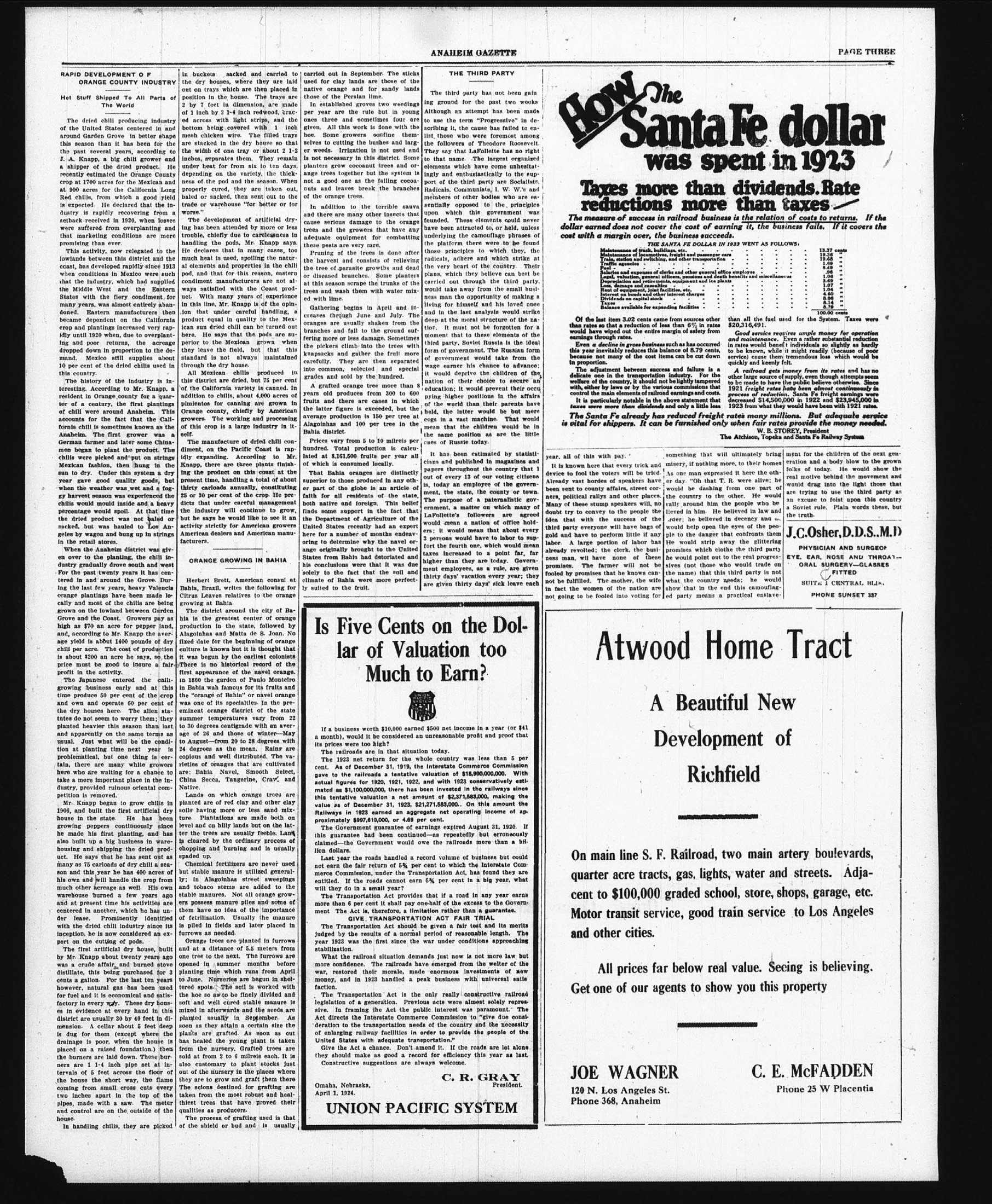
Searchable text
RAPID DEVELOPMENT OF ORANGE COUNTY INDUSTRY
Hot Stuff Shipped To All Parts of The World
The dried chili producing industry of the United States centered in and around Garden Grove in better shape this season than it has been for the past several years, according to J. A. Knapp, a big chill grower and a shipper of the dried product. He recently estimated the Orange County crop at 1700 acres for the Mexican and at 900 acres for the California Long Red chilis, from which a good yield is expected. He declared that the industry is rapidly recovering from a setback received in 1920, when losses were suffered from overplanting and that marketing conditions are more promising than ever.
This activity, now relegated to the lowlands between this district and the coast, has developed rapidly since 1913 when conditions in Mexico were such that the industry, which had supplied the Middle West and the Eastern States with the fiery condiment for many years, was almost entirely abandoned. Eastern manufacturers then became dependent on the California crop and plantings increased very rapidly until 1920 when, due to overplanting and poor returns, the acreage dropped down in proportion to the demand. Mexico still supplies about 10 per cent of the dried chilis used in this country.
The history of the industry is interesting. According to Mr. Knapp, a resident in Orange county for a quarter of a century, the first plantings of chili were around Anaheim. This accounts for the fact that the California chili is sometimes known as the Anaheim. The first grower was a German farmer and later some Chinese born to plant the product. The buckets sacked and carried to the dry houses, where they are laid out on trays which are then placed in position in the house. The trays are 2 by 7 feet in dimension, are made of 1 inch by 2 1-4 inch redwood, braced across with light strips, and the bottom being covered with 1 inch mesh chicken wire. The filled trays are stacked in the dry house so that the width of one tray or about 2 1-2 inches, separates them. They remain under heat for from six to ten days, depending on the variety, the thickness of the pod and the season. When properly cured, they are taken out, baled or sacked, then sent out to the trade or warehouse "for better or for worse."
The development of artificial drying has been attended by more or less trouble, chiefly due to carelessness in handling the pods, Mr. Knapp says. He declares that in many cases, too much heat is used, spoiling the natural elements and properties in the chili pod, and that for this reason, eastern condiment manufacturers are not always satisfied with the Coast product. With many years of experience in this line, Mr. Knapp is of the opinion that under careful handling, a product equal in quality to the Mexican sun dried chili can be turned out here. He says that the pods are superior to the Mexican grown when they leave the field, but that this standard is not always maintained through the dry house.
All Mexican chilis produced in this district are dried, but 75 per cent of the California variety is canned. In addition to chilis, about 4,000 acres of pimientos for canning are grown in Orange county, chiefly by American growers. The working and processing of this crop is a large industry in itself.
The manufacture of dried chili condiment on the Pacific Coast is carried out in September used for clay lands and native orange and for those of the Persian land.
In established groves per year are the rules ones three and some given. All this work hoe. Some growers selfes to cutting the borer weeds. Irrigation is not necessary in these planters grow cocoanut ange trees together but not a good one as the nuts and leaves break off of the orange trees.
In addition to them and there are many other cause serious damage trees and the growers adequate equipment to these pests are very rare.
Pruning of the tree the harvest and construe the tree of parasite grubs or diseased branches. At this season scrape these trees and wash them ed with lime.
Gathering begins in creases through June oranges are usually small branches and fall to offering more or less darn the pickers climb into knapsacks and gather carefully. They are into common, selected grades and sold by tha
A grafted orange tree years old produces fruit and there are also the latter figure is ex average production is Alagoinhas and 100 Bahia district.
Prices vary from 5 to hundred. Total produc
Mexico still supplies about 10 per cent of the dried chilis used in this country.
The history of the industry is interesting. According to Mr. Knapp, a resident in Orange county for a quarter of a century, the first plantings of chilis were around Anaheim. This accounts for the fact that the California chili is sometimes known as the Anaheim. The first grower was a German farmer and later some Chinamen began to plant the product. The chilis were picked and put on strings Mexican fashion, then hung in the sun to dry. Under this system a dry year gave good quality goods, but when the weather was wet and a foggy harvest season was experienced the chilis would mould inside and a heavy percentage would spoil. At that time the dried product was not baled or sacked, but was hauled to Los Angeles by wagon and bung up in strings in the retail stores.
When the Anaheim district was given over to the planting, the chill industry gradually drove south and west. For the past twenty years it has centered in and around the Grove. During the last few years, heavy Valencia orange plantings have been made locally and most of the chilis are being grown on the lowland between Garden Grove and the Coast. Growers pay as high as $70 an acre for pepper land, and, according to Mr. Knapp the average yield is about 1400 pounds of dry chill per acre. The cost of production is about $200 an acre he says, so the price must be good to insure a fair profit in the activity.
The Japanese entered the chiligrowing business early and at this time produce 50 per cent of the crop and own and operate 60 per cent of the dry houses here. The alien statutes do not seem to worry them; they planted heavier this season than last and apparently on the same terms as usual. Just what will be the condition at planting time next year is problematical, but one thing is certain, there are many white growers here who are waiting for a chance to take a more important place in the industry, provided rulnous oriental competition is removed.
Mr. Knapp began to grow chilis in 1906, and built the first artificial dry house in the state. He has been growing peppers continuously since he made his first planting, and has also built up a big business in warehousing and shipping the dried prod-
All Mexican chilis produced in this district are dried, but 75 per cent of the California variety is canned. In addition to chilis, about 4,000 acres of pimentos for canning are grown in Orange county, chiefly by American growers. The working and processing of this crop is a large industry in itself.
The manufacture of dried chili condiment, on the Pacific Coast is rapidly expanding. According to Mr. Knapp, there are three plants finishing the product on this coast at the present time, handling a total of about thirty carloads annually, constituting 25 or 30 per cent of the crop. He predicts that under careful management the industry will continue to grow, but he says he would like to see it an activity strictly for American growers American dealers and American manufacturers.
ORANGE GROWING IN BAHIA
Herbert Brett, American consul at Bahia, Brazil, writes the following for Citrus Leaves relatives to the orange growing at Bahia.
The district around the city of Bahia is the greatest center of orange production in the state, followed by Alagoinhas and Matta de S. Joan. No fixed date for the beginning of orange culture is known but it is thought that it was begun by the earliest colonists. There is no historical record of the first appearance of the navel orange. In 1860 the garden of Paulo Monteiro in Bahia wah famous for its fruits and the "orange of Bahia" or navel orange was one of its specialties. In the preeminent orange district of the state summer temperatures vary from 22 to 30 degrees centigrade with an average of 26 and those of winter—May to August—from 20 to 28 degrees with 24 degrees as the mean. Rains are copious and well distributed. The varieties of oranges that are cultivated are: Bahia Navel, Smooth Select, China Secca, Tangerine, Cravand Native.
Lands on which orange trees are planted are of red clay and other clay soils having more or less sand mixture. Plantations are made both on level and on hilly lands but on the latter the trees are usually feeble. Land is cleared by the ordinary process of chopping and burning and is usually standard is not always maintained through the dry house.
A grafted orange tree years old produces fresh fruits and there are no latter figure is exaggerated production is Alagoinhas and 100 Bahia district.
Prices vary from 5 hundred. Total produced at 8,161,500 fruit of which is consumed.
That Bahia oranges superior to those products part of the globe faith for all residents both native and foreign finds some support in the Department of Agriculture United States recently here for a number of oring to determine whether originally brought States from Bahia had his conclusions were solely to the fact that climate of Bahia were suited to the fruit.
If a business works a month), would it its prices were too low? The railroads are The 1923 net rent cent. As of December gave to the railroads actual figures for mated as $1,100,000 this tentative value as of December Railways in 1923 proximately $997,600 The Government this guarantee has claimed—the Gov-
problematical, but one thing is certain, there are many white growers here who are waiting for a chance to take a more important place in the industry, provided ruinous oriental competition is removed.
Mr. Knapp began to grow chilis in 1906, and built the first artificial dry house in the state. He has been growing peppers continuously since he made his first planting, and has also built up a big business in warehousing and shipping the dried product. He says that he has sent out as many as 75 carloads of dry chill a season and this year he has 400 acres of his own and will handle the crop from much other acreage as well. His own warehouse burned a few years ago and at present time his activities are centered in another, which he has under lease. Prominently identified with the dried chill industry since its inception, he is now considered an expert on the cutting of pods.
The first artificial dry house, built by Mr. Knapp about twenty years ago was a crude affair and burned stove distillate, this being purchased for 3 cents a gallon. For the last ten years however, natural gas has been used for fuel and it is economical and satisfactory in every way. These dry houses in evidence at every hand in this district are usually 30 by 40 feet in dimension. A cellar about 5 feet deep is dug for them (except where the drainage is poor, when the house is placed on a raised foundation.) then the burners are laid down. These burners are 1 1-4 inch pipe set at intervals of 5 feet across the floor of the house the short way, the flame coming from small cross cuts every two inches apart in the top of the pipes, made with a saw. The meter and control are on the outside of the house.
In handling chilis, they are picked
Chemical fertilizers are never used but stable manure is utilized generally; in Alagoinhas street sweepings and tobacco stems are added to the stable manures. Not all orange growers possess manure piles and some of them have no idea of the importance of fertilization. Usually the manure is piled in fields and later placed in furrows as needed.
Orange trees are planted in furrows and at a distance of 5.5 meters from one tree to the next. The furrows are opened in summer months before planting time which runs from April to June. Nurseries are begun in sheltered spots. The soil is worked with the hoe so as to be finely divided and soft and well cured stable manure is mixed in afterwards and the seeds are planted usually in September. As soon as they attain a certain size the plants are grafted. As soon as cut has healed the young plant is taken from the nursery. Grafted trees are sold at from 2 to 6 milreis each. It is also customary to plant stocks just out of the nursery in the places where they are to grow and graft them there. The sclons destined for grafting are taken from the most robust and healthiest trees that have proved their qualities as producers.
The process of grafting used is that of the shield or bud and is usually
ANAHEIM GAZETTE
THE THIRD PARTY
The third party has not been gaining ground for the past two weeks. Although an attempt has been made to use the term "Progressive" in describing it, the cause has failed to enlist those who were foremost among the followers of Theodore Roosevelt. They say that LaFollette has no right to that name. The largest organized elements which have come unhesitatingly and enthusiastically to the support of the third party are Socialists, Radicals, Communists, I. W. W.'s and members of other bodies who are essentially opposed to the principles upon which this government was founded. These elements could never have been attracted to, or held, unless underlying the camouflage phrases of the platform there were to be found those principles to which they, the radicals, adhere and which strike at the very heart of the country. Their plans, which they believe can best be carried out through the third party, would take away from the small business man the opportunity of making a living for himself and his loved one and in the last analysis would strike deep at the moral structure of the nation. It must not be forgotten for a moment that to these elements of the third party, Soviet Russia is the ideal form of government. The Russian form of government would take from the wage earner his chance to advance; it would deprive the children of the nation of their choice to secure an education; it would prevent their occupying higher positions in the affairs of the world than their parents have held, the latter would be but mere cogs in a vast machine. That would mean that the children would be in the same position as are the little ones of Russie today.
Taxes more than reductions mean
The measure of success in railroad dollar earned does not cover the cost with a margin over, the business.
THE SANTA FE DO
Maintenance of track, buildings, etc.
Maintenance of locomotives, freight and pail trains, station and switching, and other transport agencies.
Fuel
Salaries and expenses of clerks and other staff.
Legal valuation, general officers, pensioners.
Depreciation and retirements, equipment and loss, damage and casualties.
Rest of equipment, joint facilities, etc.
Interest on bonds and other interest charges.
Dividends on capital stock.
Taxes
Balance available for expanding facilities.
Of the last item 3.02 cents came from sources than rates so that a reduction of less than 6% would have wiped out the entire margin of sales earnings through rates.
Even a decline in gross business such as has occurred this year inevitably reduces this balance of 8.79 because not many of the cost items can be cut in proportion.
The adjustment between success and failure delicate one in the transportation industry. In welfare of the country, it should not be lightly taxed, either by laws or by the various commission control the main elements of railroad earnings and it is particularly notable in the above statement taxes were more than dividends and only a little ones of Russie today.
The Santa Fe already has reduced its vital for shippers. It can be farnished.
A grafted orange tree more than 8 years old produces from 300 to 600 fruits and there are cases in which the latter figure is exceeded, but the average production is 150 per tree at Alagoinhas and 100 per tree in the Bahia district.
Prices vary from 5 to 10 milreis per hundred. Total production is calculated at 8,161,500 fruits per year all of which is consumed locally.
That Bahia oranges are distinctly superior to those produced in any other part of the globe is an article of faith for all residents of the state, both native and foreign. This belief finds some support in the fact that the Department of Agriculture of the United States recently had an expert here for a number of months endeavoring to determine why the navel orange originally brought to the United States from Bahia had deteriorated and his conclusions were that it was due solely to the fact that the soil and climate of Bahia were more perfectly suited to the fruit.
It has been estimated by statisticians and published in magazines and papers throughout the country that 1 out of every 13 of our voting citizens, today an employee of the government, the state, the county or town. The purpose of a paternalistic government, a matter on which many of LaFollette's followers are agreed would mean a nation of office holders; it would mean that about every 3 persons would have to labor to support the fourth one, which would mean taxes increased to a point far, far higher than they are today. Government employees, as a rule, are given thirty days' vacation every year; they are given thirty days' sick leave each year, all of this with pay.
It is known here that every trick and device to fool the voters will be tried. Already vast hordes of speakers have been sent to county affairs, street corners, political rallys and other places. Many of these stump speakers will no doubt try to convey to the people the idea that with the success of the third party everyone will have bags of gold and have to perform little if any labor. A large portion of labor has already revolted; the clerk, the business man, will have none of these promises. The farmer will not be fooled by promises that he knows cannot be fulfilled. The mother, the wife in fact the women of the nation are not going to be fooled into voting for misery, if no As one man ever day. "Oh would be the country rally around lieved in him order; he would help people to the day He would promise we he would possess (not to the name) what the show that I ed party m
Is Five Cents on the Dollar of Valuation too Much to Earn?
If a business worth $10,000 earned $500 net income in a year (or $41 a month), would it be considered an unreasonable profit and proof that its prices were too high?
The railroads are in that situation today.
The 1923 net return for the whole country was less than 5 percent. As of December 31, 1919, the Interstate Commerce Commission gave to the railroads a tentative valuation of $18,900,000,000. With actual figures for 1920, 1921, 1922, and with 1923 conservatively estimated as $1,100,000,000, there has been invested in the railways since this tentative valuation a net amount of $2,371,583,000, making the value as of December 31, 1923, $21,271,583,000.. On this amount the Railways in 1923 earned an aggregate net operating income of approximately $997,610,000, or 4.69 per cent.
The Government guarantee of earnings expired August 31, 1920. If this guarantee had been continued—as repeatedly but erroneously claimed—the Government would owe the railroads more than a billion dollars.
The 1923 net return for the whole country was less than 5 per cent. As of December 31, 1919, the Interstate Commerce Commission gave to the railroads a tentative valuation of $18,900,000,000. With actual figures for 1920, 1921, 1922, and with 1923 conservatively estimated as $1,100,000,000, there has been invested in the railways since this tentative valuation a net amount of $2,371,583,000, making the value as of December 31, 1923, $21,271,583,000. On this amount the Railways in 1923 earned an aggregate net operating income of approximately $997,610,000, or 4.69 per cent.
The Government guarantee of earnings expired August 31, 1920. If this guarantee had been continued—as repeatedly but erroneously claimed—the Government would owe the railroads more than a billion dollars.
Last year the roads handled a record volume of business but could not earn the fair return of 5% per cent to which the Interstate Commerce Commission, under the Transportation Act, has found they are entitled. If the roads cannot earn 5% per cent in a big year, what will they do in a small year?
The Transportation Act provides that if a road in any year earns more than 6 per cent it shall pay one-half of the excess to the Government. The Act is, therefore, a limitation rather than a guarantee.
GIVE TRANSPORTATION ACT FAIR TRIAL
The Transportation Act should be given a fair test and its merits judged by the results of a normal period of reasonable length. The year 1923 was the first since the war under conditions approaching stabilization.
What the railroad situation demands just now is not more law but more confidence. The railroads have emerged from the welter of the war, restored their morale, made enormous investments of new money, and in 1923 handled a peak business with universal satisfaction.
The Transportation Act is the only really constructive railroad legislation of a generation. Previous acts were almost solely repressive. In framing the Act the public interest was paramount. The Act directs the Interstate Commerce Commission to "give due consideration to the transportation needs of the country and the necessity of enlarging railway facilities in order to provide the people of the United States with adequate transportation."
Give the Act a chance. Don't amend it. If the roads are let alone they should make as good a record for efficiency this year as last.
Constructive suggestions are always welcome.
C. R. GRAY
President.
Omaha, Nebraska,
April 1, 1924.
UNION PACIFIC SYSTEM
The Santa Fe dollar was spent in 1923
less than dividends. Rate reductions more than taxes
of success in railroad business is the relation of costs to returns. If the rates not cover the cost of earning it, the business fails. If it covers the gain over, the business succeeds.
THE SANTA FE DOLLAR IN 1923 WENT AS FOLLOWS:
Balance of track, buildings, etc.
Balance of legoemtives, freight and passenger cars
Station and switching, and other transportation
Agencies
and expenses of clerks and other general office employees
Evaluation, general officers, pensions and death benefits and miscellaneous
Station and retirements, equipment and ice plants
Mage and casualties
Equipment, joint facilities, etc.
Union bonds and other interest charges
As on capital stock
Available for expanding facilities
13.02 cents came from sources other reduction of less than 6% in rates about the entire margin of safety from rates.
Gross business such as has occurred reduces this balance of 8.79 cents, of the cost itema can be cut down between success and failure is a transportation industry. For the industry, it should not be lightly tampered or by the various commissions that elements of railroad earnings and costs are notable in the above statement that than dividends and only a little less already has reduced freight rates many millions. But adequate service owners. It can be furnished only when fair rates provide the money needed.
W. B. STOREY, President
The Atchison, Topeka and Santa Fe Railway System
already has reduced freight rates many millions. But adequate service
ers. It can be furnished only when fair rates provide the money needed.
W. B. STOREY, President
The Atchison, Topeka and Santa Fe Railway System
something that will ultimately bring misery, if nothing more, to their homes
As one man expressed it here the other day. "Oh that T. R. were alive; he would be dashing from one part of the country to the other. He would rally around him the people who be lieved in him. He believed in law and order; he believed in decency and would help open the eyes of the people to the danger that confronts them
He would strip away the glittering promises which clothe the third party he would point out to the real progressives (not those who would trade on the name) that this third party is not what the country needs; he would show that in the end this camouflaged party means a practical enslave-
J.C.Osher,D.D.S..M.D
PHYSICIAN AND SURGEON
EYE, EAR, NOSE AND THROAT—ORAL SURGERY—GLASSES
FITTED
SUITE 1 CENTRAL BLVD.
PHONE SUNSET 337
wood Home Tract
A Beautiful New Development of Richfield
Richfield
Line S. F. Railroad, two main artery boulevards,
ere tracts, gas, lights, water and streets. Adja100,000 graded school, store, shops, garage, etc.
nsit service, good train service to Los Angeles
cities.
Prices far below real value. Seeing is believing.
of our agents to show you this property
WAGNER
Angeles St.
Anaheim
C. E. McFADDEN
Phone 25 W Placentia