anaheim-gazette 1924-08-28
Scanned page
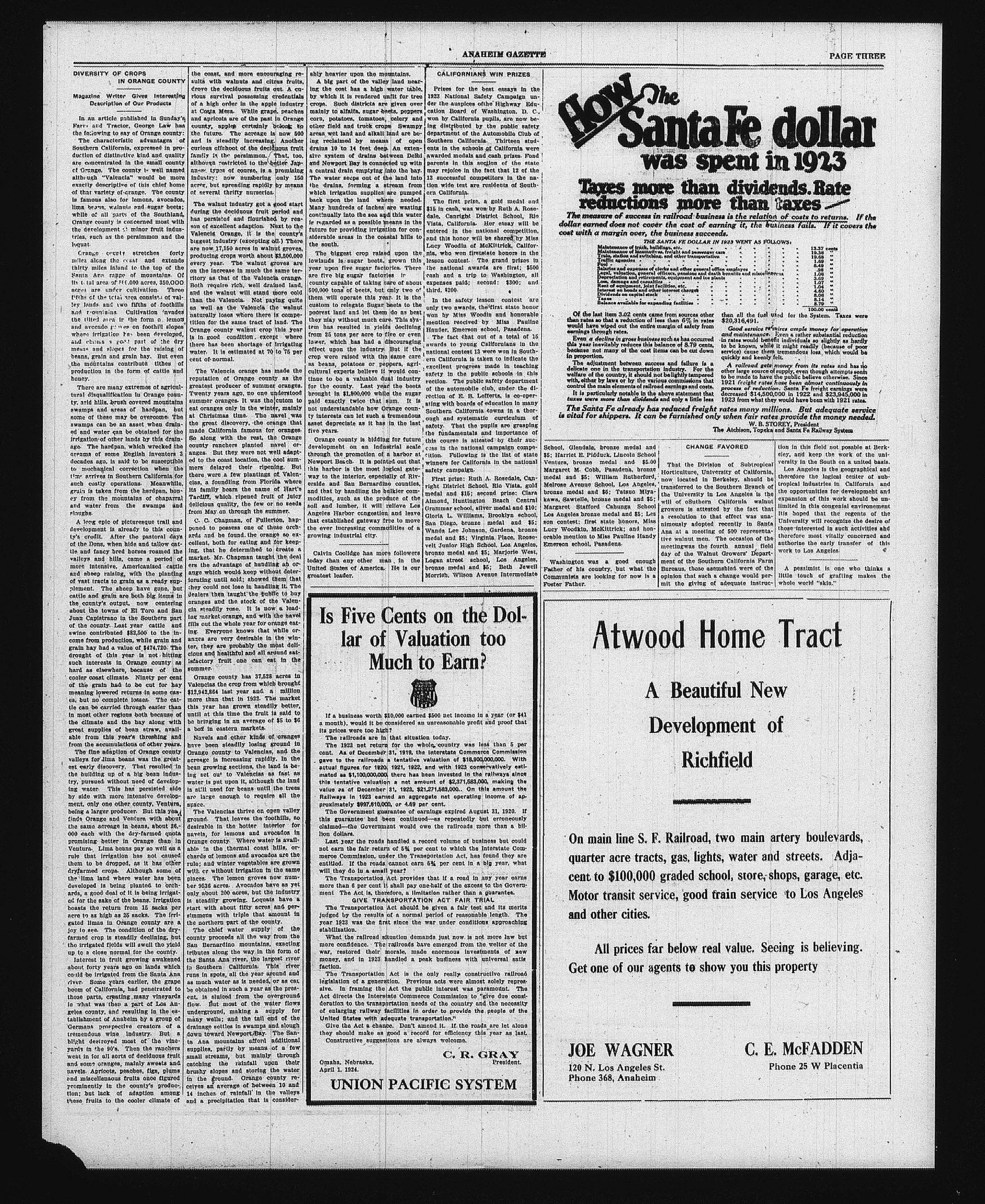
Searchable text
DIVERSITY OF CROPS
IN ORANGE COUNTY
Magazine Writer Gives Interesting Description of Our Products
In an article published in Sunday's Farmer and Tractor, George Law has the following to say of Orange county:
The characteristic advantages of Southern California, expressed in production of distinctive kind and quality are concentrated in the small county of Orange. The county is well named although "Valencia" would be more exactly descriptive of this chief home of that variety of orange. The county is famous also for lemons, avocados, lima beans, walnuts and sugar beets; while of all parts of the Southland, Orange county is concerned most with the development of minor fruit industries, such as the persimmon and the loquat.
Orange county stretches forty miles along the coast and extends thirty miles inland to the top of the Santa Ana range of mountains. Of its total area of 500,000 acres, 350,000 acres are under cultivation. Three fifths of the total area consists of valley lands and two fifths of foothills and mountains. Cultivation invades the tilted area in the form of lemon and avocado groves on foothill slopes where irrigation has been developed, and claims a good part of the dry measand slopes for the raising of beans, grain and grain hay. But even the mountains contribute tithes of production in the form of cattle and honey.
There are many extremes of agricultural disqualification in Orange county, arid hills, brush covered mountains swamps and areas of hardpan, but some of these may be overcome. The swamps can be an asset when drained and water can be obtained for the irrigation of other lands by this drainage. The hardpan, which wrecked the coast, and more encouraging results with walnuts and citrus fruits, drove the deciduous fruits out. A curious survival possessing credentials of a high order in the apple industry at Costa Mesa. While grape, peaches and apricots are of the past in Orange county, apples certainly belong to the future. The acreage is now 500 and is steadily increasing. Another curious offshoot of the deciduous fruit family is the persimmon. That, too, although restricted to the better Japanese types of course, is a promising industry: now numbering only 150 acres, but spreading rapidly by means of several thrifty nurseries.
The walnut industry got a good start during the deciduous fruit period and has persisted and flourished by reason of excellent adaption. Next to the Valencia Orange, it is the county's biggest industry (except oil.) There are now 17,150 acres in walnut groves, producing crops worth about $3,500,000 every year. The walnut groves are on the increase in much the same territory as that of the Valencia orange. Both require rich, well drained land, and the walnut will stand more cold than the Valencia. Not paying quite as well as the Valencia the walnut naturally loses where there is competition for the same tract of land. The Orange county walnut crop this year is in good condition, except where there has been shortage of irrigating water. It is estimated at 70 to 75 per cent of normal.
The Valencia orange has made the reputation of Orange county as the greatest producer of summer oranges. Twenty years ago, no one understood summer oranges. It was the custom to eat oranges only in the winter, mainly at Christmas time. The navel was the great discovery, the orange that made California famous for oranges. So along with the rest, the Orange county ranchers planted navel orably heavier upon them.
A big part of the ing cost has a value by which it is rendered crops. Such district mainly to alfalfa, suc corn, potatoes, tomato other field and truck areas wet land and drains 10 to 14 feet deep system of drain and Newport Bay is a central drain empire. The water seeps out the drains, forming which irrigation surges back upon the land. Many hundreds of lakes continually into the lake regarded as a posse future for providing siderable areas in the south.
The biggest crop lowlands is sugar year upon five sugar are five big sugar county capable of tracing 500,000 tons of beetle them will operate the custom to relegate poorest land and let they may without much tem has resulted in from 25 tons per acre lower, which has had effect upon the Indian crop were raised with as beans, potatoes cultural experts bellow to be a valuable for the county. La brought in $1,800,000 paid exactly twice not understandable by interests can let asset depreciate as five years.
Orange county is developme
beans, grain and grain hay. But even the mountains contribute tithes of production in the form of cattle and honey.
There are many extremes of agricultural disqualification in Orange county, arid hills, brush covered mountains swamps and areas of hardpan, but some of these may be overcome. The swamps can be an asset when drained and water can be obtained for the irrigation of other lands by this drainage. The hardpan, which wrecked thereams of some English inventions 3 decades ago, is said to be susceptible to mechanical correction when the time arrives in Southern California for such costly operations. Meanwhile, grain is taken from the hardpan, honey from the mountains of chaparral and water from the swamps and sloughs.
A long epic of picturesque trail and development is already to this county's credit. After the pastoral days of the Dons, when hide and tallow cattle and fancy bred horses roamed the valleys and hills, came a period of more intensive, Americanized cattle and sheep raising, with the planting of vast tracts to grain as a ready supplement. The sheep have gone, but cattle and grain are both big items in the county's output, now centering about the towns of El Toro and San Juan Capistrano in the Southern part of the county. Last year cattle and swine contributed $82,500 to the income from production, while grain and grain hay had a value of $474,720. The drought of this year is not hitting such interests in Orange county as hard as elsewhere, because of the cooler coast climate. Ninety per cent of the grain had to be cut for hay meaning lowered returns in some cases, but no complete losses. The cattle can be carried through easier than in most other regions both because of the climate and the hay along with great supplies of bean straw, available from this year's threshing and from the accumulations of other years.
The fine adaptation of Orange county valleys for lima beans was the greatest early discovery. That resulted in the building up of a big bean industry, pursued without need of developing water. This has persisted side by side with more intensive development, only one other county, Ventura, being a larger producer. But this year finds Orange and Ventura with about the same acreage in beans, about 26,000 each with the dry-farmed quota promising better in Orange than in Ventura. Lima beans pay so well as a cent of normal.
The Valencia orange has made the reputation of Orange county as the greatest producer of summer oranges. Twenty years ago, no one understood summer oranges. It was the custom to eat oranges only in the winter, mainly at Christmas time. The navel was the great discovery; the orange that made California famous for oranges. So along with the rest, the Orange county ranchers planted navel oranges. But they were not well adapted to the coast location, the cool summers delayed their ripening. But there were a few plantings of Valencias, a foundling from Florida where its family bears the name of Hart's Tardiff, which ripened fruit of juicy delicious quality, the few or no seeds from May on through the summer.
C. C. Chapman, of Fullerton, happened to possess one of these orchards and he found: the orange so excellent, both for eating and for keeping, that he determined to create a market. Mr. Chapman taught the dealers the advantage of handling an orange which would keep without deteriorating until sold; showed them that they could not lose in handling it. The dealers then taught the public to buy oranges and the stock of the Valencia steadily rose. It is now a leading market-orange, and with the navel fills out the whole year for orange eating. Everyone knows that while oranges are very desirable in the winter, they are probably the most delicious and healthful and all around satisfactory fruit one can eat in the summer.
Orange county has 37,528 acres in Valencias the crop from which brought $12,942,864 last year and a million more than that in 1922. The market this year has grown steadily better, until at this time the fruit is said to be bringing in an average of $5 to $6 a box in eastern markets.
Navels and other kinds of oranges have been steadily losing ground in Orange county to Valencias, and the acreage is increasing rapidly. In the bean growing sections, the land is being set out to Valencias as fast as water is put upon it, although the land is still used for beans until the trees are large enough to require all the space.
The Valencias thrive on open valley ground. That leaves the foothills, so desirable in the hotter interior for navels, for lemons and avocados in Orange county. Where water is available in the thermal coast hills, or cent of normal.
The Valencia orange has made the reputation of Orange county as the greatest producer of summer oranges. Twenty years ago, no one understood summer oranges. It was the custom to eat oranges only in the winter, mainly at Christmas time. The navel was the great discovery; the orange that made California famous for oranges. So along with the rest, the Orange county ranchers planted navel oranges. But they were not well adapted to the coast location, the cool summers delayed their ripening. But there were a few plantings of Valencias, a foundling from Florida where its family bears the name of Hart's Tardiff, which ripened fruit of juicy delicious quality, the few or no seeds from May on through the summer.
C. C. Chapman, of Fullerton, happened to possess one of these orchards and he found: the orange so excellent, both for eating and for keeping, that he determined to create a market. Mr. Chapman taught the dealers the advantage of handling an orange which would keep without deteriorating until sold; showed them that they could not lose in handling it. The dealers then taught the public to buy oranges and the stock of the Valencia steadily rose. It is now a leading market-orange, and with the navel fills out the whole year for orange eating. Everyone knows that while oranges are very desirable in the winter, they are probably the most delicious and healthful and all around satisfactory fruit one can eat in the summer.
Orange county has 37,528 acres in Valencias the crop from which brought $12,942,864 last year and a million more than that in 1922. The market this year has grown steadily better, until at this time the fruit is said to be bringing in an average of $5 to $6 a box in eastern markets.
Navels and other kinds of oranges have been steadily losing ground in Orange county to Valencias, and the acreage is increasing rapidly. In the bean growing sections, the land is being set out to Valencias as fast as water is put upon it, although the land is still used for beans until the trees are large enough to require all the space.
The Valencias thrive on open valley ground. That leaves the foothills, so desirable in the hotter interior for navels, for lemons and avocados in Orange county. Where water is available in the thermal coast hills, or cent of normal.
The Valencia orange has made the reputation of Orange county as the greatest producer of summer oranges. Twenty years ago, no one understood summer oranges. It was the custom to eat oranges only in the winter, mainly at Christmas time. The navel was the great discovery;the orange that made California famous for oranges.So along with the rest,the Orange county ranchers planted navel oranges.But they were not well adapted to the coast location,the cool summers delayed their ripening.But there were a few plantings of Valencias,a foundling from Florida where its family bears the name of Hart's Tardiffwhich ripened fruit of juicy delicious quality,the few or no seeds from May on through the summer.
C. C. Chapman, of Fullerton,happened to possess one of these orchards and he found:the orange so excellent,both for eating and for keepingthat he determined to create a market.Mr Chapman taughtthe dealersthe advantageofhandlinganorangewhichwouldkeepwithoutdeterioratinguntilsold;showedthemthattheycouldnotloseinhandlingit.ThedealersthentaughtthepublictobuyorangesandthestockoftheValenciasteadilyrose.Isnowaleadingmarketorange,andwiththenavelfillsoutthewholeyearfororangeeating.Everyoneknowsthatwhileorangesareverydesirableinthewinter,theyareprobablythemostdeliciousandhealthfulandallaroundsatisfactoryfruitonecaneatinthesummer.
Orange county has 37,528 acres in Valenciasthe cropfromwhichbrought$12,942,864lastyearandamillionmorethanthatin1922.Themarketthisyearhastownsteadlybetteruntainstasatisfactoryfruitonecaneatinthesummer.
Is Five lar
If a business waits a month),would its prices were too high?
The railroads
The 1923 net cent.As of Dec gave totherail actual figures fo matedas $1,100,c this tentative value asofDec Railwaysin1922 proximately $997
The Governance this guarantee claimed—theGolden dollars.
Last year theretarnnottearnthefair
valleys for lima beans was the greatest early discovery. That resulted in the building up of a big bean industry, pursued without need of developing water. This has persisted side by side with more intensive development, only one other county, Ventura, being a larger producer. But this year finds Orange and Ventura with about the same acreage in beans, about 26,000 each with the dry-farmed quota promising better in Orange than in Ventura. Lima beans pay so well as a rule that irrigation has not caused them to be dropped, as it has other dry-farmed crops. Although some of the lima land where water has been developed is being planted to orchards, a good deal of it is being irrigated for the sake of the beans. Irrigation boasts the return from 15 sacks per acre to as high as 25 sacks. The irrigated limas in Orange county are a joy to see. The condition of the dry-farmed crop is steadily declining, but the irrigated fields will swell the yield up to a close normal for the county.
Interest in fruit growing awakened about forty years ago on lands which could be irrigated from the Santa Ana river. Some years earlier, the grape boom of California, had penetrated to those parts, creating many vineyards in what was then a part of Los Angeles county, and resulting in the establishment of Anabeim by a group of Germans prospective creators of a tremendous wine industry. But a blight destroyed most of the vineyards in the 90's. Then the ranchers went in for all sorts of deciduous fruit and some oranges, mainly sweets and navels. Apricots, peaches, figs, plums and miscellaneous fruits once figured prominently in the county's production; but lack of adaption among these fruits to the cooler climate of acresage is increasing rapidly. In the bean growing sections, the land is being set out to Valencias as fast as water is put upon it, although the land is still used for beans until the trees are large enough to require all the space.
The Valencias thrive on open valley ground. That leaves the foothills, so desirable in the hotter interior for navels, for lemons and avocados in Orange county. Where water is available in the thermal coast hills, orchards of lemons and avocados are the rule; and winter vegetables are grown with or without irrigation in the same places. The lemon groves now number 9536 acres. Avocados have as yet only about 200 acres, but the industry is steadily growing. Loquats have a start with about fifty acres and perimmon with triple that amount in the northern part of the county.
The chief water supply of the county proceeds all the way from the San Bernardino mountains, exacting tributes along the way in the form of the Santa Ana river, the largest river in Southern California. This river runs in spots, all the year around and as much water as is needed, or as can be obtained in such a year as the present, is sluiced from the overground flow. But most of the water flows underground, making a supply for many wells; and the tail end of the drainage settles in swamps and slough down toward Newport Bay. The Santa Ana mountains afford additional supplies, partly by means of a few small streams, but mainly through catching the rainfall upon their brushy slopes and storing the water in the ground. Orange county receives an average of between 10 and 14 inches of rainfall in the valleys and a precipitation that is consider-
ANAHEIM GAZETTE
A big part of the valley land nearing the cost has a high water table,
by which it is rendered unfit for tree
crops. Such districts are given over
mainly to alfalfa, sugar beets, peppers
corn, potatoes, tomatoes, celery and
other field and truck crops. Swampy
areas wet land and alkali land are being reclaimed by means of open
drains 10 to 14 feet deep. An extensive system of drains between Delhi
and Newport Bay is connected up with
a central drain emptying into the bay.
The water seeps out of the land into
the drains, forming a stream from
which irrigation supplies are pumped
back upon the land where needed.
Many hundreds of inches are wasting
continually into the sea and this water
is regarded as a possible means in the
future for providing irrigation for considerable areas in the coastal hills to
the south.
The biggest crop raised upon the lowlands is sugar beets, grown this year upon five sugar factories. There are five big sugar factories in county capable of taking care of about 500,000 tons of beets, but only two of them will operate this year. It is the custom to relegate Sugar beets to the poorest land and let them do as best they may without much care. This system has resulted in yields declining from 25 tons per acre to five or even lower, which has had a discouraging effect upon the industry. But if the crop were raised with the same care as beans, potatoes or peppers, agricultural experts believe it would continue to be a valuable dual industry for the county. Last year the beets brought in $1,800,000 while the sugar paid exactly twice that sum. It is not understandable how Orange county interests can let such a tremendous asset depreciate as it has in the last five years.
Orange county is bidding for future development on an industrial scale ably heavier upon the mountains.
CALIFORNIANS WIN PRIZES
Prizes for the best essays in the 1923 National Safety Campaign under the auspices of the Highway Education Board of Washington, D.C., won by California pupils, are now being distributed by the public safety department of the Automobile Club of Southern California. Thirteen students in the schools of California were awarded medals and cash prizes. Fond parents in this section of the state may rejoice in the fact that 12 of the 13 successful competitors in the nation wide test are residents of Southern California.
The first prize, a gold medal and $15 in cash, was won by Ruth A. Rosedale, Canright District School, Rio Vista, California. Her essay will be entered in the national competition, and this honor will be shared by Miss Lucy Woodin of McKittrell, California, who won firststate honors in the lesson contest. The grand prizes in the national awards are first; $500 cash and a trip to Washington, all expenses paid; second: $300; and third: $200.
In the safety lesson contest are only two awards, the first state honor won by Miss Woodin and honorable mention received by Miss Pauline Hauder, Emerson school, Pasadena.
The fact that out of a total of 15 awards to young Californians in the national contest 13 were won in Southern California is taken to indicate the excellent progress made in teaching safety in the public schools in this section. The public safety department of the automobile club, under the direction of E.B. Loffler, is co-operating with boards of education in many Southern California towns in a thorough and systematic curriculum of safety. That the pupils are grasping the fundamentals and importance of this course is attested by their success in the national campaign competence.
Taxes more than reductions mean
The measure of success in railroad
dollar earned does not cover the cost with a margin over, the business costs.
THE Santa Fe DOE
Maintenance of track, buildings, etc.
Maintenance of locomotives, freight and passenger trains station and switching, and other transport traffic agencies.
Fuel
Salaries and expenses of clerks and other general officers, pensioners, depreciation and retirement equipment at low, damage and casualties.
Rent on equipment and facilities, etc.
Interest on bonds and other interest charges.
Dividends on capital stock.
Taxes
Balance available for expanding facilities.
Of the last item 3.02 cents came from sources than rates so that a reduction of less than 6% in would have wiped out the entire margin of safety earnings through rates.
Even a decline in gross business such as has occurred this year inevitably reduces this balance of 8.79 because not many of the cost items can be cut in proportion.
The adjustment between success and failure delicate one in the transportation industry. For welfare of the country, it should not be lightly tamed with either by laws or by the various commission control the main elements of railroad earnings and it is particularly notable in the above statement taxes were more than dividends and only a little.
The Santa Fe already has reduced fees is vital for shippers. It can be furnished...
crop were raised with the same care as beans, potatoes or peppers, agricultural experts believe it would continue to be a valuable dual industry for the county. Last year the beets brought in $1,800,000 while the sugar paid exactly twice that sum. It is not understandable how Orange county interests can let such a tremendous asset depreciate as it has in the last five years.
Orange county is bidding for future development on an industrial scale through the promotion of a harbor at Newport Beach. It is pointed out that this harbor is the most logical gateway to the interior, especially of Riverside and San Bernardino counties, and that by handling the bulkier commodities, such as the produce of the soil and lumber, it will relieve Los Angeles Harbor congestion and leave that established gateway free to move the ever increasing commodities of a growing industrial city.
Calvin Coolidge has more followers today than any other man in the United States of America. He is our greatest leader.
Is Five Cents on the Dollar of Valuation too Much to Earn?
If a business worth $10,000 earned $500 net income in a year (or $41 a month), would it be considered an unreasonable profit and proof that its prices were too high?
The railroads are in that situation today.
The 1923 net return for the whole country was less than 5 per cent. As of December 31, 1919, the Interstate Commerce Commission gave to the railroads a tentative valuation of $18,900,000,000. With actual figures for 1920, 1921, 1922, and with 1923 conservatively estimated as $1,100,000,000, there has been invested in the railways since this tentative valuation a net amount of $2,371,583,000, making the value as of December 31, 1923, $21,271,583,000.. On this amount the Railways in 1923 earned an aggregate net operating income of approximately $997,610,000, or 4.69 per cent.
The Government guarantee of earnings expired August 31, 1920. If this guarantee had been continued—as repeatedly but erroneously claimed—the Government would owe the railroads more than a billion dollars.
Last year the roads handled a record volume of business but could not earn the fair return of 5% per cent to which the Interstate Com...
gave to the railroads a tentative valuation of $18,900,000,000. With actual figures for 1920, 1921, 1922, and with 1923 conservatively estimated as $1,100,000,000 there has been invested in the railways since this tentative valuation a net amount of $2,371,583,000, making the value as of December 31, 1923, $21,271,583,000.. On this amount the Railways in 1923 earned an aggregate net operating income of approximately $997,610,000, or 4.69 per cent.
The Government guarantee of earnings expired August 31, 1920. If this guarantee had been continued—as repeatedly but erroneously claimed—the Government would owe the railroads more than a billion dollars.
Last year the roads handled a record volume of business but could not earn the fair return of 5% per cent to which the Interstate Commerce Commission, under the Transportation Act, has found they are entitled. If the roads cannot earn 5% per cent in a big year, what will they do in a small year?
The Transportation Act provides that if a road in any year earns more than 6 per cent it shall pay one-half of the excess to the Government. The Act is, therefore, a limitation rather than a guarantee.
GIVE TRANSPORTATION ACT FAIR TRIAL
The Transportation Act should be given a fair test and its merits judged by the results of a normal period of reasonable length. The year 1923 was the first since the war under conditions approaching stabilization.
What the railroad situation demands just now is not more law but more confidence. The railroads have emerged from the welter of the war, restored their morale, made enormous investments of new money, and in 1923 handled a peak business with universal satisfaction.
The Transportation Act is the only really constructive railroad legislation of a generation. Previous acts were almost solely repressive. In framing the Act the public interest was paramount. The Act directs the Interstate Commerce Commission to "give due consideration to the transportation needs of the country and the necessity of enlarging railway facilities in order to provide the people of the United States with adequate transportation."
Give the Act a chance. Don't amend it. If the roads are let alone they should make as good a record for efficiency this year as last.
Constructive suggestions are always welcome.
C. R. GRAY
President.
Omaha, Nebraska,
April 1, 1924.
UNION PACIFIC SYSTEM
IN The Santa Fe dollar was spent in 1923
has more than dividends. Rate reductions more than taxes
of success in railroad business is the relation of costs to returns. If the does not cover the cost of earning it, the business fails. If it covers the begin over, the business succeeds.
THE SANTA FE DOLLAR IN 1923 WENT AS FOLLOWS:
Balance of track, buildings, etc.
Balance of locomotives, freight and passenger cars
Balance of trains and switching, and other transportation
Regards
and expenses of clerks and other general office employees
Evaluation, general officers, pensions and death benefits and miscellaneous
Station and retirements, equipment and ice plants
Mortgage and casualties
Wages work belay facilities, etc.
Open bonds and other interest charges
Is on capital stock
Available for expanding facilities
3.02 cents came from sources other than all the fuel used for the System. Taxes were $20,316,491.
Good service requires ample money for operation and maintenance. Even a rather substantial reduction in rates would benefit individuals so slightly as hardly to be known, while it might readily (because of poor service) cause them tremendous loss which would be quickly and keenly felt.
A railroad gets money from its rates and has no other large source of supply, even though attempts seem to be made to have the public believe otherwise. Since 1921 freight rates have been almost continuously in process of reduction. Santa Fe freight earnings were decreased $14,500,000 in 1922 and $23,945,000 in 1923 from what they would have been with 1921 rates.
Already has reduced freight rates many millions. But adequate service centers. It can be furnished only when fair rates provide the money needed.
W. B. STOREY, President
The Atchison, Topeka and Santa Fe Railway System
between success and failure is a transportation industry. For the industry, it should not be lightly tampered or by the various commissions that elements of railroad earnings and costs are notable in the above statement that than dividends and only a little less already has reduced freight rates many millions. But adequate service centers. It can be furnished only when fair rates provide the money needed.
W. B. STOREY, President
The Atchison, Topeka and Santa Fe Railway System
CHANGE FAVORED
That the Division of Subtropical Horticulture, University of California, now located in Berkeley, should be transferred to the Southern Branch of the University in Los Angeles is the will of oSuthern California walnut growers is attested by the fact that a resolution to that effect was unanimously adopted recently in Santa Ana at a meeting of 500 representative walnut men. The occasion of the meeting was the fourth annual field day of the Walnut Growers' Department of the Southern California Farm Bureau, those assemblies were of the opinion that such a change would permit the giving of adequate instruction in this field not possible at Berkeley, and keep the work of the university in the South on a united basis.
Los Angeles is the geographical and therefore the logical center of subtropical industries in California and the opportunities for development and expansion of this work should be unlimited in this congenial environment it is hoped that the regents of the University will recognize the desire of those interested in such activities and therefore most vitally concerned and authorize the early transfer of this work to Los Angeles.
A pessimist is one who thinks a little touch of grafting makes the whole world "skin."
Ettwood Home Tract
A Beautiful New Development of Richfield
Line S. F. Railroad, two main artery boulevards,
line S. F. Railroad, two main artery boulevards,
cre tracts, gas, lights, water and streets. Adja100,000 graded school, store, shops, garage, etc.
transit service, good train service to Los Angeles
cities.
prices far below real value. Seeing is believing.
of our agents to show you this property
WAGNER
Angeles St.
Anaheim
C. E. McFADDEN
Phone 25 W Placentia