anaheim-gazette 1924-05-22
Scanned page
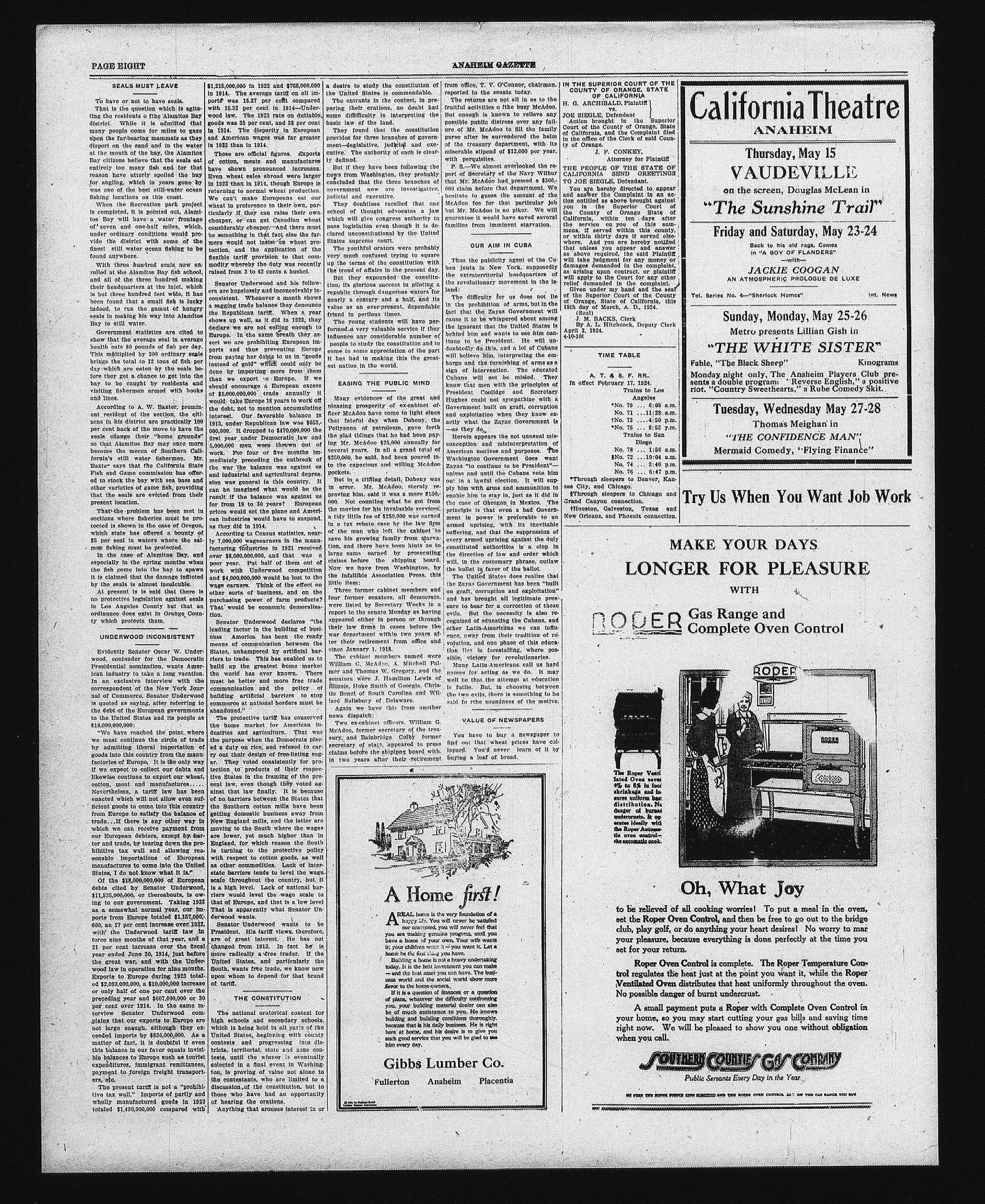
Searchable text
SEALS MUST LEAVE
To have or not to have seals.
That is the question which is agitating the residents of the Alamitos Bay district. While it is admitted that many people come for miles to gaze upon the fur-bearing mammals as they disport on the sand and in the water at the mouth of the bay, the Alamitos Bay citizens believe that the seals eat entirely too many fish and for that reason have utterly spoiled the bay for angling, which in years gone by was one of the best still-water ocean fishing locations on this coast.
When the Recreation park project is completed, it is pointed out, Alamitos Bay will have a water frontage of seven and one-half miles, which under ordinary conditions would provide the district with some of the finest still water ocean fishing to be found anywhere.
With three hundred seals now enrolled at the Alamitos Bay fish school, and all of the three hundred making their headquarters at the inlet, which is but three hundred feet wide, it has been found that a small fish is lucky indeed, to run the gamut of hungry seals in making his way into Alamitoe Bay to still water.
Government statistics are cited to show that the average seal in average health eats 80 pounds of fish per day. This multiplied by 300 ordinary seals brings the total to 12 tons of fish per day which are eaten by the seals before they get a chance to get into the bay to be caught by residents and visiting fishermen armed with hooks and lines.
According to A. W. Baxter, prominent resident of the section, the citizens in his district are practically 100 per cent back of the move to have the seals change their "home grounds" so that Alamitos Bay may once more
$1,215,000,000 in 1922 and $768,000,000 in 1914. The average tariff on all imports was 15.37 per cent compared with 15.32 per cent in 1914—Underwood law. The 1923 rate on durable goods was 35 per cent, and 38 per cent in 1914. The disparity in European and American wages was far greater in 1923 than in 1914.
Those are official figures. Exports of cotton, meats and manufactures have shown pronounced increases. Even wheat sales abroad were larger in 1923 than in 1914, though Europe is returning to normal wheat production. We can't make Europeans eat our wheat in preference to their own, particularly if they can raise their own cheaper, or can get Canadian wheat considerably cheaper. And there must be something in that fact else the farmers would not insist on wheat protection, and the application of the flexible tariff provision to that commodity whereby the duty was recently raised from 3 to 42 cents a bushel.
Senator Underwood and his followers are hopelessly and inconceivably inconsistent. Whenever a month shows a sagging trade balance they denounce the Republican tariff. When a year shows up well, as it did in 1923, they declare we are not selling enough to Europe. In the same breath they assert we are prohibiting European imports and thus preventing Europe from paying her debts to us in "goods instead of gold" which could only be done by importing more from them than we export to Europe. If we should encourage a European excess of $1,000,000,000 trade annually it would take Europe 18 years to work off the debt, not to mention accumulating interest. Our favorable balance in 1913, under Republican law was $653,-000,000. It dropped to $470,000,000 the first year under Democratic law and 5,000,000 men were thrown out of a desire to stave the United States from some difficult basic law of government.
They found provides for the ment—legislative cutive. The authority defined.
But if they news from War concluded that government judicial and other schools of the which will give pass legislation claused unconstitutional States supreme.
The youthful very much coo up the terms of the trend of a But they cation; its glorious republic through nearly a century value as an o friend in peril.
The young formed a very influence any people to study come to someone it has had in est nation in
EASING
This multiplied by 300 ordinary seals brings the total to 12 tons of fish per day which are eaten by the seals before they get a chance to get into the bay to be caught by residents and visiting fishermen armed with hooks and lines.
According to A. W. Baxter, prominent resident of the section, the citizens in his district are practically 100 per cent back of the move to have the seals change their "home grounds" so that Alamitos Bay may once more become the mecca of Southern California's still water fishermen. Mr. Baxter says that the California State Fish and Game commission has offered to stock the bay with sea bass and other varieties of game fish, providing that the seals are evicted from their present location.
That the problem has been met in sections where fisheries must be protected is shown in the case of Oregon, which state has offered a bounty of $5 per seal in waters where the salmon fishing must be protected.
In the case of Alamitos Bay, and especially in the spring months when the fish come into the bay to spawn it is claimed that the damage inflicted by the seals is almost incalculable.
At present is is said that there is no protective legislation against seals in Los Angeles County but that an ordinance does exist in Orange County which protects them.
UNDERWOOD INCONSISTENT
Evidently Senator Oscar W. Underwood, contender for the Democratic Presidential nomination, wants American industry to take a long vacation. In an exclusive interview with the correspondent of the New York Journal of Commerce, Senator Underwood is quoted as saying, after referring to the debt of the European governments to the United States and its people as $18,000,000,000:
"We have reached the point where we must continue the circle of trade by admitting liberal importation of goods into this country from the manufactories of Europe. It is the only way if we expect to collect our debts and likewise continue to export our wheat, cotton, meat and manufactures... Nevertheless, a tariff law has been enacted which will not allow even sufficient goods to come into this country from Europe to satisfy the balance of trade... If there is any other way in which we can receive payment from our European debtors, except by barter and trade, by tearing down the prohibitive tax wall and allowing resale from paying her debts to us in "goods instead of gold" which could only be done by importing more from them than we export to Europe. If we should encourage a European excess of $1,000,000,000 trade annually it would take Europe 18 years to work off the debt, not to mention accumulating interest. Our favorable balance in 1913, under Republican law was $653,000,000. It dropped to $470,000,000 the first year under Democratic law and 5,000,000 men were thrown out of work. For four or five months immediately preceding the outbreak of the war the balance was against us and industrial and agricultural depression was general in this country. It can be imagined what would be the result if the balance was against us for from 18 to 30 years? European prices would set the plane and American industries would have to suspend, as they did in 1914.
According to Census statistics, nearly 7,000,000 wageearners in the manufacturing industries in 1921 received over $8,000,000,000, and that was a poor year. Put half of them out of work with Underwood competition and $4,000,000,000 would be lost to the wage earners. Think of the effect on other sorts of business, and on the purchasing power of farm products? That would be economic demoralization.
Senator Underwood declares "the leading factor in the building of business America has been the ready means of communication between the States, unhampered by artificial barriers to trade. This has enabled us to build up the greatest home market the world has ever known. There must be better and more free trade communication and the policy of building artificial barriers to stop commerce at national borders must be abandoned."
The protective tariff has conserved the home market for American industries and agriculture. That was the purpose when the Democrats placed a duty on rice, and refused to carry out their design of free-listing sugar. They voted consistently for protection to products of their respective States in the framing of the present law, even though they voted against that law finally. It is because of no barriers between the States that the Southern cotton mills have been getting domestic business away from New England mills, and the latter are moving to the South where the wages are lower, yet much higher than in England, for which reason the South is turning to the protective policy.
goods into this country from the manufactories of Europe. It is the only way if we expect to collect our debts and likewise continue to export our wheat, cotton, meat and manufactures.... Nevertheless, a tariff law has been enacted which will not allow even sufficient goods to come into this country from Europe to satisfy the balance of trade... If there is any other way in which we can receive payment from our European debtors, except by barter and trade, by tearing down the prohibitive tax wall and allowing reasonable importations of European manufactures to come into the United States, I do not know what it is."
Of the $18,000,000,000 of European debts cited by Senator Underwood, $11,525,000,000, or thereabouts, is owing to our government. Taking 1923 as a somewhat normal year, our imports from Europe totaled $1,157,000,000, an 17 per cent increase over 1922, with the Underwood tariff law in force nine months of that year, and a 21 per cent increase over the fiscal year ended June 30, 1914, just before the great war, and with the Underwood law in operation for nine months. Exports to Europe during 1923 totaled $2,093,000,000, a $10,000,000 increase or only half of one per cent over the preceding year and $607,000,000 or 30 per cent over 1914. In the same interview Senator Underwood complains that our exports to Europe are not large enough, although they exceeded imports by $836,000,000. As a matter of fact, it is doubtful if even this balance in our favor equals invisible balances to Europe such as tourist expenditures, immigrant remittances, payment to foreign freight transporters, etc.
The present tariff is not a "prohibitive tax wall." Imports of partly and wholly manufactured goods in 1923 totaled $1,490,000,000 compared with
They voted consistently for protection to products of their respective States in the framing of the present law, even though they voted against that law finally. It is because of no barriers between the States that the Southern cotton mills have been getting domestic business away from New England mills, and the latter are moving to the South where the wages are lower, yet much higher than in England, for which reason the South is turning to the protective policy with respect to cotton goods, as well as other commodities. Lack of interstate barriers tends to level the wage scale throughout the country, but it is a high level. Lack of national barriers would level the wage scale to that of Europe, and that is a low level. That is apparently what Senator Underwood wants.
Senator Underwood wants to be President. His tariff views, therefore, are of great interest. He has not changed from 1913. In fact he is more radically a free trader. If the United States, and particularly the South, wants free trade, we know now upon whom to depend for that brand of tariff.
THE CONSTITUTION
The national oratorical contest for high schools and secondary schools, which is being held in all parts of the United States, beginning with county contests and progressing into districts, territorial, state and zone contests, until the winner is eventually selected in a final event in Washington, is proving of value not alone to the contestants, who are limited to a discussion of the constitution, but to those who have had an opportunity of hearing the orations.
Anything that arouses interest in or
ANAHEIM GAZETTE
a desire to study the constitution of the United States is commendable.
The entrants in the contest, in preparing their orations, no doubt had some difficulty in interpreting the basic law of the land.
They found that the constitution provides for three branches of government—legislative, judicial and executive. The authority of each is clearly defined.
But if they have been following the news from Washington, they probably concluded that the three branches of government now are investigative, judicial and executive.
They doubtless recalled that one school of thought advocates a law which will give congress authority to pass legislation even though it is declared unconstitutional by the United States supreme court.
The youthful orators were probably very much confused trying to square up the terms of the constitution with the trend of affairs in the present day.
But they expounded the constitution; its glorious success in piloting a republic through dangerous waters for nearly a century and a half, and its value as an ever-present, dependable friend in perilous times.
The young students will have performed a very valuable service if they influence any considerable number of people to study the constitution and to come to some appreciation of the part it has had in making this the greatest nation in the world.
EASING THE PUBLIC MIND
Many evidences of the great and pleasing prosperity of ex-cabinet officer McAdoo have come to light since that fateful day when Doheny, the Pollyanna of petroleum, gave forth the glad tidings that he had been paying Mr. McAdoo $25,000 annually for all grand total of from office, T. V. O'Connor, chairman, reported to the senate today.
The returns are not all in as to the fruitful activities ofthe busy McAdoo. But enough is known to relieve any possible public distress over any failure of Mr. McAdoo to fill the family purse after he surrendered the helm of the treasury department, with its miserable stipend $12,000 per year, with perquisites.
P. S.—We almost overlooked the report of Secretary of the Navy Wilbur that Mr. McAdoo had pressed a $300,000 claim before that department. We hesitate to guess the amount of the McAdoo fee for that particular job but Mr. McAdoo is no plker. We will guarantee it would have saved several families from imminent starvation.
OUR AIM IN CUBA
Thus the publicity agent of the Cuban junta in New York, supposedly the extraterritorial headquarters of the revolutionary movement in the island:
The difficulty for us does not lie in the prohibition of arms, but in the fact that the Zayas Government will cause it to be whispered about among the ignorant that the United States is behind him and wants to see him continue to be President. He will undoubtedly do this, and a lot of Cubans will believe him, interpreting the embargo and the furnishing of arms as a sign of intervention. The educated Cubans will not be misled. They know that men with the principles of President Coolidge and Secretary Hughes could not sympathize with a Government built on graft, corruption and exploitation when they know exactly what the Zayas Government is—as they do.
Herein appears the not unusual misconception and misinterpretation of...
EASING THE PUBLIC MIND
Many evidences of the great and pleasing prosperity of ex-cabinet officer McAdoo have come to light since that fateful day when Doheny, the Pollyanna of petroleum, gave forth the glad tidings that he had been paying Mr. McAdoo $25,000 annually for several years. In all a grand total of $250,000, he said, had been poured into the capacious and willing McAdoo pockets.
But in a trifling detail, Doheny was in error. Mr. McAdoo, sternly reproving him, said it was a mere $150,000. Not counting what he got from the movies for his invaluable services, a tidy little fee of $250,000 was earned in a tax rebate case by the law firm of the man who left the cabinet to save his growing family from starvation, and there have been hints as to large sums earned by prosecuting claims before the shipping board. Now we have from Washington, by the infallible Association Press, this little item:
Three former cabinet members and four former senators, all democrats, were listed by Secretary Weeks in a report to the senate Monday as having appeared either in person or through their law firms in cases before the war department within two years after their retirement from office and since January 1, 1918.
The cabinet members named were William G. McAdoo, A. Mitchell Palmer and Thomas W. Gregory, and the senators were J. Hamilton Lewis of Illinois, Hoke Smith of Georgia, Christie Benet of South Carolina and Willard Salisbury of Delaware.
Again we have this from another news dispatch:
Two ex-cabinet officers, William G. McAdoo, former secretary of the treasury, and Bainbridge Colby former secretary of state, appeared to press claims before the shipping board within two years after their retirement will believe him, interpreting the embargo and the furnishing of arms as a sign of intervention. The educated Cubans will not be misled. They know that men with the principles of President Coolidge and Secretary Hughes could not sympathize with a Government built on graft, corruption and exploitation when they know exactly what the Zayas Government is—as they do.
Herein appears the not unusual misconception and misinterpretation of American motives and purposes. The Washington Government does want Zayas "to continue to be President" unless and until the Cubans vote him out in a lawful election. It will supply him with arms and ammunition to enable him to stay in, just as it did in the case of Obregon in Mexico. The principle is that even a bad Government in power is preferable to an armed uprising, with its inevitable suffering, and that the suppression of every armed uprising against the duly constituted authorities is a step in the direction of law and order which will, in the customary phrase, outlaw the bullet in favor of the ballot.
The United States does realize that the Zayas Government has been "built on graft, corruption and exploitation" and has brought all legitimate pressure to bear for a correction of these evils. But the necessity is also recognized of educating the Cubans, and other Latin-Americans we can influence, away from their tradition of revolution, and one phase of this education lies in forestalling, where possible, victory for revolutionaries.
Many Latin-Americans call us hard names for acting as we do. It may well be that the attempt at education is futile. But, in choosing between the two evils, there is something to be said for rthe soundness of the motive.
VALUE OF NEWSPAPERS
You have to buy a newspaper to find out that wheat prices have collapsed. You'd never learn of it by buying a loaf of bread.
A Home first!
REAL home is the very foundation of a happy life. You will never be satisfied nor contented, you will never feel that you are making genuine progress, until you have a home of your own. Your wife wants it; your children want it—you want it. Let a home be the first thing you have.
Building a home is not a heavy undertaking today. It is the best investment you can make—and the best asset you can have. The business world and the social world show more favor to the home-owners.
If it is a question of finances or a question of plans, whatever the difficulty confronting you, your building material dealer can also be of much assistance to you. He knows building and building conditions thoroughly because that is his daily business. He is right here at home, and his desire is to give you such good service that you will be glad to see him every day.
Gibbs Lumber Co.
Fullerton Anaheim Placentia
California Theatre
ANAHEIM
Thursday, May 15
VAUDEVILLE
on the screen, Douglas McLean in
"The Sunshine Trail"
Friday and Saturday, May 23-24
Back to his old rags, Comes
in "A BOY OF FLANDERS"
—with—
JACKIE COOGAN
AN ATMOSPHERIC PROLOGUE DE LUXE
Tel. Series No. 4—"Sherlock Homes" Int. News
Sunday, Monday, May 25-26
Metro presents Lillian Gish in
"The WHITE SISTER"
Fable, "The Black Sheep" Kinograms
Monday night only, The Anaheim Players Club presents a double program: "Reverse English," a positive riot, "Country Sweethearts," a Rube Comedy Skit.
Tuesday, Wednesday May 27-28
Thomas Meighan in
"I THE CONFIDENCE MAN"
Fable, "The Black Sheep"
Kinograms
Monday night only, The Anaheim Players Club presents a double program: "Reverse English," a positive riot, "Country Sweethearts," a Rube Comedy Skit.
Tuesday, Wednesday May 27-28
Thomas Meighan in
"The Confidence Man"
Mermaid Comedy, "Flying Finance"
Try Us When You Want Job Work
MAKE YOUR DAYS
LONGER FOR PLEASURE
WITH
Gas Range and
Complete Oven Control
Oh, What Joy
To be relieved of all cooking worries! To put a meal in the oven,
set the Roper Oven Control, and then be free to go out to the bridge
club, play golf, or do anything your heart desires! No worry to mar
your pleasure, because everything is done perfectly at the time you
set for your return.
Roper Oven Control is complete. The Roper Temperature Control regulates the heat just at the point you want it, while the Roper Ventilated Oven distributes that heat uniformly throughout the oven.
No possible danger of burnt undercrust.
A small payment puts a Roper with Complete Oven Control in
your home, so you may start cutting your gas bills and saving time
right now. We will be pleased to show you one without obligation
when you call.
SOUTHERN COUNTIES GAS COMPANY
Public Servants Every Day in the Year