anaheim-gazette 1924-04-03
Scanned page
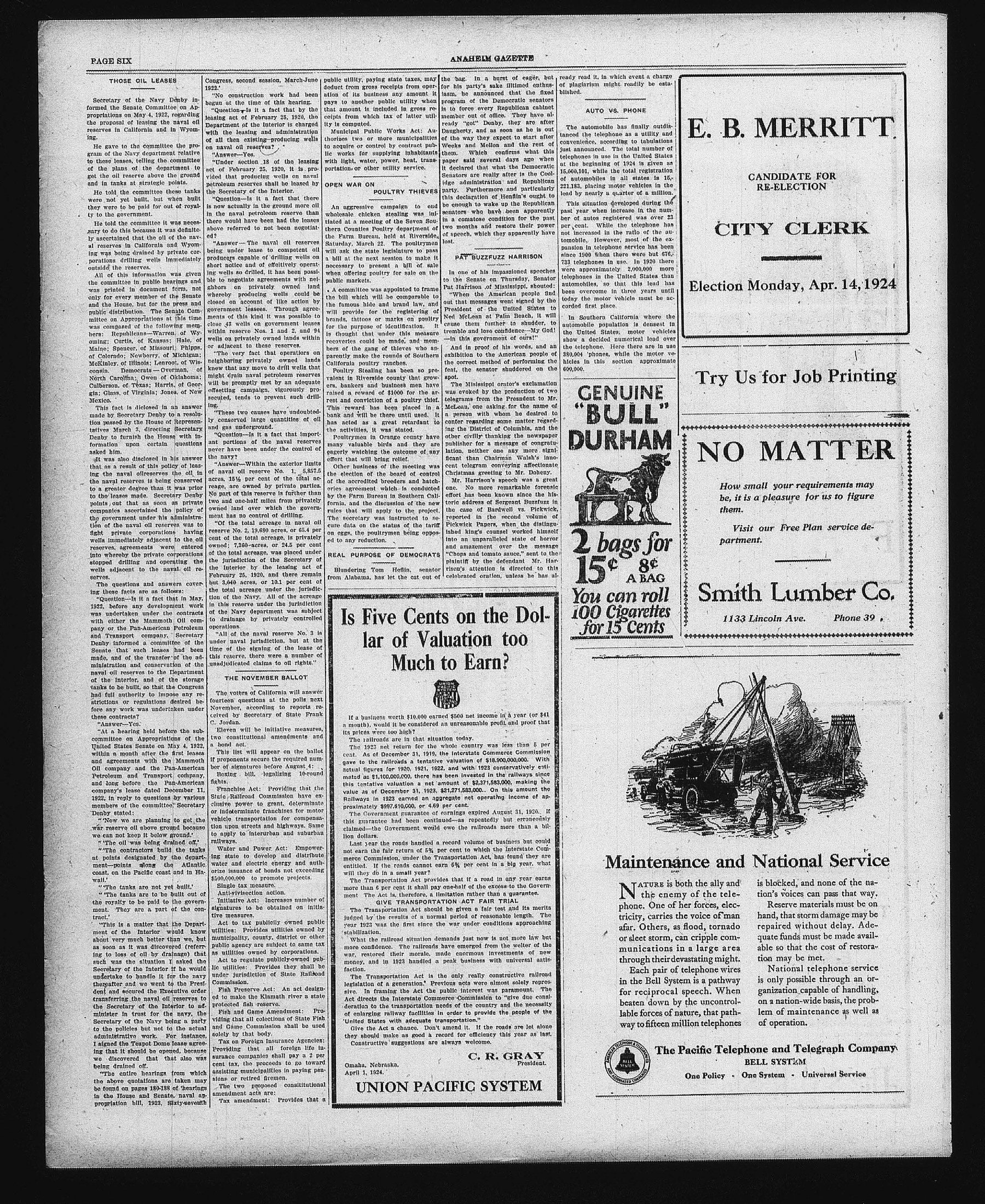
Searchable text
THOSE OIL LEASES
Secretary of the Navy Denby informed the Senate Committee on Appropriations on May 4, 1922, regarding the proposal of leasing the naval oil reserves in California and in Wyoming.
He gave to the committee the program of the Navy department relative to these leases, telling the committee of the plans of the department to get the oil reserve above the ground and in tanks at strategic points.
He told the committee these tanks were not yet built, but when built they were to be paid for out of royalty to the government.
He told the committee it was necessary to do this because it was definitely ascertained that the oil of the naval reserves in California and Wyoming was being drained by private corporations drilling wells immediately outside the reserves.
All of this information was given to the committee in public hearings and was printed in document form, not only for every member of the Senate and the House, but for the press and public distribution. The Senate Committee on Appropriations at this time was compased of the following members: Republicans—Warren, of Wyoming; Curtis, of Kansas; Hale, of Maine; Spencer, of Missouri; Phipps, of Colorado; Newberry, of Michigan; McKinley, of Illinois; Lenroot, of Wisconsin. Democrats—Overman, of North Carolina; Owen of Oklahoma; Culberson, of Texas; Harris, of Georgia; Glass, of Virginia; Jones, of New Mexico.
This fact is disclosed in an answer made by Secretary Denby to a resolution passed by the House of Representatives March 3, directing Secretary Denby to furnish the House with information upon certain questions.
Congress, second session, March-June 1922.
"No construction work had been begun at the time of this hearing.
Question—Is it a fact that by the leasing act of February 25, 1920, the Department of the Interior is charged with the leasing and administration of all then existing—producing wells on naval oil reserves?
Answer—Yes.
Under section 18 of the leasing act of February 25, 1920, it is provided that producing wells on naval petroleum reserves shall be leased by the Secretary of the Interior.
Question—Is it a fact that there is now actually in the ground more oil in the naval petroleum reserve than there would have been had the leases above referred to not been negotiated?
Answer—The naval oil reserves being under lease to competent oil producers capable of drilling wells on short notice and of effectively operating wells so drilled, it has been possible to negotiate agreements with neighbors on privately owned land whereby producing wells could be closed on account of like action by government lessees. Through agreements of this kind it was possible to close 43 wells on government leases within reserve Nos. 1 and 2, and 94 wells on privately owned lands within or adjacent to these reserves.
"The very fact that operators on neighboring privately owned lands knew that any move to drill wells that might drain naval petroleum reserves will be promptly met by an adequate offsetting campaign, vigorously prosecuted, tends to prevent such drilling.
These two causes have undoubtedly conserved large quantities of oil and gas underground.
Question—Is it a fact that important portions of the naval reserves never have been under the control of public utility, deduct from grossation of its bills pays to another that amount is ceilts from which it is computed.
Municipal Purchaser two days ago acquire or purchase works for light, water portation or other purposes.
A committee—the bill which—the famous high will provide brands, tattoos for the purpose is thought to recoveries counters of the gov't parently make California poultry Stew valent in River ers, bankers raised a reward rest and convict This reward bank and will has acted as the activities.
Poultrymen many valuable."
of Colorado; Newberry, of Michigan; McKinley, of Illinois; Lenroot, of Wisconsin. Democrats—Overman, of North Carolina; Owen of Oklahoma; Culberson, of Texas; Harris, of Georgia; Glass, of Virginia; Jones, of New Mexico.
This fact is disclosed in an answer made by Secretary Denby to a resolution passed by the House of Representatives March 3, directing Secretary Denby to furnish the House with information upon certain questions asked him.
It was also disclosed in his answer that as a result of this policy of leasing the naval oil reserves the oil in the naval reserves is being conserved to a greater degree than it was prior to the leases made. Secretary Denby points out that as soon as private companies ascertained the policy of the government under his administration of the naval oil reserves was to fight private corporations having wells immediately adjacent to the oil reserves, agreements were entered into whereby the private corporations stopped drilling and operating the wells adjacent to the naval oil reserves.
The questions and answers covering these facts are as follows:
"Question—Is it a fact that in May, 1922, before any development work was undertaken under the contracts with either the Mammoth Oil company or the Pan-American Petroleum and Transport company, Secretary Denby informed a committee of the Senate that such leases had been made, and of the transfer of the administration and conservation of the naval oil reserves to the Department of the Interior, and of the storage tanks to be built, so that the Congress had full authority to impose any restrictions or regulations desired before any work was undertaken under these contracts?
"Answer—Yes.
"At a hearing held before the subcommittee on Appropriations of the United States Senate on May 4, 1922, within a month after the first leases and agreements with the Mammoth Oil company and the Pan-American Petroleum and Transport company, and long before the Pan-American company's lease dated December 11, 1922, in reply to questions by various members of the committee, Secretary Denby stated:
"Now we are planning to get the war reserve oil above ground because we can not keep it below ground."
"The oil was being drained off."
"The contractors build the tanks"
The very fact that operations on neighboring privately owned lands knew that any move to drill wells that might drain naval petroleum reserves will be promptly met by an adequate offsetting campaign, vigorously prosecuted, tends to prevent such drilling.
"These two causes have undoubtedly conserved large quantities of oil and gas underground.
"Question—Is it a fact that important portions of the naval reserves never have been under the control of the navy?
"Answer—Within the exterior limits of naval oil reserve No. 1, 5,857.5 acres, 15½ per cent of the total acreage, are owned by private parties. No part of this reserve is further than two and one-half miles from privately owned land over which the government has no control of drilling.
"Of the total acreage in naval oil reserve No. 2, 19,680 acres, or 65.4 per cent of the total acreage, is privately owned; 7,360-acres, or 24.5 per cent of the total acreage, was placed under the jurisdiction of the Secretary of the Interior by the leasing act of February 25, 1920, and there remain but 3,040 acres, or 10.1 per cent of the total acreage under the jurisdiction of the Navy. All of the acreage in this reserve under the jurisdiction of the Navy department was subject to drainage by privately controlled operations.
"All of the naval reserve No. 3 is under naval jurisdiction, but at the time of the signing of the lease of this reserve, there were a number of unadjudicated claims to oil rights."
THE NOVEMBER BALLOT
The voters of California will answer fourteen questions at the polls next November, according to reports received by Secretary of State Frank C. Jordan.
Eleven will be initiative measures, two constitutional amendments and a bond act.
This list will appear on the ballot if proponents secure the required number of signatures before August 4:
Boxing bill, legalizing 10-round fights.
Franchise Act: Providing that the State Railroad Commission have exclusive power to grant, determine or indeterminate franchises for motor vehicle transportation for compensation upon streets and highways. Same to apply to interurban and suburban railways.
Water and Power Act: Empower
and agreements with the Mammoth Oil company and the Pan-American Petroleum and Transport company,
and long before the Pan-American company's lease dated December 11, 1922, in reply to questions by various members of the committee, Secretary Denby stated:
"Now we are planning to get the war reserve oil above ground because we can not keep it below ground."
"The oil was being drained off."
"The contractors build the tanks at points designated by the department—points along the Atlantic coast, on the Pacific coast and in Hawaii."
"The tanks are not yet built."
"The tanks are to be built out of the royalty to be paid to the government. They are a part of the contract."
"This is a matter that the Department of the Interior would know about very much better than we, but as soon as it was discovered (referring to loss of oil by drainage) that such was the situation I asked the Secretary of the Interior if he would undertake to handle it for the navy thergafter and we went to the President and secured the Executive order transferring the naval oil reserves to the Secretary of the Interior to administer in trust for the navy, the Secretary of the Navy being a party to the policies but not to the actual administrative work. For instance, I signed the Teapot Dome lease agreement that it should be opened, because we discovered that that also was being drained off.
"The entire hearings from which the above quotations are taken may be found on pages 180-188 of hearings in the House and Senate, naval appropriation bill, 1923, Sixty-seventh if proponents secure the required number of signatures before August 4:
Boxing bill, legalizing 10-round fights.
Franchise Act: Providing that the State Railroad Commission have exclusive power to grant, determinate or indeterminate franchises for motor vehicle transportation for compensation upon streets and highways. Same to apply to interurban and suburban railways.
Water and Power Act: Empowering state to develop and distribute water and electric energy and authorize issuance of bonds not exceeding $500,000,000 to promote projects.
Single tax measure.
Anti-vivisection action.
Initiative Act: Increases number of signatures to be obtained on initiative measures.
Act to tax publicly owned public utilities: Provides utilities owned by municipality, county, district or other public agency are subject to same tax as utilities owned by corporations.
Act to regulate publicly-owned public utilities: Provides they shall be under jurisdiction of State Railroad Commission.
Fish Preserve Act: An act designed to make the Klamath river a state protected fish reserve.
Fish and Game Amendment: Providing that all colections of State Fish and Game Commission shall be used solely by that body.
Tax on Foreign Insurance Agencies: Providing that all foreign life insurance companies shall pay a 2 percent tax, the proceeds to go toward assisting municipalities in paying pensions or retired firemen.
The two proposed constitutional amendment acts are:
Tax amendment: Provides that a
ANAHEIM GAZETTE
March-June
had been hearing.
that by the 1920, the
was charged
ministration
using wells
the leasing it is proon naval
leased by
war.
that there
more oil
wells on
only operatment leases
22, and 94
bands within
vessels.
crutators on
needed lands
wells that
reserves a adequate
ously prosuch drill
undoubted
ties of oil
that importal reserves control of
public utility, paying state taxes, may deduct from gross receipts from operation of its business any amount it pays to another public utility when that amount is included in gross receipts from which tax of latter utility is computed.
Municipal Public Works Act: Authorizes two or more municipalities to acquire or control by contract public works for supplying inhabitants with light, water, power, heat, transportation, or other utility service.
OPEN WAR ON
POULTRY THIEVES
An aggressive campaign to end wholesale chicken stealing was initiated at a meeting of the Seven Southern Counties Poultry department of the Farm Bureau, held at Riverside, Saturday, March 22. The poultrymen will ask the state legislature to pass a bill at the next session to make it necessary to present a bill of sale when offering poultry for sale on the public markets.
A committee was appointed to frame the bill which will be comparable to the famous hide and brand law, and will provide for the registering of brands, tattoos or marks on poultry for the purpose of identification. It is thought that under this measure recoveries could be made, and members of the gang of thieves who apparently make the rounds of Southern California poultry ranches.
Poultry Stealing has been so prevalent in Riverside county that growers, bankers and business men have raised a reward of $1000 for the arrest and conviction of a poultry thief. This reward has been placed in a bank and will be there until used. It has acted as a great retardant to the activities, it was stated.
Poultrymen in Orange county have many valuable birds and they are the bag. In a burst of eager, but for his party's sake illtimed enthusiasm, he announced that the fixed program of the Democratic senators is to force every Republican cabinet member out of office. They have already "got" Denby, they are after Daugherty, and as soon as he is out of the way they expect to start after Weeks and Mellon and the rest of them. Which confirms what this paper said several days ago when it declared that what the Democratic Senators are really after is the Coolidge administration and Republican party. Furthermore and particularly this declaration of Henflin's ought to be enough to wake up the Republican senators who have been apparently in a comatose condition for the past two months and restore their power of speech, which they apparently have lost.
PAT BUZZFUZZ HARRISON
In one of his impassioned speeches to the Senate on Thursday, Senator Pat Harrison of Mississippi, shouted:
"When the American people find out that messages went signed by the President of the United States to Ned McLean at Palm Beach, it will cause them further to shudder, to tremble and lose confidence—My God!—in this government of ours!"
And in proof of his words, and an exhibition to the American people of the correct method of performing the feat, the senator shuddered on the spot.
The Mississippi orator's exclamation was evoked by the production of two telegrams from the Presdent to Mr. McLean, one asking for the name of a person with whom he desired to confer regarding some matter regarding the District of Columbia, and the other civilly thanking the newspaper publisher for a message of congratulations read it, in which event a charge of plagiarism might readily be established.
AUTO VS. PHONE
The automobile has finally outdistanced the telephone as a utility and convenience, according to tabulations just announced. The total number of telephones in use in the United States at the beginning of 1924 is given as 15,000,101, while the total registration of automobiles in all states is 16,221,183, placing motor vehicles in the lead by nearly a quarter of a million.
This situation developed during the past year when increase in the number of autos registered was over 23 per cent. While the telephone has not increased in the ratio of the automobile. However, most of the expansion in telephone service has been since 1900 when there were but 676,733 telephones in use. In 1920 there were approximately 2,000,000 more telephones in the United States than automobiles, so that this load has been overcome in three years until today the motor vehicle must be accorded first place.
In Southern California where the automobile population is densest in the United States, motor vehicles show a decided numerical lead over the telephone. Here there are in use 380,004 phones, while the motor vehicles in this section approximate 600,000.
Poultry Stealing has been so prevalent in Riverside county that growers, bankers and business men have raised a reward of $1000 for the arrest and conviction of a poultry thief. This reward has been placed in a bank and will be there until used. It has acted as a great retardant to the activities, it was stated.
Poultrymen in Orange county have many valuable birds and they are eagerly watching the outcome of any effort that will bring relief.
Other business of the meeting was the election of the board of control of the accredited breeders and hatcheries agreement which is conducted by the Farm Bureau in Southern California, and the discussion of the new rules that will apply to the project. The secretary was instructed to secure data on the status of the tariff on eggs, the poultrymen being opposed to any reduction.
REAL PURPOSE OF DEMOCRATS
Blundering Tom Heflin, senator from Alabama, has let the cat out of exhibition to the American people of the correct method of performing the feat, the senator shuddered on the spot.
The Mississippi orator's exclamation was evoked by the production of two telegrams from the President to Mr. McLean, one asking for the name of a person with whom he desired to confer regarding some matter regarding the District of Columbia, and the other civilly thanking the newspaper publisher for a message of congratulation, neither one any more significant than Chairman Walsh's innocent telegram conveying affectionate Christmas greeting to Mr. Doheny.
Mr. Harrison's speech was a great one. No more remarkable forensic effort has been known since the historic address of Sergeant Buzzfuzz in the case of Bardwell vs. Pickwick, reported in the second volume of Pickwick Papers, when the distinguished king's counsel worked himself into an unparalleled state of horror and amazement over the message "Chops and tomato sauce," sent to the plaintiff by the defendant Mr. Harrison's attention is directed to this celebrated oration, unless he has al-
Is Five Cents on the Dollar of Valuation too Much to Earn?
If a business worth $10,000 earned $500 net income in a year (or $41 a month), would it be considered an unreasonable profit and proof that its prices were too high?
The railroads are in that situation today.
The 1923 net return for the whole country was less than 5 per cent. As of December 31, 1919, the Interstate Commerce Commission gave to the railroads a tentative valuation of $18,900,000,000. With actual figures for 1920, 1921, 1922, and with 1923 conservatively estimated as $1,100,000,000, there has been invested in the railways since this tentative valuation a net amount of $2,371,583,000, making the value as of December 31, 1923, $21,271,583,000.. On this amount the Railways in 1923 earned an aggregate net operating income of approximately $997,610,000, or 4.69 per cent.
The Government guarantee of earnings expired August 31, 1920. If this guarantee had been continued—as repeatedly but erroneously claimed—the Government would owe the railroads more than a billion dollars.
Last year the roads handled a record volume of business but could not earn the fair return of 5% per cent to which the Interstate Com-
GIVE TRANSPORTATION ACT FAIR TRIAL
The Transportation Act should be given a fair test and its merits judged by the results of a normal period of reasonable length. The year 1923 was the first since the war under conditions approaching stabilization.
What the railroad situation demands just now is not more law but more confidence. The railroads have emerged from the welter of the war, restored their morale, made enormous investments of new money, and in 1923 handled a peak business with universal satisfaction.
The Transportation Act is the only really constructive railroad legislation of a generation.* Previous acts were almost solely repressive. In framing the Act the public interest was paramount. The Act directs the Interstate Commerce Commission to "give due consideration to the transportation needs of the country and the necessity of enlarging railway facilities in order to provide the people of the United States with adequate transportation."
Give the Act a chance. Don't amend it. If the roads are let alone they should make as good a record for efficiency this year as last.
Constructive suggestions are always welcome.
C. R. GRAY
President.
Omaha, Nebraska.
April 1, 1924.
UNION PACIFIC SYSTEM
E. B. MERRITT.
CANDIDATE FOR
RE-ELECTION
CITY CLERK
Election Monday, Apr. 14, 1924
Try Us for Job Printing
Try Us for Job Printing
NO MATTER
How small your requirements may be, it is a pleasure for us to figure them.
Visit our Free Plan service department.
Smith Lumber Co.
1133 Lincoln Ave. Phone 39
Maintenance and National Service
Nature is both the ally and the enemy of the telephone. One of her forces, electricity, carries the voice of man afar. Others, as flood, tornado or sleet storm, can cripple communications in a large area through their devastating might.
Each pair of telephone wires in the Bell System is a pathway for reciprocal speech. When beaten down by the uncontrollable forces of nature, that pathway to fifteen million telephones is blocked, and none of the nation's voices can pass that way.
Reserve materials must be on hand, that storm damage may be repaired without delay. Adequate funds must be made available so that the cost of restoration may be met.
National telephone service is only possible through an organization capable of handling, on a nation-wide basis, the problem of maintenance as well as of operation.
The Pacific Telephone and Telegraph Company
BELL SYSTEM
One Policy - One System - Universal Service