anaheim-gazette 1924-03-13
Scanned page
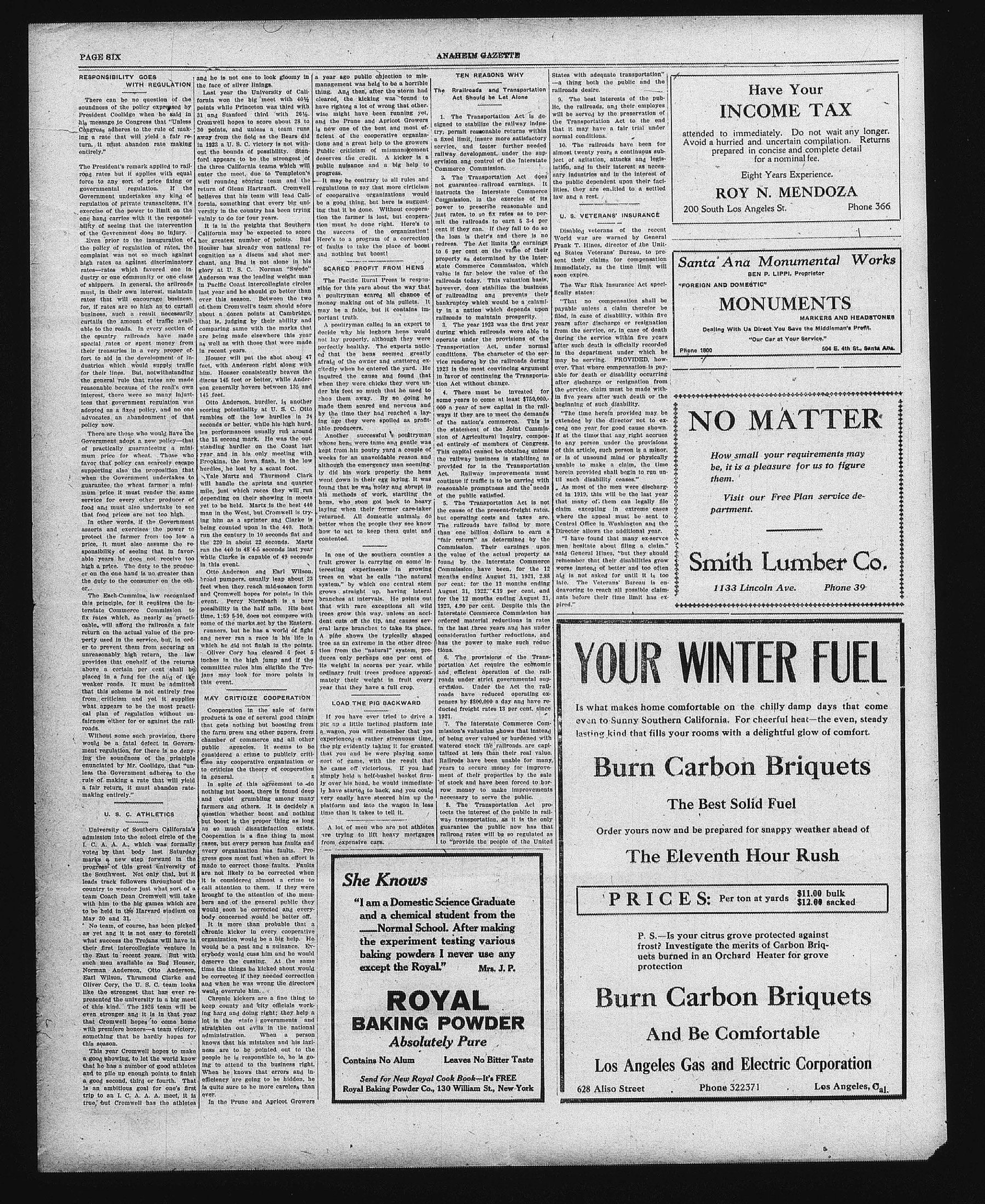
Searchable text
RESPONSIBILITY GOES WITH REGULATION
There can be no question of the soundness of the policy expressed by President Coolidge when he said in his message to Congress that "Unless Congress adheres to the rule of making a rate that will yield a fair return, it must abandon rate making entirely."
The President's remark applied to railroad rates but it applies with equal force to any sort of price fixing or governmental regulation. If the Government undertakes any kind of regulation of private transactions, it's exercise of the power to limit on the one hand carries with it the responsibility of seeing that the intervention of the Govenment does no injury.
Even prior to the inauguration of the policy of regulation of rates, the complaint was not so much against high rates as against discriminatory rates—rates which favored one industry or one community or one class of shippers. In general, the ariloads must, in their own interest, maintain rates that will encourage business, for, if rates are so high as to curtail business, such a result necessarily curtails the amount of traffic available to the roads. In every section of the country railroads have made special rates or spent money from their treasuries in a very proper effort to aid in the development of industries which would supply traffic for their lines. But, notwithstanding the general rule that rates are made reasonable because of the road's own interest, there were so many injustices that government regulation was adopted as a fixed policy, and no one advocates an abandonment of that policy now.
There are those who would have the Government adopt a new policy—that of practically guaranteeing a mini-
and he is not one to look gloomy in the face of silver linings.
Last year the University of California won the big meet with 40½ points while Princeton was third with 31 and Stanford third with 26½. Cromwell hopes to score about 28 to 30 points, and unless a team runs away from the field as the Bears did in 1923 a U. S. C. victory is not without the bounds of possibility. Stanford appears to be the strongest of the three California teams which will enter the meet, due to Templeton's well rounded scoring team and the return of Glenn Hartranft. Cromwell believes that his team will lead California, something that every big university in the country has been trying vainly to do for four years.
It is in the weights that Southern California may be expected to score her greatest number of points. Bud Houser has already won national recognition as a discus and shot merchant, and Bud is not alone in his glory at U. S. C. Norman "Swede" Anderson was the leading weight man in Pacific Coast intercollegiate circles last year and he should go better than over this season. Between the two of them Cromwell's team should score about a dozen points at Cambridge, that is, judging by their ability and comparing same with the marks that are being made elsewhere this year as well as with those that were made in recent years.
Houser will put the shot about 47 feet, with Anderson right along with him. Houser consistently heaves the discus 145 feet or better, while Anderson generally hovers between 135 and 145 feet.
Otto Anderson, hurdler, is another scoring potentiality at U. S. C. Otto rambles off the low hurdles in 24 seconds or better, while his high hurdles performances usually run around the 15 second mark. He was the outstanding hurdler on the Coast last a year ago public management was thing. And then, cleared, the kick have righted a lot wise might have and the Prune age is now one of the ficient of the coctions and a great Public criticism deserves the crea public nuisance progress.
It may be contrary regulations to say of cooperative be a good thing, ing that it be done tion the farmer must be done the success of Here's to a prog of faults to take and nothing but.
SCARED PROJECT
The Pacific Riversible for this year a poultryman seo money making o may be a fable, portant truth.
A poultryman decide why his not lay properly, perfectly healthy ed that he affraid of the own citedly when he e inquired the ca when they were der his feet so ro schoo them away made them scar by the time they ing age they w able producers.
Another succ whose hen were
fort to aid in the development of industries which would supply traffic for their lines. But, notwithstanding the general rule that rates are made reasonable because of the road's own interest, there were so many injustices that government regulation was adopted as a fixed policy, and no one advocates an abandonment of that policy now.
There are those who would have the Government adopt a new policy—that of practically guaranteeing a minimum price for wheat. Those who favor that policy can scarcely escape supporting also the proposition that when the Government undertakes to guarantee the wheat farmer a minimum price it must render the same service for every other producer of food and must also undertake to see that food prices are not too high.
In other words, if the Government assists and exercises the power to protect the farmer from too low a price, it must also assume the responsibility of seeing that in favorable years he does not receive too high a price. The duty to the producer on the one hand is no greater than the duty to the consumer on the other.
The Esch-Cummins law recognized this principle, for it requires the Interstate Commerce Commission to fix rates which, as nearly as practicable, will afford the railroads a fair return on the actual value of the property used in the service, but, in order to prevent them from securing an unreasonably high return, the law provides that one half of the returns above a certain per cent shall be placed in a fund for the aid of the weaker roads. It must be admitted that this scheme is not entirely free from criticism and yet it supplies what appears to be the most practical plan of regulation without unfairness either for or against the railroads.
Without some such provision, there would be a fatal defect in Government regulation, for there is no denying the soundness of the principle enunciated by Mr. Coolidge, that "unless the Government adheres to the rule of making a rate that will yield a fair return, it must abandon rate-making entirely."
U. S. C. ATHLETICS
University of Southern California's admission into the select circle of the I. C. A. A. A., which was formally ratified on July 15th Saturday.
Houser will put the shot about 47 feet, with Anderson right along with him. Houser consistently heavens the discus 145 feet or better, while Anderson generally hovers between 135 and 145 feet.
Otto Anderson, hurdler, is another scoring potentiality at U. S. C. Otto rambles off the low hurdles in 24 seconds or better, while his high hurdles performances usually run around the 15 second mark. He was the outstanding hurdler on the Coast last year and in his only meeting with Prookins, the Iowa flash, in the low hurdles, he lost by a scant foot.
Yale Martz and Thurmond Clark will handle the sprints and quarter mile, just which races they will run depending on their showing in meets yet to be held. Martz is the best 440 man in the West, but Cromwell is trying him as a sprinter and Clarke is being counted upon in the 440. Both run the century in 10 seconds flat and the 220 in about 22 seconds. Martz ran the 440 in 48 4-5 seconds last year while Clarke is capable of 49 seconds in this event.
Otto Anderson and Earl Wilson, broad pumpers, usually leap about 23 feet when they reach mid-season form and Cromwell hopes for points in this event. Percy Niersbach is a bare possibility in the half mile. His best time, 1:59 5-10, does not compare with some of the marks set by the Eastern runners, but he has a world of fight and never ran a race in his life in which he did not finish in the points.
Oliver Cory has cleared 6 feet 5 inches in the high jump and if the committee rules him eligible the Trojans may look for more points in this event.
MAY CRITICIZE COOPERATION
Cooperation in the sale of farm products is one of several good things that gets nothing but boosting from the farm press and other papers, from chamber of commerce and all other public agencies. It seems to be considered a crime to publicly criticise any cooperative organization or to criticize the theory of cooperation in general.
In spite of this agreement to do nothing but boost, there is found deep and quiet grumbling among many farmers and others. It is decidedly a question whether boost and nothing but boost is the proper thing as long as so much dissatisfaction exists. Cooperation is a fine thing in most cases, but every person has faults and every organization has faults.
LOAD THE Fruit grower is interesting experience on what system," by which grows straight branches at intersections with rare trees grow this dent cuts off these eral large branches. A pike shows tree as an extrection from the "produces only perils its weight in an ordinary fruit tree mately their wint year that they h...
U. S. C. ATHLETICS
University of Southern California's admission into the select circle of the I. C. A. A. A., which was formally voted by that body last Saturday marks a new step forward in the progress of this great university of the Southwest. Not only that, but it leads track followers throughout the country to wonder just what sort of a team Coach Dean Cromwell will take with him to the big games which are to be held in the Harvard stadium on May 30 and 31.
No team, of course, has been picked as yet and it is not easy to foretell what success the Trojans will have in their first intercollegiate venture in the East in recent years. But with such men available as Bud Houser, Norman Anderson, Otto Anderson, Earl Wilson, Thrumond Clarke and Oliver Cory, the U. S. C. team looks like the strongest that has ever represented the university in a big meet of this kind. The 1925 team will be even stronger and it is in that year that Cromwell hopes to come home with premiere honors—a team victory, something that he hardly hopes for this season.
This year Cromwell hopes to make a good showing, to let the world know that he has a number of good athletes and to pile up enough points to finish a good second, third or fourth. That is an ambitious goal for one’s first trip to an I. C. A. A. A. meet, it is true, but Cromwell has the athletes considered a crime to publicly criticize any cooperative organization or to criticize the theory of cooperation in general.
In spite of this agreement to do nothing but boost, there is found deep and quiet grumbling among many farmers and others. It is decidedly a question whether boost and nothing but boost is the proper thing as long as so much dissatisfaction exists. Cooperation is a fine thing in most cases, but every person has faults and every organization has faults. Progress goes most fast when an effort is made to correct those faults. Faults are not likely to be corrected when it is considered almost a crime to call attention to them. If they were brought to the attention of the members and of the general public they would soon be corrected and everybody concerned would be better off.
It is more than probable that a chronic kicker in every cooperative organization would be a big help. He would be a pest and a nuisance. Everybody would cuss him and he would deserve the cussing. At the same time the things he kicked about would be corrected if they needed correction and when he was wrong the directors would overrule him.
Chronic kickers are a fine thing to keep county and city officials working hard and doing right; they help a lot in the state governments and straighten out evils in the national administration. When a person knows that his mistakes and his laziness are to be pointed out to the people he is responsible to, he is going to attend to the business right. When he knows that errors and inefficiency are going to be hidden, he is quite sure to be more careless than ever.
In the Prune and Apricot Growers
ANAHEIM GAZETTE
A year ago public objection to mismanagement was held to be a horrible thing. And then, after the storm had cleared, the kicking was found to have righted a lot of wrong that otherwise might have been running yet, and the Prune and Apricot Growers is now one of the best and most efficient of the cooperative organizations and a great help to the growers Public criticism of mismanagement deserves the credit. A kicker is a public nuisance and a big help to progress.
It may be contrary to all rules and regulations to say that more cliticism of cooperative organizations would be a good thing, but here is suggesting that it be done. Without cooperation the farmer is lost, but cooperation must be done right. Here's to the success of the organization! Here's to a program of a correction of faults to take the place of boost and nothing but boost!
SCARED PROFIT FROM HENS
The Pacific Rural Press is responsible for this yarn about the way that a poultryman scared all chance of money making out of his pullets. It may be a fable, but it contains important truth.
A poultryman called in an expert to decide why his leghorn hens would not lay properly, although they were perfectly healthy. The experts noticed that the hens seemed greatly afraid of the owner and scattered excitedly when he entered the yard. He inquired the cause and found that when they were chicks they were under his feet so much that he used to choo them away. By so doing he made them scared and nervous and by the time they had reached a laying age they were spoiled as profitable producers.
Another successful poultryman whose hens were tame and gentle was sent from your town a couple of years ago public objection to mismanagement was held to be a horrible thing. And then, after the storm had cleared, the kicking was found to have righted a lot of wrong that otherwise might have been running yet, and the Prune and Apricot Growers is now one of the best and most efficient of the cooperative organizations and a great help to the growers Public criticism of mismanagement deserves the credit. A kicker is a public nuisance and a big help to progress.
TEN REASONS WHY
The Railroads and Transportation Act Should be Let Alone
1. The Transportation Act is designed to stabilize the railway industry, permit reasonable returns within a fixed limit, insure more satisfactory service, and foster further needed railway development, under the supervision and control of the Interstate Commerce Commission.
2. The Transportation Act does not guarantee railroad earnings. It instructs the Interstate Commerce Commission, in the exercise of its power to prescribe reasonable and just rates, to so fix rates as to permit the railroads to earn 5 3-4 per cent if they can. If they fail to do so the loss is their's and there is no redress. The Act limits the earnings to 6 per cent on the value of their property as determined by the Interstate Commerce Commission, which value is far below the value of the railroads today. This valuation basis, however, does stabilize the business of railroading and prevents their bankruptcy which would be a calamity in a nation which depends upon railroads to maintain prosperity.
3. The year 1923 was the first year during which railroads were able to operate under the provisions of the Transportation Act, under normal conditions. The character of the service rendered by the railroads during 1923 is the most convincing argument in favor of continuing the Transportation Act without change.
4. There must be invested for some years to come at least $750,000-a year of new capital in the railways if they are to meet the demands of the nation's commerce. This is the statement of the Joint Commission of Agricultural Inquiry, composed entirely of members of Congress.
States with adequate transportation"—a thing both the public and the railroads desire.
9. The best interests of the public, the railroads, and their employees will be served by the preservation of the Transportation Act to the end that it may have a fair trial under normal conditions.
10. The railroads have been for almost twenty years a continuous subject of agitation, attacks and legislation, and in their interest as necessary industries and in the interest of the public dependent upon their facilities, they are entitled to a settled law and a rest.
U. S. VETERANS' INSURANCE
Disabled veterans of the recent World war are warned by General Frank T. Hines, director of the United States Veterans' Bureau, to present their claims for compensation immediately, as the time limit will soon expire.
The War Risk Insurance Act specifically states:
"That no compensation shall be payable unless a claim therefor be filed, in case of disability, within five years after discharge or resignation from the service, or, in case of death during the service within five years after such death is officially recorded in the department under which he may be serving. PROVIDED, however. That where compensation is payable for death or disability occurring after discharge or resignation from the service, claim must be made within five years after such death or the beginning of such disability."
"The time herein provided may be extended by the director not to exceed one year for good cause shown. If at the time that any right accrues to any person under the provisions of this article such person is a minor."
Another successful poultryman whose hens were tame and gentle was kept from his poutry yard a couple of weeks for an unavoidable reason and although the emergency man seemingly did his work properly the hens went down in their egg laying. It was found that he was noisy and abrupt in his methods of work, startling the hens, who soon got back to heavy laying when their former care-taker returned. All domestic animals do better when the people they see know how to act to keep them quiet and contented.
In one of the southern counties a fruit grower is carrying on some interesting experiments in growing trees on what he calls "the natural system," by which one central stem grows straight up, having lateral branches at intervals. He points out that with rare exceptions all wild trees grow this way, unless an accident cuts off the tip, and causes several large branches to take its place. A pine shows the typically shaped tree as an extreme in the other direction from the "natural" system, produces only perhaps one per cent of its weight in acorns per year, while ordinary fruit trees produce approximately their weight in fruit every year that they have a full crop.
LOAD THE PIG BACKWARD
If you have ever tried to drive a pig up a little inclined platform into a wagon, you will remember that you experienced a rather strenuous time, the pig evidently taking it for granted that you and he were playing some sort of game, with the result that he came off victorious. If you had simply held a half-bushel basket firmly over his head, he would immediately have started to back, and you could very easily have steered him up the platform and into the wagon in less time than it takes to tell it.
A lot of men who are not athletes are trying to lift heavy mortgages from expensive cars.
The character of the service rendered by the railroads during 1923 is the most convincing argument in favor of continuing the Transportation Act without change.
4. There must be invested for some years to come at least $750,000,000 a year of new capital in the railways if they are to meet the demands of the nation's commerce. This is the statement of the Joint Commission of Agricultural Inquiry, composed entirely of members of Congress. This capital cannot be obtained unless the railway business is stabilized as provided for in the Transportation Act. Railway improvements must continue if traffic is to be carried with reasonable promptness and the needs of the public satisfied.
5. The Transportation Act is not the cause of the present freight rates, but operating costs and taxes are. The railroads have failed by more than one billion dollars to earn a "fair return" as determined by the Commission. Their earnings upon the value of the actual property as found by the Interstate Commerce Commission have been, for the 12 months ending August 31, 1921, 2.88 per cent; for the 12 months ending August 31, 1922, 4.19 per cent, and for the 12 months ending August 31, 1923, 4.90 per cent. Despite this the Interstate Commerce Commission has ordered material reductions in rates in the last three years and has under consideration further reductions, and has the power to make such reductions.
6. The provisions of the Transportation Act require the economic and efficient operation of the railroads under strict governmental supervision. Under the Act the railroads have reduced operating expenses by $800,000 a day and have reduced freight rates 13 per cent, since 1921.
7. The Interstate Commerce Commission's valuation shows that instead of being over valued or burdened with watered stock the railroads are capitalized at less than their real value. Railrods have been unable for many years to secure money for improvement of their properties by the sale of stock and have been forced to borrow money to make improvements necessary to serve the public.
8. The Transportation Act protects the interest of the public in railway transportation, as it is the only guarantee the public now has that railroad rates will be so regulated as to "provide the people of the United
She Knows
"I am a Domestic Science Graduate and a chemical student from the Normal School. After making the experiment testing various baking powders I never use any except the Royal." Mrs. J. P.
ROYAL
BAKING POWDER
Absolutely Pure
Contains No Alum Leaves No Bitter Taste
Send for New Royal Cook Book—It's FREE
Royal Baking Powder Co., 130 William St., New York
Have Your
INCOME TAX
attended to immediately. Do not wait any longer.
Avoid a hurried and uncertain compilation. Returns
prepared in concise and complete detail
for a nominal fee.
Eight Years Experience.
ROY N. MENDOZA
200 South Los Angeles St. Phone 366
Santa Ana Monumental Works
BEN P. LIPPI, Proprietor
"FOREIGN AND DOMESTIC"
MONUMENTS
MARKERS AND HEADSTONES
Dealing With Us Direct You Save the Middleman's Profit.
"Our Car at Your Service."
Phone 1800 504 E. 4th St., Santa Ana.
NO MATTER
NO MATTER
How small your requirements may be, it is a pleasure for us to figure them.
Visit our Free Plan service department.
Smith Lumber Co.
1133 Lincoln Ave. Phone 39
OUR WINTER FUEL
Makes home comfortable on the chilly damp days that come sunny Southern California. For cheerful heat—the even, steady and that fills your rooms with a delightful glow of comfort.
Return Carbon Briquets
The Best Solid Fuel
For yours now and be prepared for snappy weather ahead of
URN CARBON BRIQUETS
The Best Solid Fuel
For yours now and be prepared for snappy weather ahead of
The Eleventh Hour Rush
PRICES: Per ton at yards $11.00 bulk
$12.00 sacked
P. S.—Is your citrus grove protected against frost? Investigate the merits of Carbon Briquets burned in an Orchard Heater for grove protection
URN CARBON BRIQUETS
And Be Comfortable
Angeles Gas and Electric Corporation
Street Phone 322371 Los Angeles, Cal.