anaheim-gazette 1923-11-15
Scanned page
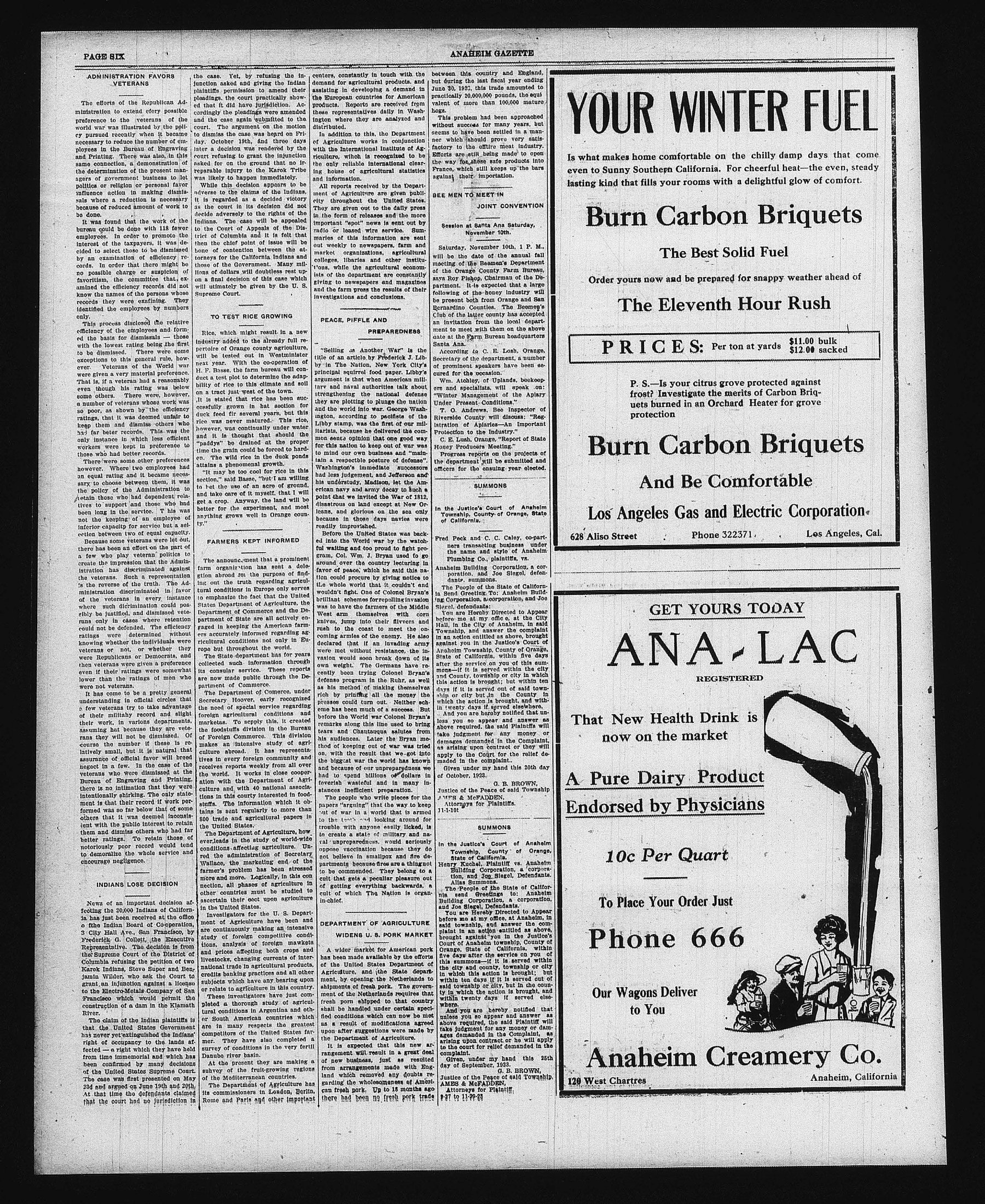
Searchable text
ADMINISTRATION FAVORS VETERANS
The efforts of the Republican Administration to extend efly possible preference to the veterans of the world war was illustrated by the policy pursued recently when it became necessary to reduce the number of employees in the Bureau of Engraving and Printing. There was also, in this same connection, a demonstration of the determination of the present managers of government business to let politics or religion or personal favor influence action in making dismissals where a reduction is necessary because of reduced amount of work to be done.
It was found that the work of the bureau could be done with 118 fewer employees. In order to promote the interest of the taxpayers, it was decided to select those to be dismissed by an examination of efficiency records. In order that there might be no possible charge or suspicion of favoritism, the committee that examined the efficiency records did not know the names of the persons whose records they were exafining. They identified the employees by numbers only.
This process disclosed the relative efficiency of the employees and formed the basis for dismissals — those with the lowest rating being the first to be dismissed. There were some exceptions to this general rule, however. Veterans of the World war were given a very material preference. That is, if a veteran had a reasonably even though his rating was below some others. There were, however, a number of veterans whose work was so poor, as shown by the efficiency ratings, that it was deemed unfair to keep them and dismiss others who had far better records. This was the only instance in which less efficient workers were kept in preference to the case. Yet, by refusing the injunction asked and giving the Indian plaintiffs permission to amend their pleadings, the court practically showed that it did have jurisdiction. Accordingly the pleadings were amended and the case again submitted to the court. The argument on the motion to dismiss the case was heard on Friday, October 19th, and three days later a decision was rendered by the court refusing to grant the injunction asked for on the ground that no irreparable injury to the Karok Tribe was likely to happen immediately.
While this decision appears to be adverse to the claims of the Indians, it is regarded as a decided victory as the court in its decision did not decide adversely to the rights of the Indians. The case will be appealed to the Court of Appeals of the District of Columbia and it is felt that then the chief point of issue will be bone of contention between the attorneys for the California Indians and those of the Government. Many millions of dollars will doubtless rest upon a final decision of this case which will ultimately be given by the U.S. Supreme Court.
TO TEST RICE GROWING
Rice, which might result in a new industry added to the already full repertoire of Orange county agriculture, will be tested out in Westminster next year. With the co-operation of H.F. Basse, the farm bureau will conduct a test plot to determine the adaptability of rice to this climate and soil on a tract just west of the town. It is stated that rice has been successfully grown in hat section for duck feed for several years, but this rice was never matured. This rice, however, was continually under water and it is thought that should the "paddys" be drained at the proper centers, constantly demand for agricultural assisting in developing European countries products. Reports these representativesington where they distributed.
In addition to the of Agriculture work with the International culture, which is the only reliable house of agriculture and information.
All reports recentment of Agriculture city throughout They are given out in the form of rel-important "spot" radio or leased waries of this in-ouat weekly to new market organizes, libraries, while the assists of the departr-giving to newspa-y and the farm press investigations and
PEACE, PIFFLE
Veterans of the World war were given a very material preference. That is, if a veteran had a reasonably even though his rating was below some others. There were, however, a number of veterans whose work was so poor, as shown by the efficiency ratings, that it was deemed unfair to keep them and dismiss others who had far better records. This was the only instance in which less efficient workers were kept in preference to those who had better records.
There were some other preferences however. Where two employees had an equal rating and it became necessary to choose between them, it was the policy of the Administration to retain those who had dependent relatives to support and those who had been long in the service. This was not the keeping of an employee of inferior capacity for service but a selection between two of equal capacity.
Because some veterans were let out, there has been an effort on the part of a few who play veteran politics to create the impression that the Administration has discriminated against the veterans. Such a representation is the reverse of the truth. The Administration discriminated in favor of the veterans in every instance where such discrimination could possibly be justified, and dismissed veterans only in cases where retention could not be defended. The efficiency ratings were determined without knowing whether the individuals were veterans or not, or whether they were Republicans or Democrats, and then veterans were given a preference even if their ratings were somewhat lower than the ratings of men who were not veterans.
It has come to be a pretty general understanding in official circles that a few veterans try to take advantage of their military record and slight their work, in various departments, assuming they are veterans they will not be dismissed. Of course the number if these is relatively small, but it is natural that assurance of official favor will breed neglect in a few. In the case of the veterans who were dismissed at the Bureau of Engraving and Printing, there is no intimation that they were intentionally shirking. The only statement is that their record if work performed was so far below that of some others that it was deemed inconsistent with the public interest to retain them and dismiss others who had far better ratings. To retain those of notoriously poor record would tend exceptions to this general rule, however.
Veterans of the World war were given a very material preference. That is, if a veteran had a reasonably even though his rating was below some others. There were, however, a number of veterans whose work was so poor, as shown by the efficiency ratings, that it was deemed unfair to keep them and dismiss others who had far better records. This was the only instance in which less efficient workers were kept in preference to those who had better records.
There were some other preferences however. Where two employees had an equal rating and it became necessary to choose between them, it was the policy of the Administration to retain those who had dependent relatives to support and those who had been long in the service. This was not the keeping of an employee of inferior capacity for service but a selection between two of equal capacity.
Because some veterans were let out, there has been an effort on the part of a few who play veteran politics to create the impression that the Administration has discriminated against the veterans. Such a representation is the reverse of the truth. The Administration discriminated in favor of the veterans in every instance where such discrimination could possibly be justified, and dismissed veterans only in cases where retention could not be defended. The efficiency ratings were determined without knowing whether the individuals were veterans or not, or whether they were Republicans or Democrats, and then veterans were given a preference even if their ratings were somewhat lower than the ratings of men who were not veterans.
It has come to be a pretty general understanding in official circles that a few veterans try to take advantage of their military record and slight their work, in various departments, assuming they are veterans they will not be dismissed. Of course the number if these is relatively small, but it is natural that assurance of official favor will breed neglect in a few. In the case of the veterans who were dismissed at the Bureau of Engraving and Printing, there is no intimation that they were intentionally shirking. The only statement is that their record if work performed was so far below that of some others that it was deemed inconsistent with the public interest to retain them and dismiss others who had far better ratings. To retain those of notoriously poor record would tend exceptions to this general rule, however.
Veterans of the World war were given a very material preference. That is, if a veteran had a reasonably even though his rating was below some others. There were, however, a number of veterans whose work was so poor, as shown by the efficiency ratings, that it was deemed unfair to keep them and dismiss others who had far longer in the service. This was the only instance in which less efficient workers were kept in preference to those who had better records.
There were some other preferences however. Where two employees had an equal rating and it became necessary to choose between them, it was the policy of the Administration to retain those who had dependent relatives to support and those who had been long in the service. This was not the keeping of an employee of inferior capacity for service but a selection between two of equal capacity.
Because some veterans were let out, there has been an effort on the part of a few who play veteran politics to create the impression that the Administration has discriminated against the veterans. Such a representation is the reverse of the truth. The Administration discriminated in favor of the veterans in every instance where such discrimination could possibly be justified, and dismissed veterans only in cases where retention could not be defended. The efficiency ratings were determined without knowing whether the individuals were veterans or not, or whether they were Republicans or Democrats, and then veterans were given a preference even if their ratings were somewhat lower than the ratings of men who were not veterans.
It has come to be a pretty general understanding in official circles that a few veterans try to take advantage of their military record and slight their work, in various departments, assuming they are veterans they will not be dismissed. Of course the number if these is relatively small, but it is natural that assurance of official favor will breed neglect in a few. In the case of the veterans who were dismissed at the Bureau of Engraving and Printing, there is no intimation that they were intentionally shirking. The only statement is that their record if work performed was so far below that of some others that it was deemed inconsistent with the public interest to retain them and dismiss others who had far better ratings. To retain those of notoriously poor record would tend exceptions to this general rule, however.
Veterans of the World war were given a very material preference. That is, if a veteran had a reasonably even though his rating was below some others. There were, however, a number of veterans whose work was so poor, as shown by the efficiency ratings, that it was deemed unfair to keep them and dismiss others who had far longer in the service. This was not the keeping of an employee of inferior capacity for service but a selection between two of equal capacity.
Because some veterans were let out, there has been an effort on the part of a few who play veteran politics to create the impression that the Administration has discriminated against the veterans. Such a representation is the reverse of the truth. The Administration discriminated in favor of the veterans in every instance where such discrimination could possibly be justified, and dismissed veterans only in cases where retention could not be defended. The efficiency ratings were determined without knowing whether the individuals were veterans or not, or whether they were Republicans or Democrats, and then veterans were given a preference even if their ratings were somewhat lower than the ratings of men who were not veterans.
It has come to be a pretty general understanding in official circles that a few veterans try to take advantage of their military record and slight their work, in various departments, assuming they are veterans they will not be dismissed. Of course the number if these is relatively small, but it is natural that assurance of official favor will breed neglect in a few. In the case of the veterans who were dismissed at the Bureau of Engraving and Printing, there is no intimation that they were intentionally shirking. The only statement is that their record if work performed was so far below that of some others that it was deemed inconsistent with the public interest to retain them and dismiss others who had far better ratings. To retain those of notoriously poor record would tend exceptions to this general rule, however.
Veterans of the World war were given a very material preference. That is, if a veteran had a reasonably even though his rating was below some others. There were, however, a number of veterans whose work was so poor, as shown by the efficiency ratings, that it was deemed unfair to keep them and dismiss others who had far longer in the service. This was not the keeping of an employee of inferior capacity for service but a selection between two of equal capacity.
Because some veterans were let out, there has been an effort on the part of a few who play veteran politics to create the impression that the Administration has discriminated against the veterans. Such a representation is the reverse of the truth. The Administration discriminated in favor of the veterans in every instance where such discrimination could possibly be justified, and dismissed veterans only in cases where retention could not be defended. The efficiency ratings were determined without knowing whether the individuals were veterans or not, or whether they were Republicans or Democrats, and then veterans were given a preference even if their ratings were somewhat lower than the ratings of men who were not veterans.
It has come to be a pretty general understanding in official circles that a few veterans try to take advantage of their military record and slight their work, in various departments, assuming they are veterans they will not be dismissed. Of course the number if these is relatively small, but it is natural that assurance of official favor will breed neglect in a few. In the case of the veterans who were dismissed at the Bureau of Engraving and Printing, there is no intimation that they were intentionally shirking. The only statement is that their record if work performed was so far below that of some others that it was deemed inconsistent with the public interest to retain them and dismiss others who had far better ratings. To retain those of notoriously poor record would tend exceptions to this general rule, however.
Veterans of the World war were given a very material preference. That is, if a veteran had a reasonably even though his rating was below some others. There were, however, a number of veterans whose work was so poor, as shown by the efficiency ratings, that it was deemed unfair to keep them and dismiss others who had far longer in the service. This was not the keeping of an employee of inferior capacity for service but a selection between two of equal capacity.
Before the United into the World ful waiting and too gram, Col. Wm., around over the flavor of peace; wition could procure tthe whole world d wouldn't fight. On brilliant schemes was to have he f West arm them knives; jump into rush to tha coo coming armies off declared that if were met without vasion would soon own weight. Thently been try defense program as his method o rich by printing presses could turme has been mu before The World remarks along tha tears and Chau his audiences. I hod o keeping on with tha resihe bigost war and because o o had to spend b feverish wastefe stances ineffiecnts
The people wh papers "arguing" out of war in alto tha tenth any trouble with any o create a statu al unprepared oppose vaccinat
assurance of official favor will breed neglect in a few. In the case of the veterans who were dismissed at the Bureau of Engraving and Printing, there is no intimation that they were intentionally shirking. The only statement is that their record if work performed was so far below that of some others that it was deemed inconsistent with the public interest to retain them and dismiss others who had far better ratings. To retain those of notoriously poor record would tend to demoralize the whole service and encourage negligence.
INDIANS LOSE DECISION
News of an important decision affecting the 20,000 Indians of California has just been received at the office of the Indian Board of Cooperation, 3 City Hall Ave., San Francisco, by Frederick G. Collett, the Executive Representative. The decision is from the Supreme Court of the District of Columbia refusing the petition of two Karok Indians, Steve Super and Benjamin Wilder, who ask the Court to grant an injunction against a license to the Electro-Metals Company of San Francisco which would permit the construction of a dam in the Klamath River.
The claim of the Indian plaintiffs is that the United States Government has never yet extinguished the Indians' right of occupancy to the lands affected—a right which they have held from time immemorial and which has been confirmed by many decisions of the United States Supreme Court. The case was first presented on May 23d and argued on June 19th and 20th. At that time the defendants claimed that the court had no jurisdiction in matters in every foreign community and receives reports weekly from all over the world. It works in close cooperation with the Department of Agriculture and with 40 national associations in this courtyard interested in foodstuffs. The information which it obtains is sent regularly to more than 800 trade and agricultural papers in the United States.
The Department of Agriculture, however, leads in the study of world-wide conditions affecting agriculture. Unred the administration of Secretary Wallace, the marketing end of the farmer's problem has been stressed more and more. Logically, in this connection, all phases of agriculture in other countries must be studied to ascertain their effect upon agriculture in the United States.
Investigators for the U.S. Department of Agriculture have been and are continuously making an intensive study of foreign competitive conditions, analysis of foreign mawkets and prices affecting both crops and livestock, changing currents of international trade in agricultural products, credits banking practices and all other subjects which have any bearing upon or relate to agriculture in this country.
These investigators have just completed a thorough study of agricultural conditions in Argentina and other South American countries which are in many respects the greatest competitors of the United States farmer. They have also completed a survey of conditions in the very fertile Danube river basin.
At the present they are making a subway of the fruit-growing regions of the Mediterranean countries.
The Department of Agriculture has its commissioners in London, Berlin, Rome and Paris and other important
ANAHEIM GAZETTE
centers, constantly in touch with the demand for agricultural products, and assisting in developing a demand in the European countries for American products. Reports are received from these representatives daily in Washington where they are analyzed and distributed.
In addition to this, the Department of Agriculture works in conjunction with the International Institute of Agriculture, which is recognized to be the only reliable international clearing house of agricultural statistics and information.
All reports received by the Department of Agriculture are given public throughout the United States. They are given out to the daily press in the form of releases and the more important "epot" news is sent out by radio or leased wire service. Summaries of this information are sent out weekly to newspapers, farm and market organizations, agricultural colleges, libraries and other institutions, while the agricultural economists of the department are constantly giving to newspapers and magazines and the farm press the results of their investigations and conclusions.
PEACE, PIFFLE AND PREPAREDNESS
"Selling as Another War" is the title of an article by Frederick J. Libby in The Nation, New York City's principal squirrel food paper. Libby's argument is that when American military and naval authorities talk about strengthening the national defense they are plotting to plunge the nation and the world into war. George Washington, according to pacifists of the Libby stamp, was the first of our militarists, because he delivered the common sense opinion that one good way for this nation to keep out of war was between this country and England, but during the last fiscal year ending June 30, 1920, this trade amounted to practically 20,000,000 pounds, the equivalent of more than 100,000 mature hogs.
This problem had been approached without success for many years, but seems to have been settled in a manner which should prove very satisfactory to the entire meat industry. Efforts are still being made to open the way for these safe products into France, which still keeps up the bars against their importation.
BEE MEN TO MEET IN
JOINT CONVENTION
Session at Santa Ana Saturday, November 10th.
Saturday, November 10th, 1 P.M., will be the date of the annual fall meeting of the Beemen's Department of the Orange County Farm Bureau, says Roy Pishop, Chairman of the Department. It is expected that a large following of the honey industry will be present both from Orange and San Bernardino Counties. The Beemen's Club of the latter county has accepted an invitation from the local department to meet with them on the above date at the Farm Bureau headquarters Santa Ana.
According to C. E. Losh, Orange, Secretary of the department, a number of prominent speakers have been secured for the occasion.
Wm. Atchley, of Uplands, beekeepers and specialists, will speak on: "Winter Management of the Apiary Under Present Conditions."
T. O. Andrews, Bee Inspector of Riverside County will discuss: "Registration of Aplaries—An Important Protection to the Industry."
C. E. Luah, Orange, "Report of State Honey Producers Meeting."
title of an article by Frederick J. Libby in The Nation, New York City's principal squirrel food paper. Libby's argument is that when American military and naval authorities talk about strengthening the national defense they are plotting to plunge the nation and the world into war. George Washington, according to pacifists of the Libby stamp, was the first of our militarists, because he delivered the common santa opinion that one good way for this nation to keep out of war was to mind our own business and "maintain a respectable posture of defense". Washington's immediate successors had less judgement, and Jefferson and his understudy, Madison, let the American navy and army decay to such a point that we invited the War of 1812, disastrous on land except at New Orleans, and glorious on the sea only because in those days navies were readily improvised.
Before the United States was backed into the World war by the watchful waiting and too proud to fight program, Col. Wm. J. Bryan used to go around over the country lecturing in favor of peace, which he said this nation could procure by giving notice to the whole world that it couldn't and wouldn't fight. One of Colonel Bryan's brilliant schemes for repelling invasion was to have the farmers of the Middle West arm themselves with corn knives, jump into their flivvers and rush to the coast to meet the incoming armies of the enemy. He also declared that if an invading army were met without resistance, the invasion would soon break down of its own weight. The Germans have recently been trying Colonel Bryan's defense program in the Ruhr, as well as his method of making themselves rich by printing all the money the presses could turn out. Neither scheme has been much of a success. But before the World war Colonel Bryan's remarks along this line used to bring tears and Chautauqua salutes from his audiences. Later the Bryan method of keeping out of war was tried on, with the result that we got into the biggest war the world has known and because of our unpreparedness we had to spend billions of dollars in feverish wasteful and in many instances inefficient preparation.
The people who write pieces for the papers "arguing" that the way to keep out of war in a world that is armed to the tooth and looking around for trouble with anyone easily licked, is to create a state of military and naval unpreparedness, would seriously oppose vaccination because they do Secretary of the department, a number of prominent speakers have been secured for the occasion.
Wm. Atchley, of Uplands, beekeepers and specialists, will speak on: "Winter Management of the Apiary Under Present Conditions."
T. O. Andrews, Bee Inspector of Riverside County will discuss: "Registration of Apiaries—An Important Protection to the Industry."
C. E. Lush, Orange, "Report of State Honey Producers Meeting."
Progress reports on the projects of the department will be submitted and officers for the ensuing year elected.
SUMMONS
In the Justice's Court of Anaheim Township, County of Orange, State of California.
Fred Peck and C. C. Caley, co-partners transacting business under the name and style of Anaheim Plumbing Co., plaintiffs, vs.
Anaheim Building Corporation, a corporation, and Joe Siegel, defendants.
The People of the State of California Send Greeting To: Anaheim Building Corporation, corporation, and Joe Siegel, defendants:
You are hereby Directed to Appear before me at my office, at the City Hall, in the City of Anaheim, in said Township, and answer the complaint in an action entitled as above, brought against you in the Justice's Court of Anaheim Township, County of Orange, State of California, within five days after the service on you of this summons—if it is served within the city and County, township or city in which this action is brought; but within ten days if it is served out of said township or city but in the County in which the action is brought, and within twenty days if served elsewhere.
And you are hereby notified that unless you so appear and answer as above required, the said Plaintiffs will take judgment for any money or damages demanded in the Complaint, as arising upon contract or they will apply to the Court for the relief demanded in the complaint.
Given under my hand this 20th day of October, 1923.
G. B. BROWN,
Justice of the Peace of said Township AMES & McFADDEN,
Attorneys for Plaintiffs.
11-1-10t
DEPARTMENT OF AGRICULTURE
WIDENS U. S. PORK MARKET
A wider market for American pork has been made available by the efforts of the United States Department of Agriculture, and the State department, by opening the Netherlands to shipments of fresh pork. The government of the Netherlands requires that fresh pork shipped to that country shall be handled under certain specified conditions which can now be met as a result of modifications agreed upon after suggestions were made by the Department of Agriculture.
It is expected that this new arrangement will result in a great deal of new business, just as resulted from arrangements made with England which removed any doubts regarding the wholesomeness of American fresh pork. Up to 18 months ago there had been no fresh pork trade
SUMMONS
In the Justice's Court of Anaheim Township, County of Orange, State of California.
Henry Kuchel, Plaintiff vs. Anaheim Building Corporation, a corporation, and Joe Siegel, Defendants.
Allas Summons.
The People of the State of California send Greetings to: Anaheim Building Corporation, a corporation, and Joe Siegel, Defendants.
You are hereby Directed to Appear before me at my office, at Anaheim, in said township, and answer the complaint in an action entitled as above, brought against you in the Justice's Court of Anaheim township, County of Orange, State of California, within five days after the service on you of this summons—if it is served within the city and county, township or city in which this action is brought; but within ten days if it is served out of said township or city, but in the county in which the action is brought, and within twenty days if served elsewhere.
And you are hereby notified that unless you so appear and answer as above required, the said Plaintiff will take judgment for any money or damages demanded in the Complaint, as arising upon contract or he will apply to the court for relief demanded in the complaint.
Given, under my hand this 25th day of September, 1923.
G. B. BROWN,
Justice of the Peace of said Township,
AMES & McFADDEN,
Attorneys for Plaintiff,
9-27 to 11-29-28
OUR WINTER FUEL
kees home comfortable on the chilly damp days that come
any Southern California. For cheerful heat—the even, steady
that fills your rooms with a delightful glow of comfort.
Burn Carbon Briquets
The Best Solid Fuel
yours now and be prepared for snappy weather ahead of
The Eleventh Hour Rush
PRICES: Per ton at yards $11.00 bulk
$12.00 sacked
P. S.—Is your citrus grove protected against frost? Investigate the merits of Carbon Briquets burned in an Orchard Heater for grove protection
P. S.—Is your citrus grove protected against frost? Investigate the merits of Carbon Briquets burned in an Orchard Heater for grove protection
Turn Carbon Briquets
And Be Comfortable
Los Angeles Gas and Electric Corporation
Street Phone 322371 Los Angeles, Cal.
GET YOURS TODAY
ANA-LAC
REGISTERED
New Health Drink is now on the market
Dairy Product used by Physicians
re Dairy Product
used by Physicians
0c Per Quart
Place Your Order Just
phone 666
Wagons Deliver
to You
Anaheim Creamery Co.
chartres
Anaheim, California