anaheim-gazette 1923-10-25
Scanned page
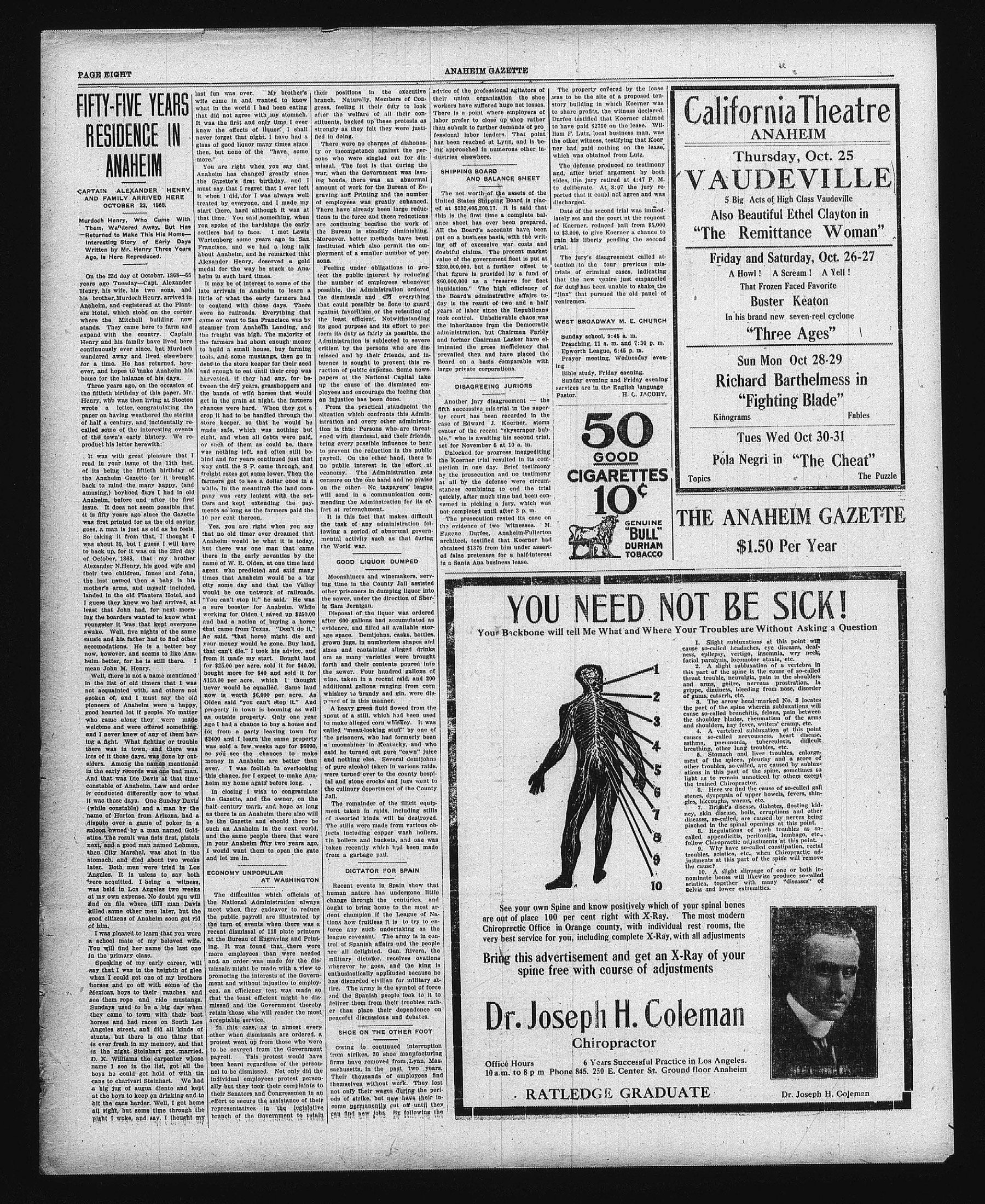
Searchable text
FIFTY-FIVE YEARS RESIDENCE IN ANAHEIM
CAPTAIN ALEXANDER HENRY AND FAMILY ARRIVED HERE OCTOBER 23, 1868.
Murdoch Henry, Who Came With Them, Wandered Away, But Has Returned to Make This His Home—Interesting Story of Early Days Written by Mr. Henry Three Years Ago, is Here Reproduced.
On the 23d day of October, 1868—55 years ago Tuesday—Capt. Alexander Henry, his wife, his two sons, and his brother, Murdoch Henry, arrived in Anaheim, and registered at the Planters Hotel, which stood on the corner where the Mitchell building now stands. They came here to farm and expand with the country. Captain Henry and his family have lived here continuously ever since, but Murdoch wandered away and lived elsewhere for a time. He has returned, however, and hopes to make Anaheim his home for the balance of his days.
Three years ago, on the occasion of the fiftieth birthday of this paper, Mr. Henry, who was then living at Stocton wrote a letter, congratulating the paper on having weathered the storms of half a century, and incidentally recalled some of the interesting events of the town's early history. We reproduce his letter herewith:
last fun was over. My brother's wife came in and wanted to know what in the world I had been eating that did not agree with my stomach. It was the first and only time I ever knew the effects of liquor. I shall never forget that night. I have had a glass of good liquor many times since then, but none of the "have some more."
You are right when you say that Anaheim has changed greatly since the Gazette's first birthday, and I must say that I regret that I ever left it when I did. For I was always well treated by everyone, and I made my start there, hard although it was at that time. You said something, when you spoke of the hardships the early settlers had to face. I met Lewis Wartenberg some years ago in San Francisco, and we had a long talk about Anaheim, and he remarked that Alexander Henry, deserved a gold medal for the way he stuck to Anaheim in such hard times.
It may be of interest to some of the late arrivals in Anaheim to learn a little of what the early farmers had to contend with those days. There were no railroads. Everything that came or went to San Francisco was by steamer from Anaheim Landing, and the freight was high. The majority of the farmers had about enough money to build a small house, buy farming tools, and some mustangs, then go in debt to the store keeper for their seed and enough to eat until their crop was harvested, if they had any, for between the dry years, grasshoppers and the bands of wild horses that would get in the grain at night, the farmers chances were hard. When they got a crop it had to be handled through the store keeper, so that he would be made safe, which was nothing but right, and when all debts were paid, or such of them as could be, there their positions in branch. Naturally grees, feeling it after the welfare stituents, backed up strongly as they fled in doing.
There were no ty or incompetence sons who were missal. The fact war, when the Good bonds, there amount of work for graving and Print of employees was There have already tions in the force are continuing by the Bureau is so Moreover, better instituted which employment of a smoons.
Feeling underfect the public is the number of possible, the Add the dismissals and that could possibly against favoritism the least efficient its good purpose form its duty as Administration is criticism by the pmissed and by the buonce is sought reuction of public papers at the N up the cause of employees and enco an injustice has
From the prais situation which o istration and evi tion is this: Per ened with dismis bring every possi
wandored away and lived elsewhere for a time. He has returned, however, and hopes to make Anaheim his home for the balance of his days.
Three years ago, on the occasion of the fifteenth birthday of this paper, Mr. Henry, who was then living at Stocton wrote a letter, congratulating the paper on having weathered the storms of half a century, and incidentally recalled some of the interesting events of the town's early history. We reproduce his letter herewith:
It was with great pleasure that I read in your issue of the 11th inst. of its being the fifteenth birthday of the Anaheim Gazette for it brought back to mind the many happy, (and amusing,) boyhood days I had in old Anaheim, before and after the first issue. It does not seem possible that it is fifty years ago since the Gazette was first printed for as the old saying goes, a man is just as old as he feels. So taking it from that, I thought I was about 35, but I guess I will have to back up, for it was on the 23rd day of October, 1868, that my brother Alexander N.Henry, his good wife and their two children, Innes and John, the last named then a baby in his mother's arms, and myself included, landed in the old Planters Hotel, and I guess they knew we had arrived, at least that John had, for next-morning the boarders wanted to know what youngster it was that kept everyone awake. Well, five nights of the same music and his father had to find other accommodations. He is a better boy now, however, and seems to like Anaheim better, for he is still there. I mean John M. Henry.
Well, there is not a name mentioned in the list of old timers that I was not acquainted with, and others not spoken of, and I must say the old pioneers of Anaheim were a happy, good hearted lot if people. No matter who came along they were made welcome and were offered something. And I never knew of any of them having a fight. What fighting or trouble there was in town, and there was lots of it those days, was done by outsiders. Among the names mentioned in the early records was one bad man. And that was Die Davis at that time constable of Anaheim. Law and order is conducted differently now to what it was those days. One Sunday Davis (while constable) and a man by the name of Horton from Arizona, had a dispute over a game of poker in a saloon owned by a man named Goldstine. The result was fists first, pistols next, and a good man named Lehman,
tools, and some mustangs, then go in debt to the store keeper for their seed and enough to eat until their crop was harvested, if they had any, for between the dry years, grasshoppers and the bands of wild horses that would get in the grain at night, the farmers chances were hard. When they got a crop it had to be handled through the store keeper, so that he would be made safe, which was nothing but right, and when all debts were paid, or such of them as could be, there was nothing left, and often still behind and for years continued just that way until the S.P. came through, and freight rates got some lower. Then the farmers got to see a dollar once in a while. In the meantime the land company was very lenient with the settlers and kept extending the payments so long as the farmers paid the 10 per cent thereon.
Yes, you are right when you say that no old timer ever dreamed that Anaheim would be what it is today, but there was one man that came there in the early seventies by the name of W.R.Olden, at one time land agent who predicted and said many times that Anaheim would be a big city some day and that the Valley would be one network of railroads. "You can't stop it," he said. He was a sure booster for Anaheim. While working for Olden I saved up $250.00 and had a notion of buying a horse that came from Texas. "Don't do it," he said, "that horse might die and your money would be gone. Buy land, that can't die." I took his advice, and from it made my start. Bought land for $25.00 per acre, sold it for $40.00, bought more for $40 and sold it for $151.00 per acre, which I thought never would be equalled. Same land now is worth $6,000 per acre. As Olden said "you can't stop it." And property in town is booming as well outside property. Only one year ago I had a chance to buy a house and lot from a party leaving town for $2400 and I learn the same property was sold a few weeks ago for $6000, so you see the chances to make money in Anaheim are better than ever. I was foolish in overlooking this chance, for I expect to make Anaheim my home again before long.
In closing I wish to congratulate the Gazette, and she owner, on the half century mark, and hope as long as there is an Anaheim there also will be such an Anaheim in the next world, and the same people there that were in your Anaheim fifty two years ago. I would want them to open the gate missed and by buceism is sought outduction of public papers at the N up the cause of ployees and enco an injustice has
From the prais situation which o distraction and eviction is this: Per enced with dismiss bring every possi to prevent the re payroll. On ther no public intere economy. The censure on the o on the other will send in an mending the Ad fort at retrench.
It is this faci the task of an lowing a period mental activity; the World war.
GOOD LIGHT
Moonshiners ing time in ther other prisoners s the sewer; under ig Sam Jernigal
Disposal of tha after 600 gallon evidence,and fi age space. Dew grown jugs,i n sizes and cont om as many w forth and their sewer. For wine,taken in additional gallo whiskey to brass posed of in this.
A heavy grease spout of a still to make alleged called "mean-loe the prisoners," a moonshiner said he turned and nothing eld of pure alcohol were turned ovital and stone o the culinary de Jail.
The remain ment taken in assorted kj The stills were jects including tin boilers an taken recently
Among the names mentioned in the early records was one bad man. And that was Die Davis at that time constable of Anaheim. Law and order is conducted differently now to what it was those days. One Sunday Davis (while constable) and a man by the name of Horton from Arizona, had a dispute over a game of poker in a saloon owned by a man named Goldstine. The result was fists first, pistols next, and a good man named Lehman, then City Marshal, was shot in the stomach, and died about two weeks later. Both men were tried in Los Angeles. It is useless to say both were acquitted. I being a witness, was held in Los Angeles two weeks at my own expense. No doubt you will find on file where this man Davis killed some other men later, but the good citizens of Anaheim soon got rid of him.
I was pleased to learn that you were a school mate of my beloved wife. You will find her name the last one in the primary class.
Speaking of my early career, will say that I was in the height of glee when I could get one of my brothers horses and go off with some of the Mexican boys to their ranches and see them rope and ride mustangs. Sundays used to be a big day when they came to town with their best horses and had races on South Los Angeles street, and did all kinds of stunts, but there is one thing that is ever fresh in my memory, and that is the night Steinhart got married. D.K. Williams the carpenter whose name I see in the list, got all the boys he could get hold of with tin cans to charivari Steinhart. We had a big jug of augua diente and kept at the boys to keep on drinking and to hit the cans harder. Well, I got home all right, but some time through the night I woke, and say, I thought my money in Anaheim are better than ever. I was foolish in overlooking this chance, for I expect to make Anaheim my home again before long.
In closing I wish to congratulate the Gazette, and the owner, on the half century mark, and hope as long as there is an Anaheim there also will be the Gazette and should there be such an Anaheim in the next world, and the same people there that were in your Anaheim city two years ago, I would want them to open the gate and let me in.
ECONOMY UNPOPULAR AT WASHINGTON
The difficulties which officials of the National Administration always meet when they endeavor to reduce the public payroll are illustrated by the turn of events when there was a recent dismissal of 118 plate printers at the Bureau of Engraving and Printing. It was found that there were more employees than were needed and an order was made for the dismissals might be made with a view to promoting the interests of the Government and without injustice to employees, an efficiency test was made so that the least efficient might be dismissed and the Government thereby retain those who will render the most acceptable service.
In this case, as in almost every other when dismissals are ordered, a protest went up from those who were to be severed from the Government payroll. This protest would have been heard regardless of the personnel to be dismissed. Not only did the individual employees protest personally but they took their complaints to their Senators and Congressmen in an effort to secure the assistance of their representatives in the legislative branch of the Government to retain
their positions in the executive branch. Naturally, Members of Congress, feeling it their duty to look after the welfare of all their constituents, backed up these protests as strongly as they felt they were justified in doing.
There were no charges of dishonesty or incompetence against the persons who were singled out for dismissal. The fact is that during the war, when the Government was issuing bonds, there was an abnormal amount of work for the Bureau of Engraving and Printing and the number of employees was greatly enhanced. There have already been large reductions in the force and these reductions are continuing because the work of the Bureau is steadily diminishing. Moreover, better methods have been instituted which also permit the employment of a smaller number of persons.
Feeling under obligations to protect the public interest by reducing the number of employees whenever possible, the Administration ordered the dismissals and did everything that could possibly be done to guard against favoritism or the retention of the least efficient. Notwithstanding its good purpose and its effort to perform its duty as fairly as possible, the Administration is subjected to severe criticism by the persons who are dismissed and by their friends, and influence is sought to prevent this reduction of public expense. Some newspapers at the National Capital take up the cause of the dismissed employees and encourage the feeling that an injustice has been done.
From the practical standpoint the situation which confronts this Administration and every other administration is this: Persons who are threatened with dismissal, and their friends, bring every possible influence to bear
advice of the professional agitators of their union organization the shoe workers have suffered huge net losses. There is a point where employers of labor prefer to close up shop rather than submit to further demands of professional labor leaders. That point has been reached at Lynn, and is being approached in numerous other industries elsewhere.
SHIPPING BOARD AND BALANCE SHEET
The net worth of the assets of the United States Shipping Board is placed at $292,405,200.17. It is said that this is the first time a complete balance sheet has ever been prepared. All the Board's accounts have been put on a business basis, with the writing off of excessive war costs and doubtful claims. The present market value of the government fleet is put at $230,000,000, but a further offset to that figure is provided by a fund of $60,000,000 as a "reserve for fleet liquidation." The high efficiency of the Board's administrative affairs today is the result of two and a half years of labor since the Republicans took control. Unbelievable chaos was the inheritance from the Democratic administration, but Chairman Farley and former Chairman Lasker have eliminated the gross inefficiency that prevailed then and have placed the Board on a basis comparable with large private corporations.
DISAGREEING JURIORS
Another jury disagreement — the fifth successive mis-trial in the superior court has been recorded in the case of Edward J. Koerner, storm center of the recent "skyscraper bubble," who is awaiting his second trial, set for November 6 at 10 a.m.
missed and by their friends, and in buce is sought to prevent this reduction of public expense. Some newspapers at the National Capital take up the cause of the dismissed employees and encourage the feeling that an injustice has been done.
From the practical standpoint the situation which confronts this Administration and every other administration is this: Persons who are threatened with dismissal, and their friends, bring every possible influence to bear to prevent the reduction in the public payroll. On the other hand, there is no public interest in the effort at economy. The Administration gets censure on the one hand and no praise on the other. No taxpayers' league will send in a communication commending the Administration for its effort at retrenchment.
It is this fact that makes difficult the task of any administration following a period of abnormal governmental activity such as that during the World war.
GOOD LIQUOR DUMPED
Moonshiners and winemakers, serving time in the County Jail assisted other prisoners in dumping liquor into the sewer, under the direction of Sheri Sam Jernigan.
Disposal of the liquor was ordered after 600 gallons had accumulated as evidence, and filled all available storage space. Demijohns, casks, bottles, grown jugs, in numberless shapes and sizes and containing alleged drinks om as many varieties were brought forth and their contents poured into the sewer. Four hundred gallons of wine, taken in a recent raid, and 200 additional gallons ranging from corn whiskey to brandy and gin, were disposed of in this manner.
A heavy green fluid flowed from the spout of a still, which had been used to make alleged corn whiskey. It was called "mean-looking stuff" by one of the prisoners, who had formerly been a moonshiner in Kentucky, and who said he turned out pure "cawn" juice and nothing else. Several demijohns of pure alcohol taken in various raids, were turned over to the county hospital and stone crocks and jugs went to the culinary department of the County Jail.
The remainder of the illicit equipment taken in raids, including stills of assorted kinds will be destroyed. The stills were made from various objects including copper wash hollers, tin boilers and buckets, and one was taken recently which had been made
DISAGREEING JURIORS
Another jury disagreement — the fifth successive mis-trial in the superior court has been recorded in the case of Edward J. Koerner, storm center of the recent "skyscraper bubble," who is awaiting his second trial, set for November 6 at 10 a.m.
Unlocked for progress inexpediting the Koerner trial resulted in its completion in one day. Brief testimony by the prosecution and no testimony at all by the defense were circumstances combining to end the trial quickly, after much time had been consumed in pickling a jury, which was not completed until after 3 p.m.
The prosecution rested its case on the evidence of two witnesses. M. Eugene Durfee, Anaheim-Fullerton architect, testified that Koerner had obtained $1375 from him under asserted false pretenses for a half-interest in a Santa Ana business lease.
YOU NEED NOT
Your Backbone will tell Me What and Where You Are
DICTATOR FOR SPAIN
Recent events in Spain show that human nature has undergone little change through the centuries, and ought to bring home to the most ardent champion if the League of Nations how fruitless it is to try to enforce any such undertaking as the league covenant. The army is in control of Spanish affairs and the people are all delighted. Gen. Rivorn, the military dictator, receives ovations wherever he goes, and the king is enthusiastically applauded because he has discarded civilian for military atire. The army is the symbol of force and the Spanish people look to it to deliver them from their troubles rather than place their dependence on peaceful discussions and debates.
SHOE ON THE OTHER FOOT
Owing to continued interruption from strikes, 30 shoe manufacturing firms have removed from Lynn, Massachusetts, in the past two years. Their thousands of employees find themselves without work. They lost not only their wages during the periods of strike, but now have their income permanently cut off until they can find new jobs. By following the
See your own Spine and know positively which of you are out of place 100 per cent right with X-Ray. The Chiropractic Office in Orange county, with individual very best service for you, including complete X-Ray, with all
Bring this advertisement and get an X-Ray spine free with course of adjustment
Dr. Joseph H. Cole
Chiropractor
Office Hours
6 Years Successful Practice in
10 a.m. to 8 p.m Phone 845. 250 E. Center St. Ground fl
RATLEDGE GRADUATE
California Theatre
ANAHEIM
Thursday, Oct. 25
VAUDEVILLE
5 Big Acts of High Class Vaudeville
Also Beautiful Ethel Clayton in
“The Remittance Woman”
Friday and Saturday, Oct. 26-27
A Howl! A Scream! A Yell!
That Frozen Faced Favorite
Buster Keaton
In his brand new seven-reel cyclone
“Three Ages”
Sun Mon Oct 28-29
Richard Barthelmess in
“Fighting Blade”
Kinograms Fables
Tues Wed Oct 30-31
Sun Mon Oct 28-29
Richard Barthelmess in "Fighting Blade"
Kinograms Fables
Tues Wed Oct 30-31
Pola Negri in "The Cheat"
Topics The Puzzle
THE ANAHEIM GAZETTE
$1.50 Per Year
ED NOT BE SICK!
It and Where Your Troubles are Without Asking a Question
1. Slight subluxations at this point will cause so-called headaches, eye diseases, deafness, epilepsy, vertigo, insomnia, wry neck, facial paralysis, locomotor ataxia, etc.
2. A slight subluxation of a vertebra in this part of the spine is the cause of so-called throat trouble, neuralgia, pain in the shoulders and arms, goitre, nervous prostration, la grippe, dizziness, bleeding from nose, disorder of gums, catarrh, etc.
3. The arrow head-marked No. 3 locates the part of the spine wherein subluxations will cause so-called bronchitis, felons, pain between the shoulder blades, rheumatism of the arms and shoulders, hay fever, writers' cramp, etc.
4. A vertebral subluxation at this point causes so-called nervousness, heart disease, asthma, pneumonia, tuberculosis, difficult breathing, other lung troubles, etc.
5. Stomach and liver troubles, enlargement of the spleen, pleurisy and a score of other troubles, so-called, are caused by subluxations in this part of the spine, sometimes so light as to remain unnoticed by others except the trained Chiropractor.
6. Here we find the cause of so-called gall stones, dyspepsia of upper bowels, fevers, shingles, hiccoughs, worms, etc.
7. Bright's disease, diabetes, floating kidney, skin disease, boils, eruptions and other diseases, so-called, are caused by nerves being pinched in the spinal openings at this point.
8. Regulations of such troubles as so-called appendicitis, peritonitis, lumbago, etc., follow Chiropractic adjustments at this point.
9. Why have so-called constipation, rectal
positively which of your spinal bones
with X-Ray. The most modern
way, with individual rest rooms, the
complete X-Ray, with all adjustments
and get an X-Ray of your
course of adjustments
H. Coleman
ractor
successful Practice in Los Angeles.
Center St. Ground floor Anaheim
GRADUATE
Dr. Joseph H. Coleman