anaheim-gazette 1923-10-11
Scanned page
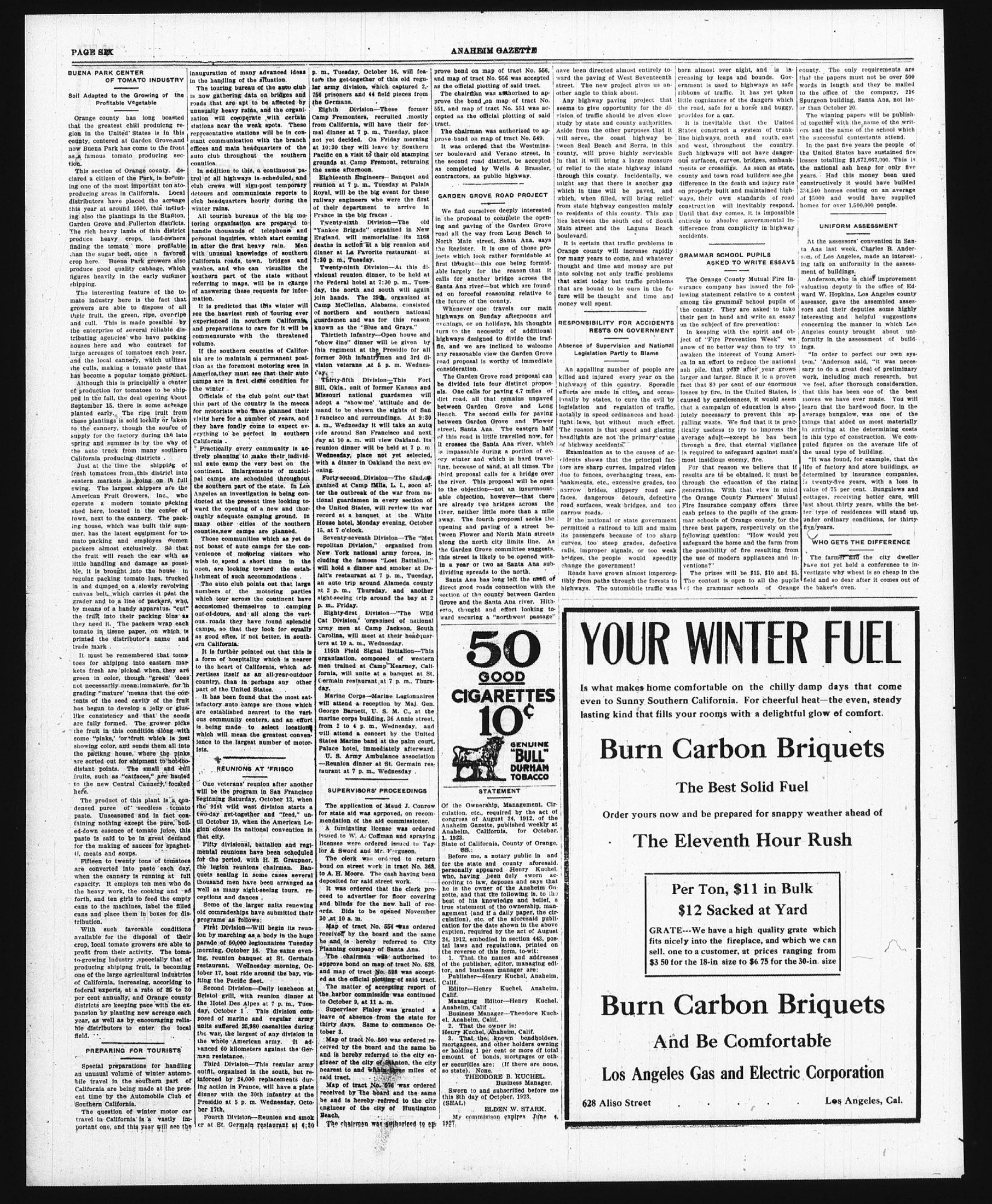
Searchable text
BUENA PARK CENTER
OF TOMATO INDUSTRY
Soil Adapted to the Growing of the Profitable Vegetable
Orange county has long boasted that the greatest chili producing region in the United States is in this county, centered at Garden Grove, and now Buena Park has come to the front as a famous tomato producing section.
This section of Orange county, declared a citizen of the Park, is becoming one of the most important tomato-producing areas in California. Local distributors have placed the acreage this year at around 1500, this including also the plantings in the Stanton, Garden Grove and Fullerton districts. The rich heavy lands of this district produce heavy crops, land-owners finding the tomato more profitable than the sugar beet, once a favored crop here. Buena Park growers also produce good quality cabbage, which figures heavily in the early summer shipping.
The interesting feature of the tomato industry here is the fact that growers are able to dispose of all their fruit, the green, ripe, over-ripe and cull. This is made possible by the enterprise of several reliable distributing agencies who have packing houses here and who contract for large acreages of tomatoes each year, and the local cannery, which utilizes the culls, making a tomato paste that has become a popular tomato product.
Although this is principally a center of production for tomatoes to be shipped in the fall, the deal opening about September 15, there is some acreage planted early. The ripe fruit from these plantings is sold locally or taken to the cannery, though the source of supply for the factory during the late spring and summer is by the way of inauguration of many advanced ideas in the handling of the situation.
The touring bureau of the auto club is now gathering data on bridges and roads that are apt to be affected by unusually heavy rains, and the organization will cooperate with certain stations near the weak spots. These representative stations will be in constant communication with the branch offices and main headquarters of the auto club throughout the southern counties.
In addition to this, a continuous patrol of all highways is scheduled, and club crews will sign-post temporary detours and communicate reports to club headquarters hourly during the winter rains.
All tourinb bureaus of the big motoring organization are prepared to handle thousands of telephone and personal inquiries, which start coming in after the first heavy rain. Men with unusual knowledge of southern California roads, town, bridges and washes, and who can visualize the southern part of the state without referring to maps, will be in charge of answering these requests for information.
It is predicted that this winter will see the heaviest rush of touring ever experienced in southern California, and preparations to care for it will be commensurate with the threatened volume.
If the southern counties of California are to maintain a permanent position as the foremost motoring area in America, they must see that their auto camps are in first class condition for the winter.
Officials of the club point out that this part of the country is the mecca for motorists who have planned their visits here for a number of years, and they have fondly come to expect everything to be perfect in southern California.
Practically every community is acclimatization of many advanced ideas in the handling of the situation.
The touring bureau of the auto club is now gathering data on bridges and roads that are apt to be affected by unusually heavy rains, and the organization will cooperate with certain stations near the weak spots. These representative stations will be in constant communication with the branch offices and main headquarters of the auto club throughout the southern counties.
In addition to this, a continuous patrol of all highways is scheduled, and club crews will sign-post temporary detours and communicate reports to club headquarters hourly during the winter rains.
All tourinb bureaus of the big motoring organization are prepared to handle thousands of telephone and personal inquiries, which start coming in after the first heavy rain. Men with unusual knowledge of southern California roads, town, bridges and washes, and who can visualize the southern part of the state without referring to maps, will be in charge of answering these requests for information.
It is predicted that this winter will see the heaviest rush of touring ever experienced in southern California, and preparations to care for it will be commensurate with the threatened volume.
If the southern counties of California are to maintain a permanent position as the foremost motoring area in America, they must see that their auto camps are in first class condition for the winter.
Officials of the club point out that this part of the country is the mecca for motorists who have planned their visits here for a number of years, and they have fondly come to expect everything to be perfect in southern California.
Practically every community is acclimatization of many advanced ideas in the handling of the situation.
The touring bureau of the auto club is now gathering data on bridges and roads that are apt to be affected by unusually heavy rains, and the organization will cooperate with certain stations near the weak spots. These representative stations will be in constant communication with the branch offices and main headquarters of the auto club throughout the southern counties.
In addition to this, a continuous patrol of all highways is scheduled, and club crews will sign-post temporary detours and communicate reports to club headquarters hourly during the winter rains.
All tourinb bureaus of the big motoring organization are prepared to handle thousands of telephone and personal inquiries, which start coming in after the first heavy rain. Men with unusual knowledge of southern California roads, town, bridges and washes, and who can visualize the southern part of the state without referring to maps, will be in charge of answering these requests for information.
It is predicted that this winter will see the heaviest rush of touring ever experienced in southern California, and preparations to care for it will be commensurate with the threatened volume.
If the southern counties of California are to maintain a permanent position as the foremost motoring area in America, they must see that their auto camps are in first class condition for the winter.
Officials of the club point out that this part of the country is the mecca for motorists who have planned their visits here for a number of years, and they have fondly come to expect everything to be perfect in southern California.
Practically every community is acclimatization of many advanced ideas in the handling of the situation.
The touring bureau of the auto club is now gathering data on bridges and roads that are apt to be affected by unusually heavy rains, and the organization will cooperate with certain stations near the weak spots. These representative stations will be in constant communication with the branch offices and main headquarters of the auto club throughout the southern counties.
In addition to this, a continuous patrol of all highways is scheduled, and club crews will sign-post temporary detours and communicate reports to club headquarters hourly during the winter rains.
All tourinb bureaus of the big motoring organization are prepared to handle thousands of telephone and personal inquiries, which start coming in after the first heavy rain. Men with unusual knowledge of southern California roads, town, bridges and washes, and who can visualize the southern part of the state without referring to maps, will be in charge of answering these requests for information.
It is predicted that this winter will see the heaviest rush of touring ever experienced in southern California, and preparations to care for it will be commensurate with the threatened volume.
If the southern counties of California are to maintain a permanent position as the foremost motoring area in America, they must see that their auto camps are in first class condition for the winter.
Officials of the club point out that this part of the country is the mecca for motorists who have planned their visits here for a number of years, and they have fondly come to expect everything to be perfect in southern California.
Practically every community is acclimatization of many advanced ideas in the handling of the situation.
The touring bureau of the auto club is now gathering data on bridges and roads that are apt to be affected by unusually heavy rains, and the organization will cooperate with certain stations near the weak spots. These representative stations will be in constant communication with the branch offices and main headquarters of the auto club throughout the southern counties.
In addition to this, a continuous patrol of all highways is scheduled, and club crews will sign-post temporary detours and communicate reports to club headquarters hourly during the winter rains.
All tourinb bureaus of the big motoring organization are prepared to handle thousands of telephone and personal inquiries, which start coming in after the first heavy rain. Men with unusual knowledge of southern California roads, town, bridges and washes, and who can visualize the southern part of the state without referring to maps, will be in charge of answering these requests for information.
It is predicted that this winter will see the heaviest rush of touring ever experienced in southern California, and preparations to care for it will be commensurate with the threatened volume.
If the southern counties of California are to maintain a permanent position as the foremost motoring area in America,they must see that their auto camps are in first class condition for the winter.
Officials of the club point out that this part of the country isthe mecca for motorists who have planned their visits here for a number of years,and they have fondly come to expect everything to be perfect in southern California.
Practically every community is acclimatization of many advanced ideas in the handling of the situation.
The touring bureau of the auto club is now gathering data on bridges and roads that are apt to be affected by unusually heavy rains, and the organization will cooperate with certain stations near the weak spots. These representative stations will be in constant communication with the branch offices and main headquarters ofthe auto club throughoutthe southern counties.
In addition to this,a continuous patrolof all highwaysis scheduled,and club crewswill sign-post temporary detoursand communicatereportstoclubheadquartershourlyduringthewinterrains.
All tourinb bureausofthebigmotoringorganizationarepreparedtohandlethousandsoftelephonesandpersonalinquirieswhichstartcominginafterthefirstheavyrain.MenwithunusualknowledgeofsouthernCaliforniaroads,town,bridgesandwashes,andwhocanvisualizethesouthernpartofthestatewithoutreferringtotomaps.willbeinchargeofansweringtheserequestsforinformation.
ItispredictedthatthiswinterwillseetheheaviestrushoftouringeverexperiencedinsouthernCaliforniaandpreparationstocareforitwillbecommensuratewiththethreatenedvolume.
IfthesoutherncountiesofCaliforniaaretomaintainapermanentpositionastheforemostmotoringareainAmerica,theymustseethattheirautocampssareinfirstclassconditionforkindergarten
p.m.,Tuesday.Octobertheget-togetherlararmydivision7p.m.,RoyalwillbeetherailwayengineersofthedepartmentFranceinthebigtemperaturetheget-togetherlararmydivision7p.m.,RoyalwillbeetherailwayengineersofthedepartmentFranceinthebigtemperaturetheget-togetherlararmydivision7p.m.,RoyalwillbeetherailwayengineersofthedepartmentFranceinthebigtemperaturetheget-togetherlararmydivision7p.m.,RoyalwillbeetherailwayengineersofthedepartmentFranceinthebigtemperaturetheget-togetherlararmydivision7p.m.,RoyalwillbeetherailwayengineersofthedepartmentFranceinthebigtemperaturetheget-togetherlararmydivision7p.m.,RoyalwillbeetherailwayengineersofthedepartmentFranceinthebigtemperaturetheget-togetherlararmydivision7p.m.,RoyalwillbeetherailwayengineersofthedepartmentFranceinthebigtemperaturetheget-togetherlararmydivision7p.m.,RoyalwillbeetherailwayengineersofthedepartmentFranceinthebigtemperaturetheget-togetherlararmydivision7p.m.,RoyalwillbeetherailwayengineersofthedepartmentFranceinthebigtemperaturetheget-togetherlararmydivision7p.m.,RoyalwillbeetherailwayengineersofthedepartmentFranceinthebigtemperaturetheget-togetherlararmydivision7p.m.,RoyalwillbeetherailwayengineersofthedepartmentFranceinthebigtemperaturetheget-togetherlararmydivision7p.m.,RoyalwillbeetherailwayengineersofthedepartmentFranceinthebigtemperaturetheget-togetherlararmydivision7p.m.,RoyalwillbeetherailwayengineersofthedepartmentFranceinthebigtemperaturetheget-togetherlararmydivision7p.m.,RoyalwillbeetherailwayengineersofthedepartmentFranceinthebigtemperaturetheget-togetherlararmydivision7p.m.,RoyalwillbeetherailwayengineersofthedepartmentFranceinThebigtemperaturetheget-togetherlararmydivision7p.m.,RoyalwillbeetherailwayengineersofthedepartmentFranceinThebigtemperaturetheget-togetherlararmydivision7p.m.,RoyalwillbeetherailwayengineersofthedepartmentFranceinThebigtemperaturetheget-togetherlararmydivision7p.m.,Royalwillbeethe railwayengineersofthedepartmentFranceinThebigtemperaturetheget-togetherlararmydivision7p.m.,Royalwillbeethe railwayengineersofthedepartmentFranceinThebigtemperaturetheget-togetherlararmydivision7p.m.,Royalwillbeethe railwayengineersofthedepartmentFranceinThebigtemperaturetheget-togetherlararmydivision7p.m.,Royalwillbeethe railwayengineersofthedepartmentFranceinThebigtemperatureTheget-togetherlararmydivision7p.m.,Royalwillbeethe railwayengineersofthedepartmentFranceinThebigtemperatureTheget-togetherlararmydivision7p.m.,Royalwillbeethe railwayengineersofthedepartmentFranceinThebigtemperatureTheget-togetherlararmydivision7p.m.,Royalwillbeethe railwayengineersofthedepartmentFranceinThebigtemperatureTheget-togetherlararmydivision7p.m.,Royalwillbeethe railwayengineersofthedepartmentFranceinThebigtemperatureTheget-togetherlararmydivision7p.m.,Royalwillbeethe railwayengineersofthedepartmentFranceinThebigtemperatureTheget-togetherlararmydivision7p.m.,Royalwillbeethe railwayengineersofthedepartmentFranceinThebigtemperatureThe get-togetherlararmydivision7p.m.,Royalwillbeethe railwayengineersofthedepartmentFranceinThebigtemperatureThe get-togetherlararmydivision7p.m.,Royalwillbeethe railwayengineersofthedepartmentFranceinThebigtemperatureThe get-togetherlararmydivision7p.m.,Royalwillbeethe railwayengineersofthedepartmentFranceinThebigtemperatureThe get-togetherlararmydivision7p.m.,Royalwillbeethe railwayengineersofthedepartmentFranceinThebigtemperatureThe get-togetherlararmydivision7p.m.,Royalwillbeethe railwayengineersofthedepartmentFranceinThebigtemperatureThe get-togetherlararmydivision7p.m.,Royalwillbeethe railwayengineersofTHEDEPARTMENTFRANCEINTHEDEPARTMENTFRANCEINTHEDEPARTMENTFRANCEINTHEDEPARTMENTFRANCEINTHEDEPARTMENTFRANCEINTHEDEPARTMENTFRANCEINTHEDEPARTMENTFRANCEINTHEDEPARTMENTFRANCEINTHEDEPARTMENTFRANCEINTHEDEPARTMENTFRANCEINTHEDEPARTMENTFRANCEINTHEDEPARTMENTFRANCEINTHEDEPARTMENTFRANCEINTHEDEPARTMENTFRANCEINTHEDEPARTMENTFRANCEINTHEDEPARTMENTFRANCEINTHEDEPARTMENTFRANCEINTHEDEPARTMENTFRANCEINTHEDEPARTMENTFRANCEINTHEDEPARTMENTFRANCEINTHEDEPARTMENTFRANCEINTHEDEPARTMENTFRANCEINTHEDEPARTMENTFRANCEINTHEDEPARTMENTFRANCEINTHEDEPARTMENTFRANCEINTHEDEPARTMENTFRANCEINTHEDEPARTMENTFRANCEINTHEDEPARTMENTFRANCEINTHEDepartMENTFRANCEINTHEDepartMENTFRANCEINTHEDepartMENTFRANCEINTHEDepartMENTFRANCEINTHEDepartMENTFRANCEINTHEDepartMENTFRANCEINTHEDepartMENTFRANCEINTHEDepartMENTFRANCEINTHEDepartMENTFRANCEINTHEDepartMENTFRANCEINTHEDepartMENTFRANCEINTHEDepartMENTFRANCEINTHEDepartMENTFRANCEINTHEDepartMENTFRANCEINTHEDepartMENTFRANCEINTHEDepartMENTFRANCEINTHEDepartMENTFRANCEINTHEDepartMENTFRANCEINTHEDepartMENTFRANCEINTHEDepartMENTFRANCEINTHEDepartMENTFRANCEINTHEDepartMENTFRANCEINTHEDepartMENTFRANCEINTHEDepartMENTFRANCEINTHEDepartMENTFRANCEINTHEDepartMENTFRANCEINTHEDepartMENTFRANCEINTHEDepartMENTFRANCEINTHEDepartMENTFRANCEINTHEDepartMENTFRANCEINTHEDepartMENTFRANCEINTHEDepartMENTFRANCEINTHEDepartMENTFRENCEINTHEDepartMENTFRENCEINTHEDepartMENTFRENCEINTHEDepartMENTFRENCEINTHEDepartMENTFRENCEINTHEDepartMENTFRENCEINTHEDEPARTMENTFRENCEINTHEDEPARTMENTFRENCEINTHEDEPARTMENTFRENCEINTHEDEPARTMENTFRENCEINTHEDEPARTMENTFRENCEINTHEDEPARTMENT FRENCE IN THEDEPARTMENT FRENCE IN THEDEPARTMENT FRENCE IN THEDEPARTMENT FRENCE IN THEDEPARTMENT FRENCE IN THEDEPARTMENT FRENCE IN THEDEPARTMENT FRICE IN THEDEPARTMENT FRICE IN THEDEPARTMENT FRICE IN THEDEPARTMENU FRICE IN THEDEPARTMENU FRICE IN THEDEPARTMENU FRICE IN THEDEPARTMENU FRICE IN THEDEPARTMENU FRICE IN THEDEPARTMENU FRICE IN THEDEPARTMENU FRICE IN THEDEPARTMENU FRICE IN THEDEPARTMENU FRICE IN THEDEPARTMENU FRICE IN THEDEPARTMENU FRICE IN THEDEPARTMENU FRICE IN THEDEPARTMENU FRICE IN THEDEPARTMENU FRICE IN THEDEPARTMENU FRICE IN THEDEPARTMENU FRICE IN THDEDEPARTMENU FRICE IN THDEDEPARTMENU FRICE IN THDEDEPARTMENU FRICE IN THDEDEPARTMENU FRICE IN THDEDEPARTMENU FRICE IN THDEDEPARTMENU FRICE IN THDEDEPARTMENU FRICE IN THDEDEPARTMENU FRICE IN THDEDEPARMENU FRICE IN THDEDEPARMENU FRICE IN THDEDEPARMENU FRICE IN THDEDEPARMENU FRICE IN THDEDEPARMENU FRICE IN THDEDEPARMENU FRICE IN THDEDEPARMENU FRICE IN THDEDEPARMENU FRICE IN THDEDEPARMENU FRICE IN THDEDEPARMENU FRICE IN THDEDEPARMENU FRICE IN THDEDEPARMENU FRICE IN THDEDEPARMenu Frice In ThEdDepArtmen Frice In ThEdDepArtmen Frice In ThEdDepArtmen Frice In ThEdDepArtmen Frice In ThEdDepArtmen Frice In ThEdDepArtmen Frice In ThEdDepArtmen Frice In ThEdDepArtmen Frice In ThEdDepArtmen Frice In ThEdDepArtmen Frice In ThEdDepArtmen Frice In ThEdDepArtmen Frice In ThEdDepArtmen Frice In ThEdDepArtmen Frice In ThEdDepArtmen Frice In ThEdDepArtmen Frice In ThEdDepArtmen Frice In ThEdDepArtmen Frice In ThEdDepArtmen Frice In ThEdDepArtmen Frice In ThEdDepArtmen Frice In ThEdDepArtmen Frice In ThEdDepArtmen Frice In ThEdDepArtmen Frice In ThEdDepArtmen Frice InThEdDepArtmen Frice In ThEdDepArtmen Frice In ThEdDepArtmen Frice In ThEdDepArtmen Frice In ThEdDepArtmen Frice In ThEdDepArtmen Frice In ThEdDepArtmen Frice In ThEdDepArtmen Frice In ThEdDepArtmen Frice In ThEdDepArtmen Frice In ThEdDepArtmen Frice In ThEdDepArtmen Frice In ThEdDepArtmen Frice In ThEdDepArtmen Frice In ThEdDepArtmen Frice In ThEdDepArtmen Frice In ThEdDepArtmen Frice In ThEdDepArtmen Frice In ThEdDepArtmen Frice In ThEdDepArtmen Frice In ThEdDepArtmen Frice In ThEdDepArtmen Frice In ThEdDepArtmen Frice In ThEdDepArtmen Frice In ThEdDepArtmen FriceInThEdDepArtmen FriceInThEdDepArt men FriceInThEd dep Art men FriceInTh Ed dep Art men FriceInTh Ed dep Art men FriceInTh Ed dep Art men FriceInTh Ed dep Art men FriceInTh Ed dep Art men FriceInTh Ed dep Art men FriceInTh Ed dep Art men FriceInTh Ed dep Art men FriceInTh Ed dep Art men FriceInTh Ed dep Art men FriceInTh Ed dep Art men FriceInTh Ed dep Art men FriceInTh Ed dep Art men FriceInTh Ed dep Art men FriceInTh Ed dep Art men FriceInTh Ed dep Art men frceInTh ed dep art men frceInTh ed dep art men frceInTh ed dep art men frceInTh ed dep art men frceInTh ed dep art men frceInTh ed dep art men frceInTh ed dep art men frceInTh ed dep art men frceInTh ed dep art men frceInTh ed dep art men frceInTh ed dep art men frceInTh ed dep art men frceInTh ed dep art men frceInTh ed dep art men frceInTh ed dep art men frceInTh ed dep art men frceInTh ed dep art men frceInTh ed dep art men frceInTh ed dep art menfrceInTh ed dep art men frceInTh ed dep art men frceInTh ed dep art men frceInTh ed dep art men frceInTh ed dep art men frceInTh ed dep art men frceInTh ed dep art men frceInTh ed dep art men frceInTh ed dep art men frceInTh ed dep art men frceInTh ed dep art men frceInTh ed dep art men frceInTh ed dep art men frceInTh ed dep art men frceInTh ed dep art men frceInTh ed dep artMen frceInTh ed dep艺术Men frceInTh ed dep艺术Men frceInTh ed dep艺术Men frceInTh ed dep艺术Men frceInTh ed dep艺术Men frceInTh ed dep艺术Men frceInTh ed dep艺术Men frceInTh ed dep艺术Men frceInTh ed dep艺术Men frceInTh ed dep艺术Men frceInTh ed dep艺术Men frceInTh ed dep艺术Men frce在Th.ed Dep艺术Men frce在Th.ed Dep艺术Men frce在Th.ed Dep艺术Men frce在Th.ed Dep艺术Men frce在Th.ed Dep艺术Men frce在Th.ed Dep艺术Men frce在Th.ed Dep艺术Men frce在Th.ed Dep艺术Men frce在Th.ed Dep艺术Men frce在Th.ed Dep艺术Men frce在Th.ed Dep艺术Men frce在Th.ed Dep艺术Menfrce在Th.ed Dep艺术Menfrce在Th.ed Dep艺术MenfrCE在Th.ed Dep艺术MenfrCE在Th.ed Dep艺术MenfrCE在Th.ed Dep艺术MenfrCE在Th.ed Dep艺术MenfrCE在Th.ed Dep艺术MenfrCE在Th.ed Dep艺术MenfrCE在Th.ed Dep艺术MenfrCE在Th.ed Dep艺术MenfrCE在Th.ed Dep艺术MenfrCE在ThresholdDepthDepthDepthDepthDepthDepthDepthDepthDepthDepthDepthDepthDepthDepthDepthDepthDepthDepthDepthDepthDepthDepthDepthDepthDepthDepthDepthDepthDepthDepthDepthDepthDepthDepthDepthDepthDepthDepthDepthDepthDepthDepthDepthDepthDepthDepthDepthDepthDepthDepthDepthDepthDepthDepthDepthDepth depth深度深度深度深度深度深度深度深度深度深度深度深度深度深度深度深度深度深度深度深度深度深度深度深度深度深度深度深度深度深度深度深度深度深度深度深度深度深度深度深度深度深度深度深度深度深度深度深度深度深度深度深度深度深度深度深度深度高度高度高度高度高度高度高度高度高度高度高度高度高度高度高度高度高度高度高度高度高度高度高度高度高度高度高度高度高度高度高度高度高度高度高度高度高度高度高度高度高度高度高度高度高度高度高度高度高度高度高度高度高度高度高度的高度高度高度高度的高度heightheightheightheightheightheightheightheightheightheightheightheightheightheightheightheightheightheightheightheightheightheightheightheightheightheightheightheightheightheightheight height height height height height height height height height height height height height height height height height height height height height height height height height height height height height height height height height height height height height height height height height height height height height height height height height height height height height height height height height height heightHeight Height Height Height Height Height Height Height Height Height Height Height Height Height Height Height Height Height Height Height Height Height Height Height Height Height Height Height Height Height Height Height Height Height Height Height Height Height Height Height Height Height Height Height Height Height Height Height Height Height Height Height Height Height Height Height Height Height Height Height Height Height Height Height Height Height HeightHeightHeightHeightHeightHeightHeightHeightHeightHeightHeightHeightHeightHeightHeightHeightHeightHeightHeightHeightHeightHeightHeightHeightHeightHeightHeightHeightHeightHeightHeightHeightHeightHeightHeightHeightHeightHeightHeightHeightHeightHeightHeightHeightHeightHeightHeightHeightHeightHeightHeightHeightHeightHeightHeightHeightHeightHeightHeightHeightHeightHeightHeightHeightHeightHeightHeightHeightHeightHeightHeightHeightHeightHeightHeightHeightHighHighHighHighHighHighHighHighHighHighHighHighHighHighHighHighHighHighHighHighHighHighHighHighHighHighHighHighHighHighHighHighHighHighHighHighHighHighHighHighHighHighHighHighHighHighHighHighHighHighHighHighHighHighHighHighHighHighHighHighHighHighHighHigh High High High High High High High High High High High High High High High High High High High High High High High High High High High High High High High High High High High High High High High High High High High High High High High High High High High High High High High High High High High High High High High High High High High High High High High High High High High High High High High High High High High High High High High High High High High High High Highhighhighhighhighhighhighhighhighhighhighhighhighhighhighhighhighhighhighhighhighhighhighhighhighhighhighhighhighhighhighhighhighhighhighhighhighhighhighhighhighhighhighhighhighhighhighhighhighhighhighhighhighhighhighhighhighhighhighhighhighhighhighhighlighthighlighthighlighthighlighthighlighthighlighthighlighthighlighthighlighthighlighthighlighthighlighthighlighthighlighthighlighthighlighthighlighthighlight
Although this is principally a center of production for tomatoes to be shipped in the fall, the deal opening about September 15, there is some acreage planted early. The ripe fruit from these plantings is sold lochly or taken to the cannery, though the source of supply for the factory during the late spring and summer is by the way of the auto truck from many southern California producing districts.
Just at the time the shipping of fresh tomatoes from this district into eastern markets is going on in full swing. The largest shippers are the American Fruit Growers, Inc., who operate a modern tomato packing shed here, located in the center of town, next to the cannery. The packing house, which was built this summer, has the latest equipment for tomato packing and employs women packers almost exclusively. So that the fruit will reach the car with as little handling and damage as possible, it is brought into the house in regular packing tomato lugs, trucked in and dumped on a slowly revolving canvas belt, which carries it past the grader and to a line of packers, who, by means of a handy apparatus, "cut" the fruit into their packing bins as they need it. The packers wrap each tomato in tissue paper, on which is printed the distributor's name and trade mark.
It must be remembered that tomatoes for shipipng into eastern markets fresh are picked when they are green in color, though "green" does not necessarily mean immature, for in grading "mature" means that the contents of the seed cavity of the fruit has begun to develop a jelly or glue-like consistency and that the seeds are fully formed. The grower picks the fruit in this condition along with some "pinks," or fruit which is just showing color, and sends them all into the packing house, where the pinks are sorted out for shipment to not too-distant points. The small and cull fruits, such as "catfaces," are hauled to the new Central Cannery, located here.
The product of this plant is a condensed puree of seedless tomato paste. Unseasoned and in fact containing nothing except the pure, boiled-down essence of tomato juice, this paste is said to be in great demand for the making of sauces for spaghetti.
One veterans' reunion after another will be the program in San Francisco beginning Saturday, October 13, when the 91st wild west division starts a two-day get-together and "feed," until October 19, when the American Legion closes its national convention in that city.
Fifty divisional, battalion and regimental positions are to maintain a permanent position as the foremost motoring area in America, they must see that their auto camps are in first class condition for the winter.
Officials of the club point out that this part of the country is the mecca for motorists who have planned their visits here for a number of years, and they have fondly come to expect everything to be perfect in southern California.
Practically every community is actively planning to make their individual auto camp the very best on the continent. Enlargements of municipal camps are scheduled throughout the southern part of the state. In Los Angeles an investigation is being conducted at the present time looking toward the opening of a new and thoroughly adequate camping ground. In many other cities of the southern counties, new camps are planned.
Those communities which as yet do not boast of auto camps for the convenience of motoring visitors who wish to spend a short time in the open, are looking toward the establishment of such accommodations.
The auto club points out that large numbers of the motoring parties which tour across the continent have accustomed themselves to camping out-of-doors, and all along the various roads they have found splendid camps, so that they look for equally as good sites, if not better, in southern California.
It is further pointed out that this is a form of hospitality which is nearer to the heart of California, which advertises itself as an all-year-outdoor country, than in perhaps any other part of the United States.
It has been found that the most satisfactory auto camps are those which are established nearest to the various community centers, and an effort is being made to select locations which will mean the greatest convenience to the largest number of motorists.
REUNIONS AT 'FRISCO
One veterans' reunion after another will be the program in San Francisco beginning Saturday, October 13, when the 91st wild west division starts a two-day get-together and "feed," until October 19, when the American Legion closes its national convention in that city.
SUPERVISOR
The application for state aid was mended of the A funigating issued to W. A./C licenses were on for & Sword and former 30th infant vision veterans a day.
PREPARING FOR TOURISTS
Special preparations for handling an unusual volume of winter automobile travel in the southern part of California are being made at the present time by the Automobile Club of Southern California.
The question of winter motor car travel in California is a vastly important one, and this year will see the
REUNIONS AT 'FRISCO
One veterans' reunion after another will be the program in San Francisco beginning Saturday, October 13, when the 91st wild west division starts a two-day get-together and "feed," until October 19, when the American Legion closes its national convention in that city.
Fifty divisional, battalion and regimental reunions have been scheduled for the period, with H. E. Graupnor, the legion reunions chairman. Banquets seating in some cases several thousand men have been arranged as well as many sight-seeing tours, receptions and dances.
Some of the larger units renewing old comradeships have submitted their programs as follows:
First Division—Will begin its reunion by marching as a body in the huge parade of 60,000 legionnaires Tuesday morning, October 16. The same evening, reunion banquet at St. Germain restaurant. Wednesday morning, October 17, boat ride around the bay, visiting the Pacific fleet.
Second Division—Daily luncheon at Bristol grill, with reunion dinner at the Hotel Des Alpes at 7 p.m., Tuesday, October 1. This division composed of marine and regular army units suffered 25,980 casualties during the war, the largest of any division in the whole American army. It advanced 60 kilometers against the German resistance.
Third Division—This regular army outfit, organized in the south, but reinforced by 24,000 replacements during action in France, will have a plate dinner with the 30th infantry at the Presidio at 5 p.m. Wednesday, October 17th.
Fourth Division—Reunion and smoker at St. Germain restaurant at 6:30
ANAHEIM GAZETTE
p. m., Tuesday, October 16, will feature the get-together of this old regular army division, which captured 2,756 prisoners and 44 field pieces from the Germans.
Eighth Division—These former Camp Fremonters, recruited mostly from California, will have their formal dinner at 7 p. m., Tuesday, place not yet decided. On Friday morning at 10:30 they will leave by Southern Pacific on a visit to their old stamping grounds at Camp Fremont, returning the same afternoon.
Eighteenth Engineers—Banquet and reunion at 7 p. m., Tuesday at Palais Royal, will be the big event for these railway engineers who were the first of their department to arrive in France in the big fracas.
Twenty-sixth Division—The old "Yankee Brigade" organized in New England, will memorialize its 2168 deaths in action at a big reunion and dinner at La Favorite restaurant at 7:30 p. m., Tuesday.
Twenty-ninth Division—At this divisional reunion dinner, to be held at the Federal hotel at 7:30 p. m., Tuesday, the north and south will again join hands. The 29th, organized at Camp McClellan, Alabama, consisted of northern and southern national guardsmen and was for this reason known as the "Blue and Grays."
Thirtieth Infantry—Open house and "show line" dinner will be given by this regiment at the Presidio for all former 30th infantrymen and 3rd division veterans at 5 p. m. Wednesday.
Thirty-fifth Division—This Fort Sill, Okla., unit of former Kansas and Missouri national guardsmen will adopt a "show-me' attitude and demand to be shown the sights of San Francisco and surroundings. At 9:30 a. m., Wednesday it will take an auto ride around San Francisco and next day at 10 a. m. will view Oakland. Its reunion dinner will be held at 7 p. m.
prove bond on map of tract No. 556, and map of tract No. 556 was accepted as the official plotting of said tract.
The chairman was authorized to approve the bond on map of tract No. 551, and map of tract No. 551 was accepted as the official plotting of said tract.
The chairman was authorized to approve bond on map of tract No. 549.
It was ordered that the Westminster boulevard and Verano street, in the second road district, be accepted as completed by Wells & Brassler, contractors, as public highway.
GARDEN GROVE ROAD PROJECT
We find ourselves deeply interested in the proposal to complete the opening and paving of the Garden Grove road all the way from Long Beach to North Main street, Santa Ana, says the Register. It is one of those projects which look rather formidable at first thought—this one being formidable largely for the reason that it calls for another bridge across the Santa Ana river—but which are founded on forceful reasoning relative to the future of the county.
Whenever one travels our main highways on Sunday afternoons and evenings, or on holidays, his thoughts turn to the necessity of additional highways designed to divide the traffic, and we are inclined to welcome any reasonable view the Garden Grove road proposal is worthy of immediate consideration.
The Garden Grove road proposal can be divided into four distinct proposals. One calls for paving 4.7 miles of dirt road, all that remains unpaved between Garden Grove and Long Beach. The second calls for paving between Garden Grove and Flower street, Santa Ana. The eastern half of this road is little travelled now, for it crosses the Santa Ana river, which have been directed almost entirely toward the paving of West Seventeenth street. The new project gives us another angle to think about.
Any highway paving project that seems to give opportunity for the division of traffic should be given close study by state and county authorities. Aside from the other purposes that it will serve, the coast highway between Seal Beach and Serra, in this county, will prove highly servicable in that it will bring a large measure of relief to the state highway inland through this county. Incidentally, we might say that there is another gap which in time will be paved, and which, when filled, will bring relief from state highway congestion mainly to residents of this county. This gap lies between the south end of South Main street and the Laguna Beach boulevard.
It is certain that traffic problems in Orange county will increase rapidly for many years to come, and whatever thought and time and money are put into solving not only traffic problems that exist today but traffic problems that are bound to be ours in the future will be thought and time and money well spent.
RESPONSIBILITY FOR ACCIDENTS RESTS ON GOVERNMENT
Absence of Supervision and National Legislation Partly to Blame
An appalling number of people are killed and injured every year on the highways of this country. Sporadic efforts are made in cities, and occasionally by states, to cure the evil by legislation and regulation of traffic, notably in speed ordinances and headlight laws, but without much effect. The reason is that speed and glaring headlights are not the primary cause of highway accidents.
born all creasing ernment ribbons little coats the road providers.
It is States line high and wide Such high surmounts on property ways, thus construct Until they entirely different accident.
GRAMMER
The curvature lowing among the countryside their power on the hill.
In key object of snow awaken ca in ash pill larger fact that losses caused that a lately falling tically average through
THIRTY-FIFTH DIVISION—This Fort Sill, Okla., unit of former Kansas and Missouri national guardsmen will adopt a "show-me' attitude and demand to be shown the sights of San Francisco and surroundings. At 9:30 a.m., Wednesday it will take an auto ride around San Francisco and next day at 10 a.m. will view Oakland. Its reunion dinner will be held at 7 p.m. Wednesday, place not yet selected, with a dinner in Oakland the next evening.
Forty-second Division—The 42nd organized at Camp Mills, L. I., soon after the outbreak of the war from national guardsmen in every section of the United States, will review its war record at a banquet at the White House hotel, Monday evening, October 15, at 7 o'clock.
Seventy-seventh Division—The "Metropolitan Division," organized from New York national army forces, including the famous "Lost Battalion," will hold a dinner and smoker at Default's restaurant at 7 p.m., Tuesday, an auto trip around Alameda county at 2 p.m., Thursday, and another sight-seeing trip around the bay at 2 p.m., Friday.
Eighty-first Division—The Wild Cat Division, organized of national army men at Camp Jackson, South Carolina, will meet at their headquarters at 10 a.m., Wednesday.
116th Field Signal Battalion—This organization, composed of western men trained at Camp Kearney, California, will unite at a banquet at St. Germain restaurant at 7 p.m., Thursday.
Marine Corps—Marine Legionnaires will attend a reception by Maj. Gen. George Barnett, U. S. M. C., at the marine corps building, 36 Annie street, from 2 to 4 p.m., Wednesday, and will attend a concert by the United States Marine band at the palm court, Palace hotel, immediately afterward.
U. S. Army Ambulance association—Reunion dinner at St. Germain restaurant at 7 p.m., Wednesday.
SUPERVISORS' PROCEEDINGS
The application of Maud J. Conrow for state aid was approved, on recommendation of the aid commissioner.
A fumigating license was ordered issued to W. A. Coffman and spraying licenses were ordered issued to Taylor A. Sword and Mr. Ferguson.
THE GARDEN GROVE road proposal can be divided into four distinct proposals. One calls for paving 4.7 miles of dirt road, all that remains unpaved between Garden Grove and Long Beach. The second calls for paving between Garden Grove and Flower street, Santa Ana. The eastern half of this road is little travelled now, for it crosses the Santa Ana river, which is impassable during a portion of every winter and which is hard traveling, because of sand, at all times. The third proposal calls for a bridge over the river. This proposal will be open to the objection—not an insurmountable objection, however—that there are already two bridges across the river, neither little more than a mile away. The fourth proposal seeks the opening and paving of a street between Flower and North Main streets along the north city limits line. As the Garden Grove committee suggests, this street is likely to be opened within a year or two as Santa Ana subdividing spreads to the north.
Santa Ana has long left the need of direct good roads connection with the section of the county between Garden Grove and the Santa Ana river. Hitherto, thought and effort looking toward securing a "northwest passage"
STATEMENT
Of the Ownership, Management, Circulation, etc., required by the act of congress of August 24, 1912, of the Anaheim Gazette, published weekly at Anaheim, California, for October, 1, 1923. State of California, County of Orange,
Legislation Party to Blaine
An appalling number of people are killed and injured every year on the highways of this country. Sporadic efforts are made in cities, and occasionally by states, to cure the evil by legislation and regulation of traffic, notably in speed ordinances and headlight laws, but without much effect. The reason is that speed and glaring headlights are not the primary cause of highway accidents.
Examination as to the causes of accidents shows that the principal factors are sharp curves, impaired vision due to fences, overhanging trees, embankments, etc., excessive grades, too narrow brides, slippery road surfaces, dangerous detours, defective road surfaces, weak bridges, and too narrow roads.
If the national or state government permitted a railroad to kill and maim its passengers because of too sharp curves, too steep grades, defective rails, improper signals, or too weak bridges, the people would speedily change the government!
Roads have grown almost imperceptibly from paths through the forests to highways. The automobile traffic was
YOUR WAY
Is what makes home comfort even to Sunny Southern Ca lasting kind that fills your needs most! For results through generosity the O Fire Inc cash pay marshal three follow safeguard the public use ventilation The The of the
SUPERVISORS' PROCEEDINGS
The application of Maud J. Conrow for state aid was approved, on recommendation of the aid commissioner.
A fumigating license was ordered issued to W. A. Coffman and spraying licenses were ordered issued to Taylor & Sword and Mr. Ferguson.
The clerk was ordered to return bond on street work in tract No. 368, to A. H. Moore. The cash having been deposited for said street work.
It was ordered that the clerk proceed to advertise for floor covering and blinds for the new hall of records. Bids to be opened November 30, at 10 a.m.
Map of tract No. 554 was ordered received by the board and the same be and is hereby referred to City Planning company of Santa Ana.
The chairman was authorized to approve bond on map of tract No. 528, and map of tract No. 528 was accepted as the official plotting of said tract.
The matter of accepting report of the harbor commission was continued to October 9, at 11 a.m.
Supervisor Finley was granted a leave of absence from the state for thirty days. Same to commence October 3.
Map of tract No. 560 was ordered received by the board and the same be and is hereby referred to the city engineer of the city of Stanton, the city nearest to and within three miles of said tract.
Map of tract No. 576 was ordered received by the board and the same be and is hereby referred to the city engineer of the city of Huntington Beach.
The chairman was authorized to ap-
STATEMENT
Of the Ownership, Management, Circulation, etc., required by the act of congress of August 24, 1912, of the Anaheim Gazette, published weekly at Anaheim, California, for October, 1, 1923.
State of California, County of Orange,
SS:
Before me, a notary public in and for the state and county aforesaid, personally appeared Henry Kuchel, who, having been duly sworn according to law, deposes and says that he is the owner of the Anaheim Gazette, and that the following is, to the best of his knowledge and belief, a true statement of the ownership management (and if a daily paper, the circulation), etc. of the aforesaid publication for the date shown in the above caption, required by the act of August 24, 1912, embodied in section 443, postal laws and regulations, printed on the reverse of this form, to-wit:
1. That the names and addresses of the publisher, editor, managing editor, and business manager are:
Publisher—Henry Kuchel, Anaheim, Calif.
Editor—Henry Kuchel, Anaheim, Calif.
Managing Editor—Henry Kuchel, Anaheim, Calif.
Business Manager—Theodore Kuchel, Anaheim, Calif.
2. That the owner is:
Henry Kuchel, Anaheim, Calif.
3. That the known bondholders, mortgagees, and other holders owning or holding 1 per cent or more of total amount of bonds, mortgages or other securities are: (If there are none, so state). None.
THEODORE B. KUCHEL,
Business Manager.
Sworn to and subscribed before me this 8th day of October, 1923.
(SEAL)
ELDEN W. STARK,
My commissison expires June 4,
1927.
most entirely to test Seventeenth project gives us an about.
project that county authorities,
purposes that it most highway be Serra, in this highly servicable large measure highway inland Incidentally, we is another gap be paved, and will bring relief congestion mainly county. This gap with end of South Laguna Beach traffic problems in increase rapidly time, and whatever money are put traffic problems ours in the furand time and
FOR ACCIDENTS IN GOVERNMENT
ation and National unity to Blame
number of people are every year on the country. Sporadic cities, and occasion the evil by regulation of traffic, finances and headout much effect. speed and glaring the primary cause.
born almost over night, and is increasing by leaps and bounds. Government is used to highways as safe ribbons of traffic. It has yet taken little cognizance of the dangers which the road, safe for a horse and buggy, provides for a car.
It is inevitable that the United States construct a system of trunkline highways, north and south, east and west, throughout the country. Such highways will not have dangerous surfaces, curves, bridges, embankments or crossings. As soon as state, county and town road builders see the difference in the death and injury rate on properly built and maintained highways, their own standards of road construction will inevitably respond. Until that day comes, it is impossible entirely to absolve governmental indifference from complicity in highway accidents.
GRAMMAR SCHOOL PUPILS
ASKED TO WRITE ESSAYS
The Orange County Mutual Fire Insurance company has issued the following statement relative to a contest among the grammar school pupils of the county. They are asked to take their pen in hand and write an essay on the subject of fire prevention:
In keeping with the spirit and object of "Fire Prevention Week" we know of no better way than to try to awaken the interest of Young America in an effort to reduce the national ash pile, that ydirt after year grows larger and larger. Since it is a proven fact that 80 per cent of our enormous losses by fire, in the United States, is caused by carelessness, it would seem that a campaign of education is absolutely necessary to prevent this appalling waste. We find that it is practically useless to try to impress the average adult—except he has been through a fire, that eternal vigilance
county. The only requirements are that the papers must not be over 500 words in length and they be mailed to the office of the company, 216 Spurgeon building, Santa Ana, not later than October 20.
The winning papers will be published together with the name of the writers and the name of the school which the successful contestants attend.
In the past five years the people of the United States have sustained fire losses totalling $1,672,667,000. This is the national ash heap for only five years. Had this money been used constructively it would have builted 334,540 homes costing on an average of $5000 and would have supplied homes for over 1,500,000 people.
UNIFORM ASSESSMENT
At the assessors' convention in Santa Ana last week, Charles B. Anderson, of Los Angeles, made an interesting talk on uniformity in the assessment of buildings.
Anderson, who is chief improvement valuation deputy in the office of Edward W. Hopkins, Los Angeles county assessor, gave the assembled assessors and their deputies some highly interesting and helpful suggestions concerning the manner in which Los Angeles county brought about uniformity in the assessment of buildings.
"In order to perfect our own system," Anderson said, "it was necessary to do a great deal of preliminary work, including much research, but we feel, after thorough consideration, that this has been one of the best moves we have ever made. You will learn that the hardwood floor, in the average bungalow, was one of the things that aided us most materially in arriving at the determining costs in this type of construction. We computed figures on the average life of
of people are every year on the country. Sporadic cities, and occasional evils by regulation of traffic, finances and head-out much effect. Speed and glaring the primary cause of the causes of acceleraion principal facets, impaired vision changing trees, emissive grades, too oppy road surdetours, defective bridges, and too state government to kill and maim use of too sharp grades, defective finals, or too weak would speedily event!
almost imperceptibly the forests to mobile traffic was awaken the interest of Young America in an effort to reduce the national ash pile, that year after year grows larger and larger. Since it is a proven fact that 80 per cent of our enormous losses by fire, in the United States, is caused by carelessness, it would seem that a campaign of education is absolutely necessary to prevent this appalling waste. We find that it is practically useless to try to impress the average adult—except he has been through a fire, that eternal vigilance is required to safeguard against man's most insidious enemy, fire.
For that reason we believe that if results are to be obtained, it must be through the education of the rising generation. With that view in mind the Orange County Farmers' Mutual Fire Insurance company offers three cash prizes to the pupils of the grammar schools of Orange county, for the three best papers, respectively on the following question: "How would you safeguard the home and the farm from the possibility of fire resulting from the use of modern appliances and inventions?"
The prizes will be $15, $10 and $5. The contest is open to all the pupils of the grammar schools of Orange
in order to perfect our own system," Anderson said, "it was necessary to do a great deal of preliminary work, including much research, but we feel, after thorough consideration, that this has been one of the best moves we have ever made. You will learn that the hardwood floor, in the average bungalow, was one of the things that aided us most materially in arriving at the determining costs in this type of construction. We computed figures on the average life of the usual type of building.
"It was found, for example, that the life of factory and store buildings, as determined by insurance companies, is twenty-five years, with a loss in value of 75 per cent. Bungalows and cottages, receiving better care, will last about thirty years, while the better type of residences will stand up, under ordinary conditions, for thirty-five years."
WHO GETS THE DIFFERENCE
The farmer and the city dweller have not yet held a conference to investigate why wheat is so cheap in the field and so dear after it comes out of the baker's oven.
OUR WINTER FUEL
makes home comfortable on the chilly damp days that come sunny Southern California. For cheerful heat—the even, steady and that fills your rooms with a delightful glow of comfort.
Return Carbon Briquets
The Best Solid Fuel
After yours now and be prepared for snappy weather ahead of
The Eleventh Hour Rush
The Best Solid Fuel
er yours now and be prepared for snappy weather ahead of
The Eleventh Hour Rush
Per Ton, $11 in Bulk
$12 Sacked at Yard
GRATE---We have a high quality grate which
fits nicely into the fireplace, and which we can
sell. one to a customer, at prices ranging from
$3 50 for the 18-in size to $6 75 for the 30-in. size
Return Carbon Briquets
And Be Comfortable
Los Angeles Gas and Electric Corporation
Street Los Angeles, Cal.