anaheim-gazette 1923-10-04
Scanned page
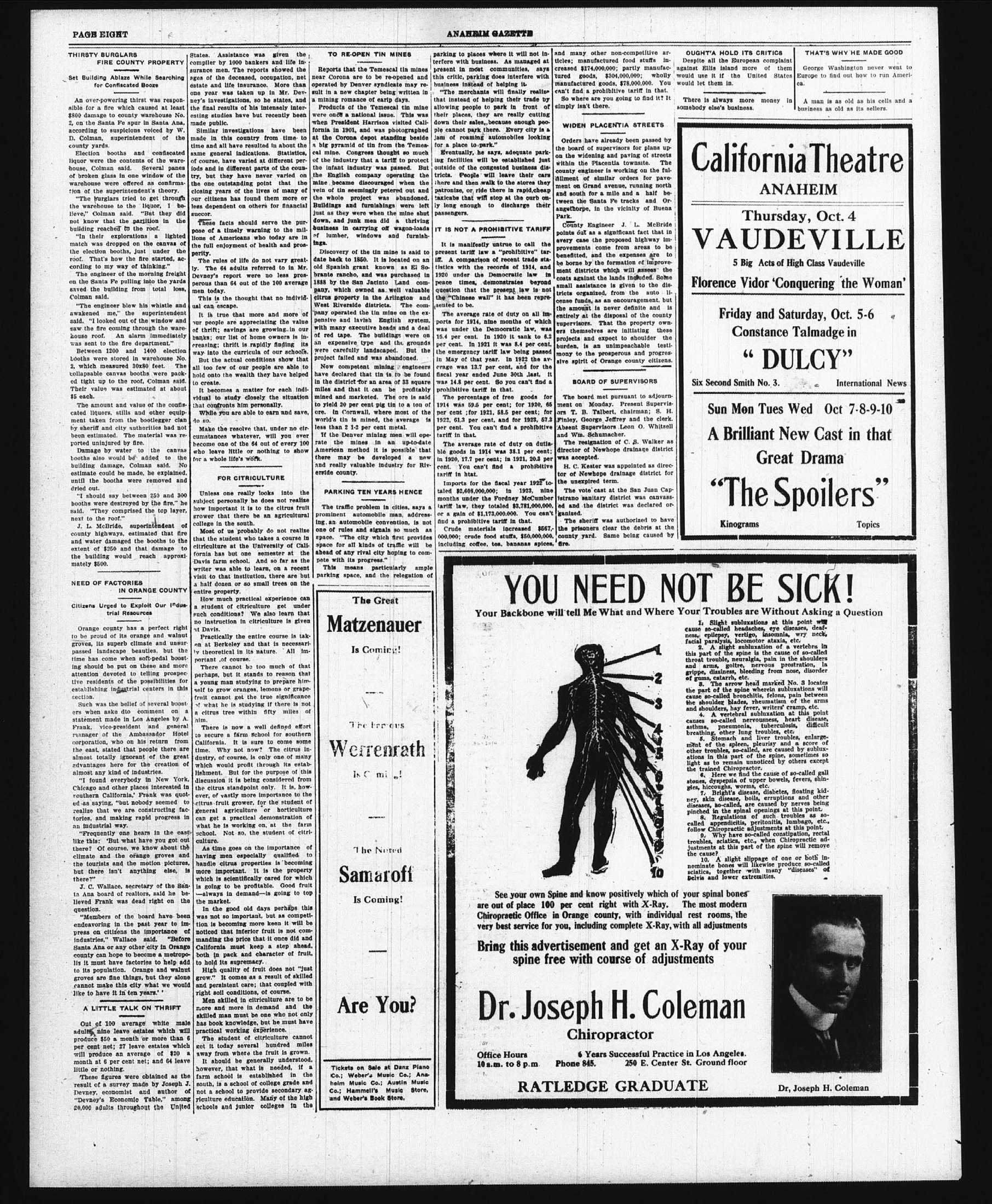
Searchable text
THIRSTY BURGLARS
FIRE COUNTY PROPERTY
Set Building Ablaze While Searching for Confiscated Booze
An over-powering thirst was responsible for a fire which caused at least $800 damage to county warehouse No. 2, on the Santa Fe spur in Santa Ana, according to suspicions voiced by W. D. Colman, superintendent of the county yards.
Election booths and confiscated liquor were the contents of the warehouse, Colman said. Several panes of broken glass in one window of the warehouse were offered as confirmation of the superintendent's theory.
"The burglars tried to get through the warehouse to the liquor, I believe," Colman said. "But they did not know that the partition in the building reached to the roof."
"In their explorations a lighted match was dropped on the canvas of the election booths, just under the roof. That's how the fire started, according to my way of thinking."
The engineer of the morning freight on the Santa Fe pulling into the yards saved the building from total loss, Colman said.
"The engineer blew his whistle and awakened me," the superintendent said. "I looked out of the window and saw the fire coming through the warehouse roof. An alarm immediately was sent to the fire department."
Between 1200 and 1400 election booths were stored in warehouse No. 2, which measured 30x80 feet. The collapsable canvas booths were packed tight up to the roof, Colman said. Their value was estimated at about $5 each.
The amount and value of the confiscated liquors, stills and other equipment taken from the bootlegger clan by sheriff and city authorities had not been estimated. The material was reported uninjured by fire.
States. Assistance was given the compiler by 1000 bankers and life insurance men. The reports showed the ages of the deceased, occupation, net estate and life insurance. More than one year was taken up in Mr. Devney's investigations, so he states, and the final results of his intensely interesting studies have but recently been made public.
Similar investigations have been made in this country from time to time and all have resulted in about the same general indications. Statistics, of course, have varied at different periods and in different parts of the country, but they have never varied on the one outstanding point that the closing years of the lives of many of our citizens has found them more or less dependent on others for financial success.
These facts should serve the purpose of a timely warning to the millions of Americans who today are in the full enjoyment of health and prosperity.
The rules of life do not vary greatly. The 64 adults referred to in Mr. Devney's report were no less prosperous than 64 out of the 100 average men today.
This is the thought that no individual can escape.
It is true that more and more of our people are appreciating the value of thrift; savings are growing in our banks; our list of home owners is increasing; thrift is rapidly finding its way into the curricula of our schools.
But the actual conditions show that all too few of our people are able to hold onto the wealth they have helped to create.
It becomes a matter for each individual to study closely the situation that confronts him personally.
While you are able to earn and save, do so.
Make the resolve that, under no circumstances whatever, will you ever become one of the 64 out of every 100
TO RE-OPEN
Reports that the near Corona are to operated by Denver sult in a new chapter a mining romance o
Products of the were once a nation when President Hafornia in 1901, and at the Corona depa big pyramid of tcal mine. Congress of the industry that the infant industrythe English compaine became discovine of tin seemingthe whole projectBuildings and furjust as they were wdown, and junk m business in carrylof lumber, windings.
Discovery of the date back to 1850. old Spanish grantbrante rancho, and1888 by the San Janypany, which ownercitrus property inWest Riverside dispany operated thepensive and lavishwith many executiveof red tape. The an expensive typewere carefully lairproject failed and
Now competent have declared thatin the district formiles and that itmined and marketeto yield 20 per centore. In Cornwall,world's tin is minless than 2 1/2 perIf the Denver mrate the minesAmerican method
booths were stored in warehouse No. 2, which measured 30x80 feet. The collapsable canvas booths were packed tight up to the roof, Colman said. Their value was estimated at about $5 each.
The amount and value of the confiscated liquors, stills and other equipment taken from the bootlegger clan by sheriff and city authorities had not been estimated. The material was reported uninjured by fire.
Damage by water to the canvas booths also would be added to the building damage, Colman said. No estimate could be made, he explained, until the booths were removed and dried out.
"I should say between 250 and 300 booths were destroyed by the fire," he said. "They comprised the top layer, next to the roof."
J. L. McBride, superintendent of county highways, estimated that fire and water damaged the booths to the extent of $250 and that damage to the building would reach approximately $500.
NEED OF FACTORIES IN ORANGE COUNTY
Citizens Urged to Exploit Our Industrial Resources
Orange county has a perfect right to be proud of its orange and walnut groves, its superb climate and unsurpassed landscape beauties, but the time has come when soft-pedal boosting should be put on these and more attention devoted to telling prospective residents of the possibilities for establishing industrial centers in this section.
Such was the belief of several boosters when aske dto comment on a statement made in Los Angeles by A. Frank, vice-president and general manager of the Ambassador Hotel corporation, who on his return from the east, stated that people there are almost totally ignorant of the great advantages here for the creation of almost any kind of industries.
"I found everybody in New York, Chicago and other places interested in southern California," Frank was quoted as saying, "but nobody seemed to realize that we are constructing factories, and making rapid progress in an industrial way.
"Frequently one hears in the east like this: 'But what have you got out there?' Of course, we know about the way into the curriculum show that all too few of our people are able to hold onto the wealth they have helped to create.
It becomes a matter for each individual to study closely the situation that confronts him personally.
While you are able to earn and save, do so.
Make the resolve that, under no circumstances whatever, will you ever become one of the 64 out of every 100 who leave little or nothing to show for a whole life's work.
FOR CITRICULTURE
Unless one really looks into the subject personally he does not realize how important it is to the citrus fruit grower that there be an agricultural college in the south.
Most of us probably do not realize that the student who takes a course in citriculture at the University of California has but one semester at the Davis farm school. And so far as the writer was able to learn, on a recent visit to that institution, there are but a half dozen or so small trees on the entire property.
How much practical experience can a student of citriculture get under such conditions? We also learn that no instruction in citriculture is given at Davis.
Practically the entire course is taken at Berkeley and that is necessarily theoretical in its nature. All important of course.
There cannot be too much of that perhaps, but it stands to reason that a young man studying to prepare himself to grow oranges, lemons or grapefruit cannot get the true significance of what he is studying if there is not a citrus tree within fifty miles of him.
There is now a well defined effort to secure a farm school for southern California. It is sure to come some time. Why not now? The citrus industry, of course, is only one of many which would profit through its establishment. But for the purpose of this discussion it is being considered from the citrus standpoint only. It is, however, of vastly more importance to the citrus-fruit grower, for the student of general agriculture or horticulture can get a practical demonstration of what he is working on, at the farm school. Not so, the student of citriculture.
As time goes on the importance of
"I found everybody in New York, Chicago and other places interested in southern California," Frank was quoted as saying, "but nobody seemed to realize that we are constructing factories, and making rapid progress in an industrial way.
"Frequently one hears in the east like this: 'But what have you got out there? Of course, we know about the climate and the orange groves and the tourists and the motion pictures, but there isn't anything else, is there?'"
J. C. Wallace, secretary of the Santa Ana board of realtors, said he believed Frank was dead right on the question.
"Members of the board have been endeavoring in the past year to impress on citizens the importance of industries," Wallace said. "Before Santa Ana or any other city in Orange county can hope to become a metropolis it must have factories to help add to its population. Orange and walnut groves are fine things, but they alone cannot make this city what we would like to have it in ten years."
A LITTLE TALK ON THRIFT
Out of 100 average white male adults, nine leave estates which will produce $50 a month or more than 6 per cent net; 27 leave estates which will produce an average of $20 a month at 6 per cent net; and 64 leave little or nothing.
These figures were obtained as the result of a survey made by Joseph J. Devney, economist and author of "Devney's Economic Table," among 20,000 adults throughout the United
dustry, of course, is only one of many which would profit through its establishment. But for the purpose of this discussion it is being considered from the citrus standpoint only. It is, however, of vastly more importance to the citrus fruit grower, for the student of general agriculture or horticulture can get a practical demonstration of what he is working on, at the farm school. Not so, the student of citriculture.
As time goes on the importance of having men especially qualified to handle citrus properties is becoming more important. It is the property which is scientifically cared for which is going to be profitable. Good fruit—always in demand—is going to top the market.
In the good old days perhaps this was not so important, but as competition is becoming more keen it will be noticed that inferior fruit is not commanding the price that it once did and California must keep a step ahead, both in pack and character of fruit, to hold its supremacy.
High quality of fruit does not "just grow." It comes as a result of skilled and persistent care; that coupled with right soil conditions, of course.
Men skilled in citriculture are to be more and more in demand and the skilled man must be one who not only has book knowledge, but he must have practical working experience.
The student of citriculture cannot get it today several hundred miles away from where the fruit is grown.
It should be generally understood, however, that what is needed, if a farm school is established in the south, is a school of college grade and not a school to provide secondary agriculture education. Many of the high schools and junior colleges in the
TO RE-OPEN TIN MINES
Reports that the Temescal tin mines near Corona are to be re-opened and operated by Denver syndicate may result in a new chapter being written in a mining romance of earlp days.
Products of the Temescal tin mine were once a national issue. This was when President Harrison visited California in 1901, and was photographed at the Corona depot standing beside a big pyramid of tin from the Temescal mine. Congress thought so much of the industry that a tariff to protect the infant industry was passed. But the English company operating the mine became discouraged when the vein of tin seemingly petered out and the whole project was abandoned. Buildings and furnishings were left just as they were when the mine shut down, and junk men did a thriving business in carrying off wagon-loads of lumber, windows and furnishings.
Discovery of the tin mine is said to date back to 1850. It is located on an old Spanish grant known as El Sorbrante rancho, and was purchased in 1888 by the San Jacinto Land company, which owned as well valuable citrus property in the Arlington and West Riverside districts. The company operated the tin mine on the expensive and lavish English system, with many executive heads and a deal of red tape. The buildings were on an expensive type and the grounds were carefully landscaped. But the project failed and was abandoned.
Now competent mining engineers have declared that tin is to be found in the district for an area of 33 square miles and that it can be profitably mined and marketed. The ore is said to yield 20 per cent pig tin to a ton of ore. In Cornwall, where most of the world's tin is mined, the average is less than 2 1/2 per cent metal.
If the Denver mining men will operate the mines in an up-to-date American method it is possible that parking to places where it will not interfere with business. As managed at present in most communities, says this critic, parking does interfere with business instead of helping it.
"The merchants will finally realize that instead of helping their trade by allowing people to park in front of their places, they are really cutting down their sales, because enough people cannot park there. Every city is a jam of roaming automobiles looking for a place to park."
Eventually, he says, adequate parking facilities will be established just outside of the congested business districts. People will leave their cars there and then walk to the stores they patronize, or ride there in rapid, cheap taxicabs that will stop at the curb only long enough to discharge their passengers.
IT IS NOT A PROHIBITIVE TARIFF
It is manifestly untrue to call the present tariff law a "prohibitive" tariff. A comparison of recent trade statistics with the records of 1914, and 1920 under the Democratic law in peace times, demonstrates beyond question that the present law is not the "Chinese wall" it has been represented to be.
The average rate of duty on all imports for 1914, nine months of which was under the Democratic law, was 15.4 per cent. In 1920 it sank to 6.2 per cent. In 1921 it was 8.4 per cent, the emergency tariff law being passed in May of that year. In 1922 the average was 13.7 per cent, and for the fiscal year ended June 30th last, it was 14.8 per cent. So you can't find a prohibitive tariff in that.
The percentage of free goods for 1914 was 59.5 per cent; for 1920, 65 per cent; for 1921, 58.5 per cent; for 1922, 61.3 per cent, and for 1923, 57.3 per cent. You can't find a prohibitive tariff in that.
The average rate of duty on dutia-and many other non-competitive articles; manufactured food stuffs increased $174,000,000; partly manufactured goods, $304,000,000; wholly manufactured goods, $78,000,000. You can't find a prohibitive tariff in that.
So where are you going to find it? It simply isn't there.
WIDEN PLACENTIA STREETS
Orders have already been passed by the board of supervisors for plans upon the widening and paving of streets within the Placentia townsite. The county engineer is working on the fulfillment of similar orders for pavement on Grand avenue, running north and south for a mile and a half between the Santa Fe tracks and Orangathorpe, in the vicinity of Buena Park.
County Engineer J. L. McBride points out as a significant fact that in every case the proposed highway improvements come from areas to be benefitted, and the expenses are to be borne by the formation of improvement districts which will assess the costs against the lands included. Some small assistance is given to the districts organized, from the auto license funds, as an encouragement, but the amount is never definite and is entirely at the disposal of the county supervisors. That the property owners themselves are initiating these projects and expect to shoulder the burden, is an unimpeachable testimony to the prosperous and progressive spirit of Orange county citizens.
BOARD OF SUPERVISORS
The board met pursuant to adjournment on Monday. Present Supervisors T. B. Talbert, chairman; S. H. Finley, George Jeffrey and the clerk. Absent Supervisors Leon O. Whitsell and Wm. Schumacher.
The resignation of C. S. Walker as director of Newhaven drainage district
Now competent mining engineers have declared that tin is to be found in the district for an area of 33 square miles and that it can be profitably mined and marketed. The ore is said to yield 20 per cent pig tin to a ton of ore. In Cornwall, where most of the world's tin is mined, the average is less than 2 1/2 per cent metal.
If the Denver mining men will operate the mines in an up-to-date American method it is possible that there may be developed a new and really valuable industry for Riverside county.
PARKING TEN YEARS HENCE
The traffic problem in cities, says a prominent automobile man, addressing an automobile convention, is not one of rules and signals so much as space. "The city which first provides space for all kinds of traffic will be ahead of any rival city hoping to compete with its progress."
This means particularly ample parking space, and the relegation of
The Great Matzenauer
Is Coming!
The Irresus Werrenrath
Is Coming!
The Noted
In May of that year. In 1922 the average was 13.7 per cent, and for the fiscal year ended June 30th last, it was 14.8 per cent. So you can't find a prohibitive tariff in that.
The percentage of free goods for 1914 was 59.5 per cent; for 1920, 65 per cent; for 1921, 58.5 per cent; for 1922, 61.3 per cent, and for 1923, 57.3 per cent. You can't find a prohibitive tariff in that.
The average rate of duty on dutile goods in 1914 was 38.1 per cent; in 1920, 17.7 per cent; in 1921, 20.3 per cent. You can't find a prohibitive tariff in htat.
Imports for the fiscal year 1922 totaled $2,608,000,000; in 1923, nine months under the Fordney McCumber tariff law, they totaled $3,781,000,000 or a gain of $1,173,000,000. You can't find a prohibitive tariff in that.
Crude materials increased $567,000,000; crude food stuffs, $50,000,000, including coffee, tea, bananas spices,
BOARD OF SUPERVISORS
The board met pursuant to adjournment on Monday. Present Supervisors T. B. Talbert, chairman; S. H. Finley, George Jeffrey and the clerk. Absent Supervisors Leon O. Whitsell and Win. Schumacher.
The resignation of C. S. Walker as director of Newhope drainage district was accepted.
H. C. Kester was appointed as director of Newhope drainage district for the unexpired term.
The vote cast at the San Juan Capistrano sanitary district was canvassed and the district was declared organized.
The sheriff was authorized to have the prisoners clear the debris at the county yard. Same being caused by fire.
YOU NEED NOT
Your Backbone will tell Me What and Where Your
Is Coming!
The Noted
Samaroff
Is Coming!
Are You?
Tickets on Sale at Danz Plano Co.; Weber's Music Co.; Anaheim Music Co.; Austin Music Co.; Hammell's Music Store, and Weber's Book Store.
See your own Spine and know positively which of your are out of place 100 per cent right with X-Ray. The Chiropraetic Office in Orange county, with individual rest very best service for you, including complete X-Ray, with all
Bring this advertisement and get an X-Ray spine free with course of adjustme
Dr. Joseph H. Cole
Chiropractor
Office Hours
10 a.m. to 8 p.m. Phone 845. 250 E. Center St.
RATLEDGE GRADUATE
OUGHT’A HOLD ITS CRITICS
Despite all the European complaint against Ellis island more of them would use it if the United States would let them in.
There is always more money in somebody else’s business.
THAT’S WHY HE MADE GOOD
George Washington never went to Europe to find out how to run America.
A man is as old as his cells and a business as old as its sellers.
California Theatre
ANAHEIM
Thursday, Oct. 4
VAUDEVILLE
5 Big Acts of High Class Vaudeville
Florence Vidor ‘Conquering the Woman’
Friday and Saturday, Oct. 5-6
Constance Talmadge in “DULCY”
Six Second Smith No. 3. International News
Sun Mon Tues Wed Oct 7-8-9-10
A Brilliant New Cast in that
"DULCY"
Six Second Smith No. 3. International News
Sun Mon Tues Wed Oct 7-8-9-10
A Brilliant New Cast in that Great Drama
"The Spoilers"
Kinograms Topics
ED NOT BE SICK!
t and Where Your Troubles are Without Asking a Question
1. Slight subluxations at this point will cause so-called headaches, eye diseases, deafness, epilepsy, vertigo, insomnia, wry neck, facial paralysis, locomotor ataxia, etc.
2. A slight subluxation of a vertebra in this part of the spine is the cause of so-called throat trouble, neuralgia, pain in the shoulders and arms, goitre, nervous prostration, la grippe, dizziness, bleeding from nose, disorder of gums, catarrh, etc.
3. The arrow head marked No. 3 locates the part of the spine wherein subluxations will cause so-called bronchitis, felons, pain between the shoulder blades, rheumatism of the arms and shoulders, hay fever, writers' cramp, etc.
4. A vertebral subluxation at this point causes so-called nervousness, heart disease, asthma, pneumonia, tuberculosis, difficult breathing, other lung troubles, etc.
5. Stomach and liver troubles, enlargement of the spleen, pleurisy and a score of other troubles, so-called, are caused by subluxations in this part of the spine, sometimes so light as to remain unnoticed by others except the trained Chiropractor.
6. Here we find the cause of so-called gall stones, dyspepsia of upper bowels, fevers, shingles, hiccoughs, worms, etc.
7. Bright's disease, diabetes, floating kidney, skin disease, boils, eruptions and other diseases, so-called, are caused by nerves being pinched in the spinal openings at this point.
8. Regulations of such troubles as so-called appendicitis, peritonitis, lumbago, etc., follow Chiropractic adjustments at this point.
9. Why have so-called constipation, rectal troubles, sciatica, etc., when Chiropractic adjustments at this part of the spine will remove
6. Here we find the cause of so-called gall stones, dyspepsia of upper bowels, fevers, shingles, hiccoughs, worms, etc.
7. Bright's disease, diabetes, floating kidney, skin disease, boils, eruptions and other diseases, so-called, are caused by nerves being pinched in the spinal openings at this point.
8. Regulations of such troubles as so-called appendicitis, peritonitis, lumbago, etc., follow Chiropractic adjustments at this point.
9. Why have so-called constipation, rectal troubles, sciatica, etc., when Chiropractic adjustments at this part of the spine will remove the cause?
10. A slight slippage of one or both innominate bones will likewise produce so-called sciatica, together with many "diseases" of pelvis and lower extremities.
Initively which of your spinal bones is with X-Ray. The most modern with individual rest rooms, the complete X-Ray, with all adjustments
and get an X-Ray of your use of adjustments
H. Coleman
actor
Successful Practice in Los Angeles.
250 E. Center St. Ground floor
GRADUATE
Dr, Joseph H. Coleman