anaheim-gazette 1923-10-04
Scanned page
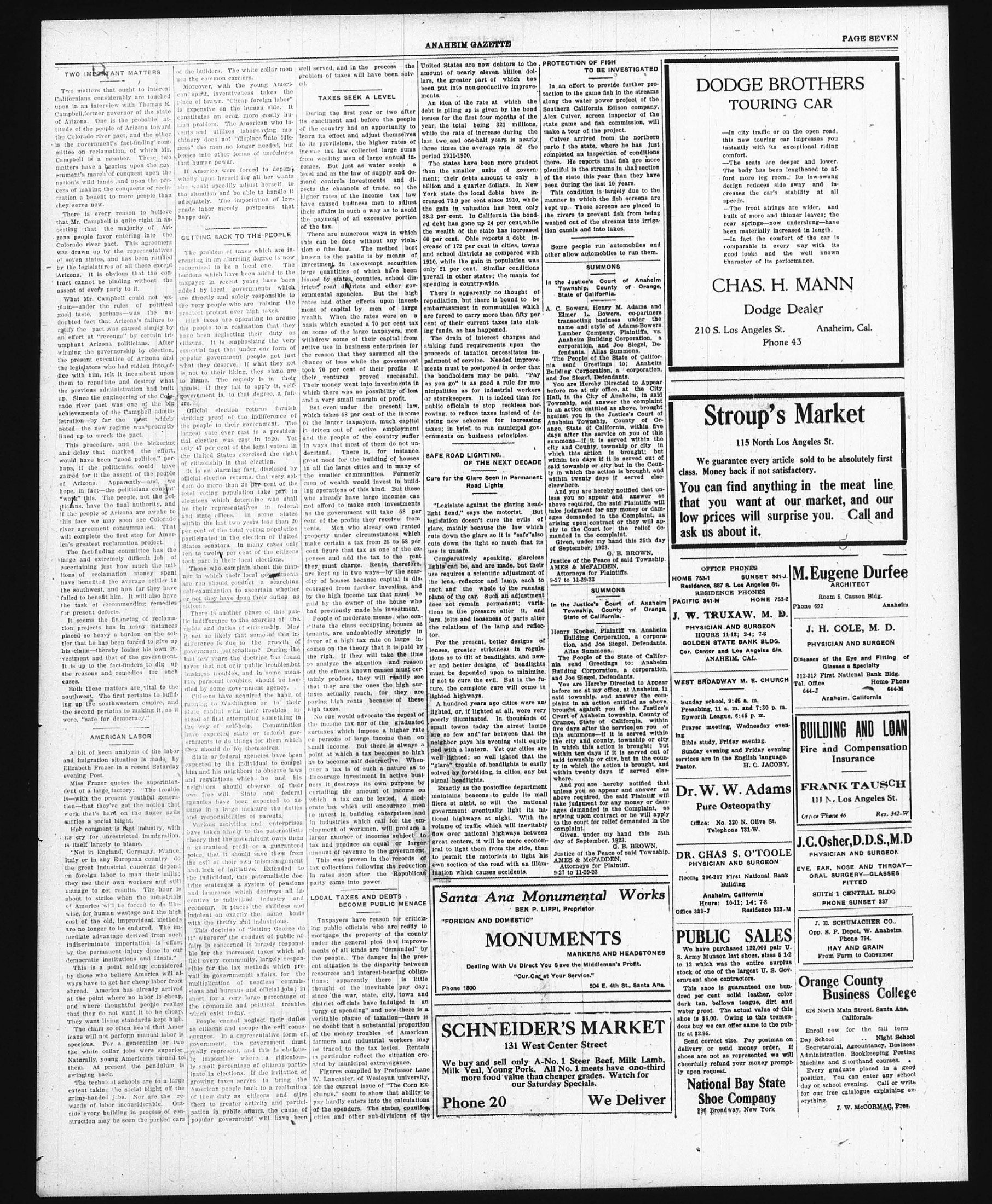
Searchable text
TWO IMPORTANT MATTERS
Two matters that ought to interest Californians considerably are touched upon in an interview with Thomas E. Campbell, former governor of the state of Arizona. One is the probable attitude of the people of Arizona toward the Colorado river pact, and the other is the government's fact-finding committee on reclamation, of which Mr. Campbell is a member. These two matters have a bearing upon the government's march of conquest upon the nation's wild lands, and upon the process of making the conquests of reclamation a benefit to more people than they serve now.
There is every reason to believe that Mr. Campbell is quite right in asserting that the majority of Arizona people favor entering into the Colorado river pact. This agreement was drawn up by the representatives of seven states, and has been ratified by the legislatures of all these except Arizona. It is obvious that the contract cannot be binding without the assent of every party to it.
What Mr. Campbell could not explain—under the rules of political good taste, perhaps—was the undoubted fact that Arizona's failure to ratify the pact was caused simply by an effort at "revenge" by certain triumphant Arizona politicians. After winning the governorship by election, the present executive of Arizona and the legislators who had ridden into office with him, felt it incumbent upon them to repudiate and destroy what the previous administration had built up. Since the engineering of the Colorado river pact was one of the big achievements of the Campbell administration—by far the most widely noted—the new regime was promptly lined up to wreck the pact.
This procedure, and the bickering of the builders. The white collar men use the common carriers.
Moreover, with the young American spirit, inventiveness takes the place of brawn. "Cheap foreign labor" is expensive on the human side. It constitutes an even more costly human problem. The American who invents and utilizes labor-saving machinery does not "displace into idleness" the men no longer needed, but leases into other forms of usefulness that human power.
If America were forced to depend wholly upon herself for all her wants she would speedily adjust herself to the situation and be able to handle it adequately. The importation of low-grade labor merely postpones that happy day.
GETTING BACK TO THE PEOPLE
The problem of taxes which are increasing in an alarming degree is now recognized to be a local one. The burdens which have been added to the taxpayer in recent years have been added by local governments which are directly and solely responsible to the very people who are raising the greatest protest over high taxes.
High taxes are operating to arouse the people to a realization that they have been neglecting their duty as citizens. It is emphasizing the very essential fact that under our form of popular government people get just what they deserve. If what they get is not to their liking, they alone are to blame. The remedy is in their hands. If they fail to apply it, self-government is, to that degree, a failure.
Official election returns furnish striking proof of the indifference of the people to their government. The largest vote ever cast in a presidential election was cast in 1920. Yet only 47 per cent of the legal voters well served, and in the problem of taxes will be.
TAXES SEEK A
During the first year its enactment and before of the country had an learn its effect and adjudicate its provisions, the income tax law collects from wealthy men of law comes. But just as we level and as the law of mand controls investment rects the channels of higher rates of the income have caused business their affairs in such a way the payment of an extra of the tax.
There are numerous this can be done with tion o fthe law. The known to the public is investment in tax-excess large quantities of which issued by states, countricts road districts or governmental agencies. rates had other effect of capital by wealth. When the rate basis which exacted a on some of the large withdrew some of the active use in business the reason that they a chance of loss while took 70 per cent of their ventures prov Their money went into which there was no po and a very small margin.
But even under which takes 58 per cent of the larger taxpayers in driven out of action and the people of tha in ways that most of
the present executive of Arizona and the legislators who had ridden into office with him, felt it incumbent upon them to repudiate and destroy what the previous administration had built up. Since the engineering of the Colorado river pact was one of the big achievements of the Campbell administration—by far the most widely noted—the new regime was promptly lined up to wreck the pact.
This procedure, and the bickering and delay that marked the effort, would have been "good politics," perhaps, if the politicians could have gained for it the assent of the people of Arizona. Apparently—and, we hope, in fact—the politicians consent "work" this. The people, not the politicians, have the final authority, and if the people of Arizona are awake to this face we may soon see Colorado river agreement consummated. That will complete the first step for America's greatest reclamation project.
The fact-finding committee has the large and extremely difficult job of escertaining just how much the millions of reclamation money spent have benefited the average settler in the southwest, and how far they have failed to benefit him. It will also have the task of recommending remedies for present defects.
It seems the financing of reclamation projects has in many instances placed so heavy a burden on the settler that he has been forced to give up his claim—thereby losing his own investment and that of the government. It is up to the fact-finders to dig up the reasons and remedies for such cases.
Both these matters are vital to the southwest. The first pertains to building up the southwestern empire, and the second pertains to making it, as it were, "safe for democracy."
AMERICAN LABOR
A bit of keen analysis of the labor and immigration situation is made by Elizabeth Frazer in a recent Saturday evening Post.
Miss Frazer quotes the superintendent of a large factory: "The trouble is—with the present youthful generation—that they've got the notion that work that's hard on the finger nails carries a social blight.
Her comment is that industry, with its cry for unrestricted immigration, is itself largely to blame.
Official election returns furnish striking proof of the indifference of the people to their government. The largest vote ever cast in a presidential election was cast in 1920. Yet only 47 per cent of the legal voters in the United States exercised the right of citizenship in that election.
It is an alarming fact, disclosed by official election returns, that very seldom do more than 30 per cent of the total voting population take part in elections which determine who shall be their representatives in federal and state offices. In some states within the last two years less than 20 per cent of the total voting population participated in the election of United States senators. In many cases only ten to twelve per cent of the citizens took part in their local elections.
Those who complain about the manner in which their local governments are run should conduct a searching self-examination to ascertain whether or not they have done their duties as citizens.
There is another phase of this public indifference to the exercise of rights and duties of citizenship. May it not be likely that some of this indifference is due to the growth of government paternalism? During the last few years the doctrine has found favor that not only public troubles, but business troubles, and in some measure, personal troubles, should be handled by some government agency.
Citizens have acquired the habit of running to Washington or to their state capital with their troubles instead of first attempting something in the way of self-help. Communities have expected state or federal governments to do things for them which they should do for themselves.
State or federal agencies have been expected by the individual to compel him and his neighbors to observe laws and regulations which he and his neighbors should observe of their own free will. State and federal agencies have been expected to assume in a large measure the duties and responsibilities of parents.
Various activities and enterprises have taken kindly to the paternalistic theory that the government owes them a guaranteed profit or a guaranteed popular government people get just what they deserve. If what they get is not to their liking, they alone are to blame. The remedy is in their hands; If they fail to apply it, self-government is, to that degree, a failure.
Official election returns furnish striking proof of the indifference of the people to their government. The largest vote ever cast in a presidential election was cast in 1920. Yet only 47 per cent of the legal voters in the United States exercised the right of citizenship in that election.
It is an alarming fact, disclosed by official election returns, that very seldom do more than 30 per cent of the total voting population take part in elections which determine who shall be their representatives in federal and state offices. In some states within the last two years less than 20 per cent of the total voting population participated in the election of United States senators. In many cases only ten to twelve per cent of the citizens took part in their local elections.
Those who complain about the manner in which their local governments are run should conduct a searching self-examination to ascertain whether or not they have done their duties as citizens.
There is another phase of this public indifference to the exercise of rights and duties of citizenship. May it not be likely that some of this indifference is due to the growth of government paternalism? During the last few years the doctrine has found favor that not only public troubles, but business troubles, and in some measure, personal troubles, should be handled by some government agency.
Citizens have acquired the habit of running to Washington or to their state capital with their troubles instead of first attempting something in the way of self-help. Communities have expected state or federal governments to do things for them which they should do for themselves.
State or federal agencies have been expected by the individual to compel him and his neighbors to observe laws and regulations which he and his neighbors should observe of their own free will. State and federal agencies have been expected to assume in a large measure the duties and responsibilities of parents.
Various activities and enterprises have taken kindly to the paternalistic theory that the government owes them a guaranteed profit or a guaranteed popular government people get just what they deserve. If what they get is not to their liking, they alone are to blame. The remedy is in their hands; If they fail to apply it, self-government is, to that degree, a failure.
Official election returns furnish striking proof of the indifference of the people to their government. The largest vote ever cast in a presidential election was cast in 1920. Yet only 47 per cent of the legal voters in the United States exercised the right of citizenship in that election.
It is an alarming fact, disclosed by official election returns, that very seldom do more than 30 per cent of the total voting population take part in elections which determine who shall be their representatives in federal and state offices. In some states within the last two years less than 20 per cent of the total voting population participated in the election of United States senators. In many cases only ten to twelve per cent of the citizens took part in their local elections.
Those who complain about the manner in which their local governments are run should conduct a searching self-examination to ascertain whether or not they have done their duties as citizens.
There is another phase of this public indifference to the exercise of rights and duties of citizenship. May it not be likely that some of this indifference is due to the growth of government paternalism? During the last few years the doctrine has found favor that not only public troubles, but business troubles, and in some measure, personal troubles, should be handled by some government agency.
Citizens have acquired the habit of running to Washington or to their state capital with their troubles instead of first attempting something in the way of self-help. Communities have expected state or federal governments to do things for them which they should do for themselves.
State or federal agencies have been expected by the individual to compel him and his neighbors to observe laws and regulations which he and his neighbors should observe of their own free will. State and federal agencies have been expected to assume in a large measure the duties and responsibilities of parents.
Various activities and enterprises have taken kindly to the paternalistic theory that the government owes them a guaranteed profit or a guaranteed popular government people get just what they deserve. If what they get is not to their liking, they alone are to blame. The remedy is in their hands; If they fail to apply it, self-government is, to that degree, a failure.
Official election returns furnish striking proof of the indifference of the people to their government. The largest vote ever cast in a presidential election was cast in 1920. Yet only 47 per cent of the legal voters in the United States exercised the right of citizenship in that election.
It is an alarming fact, disclosed by official election returns, that very seldom do more than 30 per cent of the total voting population take part in elections which determine who shall be their representatives in federal and state offices. In some states within the last two years less than 20 per cent of the total voting population participated in the election of United States senators. In many cases only ten to twelve per cent of the citizens took part in their local elections.
Those who complain about the manner in which their local governments are run should conduct a searching self-examination to ascertain whether or not they have done their duties as citizens.
There is another phase of this public indifference to the exercise of rights and duties of citizenship. May it not be likely that some of this indifference is due to the growth of government paternalism? During the last few years the doctrine has found favor that not only public troubles, but business troubles, and in some measure, personal troubles, should be handled by some government agency.
Citizens have acquired the habit of running to Washington or to their state capital with their troubles instead of first attempting something in the way of self-help. Communities have expected state or federal governments to do things for them which they should do for themselves.
State or federal agencies have been expected by the individual to compel him and his neighbors to observe laws and regulations which he and his neighbors should observe of their own free will. State and federal agencies have been expected to assume in a large measure the duties and responsibilities of parents.
Various activities and enterprises have taken kindly to the paternalistic theory that the government owes them a guaranteed profit or a guaranteed popular government people get just what they deserve. If what they get is not to their liking, they alone are to blame. The remedy is in their hands; If they fail to apply it, self-government is, to that degree, a failure.
Official election returns furnish striking proof of the indifference of the people to their government. The largest vote ever cast in a presidential election was cast in 1920. Yet only 47 per cent of the legal voters in the United States exercised the right of citizenship in that election.
It is an alarming fact, disclosed by official election returns, that very seldom do more than 30 per cent of the total voting population take part in elections which determine who shall be their representatives in federal and state offices. In some states within the last two years less than 20 per cent of the total voting population participated in the election of United States senators. In many cases only ten to twelve per cent of the citizens took part in their local elections.
Those who complain about the manner in which their local governments are run should conduct a searching self-examination to ascertain whether or not they have done their duties as citizens and add them as政府部门。
But even under these conditions takes 58 per cent of larger taxpayers driven out of action andthe peopleoftheminin ways thatmostofthederstand. Thereisgreat needforthebusinallthelargecitiesthesmallercommunitiesmenofwealthwouldingoperationsofthewhoalreadyhavelargenotaffordtomakesasthegovernmentwouldntofrotthepricestherentents.Menwhairapropertyundercircuitmake certaina taxfrancipethattaxpensesandaddthetheymustcharge.Bestare keptupintwowascityofhousesbecausecouragedfromfurtherbythehighincometheadpaidbytheownerowhadpreviouslymadepeopleofmoderatecitizenstheclassoccertenants,aundoubtfavorofahightaxncomeprecisesanddiscourageinvestmentnessitdestroyitscurtailingtheamountwhicha taxcanbcrreatetaxwhichwilltoinvestinbuildingsinindustrieswhichploymentofworksmarginallyproducehightaxs.
No one would advocatetheincometaxnorsurtaxeswhichimprovespersonseoflargesmallincome.Butpointatwhicha taxastobecomealselfdealingovera taxisofsuchdiscourageinvestmentsitdestroysitscurtailingtheamountwhicha taxcanbcrcreatetaxwhichwilltoinvestinbuildingsinindustrieswhichploymentofworksmarginallyproducehightaxs.
and immigration situation is made by Elizabeth Frazer in a recent Saturday evening Post.
Miss Frazer quotes the superintendent of a large factory: "The trouble is—with the present youthful generation—that they've got the notion that work that's hard on the finger nails carries a social blight.
Her comment is that industry, with its cry for unrestricted immigration, is itself largely to blame.
"Not in England, Germany, France, Italy or in any European country do the great industrial concerns depend on foreign labor to man their mills; they use their own workers and still manage to get results. The hour is about to strike when the industrials of America will be forced to do likewise, for human wastage and the high cost of the old, improvident methods are no longer to be endured. The immediate advantage derived from such indiscriminate importation is offset by the permanent injury done to our democratic institutions and ideals."
This is a point seldom considered by those who believe America will always have to get her cheap labor from abroad. America has already arrived at the point where no labor is cheap, and where thoughtful people realize that they do not want it to be cheap. They want living standards kept high.
The claim so often heard that Americans will not perform manual labor is specious. For a generation or two the white collar jobs were superior. Naturally, young Americans turned to them. At present the pendulum is swinging back.
The technical schools are to a large extent taking the social blight off the grimy-handed jobs. Nor are the rewards of labor inconsiderable. Outside every building in process of construction may be seen the parked cars State or federal agencies have been expected by the individual to compel him and his neighbors to observe laws and regulations which he and his neighbors should observe of their own free will. State and federal agencies have been expected to assume in a large measure the duties and responsibilities of parents.
Various activities and enterprises have taken kindly to the paternalistic theory that the government owes them a guaranteed profit or a guaranteed price, that it should save them from the evil of their own mismanagement and lack of initiative. Extended to the individual, this paternalistic doctrine embraces a system of pensions and insurance which destroys all incentive to individual industry and economy. It places the shiftless and indolent on exactly the same basis with the thrifty and industrious.
This doctrine of "letting George do it" wherever the conduct of public affairs is concerned is largely responsible for the increased taxes which affect every community, largely responsible for the lax methods which prevail in governmental affairs, for the multiplication of needless commissions and bureaus and official jobs; in short, for a very large percentage of the economic and political troubles which exist today.
People cannot neglect their duties as citizens and escape the evil consequences. In a representative form of government, the government must really represent, and this is obviously impossible where a ridiculously small percentage of citizens participate in elections. If the irritation of growing taxes serves to bring the American people back to a realization of their duty as citizens and stirs them to greater activity and participation in public affairs, the cause of popular government will have been
Taxpayers have rising public officials' mortgage, the property under the general elements of all kinds of the people. The decent situation is then resources and intentions; apparently thought of the insistence since the war, state district officials have "orgy of spending" veritable plague of no doubt that a sub-fund of the money troubled farmers and industries be traced to the time in particular reflected by municipal figures compiled W. Lancaster, of W. for the current issue change." seem to pay hardly enters into of the spenders. T cities and other s
ANAHEIM GAZETTE
TAXES SEEK A LEVEL
During the first year or two after its enactment and before the people of the country had an opportunity to learn its effect and adjust themselves to its provisions, the higher rates of income tax law collected large sums from wealthy men of large annual incomes. But just as water seeks a level and as the law of supply and demand controls investments and directs the channels of trade, so the higher rates of the income tax law have caused business men to adjust their affairs in such a way as to avoid the payment of an excessive portion of the tax.
There are numerous ways in which this can be done without any violation of the law. The method best known to the public is by means of investment in tax-exempt securities, large quantities of which have been issued by states, counties, school districts, road districts and other governmental agencies. But the high rates had other effects upon investment of capital by men of large wealth. When the rates were on a basis which exacted a 70 per cent tax on some of the large taxpayers, men withdrew some of their capital from active use in business enterprises for the reason that they assumed all the chance of loss while the government took 70 per cent of their profits if their ventures proved successful. Their money went into investments in which there was no possibility of loss and a very small margin of profit.
But even under the present law, which takes 58 per cent of the income of the larger taxpayers, much capital is driven out of active employment and the people of the country suffer in ways that most of them do not un-
United States are now debtors to the amount of nearly eleven billion dollars, the greater part of which has been put into non-productive improvements.
An idea of the rate at which the debt is piling up is given by the bond issues for the first four months of the year, the total being 321 millions, while the rate of increase during the last two and one-half years is nearly three times the average rate of the period 1911-1920.
The states have been more prudent than the smaller units of government; their debts amount to only a billion and a quarter dollars. In New York state the local debts have increased 73.9 per cent since 1910, while the gain in valuation has been only 28.3 per cent. In California the bonded debt has gone up 24 per cent, while the wealth of the state has increased 60 per cent. Ohio reports a debt increase of 172 per cent in cities, towns and school districts as compared with 1910, while the gain in population was only 21 per cent. Similar conditions prevail in other states; the mania for spending is country-wide.
There is apparently no thought of repudiation, but there is bound to be embarrassment in communities which are forced to carry more than fifty per cent of their current taxes into sinking funds, as has happened.
The drain of interest charges and sinking fund requirements upon the proceeds of taxation necessitates impairment of service. Needed improvements must be postponed in order that the bondholders may be paid. "Pay as you go" is as good a rule for municipalities as for industrial workers or storekeepers. It is indeed time for public officials to stop reckless borrowing, to reduce taxes instead of devising new schemes for increasing taxes; in brief, to run municipal governments on business principles.
PROTECTION OF FISH
TO BE INVESTIGATED
In an effort to provide further protection to the game fish in the streams along the water power project of the Southern California Edison company, Alex Culver, screen inspector of the state game and fish commission, will make a tour of the project.
Culver arrived from the northern part f the state, where he has just completed an inspection of conditions there. He reports that fish are more plentiful in the streams in that section of the state this year than they have been during the last 10 years.
This condition is largely due to the manner in which the fish screens are kept up. These screens are placed in the rivers to prevent fish from being washed out of the streams into irrigation canals and into lakes.
Some people run automobiles and other allow automobiles to run them.
SUMMONS
In the Justice's Court of Anaheim Township, County of Orange, State of California.
A. C. Bowers, Henry M. Adams and Elmer L. Bowers, co-partners transacting business under the name and style of Adams-Bowers Lumber Company, Plaintiffs, vs. Anaheim Building Corporation, a corporation, and Joe Siegel, Defendants. Alias Summons.
The People of the State of California send Greetings to; Anaheim Building Corporation, a corporation, and Joe Siegel, Defendants.
You are Hereby Directed to Appear before me at my office, at the City Hall, in the City of Anaheim, in said Township, and answer the complaint in an action entitled as above, brought against you in the Justice's Court of Anaheim Township, County of Orange, State of California, within five days after the service on you of this summons—if it is served within the city and County, township or city in
the reason that they assumed all the chance of loss while the government took 70 per cent of their profits if their ventures proved successful. Their money went into investments in which there was no possibility of loss and a very small margin of profit.
But even under the present law, which takes 58 per cent of the income of the larger taxpayers, much capital is driven out of active employment and the people of the country suffer in ways that most of them do not understand. There is, for instance, great need for the building of houses in all the large cities and in many of the smaller communities. Formerly men of wealth would invest in building operations of this kind. But those who already have large incomes can not afford to make such investments as the government will take 58 per cent of the profits they receive from rents. Men who alreay own rented property under circumstances which make certain a tax from 25 to 58 per cent figure that tax as one of the expenses and add the tax to the rent they must charge. Rents, therefore, are kept up in two ways—by the scarcity of houses because capital is discouraged from further investing, and by the high income tax that must be paid by the owner of the house who had previously made his investment.
People of moderate means, who constitute the class occupying houses as tenants, are undoubtedly strongly in favor of a high tax rate on large incomes on the theory that it is paid by the rich. If they will take the time to analyze the situation and reason out the effects known causes must certainly produce, they will readily see that they are the ones the high taxes actually reach, for they are paying high rents because of these high taxes.
No one would advocate the repeal of the income tax nor of the graduated surtaxes which impose a higher rate on persons of large income than on small income. But there is always a point at which a tax becomes so high as to become self destructive. Whenever a tax is of such a nature as to discourage investment in active business it destroys its own purpose by curtailing the amount of income on which a tax can be levied. A moderate tax which will encourage men to invest in building enterprises and in industries which call for the employment of workmen, will produce a larger number of incomes subject to tax and produce an equal or larger share of revenue to the government.
SAFE ROAD LIGHTING.
OF THE NEXT DECADE
Cure for the Glare Seen in Permanent Road Lights
"Legislate against the glaring headlight flend," says the motorist. But legislation doesn't cure the evils of glare, mainly because the law which cuts down the glare so it is "safe" also cuts down the light so much that its use is unsafe.
Comparatively speaking, glareless lights can be, and are made, but their use requires a scientific adjustment of the lens, reflector and lamp, each to each and the whole to the running plane of the car. Such an adjustment does not remain permanent; variations in tire pressure alter it, and jars, loops and looseness of parts alter the relations of the lamp and reflector.
For the present, better designs of lenses, greater strictness in regulations as to tilt of headlights, and newer and better designs of headlights must be depended upon to minimize, if not to cure the evil. But in the future, the complete cure will come in lighted highways.
A hundred years ago cities were unlighted, or, if lighted at all, were very poorly illuminated. In thousands of small towns today the street lamps are so few and far between that the neighbor pays his evening visit equipped with a lantern. Yet our cities are well lighted; so well lighted that the "glare" trouble of headlights is easily solved by forbididng, in cities, any but signal headlights.
Exactly as the postoffice department maintains beacons to guide its mail filers at night, so will the national government eventually light its national highways at night. With the volume of traffic which will inevitably flow over national highways between great centers, it will be more economical to light them from the side, than proceed or taxation accesses in pairment of service. Needed improvements must be postponed in order that the bondholders may be paid. "Pay as you go" is as good a rule for municipalities as for industrial workers or storekeepers. It is indeed time for public officials to stop reckless borrowing, to reduce taxes instead of devising new schemes for increasing taxes; in brief, to run municipal governments on business principles.
The People of the State of California send Greetings to; Anaheim Building Corporation, a corporation, and Joe Siegel, Defendants.
You are Hereby Directed to Appear before me at my office, at the City Hall, in the City of Anaheim, in said Township, and answer the complaint in an action entitled as above, brought against you in the Justice's Court of Anaheim Township, County of Orange, State of California, within five days after the service on you of this summons—if it is served within the city and County, township or city in which this action is brought; but within ten days if it is served out of said township or city but in the County in which the action is brought, and within twenty days if served elsewhere.
And you are hereby notified that unless you so appear and answer as above required, the said Plaintiffs will take judgment for any money or damages demanded in the Complaint, as arising upon contract or they will apply to the Court for the relief demanded in the complaint.
Given, under my hand this 25th day of September, 1923.
G. B. BROWN,
Justice of the Peace of said Township.
AMES & McFADDEN,
Attorneys for Plaintiffs.
9-27 to 11-29-23
SUMMONS
In the Justice's Court of Anaheim Township, County of Orange, State of California.
Henry Kuchel, Plaintiff vs. Anaheim Building Corporation, a corporation, and Joe Siegel, Defendants.
Allas Summons.
The People of the State of California send Greetings to: Anaheim Building Corporation, a corporation, and Joe Siegel, Defendants.
You are Hereby Directed to Appear before me at my office, at Anaheim, in said township, and answer the complaint in an action entitled as above, brought against you in the Justice's Court of Anaheim township, County of Orange, State of California, within five days after the service on you of this summons—if it is served within the city and county, township or city in which this action is brought; but within ten days if it is served out of said township or city but in the County in which the action is brought, and within twenty days if served elsewhere.
And you are hereby notified that unless you so appear and answer as above required, the said Plaintiffs will take judgment for any money or damages demanded in the Complaint, as arising upon contract or he will apply to the court for relief demanded in the complaint.
Given, under my hand this 25th day of September, 1923.
G. B. BROWN,
Justice of the Peace of said Township.
AMES & McFADDEN,
Attorneys for Plaintiffs.
9-27 to 11-29-23
as to become self destructive. Whenever a tax is of such a nature as to discourage investment in active business it destroys its own purpose by curtailing the amount of income on which a tax can be levied. A moderate tax which will encourage men to invest in building enterprises and in industries which call for the employment of workmen, will produce a larger number of incomes subject to tax and produce an equal or larger amount of revenue to the government.
This was proven in the records of tax collections following the reduction in rates soon after the Republican party came into power.
LOCAL TAXES AND DEBTS
BECOME PUBLIC MENACE
Taxpayers have reason for criticizing public officials who are ready to mortgage the property of the county under the general plea that improvements of all kinds are "demanded" by the people. The danger in the present situation is the disparity between resources and interest-bearing obligations; apparently there is little thought of the inevitable pay day; since the war, state, city, town and district officials have indulged in an "orgy of spending" and now there is a veritable plague of taxation—there is no doubt that a substantial proportion of the money troubles of American farmers and industrial workers may be traced to the tax levies. Rentals in particular reflect the situation created by municipal extravagance.
Figures compiled by Professor Lane W. Lancaster, of Wesleyan university, for the current issue of "The Corn Exchange," seem to show that ability to pay hardly enters into the calculations of the spenders. The states, counties, cities and other sub-divisions of the well lighted; so well lighted that the "glare" trouble of headlights is easily solved by forbidding, in cities, any but signal headlights.
Exactly as the postoffice department maintains beacons to guide its mail filers at night, so will the national government eventually light its national highways at night. With the volume of traffic which will inevitably flow over national highways between great centers, it will be more economical to light them from the side, than to permit the motorists to light his own section of the road with an illumination which causes accidents.
Santa Ana Monumental Works
BEN P. LIPPI, Proprietor
"FOREIGN AND DOMESTIC"
MONUMENTS
MARKERS AND HEADSTONES
Dealing With Us Direct You Save the Middleman's Profit.
"Our Car at Your Service."
Phone 1800
504 E. 4th St., Santa Ana.
SCHNEIDER'S MARKET
131 West Center Street
We buy and sell only A-No. 1 Steer Beef, Milk Lamb, Milk Veal, Young Pork. All No. 1 meats have one-third more food value than cheaper grades. Watch for our Saturday Specials.
Phone 20
We Deliver
DODGE BROTHERS
TOURING CAR
—In city traffic or on the open road,
this new touring car impresses you instantly with its exceptional riding comfort.
—The seats are deeper and lower.
The body has been lengthened to afford more leg room... Its low-swung design reduces side sway and increases the car's stability at all speeds.
—The front strings are wider, and built of more and thinner leaves; the rear springs—now underslung—have been materially increased in length.
—In fact the comfort of the car is comparable in every way with its good looks and the well known character of its performance.
CHAS. H. MANN
Dodge Dealer
210 S. Los Angeles St. Anaheim, Cal.
Phone 43
Stroup’s Market
115 North Los Angeles St.
Stroup’s Market
115 North Los Angeles St.
We guarantee every article sold to be absolutely first class. Money back if not satisfactory.
You can find anything in the meat line that you want at our market, and our low prices will surprise you. Call and ask us about it.
OFFICE PHONES
HOME 753-1 SUNSET 341-J.
Residence, 887 & Los Angeles St.
RESIDENCE PHONES
PACIFIC 341-M HOME 753-2
J. W. TRUXAW, M. D.
PHYSICIAN AND SURGEON
HOURS 11:12; 2:4; 7:8
GOLDEN STATE BANK BLDG.
Cor. Center and Los Angeles Sts.
ANAHEIM, CAL.
WEST BROADWAY M. E. CHURCH
Sunday school, 9:45 a.m.
Preaching, 11 a.m. and 7:30 p.m.
Epworth League, 6:45 p.m.
Prayer meeting, Wednesday evening
Bible study, Friday eaening.
Sunday evening and Friday evening services are in the English language.
Pastor. H. C. JACOBY,
Dr. W. W. Adams
Pure Osteopathy
Office: No. 220 N. Olive St.
Telephone 731-W.
M. Eugene Durfee
ARCHITECT
Room 5, Cassou Bldg.
Phone 692 Anaheim
J. H. COLE, M. D.
PHYSICIAN AND SURGEON
Diseases of the Eye and Fitting of Glasses a Specialty
312-313 First National Bank Bldg.
Tel. Office Home Phone
644-J 644-M
Anaheim, California
BUILDING AND LOAN
Fire and Compensation Insurance
FRANK TAUSCH
U.S.N. Los Angeles St.
Office Phone 46 Res. 342-W
J.C.Osher,D.D.S.,M.D
Dr. W. W. Adams
Pure Osteopathy
Office: No. 220 N. Olive St.
Telephone 731-W.
DR. CHAS S. O'TOOLE
PHYSICIAN AND SURGEON
Rooms 206-207 First National Bank Building
Anaheim, California
Hours: 10-11; 14; 7-8
Office 333-J Residence 333-M
PUBLIC SALES
We have purchased 122,000 pair U. S. Army Munson last shoes, sizes 5 1-2 to 12 which was the entire surplus stock of one of the largest U. S. Government shoe contractors.
This snoe is guaranteed one hundred per cent solid leather, color dark tan, bellows tongue, dirt and water proof. The actual value of this shoe is $6.00. Owing to this tremendous buy we can offer same to the public at $2.95.
Send correct size. Pay postman on delivery or send money order. If shoes are not as represented we will cheerfully refund your money promptly upon request.
National Bay State Shoe Company
996 Broadway, New York
Insurance
FRANK TAUSCH
111 N. Los Angeles St.
Office Phone 46 Res. 342-W
J.C.Osher,D.D.S.,M.D
PHYSICIAN AND SURGEON
EYE, EAR, NOSE AND THROAT—ORAL SURGERY—GLASSES FITTED
SUITE 1 CENTRAL BLDG
PHONE SUNSET 337
J. E. SCHUMACHER CO.
Opp. S. P. Depot, W. Anaheim.
Phone 794.
HAY AND GRAIN
From Farm to Consumer
Orange County Business College
626 North Main Street, Santa Ana,
California.
Enroll now for the fall term Day School ... Night School
Secretarial, Accountancy, Business Administration. Bookkeeping Posting Machine and Shorthand courses.
Every graduate placed in a good position. You can enter any school day or school evening. Call or write for our free catalogue explaining everything.
J. W. McCORMAG, Pres.