anaheim-gazette 1923-08-02
Scanned page
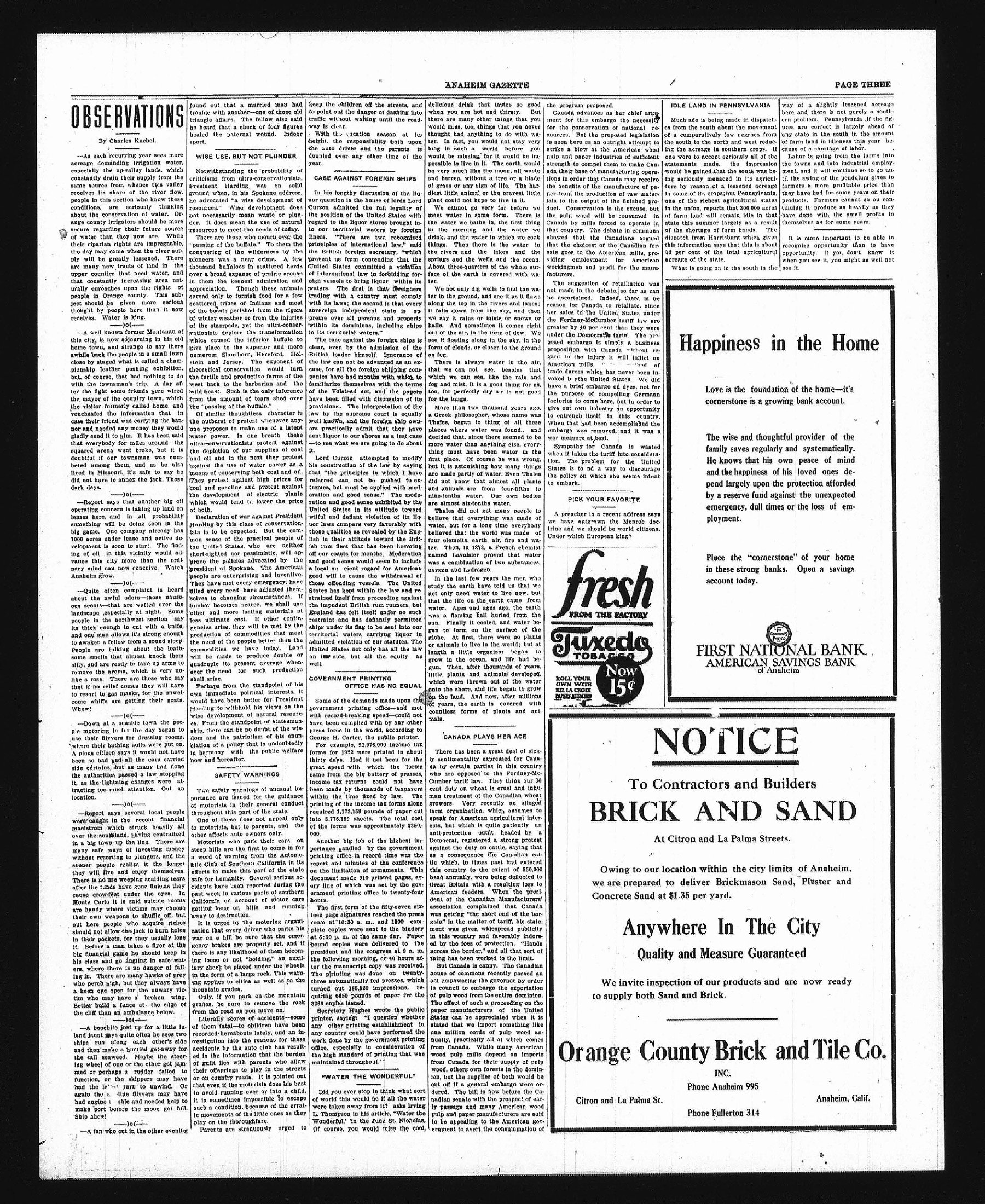
Searchable text
OBSERVATIONS
By Charles Kuchel.
As each recurring year sees more acreage demanding irrigation water, especially the up-valley lands, which constantly drain their supply from the same source from whence this valley receives its share of the river flow. People in this section who know these conditions, are seriously thinking about the conservation of water. Orange county irrigators should be more secure regarding their future source of water than they now are. While their riparian rights are impregnable, the day may come when the river supply will be greatly lessened. There are many new tracts of land in the upper counties that need water, and that constantly increasing area naturally enroaches upon the rights of people in Orange county. This subject should be given more serious thought by people here than it now receives. Water is king.
A well known former Montanan of this city is now sojourning in his old home town, and strange to say there awhile back the people in a small town close by staged what is called a championship leather pushing exhibition, but, of course, that had nothing to do with the townsman's trip. A day after the fight some friends here wired the mayor of the country town, which the visitor formerly called home, and vouchsafeed the information that in case their friend was carrying the banner and needed any money they would gladly send it to him. It has been said that everybody for miles around the found out that a married man had trouble with another—one of those old triangle affairs. The fellow also said he heard that a check of four figures healed the paternal wound. Indoor sport.
WISE USE, BUT NOT PLUNDER
Notwithstanding the probability of criticisms from ultra-conservationists, President Harding was on solid ground when, in his Spokane address, he advocated "a wise development of resources." Wise development does not necessarily mean waste or plunder. It does mean the use of natural resources to meet the needs of today.
There are those who mourn over the "passing of the buffalo." To them the conquering of the wilderness by the pioneers was a near crime. A few thousand buffaloes in scattered herds over a broad expanse of prairie arouse in them the keenest admiration and appreciation. Though these animals served only to furnish food for a few scattered tribes of Indians and most of the beasts perished from the rigors of winter weather or from the injuries of the stampede, yet the ultra-conservationists deplore the transformation which caused the inferior buffalo to give place to the superior and more numerous Shorthorn, Hereford, Holstein and Jersey. The exponent of theoretical conservation would turn the fertile and productive farms of the west back to the barbarian and the wild beast. Such is the only inference from the amount of tears shed over the "passing of the buffalo."
Of similar thoughtless character is the outburst of protest whenever anyone proposes to make use of a latent water power. In one breath these ultra-conservationists protest against keep the children off to point out the danger traffic without waith way is clear.
With the vacation height, the response the auto driver and doubled over any year.
CASE AGAINST P
In his lengthy discussion question in the hull Curzon admitted that the position of the U regard to the liquor to our territorial wineries. "There are principles of internment the British foreign prevent us from co united States commute international laweign vessels to bring waters. The first trading with a countryside with its laws; the se sovereign independenc preme over all parts within its dominion in its territorial waters.
The case against it clear, even by the British leader himself, the law can not be a cause, for all the forepanies have had more familiarize themselves of the Volstead act have been filled with provisions. The law by the supremely well known, and the ers practically admit liquidor to our abode—to see what we are...
close by staged what is called a championship leather pushing exhibition, but, of course, that had nothing to do with the townman's trip. A day after the fight some friends here wired the mayor of the country town, which the visitor formerly called home, and vouchsafed the information that in case their friend was carrying the banner and needed any money they would gladly send it to him. It has been said that everybody for miles around the squared arena went broke, but it is doubtful if our townman was numbered among them, and as he also lived in Missouri, it's safe to say he did not have to annex the jack. Those dark days.
Report says that another big oil operating concern is taking up land on leases here, and in all probability something will be doing soon in the big game. One company already has 1000 acres under lease and active development is soon to start. The finding of oil in this vicinity would advance this city more than the ordinary mind can now conceive. Watch Anaheim grow.
Quite often complaint is heard about the awful odors—those nauseous scents—that are wafted over the landscape especially at night. Some people in the northwest section say its thick enough to cut with a knife, and one man allows it's strong enough to awaken a fellow from a sound sleep. People are talking about the loathsome smells that almost knock them ally, and are ready to take up arms to remove the aroma, which is very unlike a rose. There are those who say that if no relief comes they will have to resort to gas masks, for the unwelcome whiffs are getting their goats. Whew!
Down at a seaside town the people motoring in for the day began to use their fluvvers for dressing rooms, where their bathing suits were put on. A plous citizen says it would not have been so bad had all the cars carried side curtains, but as many had none the authorities passed a law stopping it, as the lightning changes were attracting too much attention. Out on location.
Report says several local people were caught in the recent financial malstrom which struck heavily all over the southland, having centralized in a big town up the line. There are many safe ways of investing money numerous Shorthorn, Hereford, Holstein and Jersey. The exponent of theoretical conservation would turn the fertile and productive farms of the west back to the barbarian and the wild boast. Such is the only inference from the amount of tears shed over the "passing of the buffalo."
Of similar thoughtless character is the outburst of protest whenever anyone proposes to make use of a latent water power. In one breath these ultra-conservationists protest against the depletion of our supplies of coal and oil and in the next they protest against the use of water power as a means of conserving both coal and oil. They protest against high prices for coal and gasoline and protest against the development of electric plants which would tend to lower the price of both.
Declaration of war against President Harding by this class of conservationists is to be expected. But the common sense of the practical people of the United States, who are neither short-sighted nor pessimistic, will approve the policies advocated by the president at Spokane. The American people are enterprising and inventive. They have met every emergency, have adjusted themselves to changing circumstances. If lumber becomes scarce, we shall use other and more lasting materials at less ultimate cost. If other contingencies arise, they will be met by the production of commodities that meet the need of the people better than the commodities we have today. Land will be made to produce double or quadruple its present average whenever the need for such production shall arise.
Perhaps from the standpoint of his own immediate political interests, it would have been better for President Harding to withhold his views on the wise development of natural resources. From the standpoint of statesmanship, there can be no doubt of the wisdom and the patriotism of his enunciation of a policy that is undoubtedly in harmony with the public welfare how and hereafter.
SAFETY WARNINGS
Two safety warnings of unusual importance are issued for the guidance of motorists in their general conduct throughout this part of the state.
One of these does not appeal only to motorists, but to parents, and the other affects auto owners only.
Motorists who park their cars on steep hills are the first to come in for British leader himself, the law cannot be cased, for all the former panies have had more familiarize themselves with the Volstead act have been filled with provisions.. The law by the supreme well known, and they practically admit liquor to our shoppers...to see what we are it.
Lord Curzon attaches his construction of that "the principles referred can not tremes, but must be formation and good service United States in its wilful and defiant woe or laws compare with those qualities as reallish in their attitude is rum fleet that off our coasts for me and good sense would a local su client rego good will to cause those offending vessels States has kept itself from the impudent British England has felt its restraint and has done ships under its flag territorial waters o admitted violation of United States not on on side, but a well.
GOVERNMENT PRIVATE OFFICE
Some of the deman government printing with record-breaking have been complied press force in the w George H. Carter, t For example, 91.5 forms for 1922 were thirty days. Had it great speed with came from the big income tax returns been made by thou within the time frame printing of the income required 1,172,159 pages into 8,775,159 sheets of the forms was about 4000.
Another big job portance handled
been so bad had all the cars carried side curtains, but as many had none the authorities passed a law stopping it, as the lightning changes were attracting too much attention. Out on location.
Report says several local people were caught in the recent financial maelstrom which struck heavily all over the southland, having centralized in a big town up the line. There are many safe ways of investing money without resorting to plungers, and the sooner people realize it the longer they will five and enjoy themselves. There is no use weeping scalding tears after the funds have gone flue, as they cause crow-fet under the eyes. Monte Carlo it is said suicide rooms are handy where victims may choose their own weapons to shuffle off, but out here people who acquire riches should not allow the jack to burn holes in their pockets, for they usually lose it. Before a man takes a flyer at the big financial game he should keep in his class and go angling in safe waters, where there is no danger of falling in. There are many hawks of prey who perch high, but they always have a keen eye open for the unwary victim who may have a broken wing. Better build a fence at the edge of the cliff than an ambulance below.
A beach life just up for a little inland jaunt says quite often he sees two ships run along each other's side and then make a hurried get-away for the tall seaweed. Maybe the steering wheel of one or the other got jammed or perhaps a rudder failed to function, or the skippers may have had the latest yarn to unwind. Or again the s-line skippers may have had engine trouble and needed help to make port before the moon got full. Ship ahoy!
A fan who cut in the other evening
SAFETY WARNINGS
Two safety warnings of unusual importance are issued for the guidance of motorists in their general conduct throughout this part of the state.
One of these does not appeal only to motorists, but to parents, and the other affects auto owners only.
Motorists who park their cars on steep hills are the first to come in for a word of warning from the Automobile Club of Southern California in its efforts to make this part of the state safe for humanity. Several serious accidents have been reported during the past week in various parts of southern California on account of motor cars getting loose on hills and running away to destruction.
It is urged by the motoring organization that every driver who parks his war on a hill be sure that the emergency brakes are properly set, and if there is any likelihood of them becoming loose or not "holding," an auxiliary check be placed under the wheels in the form of a large rock. This warning applies to cities as well as to the mountain grades.
Only, if you park on the mountain grades, be sure to remove the rock from the road as you move on.
Literally scores of accidents—some of them fatal—to children have been recorded hereabouts lately, and an investigation into the reasons for those accidents by the auto club has resulted in the information that the burden of guilt lies with parents who allow their offspring to play in the streets or on country roads. It is pointed out that even if the motorists does his best to avoid running over or into a child, it is sometimes impossible to escape such a condition, because of the erratic movements of the little ones as they play on the thoroughfare.
Parents are strenuously urged to
ANAHEIM GAZETTE
keep the children off the streets, and to point out the danger of dashing into traffic without waiting until the roadway is clear.
With the vacation season at its height, the responsibility both upon the auto driver and the parents is doubled over any other time of the year.
CASE AGAINST FOREIGN SHIPS
In his lengthy discussion of the liquor question in the house of lords Lord Curzon admitted the full legality of the position of the United States with regard to the liquor stores brought into our territorial waters by foreign liners. "There are two recognized principles of international law," said the British foreign secretary, "which prevent us from contending that the United States committed a violation of international law in forbidding foreign vessels to bring liquor within its waters. The first is that foreigners trading with a country must comply with its laws; the second is that every sovereign independent state is supreme over all persons and property within its dominions, including ships in its territorial waters."
The case against the foreign ships is clear, even by the admission of the British leader himself. Ignorance of the law can not be advanced as an excuse, for all the foreign shipping companies have had months with which to familiarize themselves with the terms of the Volstead act, and the papers have been filled with discussion of its provisions...
The interpretation of the law by the supreme court is equally well known, and the foreign ship owners practically admit that they have sent liquor to our shores as a test case—to see what we are going to do about delicious drink that tastes so good when you are hot and thirsty. But there are many other things that you would miss, too, things that you never thought had anything to do with water. In fact, you would not stay very long in such a world before you would be missing, for it would be impossible to live in it. The earth would be very much like the moon, all waste and barren, without a tree or a blade of grass or any sign of life. The hardest little animal or the bravest little plant could not hope to live in it.
We cannot go very far before we meet water in some form. There is the water we bathe in, the first thing in the morning, and the water we drink, and the water in which we cook things. Then there is the water in the rivers and the lakes and the springs and the wells and the ocean. About three-quarters of the whole surface of the earth is covered with water.
We not only dig wells to find the water in the ground, and see it as it flows along the top in the rivers and lakes; it falls down from the sky, and then we say it rains or mists or snows or hails. And sometimes it comes right out of the air, in the form of dew. We see it floating along in the sky, in the form of clouds, or closer to the ground as fog.
There is always water in the air, that we can not see, besides that which we can see, like the rain and fog and mist. It is a good thing for us, too, for perfectly dry air is not good for the lungs.
More than two thousand years ago, a Greek philosopher, whose name was Thales, began to thing of all these places where water was found., and decided that, since there seemed to be more water than anything else, every-the program proposed.
Canada advances as her chief argument for this embargo the necessity for the conservation of national resources. But the proposed legislation is seen here as an outright attempt to strike a blow at the American wood pulp and paper industries of sufficient strength to compel them to make Canada their base of manufacturing operations in order that Canada may receive the benefits of the manufacture of paper from the production of raw materials to the output of the finished product. Conservation is the excuse, but the pulp wood will be consumed in Canada by mills forced to operate in that country. The debate in commons showed that the Canadians argued that the choicest of the Canadian forests goes to the American mills, providing employment for American workingmen and profit for the manufacturers.
The suggestion of retaliation was not made in the debate, so far as can be ascertained. Indeed, there is no reason for Canada to retaliate, since her sales to the United States under the Fordney-McCumber tariff law are greater by 40 per cent than they were under the Democratic tariff. The proposed embargo is simply a business proposition with Canada without regard to the injury it will inflict on American mills.
Of trade duress which has never been invoked by ythe United States. We did have a brief embargo on dyes, not for the purpose of compelling German factories to come here, but in order to give our own industry an opportunity to entrench itself in this country. When that had been accomplished the embargo was removed, and it was a war measure at best.
Sympathy for Canada is wasted
GOVERNMENT PRINTING
OFFICE HAS NO EQUAL
Some of the demands made upon the government printing office—and met with record-breaking speed—could not have been complied with by any other press force in the world, according to George H. Carter, the public printer.
For example, 91,976,000 income tax forms for 1922 were printed in about thirty days. Had it not been for the great speed with which the Forms came from the big battery of presses, income tax returns could not have been made by thousands of taxpayers within the time fixed by law. The printing of the income tax forms alone required 1,172,159 pounds of paper cut into 8,775,159 sheets. The total cost of the forms was approximately $357,000.
Another big job of the highest importance handled by the government is always water in the air, that we can not see, besides that which we can see, like the rain and fog and mist. It is a good thing for us, too, for perfectly dry air is not good for the lungs.
More than two thousand years ago, a Greek philosopher, whose name was Thales, began to thing of all these places where water was found., and decided that, since there seemed to be more water than anything else, everything must have been water in the first place. Of course he was wrong, but it is astonishing how many things are made partly of water. Even Thales did not know that almost all plants and animals are from four-fifths to nine-tenths water. Our own bodies are almost six-tenths water.
Thales did not get many people to believe that everything was made of water, but for a long time everybody believed that the world was made of four elements: earth, air, fire and water. Then, in 1873, a French chemist named Lavoisier proved that water was a combination of two substances, oxygen and hydrogen.
In the last few years the men who study the earth have told us that we not only need water to live now, but that the life on the earth came from water. Ages and ages ago, the earth was a flaming ball hurled from the sun. Finally it cooled, and water began to form on the surface of the globe. At first, there were no plants or animals to live in the world; but at length a little organism began to grow in the ocean, and life had begun. Then, after thousands of years, little plants and animals developed, which were thrown out of the water onto the shore, and life began to grow on the land. And now, after millions of years, the earth is covered with countless forms of plants and animals.
CANADA PLAYS HER ACE
There has been a great deal of sickly sentimentality expressed for Canada by certain parties in this country who are opposed to the Fordney-McCumber tariff law. They think our 30 cent duty on wheat is cruel and inhuman treatment of the Canadian wheat growers. Very recently an alleged farm organization, which assumes to speak for American agricultural interests, but which is quite patiently an anti-protection outfit headed by a Democrat, registered a strong protest against the duty on cattle, saying that
Had it not been for the great speed with which the Yorms came from the big battery of presses, income tax returns could not have been made by thousands of taxpayers within the time fixed by law. The printing of the income tax forms alone required 1,172,159 pounds of paper cut into 8,775,159 sheets. The total cost of the forms was approximately $357,000.
Another big job of the highest importance handled by the government printing office in record time was the report and minutes of the conference on the limitation of armaments. This document made 910 printed pages, every line of which was set by the government printing office in twenty-four hours.
The first form of the fifty-seven sixteen page signatures reached the press room at 10:30 a.m., and 1500 complete copies were sent to the blindery at 5:30 p.m. of the same day. Paper bound copies were delivered to the president and the congress at 9 a.m. the following morning, or 40 hours after the manuscript copy was received. The printing was done on twenty-three automatically fed presses, which turned out 185,820 impressions, requiring 6650 pounds of paper for the 3260 copies issued.
Secretary Hughes wrote the public printer, saying: "I question whether any other printing establishment in any country could have performed the work done by the government printing office, especially in consideration of the high standard of printing that was maintained throughout."
"WATER THE WONDERFUL"
Did you ever stop to think what sort of world this would be if all the water were taken away from it? asks Irving L. Thompson in his article, "Water the Wonderful," in the June St. Nicholas, Of course, you would miss the cool, sentimentality expressed for Canada by certain parties in this country who are opposed to the Fordney-McCumber tariff law. They think our 30 cent duty on wheat is cruel and human treatment of the Canadian wheat growers. Very recently an alleged farm organization, which assumes to speak for American agricultural interests, but which is quite patiently an anti-protection outfit headed by a Democrat, registered a strong protest against the duty on cattle, saying that as a consequence the Canadian cattle which, in times past had entered this country to the extent of 550,000 head annually, were being deflected to Great Britain with a resulting loss to American feeders. When the president of the Canadian Manufacturers' association complained that Canada was getting "the short end of the bargain" in the matter of tariff, his statement was given widespread publicity in this country and favorably indorsed by the foes of protection. "Hands across the border," and all that sort of thing has been worked to the limit.
But Canada is canny. The Canadian house of commons recently passed an act empowering the governor by order in council to embargo the exportation of pulp wood from the entire dominion. The effect of such a proceeding on the paper manufacturers of the United States can be appreciated when it is stated that we import something like one million cords of pulp wood annually, practically all of which comes from Canada. While many American wood pulp mills depend on imports from Canada for their supply of pulp wood, others own forests in the dominion, but the supplies of both would be cut off if a general embargo were ordered. The bill is now before the Canadian senate with the prospect of early passage and many American wood pulp and paper manufacturers are said to be appealing to the American government to avert the consummation of
IDLE LAND IN PENNSYLVANIA
Much ado is being made in dispatches from the south about the movement of a comparatively few negroes from the south to the north and west reducing the acreage in southern crops. If one wore to accept seriously all of the statements made, the impression would be gained that the south was being seriously menaced in its agriculture by reason of a lessened acreage in some of its crops; but Pennsylvania, one of the richest agricultural states in the union, reports that 300,000 acres of farm land will remain idle in that state this summer largely as a result of the shortage of farm hands. The dispatch from Harrisburg which gives this information says that this is about 10 per cent of the total agricultural acreage of the state.
What is going on in the south in the way of a slightly lessened acreage here and there is not purely a southern problem. Pennsylvania, if the figures are correct is largely ahead of any state in the south in the amount of farm land in idleness this year because of a shortage of labor.
Labor is going from the farms into the towns and into industrial employment, and it will continue so to go until the swing of the pendulum gives to farmers a more profitable price than they have had for some years on their products. Farmers cannot go on continuing to produce as heavily as they have done with the small profits to themselves as for some years.
It is more important to be able to recognize opportunity than to have opportunity. If you don't know it when you see it, you might as well not see it.
Happiness in the Home
Love is the foundation of the home—it's cornerstone is a growing bank account.
The wise and thoughtful provider of the family saves regularly and systematically.
Love is the foundation of the home—it's cornerstone is a growing bank account.
The wise and thoughtful provider of the family saves regularly and systematically. He knows that his own peace of mind and the happiness of his loved ones depend largely upon the protection afforded by a reserve fund against the unexpected emergency, dull times or the loss of employment.
Place the "cornerstone" of your home in these strong banks. Open a savings account today.
FIRST NATIONAL BANK
AMERICAN SAVINGS BANK
of Anaheim
NOTICE
To Contractors and Builders
RICK AND SAND
At Citron and La Palma Streets.
To Contractors and Builders
BRICK AND SAND
At Citron and La Palma Streets.
Being to our location within the city limits of Anaheim,
we prepared to deliver Brickmason Sand, Plaster and
Concrete Sand at $1.35 per yard.
Anywhere In The City
Quality and Measure Guaranteed
Invite inspection of our products and are now ready
to apply both Sand and Brick.
Ge County Brick and Tile Co.
INC.
Phone Anaheim 995
La Palma St.
Anaheim, Calif.
Phone Fullerton 314