anaheim-gazette 1923-08-02
Scanned page
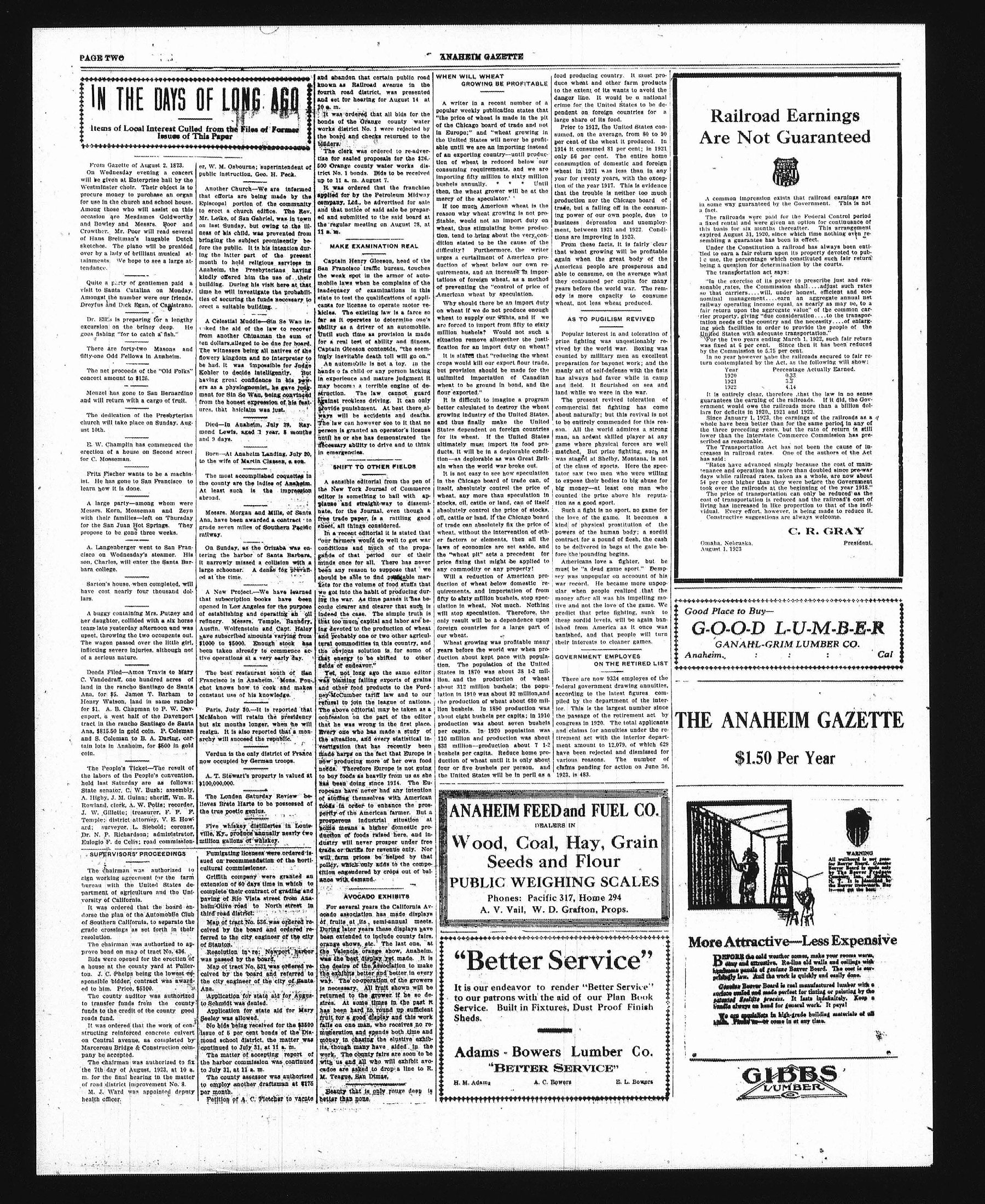
Searchable text
IN THE DAYS OF LONG AGO
Items of Local Interest Culled from the Files of Former Issues of This Paper
From Gazette of August 2, 1873.
On Wednesday evening a concert will be given at Enterprise hall by the Westminster choir. Their object is to procure money to purchase an organ for use in the church and school house. Among those who will assist on this occasion are Mesdames Goldworthy and Bowley and Messrs. Poor and Crowther. Mr. Poor will read several of Hans Breitman's laugable Dutch sketches. The piano will be presided over by a lady of brilliant musical attainments. We hope to see a large attendance.
Quite a party of gentlemen paid a visit to Santa Catalina on Monday. Amongst the number were our friends, Dreyfus and Dick Egan, of Capistrano.
Dr. Ellis is preparing for a lengthy excursion on the briney deep. He goes fishing "for to catch a fish."
There are forty-two Masons and fifty-one Odd Fellows in Annheim.
The net proceeds of the "Old Folks" concert amount to $125.
Monzel has gone to San Bernardino and will return with a cargo of fruit.
The dedication of the Presbyterian church will take place on Sunday, August 10th.
E. W. Champlin has commenced the er, W. M. Osbourne; superintendent of public instruction, Geo. H. Peck.
Another Church—We are informed that efforts are being made by the Episcopal portion of the community to erect a church edifice. The Rev. Mr. Letke, of San Gabriel, was in town on last Sunday, but owing to the illness of his child, was prevented from bringing the subject prominently before the public. It is his intention during the latter part of the present month to hold religious services in Anaheim, the Presbyterians having kindly offered him the use of their building. During his visit here at that time he will investigate the probabilities of securing the funds necessary to erect a suitable building.
A Celestial Muddle—Sin Se Wau invoked the aid of the law to recover from another Chinaman the sum of ten dollars, alleged to be due for board. The witnesses being all natives of the flowery kingdom and no interpreter to be had. It was impossible for Judge Kohler to decide intelligently. But having great confidence in his powers as a physiognomist, he gave judgment for Sin Se Wau, being convinced from the honest expression of his features, that his claim was just.
Died—In Anaheim, July 29, Raymond Lewis, aged 1 year, 8 months and 9 days.
Captain Henry San Francisco tried the weak spot in mobile laws when inadequacy of state to test the cants for license vehicles. The exist far as it operates ability as a driver Until such time for a real test Captain Gleeson ingly inevitable d An automobile hands o fa child in experience and may become a t construction. The against reckless provide punishment ways will be ad The law can how person is granted until he or she necessary ability...
The net proceeds of the "Old Folks" concert amount to $125.
Menzel has gone to San Bernardino and will return with a cargo of fruit.
The dedication of the Presbyterian church will take place on Sunday. August 10th.
E. W. Champlin has commenced the erection of a house on Second street for C. Mosseman.
Fritz Fischer wants to be a machinist. He has gone to San Francisco to learn how it is done.
A large party—among whom were Messrs. Korn, Mosseman and Zeyn with their families—left on Thursday for the San Juan Hot Springs. They propose to be gone three weeks.
A. Langenberger went to San Francisco on Wednesday's steamer. His son, Charles, will enter the Santa Barbara college.
Sarton's house, when completed, will have cost nearly four thousand dollars.
A buggy containing Mrs. Putney and her daughter, collided with a six horse team late yesterday afternoon and was upset, throwing the two occupants out. The wagon passed over the little girl, inflicting severe injuries, although not of a serious nature.
Deeds Filed—Amos Travis to Mary C. Vandedraff, one hundred acres of land in the rancho Santiago de Santa Ana, for $5. James T. Barham to Henry Watson, land in same rancho for $1. A. B. Chapman to P. W. Davenport, a west half of the Davenport tract in the rancho Santiago de Santa Ana, $815.50 in gold coin. P. Coleman and S. Coleman to B. A. Daring, certain lots in Anaheim, for $500 in gold coin.
The People's Ticket—The result of the labors of the People's convention, held last Saturday are as follows: State senator; C. W. Bush; assembly, A. Higby, J. M. Guinn; shoriff, Wm. R. Rowland, clerk, A. W. Potts; recorder, J. W. Gillette; treasurer, F. P. F. Temple; district attorney, V. E. Howard; surveyor, L. Siebold; coroner, Dr. N. P. Richardson; administrator, Eulogio F. de Colis; road commission-
flowery kingdom and no interpreter to be had. It was impossible for Judge Kohler to decide intelligently. But having great confidence in his powers as a physiognomist, he gave judgment for Sin Se Wau, being convinced from the honest expression of his features, that hsiclaim was just.
Died—In Anaheim, July 29, Raymond Lewis, aged 1 year, 8 months and 9 days.
Born—At Anaheim Landing, July 20, to the wife of Martin Classen, a son.
The most accomplished coquettes in the county are the ladies of Anaheim. At least such is the impression abroad.
Messrs. Morgan and Mills, of Santa Ana, have been awarded a contract to grade seven miles of Southern Pacific railway.
On Sunday, as the Orizaba was entering the harbor of Santa Barbara, it narrowly missed a collision with a large schooner. A dense fog prevailed at the time.
A New Project—We have learned that subscription books have been opened in Los Angeles for the purpose of establishing and operating an oil refinery. Messrs. Temple, Baundry, Austin, Wolfenstein and Capt. Halay have subscribed amounts varying from $1000 to $5000. Enough stock has been taken already to commence active operations at a very early day.
The best restaurant south of San Francisco is in Anaheim. Mons. Pouchot knows how to cook and makes constant use of his knowledge.
Paris, Judy 30—It is reported that McMahon will retain the presidency but six months longer, when he will resign. It is also reported that a monarchy will succeed the republic.
Verdun is the only district of France now occupied by German troops.
A. T. Stewart's property is valued at $100,000,000.
The London Saturday Review believes Breta Harte to be possessed of the true poetic genius.
Five whiskey distilleries in Louisville, Ky., produce annually nearly two million gallons of whiskey.
An automobile hands o fa child in experience and may become a trainee.
The against recklessness provide punishment ways will be able.
The law can how person is granted until he or she has necessary ability in emergencies.
SHIFT TO
A sensible editor the New York Journal editor is sometimes plausible and strained for the Joan free trade paper sheet, all things in a recent edit our farmers would conditions and ganda of that people once for they been any reason should be able to keys for the volunteers we got into the hating war. As come clearer and indeed the case that too much caring devoted to them and probably one natural commodities the obvious solution that energy to fields of endeavors.
Yet, not long was blaming fall and other food pests McCumber refused to join The above editor confession on that he was wrong Every one who did the situation, and investigation that made harps on the now producing needs. Therefore to buy foods as has been doing ropeans have need of stuffing them foods in order prosperous indus home means anduction of foods dustry will never grade or tariff f
The People's Ticket—The result of the labors of the People's convention, held last Saturday are as follows: State senator; C. W. Bush; assembly, A. Higby, J. M. Guinn; sheriff, Wm. R. Rowland, clerk, A. W. Potts; recorder, J. W. Gillette; treasurer, F. P. F. Temple; district attorney, V. E. Howard; surveyor, L. Siebold; coroner, Dr. N. P. Richardson; administrator, Eulogio F. de Celis; road commission.
SUPERVISORS' PROCEEDINGS
The chairman was authorized to sign working agreement for the farm bureau with the United States department of agriculture and the University of California.
It was ordered that the board endorse the plan of the Automobile Club of Southern California, to separate the grade crossings as set forth in their resolution.
The chairman was authorized to approve bond on map of tract No. 436.
Bids were opened for the erection of a house at the county yard at Fullerton. J. C. Phelps being the lowest responsible bidder, contract was awarded to him. Price, $5100.
The county auditor was authorized to transfer funds from the county funds to the credit of the county good roads fund.
It was ordered that the work of constructing reinforced concrete culvert on Central avenue, as completed by Marcereau Bridge & Construction company be accepted.
The chairman was authorized to fix the 7th day of August, 1923, at 10 a.m. for the final hearing in the matter of road district improvement No. 8.
M. J. Ward was appointed deputy health officer.
Fumigating licenses were ordered issued on recommendation of the horticultural commissioner.
Griffith company were granted an extension of 60 days time in which to complete their contract of grading and paving of Rio Vista street from Anaheim-Olive road to North street in third road district.
Map of tract No. 536 was ordered received by the board and ordered referred to the city engineer of the city of Stanton.
Resolution in re: Newport harbor was passed by the board.
Map of tract No. 531 was ordered received by the board and referred to the city engineer of the city of Santa Ana.
Application for state aid for Augusto Schmidt was denied.
Application for state aid for Mary Seely was allowed.
No bids being received for the $3500 issue of 5 per cent bonds of the Diamond school district, the matter was continued to July 31, at 11 a.m.
The matter of accepting report of the harbor commission was continued to July 31, at 11 a.m.
The county assessor was authorized to employ another draftsman at $175 per month.
Petition of A. C. Fletcher to vacate now occupied by German troops.
A. T. Stewart's property is valued at $100,000,000.
The London Saturday Review believes Brete Harte to be possessed of the true poetic genius.
Five whiskey distilleries in Louisville, Ky., produce annually nearly two million gallons of whiskey.
AVOCAR
For several years oocado association of fruits at its During later year been extended to orange shows, so the Valencia or was the best dill desire of the exhibits better way. The co-op is necessary. A returned to the stores. At some has been hard fruit for a good falls on one man muneration and money in chasing it though many work. The county with us and all cados are asked M. Teague, San Beauty that is better than none
and abandon that certain public road known as Railroad avenue in the fourth road district, was presented and set for hearing for August 14 at 10 a.m.
It was ordered that all bids for the bonds of the Orange county water works district No. 1 were rejected by the board and checks returned to the bidders.
The clerk was ordered to re-advertise for sealed proposals for the $26,500 Orange county water works district No. 1 bonds. Bids to be received up to 11 a.m. August 7.
It was ordered that the franchise applied for by the Petroleum Midway company, Ltd., be advertised for sale and that notice of said sale be prepared and submitted to the said board at the regular meeting on August 28, at 11 a.m.
MAKE EXAMINATION REAL
Captain Henry Gleeson, head of the San Francisco traffic bureau, touches the weak spot in the armor of automobile laws when he complains of the inadequacy of examinations in this state to test the qualifications of applicants for license to operate motor vehicles. The existing law is a farce so far as it operates to determine one's ability as a driver of an automobile. Until such time as provision is made for a real test of ability and fitness, Captain Gleeson contents, "the seemingly inevitable death toll will go on."
An automobile is not a toy, in the hands of fa child or any person lacking in experience and mature judgment it may become a terrible engine of destruction. The law cannot guard against reckless driving. It can only provide punishment. At best there always will be accidents and deaths. The law can however see to it that no person is granted an operator's license until he or she has demonstrated the necessary ability to drive and to think WHEN WILL WHEAT GROWING BE PROFITABLE
A writer in a recent number of a popular weekly publication states that "the price of wheat is made in the pit of the Chicago board of trade and not in Europe;" and "wheat growing in the United States will never be profitable until we are an importing instead of an exporting country—until production of wheat is reduced below our consuming requirements, and we are importing fifty million to sixty million bushels annually." Until then, the wheat grower will be at the mercy of the speculator.
If too much American wheat is the reason why wheat growing is not profitable, would not an import duty on wheat, thus stimulating home production, tend to bring about the very condition stated to be the cause of the difficulty? Furthermore, the writer urges a curtailment of American production of wheat below our own requirements, and an increase in imports of foreign wheat, as a method of preventing the "control of price of American wheat by speculation.
Why should there be an import duty on wheat if we do not produce enough wheat to supply our wants, and if we are forced to import from fifty to sixty million bushels? Would not such a situation remove altogether the justification for an import duty on wheat?
It is stated that "reducing the wheat crops would kill our export flour trade, but provision should be made for the unlimited importation of Canadian wheat to be ground in bond, and the flour exported."
It is difficult to imagine a program better calculated to destroy the wheat growing industry of the United States and thus finally make the United States dependent on foreign countries for its wheat. If the United States ultimately must import its food producing country. It must produce wheat and other farm products to the extent of its wants to avoid the danger line. It would be a national crime for the United States to be dependent on foreign countries for a large share of its food.
Prior to 1912, the United States consumed, on the average, from 80 to 90 per cent of the wheat it produced. In 1914 it consumed 81 per cent; in 1921 only 56 per cent. The entire home consumption of domestic and foreign wheat in 1921 was less than in any year for twenty years, with the exception of the year 1917. This is evidence that the trouble is neither too much production nor the Chicago board of trade, but a falling off in the consuming power of our own people, due to business depression and unemployment, between 1921 and 1922. Conditions are improving in 1923.
From these facts, it is fairly clear that wheat growing will be profitable again when the great body of the American people are prosperous and able to consume, on the average what they consumed per capita for many years before the world war. The remedy is more capacity to consume wheat, not less wheat produced.
AS TO PUGILISM REVIVED
Popular interest in and toleration of prize fighting was unquestionably revived by the world war. Boxing was counted by military men an excellent preparation for bayonet work; and the manly art of self-defense with the fists has always had favor while in camp and field. It flourished on sea and land while we were in the war.
The present revived toleration of commercial fist fighting has come about naturally; but this revival is not to be entirely commended for this reason. All the world admires a strong man, an ardent skilled player at any game where physical forces are well
SHIFT TO OTHER FIELDS
A sensible editorial from the pen of the New York Journal of Commerce editor is something to hail with applause and straight-way to disseminate, for the Journal, even though a free trade paper, is a rattling good sheet, all things considered.
In a recent editorial it is stated that "our farmers would do well to get war conditions and much of the propaganda of that period our minds once for all. There has never been any reason to suppose that we should be able to find profitable markets for the volume of food stuffs that we got into the habit of producing during the war. As time passes it has become clearer and clearer that such is indeed the case. The simple truth is that too much capital and labor are being devoted to the production of wheat and probably one or two other agricultural commodities in this country, and the obvious solution is for some of that energy to be shifted to other fields of endeavor."
Yet, not long ago the same editor was blaming falling exports of grains and other food products to the Fordney McCumber tariff law and to our refusal to join the league of nations. The above editorial may be taken as a confession on the part of the editor that he was wrong in the first place. Every one who has made a study of the situation, and every statistical investigation that has recently been made harps on the fact that Europe is now producing more of her own food needs. Therefore Europe is not going to buy foods as heavily from us as she has been doing since 1914. The Europeans have never had any intention of stuffing themselves with American foods in order to enhance the prosperity of the American farmer. But a prosperous industrial situation at home means a higher domestic production of foods raised here, and industry will never prosper under free trade or tariffs for revenue only. Nor it is stated that "reducing the wheat crops would kill our export flour trade, but provision should be made for the unlimited importation of Canadian wheat to be ground in bond, and the flour exported."
It is difficult to imagine a program better calculated to destroy the wheat growing industry of the United States, and thus finally make the United States dependent on foreign countries for its wheat. If the United States ultimately must import its food products, it will be in a deplorable condition—as deplorable as was Great Britain when the world war broke out.
It is not easy to see how speculation in the Chicago board of trade can, of itself, absolutely control the price of wheat, any more than speculation in stocks, oil, cattle or land, can of itself absolutely control the price of stocks, oil, cattle or land. If the Chicago board of trade can absolutely fix the price of wheat, without the intervention of other factors or elements, then all the laws of economics are set aside, and the "wheat pit" sets a precedent for price fixing that might be applied to any commodity or any property!
Will a reduction of American production of wheat below domestic requirements, and importation of from fifty to sixty million bushels, stop speculation in wheat. Not much. Nothing will stop speculation. Therefore, the only result will be a dependence upon foreign countries for a large part of our wheat.
Wheat growing was profitable many years before the world war when production about kept pace with population. The population of the United States in 1870 was about 38 1-2 million, and the production of wheat about 312 million bushels; the population in 1910 was about 92 million, and the production of wheat about 680 million bushels. In 1890 production was about eight bushels per capita; in 1910 production was about seven bushels per capita. In 1920 population was 110 million and production was about 833 million—production about 7 1-2 bushels per capita. Reduce home production of wheat until it is only about four or five bushels per person, and the United States will be in peril as a...
ANAHEIM FEED and FUEL CO.
DEALERS IN
Wood, Coal, Hay, Grain
Seeds and Flour
PUBLIC WEIGHING SCALES
Phones: Pacific 317, Home 294
A. V. Vail, W. D. Grafton, Props.
"Better Service"
It is our endeavor to render "Better Service" to our patrons with the aid of our Plan Book Service. Built in Fixtures, Dust Proof Finish Sheds.
Adams - Bowers Lumber Co.
"BEITER SERVICE"
H. M. Adams A. C. Bowers E. L. Bowers
Beauty that is only rouge deep is better than none.
Railroad Earnings
Are Not Guaranteed
A common impression exists that railroad earnings are in some way guaranteed by the Government. This is not a fact.
The railroads were paid for the Federal Control period a fixed rental and were given an option for continuance of this basis for six months thereafter. This arrangement expired August 31, 1920, since which time nothing even resembling a guarantee has been in effect.
Under the Constitution a railroad has always been entitled to earn a fair return upon its property devoted to public use, the percentage which constituted such fair return being a question for determination by the courts.
The transportation act says:
"In the exercise of its power to prescribe just and reasonable rates, the Commission shall...adjust such rates so that carriers...will, under honest, efficient and economical management...earn an aggregate annual net railway operating income equal, as nearly as may be, to a fair return upon the aggregate value" of the common carrier property, giving "due consideration...to the transportation needs of the country and the necessity...of enlarging such facilities in order to provide the people of the United States with adequate transportation."
For the two years ending March 1, 1922, such fair return was fixed at 6 per cent. Since then it has been reduced by the Commission to 5.75 per cent.
In no year however have the railroads secured to fair return contemplated by the Act, as the following will show:
| Year | Percentage Actually Earned |
| :--- | :--- |
| 1920 | 0.33 |
| 1921 | 3.3 |
| 1922 | 4.14 |
It is entirely clear, therefore, that the law in no sense guarantees the earning of the railroads. If it did, the Government would owe the railroads more than a billion dollars for deficits in 1920., 1921 and 1922.
Since January 1, 1923, the earnings of the railroads as a whole have been better than for the same period in any of the three preceding years, but the rate of return is still lower than the Interstate Commerce Commission has prescribed as reasonable.
The Transportation Act has not been the cause of in-
In no year however habe the railroads secured to fair return contemplated by the Act, as the following will show:
Year Percentage Actually Earned.
1920 0.33
1921 3.3
1922 4.14
It is entirely clear, therefore, that the law in no sense guarantees the earning of the railroads. If it did, the Government would owe the railroads more than a billion dollars for deficits in 1920., 1921 and 1922.
Since January 1, 1923, the earnings of the railroads as a whole have been better than for the same period in any of the three preceding years, but the rate of return is still lower than the Interstate Commerce Commission has prescribed as reasonable.
The Transportation Act has not been the cause of increases in railroad rates. One of the authors of the Act has said:
"Rates have advanced simply because the cost of maintenance and operation has more than doubled since pre-war days while railroad rates, taken as a whole, are now about 54 per cent higher than they were before the Government took over the railroads at the beginning of the year 1918."
The price of transportation can only be reduced as the cost of transportation is reduced and the railroad's cost of living has increased in like proportion to that of the individual. Every effort, however, is being made to reduce it.
Constructive suggestions are always welcome.
C. R. GRAY
Omaha, Nebraska.
President.
August 1, 1923
Good Place to Buy—
G-O-O-D L-U-M-B-E-R
GANAHL-GRIM LUMBER CO.
Anaheim. : : : Cal
THE ANAHEIM GAZETTE
$1.50 Per Year
$1.50 Per Year
WARNING
All wallboard is not genuine Beaver Board. Greater Beaver Board is made only by The Beaver Products Company, Inc., of Madison, N.C. It is manufactured by the Beaver trade-mark. Buy it—and get the best!
More Attractive—Less Expensive
BEFORE the cold weather comes, make your rooms warm, easy and attractive. Re-line old walls and ceilings with handmade panels of genlane Beaver Board. The cost is surprisingly low. And the work is quickly and easily done.
Genlane Beaver Board is real manufactured lumber with a surface smiled and made perfect for tinting or painting by the painted Realite process. It lasts indefinitely. Keep a bundle always on hand for general work. It pays!
We are specialists in high-grade building materials of all kinds. Please come in at any time.
GIBBS
LUMBER