anaheim-gazette 1923-02-22
Scanned page
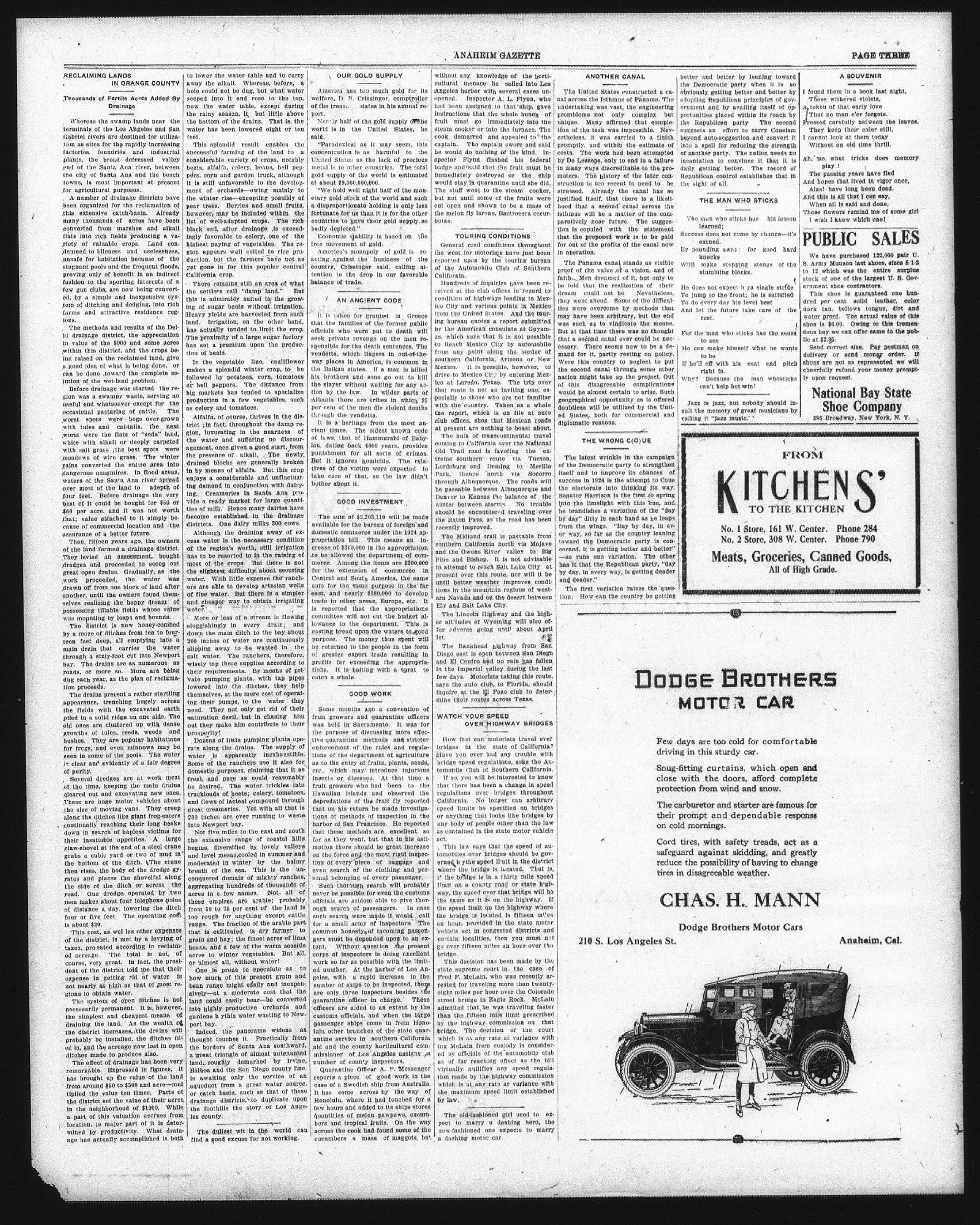
Searchable text
RECLAIMING LANDS
IN ORANGE COUNTY
Thousands of Fertile Acres Added By Drainage
Whereas the swamp lands near the terminals of the Los Angeles and San Gabriel rivers are destined for utilization as sites for the rapidly increasing factories, foundries and industrial plants, the broad detressed valley end of the Santa Ana river, between the city of Santa Ana and the beach towns, is most important at present for agricultural purposes.
A number of drainage districts have been organized for the reclamation of this extensive catch-basin. Already many thousands of acres have been converted from marshes and alkali flats into rich fields producing a variety of valuable crops. Land condemned to idleness and uselessness, unsafe for habitation because of the stagnant pools and the frequent floods, proving only of benefit in an indirect fashion to the sporting interests of a few gun clubs, are now being converted, by a simple and inexpensive system of ditching and dedging, into rich farms and attractive residence regions.
The methods and results of the Delhi drainage district, the appreciation in value of the 8000 and some acres within this district, and the crops being raised on the reclaimed land, give a good idea of what is being done, or can be done toward the complete solution of the wet-land problem.
Before drainage was started the region was a swampy waste, serving no useful end whatsoever except for the occasional pasturing of cattle. The worst spots were bogs over-grown with tules and cat-tails, the next worst were the flats of "soda" land, white with alkali or deeply carpeted with salt grass; the best spots were meadows of wire grass. The winter to lower the water table and to carry away the alkali. Whereas, before, a hole could not be dug, but what water seeped into it and rose to the top, now the water table, except during the rainy season, it but little above the bottom of the drains. That is, the water has been lowered eight or ten feet.
This splendid result enables the successful farming of the land to a considerable variety of crops, notably beets, alfalfa, celery, beans, bell peppers, corn and garden truck, although it is still unfavorable to the development of orchards—owing mainly to the winter rise—excepting possibly of pear trees. Berries and small fruits, however, may be included within the list of well-adapted crops. The rich black soil, after drainage is exceedingly favorable to celery, one of the highest paying of vegetables. The region appears well suited to rice production, but the farmers have not as yet gone in for this popular central California crop.
There remains still an area of what the settlers call "damp land." But this is admirably suited to the growing of sugar beets without irrigation. Heavy yields are harvested from such land. Irrigation, on the other hand, has actually tended to limit the crop. The proximity of a large sugar factory has set a premium upon the production of beets.
In the vegetable line, cauliflower makes a splendid winter crop, to be followed by potatoes, corn, tomatoes or bell peppers. The distance from big markets has tended to specialize production in a few vegetables, such as celery and tomatoes.
Alfalfa, of course, thrives in the district; in fact, throughout the damp region, luxurating in the nearness of the water and suffering no discouragement, once given a good start, from the presence of alkali. The newly America has to welfare, D. R. Criffle of the treasury port.
Nearly half of the world is in the said.
"Paradoxical as concentration is in United States as metal is to other gold supply of these at about $9,000,000."
"We hold well my eary gold stock on a disproportionate fortune for us these countries to have badly depleted."
Economic stabilization movement of America's mono-acting against this country, Crissinger tion to the dry balance of trade.
AN ANCIENT
It is taken for that the families who were seek private revenge sponsible for the d vendetta, which I way places in Amor the Balkan states. His brothers and his slayer without tion by the law. Albania there are per cent of the men through the vende It is a heritage cient times. The laws, that of H lon, dating back punishment for m
Before drainage was started the region was a swampy waste, serving no useful end whatsoever except for the occasional pasturing of cattle. The worst spots were bogs over-grown with tules and cat-tails, the next worst were the flats of "soda" land, white with alkali or deeply carpeted with salt grass; the best spots were meadows of wire grass. The winter rains converted the entire area into dangerous quagmires. In flood areas, waters of the Santa Ana river spread over most of the land to adepth of four feet. Before drainage the very best of it could be bought for $50 or $60 per acre, and it was not worth that; value attached to it simply because of commercial location and the assurance of a better future.
Then, fifteen years ago, the owners of the land formed a drainage district. They levied an assessment, bought dredges and proceeded to scoop out great open drains. Gradually, as the work proceeded, the water was drawn off from one block of land after another, until the owners found themselves realizing the happy dream of possessing tillable fields whose value was mounting by leaps and bounds.
The district is now honey-combed by a maze of ditches from ten to fourteen feet deep, all emptying into a main drain that carries the water through a sixty-foot cut into Newport bay. The drains are as numerous as roads, or more so. More are being dug each year, as the plan of reclamation proceeds.
The drains present a rather startling appearance, trenching hugely across the fields with the excavated earth piled in a solid ridge on one side. The old ones are cluttered up with dense growths of tules, reeds, weeds and bushes. They are popular habitations for frogs, and even minnows may be seen in some of the pools. The water is clear and evidently of a fair degree of purity.
Several dredges are at work most of the time, keeping the main drains cleared out and excavating new ones. These are huge motor vehicles about the size of moving vans. They creep along the ditches like giant frog-eaters continually reaching their long beaks down in search of hapless victims for their insatiable appetites. A large claw-shovel at the end of a steel crane grabs a cubic yard or two of mud in the bottom of the ditch. The crane
In the vegetable line, cauliflower makes a splendid winter crop, to be followed by potatoes, corn, tomatoes or bell peppers. The distance from big markets has tended to specialize production in a few vegetables, such as celery and tomatoes.
Alfalfa, of course, thrives in the district; in fact, throughout the damp region, luxurating in the nearness of the water and suffering no discouragement, once given a good start, from the presence of alkali. The newly drained blocks are generally broken in by means of alfalfa. But this crop enjoys a considerable and unfluctuating demand in conjunction with dairying. Creameries in Santa Ana provide a ready market for large quantities of milk. Hence many dairies have become established in the drainage districts. One dairy milks 300 cows.
Although the draining away of excess water is the necessary condition of the region's worth, still irrigation has to be resorted to in the raising of most of the crops. But there is not the slightest difficulty about securing water. With little expense the ranchers are able to develop artesian wells of fine water. But there is a simpler and cheaper way to obtain irrigating water.
More or less of a stream is flowing sluggishly in every drain; and down the main ditch to the bay about 200 inches of water are continuously slipping away to be wasted in the salt water. The ranchers, therefore, wisely tap these supplies according to their requirements. By means of private pumping plants, with tap pipes lowered into the ditches, they help themselves, at the mere cost of operating their pumps, to the water they need. They not only get rid of their saturation devil, but in chasing him out they make him contribute to their prosperity!
Dozens of little pumping plants operate along the drains. The supply of water is apparently inexhaustible. Some of the ranchers use it also for domestic purposes, claiming that it as fresh and pure as could reasonably be desired. The water trickles into truckloads of beets; celery, tomatoes, and flows of lacteal compound through great creameries. Yet with all that is 200 inches are ever running to waste into Newport bay.
Not five miles to the east and south the extensive range of coastal hills begins, diversified by lovely valleys and level mesas,coolled in summer and moderated in winter by the balmy way places in America the Balkan states; his brothers and his slayer without intention by the law. Albania there are per cent of the men through the vender.
It is a heritage client times. The laws, that of Hlon, dating back to punishment for slander. But it ignores his lives of the victim take care of that bother about it.
GOOD IN
The sum of $2.5 available for the basic commercial propriation bill. crease of $300,000 to be allowed there merce. Among them for the extension Central and South Sum for the same east, and nearly all trade in other areas is reported that committee will not lowance to the de casting bread upon purpose. The man be returned to the greater export profits far exceedions. It is baitful catch a whale.
GOOD IN
Some months a fruit growers and was held in Sacramento the purpose of diative quarantine n enforcement of thie tions of the depart as to the entry oft etc., which may insects or disease fruit growers who Hawaiian islands depredations of tht that on his return tions of methods harbor of San Francisco that these method far as they went, mation there show on the force and tion of every piece
Several dredges are at work most of the time, keeping the main drains cleared out and excavating new ones. These are huge motor vehicles about the size of moving vans. They creep along the ditches like giant frog-eaters continually reaching their long beaks down in search of hapless victims for their insatiable appetites. A large claw-shovel at the end of a steel crane grabs a cubic yard or two of mud in the bottom of the ditch. The crane then rises, the body of the dredge gyrates and places the shovelful along the side of the ditch or across the road. One dredge operated by two men makes about four telephone poles of distance a day, lowering the ditch four or five feet. The operating cost is about $20.
This cost, as well as other expenses of the district, is met by a levying of taxes, pro-rated according to reclaimed acreage. The total is not, of course, very great. In fact, the president of the district told me that their expense in getting rid of water is not nearly as high as that of most regions to obtain water.
The system of open ditches is not necessarily permanent. It is, however, the simplest and cheapest means of draining the land. As the wealth of the district increases, tile drains will probably be installed, the ditches filled in, and the acreage now lost in open ditches made to produce also.
The effect of drainage has been very remarkable. Expressed in figures, it has brought up the value of the land from around $50 to $500 and acre—multiple times. Parts of the district set the value of their acres in the neighborhood of $1000. While a part of this valuation accrues from location, te major part of it is determined by productivity. What drainage has actually accomplished is both domestic purposes, claiming that it as fresh and pure as could reasonably be desired. The water trickles into truckloads of beets; celery, tomatoes, and flows of lacteal compound through great creameries. Yet with all that is 200 inches are ever running to waste into Newport bay.
Not five miles to the east and south the extensive range of coastal hills begins, diversified by lovely valleys and level mesas, cooled in summer and moderated in winter by the balmy breath of the sea. This is the unconquered domain of mighty ranchos, aggregating hundreds of thousands of acres in a few names. Not all of these empires are arable; probably from 50 to 75 per cent of the land is too rough for anything except cattle range. The fraction of the arable part that is cultivated is dry farmer to grain and hay; the finest acres of lima beans, and a few of the warm seaside acres to winter vegetables. But all, or almost all, without water!
One is prone to speculate as to how much of this present grain and bean range might easily and inexpensively—at a moderate cost that the land could easily bear—be converted into highly productive orchards and gardens by this water wasting to Newport bay.
Indeed, the panorama widens as thought touches it. Practically from the borders of Santa Ana southward, a great triangle of almost untenanted land, roughly demarked by Irvine, Balboa and the San Diego county line, is awaiting only the service of an aqueduct from a great water source, or catch basin, such as that of these drainage districts, to duplicate upon the foothills the story of Los Angeles county.
The dullest wit in the world can find a good excuse for not working.
Such thorough work so far as possible officials are seldom search of such search were for a small army common honestygers must be depent. Without corps of inspectors work so far as possible geles, with a ra number of ships they are only three in quarantine officers officers are alded customs officials, passenger ships lulu other branch antine service in aid and the coun missioner of Los number of counties.
Quarantine Office reports a piece case of a Swedish It has come acc Honolulu, where few hours and ad quantities of members and tropical across the cook h cucumbers a m
ANAHEIM GAZETTE
OUR GOLD SUPPLY
America has too much gold for its welfare, D. R. Crissinger, comptroller of the treasury states in his annual report.
Nearly half of the gold supply of the world is in the United States, he said.
"Paradoxical as it may seem, this concentration is as harmful to the United States as the lack of precious metal is to other countries. The total gold supply of the world is estimated at about $9,000,000,000."
"We hold well night half of the monetary gold stock of the world and such a disproportionate holding is only less fortunate for us than it is for the other countries to have their gold supply so badly depleted."
Economic stability is based on the free movement of gold.
America's monopoly of gold is reacting against the business of the country, Crissinger said, calling attention to the drop in our favorable balance of trade.
AN ANCIENT CODE
It is taken for granted in Greece that the families of the former public officials who were put to death will seek private revenge on the men responsible for the death sentences. The vendetta, which lingers in out-of-the-way places in America, is common in the Balkan states. If a man is killed his brothers and sons go out to kill the slayer without waiting for any action by the law. In wilder parts of Albania there are tribes in which 25 per cent of the men die violent deaths through the vendetta.
It is a heritage from the most ancient times. The oldest known code of laws, that of Hammurabi of Babylon, dating back 4000 years, provides punishment for all sorts of crimes.
without any knowledge of the horticultural menace he sailed into Los Angeles harbor with several cases unopened. Inspector A. L. Flynn, who had been assigned to that ship, gave instructions that the whole bunch of fruit must go immediately into the steam cooker or into the furnace. The cook demurred and appealed to the captain. The captain swore and said he would do nothing of the kind. Inspector Flynn flashed his federal badge and said that the fruit must be immediately destroyed or the ship would stay in quarantine until she did.
The stuff went to the steam cooker, but not until some of the fruits were cut open and shown to be a mass of the melon fly larvae, Bactrocera occurrente.
TOURING CONDITIONS
General road conditions throughout the west for motorists have just been reported upon by the touring bureau of the Automobile Club of Southern California.
Hundreds of inquiries have been received at the club offices in regard to condition of highways leading to Mexico City and various points in Mexico from the United States. And the touring bureau quotes a report submitted by the American consulate at Guyamas, which says that it is not possible to Reach Mexico City by automobile from any point along the border of southern California, Arizona or New Mexico. It is possible, however, to drive to Mexico City by entering Mexico at Laredo, Texas. The trip over that route is not an inviting one, especially to those who are not familiar with the country. Taken as a whole the report, which is on file at auto club offices, shows that Mexican roads at present are nothing to boast about.
The bulk of transcontinental travel coming to California over the National Old Trail road is favored by ex-
ANOTHER CANAL
The United States constructed a canal across the Isthmus of Panama. The undertaking was vast, the engineering problems not only complex but unique. Many affirmed that completion of the task was impossible. Nevertheless, it was carried to a finish promptly, and within the estimate of costs. The work had been attempted by De Lesseps, only to end in a failure in many ways discreditable to the promoters. The history of the later construction is too recent to need to be stressed. Already the canal has so justified itself, that there is a likelihood that a second canal across the Isthmus will be a matter of the comparatively near future. The suggestion is copuled with the statement that the proposed work is to be paid for out of the profits of the canal now in operation.
The Panama canal stands as visible proof of the value of a vision, and of faith. Men dreamed of it, but only to be told that the realization of their dream could not be. Nevertheless, they went ahead. Some of the difficulties were overcome by methods that may have been arbitrary, but the end was such as to vindicate the means. But at that time there was no thought that a second canal ever could be necessary. There seems now to be a demand for it, partly resting on policy. Were this country to neglect to put the second canal through some other nation might take up the project. Out of this disagreeable complications would be almost certain to arise. Such geographical opportunity as is offered doubtless will be utilized by the United States, both for commercial and diplomatic reasons.
THE WRONG C(O)UE
way places in America, is common in the Balkan states. If a man is killed his brothers and sons go out to kill the slayer without waiting for any action by the law. In wilder parts of Albania there are tribes in which 25 per cent of the men die violent deaths through the vendetta.
It is a heritage from the most ancient times. The oldest known code of laws, that of Hammurabi of Babylon, dating back 4000 years, provides punishment for all sorts of crimes. But it ignores homicide. The relatives of the victim were expected to take care of that, so the law didn't bother about it.
GOOD INVESTMENT
The sum of $2,203,110 will be made available for the bureau of foreign and domestic commerce under the 1924 appropriation bill. This means an increase of $300,000 in the appropriation to be allowed the department of commerce. Among the items are $200,000 for the extension of commerce in Central and South America, the same sum for the same purpose in the far east, and nearly $380,000 to develop trade in other areas, Europe, etc. It is reported that the appropriations committee will not cut the budget allowance to the department. This is casting bread upon the waters to good purpose. The money thus spent will be returned to the people in the form of greater export trade resulting in profits far exceeding the appropriations. It is baiting with a sprat to catch a whale.
GOOD WORK
Some months ago a convention of fruit growers and quarantine officers was held in Sacramento. It was for the purpose of discussing more effective quarantine methods and stricter enforcement of the rules and regulations of the department of agriculture as to the entry of fruits, plants, seeds, etc., which may introduce injurious insects or diseases. At that time a fruit growers who had been to the Hawaiian islands and observed the depredations of the fruit fly reported that on his return he made investigations of methods of inspection in the harbor of San Francisco. He reported that these methods are excellent so far as they went, but that in his estimation there should be great increase on the force and the most rigid inspection of every piece of baggage and way places in America, is common in the Balkan states. If a man is killed his brothers and sons go out to kill the slayer without waiting for any action by the law. In wilder parts of Albania there are tribes in which 25 per cent of the men die violent deaths through the vendetta.
It is a heritage from the most ancient times. The oldest known code of laws, that of Hammurabi of Babylon, dating back 4000 years, provides punishment for all sorts of crimes. But it ignores homicide. The relatives of the victim were expected to take care of that, so the law didn’t bother about it.
THE WRONG C(O)UE
The latest wrinkle in the campaign of the Democratic party to strengthen itself and to improve its chances of success in 1924 is the attempt to Coue the electorate into thinking its way. Senator Harrison is the first to spring into the limelight with this cue, and he brandishes a variation of the "day by day" ditty in each hand as he leaps from the wings. "Day by day, in ever way, so far as the country leaning toward the Democratic party is concerned, it is getting better and better"—so runs one variation. The other has it that the Republican party, "day by day, in every way, is getting deader and deader."
The first variation raises the question: How can the country be getting
WATCH YOUR SPEED OVER HIGHWAY BRIDGES
How fast can motorists travel over bridges in the state of California? Have you ever had any trouble with bridge speed regulations, asks the Automobile Club of Southern California.
If so, you will be interested to know that there has been a change in speed regulations over bridges throughout California. No longer can arbitrary speed limits be specified on bridges or anything that looks like bridges by any body of people other than the law as contained in the state motor vehicle act.
This law says that the speed of automobiles over bridges should be governed by the speed limit in the district
etc., which may introduce injurious insects or diseases. At that time a fruit growers who had been to the Hawaiian islands and observed the depredations of the fruit fly reported that on his return he made investigations of methods of inspection in the harbor of San Francisco. He reported that these methods are excellent so far as they went, but that in his estimation there should be great increase on the force and the most rigid inspection of every piece of baggage and even search of the clothing and personal belonging of every passenger.
Such thorough search will probably never be possible for even the customs officials are seldom able to give thorough search of passengers. In case such search were made it would call for a small army of inspectors. The common honesty of incoming passengers must be depended upon to an extent. Without question the present corps of inspectors is doing excellent work so far as possible with the limited number. At the harbor of Los Angeles, with a rapid increase in the number of ships to be inspected, there are only three inspectors besides the quarantine officer in charge. These officers are aided to an extent by the customs officials, and when the large passenger ships come in from Honolulu other branches of the state quarantine service in southern California aid and the county horticultural commissioner of Los Angeles assigns a number of county inspectors.
Quarantine Officer A. P. Messenger reports a piece of good work in the case of a Swedish ship from Australia. It has come across by the way of Honolulu, where it had touched for a few hours and added to its ships stores quantities of melon pawpaws, cucumbers and tropical fruits. On the way across the cook had found some of the cucumbers a mass of maggots, but tomobile Club of Southern California.
If so, you will be interested to know that there has been a change in speed regulations over bridges throughout California. No longer can arbitrary speed limits be specified on bridges or anything that looks like bridges by any body of people other than the law as contained in the state motor vehicle act.
This law says that the speed of automobiles over bridges should be governed by the speed limit in the district where the bridge is located. That is, if the bridge is in a thirty mile speed limit on a county road or state highway, the speed over that bridge will be the same as it is on the highway. If the speed limit on the highway where the bridge is located is fifteen miles an hour, provided in the state motor vehicle act in congested districts and certain localities, then you must not go over fifteen miles an hour over the bridge.
This decision has been made by the state supreme court in the case of Fred F. McLain, who was recently arrested for traveling more than twenty-eight miles per hour over the Colorado street bridge in Eagle Rock. McLain admitted that he was traveling faster than the fifteen mile limit prescribed by the highway commission on that bridge. The decision of the court which is at any rate at variance with McLain from custody is considered by officials of the automobile club as of far reaching effect as the bill virtually nullifies any speed regulation made by the highway commission which is at any rate at variance with the maximum speed limit established by law.
The old-fashioned girl used to expect to marry a dashing hero, the new-fashioned one expects to marry a dashing motor car.
PAGE THREE
A SOUVENIR
I found them in a book last night,
These withered violets,
A token of that early love
That no man e'er forgets.
Pressed carefully between the leaves,
They keep their color still.
I cannot look at them today
Without an old time thrill.
Ah, me, what tricks does memory play!
The passing years have fled
And hopes that lived in vigor once,
Alas! have long been dead.
And this is all that I can say,
When all is said and done,
Those flowers remind me of some girl
I wish I knew which one!
THE MAN WHO STICKS
The man who sticks has his lesson learned;
Success does not come by chance—it's earned.
By pounding away; for good hard knocks
Will make stepping stones of the stumbling blocks.
He does not expect b ya single stride
To jump to the front; he is satisfied
To do every day his level best
And let the future take care of the rest.
For the man who sticks has the sense to see
He can make himself what he wants to be
If he'll off with his coat and pitch right in.
Why? Because the man whosticks can't help but win!
Jazz is jazz, but nobody should insult the memory of great musicians by calling it "jazz music."
PUBLIC SALES
We have purchased 122,000 pair U.
S. Army Munson last shoes, sizes 5 1-2
to 12 which was the entire surplus stock of one of the largest U. S. Government shoe contractors.
This shoe is guaranteed one hundred per cent solid leather, color dark tan, bellows tongue, dirt and water proof. The actual value of this shoe is $6.00. Owing to this tremendous buy we can offer same to the public at $2.95.
Send correct size. Pay postman on delivery or send money order. If shoes are not as represented we will cheerfully refund your money promptly upon request.
National Bay State Shoe Company
296 Broadway, New York, N. Y.
FROM
KITCHENS'
TO THE KITCHEN
No. 1 Store, 161 W. Center. Phone 284
No. 2 Store, 308 W. Center. Phone 790
Meats, Groceries, Canned Goods,
All of High Grade.
DODGE BROTHERS
MOTOR CAR
Few days are too cold for comfortable driving in this sturdy car.
Snug-fitting curtains, which open and close with the doors, afford complete protection from wind and snow.
The carburetor and starter are famous for their prompt and dependable response on cold mornings.
Cord tires, with safety treads, act as a safeguard against skidding, and greatly reduce the possibility of having to change
Shug-lifting curtains, which open and close with the doors, afford complete protection from wind and snow.
The carburetor and starter are famous for their prompt and dependable response on cold mornings.
Cord tires, with safety treads, act as a safeguard against skidding, and greatly reduce the possibility of having to change tires in disagreeable weather.
CHAS. H. MANN
Dodge Brothers Motor Cars
Los Angeles St.
Anaheim, Cal.