anaheim-gazette 1922-12-07
Scanned page
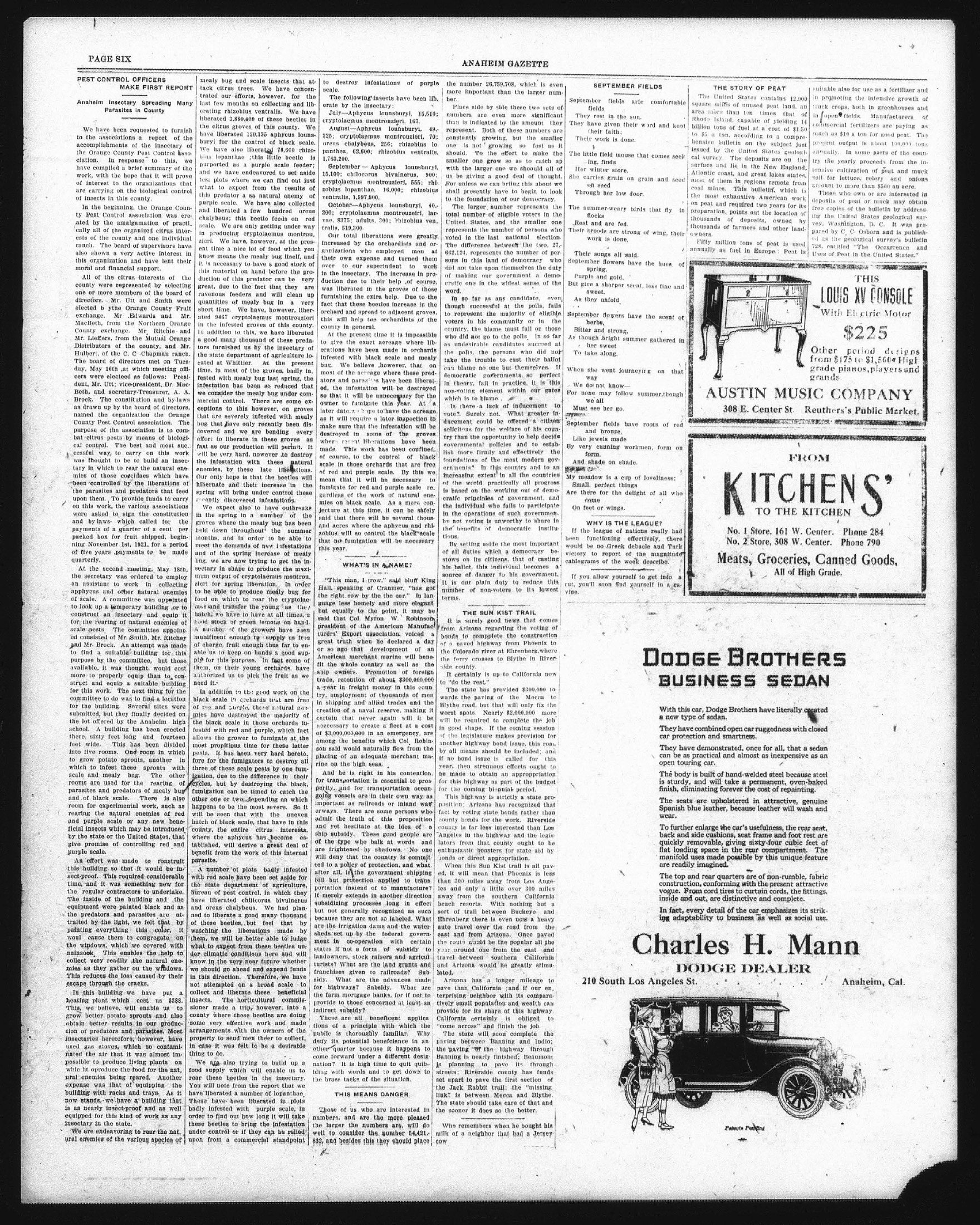
Searchable text
PEST CONTROL OFFICERS
MAKE FIRST REPORT
Anaheim Insectary Spreading Many Parasites in County
We have been requested to furnish to the associations a report of the accomplishments of the insectary of the Orange County Pest Control association. In response to this, we have compiled a brief summary of the work, with the hope that it will prove of interest to the organizations that are carrying on the biological control of insects in this county.
In the beginning, the Orange County Pest Control association was created by the amalgamation of practically all of the organized citrus interests of the county and one individual ranch. The board of supervisors have also shown a very active interest in this organization and have lent their moral and financial support.
All of the citrus interests of the county were represented by selecting one or more members of the board of directors. Mr. Utt and Smith were elected by ythe Orange County Fruit exchange. Mr. Edwards and Mr. MacBeth, from the Northern Orange County exchange. Mr. Ritchie and Mr. Lieffers, from the Mutual Orange Distributors of the county, and Mr. Hulbert, of the C. C. Chapman ranch. The board of directors met on Tuesday, May 16th at which meeting officers were electeed as follows: President, Mr. Utt; vice-president, Dr. MacBeth, and secretary-Treasurer, A. A. Brock. The constitution and by-laws as drawn up by the board of directors, named the organization the Orange County Pest Control association. The purpose of the association is to combat citrus pests by means of biological control. The best and most successful way to carry on this work mealy bug and scale insects that attack citrus trees. We have concentrated our efforts, however, for the last few months on collecting and liberating rhizobius ventralis. We have liberated 3,880,400 of these beetles in the citrus groves of this county. We have liberated 120,135 aphycus lounsburyi for the control of black scale. We have also liberated 78,600 rhizobius lopanthae; this little beetle is purported as a purple scale feeder; and we have endeavored to set aside test plots where we can find out just what to expect from the results of this predator a sa natural enemy of purple scale. We have also collected and liberated a few hundred orcas chalybeus; this beetle feeds on red scale. We are only getting under way in producing cryptolaemus montrouzieri. We have, however, at the present time a nice lot of food which you know means the mealy bug itself, and it is necessary to have a good stock of this material on hand before the production of this predator can be very great, due to the fact that they are ravenous feeders and will clean up quantities of mealy bug in a very short time. We have, however, liberated 9467 cryptolaemus montrouzieri in the infested groves of this county. In addition to this, we have liberated a good many thousand of these predators furnished us by the insectary of the state department of agriculture located at Whittier. At the present time, in most of the groves, badly infested with mealy bug last spring, the infestation has been so reduced that we consider the mealy bug under commercial control. There are some exceptions to this however, on groves that are severely infested with mealy bug that have only recently been discovered and we are bending every effort to liberate in these groves as fast as our production will permit. It will be very hard, however, to destroy to destroy its scale.
The following erate by the late July—Aphycryptolaemus August—Aphycryptolaemus 325; cryptolaemus zobius lopanthus ventralis, 1,597.
October—Aphycryptolaemus 200; cryptolaemus vae, 8375; adult tralis, 519,300.
Our total life increased by the organizations when their own expoer over to our in the insectaryduction due to them was liberated by furnishing the fact that these orchard and spruce this will help county in genere.
At the present to give the exerations have been infested with bug. We believe most of the accrators and parasitic, the infestation so that it will owner to furnish later date, we as it will require make sure that destroyed in where recent made. This ww course to th
The board of directors met on Tuesday, May 16th, at which meeting officers were elected as follows: President, Mr. Utt; vice-president, Dr. MacBeth, and secretary-Treasurer, A. A. Brock. The constitution and by-laws as drawn up by the board of directors, named the organization the Orange County Pest Control association. The purpose of the association is to combat citrus pests by means of biological control. The best and most successful way to carry on this work was thought to be to build an insectary in which to rear the natural enemies of those coccidias which have been controlled by the liberations of the parasites and predators that feed upon them. To provide funds to carry on this work, the various associations were asked to sign the constitution and by-laws which called for the payments of a quarter of a cent per packed box for fruit shipped, beginning November 1st, 1921, for a period of five years, payments to be made quarterly.
At the second meeting, May 18th, the secretary was ordered to employ an assistant to work in collecting apphycus and other natural enemies of scale. A committee was appointed to look up a temporary building or to construct an insectary and equip it for the rearing of natural enemies of scale pests. The committee appointed consisted of Mr. Smith, Mr. Ritchey and Mr. Brock. An attempt was made to find a suitable building for this purpose by the committee, but those available, it was thought, would cost more to properly equip than to construct and equip a suitable building for this work. The next thing for the committee to do was to find a location for the building. Several sites were submitted, but they finally decided on the lot offered by the Anaheim high school. A building has been erected there, sixty feet long and fourteen feet wide. This has been divided into five rooms. One room in which to grow potato sprouts, another in which to infest these sprouts with scale and mealy bug. The other rooms are used for the rearing of parasites and predators of mealy bug and of black scale. There is also room for experimental work, such as rearing the natural enemies of red and purple scale or any new beneficial insects which may be introduced by the state or the United States, that give promise of controlling red and purple scale.
An effort was made to reinstruticated at Whittier. At the present time, in most of the groves, badly infested with mealy bug last spring, the infestation has been so reduced that we consider the mealy bug under commercial control. There are some exceptions to this however, on groves that are severely infested with mealy bug that have only recently been discovered and we are bending every effort to liberate in these groves as fast as our production will permit. It will be very hard, however, to destroy the infestation with these natural enemies, by these late libertations. Our only hope is that the beetles will hibernate and their increase in the spring will bring under control these recently discovered infestations.
We expect also to have outbreaks in the spring in a number of the groves where the mealy bug has been held down throughout the summer months, and in order to be able to meet the demands of new infestations and of the spring increase of mealy bug, we are now trying to get the insectary in shape to produce the maximum output of cryptolaemus montrouzieri for spring liberation. In order to be able to produce mealy bug for food on which to rear the cryptolaemus and transfer the young as they hatch, we have to have at all times, a good stock of green lemons on hand. A number of the growers have been munificent enough to supply us free of charge, fruit enough thus far to enable us to keep on hands a good supply for this purpose. In fact some of them, on their young orchards, have authorized us to pick the fruit as we need it.
In addition to the good work on the black scale in orchards that are free of red and purple, these natural enemies have destroyed the majority of the black scale in those orchards infested with red and purple, which fact allows the grower to fumigate at the most propitious time for these latter pests. It has been very hard heretofore for the fumigators to destroy all three of these scale pests by one fumigation, due to the difference in their cycles, but by destroying the black, fumigation can be timed to catch the other one or two, depending on which happens to be the most severe. So it will be seen that with the uneven hatch of black scale, that have in this county, the entire citrus interests, where the aphycus has become established, will derive a great deal of benefit from the work of this internal parasite.
WHAT?
This man, I Hall, speaking at the right sow bed guage less homely but equally so said that Col. N president of the turers' Export great truth who or so ago that American merch fit the whole co ship owners trade, retention a year in freight try, employment in shipping and creation of a new certain that nee necessary to cut $3,000,000,000 among the benefi son said would m placing of an ac rine on the high.
And he is right for transportation perity, and for going vessels are important as rai erways. There are admit the truth and yet hesitate ship subsidy. Tof the type who are frightened b will deny that tha ted to a policy o
An effort was made to reinstrut this building so that it would be insect-proof. This required considerable time, and it was something new for the regular contractors to undertake. The inside of the building and the equipment were painted black and as the predators and parasites are attracted by the light, we felt that by painting everything this color, it woul cause them to congregate on the windows, which we covered with nainsook. This enables the help to collect very readily the natural enemies as they gather on the windows. This reduces the loss caused by their escape through the cracks.
In this building we have put a heating plant which cost us $388. This, we believe, will enable us to grow better potato sprouts and also obtain better results in our production of predators and parasites. Most insectaries heretofore, however, have used gas stoves, which so contaminated the air that it was almost impossible to produce living plants on which it oproduce the food for the natural enemies being repaired. Another expense was that of equipping the building with racks and trays. As it now stands, we have a building that is as nearly insect-proof and as well equipped for this kind of work as any insectary in the state.
We are endeavoring to rear the natural enemies of the various species of scale and mealy bug. The other rooms are used for the rearing of parasites and predators of mealy bug and of black scale. There is also room for experimental work, such as rearing the natural enemies of red and purple scale or any new beneficial insects which may be introduced by the state or the United States, that give promise of controlling red and purple scale.
A number of plots badly infested with red scale have been set aside for the state department of agriculture, bureau of pest control, in which they have liberated chilicorus bivulnerus and orcus chalybeus. We had planned to liberate a good many thousand of these beetles, but feel that by watching the liberations made by them, we will be better able to judge what to expect from these beetles under climatic conditions here and will know in the very near future whether we should go ahead and expend funds in this direction. Therefore, we have not attempted on a broad scale to collect and liberate these beneficial insects. The horticultural commissioner made a trip, however, into a county where these beetles are doing some very effective work and made arrangements with the owners of the property to send men there to collect, in case it was felt to be a desirable thing to do.
We are also trying to build up a food supply which will enable us to rear these beetles in the insectary. You will note from the report that we have liberated a number of lopanthae. These have been liberated in plots badly infested with purple scale, in order to find out how long it will take these beetles to bring the infestation under control or if they can be relied upon from a commercial standpoint.
And he is right for transportation perity, and for going vessels are important as railways. There are admit the truth and yet hesitate ship subsidy. The type who are frightened will deny that they ted to a policy of after all, is the bill but protection instead. It merely extends subsidizing process but not generally because they are are the irrigation sheds set up by ment in co-open states if not a for landowners, stock turists? What are franchises given subsidy. What are for highways? The farm mortgage provide to those indirect subsidy?
These are all tions of a principle public is thorough deny its potential other quarter be come forward unnation? It is high bling with words the brass tacks on...
ANAHEIM GAZETTE
to destroy infestations of purple scale.
The following insects have been liberate by the insectary:
July—Aphycus lounsburyi, 15,510; cryptolaemus montrouzieri, 167.
August—Aphycus lounsburyi, 49,325; cryptolaemus montrouzieri, 70; orcus chalybeus, 256; rhizobius lapanthea, 62,600; rhizobius ventrallis, 1,763,200.
September—Aphycus lounsburyi, 15,100; chilocorus bivulnerus, 900; cryptolaemus montrouzieri, 555; rhizobius lopanthae, 16,000; rhizobius ventrallis, 1,597,900.
October—Aphycus lounsburyi, 40,200; cryptolaemus montrouzieri, larvae, 8375; adults, 300; rhizobius ventrallis, 519,300.
Our total liberations were greatly increased by the orchardists and organizations who employed men at their own expense and turned them over to our superindent to work in the insectary. The increase in production due to their help of course was liberated in the groves of those furnishing the extra help. Due to the fact that these beetles increase in the orchard and spread to adjacent groves, this will help tue orchardists of the county in general.
At the present time it is impossible to give the exact acreage where liberations have been made in orchards infested with black scale and mealy bug. We believe however that on most of the acreage where these predators and parasites have been liberated, the infestation will be destroyed so that it will be unnecessary for the owner to fumigate this year. At a later date we hope to have the acreage as it will require a later inspection to make sure that the infestation will be destroyed in some of the groves where recent liberations have been made. This work has been confined, of course to the control of black number 26,759,708, which is even more important than the larger number.
Place side by side these two sets of numbers are even more significant than is indicated by the amount they represent. Both of these numbers are constantly growing, but the smaller one is not growing so fast as it should. To the effort to make the smaller one grow so as to catch up with the larger one we should all of us be giving a good deal of thought. For unless we can bring this about we shall presently have to begin to look to the foundation of our democracy.
The larger number represents the total number of eligible voters in the United States, and the smaller one represents the number of persons who voted in the last national election. The difference between the two, 27,662,124, represents the number of persons in this land of democracy who did not take upon themselves the duty of making our government a democratic one in the widest sense of the word.
In so far as any candidate, even though successful at the polls, fails to represent the majority of eligible voters in his community or in the country, the blame must fall on those who did not go to the polls. In so far as undesirable candidates succeed at the polls, the persons who did not take the trouble to cast their ballot can blame no one but themselves. If democratic governments, so perfect in theory, fail in practice, it is this non-voting element within our gates which is to blame.
Is there a lack of inducement to vote? Surely not. What greater inducement could be offered a citizen solicited for the welfare of his country than the opportunity to help decide governmental policies and to establish more firmly and effectively the
SEPTEMBER FIELDS
September fields arfe comfortable fields
They rest in the sun.
They have given their word and kept their faith;
Their work is done.
The little field mouse that comes seeking finds
Her winter store.
She carries grain on grain and seed on seed
Through her low door.
The summer-weary birds that fly in flocks
Rest and are fed.
Their broods are strong of wing, their work is done.
Their songs all said.
September flowers have the hues of spring,
Purple and gold.
But give a sharper scent, less fine and sweet.
As they unfold.
September flowers have the scent of herbs,
Bitter and strong.
As though bright summer gathered in her sweet
To take along.
When she went journeying on that way
We do not know—
For none may follow summer, though we all
Must see her go.
September fields have roots of red and bronze.
Like jewels made
By very cunning workmen, form on form.
WHAT'S IN A NAME?
"This man, I trow," said bluff King Hall, speaking of Cranmer, "has got the right sow by the ear." In language less homely and more elegant but equally to the point, it may be said that Col. Myron W. Robinson president of the American Manufacturers' Export association, voiced a great truth when he declared a day or so ago that development of an American merchant marine will benefit the whole country as well as the ship owners. Promotion of foreign trade, retention of about $300,000,000 a year in freight money in this country, employment of thousands of men in shipping and allied trades and the creation of a naval reserve, making it certain that never again will it be necessary to create a fleet at a cost of $3,000,000,000 in an emergency, are among the benefits which Col. Robinson said would naturally flow from the placing of an adequate merchant marine on the high seas.
And he is right in his contention, for transportation is essential to prosperity, and for transportation oceangoing vessels are in their own way as important as railroads or inland waterways. There are some persons who admit the truth of this proposition and yet hesitate at the idea of a ship subsidy. These good people are of the type who balk at words and are frightened by shadows. No one will deny that the country is committed to a policy of protection and what take the trouble to cast their ballot can blame no one but themselves. If democratic governments, so perfect in theory, fail in practice, it is this non-voting element within our gates which is to blame.
Is there a lack of inducement to vote? Surely not. What greater inducement could be offered a citizen solicited for the welfare of his country than the opportunity to help decide governmental policies and to establish more firmly and effectively the foundations of the most modern governments? In this country and to an increasing extent in all the countries of the world, practically all progress is based on the working out of democratic principles of government, and the individual who fails to participate in the operations of such government by not voting is unworthy to share in the benefits of democratic institutions.
By setting aside the most important of all duties which a democracy bestows on its citizens, that of casting his ballot, this individual becomes a source of danger to his government. It is our plain duty to reduce this number of non-voters to its lowest terms.
THE SUN KIST TRAIL
It is surely good news that comes from Arizona regarding the voting of bonds to complete the construction of a naval reserve, making it certain that never again will it be necessary to create a fleet at a cost of $3,000,000,000 in an emergency, are among the benefits which Col. Robinson said would naturally flow from the placing of an adequate merchant marine on the high seas.
This highway is strictly a state proposition; Arizona has recognized that fact by voting state bonds rather than county bonds for the work. Riverside county is far less interested than Los Angeles in the highway and the legislators from that county ought to be enthusiastic boosters for state aid by bonds or direct appropriation.
When she went journeying on that way
We do not know—
For none may follow summer, though we all
Must see her go.
September fields have roots of red and bronze,
Like jewels made
By very cunning workmen, form on form,
And shade on shade.
My meadow is a cup of loveliness;
Small, perfect things
Are there for the delight of all who come
On feet or wings.
WHY IS THE LEAGUE?
If the league of nations really had been functioning effectively, there would be no Greek debacle and Turk victory to report of the magnitude cablegrams of the week describe.
If you allow yourself to get into a rut, you'll soon find yourself in a ravine.
And he is right in his contention, for transportation is essential to prosperity, and for transportation ocean-going vessels are in their own way as important as railroads or inland waterways. There are some persons who admit the truth of this proposition and yet hesitate at the idea of a ship subsidy. These good people are of the type who balk at words and are frightened by shadows. No one will deny that the country is committed to a policy of protection, and what after all, is the government shipping bill but protection applied to transportation instead of to manufacture? It merely extends in another direction subsidizing processes long in effect but not generally recognized as such because they are not so labeled. What are the irrigation dams and the watersheds set up by the federal government in co-operation with certain states if not a form of subsidy to landowners, stock raisers and agriculturists? What are the land grants and franchises given to railroads? Subsidy. What are the advances made for highways? Subsidy. What are the farm mortgage banks, for if not to provide to those concerned at least an indirect subsidy?
These are all beneficent applications of a principle with which the public is thoroughly familiar. Why deny its potential benefcience in an other quarter because it happens to come forward under a different designation? It is high time to quit quibbling with words and to get down to the brass tacks of the situation.
THIS MEANS DANGER
Those of us who are interested in numbers, and are the more pleased the larger the numbers are, will do well to consider the number 54,421,832, and besides this they should place be made to obtain an appropriation for this highway as part of the budget for the coming biennial period.
This highway is strictly a state proposition; Arizona has recognized that fact by voting state bonds rather than county bonds for the work. Riverside county is far less interested than Los Angeles in the highway and the legislators from that county ought to be enthusiastic boosters for state aid by bonds or direct appropriation.
When this Sun Kist trail is all paved, it will mean that Phoenix is less than 300 miles away from Los Angeles and only a little over 300 miles away from the southern California beach resorts. With nothing but a sort of trail between Buckeye and Ehrenberg there is even now a heavy auto travel over the road from the east and from Arizona. Once paved the route would be the popular all the year around one from the east and travel between southern California and Arizona would be greatly stimulated.
Arizona has a longer mileage to pave than California; and if our enterprising neighbor with its comparatively small population and wealth can provide for its share of this highway, California certainly is obliged to "come across" and finish the job.
The state will soon complete the paving between Banning and Indio; the paving of the highway through Banning is nearly finished; Beaumont is planning to pave its through streets; Riverside county has funds set apart to pave the first section of the Jack Rabbit trail; the "missing link" is between Mecca and Blythe. The state should take care of that and the sooner it does so the better.
Who remembers when he bought his milk of a neighbor that had a Jersey cow.
MEMBER FIELDS
fields arfe comfortable
the sun.
en their word and keut
th;
is done.
mouse that comes seek
store.
rain on grain and seed
low door.
eary birds that fly in
fed.
are strong of wing, their
done.
all said.
ers have the hues of
old,
per scent, less fine and
old.
ers have the scent of
rong.
nt summer gathered in
ng.
journeyirg on that
now—
follow summer, though
go.
ids have roots of red
ze.
made
ing workmen, form on
THE STORY OF PEAT
The United States contains 12,000 square miles of unused peat land, an area more than ten times that of Rhode Island, capable of yielding 14 billion tons of fuel at a cost of $1.50 to $5 a ton, according to a comprehensive bulletin on the subject just issued by the United States geological survey. The deposits are on the surface and lie in the New England, Atlantic coast, and great lakes states, most of them in regions remote from coal mines. This bulletin, which is the most exhaustive American work on peat and required two years for its preparation, points out the location of thousands of deposits, owned by thousands of farmers and other landowners.
Fifty million tons of peat is used annually as fuel in Europe. Peat is suitable also for use as a fertilizer and in promoting the intensive growth of truck crops, both in greenhouses and in open fields. Manufacturers of commercial fertilizers are paying as much as $10 a ton for good peat. The present output is about 100,000 tons annually. In some parts of the country the yearly proceeds from the intensive cultivation of peat and muck soil for lettuce; celery and onions amount to more than $500 an acre.
Those who own or are interested in deposits of peat or muck may obtain free copies of the bulletin by addressing the United States geological survey, Washington, D. C. It was prepared by C. C. Osborn and is published as the geological survey's bulletin 728, entitled "The Occurrence and Uses of Peat in the United States."
THIS
LOUIS XV CONSOLE
With Electric Motor
$225
Other period designs from $175 to $1,560 High grade pianos, players and grands.
AUSTIN MUSIC COMPANY
308 E. Center St. Reuthers's Public Market.
FROM
KITCHENS'
TO THE KITCHEN
No. 1 Store, 161 W. Center. Phone 284
No. 2 Store, 308 W. Center. Phone 790
Meats, Groceries, Canned Goods,
All of High Grade.
DODGE BROTHERS
BUSINESS SEDAN
With this car, Dodge Brothers have literally created a new type of sedan.
They have combined open car ruggedness with closed car protection and smartness.
They have demonstrated, once for all, that a sedan can be as practical and almost as inexpensive as an open touring car.
The body is built of hand-welded steel because steel is sturdy, and will take a permanent, oven-baked finish, eliminating forever the cost of repainting.
The seats are upholstered in attractive, genuine Spanish blue leather, because leather will wash and wear.
To further enlarge the car's usefulness, the rear seat, back and side cushions, seat frame and foot rest are quickly removable, giving sixty-four cubic feet of flat loading space in the rear compartment. The manifold uses made possible by this unique feature are readily imagined.
The body is built of hand-welded steel because steel is sturdy, and will take a permanent, oven-baked finish, eliminating forever the cost of repainting.
The seats are upholstered in attractive, genuine Spanish blue leather, because leather will wash and wear.
To further enlarge the car's usefulness, the rear seat, back and side cushions, seat frame and foot rest are quickly removable, giving sixty-four cubic feet of flat loading space in the rear compartment. The manifold uses made possible by this unique feature are readily imagined.
The top and rear quarters are of non-rumble, fabric construction, conforming with the present attractive vogue. From cord tires to curtain cords, the fittings inside and out, are distinctive and complete.
In fact, every detail of the car emphasizes its striking adaptability to business as well as social use.
Charles H. Mann
DODGE DEALER
South Los Angeles St.
Anaheim, Cal.