anaheim-gazette 1922-08-17
Scanned page
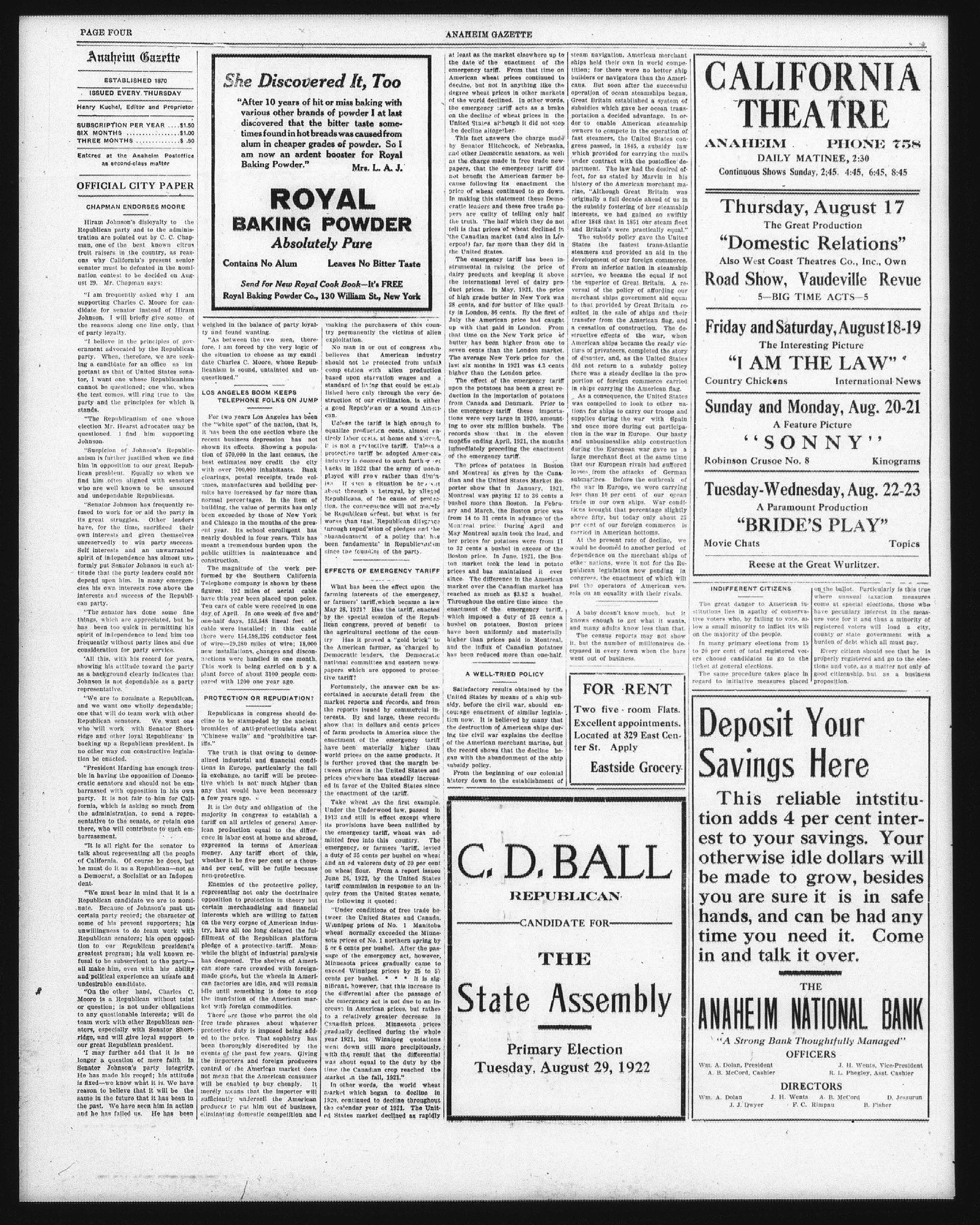
Searchable text
Anaheim Gazette
ESTABLISHED 1870
ISSUED EVERY THURSDAY
Henry Kuchel, Editor and Proprietor
SUBSCRIPTION PER YEAR ... $1.50
SIX MONTHS ... $1.00
THREE MONTHS ... $ .50
Entred at the Anaheim Postoffice as second-class matter
OFFICIAL CITY PAPER
CHAPMAN ENDORSES MOORE
Hiram Johnson's disloyalty to the Republican party and to the administration are pointed out by C. C. Chapman, one of the best known citrus fruit raisers in the country, as reasons why California's present senior senator must be defeated in the nomination contest to be decided on August 29. Mr. Chapman says:
"I am frequently asked why I am supporting Charles C. Moore for candidate for senator instead of Hiram Johnson. I will briefly give some of the reasons along one line only, that of party loyalty.
"I believe in the principles of government advocated by the Republican party. When, therefore, we are seeking a candidate for an office so important as that of United States senator, I want one whose Republicanism cannot be questioned; one who, when the test comes, will ring true to the party and the principles for which it stands.
"The Republicanism of one whose election Mr. Hearst advocates may be questioned. I find him supporting Johnson."
"Suspicion of Johnson's Republicism is further evidence when weighed in the balance of party loyalty and found wanting.
"As between the two men, therefore, I am forced by the very logic of the situation to choose as my candidate Charles C. Moore, whose Republicanism is sound, untainted and unquestioned."
LOS ANGELES BOOM KEEPS TELEPHONE FOLKS ON JUMP
For two years Los Angeles has been the "white spot" of the nation, that is, it has been the one section where the recent business depression has not shown its effects. Showing a population of 570,000 in the last census, she discovered that the bitter taste times found in hot breads was caused by cheaper grades of powder am now an ardent booster for Baking Powder."
ROYAL BAKING POWDER
Absolutely Pure
Contains No Alum Leaves No
Send for New Royal Cook Book—Royal Baking Powder Co., 130 William
ing a candidate for an office so important as that of United States senator, I want one whose Republicanism cannot be questioned; one who, when the test comes, will ring true to the party and the principles for which it stands.
"The Republicanism of one whose election Mr. Hearst advocates may be questioned. I find him supporting Johnson."
"Suspicion of Johnson's Republicanism is further justified when we find him in opposition to our great Republican president. Equally so when we find him often aligned with senators who are well known to be unsound and undependable Republicans.
"Senator Johnson has frequently refused to work for or aid the party in its great struggles. Other leaders have, for the time, sacrificed their own interests and given themselves unreservedly to win party success. Self interests and an unwarranted spirit of independence has almost uniformly put Senator Johnson in such attitude that the party leaders could not depend upon him. In many emergencies his own interests rose above the interests and success of the Republican party.
"The senator has done some fine things, which are appreciated, but he has been too quick in permitting his spirit of independence to lead him too frequently without party lines and due consideration for party service.
'All this, with his record for years, showing his attitude toward the party as a background clearly indicates that Johnson is not dependable as a party representative.
"We are to nominate a Republican, and we want one wholly dependable; one that will do team work with other Republican senators. We want one who will work with Senator Shortridge and other loyal Republicans in backing up a Republican president. In no other way can constructive legislation be enacted.
"President Harding has enough trouble in having the opposition of Doeconomic senators and should not be embarrassed with opposition in his own party. It is not fair to him for California, which is asking so much from the administration, to send a representative to the senate, or retain one there, who will contribute to such embarrassment.
"It is all right for the senator to talk about representing all the people of California. Of course he does, but date Charles C. Moore, whose Republicanism is sound, untainted and unquestioned."
LOS ANGELES BOOM KEEPS TELEPHONE FOLKS ON JUMP
For two years Los Angeles has been the "white spot" of the nation, that is, it has been the one section where the recent business depression has not shown its effects. Showing a population of 570,000 in the last census, the best estimates now credit the city with over 700,000 inhabitants. Bank clearings, postal receipts, trade volumes, manufactures and building permits have increased by far more than normal percentages. In the item of building, the value of permits has only been exceeded by those of New York and Chicago in the months of the present year. Its school enrollment has nearly doubled in four years. This has meant a tremendous burden upon the public utilities in maintenance and construction.
The magnitude of the work performed by the Southern California Telephone company is shown by these figures: 192 miles of aerial cable have this year been placed upon poles. Ten cars of cable were received in one day of April. In one week of five and one-half days, 153,548 lineal feet of cable were installed; in this cable there were 154,598,326 conductor feet of wire—29,280 miles of wire; 18,000 new installations, changes and disconnections were handled in one month. This work is being carried on by a plant force of about 3100 people compared with 1200 one year ago.
PROTECTION OR REPUDIATION?
Republicans in congress should decline to be stampeded by the ancient bromides of anti-protectionists about "Chinese walls" and "prohibitive tariffs."
The truth is that owing to demoralized industrial and financial conditions in Europe, particularly the fall in exchange, no tariff will be protective which is not much higher than any that would have been necessary a few years ago.
It is the duty and obligation of the majority in congress to establish a tariff on all articles of general American production equal to the difference in labor cost at home and abroad, expressed in terms of American money. Any tariff short of this, whether it be five per cent or a thousand dollars, should not be competition based upon standard here constructed of good Republican can.
Unless the equalize produre tirely labor costs it is not a pre-protective tariff industry is do backs in 1922 played will pise if soon about through Republicans, tion, the consbe Republican worse than thru through repudiation abandonment been fundamed since the fourth century.
EFFECTS OF
What has been farming interest or farmers' tax May 28, 1921? by the special lican congress the agriculture try Has it p the American Democratic le national comm papers which tive tariff?
Fortunately certain in a market report the reports is terests. By a show that in of farm produce enactment of have been m world prices o is further pro tieen prices s prices elsewh ed in favor of the enactment.
Take wheat Under the Un 1913 and still its provisions the emergency mitted free in emergency, o a duty of 35 cents and an ad val
President Harding has enough trouble in having the opposition of Doemocratic senators and should not be embarrassed with opposition in his own party. It is not fair to him for California, which is asking so much from the administration, to send a representative to the senate, or retain one there, who will contribute to such embarrassment.
"It is all right for the senator to talk about representing all the people of California. Of course he does, but he must do it as a Republican—not as a Democrat, a Socialist or an Independent.
"We must bear in mind that it is a Republican candidate we are to nominate. Because of Johnson's past uncertain party record; the character of some of his present supporters; his unwillingness to do team work with Republican senators; his open opposition to our Republican president's greatest program; his well known refusal to be subservient to the party—all make him, even with his ability and political experience an unsafe and undesirable candidate.
"On the other hand, Charles C. Moore is a Republican without taint or question; is not under obligations to any questionable interests; will do team work with other Republican senators, especially with Senator Shortridge, and will give loyal support to our great Republican president.
"I may further add that it is no longer a question of mere faith in Senator Johnson's party integrity. He has made his record; his attitude is fixed—we know what it is. We have reason to believe that it will be the same in the future that it has been in the past. We have seen him in action and he has failed us. He has been
It is the duty and obligation of the majority in congress to establish a tariff on all articles of general American production equal to the difference in labor cost at home and abroad, expressed in terms of American money. Any tariff short of this, whether it be five per cent or a thousand per cent, will be futile because non-protective.
Enemies of the protective policy, representing not only the doctrinaire opposition to protection in theory but certain merchandising and financial interests which are willing to fatten on the very corpse of American industry, have all too long delayed the fulfillment of the Republican platform pledge of a protective tariff. Meanwhile the blight of industrial paralysis has deepened. The shelves of American store care crowded with foreign-made goods, but the wheels in American factories are idle, and will remain idle until something is done to stop the inundation of the American market with foreign commodities.
There are those who parrot the old free trade phrases about whatever protective duty is imposed being added to the price. That sophistry has been thoroughly discredited by the events of the past few years. Giving the importers and foreign producers control of the American market does not mean that the American consumer will be enabled to buy cheaply. It merely means that the importer will sufficiently undersell the American producer to put him out of business, eliminating domestic competition and
ANAHEIM GAZETTE
Recovered It, Too
ears of hit or miss baking with
other brands of powder I at last
that the bitter taste somein hot breads was caused from
paper grades of powder. So I
am ardent booster for Royal
powder."
Mrs. L. A. J.
ROYAL
ING POWDER
Absolutely Pure
Leaves No Bitter Taste
New Royal Cook Book—It's FREE
powder Co., 130 William St, New York
making the purchasers of this country permanently the victims of alien exploitation.
No man in or out of congress who believes that American industry should not be protected from unfair competition with alien production based upon starvation wages and a standard of living that could be established here only through the very destruction of our civilization, is either a good Republican or a sound American.
Unless the tariff is high enough to equalize production costs, almost entirely labor costs, at home and abroad, it is not a protective tariff. Unless a protective tariff be adopted American at least as the market elsewhere up to the date of the enactment of the emergency tariff. From that time on American wheat prices continued to decline, but not in anything like the degree wheat prices in other markets of the world declined. In other words, the emergency tariff acts as a brake on the decline of wheat prices in the United States although it did not stop the decline altogether.
This fact answers the charge made by Senator Hitchcock, of Nebraska, and other Democratic senators, as well as the charge made in free trade newspapers, that the emergency tariff did not benefit the American farmer because following its enactment the price of wheat continued to go down. In making this statement these Democratic leaders and these free trade papers are guilty of telling only half the truth. The half which they do not tell is that prices of wheat declined in the Canadian market (and also in Liverpool) far, far more than they did in the United States.
The emergency tariff has been instrumental in raising the price of dairy products and keeping it above the international level of dairy product prices. In May, 1921, the price of high grade butter in New York was 28 cents, and for butter of like quality in London, 36 cents. By the first of July the American price had caught up with that paid in London. From that time on the New York price of butter has been higher from one to seven cents than the London market. The average New York price for the last six months in 1921 was 4.3 cents higher than the London price.
The effect of the emergency tariff upon the potatoes has been a great reduction in the importation of potatoes from Canada and Denmark. Prior to the emergency tariff these importations were very large in 1920, amounting to over six million bushels. The records show that in the eleven months ending April, 1921, the months immediately preceding the enactment of the emergency tariff.
steam navigation, American merchant ships held their own in world competition; for there were no better ship builders or navigators than the Americans. But soon after the successful operation of ocean steamships began, Great Britain established a system of subsidies which gave her ocean transportation a decided advantage. In order to enable American steamship owners to compete in the operation of fast steamers, the United States congress passed, in 1845, a subsidy law which provided for carrying the mails under contract with the postoffice department. The law had the desired effect, for as stated by Marvin in his history of the American merchant marine, "Although Great Britain was originally a full decade ahead of us in the subsidy fostering of her steamship interests, we had gained so swiftly after 1848 that in 1851 our steam fleet and Britain's were practically equal."
The subsidy policy gave the United States the fastest trans-Atlantic steamers and provided an aid in the development of our foreign commerce. From an inferior nation in steamship service, we became the equal if not superior of Great Britain. A reversal of the policy of affording our merchant ships government aid equal to that provided by Great Britain resulted in the sale of ships and their transfer from the American flag, and a cessation of construction. The destructive effects of the war, when American ships became the ready victims of privateers, completed the story of disaster, and, as the United States did not return to a subsidy policy there was a steady decline in the proportion of foreign commerce carried in ships carrying the American flag.
As a consequence, the United States was compelled to look to other nations for ships to carry our troops and supplies during the war with Spain and once more during out participation in the war in Europe. Our hasty and unbusinesslike ship construction during the European war gave us a large merchant fleet at the same time.
should not be protected from unfair competition with alien production based upon starvation wages and a standard of living that could be established here only through the very destruction of our civilization, is either a good Republican or a sound American.
Unless the tariff is high enough to equalize production costs, almost entirely labor costs, at home and abroad, it is not a protective tariff. Unless a protective tariff be adopted American industry is doomed to such further backs in 1922 that the army of unemployed will grow rather than diminish. If even a situation be brought about through a betrayal, by alleged Republicans, of the cause of protection, the consequence will not merely be Republican defeat, but what is far worse than that. Republican disgrasses through repudiation of pledges and the abandonment of a policy that has been fundamentally in Republicanism since the founding of the party.
EFFECTS OF EMERGENCY TARIFF
What has been the effect upon the farming interests of the emergency, or farmers' tariff, which became a law May 28, 1921? Has the tariff, enacted by the special session of the Republican congress, proved of benefit to the agricultural sections of the country. Has it proved a "gold brick" to the American farmer, as charged by Democratic leaders, the Democratic national committee and eastern newspapers which are opposed to protective tariff?
Fortunately, the answer can be ascertained in accurate detail from the market reports and records, and from the reports issued by commercial interests. By large, these records show that in dollars and cents prices of farm products in America since the enactment of the emergency tariff have been materially higher than world prices on the same products. It is further proved that the margin between prices in the United States and prices elsewhere has steadily increased in favor of the United States since the enactment of the tariff.
Take wheat as the first example. Under the Underwood law, passed in 1913 and still in effect except where its provisions have been nullified by the emergency tariff, wheat was admitted free into this country. The emergency, or farmers' tariff, levied a duty of 35 cents per bushel on wheat and an ad valorem duty of 20 per cent last six months in 1921 was 4.3 cents higher than the London price.
The effect of the emergency tariff upon the potatoes has been a great reduction in the importation of potatoes from Canada and Denmark. Prior to the emergency tariff these importations were very large in 1920, amounting to over six million bushels. The records show that in the eleven months ending April, 1921, the months immediately preceding the enactment of the emergency tariff.
The prices of potatoes in Boston and Montreal as given by the Canadian and the United States Market Reporter show that in January, 1921, Montreal was paying 12 to 36 cents a bushel more than Boston. In February and March, the Boston price was from 14 to 31 cents in advance of the Montreal price. During April and May Montreal again took the lead, and her prices for potatoes were from 11 to 32 cents a bushel in excess of the Boston price. In June, 1921, the Boston market took the lead in potato prices and has maintained it ever since. The difference in the American market over the Canadian market has reached as much as $3.82 a bushel. Throughout the entire time since the enactment of the emergency tariff, which imposed a duty of 25 cents a bushel on potatoes, Boston prices have been uniformly and materially higher than prices paid in Montreal, and the influx of Canadian potatoes has been reduced more than one-half.
A WELL-TRIED POLICY
Satisfactory results obtained by the United States by means of a ship subsidy, before the civil war, should encourage enactment of similar legislation now. It is believed by many that the destruction of American ships during the civil war explains the decline of the American merchant marine, but the record shows that the decline began with the abandonment of the ship subsidy policy.
From the beginning of our colonial history down to the establishment of two five-room Flats. Excellent appointments. Located at 329 East Center St. Apply Eastside Grocery.
FOR RENT
Two five-room Flats. Excellent appointments. Located at 329 East Center St. Apply Eastside Grocery.
C. D. BALL
REPUBLICAN
CANDIDATE FOR
THE
State Assembly
Primary Election
Tuesday, August 29, 1922
In other words, the world wheat market which began to decline in 1920, continued to decline throughout the calendar year of 1921. The United States market declined as rapidly
CALIFORNIA
THEATRE
ANAHEIM PHONE 758
DAILY MATINEE, 2:30
Continuous Shows Sunday, 2;45. 4:45, 6:45, 8:45
Thursday, August 17
The Great Production
“Domestic Relations”
Also West Coast Theatres Co., Inc., Own
Road Show, Vaudeville Revue
5—BIG TIME ACTS—5
Friday and Saturday, August 18-19
The Interesting Picture
“I AM THE LAW”"
Country Chickens International News
Sunday and Monday, Aug. 20-21
A Feature Picture
“‘SONNY’”
Country Chickens International News
Sunday and Monday, Aug. 20-21
A Feature Picture
“SONNY”
Robinson Crusoe No. 8 Kinograms
Tuesday-Wednesday, Aug. 22-23
A Paramount Production
“BRIDE’S PLAY”
Movie Chats Topics
Reese at the Great Wurlitzer.
INDIFFERENT CITIZENS
The great danger to American institutions lies in apathy of conservative voters who, by failing to vote, allow a small minority to inflict its will on the majority of the people.
In many primary elections from 15 to 20 per cent of total registered voters choose candidates to go to the ticket at general elections.
The same procedure takes place in regard to initiative measures placed on the ballot. Particularly is this true where unusual taxation measures come at special elections, those who have pecuniary interest in the measure vote for it and thus a minority of registered voters will load a city, county or state government with a burden of debt which all must pay.
Every citizen should see that he is properly registered and go to the elections and vote, as a matter not only of good citizenship, but as a business proposition.
Deposit Your Savings Here
This reliable institution adds 4 per cent interest to your savings. Your otherwise idle dollars will
This reliable institution adds 4 per cent interest to your savings. Your otherwise idle dollars will be made to grow, besides you are sure it is in safe hands, and can be had any time you need it. Come in and talk it over.
THE
ANAHEIM NATIONAL BANK
"A Strong Bank Thoughtfully Managed"
OFFICERS
Wm. A. Dolan, President
A. B. McCord, Cashier
J. H. Wents, Vice-President
R. L. Phegley, Asst. Cashier
DIRECTORS
Wm. A. Dolan
J. H. Wents
A. B. McCord
D. Jessurun
J. J. Dwyer
F. C. Rimpau
B. Fisher