anaheim-gazette 1921-09-15
Scanned page
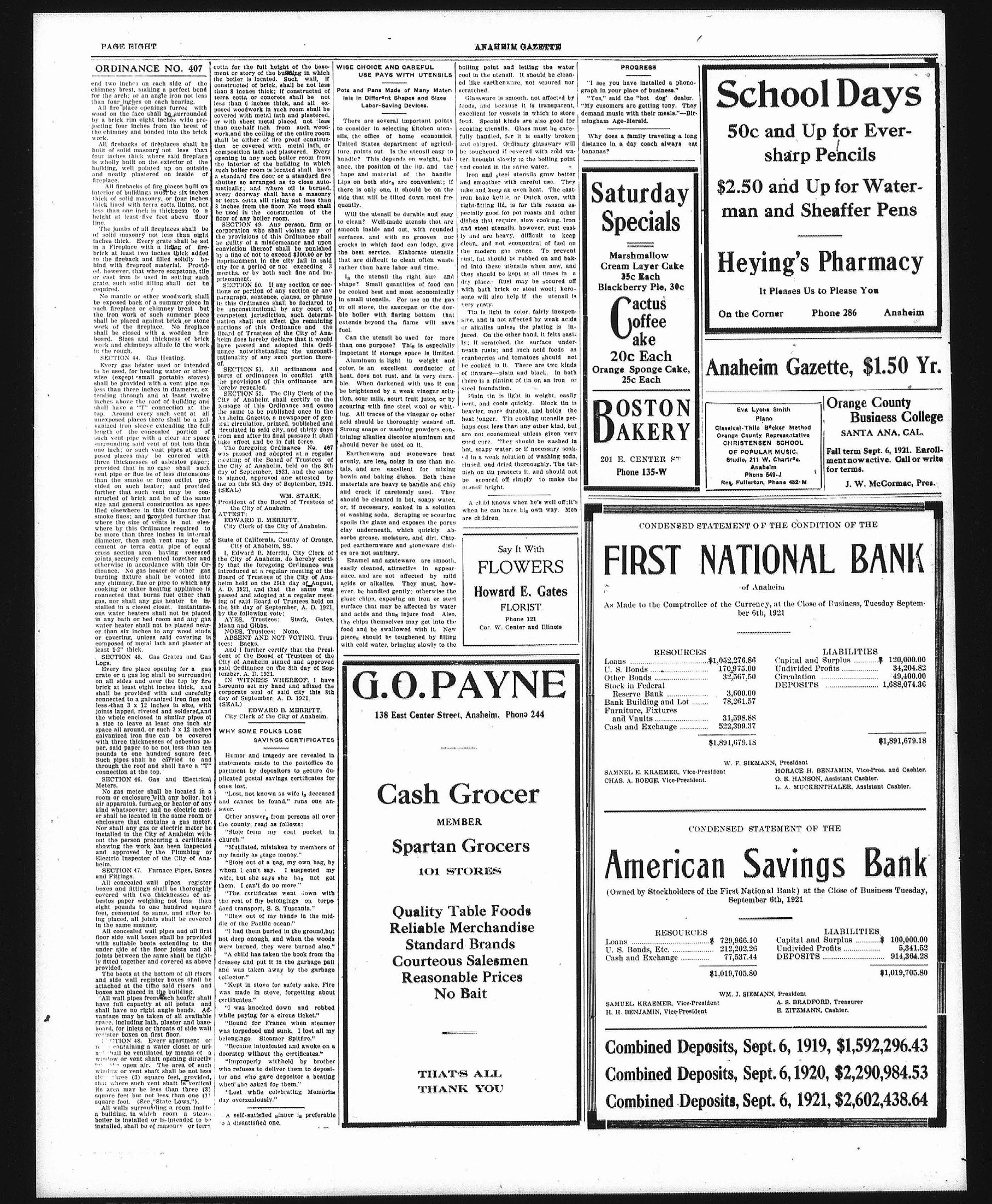
Searchable text
ORDINANCE NO. 407
end two inches on each side of the chimney breast, making a perfect bond for the arch; or an angle iron not less than four inches on each bearing.
All fire place openings furred with wood on the face shall be surrounded by a brick rim eight inches wide projecting four inches from the brest of the chimney and bonded into the brick work.
All firebacks of fireplaces shall be built of solid masonry not less than four inches thick where said fireplace is wholly built on the exterior of the building, well pointed up on outside and neatly plastered on inside of fireplace.
All firebacks of fire places built on interior of buildings must be six inches thick of solid masonry, or four inches thick lined with terra cotta lining, not less than one inch in thickness to a height at least five feet above floor line.
The jambs of all fireplaces shall be of solid masonry not less than eight inches thick. Every grate shall be set in a Fireplace with a lining of firebrick at least two inches thick added to the fireback and filled solidly behind with fireproof material. Provided, however, that where soapstone, tile or cast iron is used in setting such grate, such solid filling shall not be required.
No mantle or other woodwork shall be exposed back of a summer piece in such fireplace or chimney breast but the iron work of such summer piece shall be placed against brick or stone work of the fireplace. No fireplace shall be closed with a wooden fireboard. Sizes and thickness of brick work and chimneys allude to the work in the rough.
SECTION 44. Gas Heating.
Every gas heater used or intended to be used, for heating water or otherwise (except small portable stoves) shall be provided with a vent pipe not less than three inches in diameter, extending through and at least twelve inches above the roof of building and shall have a "T" connection at the top. Around every such vent at all unexposed places there shall be a galvanized iron sleeve extending the full length of the concealed portion of such vent pipe with a clear air space surrounding said vent of not less than one inch on such pipes at upper cottas for the full height of the basement or story of the building in which the boiler is located. Such wall, if constructed of brick, shall be not less than 8 inches thick; if constructed of terra cotta or concrete shall be not less than 6 inches thick, and all exposed woodwork in such room shall be covered with metal fath and plastered, or with sheet metal placed not less than one-half inch from such woodwork, and the ceiling or the entire room shall be either of fire proof construction or covered with metal lath, or composition lath and plastered. Every opening in any such boiler room from the interior of the building in which such boiler room is located shall have a standard fire door or a standard fire shutter so arranged as to close automatically; and where oil is burned, every doorway shall have a masonry or terra cotta sill rising not less than 8 inches from the floor. No wood shall be used in the construction of the floor of any boiler room.
SECTION 49. Any person, firm or corporation who shall violate any of the provisions of this Ordinance shall be guilty of a misdemeanor and upon conviction thereof shall be punished by a fine of not to exceed $300.00 or by imprisonment in the city jail in said city for a period or not exceeding 3 months, or by both such fine and imprisonment.
SECTION 50. If any section or sections or portion of any section or any paragraph, sentence, clause, or phrase in this Ordinance shall be declared to be unconstitutional by any court of competent jurisdiction, such determination shall not affect the remaining portions of this Ordinance and the Board of Trustees of the City of Anaheim does hereby declare that it would have passed and adopted this Ordinance notwithstanding the unconstitutionality of any such portion thereof.
SECTION 51. All ordinances and parts of ordinances in conflict with the provisions of this ordinance are hereby repealed.
SECTION 52. The City Clerk of the City of Anaheim shall certify to the passage of this Ordinance and cause the same to be published once in the Anaheim Gazette, a newspaper of general circulation, printed, published and circulated in said city, and thirty days from and after its final passage it shall take effect and be in full force.
The foregoing Ordinance No. 407
SECTION 44. Gas Heating.
Every gas heater used or intended to be used, for heating water or otherwise (except small portable stoves) shall be provided with a vent pipe not less than three inches in diameter, extending through and at least twelve inches above the roof of building and shall have a "T" connection at the top. Around every such vent at all unexposed places there shall be a galvanized iron sleeve extending the full length of the concealed portion of such vent pipe with a clear air space surrounding said vent of not less than one inch; or such vent pipes at unexposed places may be covered with three thicknesses of asbestos paper; provided that in no case shall such vent pipe or flue be of less dimensions than the smoke or fume outlet provided on such heater; and provided further that such vent may be constructed of brick and be of the same size and general construction as specified elsewhere in this Ordinance for smoke flues; and provided further that where the size of vents is not elsewhere by this Ordinance required to be more than three inches in internal diameter, then such vent may be of cement or terra cotta pipe of equal cross section area having recessed joints securely cemented together and otherwise in accordance with this Ordinance. No gas heater or other gas burning fixture shall be vented into any chimney, flue or pipe to which any cooking or other heating appliance is connected that burns fuel other than gas, nor shall any gas heater be installed in a closed closet. Instantaneous water heaters shall not be placed in any bath or bed room and any gas water heater shall not be placed nearer than six inches to any wood studs or covering, unless said covering is composed of metal lath and plaster at least 1-2" thick.
SECTION 45. Gas Grates and Gas Logs.
Every fire place opening for a gas grate or a gas log shall be surrounded on all sides and over the top by fire brick at least eight inches thick, and shall be provided with and carefully connected to a galvanized iron flue not less than 3 x 12 inches in size, with joints lapped, riveted and soldered, and the whole enclosed in similar pipes of a size to leave at least one inch air space all around, or such 3 x 12 inches galvanized iron flue can be covered with three thicknesses of asbestos paper, said paper to be not less than ten pounds to one hundred square feet. Such pipes shall be carried to and through the roof and shall have a "T" connection at the top.
SECTION 46. Gas and Electrical Meters.
No gas meter shall be located in a room or enclosure with any boiler, hot air apparatus, furnace or heater of any kind whatsoever; and no electric meter shall be located in the same room or enclosure that contains a gas meter. Nor shall any gas or electric meter be installed in the City of Anaheim without the person procuring a certificate showing the work has been inspected nationally of any such portion thereof.
SECTION 51. All ordinances and parts of ordinances in conflict with the provisions of this ordinance are hereby repealed.
SECTION 52. The City Clerk of the City of Anaheim shall certify to the passage of this Ordinance and cause the same to be published once in the Anaheim Gazette, a newspaper of general circulation, printed, published and circulated in said city, and thirty days from and after its final passage it shall take effect and be in full force.
The foregoing Ordinance No. 467 was passed and adopted at a regular meeting of the Board of Trustees of the City of Anaheim, held on the 8th day of September, 1921, and the same is signed, approved and attested by me on this 8th day of September, 1921.
WM. STARK,
President of the Board of Trustees of the City of Anaheim.
ATTEST:
EDWARD B. MERRITT,
City Clerk of the City of Anaheim.
State of California, County of Orange,
City of Anaheim, SS.
I. Edward B. Merritt, City Clerk of the City of Anaheim, do hereby certify that the foregoing Ordinance was introduced at a regular meeting of the Board of Trustees of the City of Anaheim held on the 25th day of August, A.D. 1921, and that the same was passed and adopted at a regular meeting of said Board of Trustees held on the 8th day of September, A.D. 1921,
AYES, Trustees: Stark, Gates, Mann and Gibbs.
NOES, Trustees: None.
ABSENT AND NOT VOTING, Trustees: Backs.
And I further certify that the President of the Board of Trustees of the City of Anaheim signed and approved said Ordinance on the 8th day of September, A.D. 1921.
IN WITNESS WHEREOF, I have hereunto set my hand and affixed the corporate seal of said city this 8th day of September, A.D. 1921.
EDWARD B. MERRITT,
City Clerk of the City of Anaheim.
WHY SOME FOLKS LOSE
SAVINGS CERTIFICATES
Humor and tragedy are revealed in statements made to the postoffice department by depositors to secure duplicated postal savings certificates for ones lost.
"Lost, not known as wife i$_g$ deceased and cannot be found," runs one answer.
Other answers from persons all over the county, read as follows:
"Stole from my coat pocket in church."
"Mutilated, mistaken by members of
Such pipes shall be carried to and through the roof and shall have a "T" connection at the top.
SECTION 46. Gas and Electrical Meters.
No gas meter shall be located in a room or enclosure with any boiler, hot air apparatus, furnace or heater of any kind whatsoever; and no electric meter shall be located in the same room or enclosure that contains a gas meter. Nor shall any gas or electric meter be installed in the City of Anaheim without the person procuring a certificate showing the work has been inspected and approved by the Plumbing or Electric Inspector of the City of Anaheim.
SECTION 47. Furnace Pipes, Boxes and Fittings.
All concealed wall pipes, register boxes and fittings shall be thoroughly covered with two thicknesses of asbestos paper weighing not less than eight pounds to one hundred square feet, cemented to same, and after being placed, all joints shall be covered in the same manner.
All concealed wall pipes and all first floor side wall boxes shall be provided with suitable boots extending to the under side of the floor joists and all joints between the same shall be tightly fitted together and covered as above provided.
The boots at the bottom of all risers and side wall register boxes shall be attached at the time said risers and boxes are placed in the building.
All wall pipes from each heater shall have full capacity at all points and shall have no right angle bends. Advantage may be taken of all available rpacce, including lath, plaster and baseboard, for inlets or throats of side wall register boxes on first floor.
SECTION 48. Every apartment or room containing a water closet or urinal shall be ventilated by means of a window or vent shaft opening directly into the open air. The area of such window or vent shaft shall be not less than three (3) square feet, provided that where such vent shaft is vertical its area may be less than three (3) square feet but not less than one (1) square foot. (See "State Laws.")
All walls surrounding a room inside a building, in which room a steam boiler is installed or is intended to be installed, shall be of masonry or terra
Humor and tragedy are revealed in statements made to the postoffice departement by depositors to secure duplicated postal savings certificates for ones lost.
"Lost, not known as wife i5 deceased and cannot be found," runs one answer.
Other answers from persons all over the county, read as follows:
"Stole from my coat pocket in church."
"Mutilated, mistaken by members of my family as stage money."
"Stole out of a bag, my own bag, by whom I can't say. I suspected my wife, but she says she has not got them. I can't do no more."
"The certificates went down with the rest of fly belongings on torpedo transport, S. S. Tuscanla."
"Blew out of my hands in the middle of the Pacific ocean."
"I had them buried in the ground, but not deep enough, and when the woods were burned, they were burned also."
"A child has taken the book from the dresser and put it in the garbage pail and was taken away by the garbage collector."
"Kept in stove for safety sake. Fire was made in stove, forgetting about certificates."
"I was knocked down and robbed while paying for a circus ticket."
"Bound for France when steamer was torpedoed and sunk. I lost all my belongings. Steamer Spitfire."
"Became intoxicated and awoke on a doorstep without the certificates."
Improperly withheld by brother who refuses to deliver them to depositor and who gave depositor a beating when she asked for them."
"Lost while celebrating Memorial day overzealously."
A self-satisfied inner i5 preferable to a dissatisfied one.
ANAHEIM GAZETTE
WISE CHOICE AND CAREFUL USE PAYS WITH UTENSILS
Pots and Pans Made of Many Materials in Different Shapes and Sizes Labor-Saving Devices.
There are several important points to consider in selecting kitchen utensils, the office of home economics, United States department of agriculture, points out. Is the utensil easy to handle? This depends on weight, balance, the position of the lip, and the shape and material of the handle. Lips on both sides are convenient; if there is only one, it should be on the side that will be tilted down most frequently.
Will the utensil be durable and easy to clean? Well-made utensils that are smooth inside and out, with rounded surfaces, and with no grooves nor cracks in which food can lodge, give the best service. Elaborate utensils that are difficult to clean often waste rather than have labor and time.
Is the utensil the right size and shape? Small quantities of food can be cooked best and most economically in small utensils. For use on the gas or oil stove, the saucepan or the double boiler with flaring bottom that extends beyond the flame will save fuel.
Can the utensil be used for more than one purpose? This is especially important if storage space is limited. Aluminum is light in weight and color, is an excellent conductor of heat, does not rust, and is very durable. When darkened with use it can be brightened by a weak vinegar solution, sour milk, sourt fruit juice, or by scouring with fine steel wool or whiting. All traces of the vinegar or other acid should be thoroughly washed off. Strong soaps or washing powders containing alkalies discolor aluminum and should never be used on it.
boiling point and letting the water cool in the utensil. It should be cleaned like earthenware, not scoured nor scratched.
Glassware is smooth, not affected by foods, and because it is transparent, excellent for vessels in which to store food. Special kinds are also good for cooking utensils. Glass must be carefully handled, for it is easily broken and chipped. Ordinary glassware will be toughened if covered with cold water, brought slowly to the boiling point and cooled in the same water.
Iron and steel utensils grow better and smoother with careful use. They take and keep an even heat. The cast iron bake kettle, or Dutch oven, with tight-fitting lid, is for this reason especially good for pot roasts and other dishes that require slow cooking. Iron and steel utensils, however, rust easily and are heavy, difficult to keep clean, and not economical of fuel on the modern gas range. To prevent rust, fat should be rubbed on and baked into these utensils when new, and they should be kept at all times in a dry place. Rust may be scoured off with bath brick or steel wool; kerosene will also help if the utensil is very rusty.
Tin is light in color, fairly inexpensive, and is not affected by weak acids or alkalies unless the plating is injured. On the other hand, it feels easily; if scratched, the surface underneath rusts; and such acid foods as cranberries and tomatoes should not be cooked in it. There are two kinds of tinware—plain and black. In both there is a plating of tin on an iron or steel foundation.
Plain tin is light in weight, easily bent, and cools quickly. Block tin is heavier, more durable, and holds the heat longer. Tin cooking utensils perhaps cost less than any other kind, but are not economical unless given very good care. They should be washed in hot soapy water or if necessary soak-
Aluminum is light in weight and color, is an excellent conductor of heat, does not rust, and is very durable. When darkened with use it can be brightened by a weak vinegar solution, sour milk, sourt fruit juice, or by scouring with fine steel wool or whitening. All traces of the vinegar or other acid should be thoroughly washed off. Strong soaps or washing powders containing alkalies discolor aluminum and should never be used on it.
Earthenware and stoneware heat evenly, are less noisy in use than metals, and are excellent for mixing bowls and baking dishes. Both these materials are heavy to handle and chip and crack if carelessly used. They should be cleaned in hot, soapy water, or if necessary, soaked in a solution of washing soda. Scraping or scouring spoils the glaze and exposes the porous clay underneath, which quickly absorbs grease, moisture, and dirt. Chipped earthenware and stoneware dishes are not sanitary.
Enamel and agateware are smooth, easily cleaned, attractive in appearance, and are not affected by mild acids or alkalies. They must, however, be handled gently; otherwise the glaze chips, exposing an iron or steel surface that may be affected by water and acids and thus injure food. Also, the chips themselves may get into the food and be swallowed with it. New pieces should be toughened by filling with cold water, bringing slowly to the
G.O.PAYNE
138 East Center Street, Anaheim. Phone 244
Cash Grocer
MEMBER
Spartan Grocers
Cash Grocer
MEMBER
Spartan Grocers
101 STORES
Quality Table Foods
Reliable Merchandise
Standard Brands
Courteous Salesmen
Reasonable Prices
No Bait
THAT'S ALL
THANK YOU
PROGRESS
have installed a phonoplace of business."
the "hot dog" dealer.
are getting tony. They
with their meals."—Bire-Herald.
a family traveling a long
day coach always eat
Saturday
pecials
arshmallow
m Layer Cake
35c Each
berry Ple, 30c
actus
coffee
ake
0c Each
e Sponge Cake,
25c Each
BOSTON
AKERY
School Days
50c and Up for Eversharp Pencils
$2.50 and Up for Waterman and Sheaffer Pens
Heying's Pharmacy
It Please Us to Please You
On the Corner Phone 286 Anaheim
Anaheim Gazette, $1.50 Yr.
Eva Lyons Smith
Plano
Classical-Thilo Bocker Method
Orange County Representative
CHRISTENSEN SCHOOL
Orange County
Business College
SANTA ANA, CAL.
CONDENSED STATEMENT OF THE CONDITION OF THE
FIRST NATIONAL BANK
of Anaheim
Made to the Comptroller of the Currency, at the Close of Business, Tuesday September 6th, 1921
RESOURCES
$1,052,276.86
Bonds 170,975.00
Cer Bonds 32,567.50
Bank in Federal Reserve Bank 3,600.00
Building and Lot 78,261.57
Fixtures, Fixtures
Vaults 31,598.88
and Exchange 522,399.37
LIABILITIES
Capital and Surplus $120,000.00
Undivided Profits 34,204.82
Circulation 49,400.00
DEPOSITS 1,688,074.36
$1,891,679.18
W. F. SIEMANN, President
HENEL E. KRAEMER, Vice-President
S. A. BOEGE, Vice-President.
HORACE H. BENJAMIN, Vice-Pres. and Cashier.
O. E. HANSON, Assistant Cashier.
L. A. MUCKENTHALER, Assistant Cashler.
CONDENSED STATEMENT OF THE
CONDENSED STATEMENT OF THE
American Savings Bank
Denied by Stockholders of the First National Bank) at the Close of Business Tuesday,
September 6th, 1921
RESOURCES
Ins ... $729,966.10
Bonds, Etc. ... 212,202.26
and Exchange ... 77,537.44
LIABILITIES
Capital and Surplus ... $100,000.00
Undivided Profits ... 5,341.52
DEPOSITS ... 914,364.28
$1,019,705.80
$1,019,705.80
WM. J. SIEMANN, President
JUEL KRAEMER, Vice-President
BENJAMIN, Vice-President
A. S. BRADFORD, Treasurer
E. ZITZMANN, Cashier.
Combined Deposits, Sept. 6, 1919, $1,592,296.43
Combined Deposits, Sept. 6, 1920, $2,290,984.53
Combined Deposits, Sept. 6, 1921, $2,602,438.64