anaheim-gazette 1921-09-15
Scanned page
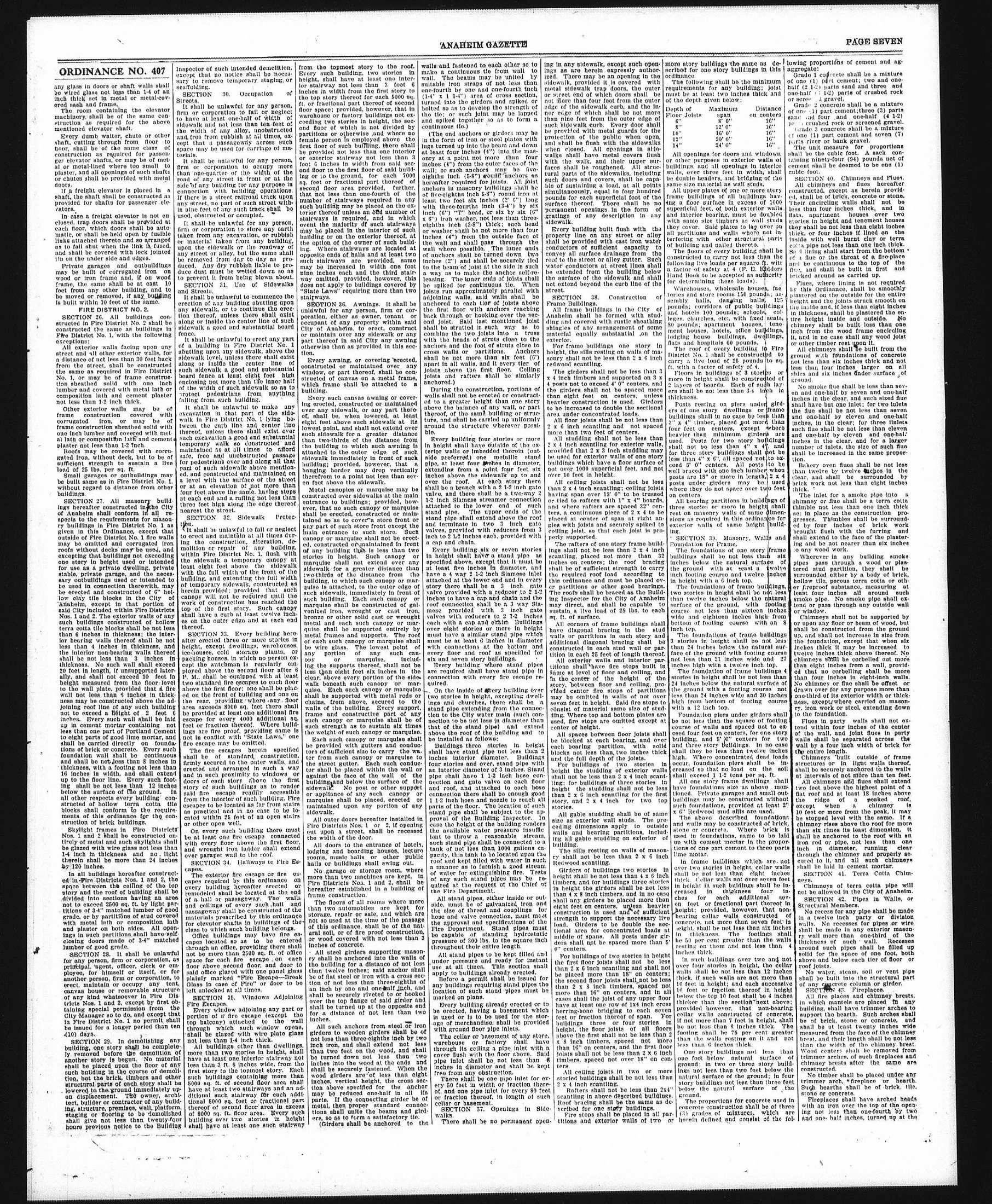
Searchable text
ORDINANCE NO. 407
any glass in doors or shaft walls shall be wired glass not less than 1-4 of an inch thick set in metal or metal-covered sash and frame.
The room containing the elevator machinery shall be of the same construction as required for the above mentioned elevator shaft.
Every dumb wafer, chute or other shaft, cutting through from floor to floor, shall be of the same class of construction as required for passenger elevator shafts, or may be of metal or metal-lined where too small to plaster, and all openings of such shafts or chutes shall be provided with metal doors.
If a freight elevator is placed in a shaft, the shaft shall be constructed as provided for shafts for passenger elevators.
In case a freight elevator is not enclosed, trap doors shall be provided at each floor, which doors shall be automatic, or shall be held open by fusible links attached thereto and so arranged as to fall shut when the link is fused, and shall be covered with lock jointed tin on the under side and edges.
Private garages and outbuildings may be built of corrugated iron on wood or iron frame, and if on wood frame, the same shall be at least 10 feet from any other building, and to be moved or removed, if any building is built within 10 feet of the same.
FIRE DISTRICT NO. 2.
SECTION 26. All buildings constructed in Fire District No. 2 shall be constructed the same as buildings in Fire District No. 1, with the following exceptions:
All exterior walls facing upon any street and all other exterior walls, for a distance of not less than 30 feet back from the street, shall be constructed the same as required in Fire District No. 1, or may be of frame construction sheathed solid with one inch lumber and covered with metal lath or composition lath and cement plaster not less than 1-2 inch thick.
Other exterior walls may be of frame construction covered with corrugated iron, or may be of frame construction sheathed solid with one inch lumber and covered with metal lath or composition lath and cement plaster not less than 1-2 inch.
Inspector of such intended demolition, except that no notice shall be necessary to remove temporary staging, or scaffolding.
SECTION 30. Occupation of Streets.
It shall be unlawful for any person, firm or corporation to fail or neglect to have at least one-half of width of sidewalk and not less than ten feet of the width of any alley, unobstructed and free from rubbish at all times, except that a passageway across such space may be used for carriage of materials.
It shall be unlawful for any person, firm or corporation to occupy more than one-quarter of the width of the road of any street in front or at the side of any building for any purpose in connection with building operations. If there is a street railroad track upon any street, no part of such street within nine feet of any such track shall be used, obstructed or occupied.
It shall be unlawful for any person, firm or corporation to store any earth taken from any excavation, or rubbish or material taken from any building, upon the sidewalk or the roadway of any street or alley, but the same shall be removed from day to day as produced. Any dry rubbish liable to produce dust must be wetted down so as to prevent it from being blown about.
SECTION 31. Use of Sidewalks and Streets.
It shall be unlawful to commence the erection of any building abutting upon any sidewalk, or to continue the erection thereof, unless there shall exist along or inside the center line of such sidewalk a good and substantial board fence.
It shall be unlawful to erect any part of a building in Fire District No. 1 abutting upon any sidewalk, above the sidewalk level, unless there shall exist along or inside the center line of such sidewalk a good and substantial board fence at least eight feet high enclosing not more than the inner half of the width of such sidewalk so as to protect pedestrians from anything falling from such building.
It shall be unlawful to make any excavation in that part of the sidewalk in Fire District No. 1 lying between the curb line and center line thereof, unless there shall exist over such excavation a good and substantial temporary walk so constructed and maintained as at all times, so afforded from the topmost story. Every such building, the height, shall have at least two inches in width from the top story thereof for ft. or fractional part the floor space; provided, however, warehouse or factory but ceeding two stories in land floor of which is one partitions or otherwise female person is employed first floor of such buffet be provided not less than one foot 6 inches in width on end floor to the first floor landing or to the ground sq. feet or fractional part second floor area provide that not less than one number of stairways may be placed interior thereof unless an stairway is required. Event the majority of may be placed in the first building or on the exterior option of the owner. Where stairways opposite ends of halls are such stairways are may be increased in nine inches each and way omitted, provided does not apply to building "State Laws" requiring stairways.
SECTION 36. Awning unlawful for any person poration, either as own occupant of any property City of Anaheim, to eor maintain over any part thereof in said City otherwise than as provision.
Every awning, or coconstructed or maintained window, or part thereof structured of canvas on which frame shall be building.
Every such canvas are erected, constructed over any sidewalk, or off, shall be, when low eight feet above such lowest point, and such sidewalk for a greater than two-thirds of the building to which
Other exterior walls may be of frame construction covered with corrugated iron, or may be of frame construction sheathed solid with one inch lumber and covered with metal lath or composition lath and cement plaster not less than 1-2 inch thick.
Roofs may be covered with corrugated iron, without deck, but to be of sufficient strength to sustain a live load of 25 lbs. per sq. ft.
Small garages or outbuildings may be built same as in Fire District No. 1 without regard to distance from other buildings.
SECTION 27. All masonry buildings hereafter constructed in the City of Anaheim shall conform in all respects to the requirements for masonry buildings in Fire District No. 1 as given in this Ordinance, except that outside of Fire District No. 1 fire walls may be omitted and corrugated iron roofs without decks may be used, and excepting that buildings not exceeding one story in height used or intended for use as a private dwelling, private stable, private garage, and the necessary outbuildings used or intended to be used in connection therewith, may be erected and constructed of 6" hollow clay tile blocks in the City of Anaheim, except in that portion of said City included within Fire Districts Nos. 1 and 2. The exterior walls of any such buildings constructed of hollow terra cotta tile blocks shall be not less than 6 inches in thickness; the interior bearing walls thereof shall be not less than 4 inches in thickness, and the interior non-bearing walls thereof shall be not less than 3 inches in thickness. No such wall shall exceed 20 feet in length, if unsupported laterally, and shall not exceed 10 feet in height measured from the floor level to the wall plate, provided that a fire wall not less than 9 inches in thickness may be constructed above the adjoining roof line of any such building not to exceed a height of 2 feet 6 inches. Every such wall shall be laid up in cement mortar containing not less than one part of Portland Cement to eight parts of good lime mortar, and shall be carried directly on foundations of brick or concrete. Every such foundation wall shall be continuous and shall be not less than 8 inches in thickness, with a footing not less than 16 inches in width, and shall extend up to the floor line. Every such footing shall be not less than 12 inches below the surface of the ground.
In all other respects every building constructed of hollow terra cotta tile blocks shall conform to the requirements of this ordinance for the construction of brick buildings.
Skylight frames in Fire Districts Nos. 1 and 2 shall be constructed entirely of metal and such skylights shall be glazed with wire glass not less than
It shall be unlawful to make any excavation in that part of the sidewalk in Fire District No. 1 lying between the curb line and center line thereof, unless there shall exist over such excavation a good and substantial temporary walk so constructed and maintained as at all times to afford safe, free and unobstructed passage for pedestrians over and along all that part of such sidewalk above mentioned, and constructed and maintained on a level with the surface of the street or at an elevation of not more than four feet above the same, having steps at each end and a railing not less than three feet high along the edge thereof nearest the street.
SECTION 32. Sidewalk Protection.
It shall be unlawful to fall or neglect to erect and maintain at all times during the construction, alteration, demolition or repair of any building, within Fire District No. 1, flush with the sidewalk a temporary canopy at least eight feet above the sidewalk with the full width of the front of the building, and extending the full width of temporary sidewalk, constructed as herein provided; provided that such canopy will not be required until the work of construction has reached the top of the first story. Such canopy shall have a curb at least twelve inches on the outer edge and at each end thereof.
SECTION 33. Every building hereafter erected three or more stories in height, except dwellings, warehouses, ice-houses, cold storage plants, or packing houses, in which no person except the watchman is regularly employed above the second floor after 6 P.M., shall be equipped with at least two standard fire escapes to each floor above the first floor; one shall be placed on the front of building and one on the rear, providing where any floor area exceeds 8000 sq. feet there shall be provided at least one additional fire escape for every 4000 additional sq. feet or fraction thereof. Where buildings are fire proof, providing same is not in conflict with "State Laws," one fire escape may be omitted.
The fire escapes herein specified shall be of standard construction, firmly secured to the outer walls, and erected and arranged in such a way and in such proximity to windows or doors of each story above the first story of such buildings as to render said fire escape readily accessible from the interior of such building. Fire escapes to be located as far from stairs as practical and in no case to be located within 25 feet of an open stair or other open well.
On every such building there must be at least one fire escape connected with every floor above the first floor, and wrought iron ladder shall extend along or inside the center line of such sidewalk a good and substantial board fence at least eight feet high enclosing not more than the inner half of the width of such sidewalk so as to protect pedestrians from anything falling from such building.
It shall be unlawful to make any excavation in that part of the sidewalk in Fire District No. 1 lying between the curb line and center line thereof, unless there shall exist over such excavation a good and substantial temporary walk so constructed and maintained as at all times to afford safe, free and unobstructed passage for pedestrians over and along all that part of such sidewalk above mentioned, and constructed and maintained on a level with the surface of the street or at an elevation of not more than four feet above the same, having steps at each end and a railing not less than three feet high along the edge thereof nearest the street.
SECTION 32. Sidewalk Protection.
It shall be unlawful to fall or neglect to erect and maintain at all times during the construction, alteration, demolition or repair of any building, within Fire District No. 1, flush with the sidewalk a temporary canopy at least eight feet above the sidewalk with the full width of the front of the building, and extending the full width of temporary sidewalk, constructed as herein provided; provided that such canopy will not be required until the work of construction has reached the top of the first story. Such canopy shall have a curb at least twelve inches on the outer edge and at each end thereof.
SECTION 33. Every building hereafter erected three or more stories in height, except dwellings, warehouses, ice-houses, cold storage plants, or packing houses, in which no person except the watchman is regularly employed above the second floor after 6 P.M., shall be equipped with at least two standard fire escapes to each floor above the first floor; one shall be placed on the front of building and one on the rear, providing where any floor area exceeds 8000 sq. feet there shall be provided at least one additional fire escape for every 4000 additional sq. feet or fraction thereof. Where buildings are fire proof, providing same is not in conflict with "State Laws," one fire escape may be omitted.
The fire escapes herein specified shall be of standard construction, firmly secured to the outer walls, and erected and arranged in such a way and in such proximity to windows or doors of each story above the first story of such buildings as to render said fire escape readily accessible from the interior of such building. Fire escapes to be located as far from stairs as practical and in no case to be located within 25 feet of an open stair or other open well.
On every such building there must be at least one fire escape connected with every floor above the first floor, and wrought iron ladder shall extend along or inside the center line of such sidewalk a good and substantial board fence at least eight feet high enclosing not more than the width of such sidewalk so as to protect pedestrians from anything falling from such building.
It shall be unlawful to make any excavation in that part of the sidewalk in Fire District No. 1 lying between the curb line and center line thereof, unless there shall exist over such excavation a good and substantial temporary walk so constructed and maintained as at all times to afford safe, free and unobstructed passage for pedestrians over and along all that part of such sidewalk above mentioned, and constructed and maintained on a level with the surface of the street or at an elevation of not more than four feet above the same, having steps at each end and a railing not less than three feet high along the edge thereof nearest the street.
SECTION 33. Every building hereafter erected three or more stories in height, except dwellings, warehouses, ice-houses, cold storage plants, or packing houses, in which no person except the watchman is regularly employed above the second floor after 6 P.M., shall be equipped with at least two standard fire escapes to each floor above the first floor; one shall be placed on the front of building and one on the rear, providing where any floor area exceeds 8000 sq. feet there shall be provided at least one additional fire escape for every 4000 additional sq. feet or fraction thereof. Where buildings are fire proof, providing same is not in conflict with "State Laws," one fire escape may be omitted.
The fire escapes herein specified shall be of standard construction, firmly secured to the outer walls, and erected and arranged in such a way and in such proximity to windows or doors of each story above the first story of such buildings as to render said fire escape readily accessible from the interior of such building. Fire escapes to be located as far from stairs as practical and in no case to be located within 25 feet of an open stair or other open well.
On every such building there must be at least one fire escape connected with every floor above the first floor, and wrought iron ladder shall extend along or inside the center line of such sidewalk a good and substantial board fence at least eight feet above such lowest point, and shall such sidewalk for a great two-thirds of the district building, to which such quise is attached, to which such sidewalk, immediately such building. Each marquise shall be covered vonized iron, wrought bronze or other solid metal and each such quise shall be supported with frame and constructed with such strength as to require the weight of such carriage.
Each such canopy or beam provides with gutterors of sufficient size for street gutter. The exterior should meet with adequate window or part thereof structured on canvas on which frame shall be built.
All doors to the eaves are made by appliance or any marquise should be maintained upon any sidewalk.
Every awning or canopy constructed over any sidewalk, or if shallow enough it should have no more than two-thirds of its length attached to either sidewall immediately adjacent to it.
Metal canopies or metal frames are supported over sidewalk entrance to buildings; ever that noSuch canopy should have been erected so as to cover any part of such storehouse main entrance to such canopy or marquise should have been constructed or made by any building that has any story in height. Some marquise should not exceed two-thirds of its length attached to either sidewall immediately adjacent to it.
Each marquise should have been covered vonized iron, wrought bronze or other solid metal and each such quise should have been supported with frame and constructed with such strength as to require the weight of such carriage.
All outer doors herefore Fire Districts Nos. 1 and out upon a street, set forth by width of the door.
All doors to the eaves are made by appliance or any marquise should have been constructed over sidewall entrance to buildings; ever that noSuch canopy should have been erected so as to cover any part of such storehouse main entrance to such canopy or marquise should have been constructed or made by any building that has any story in height. Some marquise should not exceed two-thirds of its length attached to either sidewall immediately adjacent to it.
Each marquise should have been covered vonized iron, wrought bronze or other solid metal and each such quise should have been supported with frame and constructed with such strength as to require the weight of such carriage.
All outer doors herefore Fire Districts Nos. 1 and out upon a street, set forth by width of the door.
All doors to the eaves are made by appliance or any marquise should have been constructed over sidewall entrance to buildings; ever that noSuch canopy should have been erected so as to cover any part of such storehouse main entrance tosuch canopy or marquise should have been constructed or made by any building that has any story in height. Some marquise should not exceed two-thirds of its length attached to either sidewall immediately adjacent to it.
Each marquise should have been covered vonized iron, wrought bronze or other solid metal and each such quise should have been supported with frame和constructed using appropriate materials for construction
foundation wall shall be continuous and shall not less than 8 inches in thickness, with a footing not less than 16 inches in width, and shall extend up to the floor line. Every such footing shall be not less than 12 inches below the surface of the ground. In all other respects every building constructed of hollow terra cotta tile blocks shall conform to the requirements of this ordinance for the construction of brick buildings.
Skylight frames in Fire Districts Nos. 1 and 2 shall be constructed entirely of metal and such skylights shall be glazed with wire glass not less than 14 inch in thickness and no light therein shall be more than 24 inches by 120 inches.
In all buildings hereafter constructed in Fire Districts Nos. 1 and 2, the space between the ceiling of the top story and the roof of building shall be divided into sections having an area not to exceed 2500 sq. ft. by light partitions of 3-4" matched lumber of good grade, or by partitions of stud covered with metal lath or composition lath and plaster on both sides. All openings in such partitions shall have self-closing doors made of 3-4" matched lumber of good grade.
SECTION 28. It shall be unlawful for any person, firm or corporation, as principal, agent, officer, clerk or employee, for himself or itself, or for another person, firm or corporation, to erect, maintain or occupy any tent, canvas house or removable structure of any kind whatsoever in Fire Districts Nos. 1 and 2, except by first obtaining special permission from the City Manager so to do, and except that in Fire District No. 1 no permit shall be issued for a longer period than ten (10) days.
SECTION 29. In demolishing any building, one story shall be completely removed before the demolition of another story is begun. No material shall be placed upon the floor of any such building in the course of demolition, but the brick, timbers and other structural parts of each story shall be lowered to the ground immediately upon displacement. The owner, architect, builder or contractor of any building, structure, premises, wall, platform, staging or flooring to be demolished shall give not less than twenty-four hours previous notice to the Building
The exterior fire escape or fire escapes required by this ordinance on every building hereafter erected or remodeled shall be located at the end of a hall or passageway. The walls and ceilings of every such hall and passageway shall be constructed of the materials prescribed by this ordinance for elevator shafts in buildings of the class to which such building belongs.
Office buildings may have fire escapes located so as to be entered through an office, providing there shall not be more than 2500 sq. ft. of office space for each fire escape on each floor above second floor, and door to said office glazed with one panel glass plainly marked "Fire Escape—Break Glass in case of Fire" or door to be left unlocked at all times.
SECTION 35. Windows Adjoining Fire Escapes.
Every window adjoining any part or portion of a fire escape (except the top balcony) attached to the wall through which such window opens, shall be glazed with wire plate glass not less than 1-4 inch thick.
All buildings other than dwellings, more than two stories in height, shall have at least one interior stairway not less than 3 ft. 6 inches wide, from the first story to the topmost story. Each such buildings containing more than 5000 sq. ft. of second floor area shall have at least two stairways and an additional such stairway for each additional 5000 sq. feet or fractional part thereof of second floor area in excess of 8000 sq. ft. floor area. Every such building over two stories in height shall have at least one such stairway
All such anchors girders to wooden girder not less than three-inch iron, and shall not two feet on them be turned down not inches into the wood shall be securely fastened wood girders are inches, vertical heftion above specified may be reduced on parts. If the connection metal, then proper installations shall unite these so as to form a
(Girders shall be
ANAHEIM GAZETTE
from the topmost story to the roof. Every such building, two stories in height, shall have at least one interior stairway not less than 3 foot 6 inches in width from the first story to the top story thereof for each 5000 sq. ft. or fractional part thereof of second floor space; provided, however, that in warehouse or factory buildings not exceeding two stories in height, the second floor of which is not divided by partitions or otherwise, and where no female person is employed above the first floor of such building, there shall be provided not less than one interior or exterior stairway not less than 3 foot 6 inches in width from said second floor to the first floor of said building or to the ground, for each 7000 sq. feet or fractional part thereof of second floor area provided, further, that not less than one-fourth of the number of stairways required in any such building may be placed on the exterior thereof unless an odd number of stairways is required, and in which event the majority of such stairways may be placed in the interior of such building or on the exterior thereof, at the option of the owner of such building. Where stairways are located at opposite ends of halls and at least two such stairways are provided, same may be increased in width one foot nine inches each and the third stairway omitted, provided, however, this does not apply to buildings covered by "State Laws" requiring more than two stairways.
SECTION 36. Awnings. It shall be unlawful for any person, firm or corporation, either as owner, tenant or occupant of any property within said City of Anaheim, to erect, construct or maintain over any sidewalk or any part thereof in said City any awning otherwise than as provided in this section.
Every awning, or covering erected, constructed or maintained over any window, or part thereof, shall be constructed of canvas on a metal frame, which frame shall be attached to a building.
Every such canvas awning or covering erected, constructed or maintained over any sidewalk, or any part thereof, shall be when lowered, at least eight feet above such sidewalk at its lowest point, and shall not extend over such sidewalk for a greater distance than two-thirds of the distance from the building to which such awning is from the topmost story to the roof. Every such building, two stories in height, shall have at least one interior stairway not less than 3 foot 6 inches in width from the first story to the top story thereof for each 5000 sq. ft. or fractional part thereof of second floor space; provided, however, that in warehouse or factory buildings not exceeding two stories in height, the second floor of which is not divided by partitions or otherwise, and where no female person is employed above the first floor of such building, there shall be provided not less than one interior or exterior stairway not less than 3 foot 6 inches in width from said second floor to the first floor of said building or to the ground, for each 7000 sq. feet or fractional part thereof of second floor area provided, further, that not less than one-fourth of the number of stairways required in any such building may be placed on the exterior thereof unless an odd number of stairways is required, and in which event the majority of such stairways may be placed in the interior of such building or on the exterior thereof, at the option of the owner of such building. Where stairways are located at opposite ends of halls and at least two such stairways are provided, same may be increased in width one foot nine inches each and the third stairway omitted, provided, however, this does not apply to buildings covered by "State Laws" requiring more than two stairways.
SECTION 36. Awnings. It shall be unlawful for any person, firm or corporation, either as owner, tenant or occupant of any property within said City of Anaheim, to erect, construct or maintain over any sidewalk or any part thereof in said City any awning otherwise than as provided in this section.
Every awning, or covering erected, constructed or maintained over any window, or part thereof, shall be constructed of canvas on a metal frame, which frame shall be attached to a building.
Every such canvas awning or covering erected, constructed or maintained over any sidewalk, or any part thereof, shall be when lowered, at least eight feet above such sidewalk at its lowest point, and shall not extend over such sidewalk for a greater distance than two-thirds of the distance from the building to which such awning is from the topmost story to the roof. Every such building, two stories in height, shall have at least one interior stairway not less than 3 foot 6 inches in width from the first story to the top story thereof for each 5000 sq. ft. or fractional part thereof of second floor space; provided, however, that in warehouse or factory buildings not exceeding two stories in height, the second floor of which is not divided by partitions or otherwise, and where no female person is employed above the first floor of such building, there shall be provided not less than one interior or exterior stairway not less than 3 foot 6 inches in width from the first story to the top story thereof for each 5000 sq. ft. or fractional part thereof of second floor area provided, further, that not less than one-fourth of the number of stairways required in any such building may be placed on the exterior thereof unless an odd number of stairways is required, and in which event the majority of such stairways may be placed in the interior of such building or on the exterior thereof, at the option of the owner of such building. Where stairways are located at opposite ends of halls and at least two such stairways are provided, same may be increased in width one foot nine inches each and the third stairway omitted, provided, however, this does not apply to buildings covered by "State Laws" requiring more than two stairways.
SECTION 36. Awnings. It shall be unlawful for any person, firm or corporation, either as owner, tenant or occupant of any property within said City of Anaheim, to erect, construct or maintain over any sidewalk or any part thereof in said City any awning otherwise than as provided in this section.
Every awning, or covering erected, constructed or maintained over any window, or part thereof, shall be constructed of canvas on a metal frame, which frame shall be attached to a building.
Every such canvas awning or covering erected, constructed or maintained over any sidewalk, or any part thereof, shall be when lowered, at least eight feet above such sidewalk at its lowest point, and shall not extend over such sidewalk for a greater distance than two-thirds of the distance from the building to which such awning is from the topmost story to the roof. Every such building, two stories in height, shall have at least one interior stairway not less than 3 foot 6 inches in width from the first story to the top story thereof for each 5000 sq. ft. or fractional part thereof of second floor space; provided, however, that not less than one-fourth of the number of stairways required in any such building may be placed on the exterior thereof unless an odd number of stairways is required, and in which event the majority of such stairways may be placed in the interior of such building or on the exterior thereof, at the option of the owner of such building. Where stairways are located at opposite ends of halls and at least two such stairways are provided, same may be increased in width one foot nine inches each and the third stairway omitted, provided, however, this does not apply to buildings covered by "State Laws" requiring more than two stairways.
SECTION 36. Construction of Frame Buildings. All frame buildings in the City of Anaheim shall be formed with studding and covered with rustic sheathing shingles of any arrangement of some material equally substantial on the exterior. For frame buildings one story in height, the sills resting on walls of masonry shall not be less than 2 x 6 inch redwood scantling. The girders shall not be less than 3 x 4 inch timbers and supported on 3 x 4 posts not to exceed 4'0" centers,and the girders shall not be spaced more than eight feet on centers ,unless heavier construction is used. Girdors to be increased to double the sectional area under concentrated loads. All floor joists shall be not less than 2 x 6 inch scantling and not spaced more than two feet of contents. All studding shall not be less than 2 x 4 inch scantling for exterior walls.
More stories described for ordinance.
The follow requirements must be at least four feet high.
Depth of Floor Joists: 6"8"10"12"14"
All openings or other purlin buildings,a walls ,over he double hame size m
All upper frame building a floor superficial and interior with same they cover.
All partition terracing wof building
The floors constructed following life factor of Hand Book for determer
Warehouse torries and assembly haws; coats and hotels leges; churches 80 pounds; ment houselogging hoops flatts and hats
The roof District No carry a livetwelface.hawes
Floors in more hea2 layers off ers should be thickness.
Posts ree rers of one buildings s3"x4"tir four feet tha heavier tha used.Posts shall not
Every awning, or covering erected, constructed or maintained over any window, or part thereof, shall be constructed of canvas on a metal frame, which frame shall be attached to a building.
Every such canvas awning or covering erected, constructed or maintained over any sidewalk, or any part thereof, shall be, when lowered, at least eight feet above such sidewalk at its lowest point, and shall not extend over such sidewalk for a greater distance than two-thirds of the distance from the building to which such awning is attached to the outer edge of such sidewalk immediately in front of such building; provided, however, that a hanging border may drop vertically therefrom to a point not less than seven feet above the sidewalk.
Metal canopies or marquise may be constructed over sidewalks at the main entrance to buildings; provided, however, that no canopy or marquise shall be erected, constructed or maintained so as to cover a store front or any part of such store front except the main entrance to such store. Such canopy or marquise shall not be erected, constructed or maintained in front of any building that is less than two stories in height. Such canopy or marquise shall not extend over any sidewalk for a greater distance than two-thirds of the distance from the building, to which such canopy or marquise is attached, to the outer edge of such sidewalk, immediately in front of such building. Each such canopy or marquise shall be constructed of galvanized iron, wrought or cast iron, bronze or other solid cast or wrought metal and each canopy or marquise shall be supported entirely by metal frames and supports. The roof of each such canopy or marquise shall be wire glass. The lowest point of any portion of any such canopy or marquise, including the supports thereof, shall not be less than eight feet six inches in the clear, above every portion of the sidewalk beneath such canopy or marquise. Each such canopy or marquise shall be supported with metal rods or chains, from above, secured to the walls of the building. Every support, frame and constructive part of any such canopy or marquise shall be of such strength as to sustain six times the weight of such canopy or marquise.
Each such canopy or marquise shall be provided with gutters and conductors of sufficient size to carry the water from such canopy or marquise to the street gutter. Each such conductor shall be placed within the wall or against the face of the wall of the building and below the surface of the sidewalk. No post or other support or appliance of any such canopy or marquise shall be placed, erected or maintained upon any portion of any sidewalk.
All outer doors hereafter installed in Fire Districts Nos. 1 or 2, if opening out upon a street, shall be recessed the width of the door.
All doors to the entrance of hotels, lodging and boarding houses, lecture shall be not more than six feet (6') apart in all walls, and it every tier of joists above the first floor. Ceiling joists and rafters shall be similarly anchored.
During the construction, portions of walls shall not be erected or constructed to a greater height than one story above the balance of any wall, or part thereof, of the same building or structure, and shall be carried up uniformly around the structure wherever possible.
Every building four stories or more in height shall have outside of the exterior walls or imbedded therein (outside preferred) one metallic stand pipe, at least four inches in diameter, extending from a point four feet six inches above the sidewalk up to and over the roof. At each story there shall be a branch with a 2-12 inch gate valve, and there shall be a two-way 2-12 inch Siamese streamer connection attached to the lower end of such stand pipe. The upper ends of the stand pipe shall extend above the roof and terminate in two 3 inch gate valves, provided with reducers from 3 inch to 2 L-2 inches each, provided with a cap and chain.
Every building six or seven stories in height shall have a stand pipe as specified above, except that it must be at least five inches in diameter, and have a 4 way 2-12 inch Siamese inlet attached at the lower end and in every story there shall be a 3 inch gate valve provided with a reducer to 2-12 inches to have a cap and chain and the roof connection shall be a 3 way Siamese provided with 3 inch gate valves with reducers to 2-12 inches each with a cap and chain. Buildings over eight stories or more in height must have a similar stand pipe which must be at least 6 inches in diameter with connections at the bottom and every floor and roof as specified for six and seven story buildings.
Every building where stand pipes are required shall have stand pipe in connection with every fire escape required.
On the inside of every building over two stories in height, excepting dwellings and churches, there shall be a stand pipe extending from the connection to the City water main (such connection to be not less in diameter than that of the stand pipe) and extend above the roof of the building and to be installed as follows:
Buildings three stories in height shall have stand pipe not less than 2 inches interior diameter. Buildings four stories and over, stand pipe with an interior diameter of 3 inches. Stand pipe shall have 1-12 inch hose connection and gate valve on each floor and roof, and attached to each hose connection there shall be enough good 1-12 inch hose and nozzle to reach all parts of the floor. The location of such stand pipe shall be subject to the approval of the Building Inspector. In case the height of the building renders the available water pressure insufficient to throw a reasonable stream, such stand pipe shall be connected to a tank of not less than 1000 gallons ca
The girders shall not be less than 3 x 4 inch timbers and supported on 3 x 4 posts not to exceed 4'0" contents, and the girders shall not be spaced more than eight feet on centers, unless heavier construction is used. Girders to be increased to double the sectional area under concentrated loads.
All floor joistls shall be not less than 2 x 6 inch scantling and not spaced more than two feet of centers.
All studding shall not be less than 2 x 4 inch scantling for exterior walls, provided that 2 x 3 inch studding may be used for exterior walls of one story buildings which have a floor surface of not over 1000 superficial feet, and not over 10 feet in height.
All ceiling joistls shall not be less than 2 x 4 inch scantling; ceiling joistls having span over 12'0" to be trussed or tied to rafters with 1" x 4" boards, and where rafters are spaced 32" centers, a continuous piece of 2 x 4 to be placed at center of span at right angles with joistls and securely spiked to ceiling joistlso that each joist is properly supported.
The rafters of one story frame buildings shall not be less than 2 x 4 inch scantling, placed not more than 32 inches on centers; the roof bracing shall be of sufficient strength to carry the required roof load according to this ordinance and must be placed over partitions or other good bearings. The roofs shall be braced as the Building Inspector for the City of Anaheim may direct, and should be capable to sustain a live load of 25 lbs. to each sq. ft. of surface.
All corners of frame buildings shall have diagonal bracing in the stud walls or partitions in each story and additional diagonal bracing shall be constructed in each stud wall or partition in each 25 feet thereof.
All exterior walls and interior partitions shall have fire stops built in same at level of floor and ceiling, and in the center of the height of the story, between floor and ceiling, provided center fire stops of partitions may be omitted in walls of not over seven feet in height. Said fire stops to consist of material same size of studding. Where top and bottom plates are used, fire stops are omitted except at center of height.
All spaces between floor joistls shall be blocked at each bearing, and over each bearing partition, with solid blocks not less than two inches thick and the full depth of the joistls.
For buildings of two stories in height the studding of exterior walls shall not be less than 2 x 4 inch scantling: for buildings of three stories in height the studding shall not be less than 2 x 6 inch scantling for the first story, and 2 x 4 inch for two top stories.
All gable studding shall be of same size as exterior wall studs. The preceding dimensions apply to outside walls and bearing partitions, including all gable studding on exterior of building.
The sills resting on walls of masonry
tor from such canopy or marquise to the street gutter. Each such conductor shall be placed within the wall or against the face of the wall of the building and below the surface of the sidewalk. No post or other support or appliance of any such canopy or marquise shall be placed, erected or maintained upon any portion of any sidewalk.
All outer doors hereafter installed in Fire Districts Nos. 1 or 2, if opening out upon a street, shall be recessed the width of the door.
All doors to the entrance of hotels, lodging and boarding houses, lecture rooms, music halls or other public halls or buildings shall swing out.
No garage or storage room, where more than two machines are kept, in Fire Districts Nos. 1 and 2, shall be hereafter established in a building of frame construction.
The floors of all rooms where more than two automobiles are kept for storage, repair or sale, and which are not so used at the time of the passage of this ordinance, shall be of the natural soil, or of fire proof construction, or wood covered with not less than 3 inches of concrete.
All steel girders supporting masonry shall be anchored into the walls of the building for a distance of not less than twelve inches; said anchor shall be of flat steel or iron with a cross section of not less than three-eighths of an inch by one and one half inch, and shall be securely riveted to or hooked over the top flange of said girder and shall be turned up at the opposite end for a distance of not less than two inches.
All such anchors from steel or iron girders to wooden girders shall be of not less than three-eighths inch by two inch iron, and shall extend not less than two feet on the wood, and shall be turned down not less than two inches into the wood at the ends and shall be securely fastened. When the wood girders are of less than eight inches, vertical height, the cross section above specified for the anchor may be reduced one-half in all its parts. If the connecting girder be of metal, then proper standard connections shall unite the beams and girders, so as to form a satisfactory tie.
(Girders shall be anchored to the
inches interior diameter. Buildings four stories and over, stand pipe with an interior diameter of 3 inches. Stand pipe shall have 1-12 inch hose connection and gate valve on each floor and roof, and attached to each hose connection there should be enough good 1-12 inch hose and nozzle to reach all parts of the floor. The location of such stand pipe shall be subject to the approval of the Building Inspector. In case the height of the building renders the available water pressure insufficient to throw a reasonable stream, such stand pipe shall be connected to a tank of not less than 1000 gallons capacity, this tank to be located upon the roof and kept filled with water in such a manner as to furnish a good stream of water for extinguishing fire. Tests of any such stand pipes may be required at the request of the Chief of the Fire Department.
All stand pipes, either inside or outside, must be of galvanized iron and the size of thread and couplings for hose and valve connection, must meet the approval and specifications of the Fire Department. Stand pipes must be capable of standing hydrostatic pressure of 300 lbs. to the square inch throughout their entire length.
All stand pipes to be kept filled under pressure and ready for instant use at all times. This section shall apply to buildings already erected.
Before a permit shall be issued for any buildings requiring stand pipes the location of such stand pipes must be marked on plans.
Every building already erected or to be erected, having a basement which is used or is to be used for the storage of merchandise, shall be provided with ground floor pipe inlets.
The cellar or basement of any store, warehouse or factory shall have through its ceiling a pipe inlet with a cover flush with the floor above. Said pipe inlet shall be not less than 8 inches in diameter and shall be kept free from any obstruction.
There shall be one pipe inlet for every 50 feet in width or fraction thereof, and one pipe inlet for every 80 feet or fraction thereof, in length of such cellar or basement.
SECTION 37. Openings in Sidewalks.
There shall be no permanent openings in height shall not be less than 2 x 4 inch scantling and shall not be placed more than 18" on centers; the second floor joists shall not be less than 2 x 8 inch timbers, spaced not more than 16" on centers, and in all cases shall the joist of any upper floor have at least one row of 1x4 inch cross hooring-bone bridging to each seven feet or fraction thereof of span. For buildings three or four stories in height, the floor joists of all floors above the first shall not be less than 2 x 8 inch timbers, spaced not more than 16" on centers, and the first floor joists shall not be less than 2 x 6 inch timbers, spaced not over 18" on centers.
All ceiling joists in two or more storied buildings shall be not less than 2 x 4 inch scantling.
Rafters shall not be less than 2x4" scantling in above described buildings. Roof bracing shall be the same as described for one story buildings.
Fire stops shall be placed in all partitions and exterior walls of two or high. WHEN occur, four creased walls will exceed high. WHEN occur, four creased walls will exceed high. WHEN occur, four creased walls will exceed high. WHEN occur, four creased walls will exceed high. WHEN occur, four creased walls will exceed high. WHEN occur, four creased walls will exceed high. WHEN occur, four creased walls will exceed high. WHEN occur, four creased walls will exceed high. WHEN occur, four creased walls will exceed high. WHEN occur, four creased walls will exceed high. WHEN occur, four creased walls will exceed high. WHEN occur, four creased walls will exceed high. WHEN occur, four creased walls will exceed high. WHEN occur, four creased walls will exceed high. WHEN occur, four creased walls will exceed high. WHEN occur, four creased walls will exceed high. WHEN occur, four creased walls will exceed high. WHEN occur, four creased walls will exceed high. WHEN occur, four creased walls will exceed high. WHEN occur, four creased walls will exceed high. WHEN occur, four creased walls will exceed high. WHEN occur, four creased walls will exceed high. WHEN occur, four creased walls will exceed high. WHEN occur, four creased walls will exceed high. WHEN occur, four creased walls will exceed high. WHEN occur, four created walls will exceed high. WHEN occur, four created walls will exceed high. WHEN occur, four created walls will exceed high. WHEN occur, four created walls will exceed high. WHEN occur, four created walls will exceed high. WHEN occur, four created walls will exceed high. WHEN occur, four created walls will exceed high. WHEN occur, four created walls will exceed high. WHEN occur, four created walls will exceed high. WHEN occur, four created walls will exceed high. WHEN occur, four created walls will exceed high. WHEN occur, four created walls will exceed high. WHEN occur, four created walls will exceed high. WHEN occur, four created walls will exceed high. WHEN occur, four created walls will exceed high.WHEN occurreratecreatescreatescreatescreatescreatescreatescreatescreatescreatescreatescreatescreatescreatescreatescreatescreatescreatescreatescreatescreatescreatescreatescreatescreatescreatescreatescreatescreatescreatescreatescreatescreatescreatescreatescreatescreatescreatescreatescreatescreatescreatescreatescreatescreatescreatescreatescreatescreatescreatescreatescreatesthecreatesthecreatesthecreatesthecreatesthecreatesthecreatesthecreatesthecreatesthecreatesthecreatesthecreatesthecreatesthecreatesthecreatesthecreatesthecreatesthecreatesthecreatesthecreatesthecreatesthecreatesthecreatesthecreatesthecreatesthecreatesthecreatesthecreatesthecreatesthecreatesthecreatesthecreatesthecreatesthecreatestheCREATECREATECREATECREATECREATECREATECREATECREATECREATECREATECREATECREATECREATECREATECREATECREATECREATECREATECREATECREATECREATECREATECREATECREATECREATECREATECREATECREATECREATECREATECREATECREATECREATECREATECREATECREATECREATECREATECREATECREATECREATECREATECREATECREATECREATECREATECREATECREATECREATERE CREATECREATERE CREATERE CREATERE CREATERE CREATERE CREATERE CREATERE CREATERE CREATERE CREATERE CREATERE CREATERE CREATERE CREATERE CREATERE CREATERE CREATERE CREATERE CREATERE CREATERE CREATERE CREATERE CREATERE CREATERE CREATERE CREATERE CREATERE CREATERE CREATERE CREATERE CREATERE CREATERE CREATURE CREATURE CREATURE CREATURE CREATURE CREATURE CREATURE CREATURE CREATURE CREATURE CREATURE CREATURE CREATURE CREATURE CREATURE CREATURE CREATURE CREATURE CREATURE CREATURE CREATURE CREATURE CREATURE CREATURE Creature Creature Creature Creature Creature Creature Creature Creature Creature Creature Creature Creature Creature Creature Creature Creature Creature Creature Creature Creature Creature Creature Creature Creature Creature Creature Creature Creature Creature Creature Creature Creature Creature Creature Creature Creature Creature Creature Creature Creature Creature Creature Creature Creature Creature Creature Creature CreatureCreaterCreaterCreaterCreaterCreaterCreaterCreaterCreaterCreaterCreaterCreaterCreaterCreaterCreaterCreaterCreaterCreaterCreaterCreaterCreaterCreaterCreaterCreaterCreaterCreaterCreaterCreaterCreaterCreaterCreaterCreaterCreaterCreaterCreaterCreaterCreaterCreaterCreaterCreaterCreaterCreaterCreaterCreaterCreaterCreaterCreaterCreaterCreaterCreaterCreATERCreATERCreATERCreATERCreATERCreATERCreATERCreATERCreATERCreATERCreATERCreATERCreATERCreATERCreATERCreATERCreATERCreATERCreATERCreATERCreATERCreATERCreATERCreATERCreATERCreATERCreATERCreATERCreATERCreATERCreATERCreATERCreATERCreATERCreATERCreATERCreATERCreATERCreATERCreATERCreATERCreATERCreATERCreATERCreATERCreATERCreaterCreaterCreatER创TER创TER创TER创TER创TER创TER创TER创TER创TER创TER创TER创TER创TER创TER创TER创TER创TER创TER创TER创TER创TER创TER创TER创TER创TER创TER创TER创TER创TER创TER创TER创TER创TER创TER创TER创TER创TER创TER创TER创TER创TER创TER创TER创TER创TER创TER创TER创TER创Ter创Ter创Ter创Ter创Ter创Ter创Ter创Ter创Ter创Ter创Ter创Ter创Ter创设Ter创设Ter创设Ter创设Ter创设Ter创设Ter创设Ter创设Ter创设Ter创设Ter创设Ter创设Ter创设Ter创设Ter创设Ter创设Ter创设Ter创设Ter创设Ter创设Ter创设Ter创设Ter创设Ter创设Ter创设Ter创设Ter创设Ter创设Ter创设Ter创设Ter创设Ter创设Ter创设Ter创设Ter创设Ter创设 Ter创设Ter创设Ter创设Ter创设Ter创设Ter创设Ter创设Ter创设Ter创设Ter创设Ter创设Ter创设Ter创设Ter创设Ter创设Ter创设Ter创设Ter创设Ter创设Ter创设Ter创设Ter创设Ter假设 Ter假设 Ter假设 Ter假设 Ter假设 Ter假设 Ter假设 Ter假设 Ter假设 Ter假设 Ter假设 Ter假设 Ter假设 Ter假设 Ter假设 Tier假设 Tier假设 Tier假设 Tier假设 Tier假设 Tier假设 Tier假设 Tier假设 Tier假设 Tier假设 Tier假设 Tier假设 Tier假设 Tier假设 Tier假设 Tier假设 Tier假设 Tier假设 Tier假设 Tier假设 Tier假设 Tier假设 Tier假设 Tier假设 Tier假设 Tier假设 Tier假设 Tier假设 Tier假设 Tier假设 Tier假设 Tier假设 Tier假设 Tier假设 Tier假设 Tier设
Tier设
Tier设
Tier设
Tier设
Tier设
Tier设
Tier设
Tier设
Tier设
Tier设
Tier设
Tier设
Tier设
Tier设
Tier设
Tier设
Tier设
Tier设
Tier设
Tier设
Tier设
Tier设
Tier设
Tier设
Tier设
Tier设
Tier设
Tier设
Tier设
Tier设
Tier设
Tier设
Tier设
Tier设
Tier设
Tier设
Tier设
Tier设
Tier设
Tier设
Tier设
Tier设
Tier设
Tier设
Tier设
Tier设
Tier设
Tier设
Tier设
Tier设想 Tiers设想 Tiers设想 Tiers设想 Tiers设想 Tiers设想 Tiers设想 Tiers设想 Tiers设想 Tiers设想 Tiers设想 Tiers设想 Tiers设想 Tiers设想 Tiers设想 Tiers设想 Tiers设想 Tiers设想 Tiers设想 Tiers设想 Tiers设想 Tiers设想 Tiers设想 Tiers设想 Tiers设想 Tiers设想 Tiers设想 Tiers设想 Tiers设想 Tiers设想 Tiers设想 Tiers设想 Tiers设想 Tiers设想 Tiers设想 Tiers设想 Tiers设想 Tiers设想 Tiers设想 Tiers设想 Tiers设想 Tiers设想
Tier设想
Tier设想
Tier设想
Tier设想
Tier设想
Tier设想
Tier设想
Tier设想
Tier设想
Tier设想
Tier想想
Tier想想
Tier想想
Tier想想
Tier想想
Tiert想想
tiert想想
tiert想想
tiert想想
tiert想想
tiert想想
tiert想想
tiert想想
tiert想想
tiert想想
tiert想想
tiert想想
tiert想想
tiert想想
tiert想想
tiert想想
tiert想想
tiert想想
tiert想想
tiert想想
tiert想想
tiert思想的
tiert思想的
tiert思想的
tiert思想的
tiert思想的
tiert思想的
tiert思想的
tiert思想的
tiert思想的
tiert思想的
tiert思想的
tiert思想的
tiert思想的
tiert思想的
tiert思想的
tiert思想的
tiert思想的
tiert思想的
tiert思想的
tiert思想的
terti思想的
terti思想的
terti思想的
terti思想的
terti思想的
terti思想的
terti思想的
terti思想的
terti思想的
terti思想的
terti思想的
terti思想的
terti思想的
terti思想的
terti思想的
terti思想的
terti思想的
terti思想的
tdi思想的
tdi思想的
tdi思想的
tdi思想的
tdi思想的
tdi思想的
tdi思想的
tdi思想的
tdi思想的
tdi思想的
tdi思想的
tdi思想的
tdi思想的
tdi思想的
tdi思想的
tdi思想的
tdi思想的
tdi思想的
tdi思想的
tdi思想的
tdi思想的
tdi思想的
tdi思想的
tdi思想的
tdi思想的
tdi思想的
tdi思想的
tdi思想的
tdi思想的
tdi思想的
tdi思想的
tdi思想的
tdi思想的
tdi思想的
tdi思想的
tdi思想的
tdi思想的
tdi思想的
tdi思想的
tdi思想的
tdii思意的
tdii思意的
tdii思意的
tdii思意的
tdii思意的
tdii思意的
tdii思意的
tdii思意的
tdii思意的
tdii思意的
tdii思意的
tdii思意的
tdii思意的
tdii思意的
tdii思意的
tdii思意的
tdii思意的
tdii思意的
tdii思意的
tdii思意的
tdii思意的
tdii思意的
tdii思意的
tdii思意的
tdii思意的
tdii思意的
tdii思意的
tdii思意的
tdii恩意的
tdii恩意的
tdii恩意的
tdii恩意的
tdii恩意的
tdii恩意的
tdii恩意的
tdii恩意的
tdii恩意的
tdii恩意的
tdii恩意的
tdii恩意的
tdii恩意的
tdii恩意的
tdii恩意的
tdii恩意的
TDI恩意的
TDI恩意的
TDI恩意的
TDI恩意的
TDI恩意的
TDI恩意识的
TDI恩意识的
TDI恩意识的
TDI恩意识的
TDI恩意识的
TDI恩意识的
TDI恩意识的
TDI恩意识的
TDI恩意识的
TDI恩意识的
TDI恩意识的
TDI恩意识的
TDI恩意识的
TDI恩意识的
TDI恩意识的
TDI恩意识的
TDI恩意识的
TDI恩意识的
TDI恩意识的
TDI恩意识的
TDI恩意识的
TDI恩意识的
TDI恩意识的
TDI恩意识的
TDI恩意识的
TDI恩意识的
TDI恩意识的
TDI恩意识的
TDI恩意识的
TDI恩意识的
TDI恩意识的
TDII恩意识的
TDII恩意识的
TDII恩意识的
TDII恩意识的
TDII恩意识的
TDII恩意识的
TDII恩意识的
TDII恩意识的
TDII恩意识的
TDII恩意识的
TDII恩意识的
TDII恩意识的
TDII恩意识的
TDII恩意识的
TDII恩意识的
TDII恩意识的
TDII恩意识的
TDII恳意识的
TDII恳意识的
TDII恳意识的
TDII恳意识的
TDII恳意识的
TDII恳意识的
TDII恳意识的
TDII恳意识的
TDII恳意识的
TDII恳意识的
TDII恳意识的
TDII恳意识和
<TDII恳意识和
<TDII恳意识和
<TDII恳意识和
<TDII恳意识和
<TDII恳意识和
<TDII恳意识和
<TDII恳意识和
<TDII恳意识和
<TDII恳意识和
<TDII恳意识和
<TDII恳意识和
<TDII恳意识和
<TDII恳意识和
<TDII恳意识和
<TDII恳意识和
<TDII恳意识和
<TDII恳意识和
<TDII恳意识和
<TDII恳意识和
<TDII恳意识和
<TDII恳意识和
<TDII恳意识和
<TDII恳意识和
<TDII恳意识和
<TDII恳意识和
<TDII恳意识和
<TDII恳意识和
<TDⅡ恳意识和
<TDⅡ恳意识和
<TDⅡ恳意识和
<TDⅡ恳意识和
<TDⅡ恳意识和
<TDⅡ恳意识和
<TDⅡ恳意识和
<TDⅡ恳意识和
<TDⅡ恳意识和
<TDⅡ恳意识和
<TDⅡ恳意识和
<TDⅡ恳意识和
<TDⅡ恳意识和
<TDⅡ恳意识和
<TDⅡ恳意识和
<TDⅡ恳意识和
<TDⅡ恳意识和
<TDⅡ恳意识和
<TDⅡ恳意识和
<TDⅡ恳意识和
<tdⅡ恳意识和
<tdⅡ恳意识和
<tdⅡ恳意识和
<tdⅡ恳意识和
<tdⅡ恳意识和
<tdⅡ恳意识和
<tdⅡ怠思想和
<tdⅡ怠思想和
<tdⅡ怠思想和
<tdⅡ怠思想和
<tdⅡ怠思想和
<tdⅡ怠思想和
<tdⅡ怠思想和
<tdⅡ怠思想和
<tdⅡ怠思想和
<tdⅡ怠思想和
<tdⅡ怠思想和
<tdⅡ怠思想和
<tdⅡ怠思想和
<tdⅡ怠思想和
<tdⅡ怠思想和
<tdⅡ怠思想和
<tdⅡ怠思想和
<tdⅡ怠思想和
<tdⅡ怠思想和
<tdⅡ怠思想和
<tdⅡ怠思想和
<tdⅡ怠思想和
<tdⅡ怠思想和
<tdⅡ怠思想和
<tdⅡ怠思想和
<tdⅡ怠思想和
<tdⅡ怠思想和
<tdⅡ怠思想和
<tdⅡ怠思想和
<tdⅡ怠思想和
<tdⅡ怠思想和
<tdⅡ怠思想和
<tdⅡ怠思想和
<tdⅡ怠思想和
<tdⅡ怠思想和
<tdⅢ怠思想和
<tdⅢ怠思想和
<tdⅢ怠思想和
<tdⅢ怠思想和
<tdⅢ怠思想和
<tdⅢ怠思想和
<tdⅢ怠思想和
<tdⅢ怠思想和
<tdⅢ怠思想和
<tdⅢ怠思想和
<tdⅢ怠思想和
<tdⅢ怠思想和
<tdⅢ怠思想和
<tdⅢ怠思想和
<tdⅢ怠思想和
<tdⅢ怠思想和
<tdⅢ怠思想和
<tdⅢ怠思想和
<tdⅢ怠思想和
<tdⅢ怠思想和
<tdⅢ怠思想和
<tdⅢ怠思议
<tdⅢ愈思议
<tdⅢ愈思议
<tdⅢ愈思议
<tdⅢ愈思议
<tdⅢ愈思议
<tdⅢ愈思议
<tdⅢ愈思议
<tdⅢ愈思议
<tdⅢ愈思议
<tdⅢ愈思议
<tdⅢ愈思议
<tdⅢ愈思议
<tdⅢ愈思议
<tdⅢ愈思议
<tdⅢ愈思议
<tdⅢ愈思议
<tdⅢ愈思议
<tdⅢ愈思议
<tdⅢ愈思议
<table>
<thead>
<tr>
<th>Inch</th>
<th>Inch</th>
<th>Inch</th>
<th>Inch</th>
<th>Inch</th>
<th>Inch</th>
<th>Inch</th>
<th>Inch</th>
<th>Inch</th>
<th>Inch</th>
<th>Inch</th>
<th>Inch</th>
<th>Inch</th>
<th>Inch</th>
<th>Inch</th>
<th>Inch</th>
<th>Inch</th>
<th>Inch</th>
<th>Inch</th>
<th>Inch</th>
<th>Inch</th>
<th>Inch</th>
<th>Inch</th>
<th>Inch</th>
<th>Inch</th>
<th>Inch</th>
<th>Inch</th>
<th>Inch</th>
<th>Inch</th>
<th>Inch</th>
<th>Inch</th>
<th>Inch</th>
<th>Inch</th>
<th>Inch</th>
<th>Inch</th>
<th>Inch</th>
<th>Inch</th>
<th>Inch</th>
<th>Inch</th>
<th>Inch</th>
<th>Inch</th>
<th>Inch</th>
<th>Inch</th>
<th>Inch</th>
<th>Inch</th>
<th>Inch</th>
<th>Inch</th>
<th>Inch</th>
<th>Inch</th>
<th>Inch</th>
<th>Inch</th>
<th>Inch</th>
<th>Inch</th>
<th>Inch</th>
<th>Inch</th>
<th>Inch</th>
<th>Inch</th>
<th>Inch</th>
<th>Inch</th>
<th>Inch</th>
<th>Inch</th>
<th>Inch</th>
<th>Inch</th>
<th>Inch</th>
<th>Inch</th>
<th>Inch</th>
<th>Inch</th>
<th>Inch</th>
<th>Inch</th>
<th>Inch</th>
<th>Inch</th>
<th>Inch</th>
<th>Inch</th}
<tr></tr></thead><tbody><tr><td align="left">Rafters should not be less than 2x4" scantling in above described buildings.</tr><tr><td align="left">Roof bracing should not more than 16" on centers.</tr><tr><td align="left">Roof bracing should not more than 2x4" scantling in above described buildings.</tr><tr><td align="left">Roof bracing should not more than 2x4" scantling in above described buildings.</tr><tr><td align="left">Roof bracing should not more than 2x4" scantling in above described buildings.</tr><tr><td align="left">Roof bracing should not more than 2x4" scantling in above described buildings.</tr><tr><td align="left">Roof bracing should not more than 2x4" scantling in above described buildings.</tr><tr><td align="left">Roof bracing should not more than 2x4" scantling in above described buildings.</tr><tr><td align="left">Roof bracing should not more than 2x4" scantling in above described buildings.</tr><tr><td align="left">Roof bracing should not more than 2x4" scantling in above described buildings.</tr><tr><td align="left">Roof bracing should not more than 2x4" scantling in above described buildings.</tr><tr><td align="left">Roof bracing should not more than 2x4" scantling in above described buildings.</tr><tr><td align="left">Roof bracing should not more than 2x4" scantling in above described buildings.</tr><tr><td align="left">Roof bracing should not more than 2x4" scantling in above described buildings.</tr><tr><td align="left">Roof bracing should not more than 2x4" scantling in above described buildings.</tr><tr><td align="left">Roof bracing should not more than 2x4" scantling in above described buildings.</tr><tr><td align="left">Roof bracing should not more than 2x4" scantling in above described buildings.</tr><tr><td align="left">Roof bracing should not more than 2x4" scantling in above described buildings.</tr><tr><td align="left">Roof bracing should not more than 2x4" scantling in above described buildings.</tr><tr><td align="left">Roof bracing should not more than 2x4" scantling in above described buildings.</tr><tr><td align="left">Roof bracing should not more than 2x4" scantling in above described buildings.</tr><tr><td align="left">Roof bracing should not more than 2x4" scantling in above described buildings.</tr><tr><td align="left">Roof bracing should not more than 2x4" scantling in above described buildings.</tr><tr><td align="left">Roof bracing should not more than 2x4" scantling in above described buildings.</tr><tr><td align="left">Roof bracing should not more than 2x4" scantling in above described buildings.</tr><tr><td align="left">Roof bracing should not more than 2x4" scantling in above described buildings.</tr><tr><td align="left">Roof bracing should not more than 2x4" scantling in above described buildings.</tr><tr><td align="left">Roof bracing should not more than 2x4"
not such openness authorizing in the covered with walls, the outer doors shall be from the outer and the interior not moreouter edge of every door shall guard for the when open, the sidelowings in sidelows flush or upper surfa. All structures, including shall be capable at all points four hundred foot of the shall be no form of motion in any brush with the street or alley most iron water capacity to drain from the gutter. Such not lines shall building below shall andurb line of the construction of the City of used with student sheathing amount of some material on the one story in walls of mahan 2 x 6 inch less than 3 reported on 3 x centers, and spaced more units, unless used. Girders in the sectional loads, not less than not spaced centers, be less than exterior walls, be less than exterior walls.
more story buildings the same as described for one story buildings in this ordinance.
The following shall be the minimum requirements for any building; Joist must be at least two inches thick and of the depth given below:
Depth of Maximum Distance Floor Joists span on centers
6" 8' 0" 16"
8" 12' 0" 16"
10" 16' 0" 16"
12" 20' 0" 16"
14" 24' 0" 16"
All openings for doors and windows, or other purposes in exterior walls of buildings, and all openings in interior walls, over three feet in width, shall be double headers, and bridging of the same size material as wall studs.
All upper plates of one or more story frame buildings of all buildings having a floor surface in excess of 1000 superficial feet, of both exterior walls and interior bearing, must be doubled with same size timbers as wall studs they cover. Said plates to lap over on all partitions and walls where not interfering with other structural parts of building and nailed thereto.
The floors of every building shall be constructed to carry not less than the following live loads per square ft. with a factor of safety at 4 (F. E. Kilders Hand Book to be accepted as authority for determining these loads).
Warehouses, wholesale houses, factories and store rooms 150 pounds; assembly halls, dangling halls, 125 pounds; corridors of public buildings and hotels 100 pounds; schools, colleges, churches, etc., with fixed seats, 80 pounds; apartment houses, tenement houses, hotels, office buildings, lodging house buildings, dwelling flats and hospitals 60 pounds.
The roof of every building in Fire District No. 1 shall be constructed to carry a live load of 25 pounds to sq. ft. with a factor of safety of 4.
Floors in buildings of 3 stories or more in height shall be constructed of 2 layers of boards. Each of such layers shall be not less than 3-4 inch in thickness.
Posts resting on piers under girders of one story dwellings or frame buildings shall in no case be less than 3" x 4" timber, placed not more than four feet on centers, except where heavier than minimum girders are used. Posts for two story buildings shall not be less than 4" x 4", and lowing proportions of cement and aggregate:
Grade 1 concrete shall be a mixture of one (1) part cement; two and one-half (2 1/2) parts sand and four and one-half (4 1/2) parts crushed rock or screened gravel.
Grade 2 concrete shall be a mixture of one (1) part cement and seven (7) parts river or bank gravel.
The unit measure for proportions shall be the cubic foot. A sack containing ninety-four (94) pounds net of cement shall be deemed to be one (1) cubic foot.
SECTION 40. Chimneys and Fluces.
All chimneys and flues hereafter constructed, except as herein provided, shall be of brick, concrete or stone. Their encircling walls shall not be less than four inches thick, and in flats, apartment houses over two stories in height and tenement houses they shall be not less than eight inches thick, or four inches if lined on the inside with well burnt clay or terra cotta pipe not less than one inch thick. Said lining shall start from the bottom of a flue or the throat of a fireplace and be continuous to the top of the flue, and shall be built in first and bricked around as carried up.
Fluces, where lining is not required by this Ordinance, shall be smoothly plastered on the outside for the entire height and the joints struck smooth on the inside and, if less than eight inches in thickness, shall be plastered the entire height inside and outside. No chimney shall be built less than one inch from the wood frame encircling it, and in no case shall any wood joist or other timber rest upon it.
All chimneys shall be built from the ground with foundations of concrete not less than six inches thick and not less than four inches larger on all sides and six inches under surface of ground.
No smoke flue shall be less than seven and one-half by seven and one-half inches in the clear, and such sized flue shall have but one inlet; for two inlets the flue shall not less than seven and one-half by eleven and one-half inches, in the clear; for three inlets such flue shall not less than eleven and one-half by eleven and one-half inches in the clear, and for a larger number of inlets, the size of such flue
not less than 3
imported on 3 x
centers, and
spaced more
centers, unless
used. Girders
are the sectional
loads.
not less than
one story
poor surface of
feet, and not
not be less
ceiling joists
to be trussed
x 4" boards,
spaced 32" control of 2 x 4 to be
at right annexely spiked to
each joist is produced.
frame buildment 2 x 4 inch
more than 32
roof bracing
length to carry
according to
be placed ovgood bearings.
as the Builddity of Anaheim
the capable to
15 lbs. to each
buildings shall
in the stud
each story and
ceiling shall be
bed wall or parlength thereof.
and interior parstops built in
and ceiling, and
height of the
and ceiling, produces of partitions
of not over
hold fire stops to
size of studbottom plates are
mitted except at
door joists shall
starting, and over
with solid
two inches thick
the joists.
two stories in
exterior walls
x 4 inch scanttree stories in
shall not be less
long for the first
for two top
shall be of same
studs. The preply to outside
partitions, includon exterior of
district No. 1 shall be constructed to carry a live load of 25 pounds sq. ft. with a factor of safety of 4.
Floors in buildings of 3 stories or more in height shall be constructed of 2 layers of boards. Each of such layers shall not less than 3-4 inch in thickness.
Posts resting on piers under girders of one story dwellings or frame buildings shall in no case be less than 3" x 4" timber, placed not more than four feet on centers, except where heavier than minimum girders are used.
Posts for two story buildings shall not be less than 4" x 4", and for three story buildings shall not be less than 4" x 6", all spaced not to exceed 5'0" centers. All posts to be well braced with one inch lumber when posts are 18" or more in length. 2 x 4 posts under girders may be used where they do not space over two feet on centers.
All bearing partitions in buildings of three stories or more in height shall rest on masonry walls of same dimensions as required in this ordinance for exterior walls of same height building.
SECTION 39. Masonry, Walls and Foundation for Frame.
The foundations of one story frame buildings shall be not less than six inches below the natural surface of the ground with at least a twelve inch footing course and twelve inches in height with a 6 inch top.
The foundations of frame buildings, two stories in height shall be not less than twelve inches below the natural surface of the ground, with footing course not less than sixteen inches wide and eighteen inches high from bottom of footing course with an 8 inch top.
The foundations of frame buildings 3 stories in height shall be not less than 24 inches below the natural surface of the ground with a footing course not less than 21 inches wide and 27 inches high with a twelve inch top.
The foundation of frame buildings 4 stories in height shall be not less than 24 inches below the natural surface of the ground with a footing course not less than 24 inches wide and 30 inches high from bottom of footing course with a 12 inch top.
Foundation piers under girders shall be not less than the square of footing course of walls and spaced not to exceed four feet on centers, for one story building, and 5'0" centers for two and three story buildings. In no case shall they be less than twelve inches high. Where concentrated dead loads occur, foundation piers shall be increased so that no load on the soil shall exceed 1 1/2 tons per sq. ft.
All one story frame dwellings shall have foundations size as above mentioned. Private garages and small outbuildings may be constructed without such foundations, provided at least 2" x 6" Redwood mud slips are used.
The above described foundations and walls may be constructed of brick, stone or concrete. Where brick is used in foundations, same to be laid up with cement mortar in the proportions of one part cement to three parts ground with foundations of concrete not less than six inches thick and not less than four inches larger on all sides and six inches under surface of ground.
No smoke flue shall be less than seven and one-half inches in the clear, and such sized flue shall have but one inlet; for two inlets the flue shall be not less than seven and one-half by eleven and one-half inches, in the clear; for three inlets such flue shall be not less than eleven and one-half by eleven and one-half inches in the clear, and for a larger number of inlets, the size of such flue shall be increased in the same proportion.
Bakery oven flues shall be not less than twelve by twelve inches in the clear, and shall be surrounded by brick work not less than eight inches thick.
The inlet for a smoke pipe into a chimney or flue shall be a terra cotta thimble not less than one inch thick set in place as the construction progresses. Thimbles should be surrounded by four inches of brick work brought flush with the furring and shall extend to the face of the plastering and be not nearer than six inches to any wood work.
Wherever in any building smokes pipes pass through a wood or plastered stud partition, they shall be surrounded either by a body of brick, hollow tile, porous terra cotta or other fireproof substance, measuring at least four inches all around such smoke pipe. No smoke pipe shall extend or pass through any outside wall or window.
Chimneys shall not be supported by or upon any floor or beam of wood, but shall be constructed from the ground up, and shall not increase in size from the foundation, except that when six inches thick it may be increased to twelve inches thick above thereof. No chimneys shall be corbelled out more than eight inches from a wall, provided that no corbelling shall be more than four inches in eight-inch walls. No chimney or flue shall be offset or drawn over for any purpose more than one-third of its exterior width or thickness, except where carried on masonry, iron work or steel, extending down to the foundation.
Fluces in party walls shall not extend within four inches of the center of the wall, and joint fluces in party walls shall be separated across the wall by a four inch width of brick for the entire length.
Chimneys built outside of frame structures or in light walls thereof, shall be securely anchored to the walls at intervals of not more than ten feet.
All chimneys and flues shall extend two feet above the highest point of a flat roof and at least 18 inches above the ridge of a peaked roof, except when a chimney is 10 feet or more from the peak, it may be stopped level with the same. If a chimney rises above the roof for more than six times its least dimension, it shall be anchored to the roof with an iron rod or pipe, not less than one inch in diameter, running clear
two stories in exterior walls 4 x 4 inch scantree stories in shall not be less long for the first for two top shall be of same studs. The pre-fully to outside articulations, inclusion exterior of walls of mason than 2 x 6 inch
two stories in height shall not be less long and shall not 18" on centers; shall not be lessiders, spaced not centers, and in all of any upper floor of 1x4 inch cross to each seven foot of span. For four stories in of all floors not be less than 2 inches not more and the first floor than 2 x 6 inch over 18" on cen-two or more be not less than one less than 2x4" described buildings. the same as de-buildings. placed in all par-walls of two or high. Where concentrated dead loads occur, foundation pliers shall be increased so that no load on the soil shall exceed 1-2 tons per sq. ft.
All one story frame dwellings shall have foundations size as above monitored. Private garages and small out-buildings may be constructed without such foundations, provided at least 2" x 6" Redwood mud sills are used.
The above described foundations and walls may be constructed of brick, stone or concrete. Where brick is used in foundations, same to be laid up with cement mortar in the proportions of one part cement to three parts lime motar.
In frame buildings which are not over two stories in height, cellar walls shall be not less than eight inches thick. Cellar walls not over seven feet in height in such buildings shall be increased in thickness four inches for each additional seven feet or fractional part thereof in height; provided, however, that non-bearing cellar walls constructed of concrete, not more than seven feet in height, shall be not less than six inches in thickness. The footings shall be 50 per cent greater than the walls resting on them and not less than 4 inches thick.
In such buildings over two and not over four stories in height, the cellar walls shall be not less than 12 inches thick, if such walls are not more than 10 feet in height; and each successive 10 feet or fraction thereof in height below the top 10 feet shall be 4 inches thicker than the section next above; provided however, that non-bearing cellar walls constructed of concrete, if not more than 7 feet in height, shall be not less than 6 inches thick. The footing shall be 75 per cent greater than the walls resting on it and not less than 6 inches thick.
One story buildings not less than one foot below natural surface of ground; in two or three story buildings not less than two feet below the natural surface of the ground; in four story buildings not less than three feet below the natural surface of the ground.
The proportions for concrete used in concrete construction shall be of three (3) grades of mixtures, which are herein defined and consist of the fol-chimneys built outside of frame structures or in light walls thereof, shall be securely anchored to the walls at intervals of not more than ten feet.
All chimneys and flues shall extend two feet above the highest point of a flat roof and at least 18 inches above the ridge of a peaked roof, except when a chimney is 10 feet or more from the peak, it may be stopped level with the same. If a chimney rises above the roof for more than six times its least dimension, it shall be anchored to the roof with an iron rod or pipe, not less than one inch in diameter, running clear through the chimney and properly secured to it, and all such chimneys shall be laid in cement mortar.
SECTION 41. Terra Cotta Chimneys.
Chimneys of terra cotta pipe will not be allowed in the City of Anaheim.
SECTION 42. Pipes in Walls, or Structural Members.
No recess for any pipe shall be made in a twelve inch party or division walls. No recesses for pipes or wire shall be made in any exterior masonry wall more than one-third of the thickness of such wall. Recesses around such pipes shall be filled up solid for the space of one foot, both above and below each tier of floor or roof joists.
No waer, steam, soil or vent pipe shall be built into the structural part of any concrete column or girder.
SECTION 43. Fireplaces.
All fire places and chimney brests, in which mantels are placed in any building, shall have trimmer arches to support the hearth. Such arches shall be of brick, stone or concrete, and shall be at least twenty inches wide measured from the face of the chimney breast, and their length shall be not less than the width of the chimney breast. Wood centers shall be removed from trimmer arches, of such fireplaces and chimney brests after the same are constructed.
No timber shall be placed under any trimmer arch, *fireplace or hearth. Such hearths shall be of brick, tile, stone orcrete.
Fireplaces shall have arched heads with an iron over the top of the opening not less than one-fourth by two and one-half inches, turned up at the