anaheim-gazette 1921-08-25
Scanned page
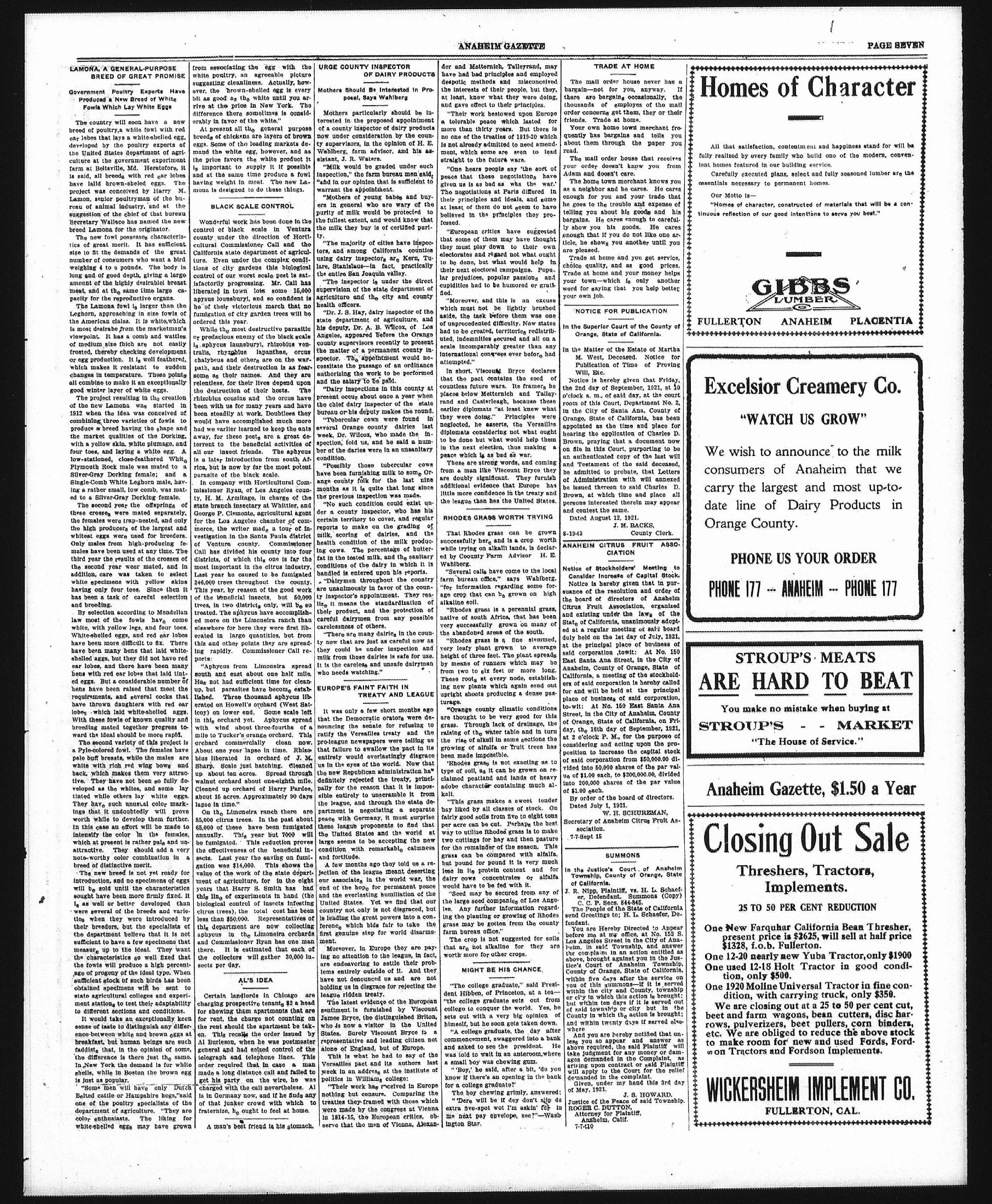
Searchable text
LAMONA, A GENERAL-PURPOSE BREED OF GREAT PROMISE
Government Poultry Experts Have Produced a New Breed of White Fowls Which Lay White Eggs
The country will soon have a new breed of poultry, a white fowl with red ear lobes that lays a white-shelled egg, developed by the poultry experts of the United States department of agriculture at the government experiment farm at Beltsville, Md. Heretofore, it is said, all breeds with red ear lobes have laid brown-shelled eggs. The project was conceived by Harry M. Lamon, senior poultryman of the bureau of animal industry, and at the suggestion of the chief of that bureau Secretary Wallace has named the new breed Lamona for the originator.
The new fowl possesses characteristics of great merit. It has sufficient size to fit the demands of the great number of consumers who want a bird weighing 4 to 5 pounds. The body is long and of good depth, giving a large amount of the highly desirable breast meat, and at the same time large capacity for the reproductive organs.
The Lamona fowl is larger than the Leghorn, approaching in size fowls of the American clauses. It is white, which is most desirably from the marketman's viewpoint. It has a comb and wattles of medium size which are not easily frosted, thereby checking development or egg production. It is well feathered, which makes it resistant to sudden changes in temperature. These points all combine to make it an exceptionally good winter layer of white eggs.
The project resulting in the creation of the new Lamona was started in 1912 when the idea was conceived of combining three varieties of fowls to produce a breed having the shape and the market qualities of the Dorking, with a yellow skin, white plumage, and from associating the egg with the white poultry, an agreeable picture suggesting cleanliness. Actually, however, the brown-shelled egg is every bit as good as the white until you arrive at the price in New York. The difference there sometimes is considerably in favor of the white."
At present all the general purpose breeds of chickens are layers of brown eggs. Some of the leading markets demand the white egg, however, and as the price favors the white product it is important to supply it if possible and at the same time produce a fowl having weight in meat. The new Lamona is designed to do these things.
BLACK SCALE CONTROL
Wonderful work has been done in the control of black scale in Ventura county under the direction of Horticultural Commissioner Call and the California state department of agriculture. Even under the complex conditions of city gardens this biological control of our worst scale pest is satisfactorily progressing. Mr. Call has liberated in town lots some 15,000 apysus lounsburyi, and so confident is he of their victorious march that no fumigation of city garden trees will be ordered this year.
While the most destructive parasitic or predacious enemy of the black scale is aphycus launsburyi, rhizobius ventralis, rhyzobius lapanthae, orcus chalybeus and others are on the warpath, and their destruction is as fearsome as their names. And they are relentless, for their lives depend upon the destruction of their hosts. The rhizobius cousins and the orcus have been with us for many years and have been steadily at work. Doubtless they would have accomplished much more had we earlier learned to keep the ants away, for these pests are a great deterrent to the beneficial activities of...
or egg production. It is well feathered, which makes it resistant to sudden changes in temperature. These points all combine to make it an exceptionally good winter layer of white eggs.
The project resulting in the creation of the new Lamona was started in 1912 when the idea was conceived of combining three varieties of fowls to produce breed having the shape and the market qualities of the Dorking, with a yellow skin, white plumage, and four toes, and laying a white egg. A low-stationed, close-feathered White Plymouth Rock male was mated to a Silver-Gray Dorking female; and a Single-Comb White Leghorn male, having a rather small, low comb, was mated to a Silver-Gray Dorking female.
The second year the offsprings of these crosse were mated separately, the females were trap-nested, and only the high producers of the largest and whitest eggs were used for breeders. Only males from high-producing females have been used at any time. The third year the results of the crosses of the second year weer mated, and in addition, care was taken to select white specimens with yellow skins having only four toes. Since then it has been a task of careful selection and breeding.
By selection according to Mendellian law most of the fowls have come white, with yellow legs, and four toes. White-shelled eggs, and red ear lobes have been more difficult to fix. There have been many hens that laid white-shelled eggs, but they did not have red ear lobes, and there have been many hens with red ear lobes that laid tinted eggs. But a considerable number of hens have been raised that meet the requirements, and several cocks that have thrown daughters with red ear lobes which laid white-shelled eggs. With these fowls of known quality and breeding mated together progress toward the ideal should be more rapid.
The second variety of this project is a Pyle-colored fowl. The females have pale buff breasts, while the males are white with rich red wing bows and back, which makes them very attractive. They have not been so fully developed as the whites, and some lay tinted while others lay white eggs. They have such unusual color markings that it undoubtedly will prove worthwhile to develop them further. In this case an effort will be made to intensify the color in the females, which at present is rather palpable and unattractive. They should add a very chalybeus and others are on the warpath, and their destruction is as fearsome as their names. And they are relentless, for their lives depend upon the destruction of their hosts. The rhizobius cousins and the orcus have been with us for many years and have been steadily at work. Doubtless they would have accomplished much more had we earlier learned to keep the ants away, for these pests are a great deterrent to the beneficial activities of all our insect friends. The aphycus is a later introduction from south Africa, but is now by far the most potent parasite of the black scale.
In company with Horticultural Commissioner Ryan, of Los Angeles county, H. M. Armitage, in charge of the state branch insectary at Whittier, and George P. Clements, agricultural agent for the Los Angeles chamber of commerce, the writer made a tour of investigation in the Santa Paula district of Ventura county. Commissioner Call has divided his county into four districts, of which this one is far the most important in the citrus industry. Last year he caused to be fumigated 246,000 trees throughout the county. This year, by reason of the good work of the beneficial insects, but 50,000 trees, in two districts only, will be treated. The aphycus have accomplished more on the Limoneira ranch than elsewhere for here they were first liberated in large quantities, but from this and other points they are spreading rapidly. Commissioner Call reports:
"Aphycus from Limoneira spread south and east about one half mile. Ha not had sufficient time for cleanup, but parasites have become established. Three thousand aphycus liberated on Howell's orchard (West Satcoy) on lower end. Some scale left in this orchard yet. Aphycus spread with wind about three-fourths of a mile to Tucker's orange orchard. This orchard commercially clean now. About one year lapse in time. Rhizobius liberated in orchard of J. M. Sharp. Scale just hatching. Cleaned up about ten acres. Spread through walnut orchard about one-eighth mile. Cleaned up orchard of Harry Pardee, about 15 acres. Approximately 90 days lapse in time."
On the Limoneira ranch there are 85,000 citrus trees. In the past about 65,000 of these have been fumigated annually. This year but 7000 will be fumigated. This reduction proves the effectiveness of the beneficial insect.
The appessitate the passage authorizing the wagon and the salary to pay.
"Dairy inspection present occur about the chief dairy in bureau or his department."
"Tubercular colony several Orange cow week, Dr. Wilcox speciation; fold us up; ber of the daries we condition.
"Possibly those have been furnished ange county folk months as it is on the previous inspection."
"No such condition der a county insure certain territory reports to make milk, scoring of health condition ing cows. The fat in the tested conditions of the handled is entered."
"Dairymen there are unanimously fairly inspector's appesi it means they their product, and careful dairymen carelessness of off."
"There are many now that are juicy they could be used milk from those dams it is the careless who needs watchin"
EUROPE'S FAINT TREE
It was only a few that the Democrat nouncing the senate ratify the Versailles pro-league news that failure to swine entirely would ease us in the eyes of the new Republic definitely rejects pally for the read able entirely to the league, and that partiment is negle peace with Germany these league provides the United States large seems to be condition with ma
pale buff breasts, while the males are white with rich red wing bows and back, which makes them very attractive. They have not been so fully developed as the whites, and some lay tinted while others lay white eggs. They have such unusual color markings that it undoubtedly will prove worthwhile to develop them further. In this case an effort will be made to intensify the color in the females, which at present is rather pale and unattractive. They should add a very note-worthy color combination in a breed of distinctive merit.
The new breed is not yet ready for introduction, and no specimens of eggs will be sold until the characteristics sought have been more firmly fixed. It is as well or better developed than were several of the breeds and varieties when they were introduced by their breeders, but the specialists of the department believe that it is not sufficient to have a few specimens that measure up to the ideal. They want the characteristics go well fixed that the fowls will produce a high percentage of progeny of the ideal type. When sufficient stock of such birds has been obtained specimens will be sent to state agricultural colleges and experiment stations to test their adaptability to different sections and conditions.
It would take an exceptionally keen sense of taste to distinguish any difference between white and brown eggs at breakfast, but human beings are such faddists that, in the opinion of some, the difference is there just the same. In New York the demand is for white shells, while in Boston the brown egg is just as popular.
"Some men will have only Dutch Belted cattle or Hampshire hogs," said one of the poultry specialists of the department of agriculture. "They are color enthusiasts. The liking for white-shelled eggs may have grown bluish liberated in orchard of J. M. Sharp. Scale just hatching. Cleaned up about ten acres. Spread through walnut orchard about one-eighth mile. Cleaned up orchard of Harry Pardee, about 15 acres. Approximately 90 days lapse in time."
On the Limoneira ranch there are 85,000 citrus trees. In the past about 65,000 of these have been fumigated annually. This year but 7000 will be fumigated. This reduction proves the effectiveness of the beneficial insects. Last year the saving on fumigation was $14,000. This shows the value of the work of the state department of agriculture, for in the eight years that Harry S. Smith has had this line of experiments in hand (the biological control of insects infesting citrus trees), the total cost has been less than $50,000. Representatives of this department are now collecting aphycus in the Limoneira orchards and Commissioner Ryan has one man there. It is estimated that each of the collectors will gather 30,000 insects per day.
AL'S IDEA
Certain landlords in Chicago are charging prospective tenants $2 a head for showing them apartments that are for rent, the charge not counting on the rent should the apartment be taken. This recalls the order issued by Al Burleson, when he was postmaster general and had seized control of the telegraph and telephone lines. This order required that in case a man made a long distance call and failed to get his party on the wire, he was charged with the call nevertheless. Al is in Germany now, and if he finds any of that junker crowd with which to fraternize, he ought to feel at home.
A man's best friend is his stomach.
URGE COUNTY INSPECTOR OF DAIRY PRODUCTS
Mothers Should Be Interested in Proposal, Says Wahlberg
Mothers particularly should be interested in the proposed appointment of a county inspector of dairy products now under consideration by the county supervisors, in the opinion of H. E. Wahlberg, farm advisor, and his assistant, J. R. Waters.
"Milk would be graded under such inspection," the farm bureau men said, "and in our opinion that is sufficient to warrant the appointment."
"Mothers of young babies and buyers in general who are wary of the purity of milk would be protected to the fullest extent, and would know that the milk they buy is of certified purity."
"The majority of cities have inspectors, and among California counties using dairy inspectors are Kern, Tulare, Stanislaus—in fact, practically the entire San Joaquin valley.
"The inspector is under the direct supervision of the state department of agriculture and the city and county health officers.
"Dr. J. S. Hay, dairy inspector of the state department of agriculture, and his deputy, Dr. A. B. Wilcox, of Los Angeles, appeared before the Orange county supervisors recently to present the matter of a permanent county inspector. The appointment would necessitate the passage of an ordinance authorizing the work to be performed and the salary to be paid.
"Dairy inspections in this county at present occur about once a year when the chief dairy inspector of the state bureau or his deputy makes the round.
"Tubercular cows were found in several Orange county dairies last week, Dr. Wilcox, who made the inspection, fold us, and he said a number of them."
der and Metternich, Talleyrand, may have had bad principles and employed despotic methods and misconceived the interests of their people, but they, at least, knew what they were doing, and gave effect to their principles.
"Their work bestowed upon Europe a tolerable peace which lasted for more than thirty years. But there is no one of the treaties of 1919-20 which is not already admitted to need amendment, which some are seen to lead straight to the future wars.
"One hears people say 'the sort of peace that these negotiations have given us is as bad as whis the war.' The negotiations at Paris differed in their principles and ideals, and some at least of them do not seem to have believed in the principles they professed.
"European critics have suggested that some of them may have thought they must play down to their own electorates and regard not what ought to be done, but what would help in their next electoral campaigns. Popular prejudices, popular passions and cupidities had to be humored or gratified.
"Moreover, and this is an excuse which must not be lightly brushed aside, the task before them was one of unprecedented difficulty. New states had to be created, territories redistributed, indemnities secured and all on a scale incomparably greater than any international convention ever before had attempted."
In short, Viscount Bryce declares that the pact contains the seed of countless future wars. Its framers he places below Metternich and Talleyrand and Casterleagh, because these earlier diplomats "at least knew what they were doing." Principles were neglected, he asserts, the Versailles diplomats considering not what ought to be done but what would help them in the next election, thus making a trade at home.
The mail order house never has a bargain—not for you, anyway. If there are bargains occasionally, the thousands of employees of the mail order concerns get them, they or their friends. Trade at home.
Your own home town merchant frequently has bargains and tells you about them through the paper you read.
The mail order house that receives your order doesn't know you from Adam and doesn’t care.
The home town merchant knows you as a neighbor and he cares. He cares enough for you and your trade that he goes to the trouble and expense of telling you about his goods and his bargains. He cares enough to carefully show you his goods. He cares enough that if you do not like one article, he shows you another until you are pleased.
Trade at home and you get service, choice quality, and as good prices. Trade at home and your money helps your town—which is only another word for saying that you help better your own job.
NOTICE FOR PUBLICATION
In the Superior Court of the County of Orange, State of California.
In the Matter of the Estate of Martha M. West, Deceased. Notice for Publication of Time of Proving Will, Etc.
Notice is hereby given that Friday, the 2nd day of September, 1921, at 10 p'clock a.m., of said day, at the court room of this Court, Department No. 2, in the City of Santa Ana, County of Orange, State of California, has been appointed as the time and place for hearing the application of Charles D. Brown, praying that a document now on file in this Court surmounting to be
EUROPE'S FAINT FAITH IN TREATY AND LEAGUE
It was only a few short months ago that the Democratic orators were denouncing the senate for refusing to ratify the Versailles treaty and the pro-league newspapers were telling us that failure to swallow the pact in its entirety would everlastingly disgrace us in the eyes of the world. Now that the new Republican administration has definitely rejected the treaty, principally for the reason that it is impossible entirely to unseramble it from the league, and through the state department is negotiating a separate peace with Germany, it must surprise these league proponents to find that the United States and the world at large seems to be accepting the new condition with remarkable calmness.
Dairy inspections in this county at present occur about once a year when the chief dairy inspector of the state bureau or his deputy makes the round.
Tubercular cows were found in several Orange county dairies last week, Dr. Wilcox, who made the inspection, fold us, and he said a number of the dairies were in an unsanitary condition.
Possibly those tubercular cows have been furnishing milk to some Orange county folk for the last nine months as it is quite that long since the previous inspection was made.
No such condition could exist under a county inspector, who has his certain territory to cover, and regular reports to make on the grading of milk, scoring of dairies, and the health condition of the milk producing cows. The percentage of butter-fat in the tested milk, and the sanitary conditions of the dairy in which it is handled is entered upon his reports.
Dairymen throughout the country are unanimously in favor of the county inspector's appointment. They realize it means the standardization of their product, and the protection of careful dairymen from any possible carelessness of others.
There are many dairies in the county now that are just as careful now as they could be under inspection and milk from those dairies is safe for use. It is the careless and unsafe dairyman who needs watching."
RHODES GRASS WORTH TRYING
That Rhodes grass can be grown successfully here and is a crop worth while trying on alkali lands, is declared by Coounty Farm Advisor H. E. Wahlberg.
Several calls have come to the local farm bureau office," says Wahlberg. "For information regarding someorage crop that can be grown on high alkaline soil.
Rhodes grass is a perennial grass, native of south Africa, that has been very successfully grown on many of the abandoned areas of the south.
Rhodes grass is a fine stemmed, very leafy plant grown to average height of three feet. The plant spreads by means of runners which may be from two to six feet or more long. These roots at every node, establishing new plants which again send out upright shoots producing a dense pasturage.
Orange county climatic conditions are thought to be very good for this grass. Through lack of drainage, the raising of the water table and in turn the rise of alkali in some sections the growing of alfalfa or fruit trees has been made impossible.
Rhodes grass is not exacting as to type of soil, as it can be grown on reclaimed peatland and lands of heavy adobe character containing much alkali.
This grass makes a sweet tender hay liked by all classes of stock. On fairly good soils from five to eight tons per acre can be cut. Perhaps the best way to utilize Rhodes grass is to make two cuttings for hay and then pasture for the remainder of the season. This international concessions over before had attempted."
In short, Viscount Bryce declares that the pact contains the seed of countless future wars. Its framers he places below Metternich and Talleyrand and Casterleagh, because these earlier diplomats "at least knew what they were doing." Principles were neglected, he asserts, the Versailles diplomats considering not what ought to be done but what would help them in the next election, thus making a peace which is as bad as war.
These are strong words, and coming from a man like Viscount Bryce they are doubly significant. They furnish additional evidence that Europe has little more confidence in the treaty and the league than has the United States.
ANAHEIM CITRUS FRUIT ASSOCIATION
Notice of Stockholders' Meeting to Consider Increase of Capital Stock.
Notice is hereby given that in pursuance of the resolution and order of the board of directors of Anaheim Citrus Fruit Association, organized and existing under the laws of the Statute of California, unanimously adopted at a regular meeting or salt board duly held on the 1st day of July, 1921, at the principal place of business of said corporation, to-wit: At No. 150 East Santa Ana Street, in the City of Anaheim, County of Orange, State of California, on Friday, the 16th day of September, 1921, at 2 o'clock P.M., for the purpose of considering and acting upon the proposition to increase the capital stock of said corporation from $50,000.00 divided into 50,000 shares of the par value of $1.00 each, to $200,000.00, divided into 200,000 shares of the par value of $1.00 each.
By order of the board of directors.
Dated July 1, 1921.
W. H. SCHUREMAN,
Secretary of Anaheim Citrus Fruit Association.
7-7-Sept 15
entirely would everlastingly disgrace us in the eyes of the world. Now that the new Republican administration has definitely rejected the treaty, principally for the reason that it is impossible entirely to unscramble it from the league, and through the state department is negotiating a separate peace with Germany, it must surprise these league proponents to find that the United States and the world at large seems to be accepting the new condition with remarkable calmness and fortitude.
A few months ago they told us a rejection of the league meant deserting our associate in the world war, the end of the hope for permanent peace and the everlasting humiliation of the United States. Yet we find that our country not only is not disgraced, but is leading the great powers into a conference which bids fair to take the first genuine step for world disarmament.
Moreover, in Europe they are paying no attention to the league, in fact, are endeavoring to settle their problems entirely outside of it. And they have not denounced us and are not holding us in disgrace for rejecting the league ridden treaty.
The latest evidence of the European sentiment is furnished by Viscount James Bryce, the distinguished Briton, who is now a visitor in the United States. Surely Viscount Bryce is a representative and leading citizen not alone of England, but of Europe.
This is what he had to say of the Versailles pact and its authors last week in an address at the Institute of politics in William college:
"Their work has received in Europe nothing but censure. Comparing the treaties they framed with those which were made by the congress at Vienna in 1814-15, the European critics, observe that the men of Vienna, Alexanbeen made impossible.
'Rhodes grass' is not exacting as to type of soil, as it can be grown on reclaimed peatland and lands of heavy adobe character containing much alkali.
"This grass makes a sweet tender hay liked by all classes of stock. On fairly good soils from five to eight tons per acre can be cut. Perhaps the best way to utilize Rhodes grass is to make two cuttings for hay and then pasture for the remainder of the season. This grass can be compared with alfalfa, but pound for pound it is very much less in its protein content and for dairy cows concentrates or alfalfa would have to be fed with it.
"Seed may be secured from any of the large seed companies of Los Angeles. Any further information regarding the planting or growing of Rhodes grass may be gotten from the county farm bureau office."
The crop is not suggested for solls that are not alkaline for they are worth more for other crops.
MIGHT BE HIS CHANCE.
"The college graduate," said President Hibben, of Princeton, at a tea—"the college graduate sets out from college to conquer the world. Yes, he sets out with a very big opinion of himself, but he soon gets taken down.
"A college graduate, the day after commencement, swaggered into a bank and asked to see the president. He was told to wait in an anteroom, where a small boy was chewing gum.
"'Boy,' he said, after a bit, 'do you know if there's an opening in the bank for a college graduate?'
The boy chewing grimly, answered:
'Dere will be if dey don't slip de extra five-spot wot I'm askin' fur in me next pay envelope, see?'—Washington Star.
of said corporation from $50,000.00 divided into 50,000 shares of the par value of $1.00 each, to $200,000.00, divided into 200,000 shares of the par value of $1.00 each.
By order of the board of directors.
Dated July 1, 1921.
W. H. SCHUREMAN,
Secretary of Anaheim Citrus Fruit Association.
7-7-Sept 15
SUMMONS
In the Justice's Court of Anaheim Township, County of Orange, State of California.
J. R. Nipp, Plaintiff, vs. H. L. Schaefer, Defendant. Summons (Copy)
C. C. P. Secs. 844-845.
The People of the State of California send Greetings to; H. L. Schaefer, Defendant.
You are Hereby Directed to Appear before me at my office, at No. 152 S. Los Angeles Street in the City of Anaheim, in said Township, and answer the complaint in an action entitled as above, brought against you in the Justice's Court of Anaheim Township, County of Orange, State of California, within five days after the service on you of this summons—if it is served within the city and County, township or city in which this action is brought; but within ten days if it is served out of said township or city but in the County in which the action is brought; and within twenty days if served elsewhere.
And you are hereby notified that unless you so appear and answer as above required, the said Plaintiff will take judgment for any money or damages demanded in the Complaint, as arising upon contract or said Plaintiff will apply to the Court for the relief demanded in the complaint.
Given, under my hand this 3rd day of May, 1921.
J. S. HOWARD,
Justice of the Peace of said Township.
ROGER C. DUTTON,
Attorney for Plaintiff,
Anaheim, Calif.
7-7-t10
Homes of Character
All that satisfaction, contentment and happiness stand for will be fully realized by every family who build one of the modern, convenient homes featured in our building service.
Carefully executed plans, select and fully seasoned lumber are the essentials necessary to permanent homes.
Our Motto is—
"Homes of character, constructed of materials that will be a continuous reflection of our good intentions to serve you best."
GIBBS
LUMBER
FULLERTON ANAHEIM PLACENTIA
Excelsior Creamery Co.
“WATCH US GROW”
Excelsior Creamery Co.
"WATCH US GROW"
We wish to announce to the milk consumers of Anaheim that we carry the largest and most up-to-date line of Dairy Products in Orange County.
PHONE US YOUR ORDER
PHONE 177 --- ANAHEIM --- PHONE 177
STROUP'S MEATS
ARE HARD TO BEAT
You make no mistake when buying at STROUP'S - - MARKET
"The House of Service."
Anaheim Gazette, $1.50 a Year
Closing Out Sale
Anaheim Gazette, $1.50 a Year
Closing Out Sale
Threshers, Tractors,
Implements.
25 TO 50 PER CENT REDUCTION
One New Farquhar California Bean Thresher, present price is $2625, will sell at half price $1328, f.o.b. Fullerton.
One 12-20 nearly new Yuba Tractor, only $1900
One used 12-18 Holt Tractor in good condition, only $500.
One 1920 Moline Universal Tractor in fine condition, with carrying truck, only $350.
We are closing out at a 25 to 50 per cent cut, beet and farm wagons, bean cutters, disc harrows, pulverizers, beet pullers, corn binders, etc. We are obliged to reduce the above stock to make room for new and used Fords, Fordson Tractors and Fordson Implements.
WICKERSHEIM IMPLEMENT CO.
FULLERTON, CAL.