anaheim-gazette 1921-08-25
Scanned page
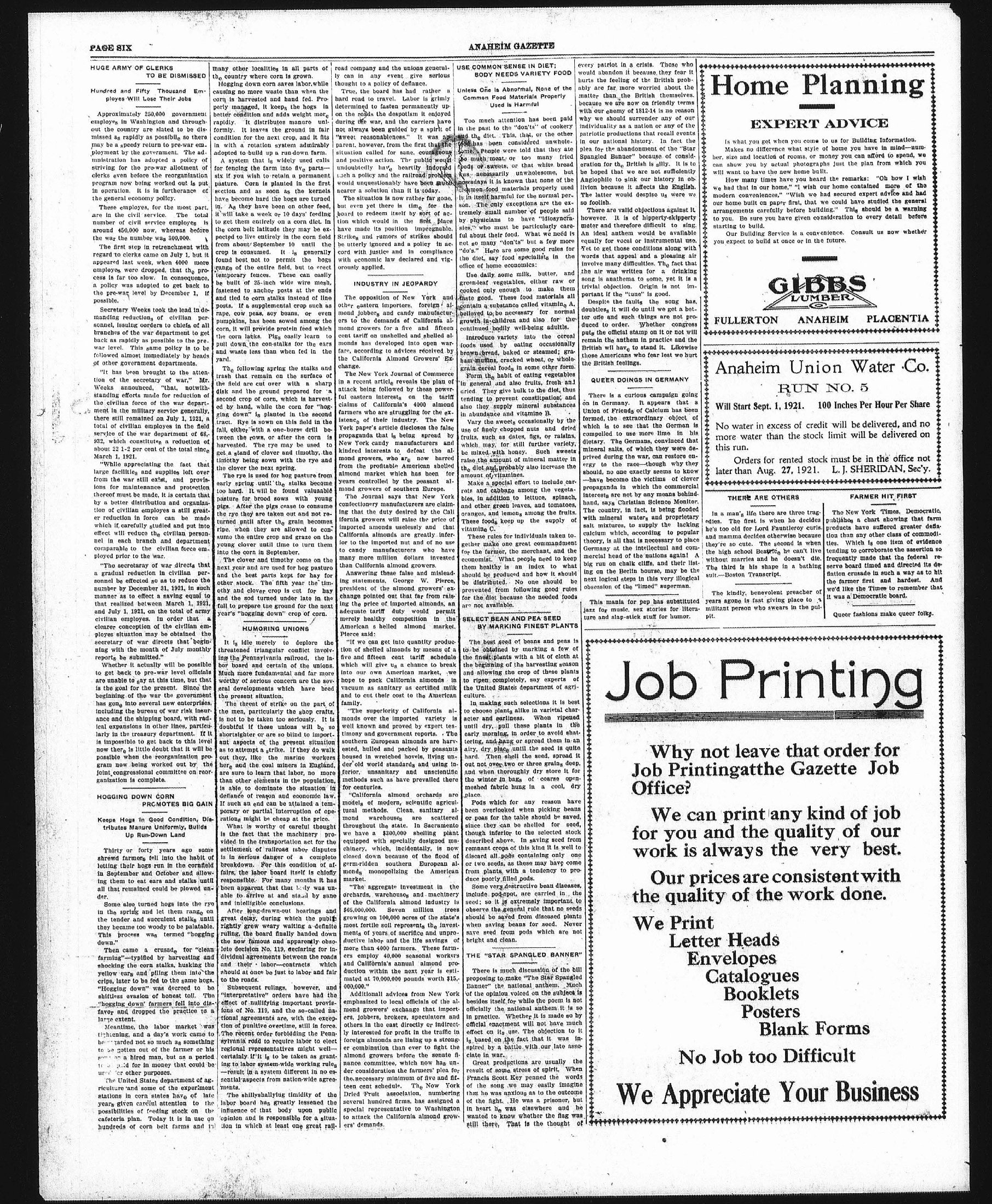
Searchable text
HUGE ARMY OF CLERKS
TO BE DISMISSED
Hundred and Fifty Thousand Employees Will Lose Their Jobs
Approximately 250,000 government employees in Washington and throughout the country are slated to be dismissed as rapidly as possible so there may be a speedy return to pre-war employment by the government. The administration has adopted a policy of striving for the pre-war allotment of clerks even before the reorganization program now being worked out is put in operation. It is in furtherance of the general economy policy.
These employees, for the most part, are in the civil service. The total number of civil service employees is around 450,000 now, whereas before the war the number was 300,000.
The first step in retrenchment with regard to clerks came on July 1, but it appeared last week, when 4000 more employees were dropped, that the process is far too slow. In consequence, a policy was adopted to get back to the pre-war level by December 1, if possible.
Secretary Weeks took the lead in demanding reductions of civilian personnel, issuing orders to chiefs of all branches of the war department to get back as rapidly as possible to the pre-war level. This same policy is to be followed almost immediately by heads of other government departments.
"It has been brought to the attention of the secretary of war," Mr. Weeks announced, "that, notwithstanding efforts made for reduction of the civilian force of the war department in the military service generally, there still remained on July 1, 1921, a total of civilian employees in the field service of the war department of 68,932, which constitutes a reduction of about 22-1/2 per cent of the total sine-many other localities in all parts of the country where corn is grown.
Hogging down corn saves labor while causing no more waste than when the corn is harvested and hand fed. Properly managed, it keeps the hogs in better condition and adds weight more rapidly. It distributes manure uniformly. It leaves the ground in fair condition for the next crop, and it fits in with a rotation system admirably adapted to build up a run-down farm.
A system that is widely used calls for fencing the farm into five parts—six if you wish to retain a permanent pasture. Corn is planted in the first section and as soon as the kernels have become hard the hogs are turned in. As they have been on other feed, it will take a week or 10 days' feeding to get them entirely on a corn diet. In the corn belt latitude they may be expected to live entirely in the corn field from about September 10 until the crop is consumed. It is generally found best not to permit the hogs range of the entire field, but to erect temporary fences. These can easily be built of 25-inch wide wire mesh, fastened to anchor posts at the ends and tied to corn stalks instead of line posts. If a supplemental crop such as rape, cow peas, soy beans, or even pumpkins, has been sowed among the corn, it will provide protein feed which the corn lacks. Pigs easily learn to pull down the con-stalks for the ears and waste less than when fed in the yard.
The following spring the stalks and trash that remain on the surface of the field are cut over with a sharp disk and the ground prepared for a second crop of corn, which is harvested by hand, while the corn for "hogging down" is planted in the second tract. Rye is sown on this field in the fall, either with a one-horse drill between the rows, or after the corn is harvested. The rye may be used to road company can in thought to a True, the hard road to determined on the road during the not always sweet read parent, how situation care and positive undoubtedly each a police would unquite nearer a soil.
The situation but even yet board to relation which have made Strikes and be utterly cord with with economically applause.
INDUCTION
The opposing eastern mond jobs ers to the mond grow cent tariff monds has fare accorde the Califor change.
The New in a recent attack being ful eastern claims of farmers wh istence of York paper propaganda New York
"It has been brought to the attention of the secretary of war," Mr. Weeks announced, "that, notwithstanding efforts made for reduction of the civilian force of the war department in the military service generally, there still remained on July 1, 1921, a total of civilian employees in the field service of the war department of 68,932, which constitutes a reduction of about 22 1-2 per cent of the total since March 1, 1921.
"While appreciating the fact that large facilities and supplies left over from the war still exist, and provisions for maintenance and protection thereof must be made, it is certain that by a better distribution and organization of civilian employes a still greater reduction in force can be made which if carefully studied and put into effect will reduce the civilian personnel in each branch and department comparable to the civilian force employed prior to the war.
"The secretaray of war directs that a gradual reduction in civilian personnel be effected so as to reduce the number by December 31, 1921, in such manner as to effect a saving equal to that realized between March 1, 1921, and July 1, 1921, on the total of army civilian employees. In order that a clearer conception of the civilian employees situation may be obtained the secretary of war directs that beginning with the month of July monthly reports be submitted."
Whether it actually will be possible to get back to pre-war level officials are unable to say at this time, but that is the goal for the present. Since the beginning of the war the government has gone into several new enterprises, including the bureau of war risk insurance and the shipping board, with radical expansions in other lines, particularly in the treasury department. If it is impossible to get back to this level now there is little doubt that it will be possible when the reorganization program now being worked out by the joint congressional committee on reorganization is complete.
HOGGING DOWN CORN
PRCMOTES BIG GAIN
Keeps Hogs in Good Condition, Distributes Manure Uniformly, Builds Up Run-Down Land
Thirty or forty years ago some yard.
The following spring the stalks and trash that remain on the surface of the field are cut over with a sharp disk and the ground prepared for a second crop of corn, which is harvested by hand, while the corn for "hogging down" is planted in the second tract. Rye is sown on this field in the fall, either with a one-horse drill between the rows, or after the corn is harvested. The rye may be used to get a stand of clover and timothy, the timothy being sown with the rye and the clover the next spring.
The rye is used for hog pasture from early spring until the stalks become too hard. It will be found valuaable pasture for brood sows with young pigs. After the pigs cease to consume the rye they are taken out and not returned until after the grain becomes ripe, when they are allowed to consume the entire crop and graze on the young clover until time to turn them into the corn in September.
The clover and timothy come on the next year and are used for hog pasture and the best parts kept for hay for other stock. The fifth year the timothy and clover crop is cut for hay and the sod turned under late in the fall to prepare the ground for the next year's "hogging down" crop of corn.
HUMORING UNIONS
It is idle merely to deplore the threatened triangular conflict involving the Pennsylvania railroad, the labor board and certain of the unions. Much more fundamental and far more worthy of serious concern are the several developments which have bred the present situation.
The threat of strike on the part of the men, particularly the shop crafts, is not to be taken too seriously. It is doubtful if these unions will be shortsighter or are so blind to important aspects of the present situation as to attempt a strike. If they do walk out they, like the marine workers here and the coal miners in England, are sure to learn that labor, no more than other elements in the population, is able to dominate the situation in defiance of reason and economic law. If such an end can be attained a temporary or partial interruption of operations might be cheap at the price.
What is worthy of careful thought is the fact that the machinery provided in the transportation act for the settlement of railroad labor disputes
California models of rural medical care throughout we have equipped chinery.
HOGGING DOWN CORN
PRCMOTES BIG GAIN
Keeps Hogs In Good Condition, Distributes Manure Uniformly, Bullds Up Run-Down Land
Thirty or forty years ago some shrewd farmers fell into the habit of letting their hogs run in the cornfield in September and October and allowing them to eat ears and stalks until all that remained could be plowed under.
Some also turned hogs into the rye in the spring and let them range on the tender and succulent stalks until they became too woody to be palatable. This process was termed "hogging down."
Then came a crusade for "clean farming"—typified by harvesting and shocking the corn stalks, husking the yellow ears and pilling them into the crips, later to be fed to the same hogs. "Hogging down" was decreed to be shiftless evasion of honest toll. The "hogging down' farmers fell into disfavor and dropped the practice to a large extent.
Meantime, the labor market was tightening, and a day's work came to be regarded not so much as something to be gotten out of the farmer or his servant a hired man, but as a period to be paid for in money that could be used for other purposes.
The United States department of agriculture and some of the experiment stations in corn states have of late years given careful attention to the possibilities of feeding stock on the cafeteria plan. Today it is in use on hundreds of corn belt farms and in out they, like the marine workers here and the coal miners in England, are sure to learn that labor, no more than other elements in the population, is able to dominate the situation in defiance of reason and economic law. If such an end can be attained a temporary or partial interruption of operation might be cheap at the price.
What is worthy of careful thought is the fact that the machinery provided in the transportation act for the settlement of railroad labor disputes is in serious danger of a complete breakdown. For this condition of affairs, the labor board itself is chiefly responsible. For many months it has been apparent that that body was unable to arrive at and stand by sane and intelligible conclusions.
After long-drawn-out hearings and great delay, during which the public rightly grew weary waiting a definite ruling, the board finally handed down the now famous and apparently obsolete decision No. 119, declaring for individual agreements between the roads and their labor—contracts which should at once be just to labor and fair to the roads.
Subsequent rulings, however, and "interpretative" orders have had the effect of nullifying important provisions of No. 119, and the so-called national agreements are, with the exception of punitive overtime, still in force. The recent order forbidding the Pennsylvania road to require labor to elect regional representatives might well—certainly if it is to be taken as granting to labor system-wide working rules—result in a system different in no essential aspects from nation-wide agreements.
The shillyshallying timidity of the labor board has greatly lessened the influence of that body upon public opinion and is responsible for a situation in which at least one great rail-
ANAHEIM GAZETTE
ALL parts of the grown.
has labor, while
can when the land fed. Prothe hogs in weight more.
manure unbound in fair
farm, and it fits
from admirably down farm.
Only used calls to five parts—permanent in the first kernels
hogs are turned on other feed,
days' feeding corn diet. In may be extended the corn feed which usually learn to for the ears fed in the stalks and surface of with a sharp prepared for which is harvest-corn for "hog-on" the second field in the horse drill being the corn be used to road company and the unions generally can in any event give serious thought to a policy of defiance.
True, the board has had rather a hard road to travel. Labor is grimly determined to fasten permanently upon the roads the despotism it enjoyed during the war, and the carriers have not always been guided by a spirit of "sweet reasonableness." It was apparent, however, from the first that the situation called for sane, courageous and positive action. The public would undoubtedly have heartily indorsed such a policy and the railroad problem would unquestionably have been much nearer a solution than it is today.
The situation is now rather far gone, but even yet there is time for the board to redeem itself by sort of action which would in the first place have made its position impregnable. Strikes and rumors of strikes should be utterly ignored and a policy in accord with justice and in compliance with economic law declared and vigorously applied.
INDUSTRY IN JEOPARDY
The opposition of New York and other eastern importers, foreign almond jobbers and candy manufacturers to the demands of California almond growers for a five and fifteen cent tariff on unshelled and shelled almonds has developed into open warfare, according to advices received by the California Almond Growers' Exchange.
The New York Journal of Commerce in a recent article reveals the plan of attack being followed by these powerful eastern interests on the tariff claims of California's 4000 almond farmers who are struggling for the existence of their industry. The New York paper's article discloses the false propaganda that is being spread by New York candy manufacturers and road company and the unions generally can in any event give serious thought to a policy of defiance.
USE COMMON SENSE IN DIET; BODY NEEDS VARIETY FOOD
Unless One is Abnormal, None of the Common Food Materials Properly Used is Harmful
Too much attention has been paid in the past to the "don'ts" of cookery and the diet. This, that, or the other food has been considered unwholesome. People were told that they ate too much meat, or too many fried foods or sweets, or that white bread was necessarily unwholesome, but nowadays it is known that none of the common food materials properly used is in itself harmful for the normal person. The only exceptions are the extremely small number of people said by physicians to have "idiosyncrasies," who must be particularly careful about their food. What we need is not so many "don'ts" but a few more "do's." Here are some good rules for the diet, say food specialists in the office of home economics:
Use daily some milk, butter, and green-leaf vegetables, either raw or cooked only enough to make them taste good. These food materials all contain a substance called vitamin A, believed to be necessary for normal growth in children and also for the continued bodily well-being adults.
Introduce variety into the cereal foods used by eating occasionally brown bread, baked or steamed; graham muffins, cracked wheat, or whole-grain cereal foods in some other form.
Form the habit of eating vegetables in general and also fruits, fresh and dried. They give bulk to the diet, thus tending to prevent constipation; and also they supply mineral substances in abundance and vitamine B.
Vary the sweetness occasionally by the use of finely chopped nuts and dried fruits, such as dates, figs, or raisins, which may, for still further variety,
every patriot in a crisis. Those who would abandon it because they fear it hurts the feeling of the British probably are far more worried about the matter than the British themselves. because we are now on friendly terms with our enemy of 1812-14 is no reason why we should surrender any of our individuality as a nation or any of the patriotic productions that recall events in our national history. In fact the plea for the abandonment of the "Star Spangled Banner" because of consideration for the British is silly. It is to be hoped that we are not sufficiently Anglophile to sink our history in oblivion because it affects the English. The latter would despise us were we so foolish.
There are valid objections against it however. It is of hipperty-skippery meter and therefore difficult to sing. An ideal anthem would be available equally for vocal or instrumental use. Yet to get those conditions along with words that appeal and a pleasing air involve many difficulties. The fact that the air was written for a drinking song is anathema to some, yet it is a trivial objection. Origin is not important if the "tune" is good.
Despite the faults the song has, doubts it will do until we get a better one and such things are not produced to order. Whether congress puts the official stamp on it or not will remain the anthem in practice and the British will have to stand it. Likewise those Americans who fear lest we hurt the British feelings.
QUEER DOINGS IN GERMANY
There is a curious campaign going on in Germany. It appears that a Union of Friends of Calcium has been formed, the extraordinary object of which is to see that the German is compelled to use more lime in his dietary. The Germans convinced that mineral salts of which they were de-
the stalks and the surface of with a sharp prepared for which is harvested corn for "hog" on the second field in the horse drill befor the corn is to be used to timothy, the rye and the pasture from stalks become valuable with young grass to consume and not re-grain becomes allowed to con- graze on the rye to turn them over. Come on the hog pasture for hay for year the time cut for hay later in the year for the next crop of corn.
deplore the conflict involv-road, the la- lade of the unions, and far more are the seve- have bred on the part of the shop crafts, everiously. It is ins will be so mind to import- present situation if they do walk marine workers in England, labor, no more the population, the situation in economic law, attained a tem-ruption of oper- at the price. Careful thought machinery pro- cution act for the labor disputes
the California Almond Growers' Exchange.
The New York Journal of Commerce in a recent article reveals the plan of attack being followed by these powerful eastern interests on the tariff claims of California's 4000 almond farmers who are struggling for the existence of their industry. The New York paper's article discloses the false propaganda that I being spread by New York candy manufacturers and kindred interests to defeat the almond growers, who are now barred from the profitable American shelled almond market which has been for years controlled by the peasant almond growers of southern Europe.
The Journal says that New York confectionery manufacturers are claiming that the duty desired by the California growers will raise the price of imported amonds uselessly and that California almonds are greatly inferior to the imported nut and of no use to candy manufacturers who have many more million dollars invested than California almond growers.
Answering these false and misleading statements, George W. Pierce, president of the almond growers' exchange pointed out that far from raising the price of imported almonds, an adequate tariff duty would permit merely healthy competition in the American s helled almond market. Pierce said:
"If we can get into quantity production of shelled almonds by means of a five and fifteen cent tariff schedule which will give us a chance to break into our own American market, we hope to pack California almonds in vacuum as sanitary as certified milk and to cut their cost to the American family.
"The superiority of California almonds over the imported variety is well known and proved by expert testimony and government reports. The southern European almonds are harvested, hulled and packed by peasants housed in wretched hovels, living under old world standards and using inferior, unsanitary and unscientific methods such as have prevailed there for centuries.
"California almond orchards are models of modern scientific agricultural methods. Clean, sanitary almond warehouses are scattered throughout the state. In Sacramento we have a $300,000 shelling plant equipped with specially designed machinery, which, incidentally, is now ham muffins, cracked wheat, or whole-grain cereal foods in some other form.
Form the habit of eating vegetables in general and also fruits, fresh and dried. They give bulk to the diet, thus tending to prevent constipation; and also they supply mineral substances in abundance and vitamin B.
Vary the sweetness occasionally by the use of finely chopped nuts and dried fruits, such as dates, figs, or raisins, which may, for still further variety, be mixed with honey. Such sweets raise the amount of mineral matter in the diet and probably also increase the amount of vitamins.
Make a special effort to include carrots and cabbage among the vegetables, in addition to lettuce, spinach, and other green leaves, and tomatoes, oranges, and lemon among the fruits. These foods keep up the supply of vitamin C.
These rules for individuals taken together make one great commandment for the farmer, the merchant, and the economist. What people need to keep them healthy is an index to what should be produced and how it should be distributed. No one should be prevented from following good rules for the diet because the needed foods are not available.
SELECT BEAN AND PEA SEED BY MARKING FINEST PLANTS
The best seed of beans and peas is to be obtained by marking a few of the finest plants with a bit of cloth at the beginning of the harvesting season and allowing the crop of these plants to ripen completely, say experts of the United States department of agriculture.
In making such selections it is best to choose plants alike in varietal character and earliness. When ripened until dry, pull these plants in the early morning, in order to avoid shattering, and hang or spread them in an airy, dry place until the seed is quite hard. Then shell the seed, spread it out not over two or three grains deep, and when thoroughly dry store it for the winter in bags of coarse open-meshed fabric hung in a cool, dry place.
Pods which for any reason have been overlooked when picking beans or peas for the table should be saved, since they can be shelled for seed, though inferior to the selected stock described above. In saving seed from remnant crops of this kind it is well to
Marine workers in England, no more the population, the situation in economic law, contained a temptation of opium at the price. Careful thought machinery production act for the labor disputes of a complete condition of affliction is chiefly months it has not body was unstand by same millions. Hearings and which the public putting a definite handed down apparently obsolete declaring for between the roads attracts which to labor and fair however, and have had the important provisions so-called naive with the exception, still in force. Adding the Pennine labor to elect might well—taken as granting working rules different in no extension-wide agree-
Amididity of the day lessened upon publicable for a situa-one great rail-
"California almond orchards are models of modern scientific agricultural methods. Clean, sanitary almond warehouses are scattered throughout the state. In Sacramento we have a $300,000 shelling plant equipped with specially designed machinery, which, incidentally, is now closed down because of the flood of germ-ridden southern European almonds monopolizing the American market.
"The aggregate investment in the orchards, warehouse and machinery of the California almond industry is $65,000,000. Seven million trees growing on 100,000 acres of the state's most fertile soil represent the investments of years of sacrifice and unproductive labor and the life savings of more than 4000 farmers. These farmers employ 40,000 seasonal workers and California's annual almond production within the next year is estimated at 70,000,000 pounds worth $15.,000,000."
Additionall advices from New York emphasized to local officials of the almond growers' exchange that importers, jobbers, brokers, speculators and others in the east directly or indirectly interested for profit in the traffic in foreign almonds are lining up a stronger combination than ever to fight the almond growers before the senate finance committee, which now has under consideration the farmers' plea for the necessary minimum of five and fifteen cent schedule. The Now York Dried Fruit association, numbering several hundred firms, has assigned a special representative to Washington to attack the California almond growers' demands.
There is much discussion of the bill proposing to make "The Star Spangled Banner" the national anthem. Much of the opinion voiced on the subject is besides itself for while the poem is not officially the national anthem it is so in practice. Whether it is made so by official enactment will not have much effect on its use. The objection to it is based on the fact that it was inspired by a battle with our late associate in war.
Great productions are usually the result of some stress of spirit. When Francis Scott Key penned the words of the song we may easily imagine that he was anxious as to the outcome of the fight. He was a prisoner, but in heart he was elsewhere and he wanted to know whether the flag was still there. That is the thought of
Home Planning
EXPERT ADVICE
Is what you get when you come to us for Building Information.
Makes no difference what style of home you have in mind—number, size and location of rooms, or money you can afford to spend, we can show you by actual photographs just the plan from which you will want to have the new home built.
How many times have you heard the remarks: "Oh how I wish we had that in our home," "I wish our home contained more of the modern conveniences," "Wish we had secured expert advice and had our home built on paper first, that we could have studied the general arrangements carefully before building." This should be a warning to you. Be sure you have given consideration to every detail before starting to build.
Our Building Service is a convenience. Consult us now whether you expect to build at once or in the future.
GIBBS
LUMBER
FULLERTON ANAHEIM PLACENTIA
Anaheim Union Water Co.
RUN NO. 5
Will Start Sept. 1, 1921. 100 Inches Per Hour Per Share
No water in excess of credit will be delivered, and no more water than the stock limit will be delivered on this run.
Anaheim Union Water Co.
RUN NO. 5
Will Start Sept. 1, 1921. 100 Inches Per Hour Per Share
No water in excess of credit will be delivered, and no more water than the stock limit will be delivered on this run.
Orders for rented stock must be in the office not later than Aug. 27, 1921. L. J. SHERIDAN, Sec'y.
THERE ARE OTHERS
In a man's life there are three tragedies. The first is when he decides he's too old for Lord Fauntleroy curls and mamma decides otherwise because they're so cute. The second is when the high school Beatrice he can't live without marries and he doesn't die. The third is his shape in a bathing suit—Boston Transcript.
The kindly, benevolent preacher of years agone is fast giving place to a militant person who swears in the pulpit.
FARMER HIT FIRST
The New York Times, Democratic, publishes a chart showing that farm products have suffered greater deflation than any other class of commodities. Which is one item of evidence tending to corroborate the assertion so frequently made that the federal reserve board timed and directed its deflation crusade in such a way as to hit the farmer first and hardest. And we'd like the Times to remember that it was a Democratic board.
Queer fashions make queer folks.
Job Printing
Why not leave that order for Job Printingatthe Gazette Job Office?
We can print any kind of job for you and the quality of our work is always the very best
Why not leave that order for Job Printingatthe Gazette Job Office?
We can print any kind of job for you and the quality of our work is always the very best.
Our prices are consistent with the quality of the work done.
We Print
Letter Heads
Envelopes
Catalogues
Booklets
Posters
Blank Forms
No Job too Difficult
We Appreciate Your Business