anaheim-gazette 1921-06-30
Scanned page
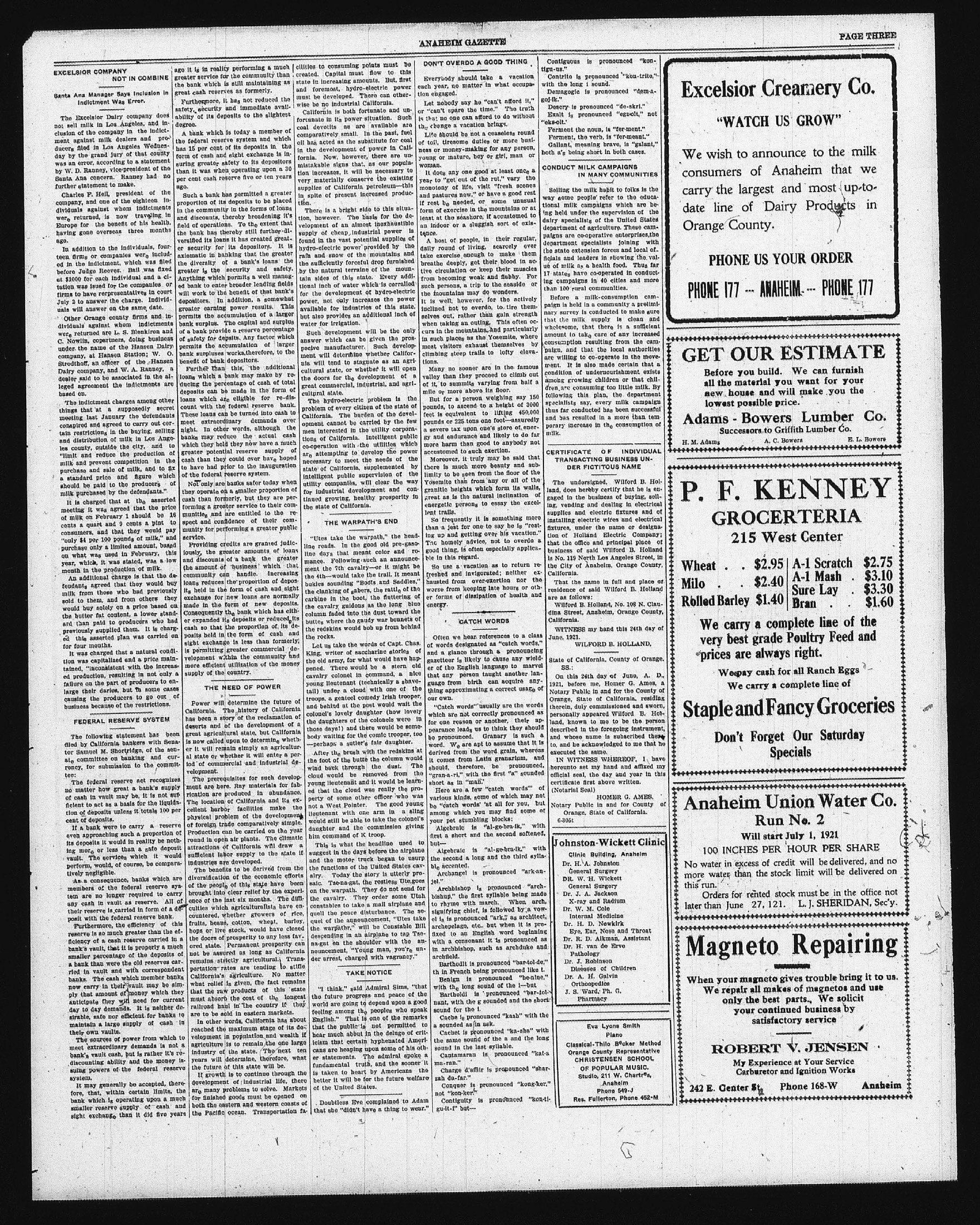
Searchable text
EXCELSIOR COMPANY
NOT IN COMBINE
Santa Ana Manager Says Inclusion in Indictment Was Error.
The Excelsior Dairy company does not sell milk in Los Angeles, and inclusion of the company in the indictment against milk dealers and producers filed in Los Angeles Wednesday by the grand jury of that county was an error, according to a statement by W. D. Ranney, vice-president of the Santa Ana concern. Ranney had no further statement to make.
Charles F. Hell, president of the company, and one of the eighteen individuals against whom indictments were returned, is now traveling in Europe for the benefit of his health, having gone overseas three months ago.
In addition to the individuals, fourteen firms or companies were included in the indictment, which was filed before Judge Reeves. Ball was fixed at $1000 for each individual and a citation was issued for the companies or firms to have representatives in court July 2 to answer the charge. Individuals will answer on the same date.
Other Orange county firms and individuals against whom indictments were returned are L. S. Blenkiron and C. Nowlin, copartners, doing business under the name of the Hansen Dairy company, at Hansen Station; W. O. Strodthoff, an officer of the Hansen Dairy company, and W. A. Ranney, a dealer said to be associated in the alleged agreement the indictments are based on.
The indictment charges among other things that at a supposedly secret meeting last January the defendants conspired and agreed to carry out certain restrictions in the buying, selling and distribution of milk in Los Angeles county, outside the city, and to limit and reduce the production of ago it is in reality performing a much greater service for the community than the bank which is still maintaining as great cash reserves as formerly.
Furthermore, it has not reduced the safety, security and immediate availability of its deposits to the slightest degree.
A bank which is today a member of the federal reserve system and which has 15 per cent of its deposits in the form of cash and eight exchange is insuring greater safety to its depositors than it was when operating upon a 30 per cent cash reserve five or ten years ago.
Such a bank has permitted a greater proportion of its deposits to be placed in the community in the forms of loans and discounts, thereby broadening its field of operations. To the extent that the bank has thereby still further diversified its loans it has created greater security for its depositors. It is axiomatic in banking that the greater diversity of a bank's loans the greater is the security and safety. Anything which permits a well managed bank to enter broader lending fields will work to the benefit of that bank's depositors. In addition, a somewhat greater earning power results. This permits the accumulation of a larger bank surplus. The capital and surplus of a bank provide a reserve percentage of safety for deposits. Any factor which permits the accumulation of larger bank surpluses works therefore, to the benefit of bank depositors.
Further than this, the additional loans which a bank may make by reducing the percentage of cash of total deposits can be made in the form of loans which are eligible for re-discount with the federal reserve bank. These loans can be turned into cash to meet extraordinary demands over night. In other words, although the banks may reduce the actual cash which they hold they now have a much greater potential reserve supply of facilities to consuming products created. Capital must state in increasing amount and foremost, hydro-must be developed. The wise be no industrial Company.
California is both fortunate in its power and coal devotits as are comparatively small. Oil has acted as the subject in the development of formia. Now, however, mistakable signs that oil increases, it will very materially conserve supplies of California in spite of present infiltration.
There is a bright situation, however. The development of an almost supply of cheap industry found in the vast potential hydro-electric power plant and snow of these sufficiently forceful by the natural terrain national inch of water we for the development of power, not only increase available for industrial but also provides an adequate water for irrigation.
Such development answers which can be peculiar manufacturer.MENT will tend to stage cultural state, or where the doors for them develop great commercial, Indian cultural state.
The hydro-electric problem of every citizen California. The burden opment cannot be carried men interested in the tions of California. Co-operation with the ar attempts to de-
Strothoff, an officer of the Hansen Dairy company, and W. A. Ranney, a dealer said to be associated in the alleged agreement the indictments are based on.
The indictment charges among other things that at a supposedly secret meeting last January the defendants conspired and agreed to carry out certain restrictions in the buying, selling and distribution of milk in Los Angeles county, outside the city, and to "limit and reduce the production of milk and prevent competition in the purchase and sale of milk, and to fix a standard price and figure which should be paid to the producers of milk purchased by the defendants."
It is charged that at the asserted meeting it was agreed that the price of milk on February 1 should be 16 cents a quart and 9 cents a pint to consumers, and that they would pay "only $4 per 100 pounds of milk," and purchase only a limited amount, based on what was used in February this year, which, it was stated, was a low month in the production of milk.
An additional charge is that the defendants agreed that they would buy milk from those who had previously sold to them, and from others they would buy solely on a price based on the butter fat content, a lower standard than paid to producers who had previously supplied them. It is charged this asserted plan was carried on for four months.
It was charged that a natural condition was capitalized and a price maintained, "inconsistent with the increased production, resulting in not only a failure on the part of producers to enlarge their daries, but in some cases causing the producers to go out of business because of the restrictions.
FEDERAL RESERVE SYSTEM
The following statement has been filed by California bankers with Senator Samuel M. Shortridge, of the senate committee on banking and currency, for submission to the committee:
The federal reserve act recognizes no matter how great a bank's supply of cash in vault may be, it is not sufficient to act as a basis for the liquidation of deposits unless it totals 100 per cent of deposits.
If a bank were to carry a reserve even approaching such a proportion of its deposits it would in reality be nothing more or less than a safe deposit vault. The services which it would perform would, of course, be comparatively small.
Further than this, the additional loans which a bank may make by reducing the percentage of cash of total deposits can be made in the form of loans which are eligible for re-discount with the federal reserve bank. These loans can be turned into cash to meet extraordinary demands over night. In other words, although the banks may reduce the actual cash which they hold they now have a much greater potential reserve supply of cash than they could ever have hoped to have had prior to the inauguration of the federal reserve system.
Not only are banks safer today when they operate on a smaller proportion of cash than formerly, but they are performing a greater service to their communities and are entitled to the respect and confidence of their community for performing a greater public service.
Providing credits are granted judiciously, the greater amounts of loans and discounts of a bank the greater amount of business which that community can handle. Increasing loans reduces the proportion of deposits held in the form of cash and sight exchange for new loans are normally made in the form of new deposits. Consequently the bank which has either expanded its deposits or reduced its cash so that the proportion of its deposits held in the form of cash and sight exchange is less than formerly, is permitting greater commercial development within the community and more efficient utilization of the money supply of the country.
THE NEED OF POWER
Power will determine the future of California. The history of California has been a story of the reclamation of deserts and of the development of a great agricultural state, but California is now called upon to determine whether it will remain simply an agricultural state or whether it will enter a period of commercial and industrial development.
The prerequisites for such development are here. Ray materials for fabrication are produced in abundance. The location of California and its excellent harbor facilities make the physical problem of the development of foreign trade comparatively simple. Production can be carried on the year round in open air plants. The climatic attractions of California will draw a sufficient labor supply to the state if industries are developed.
"Utes take the way line reads. In the fine days that meanance. Following sermon the 7th cavalry, the 4th—would take bukles sounding "Boor the clanking of gaber carbine in the boot, the cavalry guidons column faded into the buttes where the gauge redskins would be the rocks.
Let us take the wedge King, writer of succession old army, for whom pened. There would cavalry colonel in young lieutenant (tea tail) under a cloud troops, a genteel corp and behind at the picolonel's lovely dawn the daughters of these days!) and the body waiting for them—perhaps a sutler's.
After the brush with the foot of the buttle wind back through cloud would be reyoung lieutenant and ed that the cloud w垂份 of some other not a West Pointer lieutenant with one would still be able daughter and then him command of KK.
This is what they suggest in the days and the motor tru-
The federal reserve act recognizes no matter how great a bank's supply of cash in vault may be, it is not sufficient to act as a basis for the liquidation of deposits unless it totals 100 per cent of deposits.
If a bank were to carry a reserve even approaching such a proportion of its deposits it would in reality be nothing more or less than a safe deposit vault. The services which it would perform, would, of course, be comparatively negligible.
As a consequence, banks which are members of the federal reserve system are no longer required to carry any cash in vault as reserve. All of their reserve is carried in form of a deposit with the federal reserve bank.
Furthermore, the efficiency of this reserve is so much greater than the efficiency of a cash reserve carried in a bank's vault, that it is properly a much smaller percentage of the deposits of a bank than were the old reserves carried in vault and with correspondent banks. The cash which member banks now carry in their vault may be simply that amount of money which they anticipate they will need for current day to day demands. It is neither desirable, safe nor efficient for banks to maintain a large supply of cash in their own vaults.
The sources of power from which to meet extraordinary demands is not a bank's vault cash, but is rather it's rediscounting ability and the money issuing powers of the federal reserve system.
It may generally be accepted, therefore, that within certain limits, the bank which is operating upon a much smaller reserve supply of cash and sight exchange than it did five years
The prerequisites for such development are here. Ray materials for fabrication are produced in abundance. The location of California and its excellent harbor facilities make the physical problem of the development of foreign trade comparatively simple. Production can be carried on the year round in open air plants. The climatic attractions of California will draw a sufficient labor supply to the state if industries are developed.
The benefits to be derived from the diversification of the economic efforts of the people of this state have been brought into clear relief by the experience of the last six months. The difficulties which agriculturalists have encountered, whether growers of rice, fruits, beans, cotton, wheat, barley, hops or live stock, would have closed the doors of prosperity to any less favored state. Permanent prosperity cannot be assured as long as California remains strictly agricultural. Transportation rates are tending to stifle California's agriculture. No matter what relief is given, the fact remains that the raw products of this state must absorb the cost of the longest railroad haul in the country if they are to be sold in eastern markets.
In other words, California has about reached the maximum stage of its development in population and wealth if agriculture is to remain the one large industry of the state. The next ten years will determine, therefore, what the future of this state will be.
If growth is to continue through the development of industrial life, there are many problems to solve. Markets for finished goods must be opened on both the eastern and western coasts of the Pacific ocean. Transportation fa-
development.
The prerequisites for such development are here. Ray materials for fabrication are produced in abundance. The location of California and its excellent harbor facilities make the physical problem of the development of foreign trade comparatively simple. Production can be carried on the year round in open air plants. The climatic attractions of California will draw a sufficient labor supply to the state if industries are developed.
The benefits to be derived from the diversification of the economic efforts of the people of this state have been brought into clear relief by the experience of the last six months. The difficulties which agriculturalists have encountered, whether growers of rice, fruits, beans, cotton, wheat, barley, hops or live stock, would have closed the doors of prosperity to any less favored state. Permanent prosperity cannot be assured as long as California remains strictly agricultural. Transportation rates are tending to stifle California's agriculture. No matter what relief is given, the fact remains that the raw products of this state must absorb the cost of the longest railroad haul in the country if they are to be sold in eastern markets.
In other words, California has about reached the maximum stage of its development in population and wealth if agriculture is to remain the one large industry of the state. The next ten years will determine, therefore, what the future of this state will be.
If growth is to continue through the development of industrial life, there are many problems to solve. Markets for finished goods must be opened on both the eastern and western coasts of the Pacific ocean. Transportation fa-
ANAHEIM GAZETTE
cellites to consuming points must be created. Capital must flow to this state in increasing amounts. But, first and foremost, hydro-electric power must be developed. There can otherwise be no industrial California.
California is both fortunate and unfortunate in its power situation. Such coal devotits as are available are comparatively small. In the past, fuel oil has acted as the substitute for coal in the development of power in California. Now, however, there are unmistakable signs that, as our population increases, it will be necessary to very materially conserve the existing supplies of California petroleum—this in spite of present increased production.
There is a bright side to this situation, however. The basis for the development of an almost inexhaustible supply of cheap industrial power is found in the vast potential supplies of hydro-electric power provided by the raft and snow of the mountains and the sufficiently forceful drop furnished by the natural terrine of the mountain sides of this state. Every additional inch of water which is corralled for the development of hydro-electric power, not only increases the power available for industries of this state, but also provides an additional inch of water for irrigation.
Such development will be the only answer which can be given the prospective manufacturer. Such development will determine whether California will tend to stagnate as an agricultural state, or whether it will open the doors for the development of a great commercial, industrial, and agricultural state.
The hydro-electric problem is the problem of every citizen of the state of California. The burden of the development cannot be carried by the few men interested in the utility corporations of California. Intelligent public co-operation with the utilities which are attempting to develop the power
DON'T OVERDO A GOOD THING
Everybody should take a vacation each year, no matter in what occupation engaged.
Let nobody say he "can't afford it," or "can't spare the time." The truth is that no one can afford to do without change a vacation brings.
Life should be not a ceaseless round of toll, tiresome duties or more business or money-making for any person, young or mature, boy or girl, man or woman.
It does any one good at least once a year to "get out of the rut," vary the monotony of life, visit "fresh scenes and pastures new," or have a good rest if rest be needed, or some unusual form of exercise in the mountains or at least at the seashore, if accustomed to an indoor or a sluggish sort of existence.
A host of people, in their regular, daily round of living, scarcely ever take exercise enough to make them breathe deeply, get their blood in active circulation or keep their muscles from becoming weak and flabby. For such persons, a trip to the seaside or the mountains may do wonders.
It is well, however, for the actively inclined not to overdo, to tire themselves out, rather than gain strength when taking an outing. This often occurs in the mountains, and particularly in such places as the Yosemite, where most visitors exhaust themselves by climbing steep trails to lofty elevations.
Many no sooner are in the famous valley than they proceed to climb out of it, to summits varying from half a mile or more above its floor.
But for a person weighing say 150 pounds, to ascend to a height of 3000 feet is equivalent to lifting 450,000 pounds or 225 tons one foot—assuredly a severe tax upon one's store of energy and endurance and likely to do far more harm than good to anybody not accustomed to such exertion.
Contiguous is pronounced "kontigu-us."
Contrite is pronounced "kon-trite," with the long i sound.
Demagogic is pronounced "dem-a-gol-lk."
Desery is pronounced "de-skrl."
Exalt is pronounced "egzolt," not "eks-olt."
Ferment the noun, is "fer-ment."
Ferment, the verb, is "fer-meant."
Gallant, meaning brave, is "galant," both a's being short in both cases.
CONDUCT MILK CAMPAIGNS IN MANY COMMUNITIES
Selling the milk habit to folks is the way some people refer to the educational milk campaigns which are being held under the supervision of the dairy specialists of the United States department of agriculture. These campaigns are co-operative enterprises; the department specialists joining with the state extension forces and local officials and leaders in showing the value of milk as a health food. Thus far 17 states have co-operated in conducting campaigns in 40 cities and more than 100 rural communities.
Before a milk-consumption campaign is held in a community a preliminary survey is conducted to make sure that the milk supply is clean and wholesome, that there is a sufficient amount to tak care of any increased consumption resulting from the campaign, and that the local authorities are willing to co-operate in the movement. It is also made certain that a condition of undernourishment exists among growing children or that children are consuming too little milk. By following this plan, the department specialists say, every milk campaign thus far conducted has been successful and has resulted in a more than temporary increase in the consumption of milk.
CERTIFICATE OF INDIVIDUAL
The hydro-electric problem is the problem of every citizen of the state of California. The burden of the development cannot be carried by the few men interested in the utility corporations of California. Intelligent public co-operation with the utilities which are attempting to develop the power necessary to meet the needs of the state of California, supplemented by intelligent public supervision of the utility companies, will clear the way for industrial development and continued growing, healthy prosperity in the state of California.
THE WARPATH'S END
"Utes take the warpath," the headline reads. In the good old pre-gasoline days that meant color and romance. Following such an announcement the 7th cavalry—or it might be the 4th—would take the trail. It meant bukles sounding "Boots and Saddles," the clanking of sabers, the rattle of the carbine in the boot, the fluttering of the cavalry guildons as the long blue column faded into the dust toward the butte where the gaudy war bonnets of the redskins would bob up from behind the rocks.
Let us take the words of Capt. Chas. King, writer of saccharine stories of the old army, for what would have happened. There would be a stern old cavalry colonel in command, a nice young lieutenant (technically a shave-tail) under a cloud with one of the troops, a genteel comedy Irish trooper, and behind at the post would wait the colonel's lovely daughter (how lovely the daughters of the colonels were in those days!) and there would be somebody waiting for the comic trooper, too—perhaps a sutler's fair daughter.
After the brush with the redskins at the foot of the butte the column would wind back through the dust. The cloud would be removed from the young lieutenant and it would be learned that the cloud was really the property of some other officer who was not a West Pointer. The good young lieutenant with one arm in a saling would still be able to take the colonel's daughter and the commission giving him command of K troop.
This is what the headline used to suggest in the days before the airplane and the motor truck began to usurpnia will tend to stagnate as an agricultural state, or whether it will open the doors for the development of a great commercial, industrial, and agricultural state.
The hydro-electric problem is the problem of every citizen of the state of California. The burden of the development cannot be carried by the few men interested in the utility corporations of California. Intelligent public co-operation with the utilities which are attempting to develop the power necessary to meet the needs of the state of California, supplemented by intelligent public supervision of the utility companies, will clear the way for industrial development and continued growing, healthy prosperity in the state of California.
CATCH WORDS
Often we hear references to a class of words designated as "catch words," and a glance through a pronouncing gazetteer is likely to cause any wielder of the English language to marvel that any person taught another language from birth can acquire anything approximating a correct usage of our own.
"Catch words" usually are the words which are not correctly pronounced as for one reason or another, their appearance leads us to think they should be pronounced. Granary is such a word. We are apt to assume that it is derived from the word grain, whereas it comes from Latin granarium, and should, therefore, be pronounced, "gran-a-ri," with the first "a" sounded short as in "man."
Here are a few "catch words" of various kinds, some of which may not be "catch words" at all for you, but among which you may find some of your pet stumbling blocks:
Algebraic is "al-go-bra-lk," with first a short and the second softened, but Algebraic is "al-go-bra-lk," with the second a long and the third syllable accented.
CERTIFICATE OF INDIVIDUAL TRANSACTING BUSINESS UNDER FICTITOUS NAME
The undersigned, Wilford B. Holland, does hereby certify that he is engaged in the business of buying, selling, vending and dealing in electrical supplies and electric fixtures and of installing electric wires and electrical fixtures, under the name or designation of Holland Electric Company; that the office and principal place of business of said Wilford B. Holland is No. 119 North Los Angeles Street, in the City of Anaheim, Orange County, California.
That the name in full and place or residence of said Wilford B. Holland are as follows:
Wilford B. Holland, No. 108 N. Claudina Street, Anaheim, Orange County, California.
WITNESS my hand this 24th day of June, 1921.
WILFORD B. HOLLAND,
State of California, County of Orange,
SS:
On this 24th day of June, A. D., 1921, before me, Homer G. Ames, a Notary Public in and for the County of Orange, State of California, residing therein, duly commissioned and sworn personally appeared Wilford B. Holland, known to me to be the person described in the foregoing instrument, and whose name is subscribed there to, and he acknowledged to me that no executed the same.
IN WITNESS WHEREOF, I have hereunto set my hand and affixed my official seal, the day and year in this certificate first above written.
(Notarial Seal)
HOMER G. AMES.
Notary Public in and for County of Orange, State of California.
6-305t
cloud would be removed from the young lieutenant and it would be learned that the cloud was really the property of some other officer who was not a West Pointer. The good young lieutenant with one arm in a sling would still be able to take the colonel's daughter and the commission giving him command of K troop.
This is what the headline used to suggest in the days before the airplane and the motor truck began to usurp the functions of the United States cavalry. Today the story is utterly prosaic. Tse-na-gat, the restless Ute, goes on the warpath. They do not send for the cavalry. They order some Utah constables to take a mail airplane and quell the peace disturbance. The sequel of the announcement, "Utes take the warpath," will be Constable Bill descending in an airplane to tap Tse-na-gat on the shoulder with the announcement, "Young man, you're under arrest, charged with vagrancy."
TAKE NOTICE
"I think," said Admiral Sims, "that the future progress and peace of the world are going to depend upon a good feeling among the peoples who speak English." That is one of the remarks that the public is not permitted to hear much abut in the deluge of criticism that certain hyphenated Americans are heaping upon some of his other statements. The admiral spoke a fundamental truth, and the sooner it is taken to heart by Americans the better it will be for the future welfare of the United States.
Doubtless Eve complained to Adam that she "didn't have a thing to wear."
Johnston-Wickett Clinic
Clinic Building, Anaheim
Dr. H. A. Johnston
General Surgery
DR. W. H. Wickett
General Surgery
Dr. J. A. Jackson
X-ray and Radium
Dr. W. M. Cole
Internal Medicine
Dr. H. D. Newklirk
Eye, Ear, Nose and Throat
Dr. R. D. Alkman, Assistant
Dr. H. van de Erve
Pathology
Dr. J. Robinson
Diseases of Children
Dr. A. H. Galvin
Orthopedics
J. S. Ward, Ph. G.
Pharmacy
Eva Lyons Smith
Piano
Classical-Thilo Böcker Method
Orange County Representative CHRISTENSEN SCHOOL OF POPULAR MUSIC.
Studio, 211 W. Chartre's,
Anaheim
Phone 549-J
Res. Fullerton, Phone 452-M
Excelsior Creamery Co.
"WATCH US GROW"
We wish to announce to the milk consumers of Anaheim that we carry the largest and most up-to-date line of Dairy Products in Orange County.
PHONE US YOUR ORDER
PHONE 177 --- ANAHEIM. --- PHONE 177
GET OUR ESTIMATE
Before you build. We can furnish all the material you want for your new house and will make you the lowest possible price.
Adams - Bowers Lumber Co.
Successors to Griffith Lumber Co.
H. M. Adams A. C. Bowers E. L. Bowers
Before you build. We can furnish all the material you want for your new house and will make you the lowest possible price.
Adams - Bowers Lumber Co.
Successors to Griffith Lumber Co.
H. M. Adams A. C. Bowers E. L. Bowers
P. F. KENNEY
GROCERTERIA
215 West Center
Wheat . . $2.95 | A-1 Scratch $2.75
Milo . . $2.40 | A-1 Mash . $3.10
Rolled Barley $1.40 | Sure Lay . $3.30
Bran . . $1.60
We carry a complete line of the very best grade Poultry Feed and prices are always right.
We pay cash for all Ranch Eggs
We carry a complete line of Staple and Fancy Groceries
Don't Forget Our Saturday Specials
Anaheim Union Water Co.
Run No. 2
Will start July 1, 1921
100 INCHES PER HOUR PER SHARE
No water in excess of credit will be delivered, and no
Anaheim Union Water Co.
Run No. 2
Will start July 1, 1921
100 INCHES PER HOUR PER SHARE
No water in excess of credit will be delivered, and no more water than the stock limit will be delivered on this run.
Orders for rented stock must be in the office not later than June 27, 121. L. J. SHERIDAN, Sec'y.
Magneto Repairing
When your magneto gives trouble bring it to us.
We repair all makes of magnetos and use only the best parts.. We solicit your continued business by satisfactory service
ROBERT V. JENSEN
My Experience at Your Service
Carburetor and Ignition Works
242 E. Center St Phone 168-W Anaheim