anaheim-gazette 1920-08-26
Scanned page
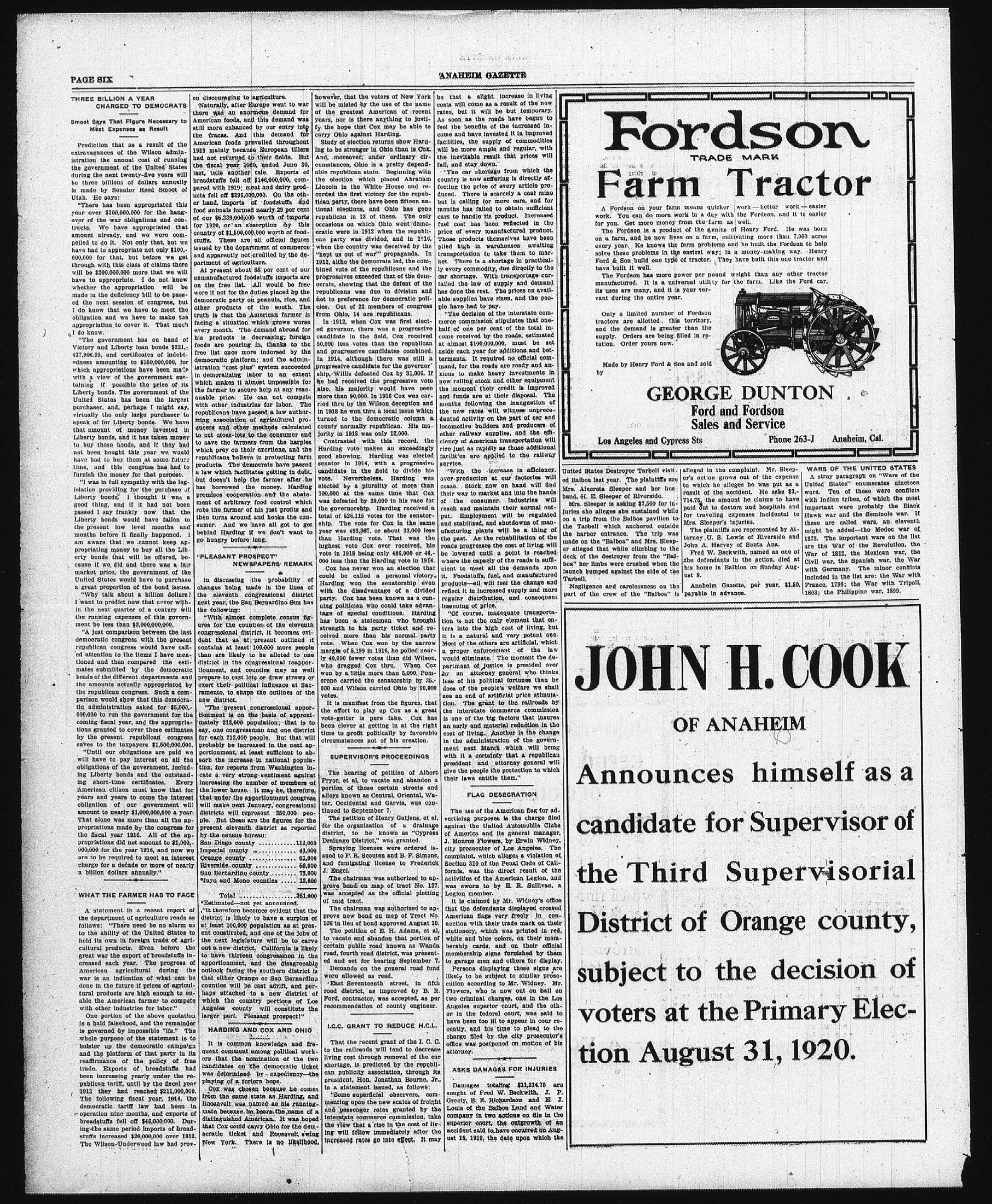
Searchable text
THREE BILLION A YEAR
CHARGED TO DEMOCRATS
Smoot Says That Figure Necessary to Meet Expenses as Result
Prediction that as a result of the extravagances of the Wilson administration the annual cost of running the government of the United States during the next twenty-five years will be three billions of dollars annually is made by Senator Reed Smoot of Utah. He says:
"There has been appropriated this year over $100,000,000 for the hangover of the war obligations and contracts. We have appropriated that amount already, and we were compelled to do it. Not only that, but we have had to appropriate not only $100,-000,000 for that, but before we get through with this class of claims there will be $200,000,000 more that we will have to appropriate. I do not know whether the appropriation will be made in the deficiency bill to be passed the next session of congress, but I do know that we have to meet the obligation and we have to make the appropriation to cover it. That much I do know.
"The government has on hand of Victory and Liberty loan bonds $221,-437,906.99, and certificates of indebtedness amounting to $150,000,000, for which appropriations have been made with a view of the government sustaining if possible the price of its Liberty bonds. The government of the United States has been the largest purchaser, and, perhaps I might say, virtually the only large purchaser to speak of for Liberty bonds. We have that amount of money invested in Liberty bonds, and it has taken money to buy those bonds, and if they had en discouraging to agriculture.
Naturally, after Europe went to war there was an enormous demand for American foods, and this demand was still more enhanced by our entry into the fracas. And this demand for American foods prevailed throughout 1919 mainly because European tillers had not returned to their fields. But the fiscal year 1920, ended June 30, last tells another tale. Exports of breadstuffs fell off $146,000,000, compared with 1919; meat and dairy products fell off $395,000,000. On the other hand, imports of foodstuffs and food animals formed nearly 29 per cent of our $2,390,000,000 worth of imports for 1920, or an absorption by this country of $1,500,000,000 worth of foodstuffs. These are all official figures issued by the department of commerce and apparently not credited by the department of agriculture.
At present about 88 per cent of our unmanufactured foodstuffs imports are on the free list. All would be free were it not for the duties placed by the democratic party on peanuts, rice, and other products of the south. The truth is that the American farmer is facing a situation which grows worse every month. The demand abroad for his products is decreasing; foreign foods are pouring in, thanks to the free list once more indorsed by the democratic platform; and the administration "cost plus" system succeeded in demoralizing labor to an extent which makes it almost impossible for the farmer to secure help at any reasonable price. He can not compete with other industries for labor. The republicans have passed a law authorizing association of agricultural producers and other methods calculated to cut cross-lots to the consumer and to save the farmers from the harples however, that the will be misled by one of the greatest years, nor is there thereby the hope that carry Ohio against Study of electioning to be stronger And, moreover, due circumstances, Ohio able republican state the election which Lincoln in the W ord corded the first vican party, there national elections, a republican in 13 occasions on which eratic were in 1911 can party was dis when the country w kept us out of war 1912, altho the denbined vote of the progressives exceed ocrats, showing that republicans was not to preference cities. Out of 22 men from Ohio, 14 are In 1912, when ed governor, there candidate in the 50,000 less votes and progressive c In 1914, although progressive candidate ship. Willis defeated also, his majority more than 90,000 ried thru by the War in 1918 he won thereturned to the d county normally majority in 1918 war Contrasted with Harding vote m
"I was in full sympathy with the legislation providing for the purchase of Liberty bonds. I thought it was a good thing, and if it had not been passed I say frankly now that the Liberty bonds would have fallen to the present low level months and months before it finally happened. I am aware that we cannot keep appropriating money to buy all the Liberty bonds that will be offered, because if we did and there was a fair market price, the government of the United States would have to purchase a great proportion of the bond issues.
"Why talk about a billion dollars? I want to predict now that never within the next quarter of a century will the running expenses of this government be less than $3,000,000,000."
"A just comparison between the last democratic congress with the present republican congress would have called attention to the items I have mentioned and then compared the estimates submitted by the democratic heads of the different departments and the amounts actually appropriated by the republican congress. Such a comparison would show that this democratic administration asked for $5,000,-000,000 to run the government for the coming fiscal year, and the appropriations granted to cover these estimates by the present republican congress saves to the taxpayers $1,500,000,000.
"Until our obligations are paid we will have to pay interest on all the obligations of the government, including Liberty bonds and the outstanding short-time certificates. Every American citizen must know that for years and years to come the interest obligation of our government will amount to nearly $1,000,000,000 a year. That alone was more than all the appropriations made by the congress for the fiscal year 1916. All of the appropriations did not amount to $1,000,-000,000 for the year 1916 and now we"
"PLEASANT PROSPECT"
NEWSPAPERS-REMARK
In discussing the probability of changes being made in the lines of the eleventh congressional district next year, the San Bernardino Sun has the following:
"With almost complete census figures for the counties of the eleventh congressional district, it becomes evident that as at present outlined it contains at least 100,000 more people than are likely to be allotted to one district in the congressional reapportionment, and counties may as well prepare to cast lots or draw straws or exert their political influence at Sacramento, to shape the outlines of the new district.
"The present congressional apportionment is on the basis of approximately 212,000 population; that is to say, one congressman and one district for each 212,000 people. But that will probably be increased in the next apportionment, at least sufficient to absorb the increase in national population, for reports from Washington indicate a very strong sentiment against increasing the number of members of the lower house. It may be, therefore, that under the apportionment congress will make next January' congressional districts will represent 250,000 people. But these are the figures for the present eleventh district as reported by the census bureau:
San Diego county ..... 112,000
Imperial county ..... 43,000
In 1914, although progressive candidate ship, Willis defeated him he had received more than 90,000. Ried thru by the W in 1918 he won turned to the d county normally w jority in 1918 was Contrasted with Harding vote most good showing. B senator in 1914 candidate in this vote. Nevertheless elected by a plus 100,000 at the time was defeated by a governorship total of 526,115 v ship. The vote year was 493,367 than Harding w highest vote Cox vote in 1918 being 000 less than the Cox has never could be called Harding won with the disadvantage party. Cox has been politician w tage of special strength to his celved more than vote. When Cox margin of 5,199 in 40,000 fewer who dragged Cox won by a little more erene carried th 000 and Wilson o votes.
It is manifest that the effort to pla vote-getter is been clever at g time to profit p circumstances n
SUPERVISOR
The hearing Pryor, et al., to portion of those alleys known as ter, Occidental tinued to September.
The petition o for the organiz district, to be Drainage District Spraying licen
will have to pay interest on all the obligations of the government, including Liberty bonds and the outstanding short-time certificates. Every American citizen must know that for years and years to come the interest obligation of our government will amount to nearly $1,000,000,000 a year. That alone was more than all the appropriations made by the congress for the fiscal year 1916. All of the appropriations did not amount to $1,000,000,000 for the year 1916, and now we are to be required to meet an interest charge for a decade or more of nearly a billion dollars annually."
WHAT THE FARMER HAS TO FACE
A statement in a recent report of the department of agriculture reads as follows: "There need be no alarm as to the ability of the United States to hold its own in foreign trade of agricultural products. Even before the great war the export of breadstuffs increased each year. The progress of American agricultural during the war is an indication of what can be done in the future if prices of agricultural products are high enough to enable the American farmer to compete with other industries for labor."
One portion of the above quotation is a bald falsehood, and the remainder is governed by impossible "ifs." The whole purpose of the statement is to bolster up the democratic campaign and the platform of that party in its reaffirmance of the policy of free trade. Exports of breadstuffs had been increasing yearly under the republican tariff, until by the fiscal year 1913 they had reached $211,000,000. The following fiscal year, 1914, the democratic tariff law had been in operation nine months, and exports of breadstuffs fell off $46,000,000. During the same period imports of breadstuffs increased $20,000,000 over 1913. The Wilson-Underwood law had prov-
Total ... 351,000
*Estimated—not yet announced.
"It therefore becomes evident that the district is likely to have a surplus of at least 100,000 population as at present constituted, and one of the jobs of the next legislature will be to carve out a new district. California is likely to have thirteen congressmen in the apportionment, and the disagreeable outlook facing the southern district is that either Orange or San Bernardino counties will be cast adrift, and perhaps attached to a new district of which the country portions of Los Angeles county will constitute the larger part. Pleasant prospect!"
HARDING AND COX AND OHIO
It is common knowledge and frequent comment among political workers that the nomination of the two candidates on the democratic ticket was determined by expediency—the playing of a forlorn hope.
Cox was chosen because he comes from the same state as Harding, and Roosevelt was named as his running-mate because he bears the name of a distinguished American. It was hoped that Cox could carry Ohio for the democratic ticket and Roosevelt swing New York. There is no likelihood,
The hearing on Pryor, et al., to portion of those alleys known as Ter, Occidental timed to September.
The petition owe for the organizer district, to be Drainage District.
Spraying licensed to F. R. Scott and fumigating J. Engel.
The chairman prove bond on was accepted as said tract.
The chairman prove new bond 126 in lieu of bond.
The petition to vacate and a certain public road, fourth road ed and set for Demands on were allowed at East Seventh road district, at Ford, contractor recommendation.
I.C.C. GRANT
That the receipt to the railroad living cost through shortage, is pre can publicity a president, Hon. In a statement:
"Some superintendent upon this and passenger interstate commute the view that an ing will follow increased rates."
however, that the voters of New York will be misled by the use of the name of the greatest American of recent years, nor is there anything to justify the hope that Cox may be able to carry Ohio against Harding.
Study of election returns show Harding to be stronger in Ohio than is Cox. And, moreover, under ordinary circumstances, Ohio is a pretty dependable republican state. Beginning with the election which placed Abraham Lincoln in the White House and recorded the first victory for the republican party, there have been fifteen national elections, and Ohio has gone republican in 13 of these. The only occasions on which Ohio went democratic were in 1912 when the republican party was divided, and in 1916, when the country was deceived by the "kept us out of war" propaganda. In 1912, altho the democrats led, the combined vote of the republicans and the progressives exceeded that of the democrats, showing that the defeat of the republicans was due to division and not preference for democratic policies. Out of 22 members of congress from Ohio, 14 are republicans.
In 1912, when Cox was first elected governor, there was a progressive candidate in the field, Cox received 50,000 less votes than the republican and progressive candidates combined. In 1914, although there was still a progressive candidate for the governor's ship, Willis defeated Cox by 31,000. If he had received the progressive vote also, his majority would have been more than 90,000. In 1916 Cox was carried thru by the Wilson deception and in 1918 he won thru a local issue which turned to the democratic column a county normally republican. His majority in 1918 was only 12,000.
Contrasted with this record, the Harding vote makes an exceedingly
be that a slight increase in living costs will come as a result of the new rates, but it will be but temporary. As soon as the roads have begun to feel the benefits of the increased income and have invested it in improved facilities, the supply of commodities will be more ample and regular, with the inevitable result that prices will fall, and stay down.
"The car shortage from which the country is now suffering is directly affecting the price of every article produced. There is scarcely a coal mine but is calling for more cars, and for months has failed to obtain sufficient cars to handle its product. Increased fuel cost has been reflected in the price of every manufactured product. Those products themselves have been piled high in warehouses awaiting transportation to take them to market. There is a shortage in practically every commodity, due directly to the car shortage. With transportage curtailed the law of supply and demand has done the rest. The prices on available supplies have risen, and the people have had to pay.
"The decision of the interstate commerce commission stipulates that one-half of one per cent of the total income received by the roads, estimated at almost $100,000,000, must be set aside each year for additions and betterments. It required no official command, for the roads are ready and anxious to make heavy investments in new rolling stock and other equipment the moment their credit is improved and funds are at their disposal. The months following the inauguration of the new rates will witness unprecedented activity on the part of car and locomotive builders and producers of other railway supplies, and the efficiency of American transportation will rise just as rapidly as those additional..."
In 1914, although there was still a progressive candidate for the governorship, Willis defeated Cox by 31,000. If he had received the progressive vote also, his majority would have been more than 90,000. In 1916 Cox was carried thru by the Wilson deception and in 1918 he won thru a local issue which turned to the democratic column a county normally republican. His majority in 1918 was only 12,000.
Contrasted with this record, the Harding vote makes an exceedingly good showing. Harding was elected senator in 1914, with a progressive candidate in the field to divide his vote. Nevertheless, Harding was elected by a plurality of more than 100,000 at the same time that Cox was defeated by 29,000 in his race for the governorship. Harding received a total of 526,115 votes for the senatorship. The vote for Cox in the same year was 493,367, or about 33,000 less than Harding vote. That was the highest vote Cox ever received, his vote in 1918 being only 486,000 or 46,-000 less than the Harding vote in 1914.
Cox has never won an election that could be called a personal victory. Harding won the senatorship even with the disadvantage of a divided party. Cox has been known as a cunning politician who could take advantage of special conditions. Harding has been a statesman who brought strength to his party ticket and received more than his normal party vote. When Cox won by the narrow margin of 5,199 in 1916, he polled nearly 40,000 fewer votes than did Wilson, who dragged Cox thru. When Cox won by a little more than 5,000, Pomerene carried the senatorship by 35,-000 and Wilson carried Ohio by 90,000 votes.
It is manifest from the figures, that the effort to play up Cox as a great vote-getter is pure fake. Cox has been clever at getting in at the right time to profit politically by favorable circumstances not of his creation.
SUPERVISOR'S PROCEEDINGS
The hearing of petition of Albert Pryor, et al., to vacate and abandon a portion of those certain streets and alleys known as Central, Oriental, Water, Occidental and Garvla, was continued to September 7.
The petition of Henry Gatjens, et al., for the organization of a drainage district, to be known as "Cypress Drainage District," was granted.
Spraying licenses were ordered isterments. It required no official command, for the roads are ready and anxious to make heavy investments in new rolling stock and other equipment the moment their credit is improved and funds are at their disposal. The months following the inauguration of the new rates will witness unprecedented activity on the part of car and locomotive builders and producers of other railway supplies, and the efficiency of American transportation will rise just as rapidly as those additional facilites are applied to the railway service.
"With the increase in efficiency, over-production at our factories will cease. Stock now on hand will find their way to market and into the hands of the consumer. Industries will reach and maintain their normal output. Employment will be regulated and stabilized, and shutdowns of manufacturing plants will be a thing of the past. As the rehabilitation of the roads progresses the cost of living will be lowered until a point is reached where the capacity of the roads is sufficient to meet all the demands upon it. Foodstuffs, fuel, and manufactured products—all will feel the change and reflect it in increased supply and more regular distribution, and consequent lessening of price."
Of course, inadequate transportation is not the only element that enters into the high cost of living, but it is a natural and very potent one. Most of the others are artificial, which a proper enforcement of the law would eliminate. The moment the department of justice is presided over by an attorney general who thinks less of his political fortunes than he does of the people's welfare we shall see an end of artificial price stimulation. The grant to the railroads by the interstate commerce commission is one of the big factors that insures an early and material reduction in the cost of living. Another is the change in the administration of the government next March which will bring with it a certainty that a republican president and attorney general will give the people the protection to which their laws entitle them."
FLAG DESECRATION
The use of the American flag for advertising purposes is the charge filed against the United Automobile Clubs of America and its general manager, J. Monroe Flowers, by Erwin Widney, city prosecutor of Los Angeles.
The hearing of petition of Albert Pryor, et al., to vacate and abandon a portion of those certain streets and alleys known as Central, Oriental, Water, Occidental and Garvia, was continued to September 7.
The petition of Henry Gatjens, et al., for the organization of a drainage district, to be known as "Cypress Drainage District," was granted.
Spraying licenses were ordered issued to F. R. Scouten and B. F. Simons, and fumigating license to Frederick J. Engel.
The chairman was authorized to approve bond on map of tract No. 127. was accepted as the official plotting of said tract.
The chairman was authorized to approve new bond on map of Tract No. 126 in lieu of bond approved August 10.
The petition of E. H. Adams, et al., to vacate and abandon that portion of certain public road known as Wanda road, fourth road district, was presented and set for hearing September 7.
Demands on the general road fund were allowed as read.
East Seventeenth street, in fifth road district, as improved by B. R. Ford, contractor, was accepted, as per recommendation of county engineer.
I.C.C. GRANT TO REDUCE H.C.L.
That the recent grant of the I. C. C. to the railreads will tend to decrease living cost through removal of the car shortage, is predicted by the republican publicity association, through its president, Hon. Jonathan Bourne, Jr., in a statement issued, as follows:
"Some superficial observers, commenting upon the new scales of freight and passenger rates granted by the interstate commerce commission, take the view that a rise in the cost of living will follow immediately after the increased rates go into effect. It may
FLAG DESECRATION
The use of the American flag for advertising purposes is the charge filed against the United Automobile Clubs of America and its general manager, J. Monroe Flowers, by Erwin Widney, city prosecutor of Los Angeles. The complaint, which alleges a violation of Section 310 of the Penal Code of California, was the direct result of the activities of the American Legion, and was sworn to by E. R. Sullivan, a Legion member.
It is claimed by Mr. Widney's office that the defendants displayed crossed American flags very freely in connection with their trade mark on their stationery, which was printed in red, white and blue colors, on their membership cards, and on their official membership signs furnished by them to garage men and others for display.
Persons displaying these signs are likely to be subject to similar prosecution according to Mr. Widney. Mr. Flowers, who is now out on bail on two criminal charges, one in the Los Angeles superior court, and the other in the federal court, was said to have been too ill to appear in court recently, and his time to plead to the charge filed by the city prosecutor's office was postponed on motion of his attorney.
ASKS DAMAGES FOR INJURIES
Damages totaling $11,214.75 are sought of Fred W. Beckwith, J. P. Greely, E. E. Richardson and E. J. Louis of the Balboa Land and Water company in two actions on file in the superior court, the outgrowth of an accident said to have occurred on August 18, 1919, the date upon which the
Fordson
TRADE MARK
farm Tractor
Fordson on your farm means quicker work—better work—easier
you can do more work in a day with the Fordson, and it is easier
to get more money from the farm as well.
Fordson is a product of the genius of Henry Ford. He was born
in, and he now lives on a farm, cultivating more than 7,000 acres
of farmland. Ke knows the farm problems and he built the Fordson to help
use problems in the easiest way; in a money-making way. Henry
Fordson build one type of tractor. They have built this one tractor and
it it well.
Fordson has more power per pound weight than any other tractor
built. It is a universal utility for the farm. Like the Ford car,
it are many, and it is your serving the entire year.
A limited number of Fordson
are allotted this territory,
demand is greater than the
Orders are being filled in reOrder yours now.
by Henry Ford & Son and sold
GEORGE DUNTON
Ford and Fordson
Sales and Service
Angeles and Cypress Sts
Phone 263-J Anaheim, Cal.
GEORGE DUNTON
Ford and Fordson
Sales and Service
Los Angeles and Cypress Sts
Phone 263-J Anaheim, Cal.
The plaintiffs are per and her husof Riverside.
King $7,500 for inthe sustained while Balboa pavilion to
anchored outside
ce. The trip was
"a" and Mrs. Sleepile climbing to the
ver from the "Balis crushed when the
inst the side of tae
carelessness on the
of the "Balboa" is
alleged in the complaint. Mr. Sleeper's action grows out of the expense
to which he alleges he was put as a result of the accident. He asks $3,-714.75, the amount he claims to have paid out to doctors and hospitals and for traveling expenses incidental to Mrs. Sleeper's injuries.
The plaintiffs are represented by Attorney U. S. Lewis of Riverside and John A. Harvey of Santa Ana.
Fred W. Beckwith, named as one of the defendants in the action, died at his home in Balbloa on Sunday August 8.
Anaheim Gazette, per year, $1.50, payable in advance.
WARS OF THE UNITED STATES
A stray paragraph on "Wars of the United States" enumerates nineteen wars. Ten of these were conflicts with Indian tribes, of which the most important were probably the Black Hawk war and the Seminole war. If these are called wars, an eleventh might be added—the Modoc war of 1873. The important wars on the list are the War of the Revolution, the War of 1812, the Mexican war, the Civil war, the Spanish war, the War with Germany. The minor conflicts included in the list are: the War with France, 1798; the War with Tripoli, 1803; the Philippine war, 1899.
JOHN H. COOK
OF ANAHEIM
announces himself as a candidate for Supervisor of
announces himself as a candidate for Supervisor of Third Supervisorial District of Orange county, subject to the decision of voters at the Primary Election August 31, 1920.