anaheim-gazette 1920-07-08
Scanned page
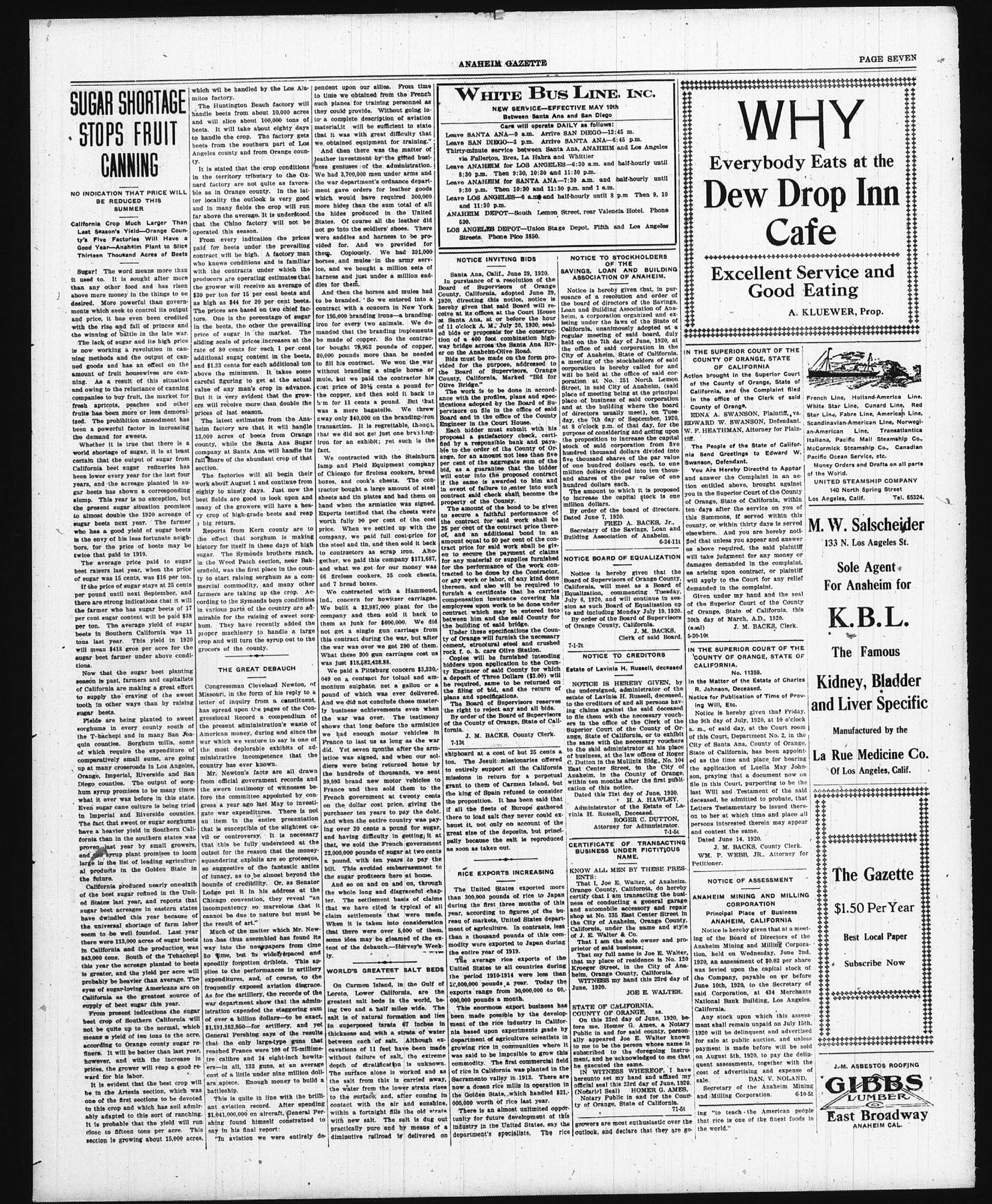
Searchable text
SUGAR SHORTAGE STOPS FRUIT CANNING
NO INDICATION THAT PRICE WILL BE REDUCED THIS SUMMER
California Crop Much Larger Than Last Season's Yield—Orange County's Five Factories Will Have a Good Year—Anaheim Plant to Slice Thirteen Thousand Acres of Beets
Sugar! The word means more than it used to. It is sought after more than any other food and has risen above mere money in the things to be desired. More powerful than governments which seek to control its output and price, it has even been credited with the rise and fall of princes and the winning of battle in the late war.
The lack of sugar and its high price is now working a revolution in canning methods and the output of canned goods and has an effect on the amount of fruit housewives are canning. As a result of this situation and owing to the reluctance of canning companies to buy fruit, the market for fresh apricots, peaches and other fruits has been more or less demoralized. The prohibition amendment has been a powerful factor in increasing the demand for sweets.
Whether it is true that there is a which will be handled by the Los Alamitos factory.
The Huntington Beach factory will handle beets from about 10,000 acres and will slice about 100,000 tons of beets. It will take about eighty days to handle the crop. The factory gets beets from the southern part of Los Angeles county and from Orange county.
It is stated that the crop conditions in the territory tributary to the Oxnard factory are not quite as favorable as in Orange county. In the latter locality the outlook is very good and in many fields the crop will run far above the average. It is understood that the Chino factory will not be operated this season.
From every indication the prices paid for beets under the prevailing contract will be high. A factory man who knows conditions and is familiar with the contracts under which the producers are operating estimates that the grower will receive an average of $30 per ton for 15 per cent beets and as high as $44 for 20 per cent beets. The prices are based on two chief factors. One is the percentage of sugar in the beets, the other the prevailing price of sugar in the market. The sliding scale of prices increases at the rate of 80 cents for each 1 per cent additional sugar content in the beets, and $1.33 cents for each additional ton above the minimum. It takes some careful figuring to get at the actual value of any man's crop in advance. But it is very evident that the growers will receive more than double the prices of last season.
The latest estimates from the Anaheim factory are that it will handle 13,000 acres of beets from Orange county, while the Santa Ana Sugar dependent upon our time we obtain such planes for tractors could provide to a complete design material, it will be that it was with we obtained equipment.
And then there were leather investment news geniuses of We had 3,700,000 m² of war department gave orders which would have more hides than the hide's product States. Of course not go into the soils were saddles and vided for. And them. Copiously horses, and mules ice, and we bought harness and just dies for them.
And then he had to be branded. 'S contract with a co for 195,000 branding iron for every two manded that the be made of copper bought 78,952 20,000 pounds me to fill his contract without branding mule, but we paid cost price of 39% the copper, and thrm for 11 cents was a mere ba away only $40,000 transaction. It is that we did not give iron for an exhibit
ning methods and the output of canned goods and has an effect on the amount of fruit housewives are canning. As a result of this situation and owing to the reluctance of canning companies to buy fruit, the market for fresh apricots, peaches and other fruits has been more or less demoralized. The prohibition amendment has been a powerful factor in increasing the demand for sweets.
Whether it is true that there is a world shortage of sugar, it is at least certain that the output of sugar from California beet sugar refineries has been lower every year for the last four years, and the acreage planted in sugar beets has shown a corresponding slump. This year is no exception, but the present sugar situation promises to almost double the 1920 acreage of sugar beets next year. The farmer who has a good yield of sugar beets is the envy of his less fortunate neighbors, for the price of beets may be twice that paid in 1919.
The average price paid to sugar beet raisers last year, when the price of sugar was 15 cents, was $16 per ton.
If the price of sugar stays at 25 cents per pound until next September, and there are strong indications that it will the farmer who has sugar beets of 17 per cent sugar content will be paid $38 per ton. The average yield of sugar beets in Southern California was 11 tons last year. This yield in 1920 will mean $418 gros per acre for the sugar beet farmer under above conditions.
Now that the sugar beet planting season is past, farmers and capitalists of California are making a great effort to supply the craving of the sweet tooth in other ways than by raising sugar beets.
Fields are being planted to sweet sorghums in every county south of the T-hachepi and in many San Joaquin counties. Sorghum mills, some of which require the expenditure of comparatively small sums, are going up at many crossroads in Los Angeles, Orange, Imperial, Riverside and San Diego counties. The output of sorghum syrup promises to be many times what it ever was before in this state. Even sugar cane culture is being tried in Imperial and Riverside counties. The fact that sweet or sugar sorghums have a heavier yield in Southern California than in the southern states was proven last year by small growers,
additional sugar content in the beets, and $1.33 cents for each additional ton above the minimum. It takes some careful figuring to get at the actual value of any man's crop in advance. But it is very evident that the growers will receive more than double the prices of last season.
The latest estimates from the Anaheim factory are that it will handle 13,000 acres of beets from Orange county, while the Santa Ana Sugar company at Santa Ana will handle its full share of the abundant crop of that section.
The factories will all begin their work about August 1 and continue from eighty to ninety days. Just now the beet fields are good to look upon and many of the growers will have a heavy crop of high-grade beets and reap a big return.
Reports from Kern county are to the effect that sorghum is making history for itself in these days of high sugar. The Symonds brothers ranch, in the Weed Patch section, near Bakersfield, was the first place in the county to start raising sorghum as a commercial commodity, and many other farmers are taking up the crop. According to the Symonds boys conditions in various parts of the country are admirable for the raising of sweet sorghum. They have recently added the proper machinery to handle a large crop and will turn the syrup out to the grocers of the county.
THE GREAT DEBAUCH
Congressman Cleveland Newton, of Missouri, in the form of his reply to a letter of inquiry from a constituent, has spread upon the pages of the Congressional Record a compendium of the present administration's waste of American money, during and since the war which we venture to say is one of the most deplorable exhibits of administrative incompetence that the country has ever known.
Mr. Newton's facts are all drawn from official government records and the sworn testimony of witnesses before the committee appointed by congress a year ago last May to investigate war expenditures. There is not an item in the entire presentation that is susceptible of the slightest caval or controversy. It is necessary that this be fully understood at the reason for that the money-
20,000 pounds must fill his contract without branding mule, but we paid cost price of 39½% the copper, and then for 11 cents was a mere bargain away only $40,000 transaction. It is that we did not go iron for an exhibit fact.
We contracted lamp and Field of Chicago for five boxes, and cook tractor bought a sheetts and tin plant hand when she Experts testified worth fully 90 pice. When we company, we paid the steel and tin, to contractors together, we paid them and what we got 66 fireless cooks and 7 bread boxes.
We contracted Ind., concern for We built a $2,500 company and then them as junk fills not get a single this contract during the war was over What these 200 was just $18,582 We paid a Piton 049 on a contract monium sulphate pound of which And we did not only business achieve the war was on shows that long we had enough France to last till Yet seven injustice was signed diers were behind the hundreds of 39,993 brand new France and then French governmen on the dollar purchaser ten And when they ing over 20 cents and having diffie that, we sold t
comparatively small sums, are going up at many crossroads in Los Angeles, Orange, Imperial, Riverside and San Diego counties. The output of sorghum syrup promises to be many times what it ever was before in this state. Even sugar cane culture is being tried in Imperial and Riverside counties. The fact that sweet or sugar sorghums have a heavier yield in Southern California than in the southern states was proven last year by small growers, and the syrup plant promises to loom large in the list of leading agricultural products in the Golden State in the future.
California produced nearly one-sixth of the beet sugar refined in the United States last year, and reports that sugar beet acreages in eastern states have dwindled this year because of the universal shortage of farm labor seem to be well founded. Last year there were 113,000 acres of sugar beets in California and the production was 843,000 tons. South of the Tehachepli this year the acreage planted to beets is greater, and the yield per acre will probably be heavier than average. The eyes of sugar-loving Americans are on California as the greatest source of supply of beet sugar this year.
From present indications the sugar beet crop of Southern California will not be quite up to the normal, which means a yield of ten tons to the acre, according to Orange county sugar refiners. It will be better than last year, however, and with the increase in prices, the grower will reap a good reward for his labor.
It is evident that the best crop will be in the Artesia section, which was one of the first sections to be devoted to this crop and which has soil admirably adapted to this sort of ranching. It is probable that the yield will run close to fifteen tons per acre. This section is growing about 15,000 acres,
Mr. Newton's facts are all drawn from official government records and the sworn testimony of witnesses before the committee appointed by congress a year ago last May to investigate war expenditures. There is not an item in the entire presentation that is susceptible of the slightest cavil or controversy. It is necessary that this be fully understood at the outset for the reason that the money-squandering exploits are so grotesque, so suggestive of the fantastic antics of lunacy, as to be almost beyond the bounds of credibility. Or, as Senator Lodge put it in his address at the Chicago convention, they reveal "an incompentency so marvelous that it cannot be due to nature but must be the result of art."
Much of the matter which Mr. Newton has thus assembled has found its way into the newspapers from time to time, but in widely spaced and speedily forgotten driblets. This applies to the performances in artillery expenditures, and, of course, to the frequently exposed aviation disgrace. As for the artillery, the records of the war department show that the administration expended the staggering sum of over a billion dollars—to be exact, $1,191,182,850—for artillery, and yet General Pershing says of the results that the only large-type guns that reached France were 109 of 75-millimeter calibre and 24 eight-inch howitzers—in all, 133 guns, at an average cost of a little under nine million dollars apiece. Enough money to build a battleship.
This is quite in line with the brilliant aviation record. After spending $1,041,000,000 on aircraft, General Pershing found himself constrained to say in his final report:
"In aviation we were entirely de-
justice was signed diers were below the hundreds of 39,993 brand new France and then French governmen on the dollar purchaser ten And when the ing over 20 cents and having diff that, we sold t 22,000,000 pounds a pound, with bill. This avoids the sugar profi
And so on at the whole longer. The settl that we have a claim settlement When it is ta that there were some idea may tent of the dely.
WORLD'S GREAT
On Carmen Loreto, Lower greatest salt ing two and a salt is of natu in superposed thickness and between each cavations of without failure depth of str The surface of the salt from the water frost to the surface contact within a forty with new sa practically p diminutive re
ANAHEIM GAZETTE
WHITE BUS LINE, INC.
NEW SERVICE—EFFECTIVE MAY 10th
Between Santa Ana and San Diego
Cars will operate DAILY as follows:
Leave SANTA ANA—9 a.m. Arrive SAN DIEGO—12:45 m.
Leave SAN DIEGO—3 p.m. Arrive SANTA ANA—6:45 p.m.
Thirty-minute service between Santa Ana, ANAHEIM and Los Angeles via Fullerton, Brea, La Habra and Whittier.
Leave ANAHEIM for LOS ANGELES—6:30 a.m. and half-hourly until 8:30 p.m. Then 9:30, 10:30 and 11:30 p.m.
Leave ANAHEIM for SANTA ANA—7:30 a.m. and half-hourly until 9:30 p.m. Then 10:30 and 11:30 p.m. and 1 a.m.
Leave LOS ANGELES—6 a.m. and half-hourly until 8 p.m. Then 9, 10 and 11:30 p.m.
ANAHEIM DEPOT—South Lemon Street, rear Valencia Hotel. Phone 520.
LOS ANGELES DEPOT—Union Stage Depot, Fifth and Los Angeles Streets. Phone Pico 3850.
NOTICE INVITING BIDS
Santa Ana, Calif., June 29, 1920.
In pursuance of a resolution of the Board of Supervisors of Orange County, California, adopted June 29, 1920, directing this notice, notice is hereby given that said Board will receive at its offices at the Court House at Santa Ana, at or before the hour of 11 o'clock A.M., July 20, 1920, sealed bids or proposals for the construction of a 400 foot combination highway bridge across the Santa Ana River on the Anaheim-Olive Road.
Bids must be made on the form provided for the purpose, addressed to the Board of Supervisors, Orange County, California, Marked "Bid for Olive Bridge."
The work is to be done in accordance with the profiles, plans and specifications adopted by the Board of Supervisors on file in the office of said Board and in the office of the County Engineer in the Court House.
Each bidder must submit with his proposal a satisfactory check, certified by a responsible bank and payable to the order of the County of Orlando.
NOTICE TO STOCKHOLDERS OF THE SAVINGS, LOAN AND BUILDING ASSOCIATION OF ANAHEIM.
Notice is hereby given that, in pursuance of a resolution and order of the board of directors of the Savings, Loan and Building Association of Anaheim, a corporation organized and existing under the laws of the State of California, unanimously adopted at a regular meeting of said board, duly held on the 7th day of June, 1920, at the office of said corporation in the City of Anaheim, State of California, a meeting of the stockholders of said corporation is hereby called for and will be held at the office of said corporation at No. 251 North Lemon Street, in said City of Anaheim, (said place of meeting being at the principal place of business of said corporation and at the building where the board of directors usually meet), on Tuesday, the 7th day of September, 1920, at 8 o'clock p.m. of that day, for the purpose of considering and acting upon the proposition to increase the capital stock of said corporation from five millions.
In their time from show the onion and a head and reap are to making of high ranch, Car Bak one councily other pop. Accordiances are adget sorged the large to the H. Newton, of apply to a constituent, the Conduit of waste since the is one of adhat all drawn words andesses be by condo investiire is not presentation tightest ca necessary at the money.
We contracted with the Steinburn lamp and Field Equipment company of Chicago for fireless cookers, bread boxes, and cook's chests. The contractor bought a large amount of steel sheets and tin plates and had them on hand when the armistice was signed. Experts testified that the chests were worth fully 90 per cent of the cost price. When we settled up with the company, we paid full cost-price for the steel and tin, and then sold it back to contractors as scrap iron. Altogether, we paid this company $171,687, and what we got for our money was 66 fireless cookers, 25 cook chests, and 7 bread boxes.
We contracted with a Hammond, Ind., concern for howitzer carriages. We built a $2,987,000 plant for the company and then sold it back to them as junk for $600,000. We did not get a single gun carriage from this contract during the war, but after the war was over we got 200 of them. What these 200 gun carriages cost us was just $18,582,428.88.
We paid a Pittsburg concern $3,330,049 on a contract for toluol and ammonium sulphate, not a gallon or a pound of which was ever delivered. And we did not conclude these mastery business achievements even when the war was over. The testimony shows that long before the armistice we had enough motor vehicles in France to last us as long as the war did. Yet seven months after the armistice was signed, and when our soldiers were being returned home by the hundreds of thousands, we sent 39,993 brand new motor vehicles to France and then sold them to the French government at twenty cents on the dollar cost price, giving the purchaser ten years to pay the debt. And when the entire country was paying over 20 cents a pound for sugar, and having difficulty in getting it at that, we sold the French government 20,000 pounds more than he needed to fill his contract. We won the war without branding a single horse or mule, but we paid the contractor his cost price of 39½ cents a pound for the copper, and then sold it back to him for 11 cents a pound. But that was a mere bagatelle. We threw away only $40,000 on the branding-Iron transaction. It is regrettable though that we did not get just one branding-Iron for an exhibit; yet such is the fact.
We contracted with the Steinburn lamp and Field Equipment company of Chicago for fireless cookers, bread boxes, and cook's chests. The contractor bought a large amount of steel sheets and tin plates and had them on hand when the armistice was signed. Experts testified that the chests were worth fully 90 per cent of the cost price. When we settled up with the company, we paid full cost-price for the steel and tin, and then sold it back to contractors as scrap iron. Altogether, we paid this company $171,687, and what we got for our money was 66 fireless cookers, 25 cook chests, and 7 bread boxes.
We contracted with a Hammond, Ind., concern for howitzer carriages. We built a $2,987,000 plant for the company and then sold it back to them as junk for $600,000. We did not get a single gun carriage from this contract during the war, but after the war was over we got 200 of them. What these 200 gun carriages cost us was just $18,582,428.88.
We paid a Pittsburg concern $3,330,049 on a contract for toluol and ammonium sulphate, not a gallon or a pound of which was ever delivered. And we did not conclude these mastery business achievements even when the war was over. The testimony shows that long before the armistice we had enough motor vehicles in France to last us as long as the war did. Yet seven months after the armistice was signed, and when our soldiers were being returned home by the hundreds of thousands, we sent 39,993 brand new motor vehicles to France and then sold them to the French government at twenty cents on the dollar cost price, giving the purchaser ten years to pay the debt. And when the entire country was paying over 20 cents a pound for sugar, and having difficulty in getting it at that, we sold the French government 20,000 pounds more than he needed to fill his contract. We won the war without branding a single horse or mule, but we paid the contractor his cost price of 39½ cents a pound for the copper, and then sold it back to him for 11 cents a pound. But that was a mere bagatelle. We threw away only $40,000 on the branding-Iron transaction. It is regrettable though that we did not get just one branding-Iron for an exhibit; yet such is the fact.
We contracted with the Steinburn lamp and Field Equipment company of Chicago for fireless cookers, bread boxes, and cook's chests. The contractor bought a large amount of steel sheets and tin plates and had them on hand when the armistice was signed. Experts testified that the chests were worth fully 90 per cent of the cost price. When we settled up with the company, we paid full cost-price for the steel and tin, and then sold it back to contractors as scrap iron. Altogether, we paid this company $171,687, and what we got for our money was 66 fireless cookers, 25 cook chests, and 7 bread boxes.
We contracted with a Hammond, Ind., concern for howitzer carriages. We built a $2,987,000 plant for the company and then sold it back to them as junk for $600,000. We did not get a single gun carriage from this contract during the war, but after the war was over we got 200 of them. What these 200 gun carriages cost us was just $18,582,428.88.
We paid a Pittsburg concern $3,330,049 on a contract for toluol and ammonium sulphate, not a gallon or a pound of which was ever delivered. And we did not conclude these mastery business achievements even when the war was over. The testimony shows that long before the armistice we had enough motor vehicles in France to last us as long as the war did. Yet seven months after the armistice was signed, and when our soldiers were being returned home by the hundreds of thousands, we sent 39,993 brand new motor vehicles to France and then sold them to the French government at twenty cents on the dollar cost price, giving the purchaser ten years to pay the debt. And when the entire country was paying over 20 cents a pound for sugar, and having difficulty in getting it at that, we sold the French government 20,000 pounds more than he needed to fill his contract. We won the war without branding a single horse or mule, but we paid the contractor his cost price of 39½ cents a pound for the copper, and then sold it back to him for 11 cents a pound. But that was a mere bagatelle. We threw away only $40,000 on the branding-Iron transaction. It is regrettable though that we did not get just one branding-Iron for an exhibit; yet such is the fact.
We contracted with the Steinburn lamp and Field Equipment company of Chicago for fireless cookers, bread boxes, and cook's chests. The contractor bought a large amount of steel sheets and tin plates and had them on hand when the armistice was signed. Experts testified that the chests were worth fully 90 per cent of the cost price. When we settled up with the company, we paid full cost-price for the steel and tin, and then sold it back to contractors as scrap iron. Altogether, we paid this company $171,687, and what we got for our money was 66 fireless cookers, 25 cook chests, and 7 bread boxes.
We contracted with a Hammond, Ind., concern for howitzer carriages. We built a $2,987,000 plant for the company and then sold it back to them as junk for $600,000. We did not get a single gun carriage from this contract during the war, but after the war was over we got 200 of them. What these 200 gun carriages cost us was just $18,582,428.88.
We paid a Pittsburg concern $3,330,049 on a contract for toluol and ammonium sulphate, not a gallon or a pound of which was ever delivered. And we did not conclude these mastery business achievements even when the war was over. The testimony shows that long before the armistice we had enough motor vehicles in France to last us as long as the war did. Yet seven months after the armistice was signed, and when our soldiers were being returned home by the hundreds of thousands, we sent 39,993 brand new motor vehicles to France and then sold them to the French government at twenty cents on the dollar cost price, giving the purchaser ten years to pay the debt. And when the entire country was paying over 20 cents a pound for sugar, and having difficulty in getting it at that, we sold the French government 20,000 pounds more than he needed to fill his contract. We won the war without branding a single horse or mule, but we paid the contractor his cost price of 39½ cents a pound for the copper, and then sold it back to him for 11 cents a pound. But that was a mere bagatelle. We threw away only $40,000 on the branding-Iron transaction. It is regrettable though that we did not get just one branding-Iron for an exhibit; yet such is the fact.
We contracted with the Steinburn lamp and Field Equipment company of Chicago for fireless cookers, bread boxes, and cook's chests. The contractor bought a large amount of steel sheets and tin plates and had them on hand when the armistice was signed. Experts testified that the chests were worth fully 90 per cent of the cost price. When we settled up with the company, we paid full cost-price for the steel and tin, and then sold it back to contractors as scrap iron. Altogether, we paid this company $171,687,and what we got for our money was 66 fireless cookers,25 cook chests,and 7 bread boxes.
We contracted with a Hammond,Ind., concern for howitzer carriages. We built a $2,987,000 plant forthecompanyandthen Solditbacktothemas junkfor$600,Oundow.ThewordofadministrationofanotherboardisnotincludedwiththecompanyandthenSolditbacktothemas junkfor$600,Oundow.ThewordofadministrationofanotherboardisnotincludedwiththecompanyandthenSolditbacktothemas junkfor$600,Oundow.ThewordofadministrationofanotherboardisnotincludedwiththecompanyandthenSolditbacktothemas junkfor$6
Justice was signed, and when our soldiers were being returned home by the hundreds of thousands, we sent 39,993 brand new motor vehicles to France and then sold them to the French government at twenty cents on the dollar cost price, giving the purchaser ten years to pay the debt. And when the entire country was paying over 20 cents a pound for sugar, and having difficulty in getting it at that, we sold the French government 22,000,000 pounds of sugar at two cents a pound, with ten years to pay the bill. This avoided embarrassment to the sugar profiteers here at home.
And so on and on and on, through the whole long and disgraceful chapter. The settlement basis of claims that we have cited is typical of all claim settlements that were made. When it is taken into consideration that there were over 5,000 of them, some idea may be gleaned of the extent of the debauch—Harvey's Weekly.
WORLD'S GREATEST SALT BEDS
On Carmen Island, in the Gulf of Loreto, Lower California, are the greatest salt beds in the world, being two and a half miles wide. The salt is of natural formation and lies in superposed tsrata 67 inches in thickness and with a strata of water between each of salt. Although excavations of 11 feet have been made without failure of salt, the extreme depth of stratification is unknown. The surface alone is worked and as the salt from this is carried away, the water from the lower strata rises to the surface, and, after coming in contact with the air and sunshine, within a fortnight fills the old strata with new salt. The salt is dug out practically pure and by means of a diminutive railroad is delivered on
RICE EXPORTS INCREASING
The United States exported more than 300,000 pounds of rice to Japan during the first three months of this year, according to figures of the bureau of markets, United States department of agriculture. In contrasts, less than a thousand pounds of this commodity were exported to Japan during the entire year of 1919.
The average rice exports of the United States to all countries during the period 1910-1914 were less than 20,000,000 pounds a year. Today the exports range from 30,000,000 to 60.,000,000 pounds a month.
This enormous export business has been made possible by the development of the rice industry in California based upon experiments made by department of agriculture scientists in growing rice in communities where it was said to be impossible to grow this commodity. The first commercial field of rice in California was planted in the Sacramento valley in 1912. There are now a dozen rice mills in operation in the Golden State, which handled $21.,000,000 worth of rice last year.
There is an almost unlimited opportunity for future development of this industry in the United States, say the department's specialists. The rice growers are most enthusiastic over the outlook, and declare that they are go-
WHY
Everybody Eats at the
Dew Drop Inn
Cafe
Excellent Service and
Good Eating
A. KLUEWER, Prop.
IN THE SUPERIOR COURT OF THE
COUNTY OF ORANGE, STATE
OF CALIFORNIA
Action brought in the Superior Court
of the County of Orange, State of
California, and the Complaint filed
in the office of the Clerk of said
County of Orange.
EDNA A. SWANSON, Plaintiff, vs.
EDWARD W. SWANSON, Defendant.
W. F. HEATHMAN, Attorney for Plaintiff.
The People of the State of California, Pacific Mail Steamship Co., McCormick Steamship Co., Canadian
COUNTY OF ORANGE, STATE OF CALIFORNIA
Action brought in the Superior Court of the County of Orange, State of California, and the Complaint filed in the office of the Clerk of said County of Orange.
EDNA A. SWANSON, Plaintiff, vs. EDWARD W. SWANSON, Defendant. W.F. HEATHMAN, Attorney for Plaintiff.
The People of the State of California Send Greetings to Edward W. Swanson, Defendant.
You Are Hereby Directed to Appear and answer the Complaint in an action entitled above, brought against you in the Superior Court of the County of Orange, State of California, within ten days after the service on you of this Summons, if served within this county, or within thirty days is served elsewhere. And you are hereby notified that unless you appear and answer as above required, the said plaintiff will take judgment for any money or damages demanded in the complaint, as arising upon contract, or plaintiff will apply to the Court for any relief demanded in the complaint.
Given under my hand and the seal of the Superior Court of the County of Orange, State of California, this 30th day of March, A.D., 1920.
(Seal) J. M. BACKS, Clerk.
5-20-10t
IN THE SUPERIOR COURT OF THE COUNTY OF ORANGE, STATE OF CALIFORNIA.
No. 11359.
In the Matter of the Estate of Charles R. Johnson, Deceased.
Notice for Publication of Time of Proving Will, Etc.
Notice is hereby given that Friday, the 9th day of July, 1920, at 10 o'clock a.m., of said day, at the Court room of this Court, Department No. 2, in the City of Santa Ana, County of Orange, State of California, has been appointed as the time and place for hearing the application of Luella May Johnson, praying that a document now on file in this Court, purporting to be the last Will and Testament of the said deceased, be admitted to probate, that Letters Testamentary be issued thereon to her at which time and place all persons interested therein may appear and contest the same.
Dated June 14, 1920.
J. M. BACKS, County Clerk.
French Line, Holland-America Line, White Star Line, Cunard Line, Red Star Line, Fabre Line, American Line, Scandinavian-American Line, Norwegian-American Line, Transatlantic Italliana, Pacific Mail Steamship Co., McCormick Steamship Co., Canadian Pacific Ocean Service, etc.
Money Orders and Drafts on all parts of the World.
UNITED STEAMSHIP COMPANY
140 North Spring Street
Los Angeles, Calif. Tel. 65324.
M. W. Salscheider
133 N. Los Angeles St.
Sole Agent For Anaheim for K.B.L.
The Famous
Kidney, Bladder and Liver Specific
Manufactured by the La Rue Medicine Co.
Of Los Angeles, Calif.
DAY OF JUNE, 1920.
H. A. HAWLEY,
of the Estate of LaDeceased.
JOGER C. DUTTON,
for Administrator.
7-1-5t
OF TRANSACTING
DER FICTITIOUS
NAME.
N BY THESE PRESWalter, of Anaheim.
California, do hereby
transacting the building a general garage
accessory and repair
East Center Street in
Anaheim, Orange County,
at the name and style
& Co.
a sole owner and probusiness;
name is Joe E. Walter,
of residence is No. 120
in the City of Anacounty, California.
and hand this 23rd day of
JOE E. WALTER.
CALIFORNIA.
RANGE, ss.
day of June, 1920, beer G. Ames, a Notary
or said county, personJoe E. Walter known
person whose name is
the foregoing instruknowledged to me that
same.
WHEREFOF. I have
my hand and affixed my
23rd day of June, 1920.
HOMER G. AMES,
be in and for the CounState of California.
71-5t
Most enthusiastic over the
declare that they are go-
ed as the time and place for hearing
the application of Luella May Johnson, praying that a document now on
file in this Court, purporting to be the
last Will and Testament of the said
deceased, be admitted to probate, that
Letters Testamentary be issued thereon
to her at which time and place all
persons interested therein may appear
and contest the same.
Dated June 14, 1920.
J. M. BACKS, County Clerk.
WM. P. WEBB, JR., Attorney for Petitioner.
NOTICE OF ASSESSMENT
ANAHEIM MINING AND MILLING CORPORATION
Principal Place of Business
ANAHEIM, CALIFORNIA
Notice is hereby given that at a meeting of the Board of Directors of the
Anaheim Mining and Milling Corporation, held on Wednesday, June 2nd,
1920, an assessment of $0.02 per share
was levied upon the capital stock of
the Company, payable on pr before
June 10th, 1920, to the Secretary of
said Corporation, at 434 Merchants
National Bank Building, Los Angeles,
California.
Any stock upon which this assessment shall remain unpaid on July 15th,
1920 will be delinquent and advertised
for sale at public auction, and unless
payment is made before will be sold
on August 5th, 1920, to pay the delinquent assessments, together with the cost of advertising and expense of sale.
DAN. V. NOLAND.
Secretary of the Anaheim Mining
and Milling Corporation.
6-10-5t
"to teach·the American people
that rice is one of the finest foods in
the world."