anaheim-gazette 1920-01-29
Scanned page
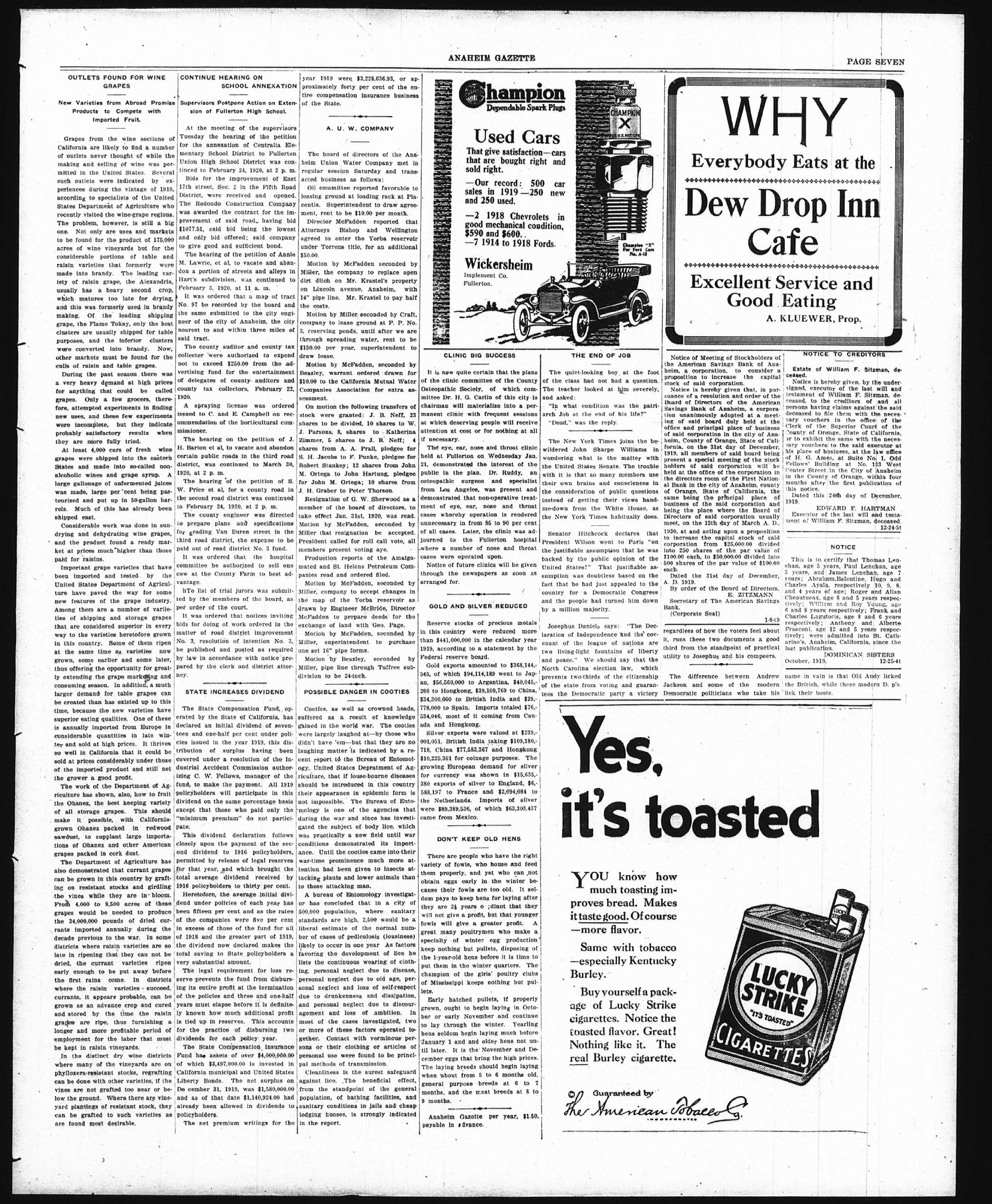
Searchable text
OUTLETS FOUND FOR WINE GRAPES
New Varieties from Abroad Promise Products to Compete with Imported Fruit.
Grapes from the wine sections of California are likely to find a number of outlets never thought of while the making and selling of wine was permitted in the United States. Several such outlets were indicated by experiences during the vintage of 1919, according to specialists of the United States Department of Agriculture who recently visited the wine-grape regions. The problem, however, is still a big one. Not only are uses and markets to be found for the product of 175,000 acres of wine vineyards but for the considerable portions of table and raisin varieties that formerly were made into brandy. The leading variety of raisin grape, the Alexandria, usually has a heavy second crop, which matures too late for drying, and this was formerly used in brandy making. Of the leading shipping grape, the Flame Tokay, only the best clusters are usually shipped for table purposes, and the inferior clusters were converted into brandy. Now, other markets must be found for the culls of raisin and table grapes.
During the past season there was a very heavy demand at high prices for anything that could be called grapes. Only a few grocers, therefore, attempted experiments in finding new uses, and these few experiments were incomplete, but they indicate probably satisfactory results when they are more fully tried.
CONTINUE HEARING ON SCHOOL ANNEXATION
Supervisors Postpone Action on Extension of Fullerton High School.
At the meeting of the supervisors Tuesday the hearing of the petition for the annexation of Centralia Elementary School District to Fullerton Union High School District was continued to February 24, 1920, at 2 p.m.
Bids for the improvement of East 17th street, Sec. 2 in the Fifth Road District, were received and opened. The Redondo Construction Company was awarded the contract for the improvement of said road., having bid $1077.51, said bid being the lowest and only bid offered; said company to give good and sufficient bond.
The hearing of the petition of Annie M. Lawrie, et al., to vacate and abandon a portion of streets and alleys in Hart's subdivision, was continued to February 3, 1920, at 11 a.m.
It was ordered that a map of tract No. 97 be recorded by the board and the same submitted to the city engineer of the city of Anaheim, the city nearest to and within three miles of said tract.
The county auditor and county tax collector were authorized to expend not to exceed $250.00 from the advertising fund for the entertainment of delegates of county auditors and county tax collectors, February 22, 1920.
A spraying license was ordered issued to C. and E. Campbell on recommendation of the horticultural commissioner.
The hearing on the petition of J. H. Barton et al., to vacate and abandon year 1919 were $3,225 approximately forty per cent compensation insured of the State.
The board of directors helm Union Water Co. regular session Saturday acted business as follows:
Oil committee report leasing ground at load centia. Superintendent ment, rent to be $10.00.
Director McFadden Attorneys Bishop agreed to enter the Y under Torrens title, for $50.00.
Motion by McFadden Miller, the company to dirt ditch on Mr. Kraig on Lincoln avenue, A 14" pipe line. Mr. Kraig the costs.
Motion by Miller second company to lease grounds 3, reserving ponds, until through spreading water $150.00 per year, super draw lease.
Motion by McFadden Beazley, warrant order $10.00 to the California Companies Association sessment.
On motion the follow stock were granted: shares to be divided. 10 J. Parsons, 8 shares Zimmer, 5 shares to shares from A. A. Pratt
other markets must be found for the culls of raisin and table grapes.
During the past season there was a very heavy demand at high prices for anything that could be called grapes. Only a few grocers, therefore, attempted experiments in finding new uses, and these few experiments were incomplete, but they indicate probably satisfactory results when they are more fully tried.
At least 4,000 cars of fresh wine grapes were shipped into the eastern States and made into so-called non-alcoholic wines and grape syrup. A large gallonage of fermented juices was made, large per cent being pasteurized and put up in 50-gallon barrels. Much of this has already been shipped east.
Considerable work was done in sun-drying and dehydrating wine grapes, and the product found a ready market at prices much higher than those paid for raisins.
Important grape varieties that have been imported and tested by the United States Department of Agriculture have paved the way for some new features of the grape industry. Among them are a number of varieties of shipping and storage grapes that are considered superior in every way to the varieties heretofore grown in this country. Some of them ripen at the same time as varieties now grown, some earlier and some later, thus offering the opportunity for greatly extending the grape marketing and consuming season. In addition, a much larger demand for table grapes can be created than has existed up to this time, because the new varieties have superior eating qualities. One of these is annually imported from Europe in considerable quantities in late winter and sold at high prices. It thrives so well in California that it could be sold at prices considerably under those of the imported product and still net the grower a good profit.
The work of the Department of Agriculture has shown, also, how to fruit the Ohanez, the best keeping variety of all storage grapes. This should make it possible, with California-grown Ohanez packed in redwood sawdust, to supplant large importations of Ohanez and other American collectors were authorized to expend not to exceed $250.00 from the advertising fund for the entertainment of delegates of county auditors and county tax collectors, February 22, 1920.
A spraying license was ordered issued to C. and E. Campbell on recommendation of the horticultural commissioner.
The hearing on the petition of J. H. Barton et al, to vacate and abandon certain public roads in the third road district, was continued to March 30, 1920, at 2 p.m.
The hearing of the petition of S. W. Price et al, for a county road in the second road district was continued to February 24, 1920, at 2 p.m.
The county engineer was directed to prepare plans and specifications for grading Van Buren street in the third road district, the expense to be paid out of road district No. 3 fund.
It was ordered that the hospital committee be authorized to sell one cow at the County Farm to best advantage.
hTe list of trial jurors was submitted by the members of the board, as per order of the court.
It was ordered that notices inviting bids for doing of work ordered in the matter of road district improvement No. 3, resolution of intention No. 3, be published and posted as required by law in accordance with notice prepared by the clerk and district attorney.
STATE INCREASES DIVIDEND
The State Compensation Fund, operated by the State of California, has declared an initial dividend of seventeen and one-half per cent under policies issued in the year 1919, this distribution of surplus having been covered under a resolution of the Industrial Accident Commission authorizing C. W. Fellows, manager of the fund, to make the payment. All 1919 policyholders will participate in this dividend on the same percentage basis except that those who paid only the "minimum premium" do not participate.
This dividend declaration follows closely upon the payment of the second dividend to 1919 policyholders.
POSSIBLE DANGER
Coothes, as well as others suffered as a result gained in the world war were largely laughed at didn't have 'em—but their laughing matter is indictment report to the Berenberg, United States Department agriculture, that if louse-blood should be introduced in their appearance in epilogue not impossible. The Berenberg mology is one of the during the war and simulated the subject of boo was practically a new conditions demonstrated.
sold at prices considerably under those of the imported product and still net the grower a good profit.
The work of the Department of Agriculture has shown, also, how to fruit the Ohanez, the best keeping variety of all storage grapes. This should make it possible, with California-grown Ohanez packed in redwood sawdust, to supplant large importations of Ohanez and other American grapes packed in cork dust.
The Department of Agriculture has also demonstrated that currant grapes can be grown in this country by grafting on resistant stocks and girdling the vines while they are in bloom. From 4,000 to 8,500 acres of these grapes would be needed to produce the 34,000,000 pounds of dried currants imported annually during the decade previous to the war. In some districts where raisin varieties are so late in ripening that they can not be dried, the currant varieties ripen early enough to be put away before the first rains come. In districts where the raisin varieties succeed, currants, it appears probable, can be grown as an advance crop and cured and stored by the time the raisin grapes are ripe, thus furnishing a longer and more profitable period of employment for the labor that must be kept in raisin vineyards.
In the distinct dry wine districts where many of the vineyards are on phylloxera-resistant stocks, regrafting can be done with other varieties, if the vines are not grafted too near or below the ground. Where there are vineyard plantings of resistant stock, they can be grafted to such varieties as are found most desirable.
This dividend declaration follows closely upon the payment of the second dividend to 1916 policyholders, permitted by release of legal reserves for that year, and which brought the total average dividend received by 1916 policyholders to thirty per cent.
Heretofore, the average initial dividend under policies of each year has been fifteen per cent and as the rates of the companies were five per cent in excess of those of the fund for all of 1918 and the greater part of 1919, the dividend now declared makes the total saving to State policyholders a very substantial amount.
The legal requirement for loss reserve prevents the fund from disbursing its entire profit at the termination of the policies and three and one-half years must elapse before it is definitely known how much additional profit is tied up in reserves. This accounts for the practice of disbursing two dividends for each policy year.
The State Compensation Insurance Fund has assets of over $4,000,000.00 of which $3,497,000.00 is invested in California municipal and United States Liberty Bonds. The net surplus on December 31, 1919, was $1,580,000.00 and as of that date $1,140,924.00 had already been allowed in dividends to policyholders.
The net premium writings for the covered under a resolution of the Industrial Accident Commission authorizing C. W. Fellows, manager of the fund, to make the payment. All 1919 policyholders will participate in this dividend on the same percentage basis except that those who paid only the "minimum premium" do not participate.
This dividend declaration follows closely upon the payment of the second dividend to 1916 policyholders, permitted by release of legal reserves for that year, and which brought the total average dividend received by 1916 policyholders to thirty per cent.
Heretofore, the average initial dividend under policies of each year has been fifteen per cent and as the rates of the companies were five per cent in excess of those of the fund for all of 1918 and the greater part of 1919, the dividend now declared makes the total saving to State policyholders a very substantial amount.
The legal requirement for loss reserve prevents the fund from disbursing its entire profit at the termination of the policies and three and one-half years must elapse before it is definitely known how much additional profit is tied up in reserves. This accounts for the practice of disbursing two dividends for each policy year.
The State Compensation Insurance Fund has assets of over $4,000,000.00 of which $3,497,000.00 is invested in California municipal and United States Liberty Bonds. The net surplus on December 31, 1919, was $1,580,000.00 and as of that date $1,140,924.00 had already been allowed in dividends to policyholders.
The net premium writings for the covered under a resolution of the Industrial Accident Commission authorizing C. W. Fellows, manager of the fund, to make the payment. All 1919 policyholders will participate in this dividend on the same percentage basis except that those who paid only the "minimum premium" do not partici-
ate.
This dividend declaration follows closely upon the payment of the second dividend to 1916 policyholders, permitted by release of legal reserves for that year, and which brought the total average dividend received by 1916 policyholders to thirty per cent.
Heretofore, the average initial dividend under policies of each year has been fifteen per cent and as the rates of the companies were five per cent in excess of those of the fund for all of 1918 and the greater part of 1919, the dividend now declared makes the total saving to State policyholders a very substantial amount.
The legal requirement for loss reserve prevents the fund from disbursing its entire profit at the termination of the policies and three and one-half years must elapse before it is definitely known how much additional profit is tied up in reserves. This accounts for the practice of disbursing two dividends for each policy year.
The State Compensation Insurance Fund has assets of over $4,000,000.00 of which $3,497,000.00 is invested in California municipal and United States Liberty Bonds. The net surplus on December 31, 1919, was $1,580,000.00 and as of that date $1,140,924.00 had already been allowed in dividends to policyholders.
The net premium writings for the covered under a resolution of the Industrial Accident Commission authorizing C. W. Fellows, manager of the fund, to make the payment. All 1919 policyholders will participate in this dividend on the same percentage basis except that those who paid only the "minimum premium" do not partici-
ate.
This dividend declaration follows closely upon the payment of the second dividend to 1916 policyholders, permitted by release of legal reserves for that year, and which brought the total average dividend received by 1916 policyholders to thirty per cent.
Heretofore, the average initial dividend under policies of each year has been fifteen per cent and as the rates of the companies were five per cent in excess of those of the fund for all of 1918 and the greater part of 1919, the dividend now declared makes the total saving to State policyholders a very substantial amount.
The legal requirement for loss reserve prevents the fund from disbursing its entire profit at the termination of the policies and three and one-half years must elapse before it is definitely known how much additional profit is tied up in reserves. This accounts for the practice of disbursing two dividends for each policy year.
The State Compensation Insurance Fund has assets of over $4,000,000.00 of which $3,497,000.00 is invested in California municipal and United States Liberty Bonds. The net surplus on December 31, 1919, was $1,580,000.00 and as of that date $1,140,924.00 had already been allowed in dividends to policyholders.
The net premium writings for the covered under a resolution of the Industrial Accident Commission authorizing C. W. Fellows, manager of the fund, to make the payment. All 1919 policyholders will participate in this dividend on the same percentage basis except that those who paid only the "minimum premium" do not partici-
ate.
This dividend declaration follows closely upon the payment of the second dividend to 1916 policyholders, permitted by release of legal reserves for that year, and which brought the total average dividend received by 1916 policyholders to thirty per cent.
Heretofore, the average initial dividend under policies of each year has been fifteen per cent and as the rates of the companies were five per cent in excess of those of the fund for all of 1918 and the greater part of 1919, the dividend now declared makes the total saving to State policyholders a very substantial amount.
The legal requirement for loss reserve prevents the fund from disbursing its entire profit at the termination of the policies and three and one-half years must elapse before it is definitely known how much additional profit is tied up in reserves. This accounts for the practice of disbursing two dividends for each policy year.
The State Compensation Insurance Fund has assets of over $4,000,000.00 of which $3,497,000.00 is invested in California municipal and United States Liberty Bonds. The net surplus on December 31, 1919, was $1,580,000.00 and as of that date $1,140,924.00 had already been allowed in dividends to policyholders.
The net premium writings for the covered under a resolution of the Industrial Accident Commission authorizing C. W. Fellows, manager of the fund, to make the payment. All 1919 policyholders will participate in this dividend onthe same percentage basis except that those who paid onlythe "minimum premium"do not partici-
ate.
This dividend declaration follows closely upon the payment ofthe seconddividendto 1916policyholderspermitedelectlifewearntheseappearanceinepatientnotimagelatedthesubjectofboyswaspracticallyanewconditionshowerthewar-timeprominencenortentionhadbeengiventackingtplantandlowertothoseattackingmanagers.A bureauofEntomologyorhasconcludedthat550,ooopopulation.weststandardsarehigh,25,liberalestimateoftheberberofcasespediculoidlikelytocoverinoneyearfavoringthedevelopmentliststhecontinuousweeding,personal neglectdowhernaleglectduetothesocialneglectandlossduetodrunknessandpersonalneglectdowagerelationandagementandlossmostofthecasesinvotermoreofthesefactoriesogether.Cleanlinessisthesuccinctainlice.Thebestfromthestandpointofpopulation.ofbathing sanitaryconditionsinjury lodginghuoses.isstronginthereport.
ANAHEIM GAZETTE
A. U. W. COMPANY
The board of directors of the Anaheim Union Water Company met in regular session Saturday and transacted business as follows:
Oil committee reported favorable to leasing ground at loading rack at Placentia. Superintendent to draw agreement, rent to be $10.00 per month.
Director McFadden reported that Attorneys Bishop and Wellington agreed to enter the Yorba reservoir under Torrens title, for an additional $50.00.
Motion by McFadden seconded by Miller, the company to replace open dirt ditch on Mr. Krastel's property on Lincoln avenue, Anaheim, with 14" pipe line. Mr. Krastel to pay half the costs.
Motion by Miller seconded by Craft, company to lease ground at P. P. No. 3, reserving ponds, until after we are through spreading water, rent to be $150.00 per year, superintendent to draw lease.
Motion by McFadden, seconded by Beazley, warrant ordered drawn for $10.00 to the California Mutual Water Companies Association for extra assessment.
On motion the following transfers of stock were granted: J. B. Neff, 23 shares to be divided, 10 shares to W. J. Parsons, 8 shares to Katherina Zimmer, 5 shares to J. B. Neff; 4 shares from A. A. Prall pledge for year 1919 were $3,228,636.93, or approximately forty per cent of the entire compensation insurance business of the State.
CHAMPION
Dependable Spark Plugs
Used Cars
That give satisfaction—cars that are bought right and sold right.
Our record: 500 car sales in 1919—250 new and 250 used.
2 1918 Chevrolets in good mechanical condition, $590 and $600.
7 1914 to 1918 Fords.
Wickersheim
Implement Co.
Fullerton.
CLINIC BIG SUCCESS
It is now quite certain that the plans of the clinic committee of the County Osteopathic Society, of which committee Dr. H. G. Carlin of this city is chairman will materialize into a permanent clinic with frequent sessions at which deserving people will receive attention at cost or for nothing at all if necessary.
THE END OF JOB
The quiet-looking boy at the foot of the class had not had a question. The teacher looked at him severely, and asked:
"In what condition was the patriarch Job at the end of his life?"
"Dead," was the reply.
The New York Times joins the bewildered John Sharpe Williams on notice of the American heim, a corp proposition stock of saction Notice is suance of a Board of D Savings Ban tion unanim ing of said office and p of said corpo heim, County fornia, on t
Motion by McFadden, seconded by Beazley, warrant ordered drawn for $10.00 to the California Mutual Water Companies Association for extra assessment.
On motion the following transfers of stock were granted: J. B. Neff, 23 shares to be divided, 10 shares to W. J. Parsons, 8 shares to Katherine Zimmer, 5 shares to J. B. Neff; 4 shares from A. A. Prall, pledgee for S. H. Jacobs to F. Punke, pledgee for Robert Stankey; 12 shares from John M. Ortega to John Hartung, pledgee for John M. Ortega; 10 shares from J. H. Graber to Peter Thorson.
Resignation of G. W. Sherwood as a member of the board of directors, to take effect Jan. 31st, 1920, was read.
Motion by McFadden, seconded by Miller that resignation be accepted. President called for roll call vote, all members present voting aye.
Production reports of the Amalgamated and St. Helens Petroleum Companies read and ordered filed.
Motion by McFadden, seconded by Miller, company to accept changes in the map of the Yorba reservoir as drawn by Engineer McBride, Director McFadden to prepare deeds for the exchange of land with Geo. Page.
Motion by McFadden, seconded by Miller, superintendent to purchase one set 16" pipe forms.
Motion by Beazley, seconded by Miller, pipe line through Tuffree subdivision to be 24-inch.
POSSIBLE DANGER IN COOTIES
Cootes, as well as crowned heads, suffered as a result of knowledge gained in the world war. The cooties were largely laughed at—by those who didn't have 'em—but that they are no laughing matter is indicated by a recent report to the Bureau of Entomology, United States Depratment of Agriculture, that if louse-bourne diseases should be introduced in this country their appearance in epidemic form is not impossible. The Bureau of Entomology is one of the agencies that during the war and since has investigated the subject of body lice, which was practically a new field until war conditions demonstrated its import-
CLINIC BIG SUCCESS
It is now quite certain that the plans of the clinic committee of the County Osteopathic Society, of which committee Dr. H. G. Carlin of this city is chairman will materialize into a permanent clinic with frequent sessions at which deserving people will receive attention at cost or for nothing at all if necessary.
The eye, ear, nose and throat clinic held at Fullerton on Wednesday Jan. 21, demonstrated the interest of the public in the plan. Dr. Ruddy, an osteopathic surgeon and specialist from Los Angeles, was present and demonstrated that non-operative treatment of eye, ear, nose and throat cases whereby operation is rendered unnecessary in from 85 to 90 per cent of all cases. Later, the clinic was adjourned to the Fullerton hospital where a number of nose and throat cases were operated upon.
Notice of future clinics will be given through the newspapers as soon as arranged for.
GOLD AND SILVER REDUCED
Reserve stocks of precious metals in this country were reduced more than $441,000,000 in the calendar year 1919, according to a statement by the Federal reserve board.
Gold exports amounted to $368,144,545, of which $94,114,189 went to Japan, $56,560,000 to Argentina, $40,045,266 to Hongkong, $39,109,769 to China, $34,300,660 to British India and $29,778,000 to Spain. Imports totaled $76,534,046, most of it coming from Canada and Hongkong.
Silver exports were valued at $239,-001,051. British India taking $109,180,-718, China $77,583,367 and Hongkong $10,225,351 for coinage purposes. The growing European demand for silver for currency was shown in $15,635,-380 exports of silver to England, $6,-588,197 to France and $2,094,084 to the Netherlands. Imports of silver were $89,389,536, of which $63,303,437 came from Mexico.
THE END OF JOB
The quiet-looking boy at the foot of the class had not had a question. The teacher looked at him severely,and asked:
"In what condition was the patriarch Job at the end of his life?"
"Dead," was the reply.
The New York Times joins the wildered John Sharpe Williams in wondering what is the matter with the United States Senate. The trouble with it is that so many members use their own brains and consciences in the consideration of public questions instead of getting their views hand-me-down from the White House, as the New York Times habitually does.
Senator Hitchcock declares that President Wilson went to Paris "on the justifiable assumption that he was backed by the public opinion of the United States!" That justifiable assumption was doubtless based on the fact that he had just appealed to the country for a Democratic Congress and the people had turned him down by a million majority.
Josephus Daniels says: "The Declaration of Independence and the covenant of the league of nations are two living-light fountains of liberty and peace." We should say that the North Carolina election law, which prevents two-thirds of the citizenship of the state from voting and guarantees the Democratic party a victory.
DON'T KEEP OLD HENS
cent report to the Bureau of Entomology, United States Depratment of Agriculture, that if louse-bourne diseases should be introduced in this country their appearance in epidemic form is not impossible. The Bureau of Entomology is one of the agencies that during the war and since has investigated the subject of body lice, which was practically a new field until war conditions demonstrated its importance. Until the cooties came into their war-time prominence much more attention had been given to insects attacking plants and lower animals than to those attacking man.
A bureau of Entomology investigator has concluded that in a city of 500,000 population, where sanitary standards are high, 2,500 would be a liberal estimate of the normal number of cases of pediculosis (lousiness) likely to occur in one year. As factors favoring the development of lice he lists the continuous wearing of clothing, personal neglect due to disease, personal neglect due to old age, personal neglect and loss of self-respect due to drunkenness and dissipation, and personal neglect due to discouragement and loss of ambition. In most of the cases investigated, two or more of these factors operated together. Contact with verminous persons or their clothing or articles of personal use were found to be principal methods of transmission.
Cleanliness is the surest safeguard against lice. The beneficial effect, from the standpoint of the general population, of bathing facilities, and sanitary conditions in jails and cheap lodging huoses, is strongly indicated in the report.
DON'T KEEP OLD HENS
There are people who have the right variety of fowls, who house and feed them properly, and yet who can not obtain eggs early in the winter because their fowls are too old. It seldom pays to keep hens for laying after they are 21 years old; dlnot that they will not give a profit, but that younger fowls will give a greater profit. A great many poultrymen who make a specialty of winter egg production keep nothing but pullets, disposing of the 1-year-old hens before it is time to put them in the winter quarters. The champion of the girls' poultry clubs of Mississippi keeps nothing but pullets.
Early hatched pullets, if properly grown, ought to begin laying in October or early November and continue to lay through the winter. Yearling hens seldom begin laying much before January 1 and older hens not until later. It is the November and December eggs that bring the high prices. The laying breeds should begin laying when about from 5 to 6 months old, general purpose breeds at 6 to 7 months, and the meat breeds at 8 to 9 months.
Anaheim Gazette per year, $1.50. payable in advance.
WHY
Everybody Eats at the
Dew Drop Inn
Cafe
Excellent Service and
Good Eating
A. KLUEWER, Prop.
Notice of Meeting of Stockholders of the American Savings Bank of Anaheim, a corporation, to consider a proposition to increase the capital stock of said corporation.
Notice is hereby given that, in pursuance of a resolution and order of the Board of Directors of the American Savings Bank of Anaheim, a corporation unanimously adopted at a meeting of said board duly held at the office and principal place of business of said corporation in the city of Anaheim, County of Orange, State of California, on the 31st day of December.
NOTICE TO CREDITORS
Estate of William F. Sitzman, deceased.
Notice is hereby given by the undersigned, executor of the last will and testament of William F. Sitzman, deceased, to the creditors of and all persons having claims against the said deceased to file them with the necessary vouchers in the office of the Clerk of the Superior Court of the County of Orange, State of California, or to exhibit the same with the necessary vouchers to the said executor at
Notice of Meeting of Stockholders of the American Savings Bank of Anaheim, a corporation, to consider a proposition to increase the capital stock of said corporation.
Notice is hereby given that, in pursuance of a resolution and order of the Board of Directors of the American Savings Bank of Anaheim, a corporation unanimously adopted at a meeting of said board duly held at the office and principal place of business of said corporation in the city of Anaheim, County of Orange, State of California, on the 31st day of December, 1919, all members of said board being present a special meeting of the stock holders of said corporation will be held at the office of the corporation in the directors room of the First National Bank in the city of Anaheim, county of Orange, State of California, the same being the principal place of business of the said corporation and being the place where the Board of Directors of said corporation usually meet, on the 12th day of March A. D., 1920, at and acting upon a proposition to increase the capital stock of said corporation from $25,000.00 divided into 250 shares of the par value of $100.00 each, to $50,000.00 divided into 500 shares of the par value of $100.00 each.
Dated the 31st day of December, A. D. 1919.
By order of the Board of Directors.
E. ZITZMANN
Secretary of The American Savings Bank.
(Corporate Seal)
regardless of how the voters feel about it, runs these two documents a good third from the standpoint of practical utility to Josephus and his compeers.
The difference between Andrew Jackson and some of the modern Democratic politicians who take his name in vain is that Old Andy licked the British, while these modern D. p.'s lick their boots.
know how
toasting imead. Makes
d. Of course
vor.
with tobacco
y Kentucky
LUCKY
STRIKE
"IT'S TOASTED"
CIGARETTES
teed by
American Tobacco Co.